Flow

In positive psychology, there is a concept called “flow” which was created by University of Chicago psychologist Mihaly Csikszentmihalyi. Flow is a state of deep focus, known colloquially as being “in the zone.”

More precisely, Csikszentmihalyi identifies flow by asking, “Do you ever get involved in something so deeply that nothing else seems to matter and you lose track of time?”

Now, being something of a skeptic and contrarian, I’m automatically suspicious of anything that has “positive” in the title. And somewhat similarly, when I first heard about “flow” I thought it was ridiculous. I’m used to the hectic world of working life: managing more tasks than are humanly possible to complete while people constantly interrupt with questions. It’s not orderly, but it’s still possible to get a lot done and finish the day with one’s sanity intact.

I’ve been having a different experience since I started school. I certainly have plenty of work to do, but there are fewer interruptions. I come in, start my work, and don’t move again for hours. I’ve gotten out of the habit of constantly tabbing over to Facebook or email – at the end of the day, I find I have a lot of catching up with the outside world to do.

I have almost missed class or nearly forgotten to go home because I’m so focused on what I’m working on.

I guess this is flow.

Csikszentmihalyi makes the bold claim that “it is the full involvement of flow, rather than happiness, that makes for excellence in life.” I’m hardly ready to go that far, but it’s certainly an interesting state. And there’s something particularly satisfying about accomplishing a task from a state of flow.

But the state is not without it’s drawbacks. Most obvious are the possible health effects: I’ve got from a life of hectic running around to one of entirely sitting. But more fundamentally, I’m not sure I’m entirely comfortable with the idea of losing time. I don’t want time to simply slip passed me while I focus on my work: I’d rather be aware of each moment.

facebooktwittergoogle_plusredditlinkedintumblrmail

network dynamics in conversation

(Dayton, OH) It is in conversations–face-to-face or virtual, oral or written, small or massive, formal or informal–that we form our views of public issues, hold ourselves accountable for our reasons and actions, check our assumptions, expand our horizons, gain the satisfaction of being recognized, display eloquence, and develop enough will to act together.

Some conversations are better than others, and we need to understand more about the differences. I think that mapping conversations as evolving networks is a promising strategy. At least three relevant phenomena can be modeled in network terms:

  1. As we discuss, we collaboratively construct networks of ideas. I say that I favor marriage equality because adults who love and commit to each other should have the protection of law, and because people should be treated equally regardless of sexual orientation. In those sentences, I have put several ideas together into a structure. You can add to my structure by posing other ideas, whether they connect to mine or conflict with mine. The group’s epistemic network expands and changes as we talk.
  2. We also form and change social networks during a discussion. The nodes in a social network are people, and the links between pairs of people can be characterized by knowledge, trust, respect, affection, etc (or their opposites). People who converse may already belong to the same social networks. Their discussions may develop and alter their social networks.
  3. We make “meta” comments about the conversation. For instance, I might ask you to clarify what you meant when you said P. Or I might say I agree with you, or withdraw my comment, or propose that the truth lies between what I said and that you said. These are interesting moments because they are about both the epistemic and the social network that already exists, and they can affect those networks. In an important 1983 article, Berkowitz and Gibbs called them “transacts” and found they led to learning when children used them.

Consider some subtle cases and how they might be modeled in network terms.

  1. Person A only cares about influencing her boss, B, who sits at the head of the table, but she chooses to turn toward everyone else in a meeting and address them. In social network terms, her talk is literally directed at a whole set of peers, but there is a more significant network connection between her and just one other person.
  2. A says P, and B pays no attention because B thinks that A is a fool. C says P, and B agrees with it because B thinks that C is smart. In this case, the social network affects the epistemic network.
  3. A wants B to like her, so she withdraws point P that she had made earlier because B objected to it. With that concession, the social network changes in one way, the epistemic network in a different way. B says, “I appreciate your flexibility, but really, you should insist on what you believe.” B’s meta-comment puts P back on the epistemic map and affects the social network.

In technical terms, I’d measure the epistemic network by representing transcripts of discussions as ideas and links (the links being arguments of various kinds) and probably locating the nodes on a two-dimensional plane that reflect key dimensions of disagreement in the conversation. I’d watch the network change as the participants talk.

I’d measure social networks by asking people to characterize the ties between them and each of the other participants, before and after the discussion.

Finally, I might model the relevant personal beliefs of each participant before and after a discussion as a network of ideas and links, which I would derive from a private interview or short essay. I would be interested in how much of the private network ends up in public and how much the public discussion affects the private network.

The point of all this measurement is to provide data that is useful for evaluative judgment. So the normative questions (“What makes a good discussion?” “How should you participate in discussions?”) are central. I think they deserve more exploration than we have had so far, although philosophers have certainly contributed criteria.

For instance, Jurgen Habermas wrote that in an ideal discussion, “no force except that of the better argument is exercised” (Habermas 1975, p. 108). He would want an epistemic network composed of objectively defensible ideas and links to influence the participants, completely independent of their places in a social network. Just because everyone knows and admires A but dislikes B, it doesn’t mean that people should absorb A’s ideas and ignore B’s ideas.

Another example: Olivia Newman argues that a good discussion in a liberal democracy won’t produce a single hierarchical framework of ideas, but will rather encompass numerous clusters of ideas that are only loosely connected. That shape reflects value pluralism while still allowing mutual learning. Thus a group’s epistemic network should be clustered but not overly centralized.

We might add that good discussants should continue to add new nodes and connections as long as the conversation continues (not repeat points already made); that

See also a method for mapping discussions as networks and assessing a discussion.

Pedagogy and Disciplines

After several years of working in academia, it’s been interesting to be back in the classroom as a student. Teaching per se was not central to my previous role, but a lot of my work focused on student development.

I’ve also had a somewhat untraditional academic path. My undergraduate studies were in physics, I went on to get a Masters in marketing communication, and then through work I had the opportunity to co-teach an undergraduate philosophy seminar course. So, I’ve been particularly struck by the different pedagogical approaches that can be found in different disciplines.

In many ways, these pedagogical approaches can be linked back to different understandings of wisdom: techne, technical knowledge; episteme, scientific knowledge; and phronesis, practical wisdom.

My undergraduate studies in physics focused on episteme – there was some techne as they taught specific mathematical approaches, but the real emphasis was on developing our theoretical understanding.

My master’s program – aimed at preparing people for careers in marketing – lay somewhere between techne and phronesis. Teaching by case studies is typically associated with phronesis – since the approach is intended to teach students how to make good decisions when confronted with new challenges. But the term is not a perfect fit for marketing – phronesis traditionally takes “good decisions” to be ethical decisions, whereas these studies took “good” to mean “good for business.” The term techne, which implies a certain art or craftship, is also relevant here.

The philosophy seminar I co-taught focused on phronesis. This is by no means intrinsic to philosophy as a discipline, but my specific class focused on civic studies, an emergent field that asks, “what should we do?”

This question is inherently linked to phronesis: as urban planner Bent Flyvbjerg writes in arguing for more on phronesis in the socials sciences: “a central question for phronesis is: What should we do?”

Each of these types of wisdom could be tied to different pedagogical methods by exploring the tasks expected by students. To develop phronesis, students are confronted with novel contextual situations asked to develop solutions. For techne students have to create something – this might be a rote recreation of ones multiplication tables, or could involve a more artistic pursuit. Episteme would be taught through problem sets – asking students to apply theoretical knowledge to answer questions with discrete answers.

From my own experience, different disciplines tend to gravitate towards different types of wisdom. But I wonder how inherent these approaches are to a discipline. Episteme may be the norm in physics, for example, but what would a physics class focused on phronesis look like?


facebooktwittergoogle_plusredditlinkedintumblrmail

Listen to Common Ground for Action Tech Tuesday Call & Join NIFI’s #CGAFriday Series on the Economy

Earlier this week, NCDD hosted another installment of our Tech Tuesday call series, this time focused on the Common Ground for Action (CGA) online deliberative tool from Kettering Foundation and Conteneo. Over 50 participants joined us for the call, which featured NCDD members Amy Lee and Laura Richardson taking us on an in-depth tour of this awesome online tool.

NIFI-CGA_Branded_LogoThe call was a great chance to learn more about how to use CGA for our own purposes and hear about opportunities to get further training with the tool, and we had a very informative discussion after the initial presentation. If you missed out on the call, don’t worry, we recorded the presentation and discussion, which you can see and hear by clicking here. Thanks again to Amy, Laura, and everyone who participated!

Looking for a chance to try out Common Ground for Action yourself? Then we highly encourage you to participate in the #CGAFridays series this month when NIFI will be hosting three opportunities for you to try both their CGA tool and their new issue guide about economic security and inequality, Making Ends Meet: How Do We Spread Prosperity and Improve Opportunity? Insights from these deliberative forums will be used in the Kettering Foundation’s reporting to federal policymakers throughout 2016.

If you’d like to participate in any of these forums, all you need to do is click the link below to register. Then, the day before the forum you’ve signed up for, you’ll receive an email with a unique URL. To join the forum, simply click that link no more than 10 minutes before the forum start time. The dates of the CGA Friday series and links to register are here:

These forums are open to the public, so feel free to share and to spread the word on social media using the hashtags #CGAFridays and #MEM+CGA. If you have any questions, email cga@nifi.org.

To find out more about CGA, visit www.nifi.org/en/common-ground-action.

To sign up to get trained as a moderator, visit www.nifi.org/en/groups/new-moderator-form
or www.everyvoiceengaged.org.

To learn more about NCDD’s Tech Tuesday series and hear recordings of past calls, please visit www.ncdd.org/events/tech-tuesdays.

thinking like a citizen–about schools

In Education, Justice & Democracy, edited by Danielle S. Allen and Rob Reich, all the chapters address the topic of educational equality in the US. The section headings are “ideals,” “constraints,” and “strategies.” In a longish review essay for Theory & Research in Education, I argue that good citizens explore just these three issues whenever they consider any important topic. In fact, you might define good citizens as people who take  ideals, constraints (or, I would say, “facts”), and strategies seriously and act accordingly. However, the three issues are badly segregated in modern intellectual life, with whole disciplines given over to the assumption that one should seek value-free facts, other disciplines happy to explore values without thinking about strategies, and some professional programs focused on strategies with a narrow conception of ideals. What we call “Civic Studies” is a deliberate effort to reintegrate thinking about social concerns from a citizen’s perspective, which inevitably combines ideals, constrains, and strategies. I chose to review this volume because it exemplifies Civic Studies, although I offer some critical thoughts about parts of the book.

My review is in Theory and Research in Education, July 2015, vol. 13, no. 2, pp. 235-238, or on Academia.edu.

Han Shot First

In on the eve of being honored by the Kennedy Center, legendary filmmaker George Lucas sat down with the Washington Post to reflect on his remarkable career. Among other things, Lucas used the opportunity to defend one of his most controversial decisions: editing a scene in the remastered Star Wars to make it appear that Greedo shot first.

The Washington Post explains:

[Lucas] went back to some scenes that had always bothered him, particularly in the 1977 film: When Han Solo (Harrison Ford) is threatened by Greedo, a bounty hunter working for the sluglike gangster Jabba the Hutt, Han reaches for his blaster and shoots Greedo by surprise underneath a cantina table. In the new version, it is Greedo who shoots first, by a split second. 

Lucas justifies the change:

“Han Solo was going to marry Leia, and you look back and say, ‘Should he be a cold-blooded killer?’ ” Lucas asks. “Because I was thinking mythologically — should he be a cowboy, should he be John Wayne? And I said, ‘Yeah, he should be John Wayne.’ And when you’re John Wayne, you don’t shoot people [first] — you let them have the first shot. It’s a mythological reality that we hope our society pays attention to.”

The Washington Post points out that Lucas is “a passionate defender of an artist’s right to go back and tweak his work.” In some ways that seems fair – yet art is not created solely by the artist. Art, nearly by definition, is a shared experience; the interpretation of art is a creative act in itself.

So, yes, perhaps Lucas has the right to re-edit his films and add terrible CGI characters. But we, too, have the right to rebel. To hold our interpretations valid.

And CGI monstrosities aside, there is something particularly problematic about the narrative change of “Greedo shot first.”

Lucas himself almost gets at it in his defense: we wish Han hadn’t shot first.

Han is a good guy. We like him. He’s a little rough around the edges, maybe, but beneath his gruff exterior, we know he is a hero. And heroes always do the right thing.

Lucas sees that as a reason to re-write history. A true hero wouldn’t shoot first, therefore a true hero didn’t shoot first.

But that is exactly why it is so important to acknowledge that Han shot first. Maybe we wish he hadn’t, maybe we want him to be so upstanding that no matter how dicey the situation he always gives others the benefit of the doubt. But no matter how much we wish that to be the way the world is, we all know the truth:

Han shot first.

Perhaps it wasn’t the ideal thing to do. Perhaps it represents a moral lapse in his character. But it’s who he is, and it doesn’t diminish his capacity to be a hero.

All of us have made mistakes in our lives. All of us have moments we are not proud of. All of us wish we could exploit our “artist’s rights” to go back and edit our darker moments, to remake ourselves more like the heroes we wish we could be. But, of course, none of us really have that luxury.

The truth is, Han shot first. But that doesn’t make him less of a hero. He can still save the day and he can still get the girl.

Han shot first, but we are all capable of redemption.


facebooktwittergoogle_plusredditlinkedintumblrmail

a co-op model for a college

Here is a model for a new kind of college that I think could compete well with the available choices today, put beneficial pressure on the whole market, and avoid the “institutional isomorphism” that makes so many of our colleges and universities similar to each other. In a sentence: It is a co-op college in which the faculty and students jointly produce scholarship and learning at low cost. The college is organized democratically, but not because democratic values are intrinsically superior or identical to intellectual values. (I have argued against those claims here.) Rather, the organization of this college is democratic and participatory because it is a common property regime. That form of economic organization can be highly successful, but only when all participants feel that they have a voice to match their obligations.

I’d suggest these features:

Location: It would be a commuter college (no dorms) in a large metro area with a shortage of high-quality existing slots for undergraduates. Los Angeles is an example. The facilities could be relatively cheaply reconfigured buildings, such as a former school.

Business model: The sticker price would be $11,000. With a student/faculty ratio of 10:1, that yields $110k per professor, which is plenty to cover salaries and benefits plus facilities and a small support staff for maintenance, IT, and accounting. (The mean associate professor’s salary in English is $62,000; in the natural sciences, $67,590). These numbers would compare favorably to UCLA–which I respect deeply–where the average student pays $13,723 and the student/faculty ratio is 17:1. I envision a student body of 1,000 and a faculty of 100.

Professors’ responsibilities: The teaching load would be two courses per semester. Faculty would be expected to be active researchers. They would also populate committees that would fully handle admissions, counseling, curriculum, hiring, tenure and promotion, discipline, and external relations. Especially heavy responsibilities, such as chairing a major committee, might earn a course release. There would be no full-time administrators, but professors would serve elected terms as leaders with titles like president, provost, and dean, and would have limited course loads for the duration. The whole faculty would also meet for deliberations and governance.

Student responsibilities: Students would meet as a kind of legislative body in a bicameral arrangement with the faculty for some decision-making purposes. Some students would also be elected to serve on committees along with faculty and to provide other forms of leadership. For instance, instead of coaches and extramural athletics, there would be strong student-led intramurals and club sports. Although faculty would be involved in counseling of various kinds, students would also play essential roles in helping their peers. Some jobs might be eligible for Federal Work Study, which would reduce the $11k sticker price for those with greater need.

A board of trustees. The faculty and students would elect a board of trustees, including a few of their own number along with prominent outsiders. This board would serve as an accountability and review committee and would be able to lend their blessing to the whole enterprise.

Culture: I would recommend not especially targeting zealous proponents of alternative economics for either the student body or the faculty. I believe groups dominated by people with that kind of motivation tend to devolve into ideological hair-splitting and factional strife. (See Jenny Mansbridge‘s work on 1960s communes–or think of the French Revolution.) Instead, I would be looking for pragmatists with maturity and people-skills, along with academic excellence and diversity of various kinds. I’d recruit the faculty from a generation of talented and dedicated younger scholars who are facing a terrible job market. I’d look for students with a high potential to benefit from the experience–in other words, not necessarily the highest test scores or GPAs, but serious interest in learning in a no-frills environment.

Curriculum: This would be developed and modified by the group, deliberatively over time. It would be disappointing if the results failed to be unusual. That would be a waste of the opportunity to innovate, given the absence of traditional silos and barriers. But it wouldn’t necessarily be wise to create one curriculum for everyone. Diversity and choice are not only intellectual values; they prevent self-governing groups from splintering over matters of principle. Specifically, there is a kind of conversation that goes: “‘X is important, so X should be a required topic of study for all.’ ‘Well, if X is important, so is Y, and why isn’t that required?'” (Repeat endlessly.) I’d expect some coherence and some distinctiveness to emerge in a wholly new college with a democratic process, but if I were in the deliberations, I’d probably be a voice for individual choice.

Apply for 2016 Taylor Willingham Legacy Fund Grants

In case you missed it, we wanted to mention that the National Issues Forums Institute is accepting applications again for the 2016 round of grants from the Taylor L. Willingham Legacy Fund. The $500-$1,000 grants are intended to honor the legacy of Taylor Willingham and her contributions to the field of deliberative democracy by supporting projects in the field, and we highly encourage NCDD members to apply for a grant or to donate to the fund.

NIF logoApplications are due on December 31st, 2015 so make sure you apply before getting swept up in the holiday season! You can download a PDF of the application form by clicking here, and you can learn more about Taylor and make a donation to her legacy fund by clicking here.

You can learn more in NIFI’s announcement about the newest round of applications at www.nifi.org/en/groups/apply-now-taylor-l-willingham-legacy-fund-award.

Just Read, Florida’s Civics Pop up Quiz Show

I had the distinct pleasure today to attend, at the invitation of one of the district social studies specialists (Tara Tillmanshofer, a fine leader!) the new JRF! Civics oriented pop up quiz game, which occurred at Lakeland Highlands Middle School in Polk County.
IMG_0100

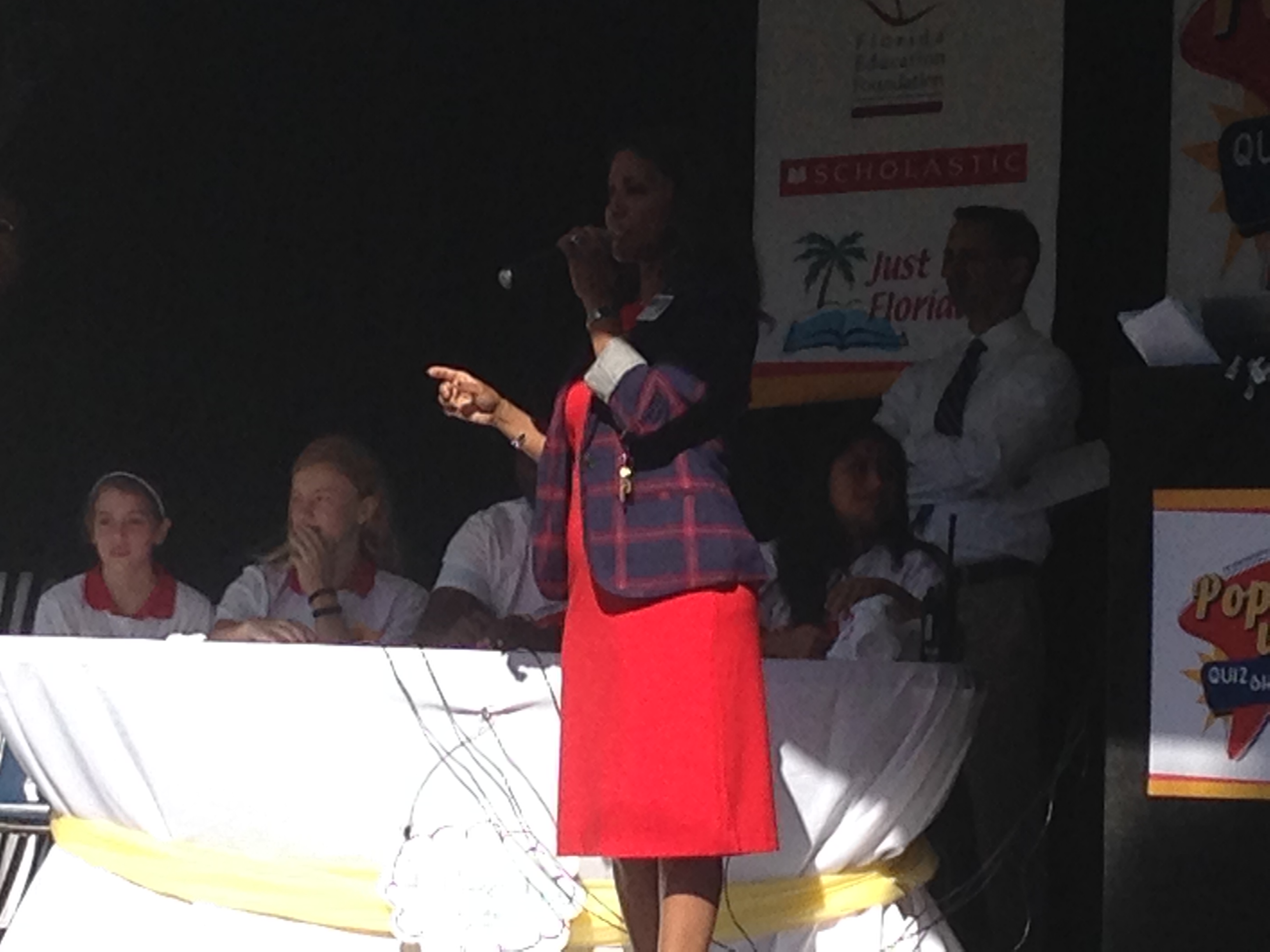
Here, Hope Colle welcomes students to the show and reminds them of the importance of reading and of civics. Great point; you can’t be a completely engaged citizen without reading OR civics!

IMG_0103

The wonderful principal of the school, Ms. Kendrick, instructed the students on what to expect and how to behave during the show.

IMG_0101

One of the great civics teachers at the school, Mr. Winters, volunteered to be the emcee and read the questions to the students.

IMG_0107

The show consisted of two rounds, with two teams of four students each in each round. Here, we see Team Plead the Fifth and Team Phoenix as they get ready.

Round 1 Teams

The kids really did do a fantastic job with the quiz show. It was refreshing to see some strong level of knowledge relating to what were not necessarily easy questions. And thanks are due to the Florida Joint Center for Citizenship’s own Dr. Terri Fine for crafting the questions for the show! Check out these kids dropping some knowledge bombs, for example:

In the next round, Team Civicians and Team Roboboxers (hey, they are middle school kids!) clashed in an epic battle that came down to the final question!

So how did they select the players for the show? According to Mr. Winter, they actually held their own civics quiz bowl last week, and the top scorers across each class were asked to participate in the show. And the work and effort that these kids and their teachers put in to this is obvious. Kudos to everyone involved. I hope that we here at the FJCC can continue to assist our friends across the state in this sort of thing, and it is wonderful to see that great passion for civics reflected in the work of the schools, teachers, and students! If you have questions or comments, or want to know when the pop up quiz show might be coming near you, contact Hope Colle or Ashley Palelis. You can also just send me a note!