Against Political Saviors — Government as Empowering Partner
What does government as empowering partner look like in education?
The exchange below is adapted from a conversation which Deborah Meier, the great democracy educator, and I are having on Education Week about reviving education for the democratic way of life.
Dear Deb
Your mention of the Sanders campaign in your last blog and the one today "Inviting Policy Ideas for Democracy Schools," brings to mind that this election shows how many people, especially young people, are eager to help make change. But this is also the Age of Trump. Many people feel powerless and look for a savior.
Expanding government benefits of health and education is one thing. But we need to develop ideas that illustrate government "by" the people, not only "for" the people. How can we recover the idea that everyday citizens are supposed to be in charge, producers not only consumers, and government can be an empowering partner?
We worked on this in Reinventing Citizenship, an initiative I coordinated with the Clinton White House from 1993-95, developing ideas to overcome the gap between citizens and government. A team led by Carmen Sirianni, our research director, proposed a "Civic Partnership Council" to coordinate civic engagement practices across agencies. It influenced the 1995 Clinton State of the Union address and had support from William Galston, White House policy director. Polling by Stan Greenberg showed potential interest. But Washington politics thwarted the idea.
It's important to recall that government as empowering partner is possible. Jess Gilbert's terrific new book, Planning Democracy: Agrarian Intellectuals and the Intended New Deal (Yale University Press, 2015) describes an extraordinary, little known case.
From 1938 to 1941, a group of agrarian leaders in the Department of Agriculture worked with land grant colleges, Cooperative Extension workers, and community leaders to develop a democracy initiative built on continuing education and cooperative land use planning. Supported by Secretary of Agriculture Henry Wallace, they included M. L. Wilson, undersecretary of agriculture, Howard Tolley, chief of the Bureau of Agricultural Economics and engaged intellectuals like the anthropologist Ruth Benedict, Charles Johnson, author of The Negro in American Civilization and others.
Against scholarship which argues that the Department of Agriculture in those years was led by technocrats, Gilbert shows that the agrarian leaders were "organic intellectuals of the Midwestern family-farming class." They created a counter-narrative that challenged the version of the American Dream where the ideal is making a lot of money. They respected local cultures, local histories, family farming, and ordinary people's intelligence. Wilson remarked, "I'm a great believer in the ability of the average man to find his way if he is given light."
Their philosophy, drawing on John Dewey, was education for a democratic way of life. "They believed that democracy required continuous learning, personal growth, cultural adjustment, and civic discussion," writes Gilbert.
The agrarian leaders worked with farm groups and unions, churches, youth clubs, professional and business groups, and government agencies. They trained about 60,000 discussion leaders. Tens of thousands of groups discussed topics ranging from family farming and soil erosion to the meaning of democracy. The effort also organized schools of philosophy to educate educators - developing what we call "citizen professionals" who think broadly about their work -- in topics such as the challenges facing modern societies. They sponsored lectures for hundreds of USDA employees on democracy, with leading intellectuals of the day.
All this conveyed the idea that democracy is something people make together, not simply consume.
The initiative ended in late 1941 after Henry Wallace left the department to become Vice President. The Farm Bureau, the big farmers' organization, mounted fierce opposition. Conservatives in Congress charged it with being "communist." All drew on the story line, developing on both right and left, that experts know best.
But the effort, called the Program Study and Discussion, was immense. Three million farm men and women took part in local discussion groups in every region of the country. Tens of thousands participated in 150 schools of philosophy. A lesson for our age of us-versus-them partisanship: all materials included critics of the administration from both left and right, as well as supporters. This was a "different kind of politics."
The effort also succeeded in launching a process of participatory land use planning across the country. Among other things, it helped birth soil conservation districts and generated plans for preventing soil erosion and fertility depletion and protecting family farms.
What policies can we propose that build democracy and agency in and around schools?
Harry
Dear Harry,
It's worth stressing that the habits that help sustain democracy and the habits that assist oligarchy are different--in dialect and substance. The relationship between means and ends is one of those things that good schools should be exploring. The trade-offs. Add to that your quote from M.L. Wilson about the belief in the intellectual ability of "ordinary" people--of those thousands of ordinary people who you describe in your letter.
The belief that "ordinary" human beings are extraordinary was reinforced for me when I became a mother and then taught 4 and 5 year olds. We are born theorists working out how the world works, persevering even when our hypotheses so often turn out to be wrong. Rare is the infant who gives up easily. This belief is now, for me, a fact not just a wish.
You and I are seeking new ways to embed these ideas, reinventing communities, into the world of schooling and the often alienated community of citizens which schools depend on. Perhaps only schools that are the centers for 5-18 year olds as well as adults can be sustained (this is what leads me to be less enthusiastic than I once was about schools of choice vs neighborhood-based schooling).
You ask: What legislation could a city, state or federal government invent that would, at the very least, shift the odds in favor of schools that are learning spaces for students, teachers and the citizenry they depend on?
Here are a few. Giving parents and teachers more time to talk together and parents paid-leave to visit their children's schools, maybe just as citizens? Money to improve facilities? Money to "waste" on lengthening the teacher's day, but not the student's? Funding for child-care and after school enrichment? Buildings that are free for community use? Exploring new ways to select principals democratically by the people who are its constituents?
Let's get a lot out on the table and argue about their importance-as well as their potential dangers.
Deb

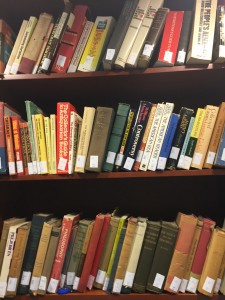
the library of Albert Shanker
This is part of the library of Albert Shanker (1928-77), which lines the walls of the conference room of the Albert Shanker Institute, which is inside the American Federation of Teachers’ Building in Washington. I was there earlier today. It seems fitting that such a library should rest in the heart of the AFT, exemplifying the long, rich, and living tradition of intellectual life within the labor movement (and—importantly—outside of universities).
The collection itself reflects a mid-20th century canon. There are books on Freud and idealist philosophers like Collingwood and Croce, as well as pragmatists like John Dewey, who was a founder of the AFT. There are many books about schooling and education, from a variety of perspectives. Several thousand volumes line the shelves.
Shanker was a highly controversial figure. In “Sleeper” (1977), Woody Allen’s character awakens 200 years after being cryogenically frozen and asks what happened to civilization. He’s told that a man called Al Shanker got hold of nuclear weapons. On issues of unionism, race, school choice, and foreign policy, Shanker made many enemies as well as friends, and probably deserved some of both. I don’t really know the whole story well enough to praise or bury him. I take the library more as a monument to the intellectual life of our unions, which is something to prize when they are under such threat.
Cf. Harry Boyte’s recent blog post on agrarian intellectuals during the New Deal and the powerful popular education movement they led.
Against Political Saviors — Government as Empowering Partner
Kettering’s Evolving Understanding- and my Own (Connections 2015)
This three-page article, Kettering’s Evolving Understanding- and my Own: Reflections on Three Decades of Involvement with Democracy and the Foundation that Studies What It Takes to Make It Work as It Should, by Ray Minor, was published Fall 2015 in Kettering Foundation‘s annual newsletter,“Connections 2015 – Our History: Journeys in KF Research”. Minor shares his experience working with Kettering for the last thirty years and how KF’s research has helped to strengthen the democratic process.
He tells of the network of individuals who started the Birmingham National Issues Forums, which would later become the National Issues Forums Institute (NIFI). Then goes on to tell of the effort to develop civic capacity in Alabama, which would lead to a series of forums that would shape the David Mathews Center for Civic Life. Below is an excerpt from the article. Connections 2015 is available for free PDF download on Kettering’s site here.
From the article…
I learned over time that Kettering studies democracy from a citizen-centered perspective—the sense that ordinary citizens desire to control their daily lives and that this desire defines what the foundation means by “democracy.” The foundation’s primary research question—what does it take to make democracy work as it should?—derives from this idea and the underlying assumption that democracy is working as it should when citizens “self-rule.”
Democratizing Alabama
In the early 1980s, when I first became involved in this work, a broad network of individuals in Birmingham, Alabama, was convened by the University of Alabama at Birmingham (UAB) Center for Urban Affairs and supported by the UAB Office of Student Affairs. This group was on the ground floor of what later became the National Issues Forums Institute (NIFI). The core group of individuals leading this effort included Odessa Woolfolk, Rebecca Falkenberry, Wanda Madison Minor, Peggy Sparks, and myself. Wanda Minor organized this group after several conversations with David Mathews in 1982. This group operated under the name Birmingham National Issues Forums (BNIF) and annually convened a series of forums on national issues with hundreds of citizens and many organizations representing a cross-section of the community.
…
A Center Grows in Alabama
Still intrigued by the work of the Kettering Foundation, I worked with Bob McKenzie and Cathy Randall to found the Alabama Center for Civic Life, a 501(c) (3), nonprofit, nonpartisan organization, which was incorporated and received tax-exempt status in 2005. The center’s purpose is to conduct research and training on citizenship, democracy, governance, and democratic practices. Since Mathews was the inspiration for establishing the center, in 2008, it was renamed the David Mathews Center for Civic Life. The center was established on the premise that democracy works best when enlightened citizens engage in the affairs of their towns, cities, states, and nations. A small group of Alabamians decided to fill a void in the public sector by establishing an organization that would equip citizens with the skills and knowledge necessary for engaging in public life.
…
Looking back, I have come to realize that Kettering’s work is important for several reasons pertaining to strengthening democracy. Perhaps paramount among the others, Kettering’s focus on the six democratic practices provides a lens through which citizens from all parts of the world can come to see themselves as key actors on public problems and see connections between their work as citizens and the work of people from widely differing circumstances. This recognition of the work of citizens by citizens themselves may well be Kettering’s most important contribution to democratic life.
About Kettering Foundation and Connections
The Kettering Foundation is a nonprofit operating foundation rooted in the American tradition of cooperative research. Kettering’s primary research question is, what does it take to make democracy work as it should? Kettering’s research is distinctive because it is conducted from the perspective of citizens and focuses on what people can do collectively to address problems affecting their lives, their communities, and their nation.
Each issue of this annual newsletter focuses on a particular area of Kettering’s research. The 2015 issue, edited by Kettering program officer Melinda Gilmore and director of communications David Holwerk, focuses on our yearlong review of Kettering’s research over time.
Follow on Twitter: @KetteringFdn.
Resource Link: www.kettering.org/sites/default/files/periodical-article/Minor_2015.pdf
Tracking Community College Outcomes Can Help Get More Students to the Finish
the Journal of Universal Rejection
(Washington, DC) On a week when I got an article rejected almost instantly and then participated in an editorial committee for a different journal that celebrated our rising rejection rate, I just have to plug the Journal of Universal Rejection. Arguably the best journal in the entire universe, it rejects all submissions as not up to snuff.
From the instructions for authors:
The JofUR solicits any and all types of manuscript: poetry, prose, visual art, and research articles. You name it, we take it, and reject it. Your manuscript may be formatted however you wish. Frankly, we don’t care.
After submitting your work, the decision process varies. Often the Editor-in-Chief will reject your work out-of-hand, without even reading it! However, he might read it. Probably he’ll skim. At other times your manuscript may be sent to anonymous referees. Unless they are the Editor-in-Chief’s wife or graduate school buddies, it is unlikely that the referees will even understand what is going on. Rejection will follow as swiftly as a bird dropping from a great height after being struck by a stone. At other times, rejection may languish like your email buried in the Editor-in-Chief’s inbox. But it will come, swift or slow, as surely as death.
The Oxford Comma
There is a topic which has caused generations of debate. Lines have been drawn. Enemies have been made.
I refer, of course, to the Oxford comma. Should it, or should it not, be a thing?
For those who don’t bask in the depths of English grammar debates, let me explain. The Oxford English Dictionary, a worthy source of knowledge on this subject, defines the Oxford comma as:
a comma immediately preceding the conjunction in a list of items.
“I bought apples, pears, and grapes” employs the Oxford comma while “I bought apples, pears and grapes” does not.
You can see why there are such heated debates about this.
The Oxford comma , so named due to “the preferred use of such a comma to avoid ambiguity in the house style of Oxford University Press,” is also known by the more prosaic name of the “serial comma.”
I have no evidence to verify this, but I believe that what one calls the comma gives insight into a person’s position on the matter. Those who are pro-comma prefer the more erudite “Oxford comma” while those who are anti-comma prefer the uninspiring “serial comma.”
Why do you need another comma? They ask. You already have so many, you don’t need a serial comma as well!
These people are wrong.
As I may have given away from my own references to the “Oxford comma,” I am firmly in the pro-Oxford comma camp.
It is clear that a comma is better there.
Not only because there’s no end to the silly and clever memes you can create mocking the absence of an Oxford comma, but because – more proudly – a sentence just feels more complete, more balanced, and more aesthetic with the comma there. It just feels right.
But, of course, this is what makes language so wonderful. Language is alive, and that life can be seen in all the little debates and inconsistencies of our grammar.
It’s like cheering for your favorite sports team: we can fight about it, mock each other, and talk all sorts of trash, but at the end of the day we can still be friends.
…Wait, we can still be friends, right?
Food as a Way to Help Refugees and Build Social Solidarity
Can food be used as a way to bring strangers together, if only for a meal or two, and create the beginnings of a new type of community? Penny Travlou, a cultural geographer and ethnographer at the University of Edinburgh, decided to find out. In an interview posted on “Social Innovation Europe,” an EU website, she talks about her experience in co-organizing “pop-up dinners” that bring together immigrants with local Greeks in Athens. The idea is to use meal preparation and eating together as a way to break down cultural barriers and support migrant integration in Greece.
Travlou’s specialty as a researcher is the collaborative practices of digital artists and practitioners. But recently she has been fascinated with “nomadic co-living communities, hackers and refugees.” Syrian refugees of course face some very different challenges than hackers, makers and other nomads of digital culture. Yet they both are living a kind of “nomadic transient citizenship” that Travlou believes is changing Europe. One might say that ad hoc cooperation based on mutual need, empathy and shared circumstances is a big aspect of modern life.
In developing the idea of pop up dinners for refugees and local Greeks, Travlou had been inspired by Jeff Andreoni of the unMonastery, who had been organizing dinners in Athens for locals and immigrants. Working with a professional cook, an Eritrean refugee named Senait, Andreoni and Travlou held a dinner for 100 people at a house in Athens. As Travlou explained:
That made us think that such small-scale events can be a great way to give job opportunities to newcomers -- i.e., immigrants and refugees -- and get them feel part of the Greek society and culture. From that event onwards, we got collaborated with and participated in other immigrant collective pop-up events. In the summer, we set up the African Collective Kitchen “OneLoveKitchen” with a group of cooks from Senegal, The Gambia, Sudan, Nigeria, Eritrea and Ethiopia. We collaborated with the African United Women Organisation and Nosotros: the free social centre.
All our events have been self-organised without any formal funding. We have organised small pop-up dinners in houses and roof terraces, have served food in a solidarity economy festival and have catered for two conferences. Since September when a great influx of Syrian refugees has been arriving in Athens, some of us have also been involved in daily collective kitchens preparing food for a housing squat for refugees and other similar initiatives.
Travlou and Andreoni are now setting up a new project, Options Foodlab, which is a professional kitchen and co-working space for food training. Travlou said that food is a great way to bring people together:
What I always say when people ask me why I got involved in such a project is to think of where the words ‘company’ and ‘companion’ come from. They both derive from the Latin word ‘companio’ which means one who eats bread [pane] with you. Thus, food making and sharing is a social act and a means of exhibiting respect for an existing or future relationship of reciprocity. Food making is about hospitality and connectivity. There is not a better way to bring people together: you don’t need linguistic cues to connect with others. With this perspective, we can think food as an object of exchange, a gift that can be shared and exchanged.
An inspiring project! You can read the full interview with Travlou here.