DemocracyOS

Method: DemocracyOS

Definition Open source software which allows citizens to: Propose - Get from zero to democracy in a click. Build proposals and be the change you want to see. Debate - Debate in a platform that rewards the best arguments and filters that noise that usually ends up calling the trolls...

Don’t Forget to Register for Feb. 9 Tech Tuesday Call on Balancing Act

As we recently mentioned on the blog, NCDD is hosting another one of our popular Tech Tuesday calls this Tech_Tuesday_BadgeTuesday, February 9th from 3 – 4pm Eastern / 12 – 1pm Pacific in conjunction with IAP2.

This time the call will offer an inside look at Balancing Act, an online tool aimed at helping average citizens learn about public budgets and the choices elected officials face in the budgeting process. It’s right around the corner, so make sure you register today!

This Tech Tuesday will feature a presentation from Chris Adams of Engaged Public, the civic engagement group that developed Balancing Act. Chris will explain the functions of Balancing Act and talk about how it’s already being used by various governments and communities. Plus, you won’t want to miss the info about a special offer for folks doing participatory budgeting! 

Don’t miss this opportunity to learn about this useful new tool and connect with your NCDD colleagues! We look forward to have you on the call!

Videoed Talk on ‘Uniting Mississippi’ at USM

Liberal Arts Building at the University of Southern Mississippi.I had a great time at the University of Southern Mississippi on Friday, January 29th. After a fun interview on WDAM TV in Hattiesburg, MS, I headed over to the new Liberal Arts Building on campus, which is beautiful.

Dr. Sam Bruton in the Philosophy and Religion department at USM organizes the Philosophical Fridays program, which runs in part with the general support from the Mississippi Humanities Council. I’m grateful to Dr. Bruton, to the department of Philosophy and Religion at USM, and to the MS Humanities Council for the chance to present in Hattiesburg and the permission to post the video of my talk here. The video was first posted here on the USM library Web site.

I’ve posted the talk on YouTube here below. If you’re interested in the book, you can learn more here or pick up a copy here.

If you can’t see this video in your RSS reader or email, then click here.

If you enjoy the talk and are interested in a speaker for an upcoming event, visit my Speaking and Contact pages.

Free Resources and PD on Arab-Israeli Conflict & Peace Process

Our content specialist, Dr. Terri Fine, is a wonderful resource for teachers in this state and beyond on issues concerning civic education. However, Dr. Fine has also made it a priority to provide content-oriented professional development connected to history and foreign policy, particularly on modern Israel. She recommends the Institute for Curriculum Services: National Resource Center for Accurate Jewish Content in Schools and has asked to share the following opportunity for professional development around the Arab-Israeli Conflict and the Peace Process. This is a free PD opportunity!

June 28 – 30, Portland State University

$300 stipend available (for attendance and travel) for first 25 registered participants.

The Institute for Curriculum Services, in collaboration with the Library of Congress and Portland State University, invites middle and high school social studies teachers to attend a dynamic 3-day workshop, Teaching the Arab-Israeli Conflict and Peace Process.

With an emphasis on inquiry based learning using Teaching with Primary Sources strategies and content-specific lectures from university scholars, this institute will enhance your professional practice and deepen your historical content knowledge.

For more information and to request applications materials please contact Jacqueline Regev, jregev@icsresources.org.


Yanjian Model of Participatory Budgeting

Definition Problems and Purpose History Participant Selection Deliberation, Decisions, and Public Interaction The preparation stage before really voting on the budget plan encompassed two major segments. First comes the determination of the total capital appointed to the public participatory budgeting plans before the formulation of concrete programs. To be specific,...

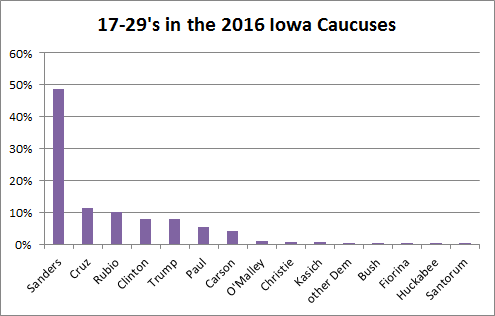
Sanders got about as many youth votes in Iowa as everyone else combined

My colleagues at CIRCLE are producing a stream of detailed and almost instantaneous analysis of the caucuses and primaries. Keep checking the CIRCLE homepage for the latest.

Here I use CIRCLE’s evidence to illustrate how Sen. Sanders’ dominated the youth vote in the Iowa caucuses. Consider the Democratic and Republican caucuses as one event: the voter first chooses which party to caucus with, and then selects a candidate. By that reasoning, about 50,000 young Iowans (ages 17-29) caucused, and about 58% of them chose the Democratic side. Sanders drew 84% of the Democratic youth, while the Republican youth split their support. As a result, Sanders drew about 49% of all the young caucus-goers put together. Cruz came in second with about 11% of all the youth, followed very closely by Rubio, then Clinton, and then Trump.

Iowa 2016

Sanders got about eight times as many votes as his main opponent on the Democratic side, and about eight times as many as Trump, with whom he is sometimes paired as a supposed enemy of “the establishment.”

That raises such questions as: Can Sen. Sanders do better among older people in other states? Can he perform as well among youth in states where young Democratic voters are far more diverse than they are in Iowa? Can Sec. Clinton narrow the generation gap, and can she get out the youth vote if she wins the nomination? (She only drew about 4,000-5,000 young Iowans on Monday and came in fourth in that age bracket, which ought to ring some alarms.) Finally, where will young Republicans land as their field narrows?

New Goals for Florida Citizen!

So, we recently had a Lou Frey Institute/Florida Joint Center for Citizenship staff meeting here at our office. It was two days of planning for the future, led by our inestimable director, Dr. Doug Dobson, and it was refreshing to sit down with the entire Lou Frey Institute/FJCC staff to discuss issues and direction for the work that we do. I just wanted to take a moment and share with you, our friends in civic education here in Florida and nationally, just some what we have going on and where we are going organizationally. This is not an inclusive list; this is just what we are most excited about!

Projects with National Archives

We have have developed, over the past few years, an ongoing relationship with the fine folks at the National Archives. They have been kind enough to share personnel who were more than willing to come to Florida to work with our teachers on using primary sources. Happily, they will be working with us next month to develop bellringer/formative assessment or enrichment type resources that are aligned with high school US History and US Government benchmarks. This is new ground for us, as most of our focus has been on the middle school and (to a lesser degree) elementary school level. We are also hoping, sometime this summer, to work with the National Archives to develop additional elementary school resources centered around primary sources.

Adopting the SAMR Model

One of the biggest issues we face with our curriculum is that while we believe that we have quality resources, they follow a traditional model of classroom pedagogy. To address this, we are exploring ways in which we can adopt the SAMR model in our curricular revision and design.

samr-model

The SAMR Model of Educational Technology . Check out more at http://edtechvoice.com/lesson-1/the-samr-model/

We are definitely open to suggestions on this end, for sure. Right now, I will be meeting with the Educational Technology experts over at the UCF College of Education to explore possibilities. At the same time, we are striving to find a way to make our curricular materials more ESE and ESOL friendly. We have high hopes that we will bring you new and improved resources!

Website Redesign (Again!)

One of the most pressing needs across the state is for our teachers to be able to disseminate some of the great resources they themselves have created. We are working on a way to facilitate that. We hope to add an expansion to Florida Citizen that allows users to upload materials and share them with others. It will feature a ‘vetting’ system that will allow FJCC to recommend some of these materials as well. We have lots of hopes, and I expect that our great IT leader, Mike Barnhardt, will do some good things.

Civics Teaching Certificate

The Civics Teaching Certificate will provide pre-service teachers with complementary, civics teaching-focused coursework that will build on and enhance the Social Science Education B.S. curriculum.  Individuals enrolled in the Civics Teaching certificate program will learn the substantive content, skills and pedagogical tools needed to deliver instruction explicitly linked to the 7th grade Civics End of Course Assessment (EOCA) in Florida.  The Civics Teaching Certificate will also support and enhance high school U.S. government instruction. Reflecting the importance of service and experiential learning in civic education, enrollees will also take part in a summer internship that involves them in hands-on practice with local government.

Pre-service teachers enrolled in the Social Science Education B.S. major will complete four courses to develop expertise in civics content, pedagogy and assessment.  The Civics Teaching Certificate will be completed as a three semester sequence. Summer coursework will include an internship in a local government office.

On the Drawing Board

We have a number of goals for the coming months. We would like to bring back some semblance of the Civic Mentor Teacher Program. We are working on a prototype, developed in house, of a three to five minute student oriented video on specific civics content, most likely around the election. This will, we believe, provide us an opportunity to see what we can affordably do with our own resources. If the video is received positively, we would love to develop more to supplement the already good teacher-oriented videos on the Florida Citizen site. We are also going to be starting work in Duval County with a couple of schools in need of assistance in Civics, and we are excited for this opportunity! Finally, we will continue to work closely with members of the Partnership for Civic Learning on newly identified civic education priorities in this state (a topic for another post!).

One of the hopes we have for the new year as well is to begin to develop more of a national presence. We will continue to work, as always, with the great teachers in Florida, and they will always be our target demographic, but we believe it is time to start partnering with other small civic-education organizations, perhaps in a version of the Civic Renewal Network that is oriented toward state level organizations, to see how we can improve civic education at the national level as well.

We all have ambitions, I suppose, and we do love what we do here. The Florida Joint Center for Citizenship remains committed to serving the needs of teachers, students, and the civic community in Florida, and we are always working to find new ways to do that. Thank you to our team and to those we have encountered both here and elsewhere for the work that you do in creating that next generation of citizens. And if YOU have ideas on how we can improve in our work, please let us know!



Join Us at Citizen University’s 2016 Conference, Mar. 18-19

We want to encourage NCDD members to consider registering Citizen University’s annual conference this March 18th – 19th in Seattle, Washington. Citizen University was founded by former NCDD keynote speaker Eric Liu to build a stronger culture of citizenship, and their annual confernece is an incredibly unique civic gathering.

This year’s conference theme is “Who Is Us? Race, Citizenship, and America Now.” As many of us in the D&D field continue to ask ourselves about how to engage more diverse populations beyond the “usual suspects”, this conference on the intersection of race and citizenship – keynoted by one of the founders of the national Black Lives Matter network – couldn’t be more timely.

Here’s how Citizen University describes the gathering:

A new America is being born. All across the country, citizens are forcing institutions to move on racial justice and social inclusion. Now more than ever, it’s time to ask: Who is Us? Who gets to define the emerging America?

This is the focus of our annual national conference, a civic gathering unlike any other in America. Join hundreds of change-makers, activists, and catalysts tolearn about power, deepen your networks, and recharge your sense of purpose.

With luminary speakers, master teachers, and rapid-fire lessons on civic power, the conversation will be rich and provocative. This is a time when citizens are solving problems in new ways, bypassing broken institutions, stale ideologies, and polarized politics. We are part of a movement to rekindle citizenship and remake the narrative of America. Join us.

The conference is going to have a great line up of speakers and engaging sessions, which you can learn more about on the conference website at www.citizenuniversity.us/programs/conference. Plus, our own NCDD Director Sandy Heierbacher will be in attendance, so we hope lots of NCDD members will be there to connect with her!

Conference registration is only $200 right now, but the early bird registration ends March 1st, so don’t wait too long! Learn more and register for the conference by clicking here, and we hope to see some of you in Seattle!