Talking about . . . what’s next after the election?

The article, Talking about . . . what’s next after the election? was posted on the Living Room Conversations site just before the US Election in Fall 2016. Living Room Conversations are a structured format of dialogue designed to hold space for participants across the ideological spectrum to come together and explore each other’s point of view. The original article can be found in full below and on Living Room Conversations’ site here.

From the site…

The presidential election brought attention to our political system… and our differences. Now we need to restore relationships around our shared hopes and dreams and get our country focused on the work of governing. But how exactly will we do this?  This conversation allows us to start exploring ‘what’s next?’. Whether we feel elated or defeated, whatever our differences – let’s insist on finding the deeper unities we can rest upon and defend. Generosity. Goodness. Kindness. Freedom. Respect.

Click here if you would like a pdf of the following topic material to share with your cohost and friends.

Background reading (optional)
While you don’t need to be an expert on this topic, sometimes people want background information. Our partner, AllSides, has prepared a variety of articles reflecting multiple sides of this topic.

Want to listen to an actual Living Room Conversation?
Check out LRC Radio.

Now that you are all together, here we go!

This Living Room Conversation flows through five rounds of questions and a closing. Some rounds ask you to answer each question. Others feature multiple questions that serve as conversation starters — you need only respond to the one or two you find most interesting.

Before you begin your conversation, please go over the Conversation Ground Rules with your participants.

One. Why are we here?
What interested you or drew you to this topic?

Two. Your core values
Answer one or more of the following:

– what sense of purpose or duty guides you in life? What is your mission statement?
– what would your best friend say about who you are and what makes you tick?
– what are your hopes and concerns for your community and/or the country, now and long-term?

Three. What are your biggest concerns now?
Remember that the goal of this Living Room Conversation is for each participant to listen to and learn about the different opinions within the group to see where you might share interests, intentions and goals.

Answer one or more of the following questions:

– How do you feel and what do you think about the election, now that it’s over?

– Have any of your close relationships been harmed due to politics this year? What happened?

– How open are you and your friends to hearing different perspectives to reach a shared goal?

– Will you reach out to repair relationships that have been harmed? What will you do first?

– What would you like our elected representatives to work on first?

Four. Reflection
Answer one or more of the following questions:

– in one sentence, share what was most meaningful or valuable to you in the experience of this Living Room Conversation;

– what new understanding or common ground did you find within this topic?

– has this conversation changed your perception of anyone in this group, including yourself?

Five. Accomplishment and moving forward
Answer both of the following questions:

– name one important thing that was accomplished here;
– is there a next step you would like to take based upon the conversation you just had?

Closing
Thank you! Please complete the feedback form to help us continue to improve Living Room Conversation

About Living Room Conversations
lrc_logoLiving Room Conversations is a non-profit organization founded in 2010 as a result of a transpartisan partnership focused on revitalizing civil discourse through conversation. Living Room Conversations offers an open-source format to facilitate structured conversations among people of differing views and backgrounds. Through these conversations we hope to increase understanding of various issues, build relationships, and pave the way for collaborative and inclusive problem-solving.

Follow on Twitter: @LivingRoomConvo

Resource Link: www.livingroomconversations.org/whats_next_after_the_election
Clinton’s support in historical context

Hillary Clinton is winning the popular vote, and I am seeing commentary to the effect that she has one of the largest vote counts ever received, at nearly 64 million. It’s true that only Obama beat that number (twice, with 69 million and then 66 million votes in his two presidential races). However, the population of the US keeps growing, so one would expect the number of votes cast to rise.

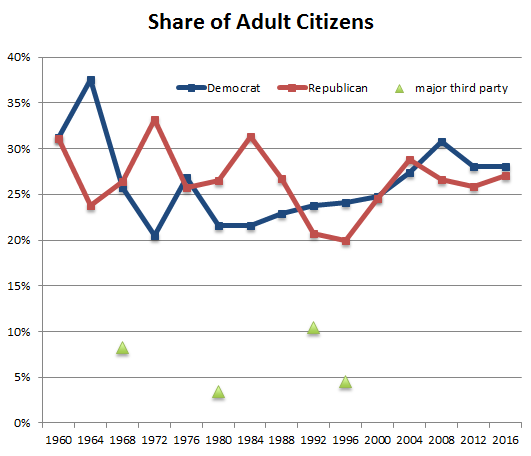
The best measure of popular support is the percentage of all adults who turn out for a given candidate. Clinton got about 28%; 27.1% voted for Trump. The 0.9% gap was one of the smallest in modern times, although 1960, 1968, and 2000 were actually closer races in these terms. Clinton’s share of all eligible voters was the same as Obama’s in 2012 (28%).

There have been thirty major party presidential nominees since 1960, and Clinton ranks seventh among all of them in votes/adult population. A few candidates drew much bigger shares back when turnout was higher and partisan swings were wider. LBJ drew the votes of 37.5% of all adults in 1964, about one third more than Clinton did–but politics has changed since then.
voteshare2

(Major third party candidates are shown for 1968, 1980, 1992, and 1996.)

CIRCLE’s full post-election analysis of the youth vote

(By the CIRCLE staff, cross-posted from civicyouth.org.) Since Election Day, CIRCLE’s analysis has focused on whom young people voted for, how many voted, and which segments of the youth population cast their ballots—placing each in historical context by examining trends from recent elections. Today’s analysis looks more deeply at the youth vote in the 2016 presidential race, offering a breakdown of young people’s support for each major candidate and for the political parties they represent. We also consider the long-term implications, for both Democrats and Republicans, of a youth electorate that is increasingly loathe to identify strongly with either major party.

READ OUR FULL ANALYSIS HERE

Major findings include:

The Youth Electorate

  • CIRCLE analysis suggests that young people voted at a similar rate than in 2012 – around 50%. In 11 battleground states, on aggregate, 55% of youth turned out to vote.
  • The racial and ethnic composition of the 2016 youth electorate closely mirrored the general population of young citizens, and remained as diverse as it has been since 2008, though this year there was a surge of young, White, male voters.
  • Young people without college experience, already historically underrepresented, made up a smaller share of the young people who cast ballots than in recent elections.
  • Less than 4 in 10 young voters identified with the Democratic Party and less than 3 in 10 identified with the Republican Party, suggesting that America’s two major parties are having trouble attracting a substantial youth base.

partyidandideology

The Youth Vote for Trump and Clinton

  • President-elect Trump lost the youth vote overall by 55% to 37%, but he garnered support from some segments of the youth electorate: Whites, evangelicals, and young people in rural areas.
  • While Secretary Clinton won by large margins among demographic groups like unmarried young women and youth of color, she lacked key support from young Whites, young men, and young White moderates.
  • President-elect Trump drew significant support from young people whose ideas and concerns tracked closely with the key themes of his campaign: the state of the country,stronger immigration controls, and a the perceived untrustworthiness of his opponent.

racegendered-graph

Implications for the Future

  • Young people are clamoring for significant change, though there are deep divisions on what that change should look like. Youth also seem increasingly skeptical of the two major political parties’ ability to bring the change they seek.
  • Moderates, Independents, and other young people who eschew the ideological extremes and strong party identification, appear to be a rising force in the youth electorate. They may also be harder to mobilize if they don’t engage with the traditional party—and partisan—organizations that for many youth provide structures and opportunities for political and broader civic engagement.
  • There’s another national election in two years! Only one in five young young people voted in the 2014 midterms, and after an election in which many youth were disappointed with both nominees (and most youth voted for the losing candidate) it may be even harder to keep youth politically motivated. Stronger civic education and strategic, intentional youth outreach remains key.

Dreams of Union, Days of Conflict

At last week’s National Communication Association (NCA) annual conference, Penn State’s Kirt Wilson gave a moving lecture on Dreams of Union, Days of Conflict: Communicating Social Justice and Civil Rights Memory in the Age of Obama.

Responding to the “civic calling” theme of this year’s conference, Wilson praised the urged to get involved, but cautioned that we must do so wisely – first understanding “the nature of the society we are called to,” and critically interrogating the civic actions we take on its behalf.

We all know that our society is not perfect – indeed, that is why we so acutely feel a civic calling; a need to engage in the hard work of democratic living. But even with the need for such a  “process-model” utopia, as Erin McKenna calls it, the entrenched inequities of our society require more than a moderate amount of collective civic work.

Wilson pointed to the innovative activism of Black Lives Matter, which seeks not only to ameliorate an immediate problem, but to fundamentally disrupt the paradigm which has supported and normalized the perpetual murder of black people.

Wilson quoted Fredrick Douglass: “Slavery has been fruitful in giving itself names…and it will call itself by yet another name; and you and I and all of us had better wait and see what new form this old monster will assume, in what new skin this old snake will come forth next.”

Black slavery still exists today, Wilson argued, but we call it by other names. The school-to-prison pipeline; the new Jim Crow; police-community relations.

When we act, when we respond to the civic calling of our times, we must do so with a critical eye to the institutions which shape our society and the how our actions will affect them.

Black Lives Matter has come under fire for the disruptive nature of their protests; for breaking with the protest approach of their 1960s peers.

But Wilson made a compelling argument for that shift in strategy. The civil rights movement made tremendous advances, but it did not end the insidious remnants of slavery and oppression. Slavery only changed its name.

The only way to truly change this institutionalized oppression is to disrupt the system, to change the paradigm.

Wilson argued that the radicals of the 60s “marched because the only life affirming response to death and to slavery is to resist.” Today’s young activists organize out of a similar need.

“Black life matters,” Wilson said, “because people are dead and they didn’t have to die. And more are going to die tomorrow.”

That is why we resist.

facebooktwittergoogle_plusredditlinkedintumblrmail

Join our Confab on “What’s Next?” Post-Election, 11/29

As we posted about earlier this week, the Presidential election has brought forth new needs for dialogue and deliberation, as well as renewed importance of the work to bridge divides that our field has been doing for many Confab bubble imageyears. We’ve been appreciating the responses our community have had so far to this post, and we’d like to provide an additional opportunity for us all to discuss this important time in our work.

Join us Tuesday, November 29th at 1pm Eastern/10am Pacific for a 90-minute Confab Call to talk together as a community about what’s next after the election. This will be an open call, allowing community members to talk about their bridge building work, or ideas for what they can do post-election. NCDD staff will lead the call, but we won’t have any featured presenters – we want to hear from you!

The need for dialogue and deliberation is stronger than ever, and our network is poised to help our communities and nation come together across divides to tackle our toughest challenges. Join us as we talk about what’s being done now, and what’s possible for us in our work individually and collectively.

NCDD’s interactive Confab Calls are free and open to all members and potential members. Register today if you’d like to join us!

NCDD’s Confab Calls are opportunities for members (and potential members) of NCDD to talk with and hear from innovators in our field about the work they’re doing, and to connect with fellow members around shared interests. Membership in NCDD is encouraged but not required for participation. Register today if you’d like to join us.

SFU Seeks Nominations for Int’l Dialogue Award

We want to highlight the recent call from Simon Fraser University’s Centre for Dialogue – an NCDD member organization – for nominations for the Jack P. Blaney Award for Dialogue which recognizes dialogue practitioners of international excellence. We encourage our members to consider nominating people you think are doing especially impactful work in our field before the Dec. 16 deadline. You can learn more in the Centre’s announcement below or find the original here.


Simon Fraser University’s Centre for Dialogue is now accepting nominations for the 2017-18 Jack P. Blaney Award for Dialogue

The Jack P. Blaney Award for Dialogue is presented every second year to an individual who has demonstrated international excellence in the use of dialogue to increase mutual understanding and advance complex public issues. Nominations are encouraged from around the world in the fields of international diplomacy & conflict resolution, climate solutions, intercultural dialogue, civic engagement, and urban sustainability.

Criteria used to select the recipient include:

  • The candidate’s demonstrated international excellence in the use of dialogue to increase mutual understanding;
  • The global significance of his or her work in addressing complex and profound public issues; and
  • Related programming opportunities.

Far more than a simple ceremony, the Blaney Award includes a short programming residency in Vancouver, Canada that builds upon the recipient’s work to achieve tangible outcomes, reflecting the mandate of Simon Fraser University to be Canada’s most community-engaged research university. Recent Blaney Award programs have engaged thousands of participants through the hosting of international announcements, book launches, capacity building workshops, and participatory research. The award endowment includes funds to cover recipient transportation and associated programming costs, as well as a $10,000 cash award.

Nomination Form (Word)
Nomination Form
(PDF)

Nomination deadline: December 16, 2016

Inquiries: Robin Prest, Program Director, rjprest[at]sfu[dot]ca

You can find the original version of this SFU announcement at www.sfu.ca/dialogue/jack-p-blaney/call-for-nominations.html.

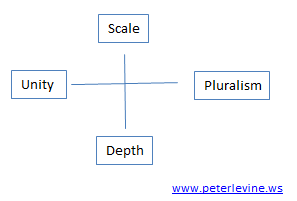
we need SPUD (scale, pluralism, unity, depth)

Whether you’re building a social movement, organization, network, or media platform, you should strive for SPUD:

Scale: You need a lot of people. For instance, if your social movement is anti-Trump, it must include 55% of all voting Americans in 2018 to have a chance of capturing the House. (Note that this is entirely possible. Joshua Spivak cites 1894 and 1994 as “among the two most important midterm elections in American history.” Both “came two years after one party won a seemingly sweeping mandate for power. Both saw historic reversals. And, perhaps more importantly, both completely reshaped the political landscape for decades to come.” Trump’s 2016 victory could be monumentally Pyrrhic–but only if the opposition attains sufficient scale to reverse it).

Pluralism: Your organization, movement, or platform must incorporate a plurality of perspectives. The criterion is not whether it represents the opinions of the American people as a whole. We are entitled to build groups that tilt one way or another; that’s what politics is about. But ideologically homogeneous groups make stupid choices. They also limit their own scale because they forget how many people disagree with their premises. Ideological homogeneity and narrowness are dangers on the left as well as on the right.

Unity: Groups are more effective when they can present a united front. We march together, sing the same anthem, or use the same hashtag to display unity. Standing together compels respect. Groups also need actual unity so that they can develop agendas and coordinate their resources and actions to accomplish their goals. Compromise is an inevitable aspect of politics, but groups that lack unity can’t negotiate effectively when it comes time to compromise.

Depth: Valuable political organizations change their participants. Truly engaged members learn skills and information, gain agency and purpose, develop allies, and (in the best cases) make their own goals more responsible and ethical by participating in groups. Both political outcomes and the quality of our civic life depend on who develops in these ways.

The SPUD values conflict. Groups with larger scale struggle to provide depth: transformative experiences for their members. But groups that really change lives struggle to reach large scale. Even more obviously, pluralism conflicts with unity. Supporters of Hillary Clinton, Bernie Sanders, Black Lives Matter, and #NeverTrump disagree about fundamental matters right now, and that is causing a lot of angst. A cheap consensus would reduce pluralism, but deep and continuous disagreements will block unity.

spud

Despite these tradeoffs and tensions, groups and movements achieve more or less SPUD. There is such a thing as populist pluralism the treats the people as highly diverse and yet united in the common interest. This is an essential antidote to Trumpian populism, which depicts the people as homogeneous and represented by a single leader. It takes work to grow large and go deep, to encourage pluralism and build unity. It would sound utopian except that it’s exactly what our best organizations and movements accomplish. And it suggests a diagnostic checklist for any group, institution, or network you’re part of. How are you doing on each dimension of SPUD?

For these distinctions, see also: Peter Levine, “Democracy in the Digital Age,” The Civic Media Reader, edited by Eric Gordon and Paul Mihailidis (Cambridge, MA: MIT Press, 2016), pp. 29-47; and Peter Levine and Eric Liu, “America’s Civic Renewal Movement: The View from Organizational Leaders” (Medford, MA: Jonathan M. Tisch College of Citizenship & Public Service, 2015).