public speaking this spring

Please join me if you’re able and interested:

March 10, Medford, MA: Fletcher Political Risk conference, morning concurrent session on varieties of populism.

March 24, Boston, MA: Northeastern University’s NULab for Texts, Maps and Networks, keynote at a conference on “Keeping the Public Sphere Open” (Boston, MA)

March 27, Orlando, FL: University of Central Florida: keynote at the Prince Mohammad Bin Fahd Program for Strategic Research & Studies, the Lou Frey Institute, and the Partnership for Civic Learning conference on “Teaching Tolerance & Peace in Education: American Experiences & International Lessons.”

March 29, Waterville, ME: The 2017 William R. and Linda K. Cotter Debate at Colby College: “American Democracy?”, with Benjamin Page, Gordon Scott Fulcher Professor of Decision Making, Northwestern University; author of Democracy in America? What Has Gone Wrong and What We Can Do About It (Forthcoming); Roslyn Fuller, scholar; author of Beasts and Gods: How Democracy Changed Its Meaning and Lost Its Purpose (2015); and me. Moderator: Joseph R. Reisert, Harriet S. Wiswell and George C. Wiswell Jr. Associate Professor of American Constitutional Law, Colby College.

April 12, Oxford, OH. At Miami University of Ohio’s Humanities Center, “Civic Studies: An Emerging Field

April 19, Los Angeles, at the University of Southern California, Center for Economic and Social Research, “The Hollowing Out of US Democracy.

April 27, San Antonio, TX: panel at the John Dewey Society annual meeting.

May 18, Medford, MA: Tisch College/Good Society symposium on Facts, Values, and Strategies. (Seminar on works-in-progress; you must request papers in advance.)

June 9, Boston, MA: plenary panel at the 2017 Social Science Education Consortium (SSEC) meeting on the theme, “Whither Democracy? Current State and Future Prospects.”

June 22-4, Boston, MA: Frontiers of Democracy conference.


school choice is a question of values not data

I disagree with my friend Robert Pondiscio about many policies, but I agree with an essential aspect of his argument in a US News article entitled “Asking the Wrong Questions on School Choice.”

Some impressive-looking recent studies assert that school choice doesn’t “work” because test scores go down when families use vouchers to transfer their kids to private schools. The New York Times describes these results as “dismal” and cites “harms” to the children from voucher experiments. Pondiscio believes that the preponderance of the evidence still “tends to favor school choice.” I don’t know if that is right, but I’m with Pondiscio that “this entire debate puts the cart before the horse.”

After all, who said that test scores are the purpose of schooling? “Choice exists to allow parents to educate their children in accordance with their own needs, desires and values.” Some parents will prefer schools that achieve lower scores on state standardized tests because they value other ends. To measure choice in terms of test scores “says, in effect, that one’s values, aspirations and priorities for one’s child amount to nothing.” He concludes:

If we limit the frame of this debate to academic outputs alone, every new study provides ammunition, but never a conclusion. The real debate we should be having is, “What kind of system do we want?” Answer that question first, then use evidence to improve the school designs, policies and programs we have agreed deserve public support.

I’ve made similar points in debates about, for example, the economic impact of civic engagement, the educational value of service learning, and the evaluation of policy more generally. We live in an age when science has enormous prestige and values are widely viewed as merely subjective. In that context, it’s common to treat programs and policies much as scientists would view natural phenomena, as things that arise on their own and have measurable effects. To decide whether they “work” means measuring their causal impact with apparently objective measures, of which state-written tests are good examples. Negative results lead to strongly value-laden conclusions–such as the Times’ headline about “dismal failures”–that are not themselves scientific.

In fact, programs and policies arise because people have value commitments. They strive to make their ideas work, albeit for various and contested purposes. Usually nothing works at first. If its impact improves, it’s because people have made it work by refining and improving the practice. The reason that data provides “ammunition, but never a conclusion” is that any empirical result can be changed by revising and improving the program under study. Therefore, the fundamental question is not what works but what we should value and try to make work.

An everyday example is public schooling. Nineteenth century reformers like Horace Mann drew from previous thinkers—and from successful experiences in countries like Prussia—to propose a new idea: every child should be educated at the government’s expense in a state-funded common school under local political control. Since then, not only have educators and policymakers refined and revised most aspects of public schooling, but scholars have critically evaluated actual schools from a wide variety of perspectives. A few observers have concluded that Horace Mann’s core idea was misplaced, but most see their role as helping to make his vision become successful. Public schools did not arise like a new species in Darwinian evolution to survive or fail on its own. Nor did Horace Mann propose a hypothesis that could be tested with a single experiment (e.g., “Common schools will work.”). Rather, universal public schooling originated with an argument that combined values and empirical predictions, and it launched a process of improvement that has combined research with practice.

The question is whether individual family choice is a transcendent value. Robert Pondiscio argues that using test scores to assess vouchers makes family preferences “amount to nothing.” I think we all value parental choice to a degree, but everyone also weighs other concerns: children’s rights, interests, and preferences, community values, prosperity at the state and national scales, democratic ideals of collective self-governance, our responsibilities to children other than one’s own, and criteria of excellence that may be unpopular.

I agree that the American ideal of the common school has always been a bit problematic, and versions of family choice common in Western Europe may get the balance better than we do with our odd mix of local monopoly schools plus radical economic inequality. But if we seriously considered the question “What kind of system do we want?”, I’m not sure the answer would be a system driven by parental preferences.

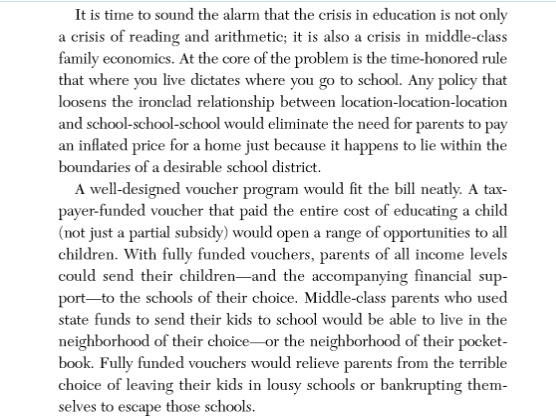
I should add that another kind of reasoning (besides scientism) motivates experiments with school choice. Some people think that market competition always or generally increases efficiency, so that introducing choice into a former monopoly will improve outcomes, almost regardless of how they’re measured. Then the effects of vouchers on test scores becomes an experiment in the efficiency hypothesis. Even if the results are mixed, the existence of major, high-quality, and recent studies in which the effects are strongly negative sounds like counter-evidence. I think that should embarrass proponents of market efficiency, of whom one was Elizabeth Warren in The Two-Income Trap: Why Middle-Class Parents are Going Broke (2003):

However, as Pondiscio argues, you can support choice as an inherent value, not because of an empirical hypothesis about economic efficiency.

Dibattito in Porto – Dibattito pubblico sul nuovo porto di Livorno [Public debate on Leghorn new harbour]

Nei mesi di Aprile e Giugno 2016 si è svolto il Dibattito Pubblico sul progetto di sviluppo e riqualificazione del porto di Livorno. Un dibattito pubblico è un percorso d’informazione, discussione e confronto che si sviluppa riguardo a opere, progetti o interventi che assumono una particolare rilevanza per la comunità...

New Kettering Publication on Engagement & Higher Ed

We want to encourage our members in higher education to check out the newest version of the Higher Education Exchange, a free annual publication from NCDD member organization the Kettering Foundation. The Exchange explores important and timely themes around the public mission of colleges and universities and offers reflections from both domestic and international scholar-practitioners on how higher education can and must shift toward teaching deliberation and civic engagement. We highly recommend it. You can learn more about the 2016 edition in the Kettering announcement below or find the full downloadable version here.


Higher Education Exchange 2016

This annual publication serves as a forum for new ideas and dialogue between scholars and the larger public. Essays explore ways that students, administrators, and faculty can initiate and sustain an ongoing conversation about the public life they share.

The Higher Education Exchange is founded on a thought articulated by Thomas Jefferson in 1820: “I know no safe depository of the ultimate powers of the society but the people themselves; and if we think them not enlightened enough to exercise their control with a wholesome discretion, the remedy is not to take it from them, but to inform their discretion by education.”

In the tradition of Jefferson, the Higher Education Exchange agrees that a central goal of higher education is to help make democracy possible by preparing citizens for public life. The Higher Education Exchange is part of a movement to strengthen higher education’s democratic mission and foster a more democratic culture throughout American society.

Working in this tradition, the Higher Education Exchange publishes interviews, case studies, analyses, news, and ideas about efforts within higher education to develop more democratic societies. The Exchange is edited by David W. Brown and Deborah Witte.

  • Foreword by Deborah Witte  (PDF)
  • Inside the Graduate School Mess: An Interview by Leonard Cassuto  (PDF)
  • Assumptions, Variables, and Ignorance by David Brown  (PDF)
  • Deliberation and Institutional Political Cultures: A Brazilian Perspective by Telma Gimenez  (PDF)
  • An Island of Deliberation in an Authoritarian Environment: The Case of Russia by Denis V. Makarov  (PDF)
  • Publicly Engaged Scholars: Next-Generation Engagement and the Future of Higher Education, Edited by Margaret A. Post, Elaine Ward, Nicholas V. Longo, and John Saltmarsh by Etana Jacobi  (PDF)
  • Afterword: Citizens in a Global Society by David Mathews  (PDF)

You can find the original announcement of this Kettering Foundation publication at www.kettering.org/catalog/product/hex-2016.

Il percorso partecipato per la pianificazione sostenibile dei Comuni di Calice Ligure e Rialto

Il fine del progetto partecipato 2015 di Calice e Rialto (Savona) è quello di “definire azioni e progetti utili alla gestione e valorizzazione del territorio sulla base di un piano di sviluppo sostenibile condiviso” (EMA, 2015, p. 13). Il progetto ha preso avvio il 17 giugno 2015 con la prima...

hearing the faint music of democracy

Democracy has many inherent flaws. This is just the start of a comprehensive list:

  1. Majority tyranny: the many may oppress the few.
  2. Free-riding: it doesn’t pay to be informed or active when you can let others engage instead.
  3. Propaganda: it works.
  4.  Motivated reasoning: people pick information to reinforce existing beliefs.
  5. Boundary problems: many political issues are about who belongs within a given polity, so how can a polity legitimately decide where to draw that line?
  6. The Iron Law of Oligarchy: even in organizations fundamentally committed to equality, a few come to dominate because bureaucracy rewards specialized expertise.
  7. The privileged position of business: because communities need investment, capital will be advantaged even if businesses don’t actively lobby.

Most of these issues have been understood for centuries, yet the scholarly evidence for them accumulates. Then along comes an actual fiasco like the 2016 election, and it’s tempting to give up on the whole idea. Democracy seems to be that system that places a racist fool in the White House.

Yet people have constructed rather remarkable “patches” to keep democracy going. Just for instance, it seems implausible that many citizens would purchase and consume a daily source of fairly independent and well-sourced news that focuses on matters of public importance. But for about a century, most Americans did buy a metropolitan newspaper every day, and the proceeds funded shoe-leather journalism. The newspaper’s financial model worked because people paid for classified ads, comics, and sports as well as news, but they saw the daily headlines on the front page. Although the model was profitable–hence sustainable–it couldn’t have existed without the dedication of the people we call “the press”: professional reporters, editors, publishers, journalism educators (k-16), and some newspaper owners, who were motivated in part by the public interest.

That’s just one example. I would add broad-based political parties, civil rights organizations, public-interest lobbies, responsive government agencies, civic education courses, civic forums, community organizing efforts, the DREAMer movement, and many more.

Why have people worked so hard to create and sustain these efforts, when the flaws of democracy seem intrinsic and intractable? They’ve heard the democratic music as well as the everyday prose.

The music is there if you listen for it. Whitman heard it: “Though it is no doubt important who is elected governor, mayor, or legislator, (and full of dismay when incompetent or vile ones get elected, as they sometimes do,) there are other, quieter contingencies, infinitely more important.” Alexander Hamilton, in most ways so unlike Whitman, heard similar chords. He started the Federalist Papers asking whether we can live together by “reflection and choice” rather than “accident and force.” These authors saw republican self-rule not only as a way of making decisions by choice but also as a path to cultural and spiritual development. For Whitman, it meant being able to stand up “without humiliation, and equal with the rest” and starting that “grand experiment of development, whose end, (perhaps requiring several generations,) may be the forming of a full-grown man or woman.”

If we’re smart, we’ll focus on the prose: the catalog of serious and enduring flaws that beset democracy. But if we’re wise, we’ll also hear the music, and that will keep us working on a new generation of solutions.

Re-imagining Value: Insights from the Care Economy, Commons, Cyberspace and Nature

What is “value” and how shall we protect it?  It’s a simple question for which we don’t have a satisfactory answer.

For conventional economists and politicians, the answer is simple:  value is essentially the same as price. Value results when private property and “free markets” condense countless individual preferences and purchases into a single, neutral representation of value:  price.  That is seen as the equivalent of “wealth.”

This theory of value has always been flawed, both theoretically and empirically, because it obviously ignores many types of “value” that cannot be given a price. No matter, it "works," and so this theory of value generally prevails in political and policy debates. Economic growth (measured as Gross Domestic Product) and value are seen as the same. 

Meanwhile, the actual value generated outside of market capitalism – the “care economy,” social labor, eco-stewardship, digital communities and commons – are mostly ignored or considered merely personal (“values”).  These types of “value” are seen as extraneous to “the economy.”

My colleagues and I wondered if it would be possible to develop a post-capitalist, commons-friendly theory of value that could begin to represent and defend these other types of value.  Could we develop a theory that might have the same resonance that the labor theory of value had in Marx’s time?

Marx’s labor theory of value has long criticized capitalism for failing to recognize the full range of value-creation that make market exchange possible in the first place.  Without the “free,” unpriced services of child-rearing, social cooperation, ethical norms, education and natural systems, markets simply could not exist.  Yet because these nonmarket value-regimes have no pricetags associated with them, they are taken for granted and fiercely exploited as “free resources” by markets.

So we were wondering:  If modern political/economic conceptions of value are deficient, then what alternative theories of value might we propose? In cooperation with the Heinrich Boell Foundation and anthropologist David Graeber, who has a keen interest in these themes, we brought together about 20 key thinkers and activists for a Deep Dive workshop in September 2016 to explore this very question.  So much seems to hinge upon how we define value.

I am pleased to say that an account of those workshop deliberations is now available as a report, Re-imagining Value:  Insights from the Care Economy, Commons, Cyberspace and Nature (pdf download). The 49-page report (plus appendices) explains that how we define value says a lot about what we care about and how we make sense of things – and therefore what kind of political agendas we pursue.   

Here is the Contents page from the report:

Introduction

I.  THE VALUE QUESTION 

            A.  Why “Value” Lies at the Heart of Politics

            B.  Should We Even Use the Word “Value”?

II.  TOWARDS A RELATIONAL THEORY OF VALUE

III.  KEY CHALLENGES IN DEVELOPING A NEW THEORY OF VALUE 

            A.  Can Abstract Metrics Help Build a New Value Regime?

            B.  How Shall We Value “Nature”? 

            C.  Should We De-Monetize Everyday Life?

IV.  COMMONS-BASED PEER PRODUCTION: A FUNDAMENTAL SHIFT IN UNDERSTANDING VALUE?                       

            A.  Practical Strategies for Building New Systems of Value

            B.  The Dangers of Co-optation and Wishful Thinking

            C.  But Peer Production Still Relies Upon (Unpaid) Care Work and Nature!

V.  NOTES TOWARD A COMMONS THEORY OF VALUE 

CONCLUSION 

Appendix A:  Participants  

Appendix B:  A Commons Theory of Value

Appendix C:  Readings for Value Deep Dive


Below, some excerpts from the report:

The absence of a credible theory of value is one reason that we have a legitimacy crisis today.  There is no shared moral justification for the power of markets and civil institutions in our lives.  Especially since the 2008 financial crisis, the idea of “rational” free markets as a fair system for allocating material wealth has become something of a joke in some quarters.  Similarly, the idea of government serving as an honest broker dedicated to meeting people’s basic needs, assuring fairness, providing ecological stewardship and advancing the public interest, is also in tatters.

“We cannot do without a value regime,” said Michel Bauwens, founder of the Peer to Peer Foundation and cofounder of the Commons Strategies Group.  “Today, we have a dictatorship of one kind of value as delivered by the market system, which determines for everyone how they can live.”  Consider how the labor of a nurse is regarded under different value regimes, he said:  A nurse working as a paid employee is considered value-creating – a contributor to Gross Domestic Product.  But the same nurse doing the same duties as a government employee is seen as “an expense, not a value-creator,” said Bauwens.  The same nurse working as a volunteer “produces no value at all” by the logic of the market system.

Bauwens said that his work in fostering peer production communities is an exploratory project in creating a new type of “value sovereignty” based on mutualism and caring.  An important aspect of this work is protecting the respective community’s value sovereignty through defensive accommodations with the market system.  “The peer production system lives a dichotomy,” explained Bauwens.  “It is based on contributions for which we don’t get paid.  We therefore have to interact with the market so that we can earn a living and get paid for what we have to do.”  Maintaining a peer community within a hostile capitalist order requires that the community “create membranes to capture value from the dominant system, but then to filter it and use it in different ways” – i.e., through collective decisionmaking and social solidarity, not through the market logic of money-based, individual exchange.

…. One participant, Ina Praetorius, a postpatriarchal thinker, author and theologian based in Switzerland, asked a provocative question:  “Do we need to use the word ‘value’ at all?”  She explained that as an ethicist she does not find the word useful.  “Value is not part of my vocabulary since writing my 2005 book, Acting Out of Abundance [in German, Handeln aus der Fülle].  It’s perfectly possible to talk about the ‘good life’ without the notion of value.”  Praetorius believes the word “value” is useful to merchants and economists in talking about money and markets.  But it has little relevance when talking about ethical living or the human condition.

Praetorius is also suspicious of “value” as a word associated with the German philosophical tradition of idealism, which she regards as “an unreliable authority because of its strange methodological origins” – “Western bourgeois men of the 19th and 20th Centuries, who created an invisible sphere of abstract concepts meant to denote certain qualities, as a means to forget their own belonging to nature and their own basic needs, especially towards women.”

But ecophilosopher Aetzel Griffioen, based in The Netherlands, regards the word “value” as “a necessary abstraction that can be used in some places and not in others.”  In his dealing with a labor union of domestic workers, for example, Griffioen considers the word too philosophical and abstract to use.  However, “for commoners trying to tackle what so-called economists call ‘value-creation,’ it is a practical necessity to use the word in trying to create commons based on their own values.”     

Again, the value/values dichotomy cropped up.  Economics claims the word “value” for itself while everyone else, in their private and social lives, may have their own personal “values.”  This rift in thinking and vocabulary is precisely what this workshop sought to overcome.  Economists are eager to protect their ideas about “value” as money-based and make them normative. Commoners and others, by contrast, want to broaden the meaning of the term to apply to all of human experience.  This conflict prompted Ina Praetorius to conclude, “Language is politics.”  For herself, she has no desire to contest with economists over control of the term.  Others, however, are determined to continue that very struggle.

Towards a Relational Theory of Value

The conventional economic definition of “value” has a significant rhetorical advantage over other notions of value/s.  It can be encapsulated in numbers, manipulated mathematically and ascribed to individuals, giving it a tidy precision.  Value defined as price also has an operational simplicity even though it flattens the messy realities of actual human life and ecosystems.  It purports to precisely quantify and calculate “value” into a single plane of commensurable, tradeable units, as mediated by price.

Through discussion, workshop participants set forth a rough alternative theory of value based on a radically different ontology.  This theory sees value arising from relationships.  Value does not inhere in objects; it emerges through a process as living entities – whether human beings or the flora and fauna of ecosystems – interact with each other.  In this sense, value is not fixed and static, but something that emerges naturally as living entities interact.

“In a commons, value is an event,” said Silke Helfrich of the Commons Strategies Group.  “It is something that needs to be enacted again and again.”  The difference between the standard economic theory of value and a commons-based one is that the latter is a relational theory of value, said Helfrich.

According to Nick Dyer-Witheford, this idea aligns with Marx’s thinking.  While some observers say that a Marxist theory of value ascribes value to things, Dyer-Witheford disagreed, noting that “Marx condemned the idea of value inhering in objects as commodity fetishism.  He believed in a relational theory of value – the relations between workers and owners – even if Marx may not have considered the full range of social relationships involved in the production of commodities.”….

Everyone agreed that a relational theory of value has great appeal and far-reaching implications.  It means that the “labor” of nonhumans – the Earth, other creatures, plants – can be regarded as a source of value, and not definitionally excluded, said Neera Singh, the geographer.  Indeed, this is a point made in a John Holloway essay on Marx’s ideas about “wealth”:  the nonhuman world produces such an excess of wealth that it overflows what capitalism can capture in the commodity form, said Sian Sullivan, a co-investigator with the Leverhulme Centre for the Study of Value in the UK and Professor of Environment and Culture at Bath Spa University.  “This of course leads to the paradox of capitalism trying to use commodity form, an engine of accumulation, to solve ecological crises that the commodity form created in the first place.  It does not know how to protect intrinsic value.”

The report deals with a wide variety of other issues related to the “value question”:  Can abstract metrics help build a new value regime?  How shall we value “nature”?  Should we attempt to de-monetize everyday life?  The report also includes a major discussion of commons-based peer production as a fundamental shift in understanding value.  This point is illustrated by open value accounting systems such as those used by Sensorica, and by organizational experiments in finance, ownership and governance.

While workshop participants did not come up with a new grand theory of value, they did develop many promising lines of inquiry for doing so.  Each prepared a short statement that attempted to identify essential elements for a commons theory of value.  (See Appendix B in the report.)  We hope that the record of the workshop’s discussions will help stimulate further discussion on the question of value – and perhaps bring forth some compelling new theories.

Re-imagining Value: Insights from the Care Economy, Commons, Cyberspace and Nature

What is “value” and how shall we protect it?  It’s a simple question for which we don’t have a satisfactory answer.

For conventional economists and politicians, the answer is simple:  value is essentially the same as price. Value results when private property and “free markets” condense countless individual preferences and purchases into a single, neutral representation of value:  price.  That is seen as the equivalent of “wealth.”

This theory of value has always been flawed, both theoretically and empirically, because it obviously ignores many types of “value” that cannot be given a price. No matter, it "works," and so this theory of value generally prevails in political and policy debates. Economic growth (measured as Gross Domestic Product) and value are seen as the same. 

Meanwhile, the actual value generated outside of market capitalism – the “care economy,” social labor, eco-stewardship, digital communities and commons – are mostly ignored or considered merely personal (“values”).  These types of “value” are seen as extraneous to “the economy.”

My colleagues and I wondered if it would be possible to develop a post-capitalist, commons-friendly theory of value that could begin to represent and defend these other types of value.  Could we develop a theory that might have the same resonance that the labor theory of value had in Marx’s time?

Marx’s labor theory of value has long criticized capitalism for failing to recognize the full range of value-creation that make market exchange possible in the first place.  Without the “free,” unpriced services of child-rearing, social cooperation, ethical norms, education and natural systems, markets simply could not exist.  Yet because these nonmarket value-regimes have no pricetags associated with them, they are taken for granted and fiercely exploited as “free resources” by markets.

So we were wondering:  If modern political/economic conceptions of value are deficient, then what alternative theories of value might we propose? In cooperation with the Heinrich Boell Foundation and anthropologist David Graeber, who has a keen interest in these themes, we brought together about 20 key thinkers and activists for a Deep Dive workshop in September 2016 to explore this very question.  So much seems to hinge upon how we define value.

I am pleased to say that an account of those workshop deliberations is now available as a report, Re-imagining Value:  Insights from the Care Economy, Commons, Cyberspace and Nature (pdf download). The 49-page report (plus appendices) explains that how we define value says a lot about what we care about and how we make sense of things – and therefore what kind of political agendas we pursue.   

read more

The Civic State of the Union

The Civic State of the Union

Tuesday, March 7 | 6:00 p.m.
ASEAN Auditorium, Fletcher School | Tufts Medford Campus

Join us for a panel about the state of civic life in the United States and the role of civic engagement in addressing national and global problems. Our featured panelists will be Robert D. Putnam, a political scientist and the Malkin Professor of Public Policy at the Harvard University John F. Kennedy School of Government who wrote the seminal book Bowling Alone; Shirley Sagawa, President and CEO of the Service Year Alliance and a Visiting Senior Fellow at the Center for American Progress; and Peter Levine, Tisch College’s Associate Dean for Research and the author of We Are the Ones We Have Been Waiting For: The Promise of Civic Renewal in America. The panel will be moderated by Mara Liasson, National Political Correspondent for NPR and a contributor at Fox News. RSVP below. Can’t make it? Watch the live stream here.