
Why Use Creative Commons Licenses?

Even though Creative Commons licenses have been around for more than a decade, I am always surprised to learn that many progressive-minded activists, artists and academics – the people who should be most enthusiastic about the licenses – know nothing about them or at least don’t use them.

A big welcome, then, to a new book Made with Creative Commons, by Paul Stacey and Sarah Hinchcliff Pearson. The book – subtitled “A guide to sharing your knowledge and creativity with the world, and sustaining your operation while you do” – explains the licenses to a new generation of users. It also offers two dozen case studies about the legal sharing of textbooks, music, data, art and other works, thanks to CC licenses. There is a short video that introduces the themes of the book.

CC licenses are widely used elements of many popular platforms these days, including Wikipedia, the Internet Archive, the video sites YouTube and Vimeo, the scientific journals published by the Public Library of Science, MIT’s OpenCourseware, and Europeana, among many others.

For newcomers to Creative Commons licenses:  They are standard public licenses that a copyright holder can use to alert people that their works can be copied, re-used, and modified (depending upon the license) without permission or payment.  They are free to use and easily used.  Since the suite of licenses was released in 2003, it has been adapted to the legal systems of more than 170 countries in the world.  An estimated 1 billion works have been tagged with CC licenses, as of 2015.

Made with Creative Commons chronicles the benefits of using the licenses and illustrates those points with profiles of an individual musician (Amanda Palmer), a university textbook publisher (Knowledge Unlatched), an electronics manufacturer (Arduino), and a global community of furniture designers (Open Desk), among many others.

As Stacey and Pearson explain, the licenses speed the dissemination of creative works and information because they ensure access to everyone.  They maximize participation and collaboration in creating new works.  They spur innovation because more people can build on existing ideas with new twists.  CC licenses also boost the reach and impact of works because there are no artificial market or distribution constraints.

Because each re-use of a work adds value to the shared pool of knowledge and creativity, CC licenses are generative to our culture, not extractive, as conventional copyright tends to be.  Finally, there is a social solidarity that the licenses tend to encourage by enabling groups of people to create and manage their own knowledge commons.

Made with Creative Commons discusses how using the licenses can help a creative newcomer get discovered. “You can stop thinking about ways to artificially make your content scarce, and instead leverage it as the potentially abundant resource that it is,” write Stacey and Pearson.  Thus the makers of Arduino printed-circuit boards make their designs openly available under a CC license, enabling Arduino to build a different sort of revenue model around an open community of tinkerers and innovators.  The science-fiction writer Cory Doctorow has used CC licenses on his commercially successful books for years.  It has helped him attract a wider audience while also boosting sales for the physical copies of his books.

Creative Commons, the organization, has come a long way since its founding, and this book reflects some new thinking.  For example, the book situates the commons within the larger spheres of the market and state, contrasting the different logic and roles played by each.  The beginnings of a critical analysis of the political economy are evident. 

When first introduced, the CC licenses focused on the emancipation that come with openness, which was indeed a significant advance over the closed, proprietary publishing world of the 20th century. But as open networks have become dominated by Google, Facebook, Amazon and other digital giants, the upside of openness per se has diminished – and the appeal of self-managed commons has grown. 

That’s because big tech companies often make significant profits by becoming default platforms for user-generated content and social sharing.  They in effect monetize social sharing without rewarding the communities or original authors.  They make social collaboration a vulnerable resource that the biggest market players see as “free for the taking.” Made with Creative Commons implicitly acknowledges the limitations of openness, suggesting that perhaps the organization is ready to move beyond some of its libertarian, Silicon Valley roots.

Made with Creative Commons is published under a CC Attribution-ShareAlike license, and available in many formats, including a printed book.
Summer Resources from the NCDD Community

There have been several new resources recently released in the D&D field that have crossed the path of NCDD staff and we wanted to share a few of the key resources with you here on the blog. These resources will also be catalogued in the NCDD Resource Center and you can learn more about them over there. We know there are many more resources in the NCDD network out there, so let us know what else you are hearing about in the comments below!

NCDDers John Gastil and Katherine Knobloch, along with Justin Reedy, Mark Henkels, and Katherine Cramer wrote the recently published research article, Assessing the Electoral Impact of the 2010 Oregon Citizens’ Initiative ReviewThe report of how the Oregon’s CIR has impacted the electoral politics and voter behavior since it became part of the process in 2010. You can read the article here.

We are excited to let you know the Center for Public Deliberation at Colorado State University recently published the report, Inclusion Around the Cyclewritten by Samantha Maldonado a grad student of NCDD Board Member Martín Carcasson. The report offers strategies for inclusivity of non-dominant voices before, during, and after deliberative processes. You can read Samantha’s report here.

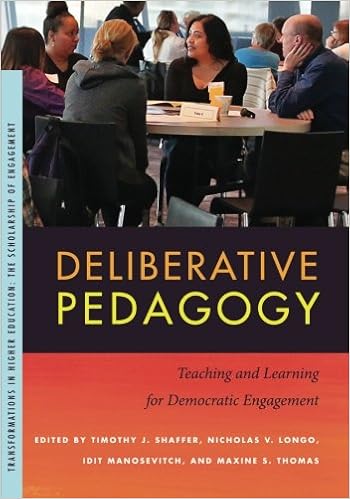
The book, Deliberative Pedagogy: Teaching and Learning for Democratic Engagement was edited by Timothy Shaffer, Nicholas Longo, Idit Manosevitch, and Maxine Thomas. This volume is written for faculty members and academic professionals involved in curricular, co-curricular, and community settings, as well as administrators who seek to support faculty, staff, and students in such efforts. The authors build upon contemporary research on participatory approaches to teaching and learning while simultaneously offering a robust introduction to the theory and practice of deliberative pedagogy as a new educational model for civic life. The book is available on AmazonSmile here and remember when you shop AmazonSmile, they will donate to NCDD on your behalf when you select for donations to go to “The National Coalition for Dialogue & Deliberation, Inc”!

National Civic League released their All-America Conversations Toolkit. All-America Conversations are designed to help cities and other groups understand residents’ aspirations for the community, the divisions facing the community and, most importantly, the small, specific actions that give people a sense of confidence that we can work across dividing lines. The toolkit can be found at: www.nationalcivicleague.org/all-america-conversations/.

We hope you will check out these great resources as part of your summer reading! We’re always impressed with the rich content coming from the D&D community.

Did we miss something? Let us know in the comments what other resources, reports, books, articles, etc. you are reading this summer, or anything you have published recently!


Upcoming Florida Council for the Social Studies Annual Conference

The Florida Council for the Social Studies (FCSS) would like to invite you and your colleagues and friends to attend the 60th Annual FCSS Conference at Innisbrook Resort in Palm Harbor, Florida on October 20 – 22, 2017. You can register for the conference here. 

This is going to be an excellent conference with some great sessions.

Conf Update 1

The Preconference sessions will, no doubt, be really good, and you are encouraged to sign up early for what we expect will be a well-attended series of events!

precons

You can register for the conference here. We look forward to seeing you in October!


civics road trip: from Philadelphia to Ukraine

I’m in Philadelphia for the Action Civics Initiative Summer Convening, a gathering of students, educators, and NGO leaders who are working to make civic education more action-oriented. From the closing plenary tomorrow, I’m heading to Ukraine to participate in the third annual European Institute of Civic Studies, this year at the Chernivtsi National University. The Institute draws practitioners, scholars, and activists involved with strengthening democracy in Ukraine and its neighbors. On my way home, I’ll stop in Kiev to talk with civic educators who work at the high-school level.

I predict some consistent themes (polarized societies, fragile democratic norms, inequalities of power and agency) as well as some important differences. I plan to blog periodically as I travel, or at least on my return.

See also: action civics goes mainstream and gets controversiallessons from a large youth service program, creating good citizens, and the European Summer Institute of Civic Studies.

Recap from Frontiers of Democracy 2017

Outgoing NCDD Youth Engagement Coordinator Roshan Bliss attended this year’s Frontiers of Democracy Conference hosted by the Jonathan M. Tisch College of Civic Life at Tufts University in the Boston area. The conference was held from June 22-24 and focused on the theme, Deliberative Democracy in an Era of Rising Authoritarianism.

Around 150 of D&D scholars, practitioners, and leaders participated in workshops, discussions, and plenaries focused on the question of what the rising leaders who appear opposed to democracy around the world means for the field of dialogue, deliberation, and public engagement, and most importantly, how we should respond. The full schedule for Frontiers 2017 is still available to check out here with detailed information on plenaries, speakers, and break out sessions.

NCDDers were prominently featured in the gathering’s schedule, including NCDD Board member Wendy Willis of Deliberative Democracy Consortium, who gave opening remarks on the effect of loneliness on civic life. Roshan presented a workshop on Saturday afternoon with several individuals, including Shari Davis of the Participatory Budgeting Project – a NCDD member org, on the promise and potential of seeing student governments as key venues in which to grow and spread deliberative democracy. Organizational NCDD member Ashley Trim of the Davenport Institute challenged our field to be more genuinely open to conservatives and you can read her poignant talk on Healthy Democracy’s site here. The gathering ended with a challenge from Dr. Archon Fung for our field to rethink the role of power in the work of dialogue & deliberative democracy and to deeply consider that we may not change much without engaging in real ways with efforts to build and wield it.

We wanted to lift up the post-conference reflection piece from Peter Levine, where he explores the direct and indirect paths to deliberative democracy and the future of dialogue and deliberation work. He wrote:

“My main point is that we must consider the choice between direct and indirect paths to deliberative democracy, taking due account of the institutions, incentives, power structures, and social divisions that actually exist in our society.

For what it’s worth, my own view would be that it’s important to build and sustain a movement devoted to explicit work on dialogue and deliberation. Deliberative experiments yield knowledge of group processes, generate models that can be inspiring, and produce a cadre of professionals whose well-deserved reputations for skillful neutrality make them useful at opportune moments.”

For more information on the Frontiers conference, check out the info from Tisch below or on their website here. You can also look through the #demfront hashtag on twitter or this great Storify page that Joshua Miller created of the #demfront hashtag which you can see here.


Frontiers 2017 via Tisch

Thanks to everyone who joined us at an exciting, thought-provoking, and timely Frontiers of Democracy 2017. You can watch video of this year’s introduction, “short take” speakers, and one of our afternoon plenaries, below. (Click on each video’s description for timestamps that allow you to skip to a specific speaker’s presentation.)

Frontiers 2017 was focused on multiple frameworks for civic and democratic work developed respectively by Caesar McDowell of the Interaction Institute for Social Change and MIT, Archon Fung of the Harvard Kennedy School of Government, and Tisch College’s Peter Levine. Our short take speakers included Rev. Dr. F. Willis Johnson, the senior minister of Wellspring Church in Ferguson, Missouri; Wendy Willis of the Deliberative Democracy Consortium and the National Policy Consensus Center; and Hardy Merriman, President of the International Center on Nonviolent Conflict.

In addition, the Journal of Public Deliberation, the Deliberative Democracy Consortium, and The Democracy Imperative held a pre-conference symposium on “Deliberative Democracy in an Era of Rising Authoritarianism.”

More about Frontiers of Democracy
Frontiers of Democracy is an annual conference hosted by the Jonathan M. Tisch College of Civic Life at Tufts University. The event is organized in collaboration with several partners, which in 2017 included Carnegie Mellon’s Entertainment Technology Center and the Deliberative Democracy Consortium.

Now more than ever, the frontiers of democracy are threatened around the world. Leaders and movements that have popular support—yet are charged with being undemocratic, xenophobic, and illiberal—are influential or dominant in many countries. Meanwhile, many peoples continue to face deep and sustained repression. Social movements and networks are confronting this global turn to authoritarianism. This conference brings together scholars and practitioners from  do to defend and expand the frontiers of democracy.

Frontiers of Democracy immediately follows the Summer Institute of Civic Studies, a 2-week seminar for scholars, practitioners, and advanced graduate students.

Land of Plenty: How Should We Ensure that People Have the Food They Need? (NIFI Issue Guide)

The 25-page issue guide, Land of Plenty: How Should We Ensure that People Have the Food They Need?, was published June 2017 from National Issues Forums Institute and Kettering Foundation.. The issue guide offers participants three options to use during deliberation on how to address the inequities within the current food system and how to create a world where all people have the food they need to thrive. The issue guide is available to download for free on NIFI’s site here, where you can also find a post-forum questionnaire.

From NIFI…

All of us affect, and are affected by, the food system: students who grow and eat carrots and tomatoes from their school garden; farm owners who maintain patches of natural habitat for bees; immigrants who hand-pick our apples, grapes, and oranges; public employees who design food-nutrition labels and monitor food safety; restaurant workers who take our orders and serve our meals; food reporters who write about ethnic cuisine; local groups of gleaners who keep edible food out of the dumpster and put it to good use; food pantries that teach teenagers to garden on vacant lots; parents who work to stretch their food budgets to the next payday; policymakers who determine agricultural subsidies; community members who advocate for policies to ensure that all of us have the food we need.

While we have one of the most productive and efficient food systems in the world, millions of people in the US still fall between the cracks. People who may have enough to eat today worry about the availability and quality of food for future generations.

This guide explores different approaches and actions that are, or could be, taken to create a food system that works for all of us. While the approaches overlap in some respects, they do suggest different priorities and involve different trade-offs. With this in mind, what should we do to ensure that people from all walks of life have the food they need?

This issue guide placemat presents three options for deliberation:

Option 1: Improve Access to Nutritious Food
Despite our nation’s abundance of food, some people still don’t have enough to eat, which undermines their health, productivity, and overall well-being. According to this option, we need a food system that ensures everyone has a stable source of affordable, nutritious food. We must strengthen our school nutrition programs and food assistance for low-income families, as well as improve access to fresh food in rural and low-income communities.

Option 2: Pay More Attention to the Multiple Benefits of Food
We have drifted away from traditions and principles that once helped us enjoy a healthier relationship to food, according to this option. We all need to be better informed about the foods we choose, their nutritional value, and how they’re produced and processed. Rather than allowing food advertisements to determine our choices, we need to pay closer attention to what we value about our food, traditions, and well-being.

Option 3: Be Good Stewards of the Food System
We are not managing our food system as well as we should, according to this option. We must do more to safeguard the quality and availability of food for generations to come. Good stewardship is needed at every link in the food-supply chain, from the seeds we plant to the reduction of food waste. It also includes preserving our natural resources, choosing sustainable methods of production, and strengthening the food-system workforce.

Preview the starter video above. Like what you see? Press the ‘BUY’ button in the upper right hand corner of the video. Your purchase includes UNLIMITED streaming and downloads of this starter video.

NIF-Logo2014About NIFI Issue Guides
NIFI’s Issue Guides introduce participants to several choices or approaches to consider. Rather than conforming to any single public proposal, each choice reflects widely held concerns and principles. Panels of experts review manuscripts to make sure the choices are presented accurately and fairly. By intention, Issue Guides do not identify individuals or organizations with partisan labels, such as Democratic, Republican, conservative, or liberal. The goal is to present ideas in a fresh way that encourages readers to judge them on their merit.

Follow on Twitter: @NIForums

Resource Link: www.nifi.org/en/issue-guide/land-of-plenty

The “Repúblicas” of Coimbra

Definition, problems and Purpose The “ Repúblicas” (republics) of Coimbra are students’ community houses, whose history dates back to the origins of Portuguese university, in the XIV century. They are spaces of living and conviviality with a specific culture, generated by a centuries-long tradition. The republics are the most ancient...