Register for Tomorrow’s NCDD Confab on Community-Police Relations with PCRC!

We wanted to remind everyone to register for the next NCDD Confab Call on community-police relations taking place tomorrow Tuesday December 19th from 1:00-2:30pm Eastern/10:00-11:30am Pacific. This FREE call will feature the Peninsula Conflict Resolution Center, an NCDD Organizational Member who will share with us their experience with community-police relations work in San Mateo County, California.

We will be joined by PCRC Executive Director Michelle Vilchez and Engaging Communities Initiative Director Malissa Netane on the call, who will share the story of their work, and the lessons they have learned. Be sure to register for this call to learn more!

From PCRC:

Silicon Valley is one of the most unique, diverse, exciting, and enlivening regions on earth, with seemingly abundant opportunities for achieving a high quality of life. Despite these unique characteristics, there are stark social and economic divides among us that sometimes lead to interpersonal misunderstandings and feelings of disconnectedness and disenfranchisement.

Many recent events across our nation involving racial tensions between communities of color and law enforcement (Baton Rouge, Minneapolis, Dallas, and others) and the associated uncivil manner of discourse appear to be amplifying ideological and political differences, making this an uneasy time in our community and nation. In this region, we are extremely fortunate that we have not experienced such extreme incidents, yet we should never consider ourselves immune. Such tragedies, no matter how geographically distant, affect us all at some level, and our thoughts, reactions and emotions come with us when we go to school, or work, or out in the community.

For the past 20 plus years, PCRC has drawn from their foundation of mediation, training, facilitation and conflict coaching to bridge the divides between many different communities and law enforcement agencies. The success of this work depends on building and sustaining respectful and mutually beneficial working relationships among all of the participating partners, which is PCRC’s area of expertise. The vision of PCRC is a future where all members of society engage and collaborate to create a strong, vibrant community. Our mission is to partner with individuals, groups and institutions to empower people, build relationships, and reduce violence through collaborative and innovative processes.

PCRC has over 30 years of providing conflict resolution, mediation, violence prevention and community building services. By engaging in authentic dialogue, building capacity through leadership development, and focusing on action that lends itself to personal and collective transformation, the targeted five communities will have stronger relations inside the community and with other groups and institutions.

Time is running out! So make sure you register to join this exciting call!

About NCDD’s Confab Calls

Confab bubble imageNCDD’s Confab Calls are opportunities for members (and potential members) of NCDD to talk with and hear from innovators in our field about the work they’re doing and to connect with fellow members around shared interests. Membership in NCDD is encouraged but not required for participation. Confabs are free and open to all. Register today if you’d like to join us!

Moana, Complacency, and the Enduring Appeal of Steady-State Economics

Even a cursory reading of Disney’s Moana suggests that it is built around a not-so-Straussian story of complacency and risk-taking. (Now try listening to it on repeat for a year because your four year-old loves it, and it starts to take on, like, layers, man.) Moana’s island is both a rich source of happy subsistence and under threat from a mythological enemy that seems like a clear metaphor for overfishing. Thus she constantly struggles with a desire for exploration that she feels duty-bound to discipline, and yet her failure to be dutiful is ultimately the salvation of her people as she learns to navigate the dangerous oceans beyond the safe harbor of the island.

You can find happiness right where you are

Like many Disney films, the ordinary storyline tells the fantasy story in reverse: in the ordinary A-story we see a culture suffering from stagnation and accepting the need for new discoveries and risks. In the supernatural B-story we see that the trickster god’s risk-taking is to blame for misfortune, and human piety is required to achieve a mythical overcoming of divine vengeance and the rejection of creativity and innovation in the name of divine–but soporific!–fecundity.

In the A-story, a group of Pacific Islanders end their nomadic wayfaring to settle in a reef-protected idyll that promises them a flourishing steady state. They develop traditions and rituals that ensure stability with minimal growth, which includes communal ownership of the means of subsistence, as well as rites of cultural passage that refuse innovation:

“Who needs a new song? This old one’s all we need.”

Yet this steady state is itself the result of great innovations: for instance, the villagers of Motunui have discovered uses for every part of the coconut tree and the taro root. And one of those innovations–fishing nets from the coir fibers of the coconut–threatens to deplete their local fishing stock. Over a long enough period the island has become unsustainable, slowly growing beyond its own carrying capacity. Yet the current chief, Moana’s father Tui, can’t see the need to return to their wayfaring traditions because he was traumatized as a child by going beyond the reef with a friend, who died in the unprotected waters. Moana’s rebelliousness thus finally meets with her  obligations as the future chief, and so she ventures out beyond the reef on her own to learn Pacific Ocean navigation techniques.

The B-story stars the trickster god Maui, who once stole the heart of a maternal creator god, Te Fititi, in order to grant her life-giving powers to humanity in the form of divine creativity and innovation. The care-giving Te Fititi is thus transformed into the vengeful volcano god Te Ka, who–thousands of years later–is blamed for the shortages on the island of Motunui. The B-story resolves when the heart of Te Fititi–the power of creativity–is returned to Te Ka by Moana, and Te Ka’s desire for vengeance is sated: restored as Te Fititi she becomes so complacent she literally returns to sleep. Here it is the desire for risk-taking and innovation that causes trouble, and the supernatural resolution comes from eschewing novelty for tradition.

Moana’s first encounter with Maui depicts him as coasting on the laurels of his earliest accomplishments (creating the sky, sun, and wind; inventing or discovering coconuts; stealing humanity fire like Prometheus) while trapped in a cave. Moana doesn’t appreciate these ancient achievements and demands that Maui return the heart of Te Fititi, launching a few picaresque adventures. Maui eventually teaches Moana wayfinding for the A-story, but along the way, Moana and Maui go to the realm of monsters to steal Maui’s magic shapeshifting hook from a giant crab named Tamatoa, another figure of complacency, who has mastered the art of fish attraction so completely he doesn’t need to do any work to feed, they just pour right into his mouth.

The stories thus resolve with the sacrifice of cosmological creativity in the name of mundane risk-taking: the volcano/nature goddess goes back to sleep, making it safe for the islanders to take moderate risks to navigate to new islands. The Motunuians political economy is shown its way to a new equilibrium steady state, nomadically moving from island to island in order to avoid depleting the resources of a single place.

Complacency, Stagnation, and the Duty to Grow

In a recent triptych of books, Tyler Cowen has been exploring a kind of generic theory of political economy that appeals to me. In The Great Stagnation (recall), Cowen argued that many of our recent economic woes were due to discovering that much recent growth had been illusory. In Average is Over, he argued that current long-run trends are all pushing towards increasing inequality. And in his most recent book, The Complacent Class, he spins the story of decreasing innovation and increasing concentrations of wealth as related: too few comfortable people are taking the risks that would lead to the next big economic (or political) revolution which would be disruptive enough to lead to major increases of overall wellbeing. (In a sense this is really a tetraptych because his free ebook of meta-ethics, Stubborn Attachmentsargues along the same lines that we have serious obligations to future generations to continue innovating.)

So: Cowen thinks most of our biggest economic problems are due to a lack of growth and invention. That’s not to say that the pace of novelties is decreasing, but just that few of these novelties are truly innovative in ways that would substantially change the quality of our lives. Computers seem like a big deal, but they haven’t been that big. They haven’t fundamentally changed the way our lives work as much as, say, the washing machine did. Norman Borlaug won the Nobel Peace Prize for saving a billion people from starvation. Mark Zuckerberg just gave billions of people a distracting website where we can fight about politics and look at cute animal pictures. If someone masters self-driving cars and trucks, maybe that will be the kind of disruptive, physical economy shift Cowen says we are morally obligated to pursue.

But we’re complacent, see? We don’t take those kinds of risks anymore. We make off-color Twitter jokes, or rap musicals about the founding fathers, when we should be moving mountains. Elon Musk is a genius, and a weirdo, and a comic book villain, because that’s what it takes to start a new car company, send rocketships to space, and redesign the electrical grid around solar power. The rest of us don’t do that kind of thing because we don’t like risks. We don’t even move out of town for new jobs as much as we used to do.

If you buy Cowen’s argument in Stubborn Attachments then we actually have a kind of limited obligation to try to innovate, because compounding innovations are what will make the future better off than the present. (In philosophy we talk about this as the “intergenerational justice” question, or under the heading of John Rawls’ discussion of the “just savings principle.”) We are ourselves massive beneficiaries of past generations’ efforts to store up for their posterity the technological and artistic achievements of their own and previous epochs. We owe the future the same.

Cowen even bites the bullet in arguing that we should be wary of making prioritarian investments in the poorest or most needy members of the current generation if they come at the expense of slowed discovery and invention. (Often these goals are not at odds, but when they are….) But he’s clear that the bourgeoisie are the real problem, insofar as we bask in our current quite high standards of living without taking the risks that could lead to greater growth. For the most part, then, Cowen’s target is not the poor but the well-off.

The Steady-State Economy

Whenever I teach environmental policy or ethics courses, we spend some time with arguments like that of William Ophuls or Herman Daly or Wendell Berry. I’ve probably taught Garrett Hardin’s “Tragedy of the Commons” essay once or twice a year for more than a decade. There’s even a utopian novel, Ecotopia, depicting a California that has seceded and voluntarily created a non-growth economy (with a dash of hippy free love that eventually sways the uptight unreliable narrator.) The gist of the arguments all boil down to this: perpetual physical growth is impossible on a finite planet. Too many humans, living too good a life, will eventually exceed the carrying capacity of the Earth. Or perhaps even worse: we’re already there! Life as the American middle class is unsustainable and will lead to our destruction.

So we need to either find our way to new planets or learn to live within the planet’s means. And given the near-impossibility of terraforming within our solar system, we might as well get used to the idea that economic growth cannot continue forever *now* and work to arrest it. The parts of our political economy that are addicted to growth need to be reined in, and that’s most of them. Apparently we need more farmers and fewer philosophers; more plumbers and fewer petroleum engineers.

Depictions of the steady state economy usually emphasize more egalitarian and communal cultural mechanisms. But my sense is that steady states usually depend on strict deference for authority and a lack of disruptive mobility. Abilities vary, but roles are assigned (as Moana’s is) by birth. What marks out stable societies is a clearer connection between cultural prestige, political power, and economic privilege. I think that’s part of the appeal that steady state political economy holds for cultural elites in particular; a community where our mastery of the seminar room will be rewarded with attendant power and wealth, and we won’t have to defer to stockbrokers who got rich by taking big risks with other people’s money. (I always associate this critique with Lynn Sanders’ “Against Deliberation” but there are other sources for this insight, including Karl Marx himself.)

The problem is that infinite growth does look impossible on a finite planet. Certainly we can sustain a little more growth, at least for a while. But the obligation to future generations may be to waste less electricity on Bitcoin mining and spend more time fighting for adequate policy responses to climate change! While Cowen might not disagree with those priorities, he certainly doesn’t seem to think that growth (understood as innovations and discoveries and cultural production) is limited. We’re not getting closer to any recognizable ceilings, for the simple reason that there are still diseases to be cured, technologies to be invented, and novels to be written. Even the rap musical about America’s first Treasury Secretary is still unfinished!

This is how I think about the error of the steady-staters: that they assume the old model of growth, where production and consumption occur primarily in terms of linear increases in resource use. This is what we measure, kind of, with GDP. But some kinds of innovation and invention are different: they create lots of value for lots of people without really costing a lot. A pill saves a life, and it only costs fifty cents to make; the pharmaceutical company will register some of those gains as profits contributing to GDP, but then the patent will expire, and it’ll SEEM like stagnation. But in fact, it’s a permanent increase in our shared wealth. More people live, but they live for cheap. (There are ways that this is supposed to be captured by the surviving worker’s productivity and the fall in drug prices is supposed to impact inflation measures, but it’s imprecise.) Growth is a misnomer: creating new things and ideas and experiences is the good bit. And there’s no reason to stop.

Aue aue
We are explorers reading every sign
We tell the stories of our elders in a never-ending chain

Aue aue
Te fenua, te mālie
Nā heko hakilia
We know the way

Introducing Kid Citizen, a New Engaging Civics Resource for K-5 Learners


KC
Good afternoon, civics friends. As you know, the Florida Joint Center for Citizenship has a great many resources for elementary civics, including our Civics in a Snap lessons.  There are, of course, other great resources available for elementary civic education as well, and I am excited to share with you one that could be simply fantastic in helping that youngest generation of students understand civic life. That resource is Kid Citizen. Our own Michael Berson, professor of Social Science Education at the University of Central Florida and a fellow here with FJCC and the Lou Frey Institute, has been heavily involved in the development of Kid Citizen, and he shares with us this overview of the program.

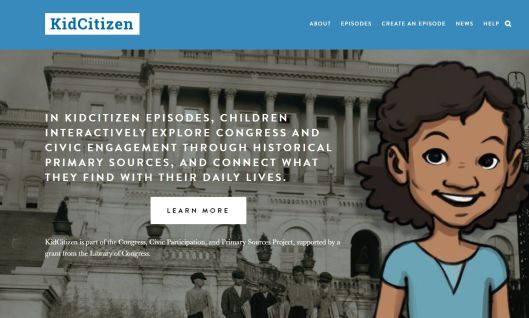
KidCitizen introduces a new way for young students (K-5) to engage with history through primary sources. In KidCitizen episodes, children interactively explore Congress and civic engagement through historical primary resources, and connect what they find with their daily lives.

KidCitizen episodes capitalize on the active and social nature of young children’s learning. They use primary sources for rich demonstrations, interactions, and models of literacy in the course of innovative hands-on activities that make academic content meaningful, build on prior experiences, and foster visual literacy and historical inquiry.

KidCitizen also includes cloud software tools that let educators create their own episodes and share them with students. Using KidCitizen tools, educators can create activities using primary source photographs that are especially relevant to their students and community. The KidCitizen tools runs on the Muzzy Lane Author platform.

KidCitizen episodes run on PCs, Macs, and iOS and Android mobile devices. The episodes can be accessed from the KidCitizen website http://www.kidcitizen.net . All are free to play, and a teacher’s guide accompanies each episode. KidCitizen is part of the Congress, Civic Participation, and Primary Sources Project, and is supported by a grant from the Library of Congress.

You will definitely want to check out this new resource. I look forward to sharing this with my own future citizen’s teachers!

why study social justice?

I just finished teaching a philosophy course in which the primary question was “How should I live?” We spent some time reading and thinking about personal and internal questions, such as what constitutes happiness and truthfulness and whether those are possible and desirable states. We also talked about political justice, reading a fairly standard canon of Mill, Rawls, Nozick, and Scanlon, plus Bayard Rustin, Kwasi Wiredu, Emmanuel Chukwudi Eze, Steve Biko, Audre Lorde, and Susan Bickford. The premise of those readings was that it might be important to know what justice is when choosing how to live a good life.

Meanwhile, my students were introspecting about the principles that guide their lives and how those principles are organized into networks of moral ideas.

The students, as they recognize, emphasize attitudes toward concrete other people in their lives plus values related to learning: empathy, openness, and hard work. The kinds of ideals that figure in political theory–liberty, equality, welfare, and democracy–are mostly absent or marginal from their maps of their own animating ideals.

They offered several explanations for this gap between what I’d assigned and what they perceived when they looked inward. Some thought it was evidence of their own privilege: they don’t have to think about freedom because they take it for granted. (For the same reason, they don’t list “having enough to eat” as a guiding principle.) Others thought their introspective maps were developmentally appropriate: their job right now is to learn and revise their views, not to hold onto principles. Some were skeptical about the validity of any abstract principles of justice. And some thought that their own views reflected political discouragement or disenfranchisement at a hard time in our history. They don’t strive directly for democracy because they don’t believe that they can.

The question arises, Why should we study and conduct research on justice? Why should justice be part of any curriculum, and specifically a curriculum whose leading question is about the good life for the individual students?

I think my colleagues in academia (writ large) would divide on that question.

For some academics, justice seems irrelevant to their professional work or is a mere matter of opinion. “Who decides what’s good or bad?” is a frequent question. It suggests that we scholars and students shouldn’t try to define justice and defend our stances in academic contexts, publications and classrooms. The most we should do is to study and explain why various populations define justice in various ways.

For some academics, commitment to justice is measured by the degree of one’s distaste for the prevailing political and economic system. The way to assess whether a colleague is oriented to justice is to see how strongly she or he opposes the status quo. One way to demonstrate such opposition is to study various concrete forms of injustice. Thus justice-oriented scholars are those who investigate and teach situations that should be abhorred.

By this standard, my curriculum would be deficient, since we did not go deeply into the empirical facts about poverty, racism, or tyranny. Moreover, we read authors chosen for their divergent views. By the time you see that Hayek and Nozick would like less government than we have, and Rawls and Scanlon would like more, you could perhaps conclude that we have about the right amount of government. I’m not saying that splitting the difference would be valid logic, but the question is whether ideological diversity might have the psychological effect of making students confused or complacent.

I belong to a third category of academics, for whom being seriously concerned with justice means asking what it is and what we can do to promote it. Both parts of that question are topics for research. One can study what justice is by critically investigating the available theories and their relationship to concrete facts. One can also study strategies and tactics for promoting justice. Those two topics intersect, because a goal without any plausible strategy is not much of a goal; and a strategy without a defensible account of its purpose is not worth undertaking. I criticize what’s called “ideal theory” in political philosophy because its focus on end states–without serious consideration of strategy–yields misleading results.

Speaking of privilege, I am privileged to move across communities with quite different ideological centers. One day recently, I was at a conference where libertarian economists were well represented and may have predominated. A speaker showed a photo of FDR and said something like, “Since we’re all classical liberals, I can count on you to hate this guy.” I suspect the speaker overestimated the ideological uniformity of his audience; I may have had some company in deeply admiring Franklin D. Roosevelt. But it was certainly a different context from the Tufts classroom where, on the very next day, we discussed this fascinating exchange between Hillary Clinton and Black Lives Matter activist Julius Jones about how to diagnose and address racial injustice in America. The center of gravity in that room lay somewhere between Clinton and Jones, with only one student openly asking whether the assumption that those two people share–that America is deeply racist–is a given.

The disadvantage of posing the question “what is justice?” in a truly open way is that one can discourage action. For instance, I think that the pending tax bill is awful, but I also have questions about some arguments against it. There’s a strong equity-based argument for curtailing the charitable tax deduction, and there’s even a case that the Republicans have generated new federal revenues while passing a deeply unpopular tax cut for the upper stratum, which is likely to be repealed. The net result, as early as 2019, may be a larger stream of revenue than would have had been possible without this bill. But making such critical points (if anyone paid attention) could dampen enthusiasm for the opposition, and there’s a plausible case that the tax bill is on its way to passage because of relatively weak popular opposition. I wouldn’t want to undermine anyone’s motivation to protest by posing awkward questions.

The advantage, of course, is learning. I feel challenged and enriched by the conference at which libertarians were well represented. I think I understand better the relative advantages and disadvantages of three ways of understanding what works in the real world: talking with people, conducting scientific research on impact, and observing price signals. The last category is valuable for reasons that you won’t notice if you hang around all the time with lefties.

In the end, we need both commitment and critical analysis, both true openness to alternative views and effective, coordinated action. We need utopian vistas and hard-nosed tactics. The balance is very hard, but there must be at least a place for abstract and dispassionate inquiry into the nature of justice.

[See also: social justice should not be a clichéwe are for social justice, but what is it?a method of mapping moral commitments as networks.]

Submit Your Nominations for 2018 Brown Democracy Medal

It’s that time again! The McCourtney Institute for Democracy – an NCDD member org, is now accepting nominations for the 2018 Laurence and Lynne Brown Democracy Medal. For the fifth year running, this medal celebrates those working to advance democracy. The winner will be awarded $5,000, have their work published, and will present at Penn State in the fall of 2018. Nominations must be submitted by January 8th, 2018! We encourage those in the NCDD network to apply, and check out the details in the post below or you can find the original here.


Call for Nominations for the 2018 Brown Democracy Medal

The McCourtney Institute for Democracy at Penn State is accepting nominations for the 2018 Brown Democracy Medal. The Medal and $5,000 are awarded annually to individuals or organizations doing the best new work to advance democracy in the United States and around the globe. The Brown Medal recognizes recent work that is significant but under-appreciated. The medal helps bring new ideas and innovations the public recognition they deserve.

Award Review Process

The award is open to any significant contribution in democratic research, reform, practice, or theory. All nominations will be considered according to the review criteria set out below.

Nominations for the 2018 medal will be accepted through January 8, 2018.

The winner will give a talk at Penn State in fall of 2018, when they will receive their award. Between the spring announcement of the winner and the on-campus event in the fall, the Institute will provide the recipient with professional editorial assistance toward completing a short (20-25 page) essay describing the innovation for a general audience. In the fall, Cornell University Press will publish the essay, which will be available at a very low price to aid the diffusion of the winning innovation. Essays from the previous winners are available through Cornell University Press and other online outlets.

To assure full consideration, please send all nomination letters before January 8, 2018 to democracyinst@psu.edu. Initial nomination letters are simply that, a one-to-two page letter that describes how the nominee’s work meets the criteria for this award and what distinguishes it from other work on democracy. Both self-nominations and nominations of others are welcomed. In either case, email, phone, and postal contact information for the nominee must be included.

A distinguished review panel will screen initial nominations and select a subset of nominees for the second round. Those nominees will be required to provide further documentation, including: a brief biographical sketch of the individual or organization nominated; two letters of support; and a basic description of the innovation and its efficacy. The review panel will scrutinize the more detailed applications and select an awardee in the spring of 2018.

Review Criteria

The democratic innovation selected will score highest on these features:

  1. Novelty. The innovation is precisely that—a genuinely new way of thinking about democracy or practicing it. The award is thus intended to recognize recent accomplishments, which have occurred during the previous five years. The innovation will likely build on or draw on past ideas and practices, but its novelty must be obvious.
  2. Systemic Change. The idea, theory, or practical reform should represent significant change in how we think about and practice democracy. Ideas should be of the highest clarity and quality, empirical studies should be rigorous and grounded in evidence, and practical reforms must have proof of their effectiveness. The change the innovation brings about should be able to alter the larger functioning of a democratic system over a long time frame.
  3. Potential for Diffusion. The idea or reform should have general applicability across many different scales and cultural contexts. In other words, it should be relevant to people who aspire to democracy in many parts of the world and/or in many different social or political settings.
  4. Democratic Quality. In practical terms, while the nominees themselves may well be partisan, the spirit of this innovation must be nonpartisan and advance the most essential qualities of democracy, such as broad social inclusion, deliberativeness, political equality, and effective self-governance.

Individuals or organizations who are Penn State alumni or employees, or who have worked closely with the Institute, are not eligible. Returning applicants may notice that our process has changed from previous years, when awards alternated between democratic theory and practical innovation.

Questions and Further Information

Any questions or requests for more information should be sent to .
The McCourtney Institute for Democracy at Penn State (http://democracyinstitute.la.psu.edu) promotes rigorous scholarship and practical innovations to advance the democratic process in the United States and abroad.

Letter from the NCDD Board of Directors

Dear NCDD Supporter,

With so many crucial and important issues facing society today – from health crises, to disconnection, to mass shootings, to nuclear threats – even if we could talk about these issues together, it would be a deadly serious time….

But, of course, we can’t even do that some days.

XS Purple NCDD logo

As you know, the National Coalition of Dialogue & Deliberation (NCDD) is a gathering place for people who know it doesn’t have to be this way – and who are doing something concrete about it. While so many others fret and philosophize about the current polarization and hyper-partisanship, this organization and its members offer practical answers that have been shown to make exactly the difference this country needs.

In the very moment this country could benefit the most from the collective skill set of this community of “domestic peacekeepers” (NCDD member Joan Blades, Living Room Conversations), however, most people remain caught up in the rhetoric of the “professional polarizers” (NCDD member Liz Joyner, Village Square).

We believe it’s time for that to change. It’s time to raise the profile of the work of our network in a way that far more Americans know about it. The Board and NCDD staff have been discussing a number of ways to do just that over the next several years:

  • Collaborative efforts to lift up the stories of NCDD members and the communities they work with making these changes. Highlight that this work happens at every level – neighborhood, local, regional, state, national, and global; in public and private sectors.
  • Bringing this network together with journalists, social justice organizations and activists, government officials, and others whose work and goals can be enhanced by better public engagement, dialogue and deliberation.
  • Fostering partnerships between NCDD members, libraries, and other community institutions to expand the public’s access to D&D.

But everything takes resources. What we can do will depend on having sufficient resources to do it. If you believe it is time for these kinds of changes in our country, please consider making a donation to these efforts – so we can get what we offer as a community in front of more and more Americans.

All contributions are welcome, whether they are $10 or $1000. Please visit www.ncdd.org/2017-funddrive to make your tax deductible donation today! Or, consider joining or renewing your membership in NCDD. You will be helping NCDD reach our $15,000 goal, which will be such a boost to these efforts in 2018. Thank you so much for supporting NCDD.

Sincerely,

NCDD Board of Directors:

Martin Carcasson, Chair
Susan Stuart Clark
Simone Talma Flowers
Jacob Hess
Betty Knighton
Wendy Willis

Home for the Holidays: Dialogue Across Divides Among Family and Friends

Living Room Conversations released the guide, Home for the Holidays: Dialogue Across Divides Among Family and Friends, which we found Fall 2017 (original publish date unknown). The guide give excellent pointers on how to hold living room conversations with family members taking into consideration all the challenges that family can bring. You can read the guide below, find a downloadable PDF here or the original on Living Room Conversation’s site here.

From the guide…

This year we’ve been hearing from all sorts of people that they want to use Living Room Conversations skills to help heal family relationships​. People have experienced loss of or harm to treasured relationships because of politics. And now with the holidays coming up they are considering how to navigate. Does love supersede politics? For most people it does. But there is still confusion and hurt to manage. How do we do this? How can we listen to each other and hold the tension of our differences?

People have reported going home and having better conversations with relatives and friends they disagree with after having Living Room Conversations. There are skills that we get to practice in Living Room Conversations that are easy to take home. ​Some have invited relatives to join them in Living Room Conversations. Like with any Living Room Conversation you only invite people you believe will be able and willing to abide by the conversation agreements and follow the structure. People have a natural intuition about what friends and family to invite. We all know family members that aren’t good at taking turns being curious or listening with respect. We also tend to know when family is good at it, or might be, with gentle reminders of the conversation agreements

For years we’ve told people that family is one situation where we are not fully confident that Living Room Conversations will work. Why? Because family is known for breaking host and guest social norms. Because family knows each other’s triggers and because family relations often require more of us. Emotional stakes tend to be higher, conversations are colored by history and it can feel easier to take the proverbial gloves off and fight dirty, unconstrained by the politeness we give others. But in most instances, we can love our family, even when we don’t like what they believe!

We are thrilled to have more and more people doing the Relationships First and other Living Room Conversations in order to hone their relationship skills and thinking. Some people come away with a new appreciation for the power of listening or new curiosity about why people they love think the way they do or new insights about the power of a asking questions without​ ​judgement​. There are very few quick fixes in the world of relationships. Building trust and understanding takes time. This is slow and satisfying work.

INTRODUCTION
It’s no secret we sometimes disagree with families and friends. What seems secret is how to handle it when we do! At Living Room Conversations, we specialize in structuring challenging conversations so they are safe and enjoyable using our Conversation Agreements and Conversation Guides. Wouldn’t it be great if we could talk to family and friends as respectfully as people in Living Room Conversations talk to strangers? We realized it could be useful to share our Conversation Agreements more broadly for the holidays. They are good to keep in mind for kinder dinner-table conversations. True, others may not be following the Conversation Agreements but sometimes good practices can be contagious and you can have the satisfaction of feeling better about your own part in the conversation.

CONVERSATION​ ​AGREEMENTS
These are the Living Room Conversation Agreements:

  • Be curious and open to learning​. Conversation is as much about listening as it is about talking. Enjoy hearing all points of view. Maintain an attitude of exploration.
  • Show respect and suspend judgment. ​Human beings tend to judge one another; do your best not to. Setting judgments aside opens you up to learning from others and makes them feel respected and appreciated.
  • Find common ground and note differences. ​Look for common ground you can agree on and take an interest in the differing beliefs and opinions of others.
  • Be authentic and welcome that from others. ​Share what’s important to you. Speak authentically from your personal experience. Be considerate of others who are doing the same.
  • Be purposeful and to the point. ​Notice if what you are conveying is or is not pertinent to the topic at hand.
  • Own and guide the conversation. ​Take responsibility for the quality of your participation and that of the conversation. Be proactive in getting yourself and others back on track if needed.

THE​ ​BASICS
Listening is powerful. It doesn’t mean you agree. Just giving someone your full attention is a valuable gift. People rarely change their beliefs in a conversation; but people often expand understanding through conversation. Focus on learning and sharing rather than debating or convincing. To do so you can:

  • Ask thoughtful questions, inspired by whatever honest curiosity you feel
  • Try to understand, not convince or persuade
  • Share personal stories and experiences, not data points
  • Notice if there are areas of agreement.
  • Assume good intentions and extend the benefit of the doubt
  • Thoughtfully end the conversation when you are triggered or tired
  • Share appreciation for having the conversation

CORE​ ​SKILLS

  • Generous listening. Listen deeply, without an intention to respond, refute, or defend. Just listen.
  • Assume good intent. Give the person the benefit of the doubt.
  • Genuine curiosity. Show curiosity by asking questions and learning more about the person’s life experiences that have shaped their perspective.
  • Respectful engagement. Showing respect and kindness can diffuse a great deal of tension and it’s often contagious.

POTENTIAL​ ​PITFALLS

  • Insults or name-calling. Using unflattering names or making derogatory remarks about people that the other person cares about (including political leaders) are fighting words.
  • Overgeneralizing. Beware of using words like “you always” and “you never.” They are seldom true, and these words tend to feel attacking.
  • Leading questions. Steer clear of asking questions designed to “trap” the person or lead them to a pre-determined answer you want to hear.
  • Talking more than listening. It is rare to make progress on understanding a different perspective while doing the majority of the talking.
  • Facts, figures, and data-points. Few things shut down a good conversation faster than cold, hard, facts…and alternative facts! Focus on concerns and experiences rather than data.

Additional​ ​Skills​ ​to​ ​Build​ ​Connection

  • Set the stage. Establish your interest in an enjoyable, productive conversation rather than a debate or argument.
  • Listen for values and desired outcomes. Most of us have core values that overlap (health, safety, prosperity). Identifying these can help strengthen the relationship.
  • Verify and acknowledge feelings. Ask about, and seek to understand what the other person is feeling about the topic. They may have very personal experiences that shape their perspective. Be aware of these feelings and acknowledge them.
  • Use humor, if possible. Be willing to laugh at yourself when and where appropriate. Humor can lighten the mood and make the conversation enjoyable.
  • First-person language. Own your feelings and express them as “I felt ______(feeling) when you ______ (describe specific behavior and when it occurred). For example, “I felt frustrated when you said I was unrealistic this morning.”
  • Explore and reflect rather than disagree directly. For example, starting sentences with “I am wondering….” can be very productive if it is sincere.
  • Find common ground. Look for and acknowledge areas of agreement.
  • Use engaging language. See how often you can replace “but” with “and”
  • Ask open-ended questions. This allows others to think out loud and may offer a better path for understanding their perspective.
  • Keep a light tone. When judgement creeps in, your tone will give you away! If this happens, own it, apologize and ask another question. FIRST​ ​AID Families know where all the buttons are. What happens if you get triggered? Avoid responding when you know you are triggered and feel yourself being defensive and/or needing to be right. Sometimes, letting go of the conversation is the best course of action. A break for a short walk or new activity or change of subject can help restore equanimity. Try the following to change the direction of a conversation and/or mend a conversation that has turned destructive:
  • Let’s change the topic. Tell me, how is your garden (or other hobby)?
  • This is a heated conversation. Our relationship is more important to me.
  • I feel bad when we argue. Let’s stop for now.
  • I’m sorry we argued. I care about you.
  • Our relationship will always be more important to me than our differences.

OTHER​ ​CONSIDERATIONS
When we stand in self-righteous anger, i.e. “how can you believe THAT?” we find ourselves separated. Some people — including family members — would prefer to be right than to be connected.

Sometimes we see family as a reflection of ourselves. We may feel an obligation to make them see “the error of their ways.” And we may want to be clear that we are not flawed in that way, too. It can be much harder to avoid judging and remain curious with family–even when we know this is the most effective way for us to connect with them.

With family, not arguing and not pushing back can feel like a betrayal of our own beliefs. It can feel like selling out just to keep peace at the dinner table. But listening with genuine curiosity is not selling out or taking the easy road. There is deep value in taking a more respectful and curious approach. When we connect in this way mutual listening is far more possible. And remember: again and again we hear from Living Room Conversation Guide users who have friends and family with very different views that love​ ​comes​ ​first​. Let’s let it!

Some family and friends may not be ready for a thoughtful conversation and that is perfectly ok. At Living Room Conversation we choose conversation partners based upon their ability — and commitment – to abide by the conversation agreements and enjoy an exploratory conversation. At a holiday gathering you may be the only person following conversation agreements. Choosing who to engage with, in what setting, and at what level is wise. For some people listening might be the only thing you want to do with them…moving on to others where you believe some mutual curiosity and appreciation might be productive. Also, recognize that a family gathering might be a place where some topics are simply not welcome. Be gentle with yourself and others. Sometimes the simple act of breaking bread together is enough.

About Living Room Conversations
Living Room Conversations are a conversational bridge across issues that divide and separate us. They provide an easy structure for engaging in friendly yet meaningful conversation with those with whom we may not agree. These conversations increase understanding, reveal common ground, and sometimes even allow us to discuss possible solutions. No fancy event or skilled facilitator is needed.

Follow on Twitter: @LivingRoomConvo

Resource Link: www.livingroomconversations.org/home-for-the-holidays/

youth in the Alabama Senate race

CIRCLE estimates that 23% of young Alabamians voted in yesterday’s special election. Just for a rough turnout comparison, 21.5% of youth in the United States as a whole voted in the 2014 election. We would normally expect turnout to be lower in a special election with only one person on the ballot than in a national Congressional election, and also lower among Alabama youth than youth across the country because just 40% of young Alabamians have any college experience (and college is correlated with voting). Thus I would call the turnout pretty good compared to expectations.

According to the Exit Polls, youth supported Doug Jones over Roy Moore by 60% to 38%. The older vote was dramatically different, with Moore winning people over 45 pretty easily. CIRCLE suggests two interesting contributing factors. First, young Alabamians are more diverse. “More than a third of the state’s young people are Black, and … Black voters of all ages went overwhelmingly for Jones (96%) in yesterday’s race.” Second, Moore may not have “garner[ed] overwhelming support even among youth who identify as conservative or Republican.” CIRCLE has previously found that “some Republican-leaning youth break with older voters on same-sex marriage and other social issues that were central to Moore’s campaign in Alabama. In addition, CIRCLE analysis of the Pew Research Center’s Political Typology dataset finds that only 5% of young people who lean toward or belong to the Republican party are “Steadfast Conservatives” (compared to 25% of Republicans or Republican-leaners aged 30+) while 31% are “Young Outsiders” who may feel less committed to the party and its candidates.”

More detail is on the CIRCLE website.

NCDD Member Explores Creating Brave Spaces

What does it look like to create not just safe spaces for conversation, but brave spaces? NCDD member, Mary Gelinas explored this is her recent blog post, Creating Brave Spaces, which challenged if it’s possible to be both safe and uncomfortable? (Spoiler alert, it’s possible.) As we navigate a myriad of conversations, especially during this holiday season, it’s important to keep in mind the needed bravery to stay within the harder conversations. We encourage you to read the post below or find the original version here. Also, let us know in the comments section, “What ground rules do you think would help one of your meetings be a brave space?”


Creating Brave Spaces

Setting ground rules or conversation guidelines seems to be the sine qua non of meetings these days. Having ground rules can create a safe space for people to interact, but they can also interfere with authentic conversation because people conflate safety with comfort. Is it possible to be both safe and uncomfortable?

My husband and business partner Roger James and I believe it is and that it is essential to be able to be both safe and uncomfortable without reverting to self-protective behaviors. When we react to discomfort by fighting, fleeing or freezing, we do not have the conversations we need to have to solve tough problems or create the organizations and communities we want to create. It is often in exploring our differences—uncomfortable for many of us—that we deepen our understanding of one another so we can find a way forward.

What’s the difference between safety and discomfort? Earlier this month Roger provided a good example in a workshop we led during the Campus Dialogue on Race at Humboldt State University in Arcata, CA. After noting that we were married he said, “We have difficult and uncomfortable conversations but I never feel unsafe.”

To tackle tough issues, in addition to tolerating discomfort, we also need to be brave, to stay present and engaged in the face of fear and unease. It takes courage to take risks and say what might be hard for others to hear, to listen to people’s painful experiences, and to hear things that contradict our opinions and challenge deeply held beliefs about the world and us. This is especially true when the conversation involves issues of inequality, inequity, racism, sexism, or agism, i.e., topics related to power and privilege.

Two ground rules that contribute to creating safe spaces but not necessarily brave ones are:

Agree to disagree. People can use this rule to avoid or retreat from a disagreement. If we are brave enough to stay with the frisson of a conflict—not get overwhelmed by fear or anger—we will no doubt learn something new and deepen our understanding of what the disagreement is really about. More constructive ground rules are “Listen to understand, first” and “Speak the truth without blame or judgment.”

Respect. This is ubiquitous in lists of ground rules and is the least controversial or discussed. But what does it really mean? When someone proposes this, ask, “What does respect look like? What would each of us be doing and saying to follow this ground rule?” Ask for examples of how anyone could challenge or disagree with someone else in a respectful manner. There are multiple, cultural understandings of what “respect” means. Talking about it surfaces these perspectives and helps people understand one another better. It also sets the stage for a common definition of “respect” that helps create a brave space.

What ground rules do you think would help one of your meetings be a brave space?

* I am grateful to Brian Arao and Kristi Clemens whose article “From Safe Spaces to Brave Spaces: A New Way to Frame Dialogue Around Diversity and Social Justice” inspired this blog.

You can read the original version on this article at www.gelinasjames.com/creating-brave-spaces/.