ALERT: POTENTIAL CIVICS360 DOWNTIME

360

Friends, one of the most requested things that districts have asked of us when it comes to Civics360 is the ability to integrate it into Single Sign On within a district level LMS. In order for us to test this capability, we must see how the ‘live’ site works. While we do NOT expect there to be any problems at all, or expect any interruption in service with the Civics360 platform, please be aware that there MAY be periods of unavoidable downtime as we test and troubleshoot integration with Classlink. We will strive to ensure that this downtime is as limited as possible. We apologize for any inconvenience this may cause.

Advertisements

Habitat Conservation Planning in the U.S.

Author: 
Habitat Conservation Planning is a process in the United States allowing nonfederal parties to obtain permits for the incidental taking of threatened and endangered species. HCPs are prepared according to the Endangered Species act to calculate the anticipated ecological effects of the proposed permit.

MetroQuest Webinar on Finding Common Ground, Feb. 28th

Coming up at the end of February, NCDD member org MetroQuest will be hosting the webinar, How to Design Public Engagement to Find Common Ground; co-sponsored by NCDD, IAP2, and the American Planning Association (APA).  This webinar will be an opportunity to learn more on how to design public engagement efforts that uplift the common ground amongst the community and create solutions that demonstrate these shared ideals. You can read the announcement below or find the original on MetroQuest’s site here.


MetroQuest Webinar: How to Design Public Engagement to Find Common Ground

A 5-star recipe for public engagement – how to find common desires and build a winning plan!

Wednesday, February 28th
11 am Pacific | 12 pm Mountain | 1 pm Central | 2 pm Eastern (1 hour)
Educational Credit Available (CM APA AICP)
Complimentary (FREE)

REGISTER HERE

When it comes to urban and transportation planning, motivated groups with competing demands often emerge in community outreach efforts. On February 28th, learn how online community engagement can help find common ground to build a plan citizens will support.

Mark Evans from BartonPartners and Mary Young with the Town of Westport will share their success in engaging the public to inform the Saugatuck Transit Oriented Design Master Plan. Find out how online engagement provided a fun and safe way for citizens to provide input without fear of reprisal from local insurgent groups. The result? A master plan that meets the common desires of the local community.

Register for this complimentary 1-hour live webinar to learn how to …

  • Create a public engagement process to find common goals
  • Ensure privacy in the process to uncover the true priorities
  • Optimize citizen engagement to go beyond motivated groups
  • Collect informed, constructive input from all demographics
  • Find the balance between livability, character, and transportation
  • Gain transparency with actionable data to support your plan

You can find the original version of this announcement on MetroQuest’s site at http://go.metroquest.com/Westport-City-Plan-Barton-Partners

Sicurezza e sviluppo per l’area Fontivegge e Bellocchio di Perugia [Security and development for Fontivegge and Bellocchio areas in Perugia]

“Sicurezza e sviluppo per Fontivegge e Bellocchio” è il progetto integrato di riqualificazione e rigenerazione urbana concernente interventi di tipo urbanistico, architettonico, sociale ed economico destinato all’area della stazione ferroviaria di Fontivegge (e dei quartieri immediatamente limitrofi). Si tratta di un progetto che l’Amministrazione Comunale di Perugia ha posto al...

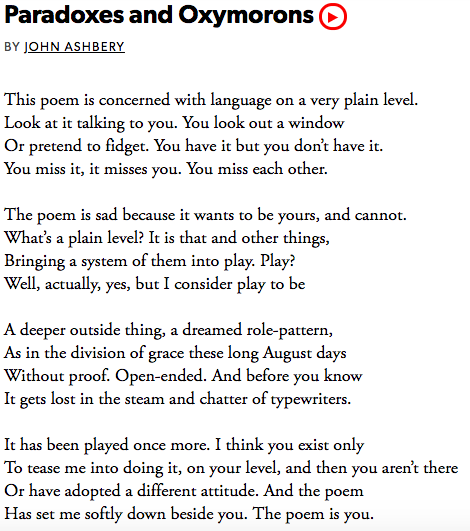
notes on John Ashbery, Paradoxes and Oxymorons

A “plain” is a level place. Some plains are places that were leveled. Isaiah 40:4: “Every valley shall be raised up, every mountain and hill made low; the rough ground shall become level, the rugged places a plain.”

A “level” is a device for seeing whether things are flat. It helps us put different objects on the same level or on the same plane.

If you “level” with people, you give them the plain facts, no playing around.

“Play”: an activity conducted for enjoyment, not for a practical purpose. It is activity without an end. Two people can play, which requires cooperation as well as competition. You can be played. “To play”: to turn written music into sound. A play is also a thing with an opening and an ending.

“Attitude” is the orientation of an object, such as an airplane, relative to the level ground. A level would be needed to measure a plane’s attitude. If you were trying to hit a target with a plane, a level would help you keep the attitude right so that you wouldn’t miss it.

If you Google “division of grace,” the first hit is Thomas Aquinas’ Summa Theologiae, First Part of the Second Part, Question 111, “The division of grace,” which begins, “Whether grace is fittingly divided into sanctifying grace and gratuitous grace?” Part of his answer: “gratuitous grace … is bestowed on a man … not to justify him, but rather that he may cooperate in the justification of another …” Aquinas proves this point with authorities and reasons.

John Ashbery didn’t have Google. I have no idea whether these obscure puns that I found by searching the Web were on his mind. But he already lived in a world of words, excessive words, words that referred to each other, that demanded attention, that bored, that confused. “It gets lost in the steam and chatter of typewriters.”

(“It?” There is literally a missing word “it” in the phrase “And before you know /It gets lost …” What gets lost? “It” is so lost that it’s not even printed in the poem.)

A poem is just a string of words. That is all it is at a “plain level.” We are deluged with words. Most text is not poetry, but even poems are enormously common, and most of them are worth very little. To write something that qualifies as a poem is easy–you just type. You make a keyboard chatter until you have rows of words. Unless your name is John Ashbery, chances are low that anyone will read those lines.

Still, if you’ve poured yourself into those words, you want someone to follow them, to play with them, to concentrate on their levels of meaning, including the levels that were plain and the ones you never noticed. You don’t want them looking out a window and fidgeting. (Let alone pretending to fidget! Who pretends to fidget?)

A poem and you are like possible lovers, but the poem doesn’t have much of a chance; there are so many other words that you could notice instead. The poem will be sad if you don’t play with it.

But suddenly, in the final stanza, you and the poem are joined by a third party. “And the poem / Has set me softly down beside you. The poem is you.” Who is this “me”?

As long as the story is about a poem wanting to connect and feeling sad, it’s all fun and games: wordplay. But when you realize that the poem is the voice of a human being who wants to connect with you, suddenly it’s not just play but also love.

“Paradoxes and Oxymorons” from Shadow Train by John Ashbery. Copyright © 1980, 1981 by John Ashbery. Source. See also “signal” and “a poem should.”

Helios

Method: Helios

Author: 
Note: the following entry is a stub. You can help Participedia by adding to it. Definition Helios is an online platform for End to End Auditable Voting , where voters can verify that their vote has been both recorded and tallied accurately, without a third party ever being able to...

Review of Deliberation across Deeply Divided Societies: Transformative Moments

The 5-page review written by Nancy A. Vamvakas of Deliberation across Deeply Divided Societies: Transformative Moments (2017), by Jürg Steiner, Maria Clara Jaramillo, Rousiley C. M. Maia, and Simona Mameli, was published in the Journal of Public Deliberation: Vol. 13: Iss. 1. In the book, the authors analyze group discussions from three distinct conflicts in Colombia, Bosnia/Herzegovina, and Brazil; and discuss the various approaches to deliberation in each area. Read an excerpt of the review below and find the PDF available for download on the Journal of Public Deliberation site here.

From the review…

Indeed, this book is the result of a very ambitious undertaking; Jürg Steiner et. al. have compiled and analyzed group discussions among ex-guerrillas and exparamilitaries in Colombia, among Serbs and Bosniaks in Srebrenica in Bosnia and Herzegovina, and among poor community residents and police officers in Brazilian favelas.

The discussions were facilitated by passive moderators who posed a general question about peace, but did not intervene; facilitators did not ask further questions and did not ask participants to speak up. In the case of Colombia, the groups were asked: what are your recommendations so that Colombia can have a future of peace, where people from the political left and the political right, guerrillas and paramilitaries, can live peacefully together? (p. 24). The Bosnian groups were asked to formulate recommendations for a better future in BosniaHerzegovina (p. 31). Finally, in Brazil, discussants were given the following question: How is it possible to create a culture of peace between poor community residents and the local police? (p. 36).

Steiner et. al. advance the on-going debate between those deliberative theorists who stress a purely rational approach and those who adopt a softer focus which incorporates finer threads of emotions. The authors argue that “deliberation means that all participants can freely express their views; that arguments are well justified, which can also be done with well-chosen personal stories or humor; that the meaning of the common good is debated; that arguments of others are respected; and that the force of the better argument prevails, although deliberation does not necessarily have to lead to consensus” (p. 2). They are in agreement with deliberative theorists such as Laura Black who see the great potential in storytelling and the limitations of the rationalist approach. Personal stories, as presented here are examples of “non-rational elements” (86) that have added to the deliberation model. Steiner et. al. argue that Jürgen Habermas set “very high standards of how rational justification of arguments should look” (p. 106). The book proposes a less demanding test for rationality; less stringent criteria; the bar is lowered. Context matters, who the actors are matters, and “standards of rationality should not be universal” (p. 106). The authors argue that given the “low level of formal schooling,” the discussions were “hard tests” (p. 86) for rational arguments.

The authors argue that there is a complexity to deliberation, hence, analysis must take into account deliberation over the course of a discussion. They code deliberation to see how it evolves and whether it fluctuates; for these ups and downs of group dynamics they coin the very innovative concept of Deliberative Transformative Moments (DTM). The units of analysis are the individual speech acts. Speech acts were coded using four categories: the speech act stays at a high level of deliberation; the speech act transforms the level of deliberation from high to low (flow of discussion is disrupted); the speech act stays at a low level of deliberation; the speech act transforms the level of deliberation from low to high (participants add new aspects to a topic or formulate a new topic). The reader has the luxury of being able to follow these discussions on the book’s website (www.ipw.unibe.ch/content/research/deliberation) and is able to see first hand the speech acts; and can also see the justifications given for the authors’ coding as to whether deliberation was high, low, shifted up or down. Hence, the authors are able to argue that their research process is “fully transparent and therefore open for replications” (p. 6).

Download the full review from the Journal of Public Deliberation here.

About the Journal of Public DeliberationJournal of Public Deliberation
Spearheaded by the Deliberative Democracy Consortium in collaboration with the International Association of Public Participation, the principal objective of Journal of Public Deliberation (JPD) is to synthesize the research, opinion, projects, experiments and experiences of academics and practitioners in the emerging multi-disciplinary field and political movement called by some “deliberative democracy.” By doing this, we hope to help improve future research endeavors in this field and aid in the transformation of modern representative democracy into a more citizen friendly form.

Follow the Deliberative Democracy Consortium on Twitter: @delibdem

Follow the International Association of Public Participation [US] on Twitter: @IAP2USA

Resource Link: www.publicdeliberation.net/jpd/vol13/iss1/art9