Ensuring Engagement is Inclusive and Fair

In order to have engagement that is fair and equitable to all members of society, it is vital to be intentional when designing and facilitating those processes by asking, “who shows up?”. NCDD member org the Participatory Budgeting Project recently shared this article on how to make PB inclusive and fair, and there are some great tips to keep in mind for all our work. We encourage you to read the post below and find the original on PBP’s site here.


Making PB Inclusive and Fair

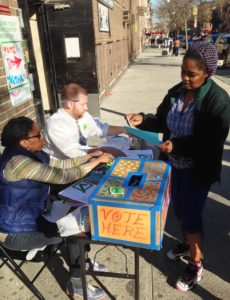
Typically, when we want to know how inclusive and fair a Participatory Budgeting (PB) process is, we ask “Who shows up?” While this is a good starting point, it’s not enough. To meaningfully assess equity, we need to dig deeper.

Celina Su, Chair of Urban Studies at the City University of New York (CUNY) and Frankie Mercedes, former Communications Strategist with the Participatory Budgeting Project (PBP), joined forces to lead a stellar PBP Network Study Session, which addressed issues of equity and fairness in PB.

This blog post reviews the main points of their conversation, identifies common barriers to equal participation in PB, and suggests how to make PB more accessible to people with low incomes and to people of color.

“Who shows up?”

Public Agenda’s report on PB in North America found that during the PB vote, “In nearly all communities, black residents were overrepresented or represented proportionally to the local census among voter survey respondents.” In contrast, PBP’s internal evaluation data shows that white people, people with high or moderate incomes, and people with advanced degrees tend to be overrepresented in the steering committee and budget delegate role. The populations in the second group tend to have more time, flexibility, and financial security—factors that make them more likely to participate in more intensive aspects of PB.
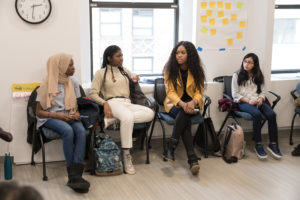
To create truly inclusive PB processes, low-income residents and people of color must be well represented on the steering committee and as budget delegates. The steering committee sets the rules for a PB process, and these rules ensure an inclusive and fair process. When low-income people and people of color are not in the room, steering committees miss valuable ideas on how to create a fair process.

Here’s how you can make sure everyone shows up:

  • Publicize and do outreach for all phases of the PB process—not just for idea collection and the vote.
  • Provide 2-way transit fare for people who’ve identified need.
  • Offer free, on-site childcare and food at PB events to boost engagement of women, parents, and low-income residents.
  • Consider the location of PB events—Fancy venues or gentrified areas in a city may feel unwelcoming to some. Switch up the location of PB events to make sure that everyone feels welcome and feels ownership of their PB process.

“Who gets heard?”

Celina Su interviewed several PB participants about their experience in PBNYC, and she saw a pattern. People of color and people with low incomes felt that the PB process was frustrating and unfair. Highly organized groups, like parent-teacher associations from high-income neighborhoods, had a set agenda and dominated the budget delegate process.
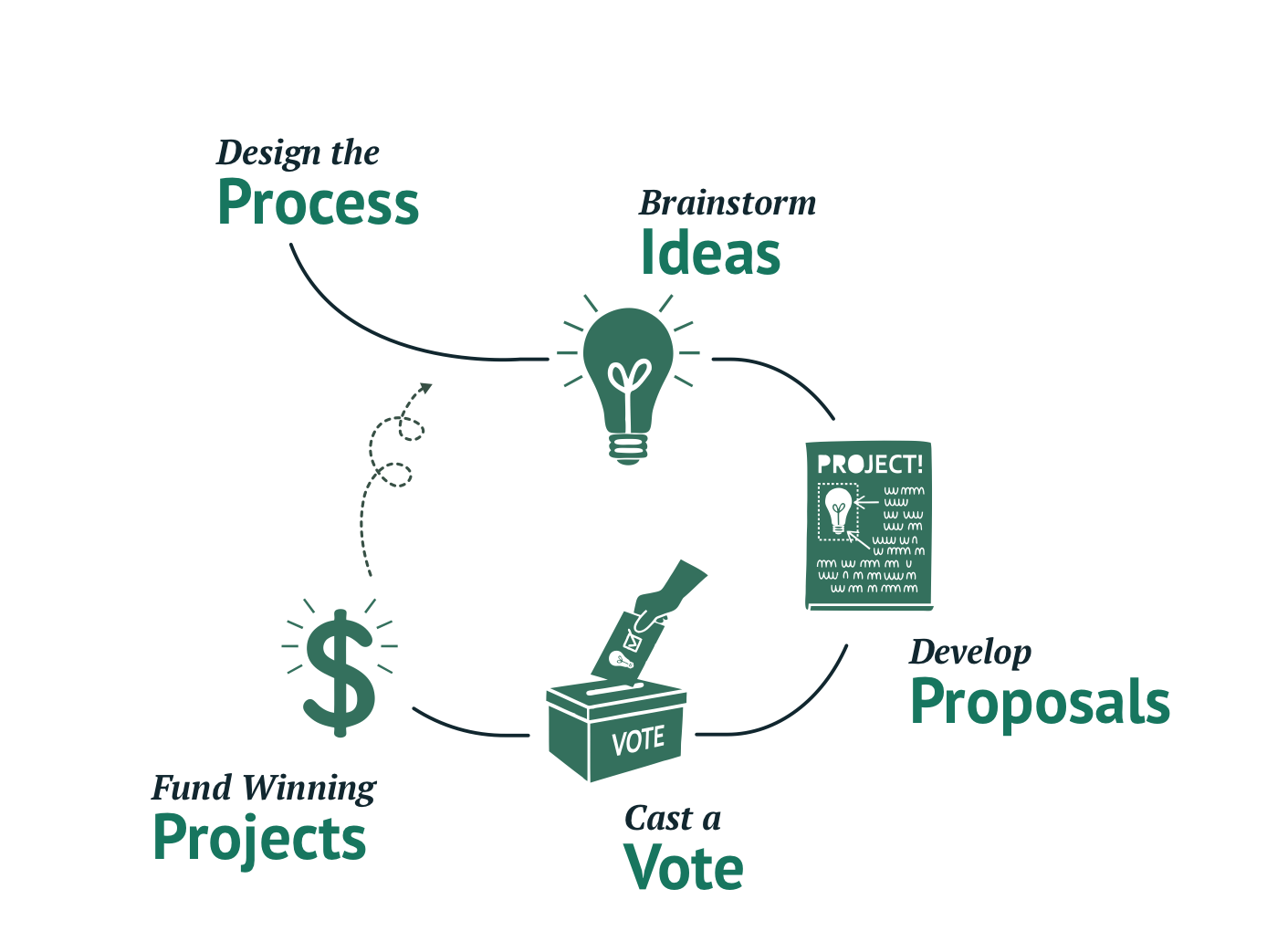
The budget delegate stage is a very important part of PB. As volunteers, budget delegates select ideas from the idea collection phase and turn them into proposals that PB participants vote on. While residents can voice any priority during the idea collection phase, budget delegates work with staff to determine which ideas are eligible for PB funding.

In many cases, PB funding comes from an elected official’s capital budget. This means that a PB proposal has to be a capital project in order it to be eligible for funding. A capital project is a physical purchase (e.g. computer), construction, or renovation (e.g. a building).

When residents think about what their community needs, they may not think of physical infrastructure; they might think of training, programs, or other non-physical investments. Residents may struggle to think of physical changes that can address their community’s most pressing needs—like quality education and job access. And, because low-income residents and people of color are often underrepresented as budget delegates, they don’t have the same opportunities to pick ideas and tweak non-eligible ideas so that they fit into PB’s rules. This is why projects that benefit marginalized communities can fall off the table during the budget delegate phase.

During Celina’s interviews, residents also said it was intimidating to talk with elected officials and city staff. Many people don’t have experience talking with elected officials or speaking in the language of government and law. Without sufficient support mechanisms, this imbalance fosters an environment that privileges those with more education and knowledge of government and law.

Here’s how you can make sure that everyone’s voice is heard:

  • Pay budget delegates and steering committee members

People who have the time and extra cash to volunteer tend to be of mid to high socioeconomic status. Paying residents for their time will incentivize people of all income backgrounds to participate in the time and energy intensive aspects of the PB process.

  • Provide space for in-group deliberation

In-group deliberation gives residents from similar backgrounds (e.g. public housing, immigrant, age group, etc.) the opportunity to discuss, solidify and agree on priorities. For example, non-English single language meetings have been very successful.

  • Offer training for government representatives
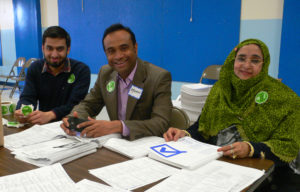
Government representatives should make themselves open and available to their community. Simple changes in tone and body language can mean the difference between intimidating residents and engaging them.

  • Bring in facilitators

Facilitators can help participants shape and develop their ideas and to ensure that certain groups don’t dominate speaking time.

“How does PB interact with society and government institutions?”

In her research on inclusion and PB in New York City, Celina notes that surveillance cameras are among the most popular projects in PBNYC. According to her report, they have “won funding every year so far.”

Celina sought to find out why cameras were so popular among NYC residents. She found that residents who wanted security cameras envisioned the cameras as part of a much broader program of public safety. Some residents’ vision of community safety included “greater police accountability and economic support as well as surveillance, and they crucially included bottom-up accountability and access to… [the video footage] captured by cameras.” But some residents were not aware that the New York City Police Department does not routinely make surveillance footage available to the public. On top of that, the economic and jobs programs that residents wanted did not qualify as capital projects and were therefore ineligible for PB funding. By the time PB voting began, NYPD-controlled surveillance cameras were the only thing left of residents’ vision for community safety.

Here’s some tips to equalize benefits from PB:

  • Make equity and inclusion an explicit goal of the PB process

PB is about making communities stronger and more civically engaged. PB participants want to help make that goal a reality. When PB leaders encourage participants to center equity, they create an environment where participants actively consider the needs of other residents.

  • Find or create a district profile

A district profile should describe the most important aspects of a community (e.g. educational achievement, income, ethnic composition). This will help residents identify what is going well in the district and locate areas for improvement. PBP’s list of community resources called Data for the People is a great starting point for gathering information about your community, as is the new tool developed by PBP, myPB.community.

  • Let participants know how government agencies implement PB projects
Some residents told Celina that they would not have voted for surveillance cameras had they known that the community would not have had control over the footage. It’s critical that PB participants understand the ramifications of what they are voting for so that they can make an informed decision.

As a tool, PB is susceptible to the same challenges faced by any other civic process. However, because it’s flexible and includes community involvement at high levels, PB leaders and residents have the opportunity to design a PB process that’s both inclusive and fair.

Want more info on PB and Inclusion? You can find more resources below:

Report: Celina Su’s Research on Inclusion in PB

PB Study Session: Equity and Inclusion in PB (Video)

PB Community Tools: Data for the People

PB Tool: Outreach Toolkit

PB Study Session: Budget Delegates (Video)

Report: Celina Su’s Research on PB

Blog Post: Black Power through Participatory Budgeting

You can find the original version of this post on the Participatory Budgeting Project’s site at www.participatorybudgeting.org/making-pb-inclusive-and-fair/.

DMC Hosts Third Annual Civic Institute on August 17th

The third annual Civic Institute is happening Friday, August 17th, hosted by NCDD member org the David Mathews Center for Civic Life. This will be one of the premier events dedicated to strengthening civic life in Alabama and will be a fantastic opportunity for those doing civic engagement work throughout the state.  DMC recently announced the session line up which you can read more below and on the DMC’s site here.


2018 Civic Institute: Be Together Differently

We’ve added new sessions to our third annual Civic Institute! Please join us Friday, August 17, for some deep conversations on strengthening civic life in Alabama – not for a day, but for the duration.

Each year, our hope at the Civic Institute is that Alabamians doing good, sustainable work in their neighborhoods and hometowns connect with each other in new ways. Every place has a unique story and faces a distinct set of challenges, yet across the state, the Mathews Center sees increasingly that Alabama residents and civic leaders often face similar issues. Through Alabama Issues Forums we see that when people desire to address an issue they all face – rather than politics or personalities – deliberative conversations can be especially suited for the uncommon and transformative experience of working together across difference. Wicked problems don’t tend to disappear overnight, and so the everyday habit of talking with each other as citizens – not circling issues, but working towards creating solutions we can all live with – often proves to be, simultaneously, one of the most effective and the most accessible approaches to sustainable community development.

At this year’s Civic Institute, we hope to find deeper ways to support Alabamians practicing such fundamental aspects of democracy as having sustained conversations on difficult issues, practicing innovations in journalism, bringing underrepresented groups to the table, and recognizing the potential each individual holds to make their communities better for everyone. More than ever, this year, we seek to continue modeling our call to listen first and to “pass the mic” by highlighting the following speakers and topics:

The Elephant in the Room: Talking About Difficult Issues: Talking about challenging issues in a divided political climate is hard. Listening to those we disagree with is difficult. Finding opportunities to bridge divides and discuss the “elephants in the room” in a productive, civil manner that prioritizes understanding over consensus is even more challenging. During this interactive session, learn from Alabama communities that are engaging citizens in deliberation on some of the most divisive public issues facing communities today. Discover tools and resources you can use to tackle the issues facing your community. Chris McCauley of Markstein will moderate; additional speaker details are forthcoming. This session is made possible by a generous donation from The Blackburn Institute at the University of Alabama.

“Public life is bigger than political life. We have narrowly equated the two in recent years, and we’ve impoverished ourselves in the process. Public life includes all of our disciplines and endeavors, including ourselves as citizens and professional people and neighbors and parents and friends. The places we’ve looked for leadership and modeling have become some of the most broken in our midst. And so it is up to us, where we live, to start having the conversations we want to be hearing and creating the realities we want to inhabit.”

– Krista Tippet, On Being

Who Remembers? Collective Memory and Public Life: The issue of monuments and memorials in public spaces divides communities around the nation, and people of goodwill on all sides of the issue struggle to hear each other productively.  In this facilitated discussion, participants will discuss what concerns them the most regarding this issue and whether they can imagine opportunities for deliberation within their communities and networks. This session will be moderated by Dr. Mark Wilson, Director of the Caroline Marshall Draughon Center for the Arts and Humanities at Auburn University. Our thanks to the Alabama Bicentennial Commission for generously sponsoring this session.

“A community is the mental and spiritual condition of knowing that the place is shared, and that the people who share the place define and limit the possibilities of each other’s lives. It is the knowledge that people have of each other, their concern for each other, their trust in each other, the freedom with which they come and go among themselves.”

– Wendell Berry

The Front Doors of Fellowship: Engaging with Difference Through Faith: What is the role of faith communities in public life? What do we find at the intersection of faith and civic engagement? How can we cultivate the physical and conceptual spaces that houses of worship occupy, in order to bring people together in new ways that connect our individual experiences and our rich inner lives with the work that we must all do, collectively, as a public? Faith communities, for many Alabamians, not only feed the spiritual life, they also serve as a hub of community life. This session will focus on stories, challenges, and opportunities in bringing faith communities together across divides to address key issues and challenges facing our hometowns and our state.

“The power of belonging creates and undoes us both; if spirituality does not speak to this power, then it speaks to little.”

-Pádraig Ó Tuama, Irish Theologian

Urban Perspectives on Civic Engagement in Alabama: The University of Alabama at Birmingham’s Woodlawn Project and Spring Hill College’s Foley Fellowship in Civic Leadership are experiential learning opportunities that seek to work alongside neighboring communities to better understand and address the complex effects that poverty and other related disparities have on their quality of life. The effectiveness of each project is rooted in its being tailored to fit the particular contexts in which each institution operates. Attendees of this session will take part in a dialogue that compares and contrasts the unique challenges, approaches, and learning outcomes that these programs have yielded working with community partners in urban contexts on opposite sides of the state.

“As we internalize the view of others, we change. And as our perception of others changes, we see possibilities for acting together that we didn’t see before.”

-Dr. David Mathews

Who’s Not At the Table? Engaging Youth in Civic Deserts: Over the past decade, civic engagement and volunteering rates among young Americans have declined across race, income, and education levels. However, youth and young adults living in “civic deserts” are disproportionately represented among the disengaged.  Civic deserts are communities that lack adequate opportunities for young people to learn about and participate in civic and political life. Over 40% of American youth and young adults live in “civic deserts.” In rural areas, the percentage of young people living in civic deserts climbs to nearly 60%. Youth in civic deserts are less engaged in politics, are less likely to vote in elections, and are less likely to believe in the influence of their own voice and the collective potential of their community. While the statistics can be harrowing, there are leaders, educators, and organizers across Alabama who are working to revive youth engagement within rural and urban civic deserts. By capitalizing on the assets within their community to create leadership opportunities, mentorship programs, career training, and youth programming, the guest speakers in our Engaging the Disengaged: Youth in Civic Deserts session are creating innovative avenues for youth engagement. This session is made possible thanks to the generous sponsorship of Alabama Public Television.

Passing the Mic: Representation & Empathy in Civic Media: The digital disruption of traditional news and media outlets has become an accepted, albeit cliche, archetype for the twenty-first century. The fourth estate that so many Americans revered throughout our history has been faced with growing distrust, diminished resources, and has struggled to translate its traditional structure and function into an increasingly viral model of news and journalism. At the same time, digital technologies have enabled millions to tell their own stories in a way that is diffuse, yet direct.

The rise of citizen journalism and social media has emerged as a critical component of what we today characterize as “civic media.” The centuries-long interpolation of citizen and journalist is newly-malleable, and calls for a radical reconceptualization of the citizen-journalist relationship. “I just want to be a voice for the voiceless,” is a refrain that is increasingly unable to bear the complex weight of citizens ready to speak for themselves. Why be a voice for the voiceless when you could just pass the mic?

This session will explore ways of passing the mic and equipping others to tell their own story through digital media as well as traditional journalistic outlets. From Twitter to the town square, we will consider examples of intergenerational cooperation amongst communities, local professors, and their students, as they reimagine what community journalism and self-representation can accomplish in our time.

To register, visit 2018civicinstitute.eventbrite.com. Please contact Rebecca Cleveland at rcleveland@mathewscenter.org if the cost of attending presents a burden; we have some scholarships available. To become a sponsor, contact Cristin Brawner at cfoster@mathewscenter.org. 

 You can find the original version of this announcement on the David Mathews Center blog at www.mathewscenter.org/2018-civic-institute-sessions/.

NIFI Common Ground for Action Events This Summer

NCDD member org, the National Issues Forums Institute, has several events and opportunities coming up this summer for their online platform, Common Ground for Action (CGA), that we wanted to share with the network. In July, there are CGA open practice sessions and several forum series events around the issues guides: Shaping Our Future, Coming to America, and The Changing World of Work. On August 15th, there is a CGA New Moderator Training Workshop for educators, which will be hosted by NCDD member Kara Dillard. We encourage you to read about the events below and find them on NIFI’s site here.


Upcoming Common Ground for Action Forums

KF and NIFI are convening four open Common Ground for Action forums in July— these are great opportunities to share with people you’d like to experience a deliberative forum: teachers who might want to use deliberation in the classroom, partners on an issue who are new to forums, all kinds of folks!  Please share this post widely with your networks and on social media!

Register below to participate in any of the following CGA forums!

“Shaping Our Future: How Should Higher Education Help Us Create the Society We Want?”
Monday,  July 9th | 7pm EST/4p PDT I REGISTER

“Coming to America: Who Should We Welcome, What Should We Do?”
Saturday July 14th |  7pm EST/4p PDT I REGISTER

“The Changing World of Work: What Should We Ask of Higher Education?”
Wednesday,  July 18th |  3p EST/12p PDT I REGISTER

“Coming to America: Who Should We Welcome, What Should We Do?”
Friday July 27th |  11am EST/8a PDT I REGISTER

Also, if you have been trained to moderate a CGA forum but are looking for chances to practice, please check out the following open practice sessions:

Wednesday July 11 | 3-5p EST | PRACTICE

Wednesday July 25th | 3-5p EST | PRACTICE

And lastly, our CGA Moderator Training Specialist, Kara Dillard, also keeps “office hours” every Friday at 3:30 pm ET/12:30 PT. Have questions about using CGA in the classroom, or remembering how to use the Gala function, or want to draft a moderator to help out with a big forum event? Register here, or just email Kara anytime!

August 2018 CGA New Moderator Training Workshop for Educators
Wednesday Aug 15th |  12pm EST/9a PDT | REGISTER

You can find the original version of this announcement on the National Issues Forums Institute’s blog at www.nifi.org/en/july-cga.

Get Your Early Bird Tickets to NCDD2018 by July 15th!

We wanted to give everyone a friendly reminder that the early bird registration is available until Sunday, July 15th for the upcoming 2018 National Conference for Dialogue & Deliberation! After that date, the prices will go up to our regular registration of $450 so we encourage you to act fast to take part in this low rate while it lasts!

We are so excited for NCDD2018 which will be happening from November 2-4 in Denver at the downtown Sheraton. NCDD conferences are an exciting and engaging experience that convenes over 400 leaders, practitioners, and enthusiasts in the dialogue, deliberation, and public engagement field. The theme of the conference is Connecting and Strengthening Civic Innovators, where we hope to come together to explore, learn, and work toward further bringing D&D work into greater visibility and widespread practice.

For folks who submitted workshop proposals, we are finalizing decisions now and will be letting people know ASAP. We received over 120 proposals, twice the amount we have space for, and are giving each proposal our careful consideration. Thank you so much for your patience as we review these incredible session ideas! Keep a lookout in your inbox for an email coming soon from the NCDD team!

There is another exciting opportunity we want to remind you of and that is our D&D showcase! The D&D Showcase is a lively cocktail networking event that provides an opportunity for select individuals and organizations in our field to share some of the leading ideas, tools, projects, and initiatives in dialogue & deliberation with conference participants all in one space. It’s an interactive space to share your work with hundreds of passionate fellow D&Ders. Learn more about the showcase and the requirements for being a presenter by clicking here.

If you are looking to heighten the profile of your work and/or organization – become an NCDD2018 conference sponsor! We offer many benefits for varying levels of sponsorship, as well as, the ability to sponsor specific parts of the conference.  Click here to learn more about the tiers and benefits when you become an NCDD sponsor! If you have any questions about sponsorship, or would like to discuss other ideas about how your organization can support the conference, send an email to NCDD founding director Sandy Heierbacher at sandy[at]ncdd[dot]org and suggest a few times you’re available for a call.

You can learn much more about this year’s national conference at www.ncdd.org/ncdd2018, and register today at www.ncdd2018.eventbrite.com to take advantage of the Early Bird rate.

Want to get a better sense of what our conferences are like? Watch the video of NCDD2016 and NCDD2014 and learn even more about our past conferences by clicking here.

how not to talk about The People

Maria Bartiromo (Fox News): As the commander-in-chief, as the president of this great country, what can you do to bring us together?

Donald Trump: Our people are so incredible. …  Do you know, there’s probably never been a base in the history of politics in this country like my base. I hope the other side realizes that they better just take it easy.

As Jonathan Chait notes, Trump equates “us,” the people of America, with “the people who voted for him.”

This is the rhetorical move that Jan-Werner Müller, in his globally influential book (2016), uses as the definition of “populism.” Populists “claim that they and they alone represent the people. All other political competitors are essentially illegitimate, and anyone who does not support them is not properly part of the people. … Elites are immoral, whereas the people are a moral, homogeneous entity whose will cannot err.”

Müller has previously quoted Trump–“the only important thing is the unification of the people – because the other people don’t mean anything”–as evidence that the current president is a populist, in this bad sense of the word.

I agree that the slippage between Trump’s supporters and “the people” is a very bad sign. However, it is not straightforward to define populism (meaning a problematic phenomenon) in this way. Trump says many things and is inconsistent in his appeal to “the people.” Meanwhile, a wide variety of political actors also depict the public as a homogeneous entity that is on their side.

Some of them define “the people” in racial or ethno-national terms. That tendency seems more accurately described as racism or xenophobia than as populism, especially if anti-racists like Venezuela’s Hugo Chávez count as populists (as Müller would suggest).

And sometimes it is the strongest champions of democratic institutions who use rhetoric that looks populist according to Müller’s definition. For instance, Jimmy Carter presented himself as an ordinary American (a peanut farmer and a Christian, not a Washington politician) who could best reflect the values shared by all Americans (Johnstone 1978). Carter invoked a unitary public and promised to connect directly to the people, unmediated by interests and organizations. His Inaugural Address could be coded as populist rhetoric, in Müller’s sense of the word. Yet Carter was committed to constitutional limits, respected his critics and the opposition, and made the promotion of democratic freedoms a centerpiece of his agenda.

Thus it is not clear that searching for Müller-style populist language will identify actors who are hostile to democratic institutions and processes. There is an upsurge of repression around the world—and it is not limited to racists and xenophobes—but there is a better word for it than “populism.” That word is “authoritarianism.”

For the purposes of empirical research, I would dispense with “populism” in the Müller sense and look instead for authoritarianism and racism as distinct but sometimes overlapping phenomena that are ascendant in our time.

Müller is, however, right that there are pitfalls to invoking a unitary public that is on one’s side–or defining one’s side as “the people.” This is an excuse for trampling on rights, whether your opponents are demographic minorities and immigrants (the right-wing variant), or corporations and the rich (the left-wing version), or extremists (the centrist version). It’s always better to recognize the legitimacy of the actual human beings who disagree with you and who vote for the other side.

Citations: Jan-Werner Müller, What Is Populism? (Philadelphia; Universoty of Pennsylvania Press, 2016), p. 101; Christopher Lyle Johnstone, “Electing Ourselves in 1976: Jimmy Carter and The American Faith,” Western Journal of Speech Communication, vol. 42  Issue 4, *Fall 1978), p. 241-249. See also Trump at the confluence of populism, chauvinism, and celebrityfighting Trump’s populism with pluralist populismseparating populism from anti-intellectualism and two kinds of populism.

Recap of our NCDD Confab Featuring Undivided Nation

We had great Confab call last week featuring NCDD members David and Erin Leaverton of Undivided Nation – and you missed an excellent call if weren’t able to join! The Leavertons shared with the 40 participants on the call, about their experience traveling to every state in the US to listen to folks throughout the country and find ways where people can be united. We strongly encourage you to check out the recording to hear about their transformative adventure and learn of the powerful takeaways.

With the beautiful Lake Champlain in the background, David and Erin joined us via video call during their stop in Vermont, to share about their journey so far and some of the humbling learning opportunities they ‘ve experienced. Just before the beginning of the year, the Leavertons sold their house, bought an RV, and have been traveling state-to-state with their three children. Spurred by the fierce partisanship David experienced while working in politics, they sought to talk with folks from all parts of the US and better understand the roots of this country, in order to hopefully find ways to unify the deep divisions. Initially, they began their journey thinking people would be focused on the political divisions in this country, and yet they found that most have shared about the deep racial and socio-economic divisions they experience.

Halfway through their trip, the Leavertons have already had profound learning and said that every person they’ve connected with has impacted them. With humility, they shared how their understanding of the racial realities in this country has shifted and recognized how much more complex the issues in the US are than they previously believed. As their understanding has grown of the deep inequities some folks in this country experience, they noted the need to genuinely address these inequalities in order to work toward a country that is just and provides the constitutional ideals of life, liberty, and the pursuit of happiness – to all people.

We were live tweeting during the call and here are some of our favorites from the Confab:

  • “We wanted to help bring unity…My heart was breaking about what was going on in the country and I had a desire to be part of the change I wanted to see, that’s what set off this journey.”
  • “We asked ourselves – how can you begin to bring unity to people you’ve never met before? So we sold our house, got an RV to travel to every state and talk to people.”
  • “We invite people to come along with us and share what we’re learning, it’s too good not to share. It’s radically changed our understanding of our county and it was important for us to do it this way.”
  • “We’re traveling to a new state every Mon, we started the journey thinking ppl would focus on political divisions, but people have been more focused on racial and social-economic divisions.”
  • “Many people have a fear of other people… on some level… and have to get past this fear of people to be able to listen. You don’t have to sacrifice your truth to understand another.”
  • “To tell people who have experienced violence to forgive or be civil, it’s not just civility and while forgiveness is a part of it, we need to understand the reality before we preach forgiveness.”
  • “We need a candid conversation about the history of this country and when we come to terms with our true story, there’ll be a day of mourning – we need to come clean and acknowledge, before we, as a country, can move forward.”
  • “You can’t force people to interact… but you can invite people. Curiosity is the key ingredient, and it will help get you through the face of fear”

We recorded the whole presentation in case you weren’t able to join us, which you can access on the archives page by clicking here. We had several insightful contributions to the chat, which you can find the transcript of here. Access to the archives is a benefit of being an NCDD member, so make sure your membership is up-to-date (or click here to join).

Confab bubble image

We want to thank David, Erin, and all the Confab participants for contributing to this informative conversation! To learn more about NCDD’s Confab Calls and hear recordings of others, visit www.ncdd.org/events/confabs.

Finally, we love holding these events and we want to continue to elevate the work of our field with Confab Calls and Tech Tuesdays. It is through your generous contributions to NCDD that we can keep doing this work! That’s why we want to encourage you to support NCDD by making a donation or becoming an NCDD member today (you can also renew your membership by clicking here). Thank you!

Democrats have a good chance of controlling at least one House of Congress in 2019

Political prognostication is a fool’s game and arguably a distraction from the important work of citizens, which is to influence–not to forecast–the future.

But I can’t resist.

Recent projections give the Democrats anywhere from a 39% to a 58% (or even 63%) chance of winning the House. One reputable model gives the Democrats a 30% chance of winning the Senate. Those two results are not truly independent, since both will be affected by the national situation in November. But they are substantially independent, as illustrated by the claim that an 8 percentage-point swing toward the Democrats would give them 44 more House seats and four fewer Senate seats. If we assume that the two elections are independent events, then Democrats have between a 43% and 70% chance of capturing at least one house of Congress.

The wildcard is how the national situation will change between now and late October. If there’s a terrorist attack on the US, it will probably help the president’s party. The nomination battle could boost Republicans by giving religious conservatives a reason to turn out and by putting red-state Democratic Senators in a tough spot. Another four months of economic growth might help the GOP a bit, as would a report from the Special Counsel that comes nowhere close to associating Trump with crimes.

But I think upcoming news is more likely to assist the Democrats. Trump and his party have already captured whatever political benefit they’re going to gain from the economy, and there’s a significant potential for economic turbulence ahead. The Mueller investigation has lost public support without yielding a damaging public report, but his report is coming. Since 67% of Americans want to preserve Roe v Wade, a nomination that places that decision in jeopardy could mobilize more people against Trump than for him. The North Korea summit was a political success for the president: he hyped a genuine crisis to the maximum and then declared it resolved, which convinced a bunch of Americans. But that domestic political gain is fragile, since the threat was not actually resolved. We can also expect massive Obamacare premium increases, ugly battles in Congress, plenty of awkward votes for Republican incumbents, a possibly damaging Special Counsel report, lawsuits and depositions against the president, and unpredictable controversies revolving around him.

Overall, I’d put the chances that the Democrats control at least one house of Congress above 70%. That estimate is compatible with any actual result in November, so there’s no way I can be proven wrong. Meanwhile, stop reading forecasts and get back to work!

Excited to Be Joining Ed Policy at UKY

It is my great pleasure to announce that I’ll be joining the department of Educational Policy Studies and Evaluation at the University of Kentucky as associate professor in August of 2018.

The University of Kentucky.

Photo with students at the University of Mississippi.Over the years, I have had the immense honor to work with countless outstanding students in Public Policy Leadership at the University of Mississippi and in Philosophy at the University of Kentucky. I love to brag about all you’re doing, work in D.C., state government, schools, policy think tanks, and so many more amazing careers. A significant majority of my students appreciated that in places like Mississippi, Kentucky, and really everywhere, some of the deepest challenges we face are in education. To those of you who have not yet gone on to pursue graduate work or would like to study further, I want to strongly encourage you to come join me and my outstanding colleagues in Educational Policy Studies and Evaluation (EPE) at UKY.

The department is updating and redesigning an awesome Master’s program in Educational Policy Studies, for example. We also offer a Master’s in Higher Education with optional concentration in student affairs, a Master’s in Research Methods in Education, an Ed.D. in Ed Policy, Measurement, and Evaluation, a Ph.D. in Higher Education, and a Ph.D. in Education Sciences. More information is available on our Web site here.

The three things I’m proudest of in my life are my family, my students, and the work I get to do with you all on how we can make our world better. I hope that many of you will come join me and my colleagues in Kentucky. You know that when I say I’m excited, I am…

Logo of the University of Kentucky.I am excited.

Come get your next degree and wear blue with me. I can’t wait to see you again.

Want to learn more & come study in Kentucky? Email me.

The post Excited to Be Joining Ed Policy at UKY first appeared on Eric Thomas Weber.

Exploring Civility in America through Ben Franklin’s Wisdom

As part of our partnership with NCDD member org, Ben Franklin Circles (BFC), we have been sharing stories from BFC. Because of the vitriol of the US political climate these last few years, there has been an increased call for civility. The article offers the views of Ben Franklin and Dale Carnegie as thought fodder for bringing more civility to America. You can read the post below and find the original post on BFC’s site here.


Ben Franklin & Civility

“The only way to win an argument is to avoid it.”

Dale Carnegie’s famous remark was preceded by Benjamin Franklin’s own formulation of this axiom, which he describes in his Autobiography as the “habit of modest diffidence.” Franklin explains that this practice banishes the categorical from his vocabulary, ascribing to this habit much of his success “when [he] had occasion to inculcate [his] opinion and persuade men into measures.”

Gone were words such as “Certainly, undoubtedly, or any others that give air to the positives to an opinion,” and welcomed were such phrases as “I conceived,” “I apprehend,” and “I imagine it to be so.”

At bottom, Carnegie and Franklin offer the same bit of advice: to persuade people to your point of view, you must appear to not disagree with them at all.

If you are now thinking, “How are you supposed to have a conversation without appearing to say anything different from one’s interlocutor?” I know what you mean. It is also fair to ask whether it is patronizing—or even dishonest—to smile and nod at your conversation partner for the sake of personal gain or social ease.

Indeed, Carnegie and Franklin may well be accused by one Tom Scocca of being purveyors of “smarm,” a disposition he scathingly condemned in a 4,000 word treatise.

“Smarm,” says Scocca, “is a kind of performance — an assumption of the forms of seriousness, of virtue, of constructiveness, without the substance.” Smarm, he says, is the tool of self-aggrandizers and the death of public discourse and intellectual honesty. It was when BuzzFeed assumed Thumper’s motto, “If you can’t say something nice, don’t say nothing at all”—which sounds vaguely reminiscent of Carnegie’s and Franklin’s advice—that Scocca could no longer stay silent. “The evasion of disputes is a defining tactic of smarm. Smarm, whether political or literary, insists that the audience accept the priors it has been given. Debate begins where the important parts of the debate have ended.” Smarm refuses to engage with ideas by instead “smoothing over” disagreement for the sake of social comfort or personal gain. This, for Scocca, is what makes smarm dishonest and worthy of contempt.

Writer Leon Wieseltier concurs: “In intellectual and literary life, where the stakes may be quite high, manners must never be the primary consideration. People who advance controversial notions should be prepared for controversy. Questions of truth, meaning, goodness, justice and beauty are bigger than Bambi.”

I quite agree.

But that does not mean we should wholly discard Carnegie’s and Franklin’s admonitions. It is possible to disagree with someone without permanently rupturing the relationship, and they point us how to do that.

By encouraging us to be sensitive to how our interlocutor will hear our words, Carnegie and Franklin direct us toward true civility, a mode that respects the inherent dignity of each person with whom one interacts

By placing people at the center, true civility provides a framework for understanding not just when to criticize and when to focus on social ease but, perhaps more importantly, how.

True civility is more than “niceness” because it respects people enough to take them and their ideas seriously. The truly civil person is one who is teachable, who is willing to be wrong, and willing to place a relationship before being right.

Oscar Wilde wrote, “A gentleman is one who never gives offense… unintentionally.” There is, contrary to Carnegie and Franklin’s position, a time to take a strong stance that perhaps even gives offense. We also are not always in control of when others are offended by us. But by plumbing with reinvigorated rigor the foundation to our souls, examining if our values and priorities are reflected in our words and deeds, and be part of re claiming a more authentic, and truly civil, America.

You can find the original version of this post on Ben Franklin Circles’ site at www.benfranklincircles.org/virtues/ben-franklin-civility.

ENGAGING IDEAS – 06/29/2018


Democracy

Gerrymandering Critics Suffer Twin Blows at the Supreme Court (Governing)
The Texas case involves racial gerrymandering, while the North Carolina case deals with partisan gerrymandering -- something the justices have hinted is unconstitutional but have yet to rule against.

The latest sign of political divide: Shaming and shunning public officials (Washington Post)
Anger and division in American politics are creating a rising phenomenon: the public shaming and shunning of political figures while they are going about their private lives.

How we know journalism is good for democracy (Local News Lab)
According to new data being released later this month, at least 900 communities across the United States have faced profound erosion in their access to local news and information since 2004.


Opportunity/Inequality

The Minimum Wage Just Turned 80. Economists Don't Give It Enough Credit(Fortune)
At the deepest level, the minimum wage embodies justice. It speaks to the words of Martin Luther King Jr. that "all labor has dignity"-and so deserves a decent rate of pay..

'Squeezed' Explores Why America Is Getting Too Expensive For The Middle Class (NPR)
Author Alissa Quart writes that the costs of housing, child care, health care and college are outpacing salaries and threatening the livelihoods of middle class Americans.

An autopsy of the American dream (Vox)
Brill has been writing about class warfare in the US since 2011, and the picture he paints is as depressing as it is persuasive.


Engagement

Re-released, Infogagement: Citizenship and Democracy in the Age of Connection (PACE)
So much about our lives, communities, and social compact is being re-envisioned. Yet here, in the intersection of information, technology, engagement, and public life, are seeds of current American upheaval.

Civic engagement declines when local newspapers shut down (Journalist's Resource)
Studies have found that areas with fewer local news outlets and declining coverage also have lower levels of civic engagement and voter turnout.

Smart Cities 3.0: 5G, Edge Computing and Citizen Engagement(State Tech Magazine)
With advanced technology and careful planning, city governments can alleviate growing problems seen in many of today's urban communities and become more sustainable for future generations.


K-12

AmeriCorps 'volunteers' in Denver schools were district employees, investigation finds (Chalkbeat)
The AmeriCorps program in Denver Public Schools has been terminated after an investigation found the district broke rules by recruiting its own employees to serve as volunteers, according to a report released Wednesday.

New education budget threatens dozens of low-performing Detroit schools with closure - again (Chalkbeat)
Dozens of struggling Detroit schools could face closure once again after Gov. Rick Snyder signed an education budget on Thursday that seeks to stiffen consequences for low-scoring schools.

A $1 billion Gates Foundation-backed education initiative failed to help students, according to a new report - here's what happened (Business Insider)
A seven-year, nearly $1 billion education initiative centered on improving teaching quality in low-income schools - and bankrolled in part by the Bill and Melinda Gates Foundation - largely failed to help students, according to a new report from nonprofit policy think tank RAND.


Higher Ed/Workforce

Vocational Programs Get Boost From Congress(Wall Street Journal)
Bill that provides incentives for technical training programs set to pass, in rare moment of bipartisan agreement.

Should America's Universities Stop Taking So Many International Students? (The Atlantic)
Critics say the country's higher-education institutions should focus on ensuring more Americans get four-year degrees, but college presidents highlight the benefits of global diversity on campus.


Health Care

Can Low-Intensity Care Solve High Health Care Costs? (The Upshot)
The shift toward cheaper settings like outpatient clinics and homes is a worthy goal, but new research is showing us where we shouldn't cut corners.

White House wants to cut this public health service corps by nearly 40 percent (Washington Post)
The White House is proposing to reduce by nearly 40 percent the uniformed public health professionals who deploy during disasters and disease outbreaks, monitor drug safety and provide health care in some of the nation's most remote and disadvantaged areas.

Fewer Americans are spending their final days in the hospital and more are dying at home(Los Angeles Times)
The American way of dying seems to have become less frantic, desperate and expensive. That's the upshot of a new study that finds that seniors insured by Medicare who died in 2015 were less likely to do so in a hospital and more likely to pass away in a home or other community setting than those who died in 2000.