ENGAGING IDEAS – 09/14/2018


Democracy

America's Slide Toward Autocracy (The Atlantic)
Democracy has taken a beating under President Trump. Will the midterms make a difference? Continue Reading

Republicans' Turn in the Barrel (Wall Street Journal)
With the last primary in New York this Thursday, the 2018 general election is fully under way. Let's take stock of the political landscape as the contest enters its final eight weeks. Continue Reading

Americans Aren't Practicing Democracy Anymore (The Atlantic)
As participation in civic life has dwindled, so has public faith in the country's system of government. Continue Reading


Opportunity/Inequality

The Inequality Industry (The Nation)
Since 2008, wonks, politicians, poets, and bankers have all started talking about inequality. But are they interested in making us more equal? Continue Reading

Research: How the Financial Crisis Drastically Increased Wealth Inequality in the U.S. (Harvard Business Review)
We live in unequal times. The causes and consequences of widening disparities in income and wealth have become a defining debate of our age. Researchers have made major inroads into documenting trends in either income or wealth inequality in the United States, but we still know little about how the two evolve together - an important question to understand the causes of wealth inequality. Continue Reading

Queens College Ranked In Top 1% In Country For Upward Mobility
The results of a recent study, as reported on this week in the Chronicle of Higher Education, provides insight into how well Queens College is propelling students up the economic ladder. The Chronicle's list is drawn from Mobility Report Cards: The Role of Colleges in Intergenerational Mobility, the widely reported study in which a team led by former Stanford economics professor Raj Chetty assessed colleges' impact on social mobility. Continue Reading


Engagement

In Chicago, The Obamas' Civic Engagement Programs Are In Action (NPR)
The Obama Foundation has raised more than a quarter of a billion dollars so far to build the Obama Presidential Center on Chicago's South Side. Key to the Foundation's mission are programs to train the next generation of civic leaders. Continue Reading

Civic engagement app launches facial recognition feature to identify politicians (Biometric Update)
An app has been launched for iPhone and Android which identifies public figures with facial recognition to improve civic engagement. The CVX Civic Engagement app's "Name to a Face" feature compares an image in a photo taken by the user to a database of public officials with AI and machine learning to identify prominent U.S. politicians. Continue Reading


K-12

Rethinking What Gifted Education Means, and Whom It Should Serve (New York Times)
Montgomery County is one of several districts that is successfully diversifying its gifted programs, in part by overhauling the admissions process and rethinking the fundamental mission of such programs. Continue Reading

Passing schools, struggling students: Colorado reconsiders its formula for rating schools (Chalkbeat)
The vast majority of Colorado schools and districts get a passing score from state regulators who track their performance. Yet fewer than half of Colorado third-graders meet state expectations in literacy and just 34 percent meet state expectations in math. Continue Reading

In latest move, Gates Foundation looks to help - and learn from - charters serving students with disabilities (Chalkbeat)
The Bill and Melinda Gates Foundation's new charter school strategy is taking shape. The foundation has made four grants in recent months focused on helping charter schools better serve students with disabilities. That's one of the ways Bill Gates said last fall that the influential foundation would focus its education giving over the next five years, along with efforts to grow networks of schools and improve curriculum. (The Gates Foundation is a supporter of Chalkbeat.) Continue Reading


Higher Ed/Workforce

Higher-education spending is falling (The Economist)
Universities are increasingly reliant on funds from the private sector. Continue Reading

Education Dept. Reopens Rutgers Case Charging Discrimination Against Jewish Students (New York Times)
The new head of civil rights at the Education Department has reopened a seven-year-old case brought by a Zionist group against Rutgers University, saying the Obama administration, in closing the case, ignored evidence that suggested the school allowed a hostile environment for Jewish students. Continue Reading

Colleges welcome first-year students by getting them thinking about jobs (Hechinger Report)
This new attention to career advising largely stems from growing expectations that institutions will help students get good jobs - which 85 percent of first-year students rated as "very important" among their reasons for going to college in the first place, according to a national survey conducted by an institute at UCLA. That's more than any other reason they considered "very important," including "to gain a general education and appreciation of ideas" and "to learn more about things that interest me." Continue Reading


Health Care

Hospitals sue HHS over 340B price transparency (Healthexec.com)
Hospital associations have launched a lawsuit that would prompt a court order to require drug companies to disclose the ceiling price for 340B drugs. Such requirements were already lawful under the Affordable Care Act, but the effective date has been delayed five times, according to the American Hospital Association. Continue Reading

Senators ask CMS to include opioid treatment in Medicare Advantage model (Modern Healthcare)
A bipartisan group of senators asked the CMS to expand the Medicare Advantage value-based insurance design model to include substance abuse disorder patients, saying it could help combat the opioid epidemic.Starting in 2020, the CMS should add substance use disorders to the specified clinical conditions identified in the current demonstration, Sens. Bob Casey (D-Pa.), John Thune (R-S.D.) and Chuck Grassley, (R-Iowa) wrote in a letter to CMS Administrator Seema Verma on Wednesday. Continue Reading

States are trying to lower drug prices. Here's how their efforts are being thwarted (Fierce Healthcare)
High drug prices may be a hot-button issue for the Trump administration with its blueprint to take on the problem released back in May. But faced with increased budget burdens tied to rapidly expanding prescription drug costs, state officials aren't waiting around for federal solutions for drug prices. Continue Reading

Founders’ Month in Florida: Judith Sargent Murray

Sept 28 Murray
American Founders’ Month (and Freedom Week!) continues in Florida. Today, let’s take a look at one of the earliest advocates for women’s rights in our young nation’s history, especially relevant as we approach the anniversary of the 19th Amendment: Judith Sargent Murray.

Judith Sargent Murray was born in pre-Revolutionary Boston, the daughter of a well-to-do merchant family. It as fortunate for us, as it was for her, that her parents believed in educating their daughters as well as their sons. Unfortunately, this education was limited to reading and writing; Sargent Murray had little opportunity for advanced education. Instead, she took advantage of her father’s vast library and educated herself in history, civics, philosophy, literature, and so much more. This education, so much of it self-taught, she put to work as a writer and thinker and, most importantly, advocate for the rights of women and the equality of the sexes.

For Judith Sargent Murray, the way in which we consider the roles and educations of boys and girls was unjust, stifling, and wrong. In her seminal work, ‘On the Equality of the Sexes‘ (1790), she raises doubts about the argument that men are inherently the intellectual superiors to women:

“Yet it may be questioned, from what doth this superiority, in thus discriminating faculty of the soul proceed. May we not trace its source in the difference of education, and continued advantage?…As their years increase, the sister must be wholly domesticated, while the brother is led by the hand through all the flowery paths of science”

In other words, the only reason men can claim superiority to women is because we do not give women the same education and opportunities as men! This theme would reappear throughout her work over the years, and she never ceased believing that America offered a great opportunity for a reconsideration of the role and education of girls. The new nation, after all, needed women who would raise the next generation to believe in and understand the American spirit and model, a ‘Republican motherhood‘ that required educated, passionate, and (to a degree for its day) liberated women.

Sargent Murray practiced what she preached, educating the children in her house as she believed they deserved and as was right. She also wrote hundreds of essays and letters and articles, many of which were published under pen names in such a way as to hide the fact that she was a woman, for she feared her arguments would be automatically rejected. She was a ‘Founding Mother’ of the pursuit of equal rights, an advocate for the American project, and someone who encouraged the new nation to live up to the ideals it promised. You can learn more about the wonderful Judith Sargent Murray from this excellent lesson.

Grab the PowerPoint featured at the top of this post: Judith Sargent Murray AFM

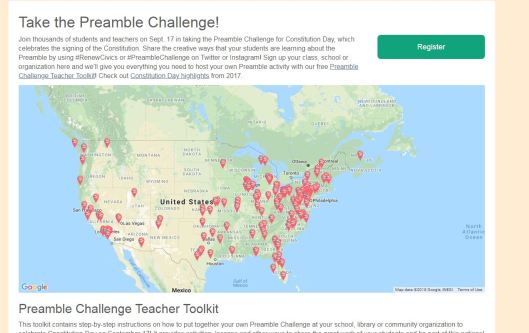
And of COURSE this Freedom Month don’t forget the Preamble Challenge from our friends at the Civics Renewal Network! Check it out today!

Preamble challengePreamble Challenge

NCDD Member Discount on Future Search Workshops

Did you know?? NCDD member org Future Search is offering NCDD members a 30% discount on their upcoming workshops if you register by October 15th. Make sure you register ASAP to get this great offer and experience these workshops led by fellow NCDD member Sandra Janoff and Marvin Weisbord. This announcement was shared with us via the Main NCDD Discussion listserv [and you can learn how to join this list if you aren’t already by clicking here]. Read the announcement below and find more information on FSN’s site here.


Sign Up for Future Search Workshops

We believe positive change takes the most powerful hold when it’s done in a participative, whole-systems way. Join us at a workshop in December to learn the skills – based on almost 40 years of experience – that make Future Search so effective.

Future Search Network is offering 2 Workshops in Philadelphia, PA December 10-12 and 13-14. We are offering a special  30% Tuition Discount for Members of NCDD if you register by October 15, 2018. If you need more help with tuition, please let us know!

Register Today! Come to one or both events with Sandra Janoff  –  co-founder, with Marvin Weisbord of Future Search Network, and recipient of the Organization Development Network 2016 Lifetime Achievement Award!

“There is a high return on this investment in human capital. It takes a lot of energy to plan but it’s worth it because of the new relationships you build, the energy unleashed, the new perspectives people get on key issues.”  – Brian Roberts, United Methodist Church, NJ

Managing a Future Search –  A Leadership Workshop
December 10-12, 2018 – Philadelphia, PA, USA

Materials include your copy of Future Search – Getting the Whole System in the Room

This workshop is for leaders and facilitators who want to learn how applying Future Search principles and methodology enables an organization to transform its capability for action.

Four key principles underlie the Future Search design:

  • Getting the “whole system” in the room.
  • Exploring the same global context (“whole elephant”) as a backdrop for local action.
  • Focusing on the future and common ground rather than conflicts and problems.

This highly successful strategic planning method is used around the world and in every sector to:

  • Create a shared vision and practical action plans among diverse parties.
  • Devise a plan and gain commitment to implement a vision or strategy that already exists.
  • Initiate rapid action on complex issues where no coordinating structure or shared vision exist.

Learn more at www.futuresearch.net/workshops/mfs/

Lead More, Control Less –  A Master Facilitation Class
December 13-14, 2018 – Philadelphia, PA, USA

Materials include your copy of Lead More, Control Less

Self control is the best control.” – Marvin Weisbord and Sandra Janoff

In this workshop, based on the latest book by Sandra Janoff and Marvin Weisbord, “Lead More, Control Less: 8 Advanced Leadership skills that Overturn Convention”,  you will learn a philosophy, principles and actions that produce superior results while reducing your need to control. These skills will support the way you work with diverse groups and complex problems.

  • With the right structures, people will learn more, teach one another, and exercise a level of control you cannot impose.
  • Change the division of labor and you change everything.
  • You overturn convention when you encourage people to use discretion in their work and to share information, coordination, and control of their work.

Speed and complexity are impacting leaders everywhere!  There are insights and skills that you can learn that overturn conventional responses and let you experience more self-control in leading in today’s world.

In her work around the world, Sandra discovered that she could get better results by creating an unconventional approach to leadership. These lessons are brought together with real world experiences to create a unique and memorable seminar.

Learn more at www.futuresearch.net/workshops/lmcl/

“Controlling people never makes great things happen. I have found that applying the principles in “Lead More, Control Less” takes patience, time and imagination. The result is always rewarding and well worth the effort” – Jesper Brodin, Global Head of Range and Supply, IKEA

You can read more about the workshops on Future Search Network’s site at www.futuresearch.net/method/workshops/.

!!!!!2018 FCSS Annual Conference!!!!!

page 12018conf

Hey friends in social studies! Have you registered to attend the upcoming Florida Council for the Social Studies Annual Conference, to be held here in sunny Orlando, Florida from October 19th to October 21st? If not, why not? It’s going to be an excellent time to network, connect, and learn! Check out some of the sessions and networking opportunities we have available!

REGISTER FOR THE CONFERENCE HERE! 

Of course we begin with a celebration of social studies in Florida! Join us for a reception on Friday!
opening reception

Sessions on Saturday and Sunday will cover a variety of topics across all grade levels, including digital learning, simulations, discussion models, curriculum tools and resources, controversial issues, and more!

On Saturday, we will feature the wonderful Dr. Tina Heafner of UNC-Charlotte, who will discuss the role that social studies NEEDS to play in the lives of our students and our communities!

Tina1

On Sunday, we are very excited for a Brunch and Learn with Sajeet Kaur of the Sikh Coalition!

sunbrunch


Celebrating the 19th Amendment with the National Archives!


19tham
Friends, some exciting news from the National Archives! To celebrate the approaching anniversary of the 19th Amendment (passed by Congress in June of 1919 and ratified in August of 1920, NARA is offering a free pop up display explaining and celebrating that historic expansion of the franchise!
You can reserve your FREE display here starting on Wednesday, 19th September. 
The National Archives is offering a free pop up display titled Rightfully Hers
To commemorate the 100th anniversary of the ratification of the 19th amendment
 
Spotlighting this landmark moment in American history and what it took to secure voting rights for women, this pop up display contains simple messages exploring the history of the 19th amendment’s ratification, women’s voting rights before and after the 19th amendment, and its impact today.
 
The link to request one will go live here at Noon EDT on Wednesday, September 19. You will not be able to request one before so mark your calendar! They will go fast!

Displays will be delivered in early March 2019.
 
Presented in part by Unilever, Pivotal Ventures, Carl M. Freeman Foundation in honor of Virginia Allen Freeman, AARP and the National Archives Foundation.

This new pop up history will be a nice addition to all of the resources available to celebrate our Constitution, especially near Constitution Day! Be sure to check out the Preamble Challenge from our friends at the Civics Renewal Network! Check it out today!

Youth with disabilities’ advocacy for inclusion and participation in Uganda

Note: the following entry is a stub. Please help us complete it. Problems and Purpose History Originating Entities and Funding Participant Selection Methods and Tools Used Deliberation, Decisions, and Public Interaction Influence, Outcomes, and Effects Analysis and Lessons Learned See Also References External Links Notes

MetroQuest Online Public Engagement Playbook Webinar

Next week, NCDD member org MetroQuest will be hosting the webinar, Online Public Engagement Playbook; co-sponsored by NCDD and the American Planning Association (APA). The free webinar on Wednesday, September 19th will discuss the successful online engagement strategy which engaged over 5100+ Austin residents and led to the development of the city’s first comprehensive transportation plan. You can read the announcement below or find the original on MetroQuest’s site here.


MetroQuest Webinar: Online Public Engagement Playbook

How is America’s #1 boom town planning for the city’s transportation future?

Wednesday, September 19th
11 am Pacific | 12 pm Mountain | 1 pm Central | 2 pm Eastern (1 hour)
Educational Credit Available (APA AICP CM)
Complimentary (FREE)

On September 19th, find out how Austin engaged 5,100+ citizens online to help inform and shape the Austin Strategic Mobility Plan, its first locally-focused comprehensive transportation plan.

Join Liane Miller, AICP and Senior Business Process Consultant with Austin’s Transportation Department, as she shares the winning elements of her team’s online public engagement playbook. Learn how they combined a great online engagement experience with the right promotional strategy to involve thousands of people, including communities that have been underrepresented in past processes. Discover which of three transportation scenarios earned the most public support.

Attend this complimentary 1-hour webinar for innovative ways to involve members of your community! You’ll learn how to:

  • Reach more people, even with limited staff
  • Share and collect richer planning information by going online
  • Leverage business partnerships to lower barriers to engagement
  • Mine survey results to build a plan that works for all communities
  • Impress city council with a transportation plan informed by the people

Liane will be joined by MetroQuest Chief Engagement Officer Dave Biggs to share best practices and to answer your questions in a live Q&A session.

Thank you to our sponsors: APA and NCDD! AICP CM credit will be available.

Speakers

Liane Miller – Planning and Policy Manager, City of Austin’s Transportation Department
Liane works on planning initiatives, such as the development of the Austin Strategic Mobility Plan, the City’s first multimodal plan. She previously led the citywide capital needs assessment and helped develop the comprehensive plan, Imagine Austin. Liane earned a BS from the University of Texas at Austin and master’s degrees in planning and public administration from the University of Southern California.

Dave Biggs – Chief Engagement Officer, MetroQuest
Dave is a die-hard champion of community engagement and has built a reputation for leading edge community outreach. He is an internationally-recognized speaker, author, and public engagement strategist. Dave is honored to serve as an advisor on best practices for public involvement to many planning agencies such as APA, FHWA, and TRB and public participation organizations such as IAP2 and NCDD.

You can find the original version of this announcement on MetroQuest’s site at http://go.metroquest.com/Online-Public-Engagement-Playbook.html.

undergraduate Introduction to Civic Studies Course

PHIL-0020-01-Intro to Civic Studies at Tufts University (Fall 2018)

  • Ioannis D. Evrigenis, Professor of Political Science
  • Erin I. Kelly, Professor of Philosophy
  • Peter Levine, Lincoln-Filene Professor and Academic Dean, Tisch College

Civic Studies is an interdisciplinary field of study that focuses on critical reflection, ethical thinking, and action for social change. People who think and act together to improve society must address problems of collective action (how to get members to work together) and deliberation (how to reason together about contested values). They must understand how power is organized and how it operates within and between societies. They must grapple with social conflict, violence, and other obstacles to peaceful cooperation. When tensions arise within a group, people face questions of justice and fairness, and they must confront questions about appropriate relationships to outsiders of all types. This introductory course explores ethical, political, and theological frameworks for understanding how people can and should organize themselves to improve societies. Readings are drawn from philosophy and political theory, economics, the history of social movements, and other disciplines. This course provides theoretical grounding for Civic Studies majors and for other students interested in social change.

Books:

Mark Lilla, The Once and Future Liberal: After Identity Politics. On order at the Tufts bookstore. Recommended: David Grann, Killers of the Flower Moon.

Final grades will depend on:

  • 10% class participation
  • 25% first paper (5-7 pages)
  • 25% second paper (5-7 pages)
  • 30% a simulation (a group exercise that comprises six short writing assignments, each worth 5%)
  • 10% in-class midterm exam

September 5: Introduction

September 10: A “feeling of personal responsibility for the world”

September 12: What is a citizen? Who is a citizen?

Aristotle, Politics III.1-5 .

September 17: The citizen in a modern democracy

John Dewey, The Public and its Problems, Chapter 5, “Search for the Great Community.

Problems of Collective Action

September 19: Elinor Ostrom and the Bloomington School

Elinor Ostrom, Nobel Prize Lecture  (Links to an external site.)Links to an external site.(video or text)

September 24: Ostrom Continued

Thomas Dietz, Nives Dolsak, Elinor Ostrom, and Paul C. Stern, “The Drama of the Commons” in Elinor Ostrom, ed., Drama of the Commons, pp. 3-26.

Elinor Ostrom, “Covenants, Collective Action, and Common-Pool Resources

September 26: Collective Action Problems at Scale

James Madison, The Federalist #10.  (Links to an external site.)Links to an external site.

Jane Mansbridge, Beyond Adversary Democracypp. 23-35, 59-76, 163-182 293-8 

October 1: Spontaneous Order

Friedrich Hayek, “The Pretence of Knowledge ” Nobel Prize Lecture (1974)

Friedrich Hayek” in the Stanford Encyclopedia of Philosophy

James C. Scott, Seeing Like a State: How Certain Schemes to Improve the Human Condition Have Failed,Introduction (pp. 1-8), Chapter 3 “Authoritarian High Modernism”

Draft of first paper due

October 3: Social Capital as a Solution

Robert D. Putnam, “Community-Based Social Capital and Educational Performance,” in Ravitch and Viteritti, eds., Making Good Citizens, pp. 58-95

Identifying Good Ends and Means

October 9: Habermas and Deliberative Democracy

First group assignment  (Links to an external site.)Links to an external site. due

October 10: Habermas Continued

  • Jürgen Habermas, Between Facts and Norms, pp. 359-379

October 15: Implementing Deliberative Democracy

Nabatchi, Matt Leighninger, Public Participation for 21st Century Democracy (2015), pp. 241-285 and 305-324 

Danielle E. Allen, Talking to Strangers: Anxieties of Citizenship Since Brown, v. Board of Education pp 140-186

Final draft of first paper due

October 17: Scholars in Public Deliberation

Visiting speaker: Prof. Jonathan Garlick

Bent Flyvbjerg, ” Social Science that Matters ” (2006)

(additional reading)

October 22: John Rawls

John Rawls, A Theory of Justice, pp. 3-19, 52-57

October 24: John Rawls, continued

John Rawls, “The Idea of Public Reason Revisited”

Nina Eliasoph, Avoiding Politics, pp. 1-22

Lynn Sanders, “ Against Deliberation

Exclusion and Identity

October 29

Audre Lorde, “The Master’s Tools Will Never Dismantle the Master’s House.” 

Steve Biko, Black Consciousness and the Quest for True Humanity” 

The Book of Nehemiah 

Second group assignment   due

October 31: Identity and the Common Good

Lilla, The Once and Future Liberal 

November 5: Social Movements

Charles Tilly, ” Social Movements, 1768-2004″

Jürgen Habermas, Theory of Communicative Action, vol. 2, pp. 391-6.

Marshall Ganz, “Why David Sometimes Wins: Strategic Capacity in Social Movements,” in Jeff Goodwin and James M. Jasper, Rethinking Social Movements: Structure, Meaning, and Emotion (Lanham, MD: Rowman and Littlefield, 2004) pp.177-98.

November 7: Community Organizing

Saul AlinskyReveille for Radicals1946 (1969 edition), pp. 76-81; 85-88; 92-100, 132-5, 155-158.

Myles Horton and Paulo Freire, We Make the Road by Walking, pp. 115-138

November 14: Midterm in class

November 19: Nonviolent Campaigns

Martin Luther King, Stride Toward Freedom, chapters 3, 4, and 5.

? Erica Chenoweth and Maria J. Stephan, Why Civil Resistance Works: The Strategic Logic of Nonviolent Conflict, chapters 1 and 2 

November 26: Nonviolence

Bikhu Parekh, GandhiChapter 4 (“Satyagraha”), pp. 51-62;

Timothy Garton Ash, “Velvet Revolution: The Prospects,” New York Review of Books, December 3, 2009

The Person in Community

November 28: Plato, Apology of Socrates

December 3: Plato, Apology of SocratesCrito

December 5: Civic Education: What all this means for what students should learn

Joel Westheimer and Joseph E. Kahne, “Educating the ‘Good Citizen’: Political Choices and Pedagogical Goals,” PS Online

Third group assignment  (Links to an external site.)Links to an external site. due

December 10: Civic Studies at Tufts and Beyond

Draft of second paper due

Dec. 20: Final paper due.

Continue reading

Democratic Learning Exchanges with NCL and Kettering

NCDD member and partner – the National Civic League has been working with the Kettering Foundation on “learning exchanges” with city managers. The two organizations have a long working history over the last several decades, which has sought to explore how to further democratic practices, particularly within local government. This is the most recent effort in this work to continue to shift deeper government collaboration with the community. You can read the article in the post below or find the original on NCL’s site here.


Learning About Democratic Practices with City Managers

The National Civic League is working with the Charles F. Kettering Foundation to organize “learning exchanges” to explore the ways professional city managers engage with members of the public to foster democratic practices in communities.

These twice-a-year exchanges, which have been held at the foundation’s campus in Dayton, Ohio, have facilitated wide-ranging conversations about civic engagement efforts and examples of complementary public action—everything from an experiment in participatory budgeting in Chicago’s 49th ward to dialogues about community-police relations in a small southern city.

The participants have also explored issues such as assets-based community development, relational organizing, social media and technology and the role of public deliberation in addressing “wicked problems,” that is, persistent problems for which there are no obvious technical solutions.

In many of the exchanges, participants have identified tensions between the job of professional manager and the idea of public engagement and democratic governance. Traditionally, managers have been trained to view themselves as technical problem-solvers who advise elected officials and manage city departments to implement the policies adopted during public meetings.

In effect, local elected and appointed officials made the tough decisions and handled the strategizing, prioritizing and long-range planning efforts that allowed municipalities and counties to flourish.

But managers are in some ways uniquely positioned to foster collective problem-solving efforts and grassroots community initiatives, especially when there is a continuity of effort by public managers over a period of years. Some city governments, in fact, have developed detailed protocols to help staff-members think about how and when to engage the public in decision-making and public deliberation.

The National Civic League’s involvement with the Kettering Foundation goes back many years. In the early 1970s, the two organizations worked together to conduct research on what was then described as “citizen participation.” With support from the foundation, the League developed a series of books and videos, highlighting how winners of the All-America City Awards had come together to address pressing issues.

The Kettering Foundation’s primary research question is, “What does it take to make democracy work as it should?” For Kettering, one aspect of this mission is to look at ways professionals can “align their work” with the work of ordinary members of communities.

The League’s various research agreements with the Kettering Foundation have offered unique opportunities over the years to develop new ideas and new relationships with individuals and organizations, some of which have led to other initiatives and projects.

The city manager exchange, for example, led to the development of the Richard S. Childs Fellowship, a project that offers editorial assistance and guidance to working city managers seeking to write about their experiences with democratic practices in their communities. Some of these writings have already appeared in the National Civic Review as case studies and essays.

The fellowship was named for the political reformer and long-serving member of the National Civic League board of directors who played a leading role in developing the 1915 Model City Charter, the original blueprint for the city council-city manager plan for local government.

These research exchanges have become an important part of the League’s efforts to learn more about community-based efforts and address challenging issues. They also serve as a bridge between the organization’s historic mission of promoting professionalism in local government with its more modern focus on civic engagement, collaborative problem-solving and social equity.

You can find the original version of this on National Civic League’s site at www.nationalcivicleague.org/learning-about-democratic-practices-with-city-managers/.

V.S. Naipaul’s view of culture

I read a lot of Naipaul in my youth and see value in his work. But Ian Buruma’s obituary profile reminds me of the main way in which I disagreed with him.

Naipaul believed there were “whole cultures”: comprehensive, harmonious, indigenous, and hermetic. Examples included classical India, England, and pre-colonial West Africa. A whole culture was “wounded” when it was mixed up with foreign elements, usually as a result of conquest or deferential imitation.

Naipaul was politically incorrect in three respects. He admired the “whole cultures” of Europe, such as England, and emphasized their indigenous roots. He saw many interventions as imperialistic–not just European conquests but, for example, the Islamic influence in India or the Arab influence on non-Arab Muslims. And he mocked people in the global South who made unsophisticated efforts to imitate the imperial centers: West Indians pretending to be British, or Malays pretending to be Arabs.

On the other hand, Naipaul was in sync with certain strains of post-colonial thought: he liked indigeneity and opposed cultural appropriation.

It’s true that “cosmopolitan” was a positive word in Naipaul’s lexicon, and he claimed to be cosmopolitan himself. But he insisted that a cosmopolitan was at home in more than one culture, truly understanding and living it. Lightly borrowing some elements of other cultures didn’t count:

[Satyajit] Ray was a Bengali intellectual and artist who was as much at home in European as in Indian culture. He loved Indian art and music as much as European classical music or literature, and had a deep knowledge of all these things. The fact that most of us eat American junk food, or watch Hollywood movies, doesn’t make us necessarily more cosmopolitan. To be cosmopolitan you need to feel at home in various different cultures, as Ray did, and few people do even now. As far as the shrinking world is concerned, this is easy to exaggerate.

For what it’s worth, I believe:

  1. There is no indigeneity. We have all migrated. Not only people but also ideas move constantly. Every group has been deeply influenced by other groups for as far back as we can see.
  2. There are no whole cultures. A culture is an assemblage of ideas about the world (defining both “ideas” and “world” broadly). Since everyone holds at least slightly different ideas, labeling people as members of a culture just means that most of them share some important ideas. It’s a statistical generalization about the beliefs of a population. Furthermore, the ideas that we happen to hold are always badly insufficient, and we are always looking for more. Because of our profound human limitations–cognitive and imaginative–every culture is drastically incomplete.
  3. Mixing is good. India, for example, is not a “wounded civilization” because the original Hindu whole has been rent by Muslims and Europeans. It is a fabulous quilt of diversity, and has been for three millennia. Even the Hindu aspect is massively diverse.
  4. Imitation is good, although you have to do it with creativity, respect, and taste. Some of Naipaul’s most effective criticism was aimed at poor efforts at imitation.
  5. Imperialism is bad. But that’s not because it disrupts indigeneity and cultural harmony or because it introduces ideas that should stay somewhere else. It’s bad because it involves forcibly seizing land and goods while usually also killing, exploiting, and (literally) raping people. The bad part is the violence and exploitation, not the mixing.

See also: what is cultural appropriation?notes on cultural appropriation after the royal wedding; and everyone unique, all connected.