Our Next Assignment: Where Americans Stand on Public K-12 Education
Reply

At Tisch College and Tufts, we are extremely proud of Moon Duchin and her team in the Metric Geometry and Gerrymandering group. This new video takes less than two minutes to play and introduces their work:
Moon and her colleagues are generating tools, participating in legal processes, and training people (from k-12 students to expert witnesses)–all in the interests of democratizing influence on the redistricting process.
As an example, they develop algorithms that start with the existing map and randomly generate enormous numbers of additional maps. Observing that set of possible maps allows one to see whether any given one is more partisan–or otherwise less fair–than the norm. Often, the real or proposed map is an outlier because it reflects a political agenda.
I am pleased to help promote this initiative on the eve of an election that will be deeply shaped by gerrymandering–and likely to affect the electoral map for the next decade.
See also Rebooting the Mathematics Behind Gerrymandering by Moon Duchin and me.
In 2016, everyone thinks the Senate “map” is terrible for Democrats. Forty-two Republican incumbents don’t face an election this year, whereas Democrats must defend 24 incumbents, 10 of them in states that Donald Trump won in 2016–sometimes by very large margins. Even a Blue Wave is expected to leave the Republicans in charge of the Senate.
You would think that 2020 would have to be better for Democrats. After all, Democratic voters outnumber Republicans in national votes for the president and the House. If, by the luck of the draw, the Democrats face a bad Senate map one year, the next time has to be better–right?
Actually, 2020 looks like another pretty hard year for the Dems. According to Nathaniel Rakich in FiveThirtyEight, 22 Republican Senators will face reelection. That sounds like fertile ground for Democrats, except that only two of those 22, Cory Gardner and Susan Collins, represent states that Hillary Clinton won in 2016. Based on that information, you might expect Republicans to lose just a seat or two. Meanwhile, 11 Democratic Senators will face reelection, and two of them represent states that Trump won in 2016: Jeanne Shaheen of New Hampshire (which was close) and Doug Jones of Alabama (which Trump won by 27 points). Based on that information, you might expect the Democrats to lose Jones and maybe one or two more. If each party loses a seat or two to the other, it will be a wash, preserving the Republican majority.
How can this be? One reason is that a harder year will finally arrive for the Republicans in 2022. Twelve Democrats and 22 Republicans will have to defend seats that year, including several Republicans in swing states: Rubio in Florida, Grassley in Iowa (if he runs again at 89), Burr in North Carolina, Portman in Ohio, Toomey in Pennsylvania, and Johnson in Wisconsin. All the Dems who are up in 2022 are in either blue or purple states.
But the other reason is the extraordinary gap between the Senate and the American population. Even now, with the Senate controlled by Republicans, Democratic senators represent substantially more people:
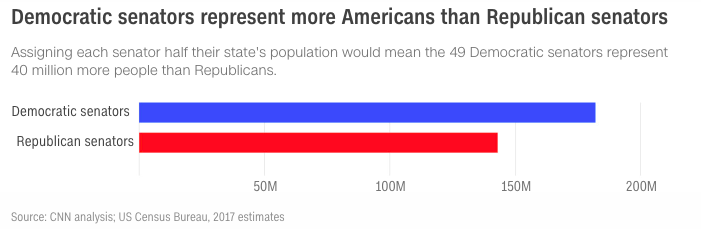
The Constitution enshrines this imbalance. Anything in the whole document can be changed by amendment, “provided that… no state, without its consent, shall be deprived of its equal suffrage in the Senate.” This is is our only unamendable rule.
Long-term predictions are foolish, but I think you can imagine a pattern of Democratic presidents and House majorities being systematically stymied by Republican senates and the Supreme Court that the Senate has shaped. Then a significant majority of the public will be consistently blocked by an increasingly radicalized minority that is based in different parts of the country as we address climate crises, AI, and other truly profound challenges. Many people will not trace the failures of the government to specific provisions in our Constitution; they will perceive a government that’s inexplicably unresponsive and unrepresentative. And that, it seems to me, is a recipe for constitutional collapse.
See also: is our constitutional order doomed?; two perspectives on our political paralysis; and are we seeing the fatal flaw of a presidential constitution?
“So successful has the prison been that, after a century and a half of ‘failures’, the prison still exists, producing the same results, and there is the greatest reluctance to dispense with it.”
Foucault, Discipline and Punish, 277
In my mini-review of Bryan Caplan’s polemic against education, I noted that he partly ignores Foucaultian arguments for schooling-as-discipline. But Foucault’s work is difficult to understand–though it’s actually written quite well–because it redescribes our ordinary world in terms that alienate us from what seems familiar. His understanding of schooling is dependent on his unfamiliar recasting of the prison as a site of innovation in discipline–techniques which ultimately had more value in the cultivation of good workers than in the punishment of transgression or the rehabilitation of criminal deviance.
Consider these seven principles of penal reform:
These all sound reasonable, don’t they? Compared to our current prison system, they sound humane. And yet these principles were first espoused in the early nineteenth century, and have been reiterated periodically since then as if they were innovations. I pulled them from Michel Foucault’s Discipline and Punish (269-70). What’s taking so long? Why don’t we ever seem to achieve these ideals?
Discipline and Punish is a famous work on a major topic: it’s read widely and it’s one of the most-cited books in the social sciences. And yet its insight is both widely parroted and widely ignored–usually by the same people. One way to read the book is as a guide to sociological methodology: “the purpose of the system is what it does.” I also like the longer version from Dreyfus and Rabinow, quoting Foucault:
“People know what they do; they frequently know why they do what they do; but what they don’t know is what what they do does.” (187)
Everything follows from that dictum: we know what we do, sometimes we even know why, but we are remarkably ignorant of what our collective intentions and actions do.
Do prisons reform criminals? No: the five year rearrest rate for prisoners is 76.6%. Even if we correct that for the technical parole violations that are basically a product of the system itself (and I’m not sure we should in this context–the system has to answer for those reincarcerations) the rate is probably around the 43% baseline that RAND uses to assess the efficacy of programs. (College in prison reduces that kind of recidivism.)
Can prisons themselves be reformed? No: the entire history of prisons is a history of reform after reform, and we’ve been facing the same prison problems–and demanding the same reforms–for centuries. LITERAL CENTURIES.
What then is the point? Prisons produce criminals, and not in the “finishing school for crime” sort of way: prisons produce a whole realm of knowledge about deviance, delinquency, and criminality, but they also produce those deviants, delinquents, and criminals as the subject of research that must exist to justify our inquiry into them. As a byproduct, prisons also produce techniques for managing students, workers, and citizens, techniques that seem to have massively increased productivity and effectiveness, but have the prison both in their genealogy and their current function. In fact, it makes perfect sense from a Foucaultian perspective to say that the technologies of schools, workplaces, and politics are the true product of prisons, and prisoners are the waste byproduct, an unrecycled remainder.
If you want to have some fun in the classroom, tell students that the way schools function is a lot like a prison:
Ask an audience in the middle of a class or lecture how many of them have to pee right that moment: we hate being reminded of our embodiment in those moments, but we’ve almost all mastered sitting for long periods of time despite that fact. Urinary continence is a skill that schools can teach, even if there’s not much evidence students will remember their calculus lessons if they don’t use them.
Schools and prisons both produce individuality as a category for praise and blame, wages and good-time credits, centered in a body and a set of behaviors, yet accomplished through a network of interlocking institutions and supports. Schools and prisons make us into the kinds of embodied minds that we are–capable of having a biographical records, capable of taking responsibility for the success or failure of our own careers and rehabilitation. And yet schools are a lot better at this than prisons, which is why we now find ourselves back at the idea that prisons aren’t enough like the schools–the same schools that prisons helped us figure out how to create. You hear now of the “prison-to-school pipeline,” a line I’ve used myself.
This spring, Elizabeth Hinton name-checked Georgetown’s Prison Scholars Program in the New York Times in her argument that we should transform prisons into colleges and restore Pell Grant eligibility for all incarcerated students. I am wholeheartedly committed to those goals–a policy for which I believe there is strong bipartisan support. But the this will not solve America’s prison problem–and in many important respects it is an extension of the logic of the prison itself.
The other major claim of Foucault’s work is that prisons are unreformable–they literally subsist on prospects of reform rather than ever actually getting reformed. And when we do “improve” prisons, we mostly do so by developing new techniques for controlling prisoners’ bodies and cultivating docility and compliance in them. As punishment has become more gentle, it has become more generalizable!
Foucault’s argument suggests that the motivations of early reformers like Beccaria and Bentham was less to make the corporal punishment common in that era gentler than it was to make it more effective at social control. I think this is generally unfair: Beccaria clearly has civic republican goals in mind, and is a forerunner of so many different civic republican and contractualist positions that he deserves the benefit of the doubt. But again one can be ignorant of the purposes to which our efforts are ultimately put. And on Foucault’s view the gentler punishments of work, solitude, and surveillance all create new techniques and disciplines for managing all sorts of people: soldiers, factory workers, students, and patients, for instance.
Instead of seeing the ultimate end of the punishment reformer’s work as creating more liberty by restraining the cruel sovereign, Foucault argues instead that reform steals the domination from the sovereign–who after all is using her power inefficiently–and appropriates it for the reformer. The reformer promises to do better–and creates an expertise and a field of knowledge with which to chart his success.
So to recap: reformers don’t fix prisons, they’ve been offering the same complaints for centuries. (The same ones we offer today!) Reformers argue for smoother and gentler punishment techniques. They promise to be punish better and thereby steal the sovereign’s monopoly on violence for themselves. They install themselves as experts and create a field of expertise to justify their exproporiation of punitive power. And they thus increase the dissemination of punitive and carceral logics, making both criminals and non-criminals worse off.
Angela Davis and Joy James are my go-to writers on abolition, but Allegra McLeod’s essay on abolition is really useful for understanding the terrain, responding to various objections, and showing the reasons why “abolition” has a valence that “reform” and even “decarceration” lack. But it’s Davis who takes up the specific preconditions of prison abolition:
“In thinking specifically about the abolition of prisons using the approach of abolition democracy, we would propose the creation of an array of social institutions that would begin to solve the social problems that set people on the track to prison, thereby helping to render the prison obsolete. There is a direct connection with slavery: when slavery was abolished black people were set free, but they lacked access to the material resources that would enable them to fashion new, free lives. Prisons have thrived over the last century precisely because of the absence of those resources and the persistence of some of the deep structures of slavery. They cannot, therefore, be eliminated unless new institutions and resources are made available to those communities that provide, in large part, the human beings that make up the prison population.”
Angela Davis, Abolition Democracy, page 96.
So long as we want the kind of bureaucratized social control that depends on the various carceral techniques Foucault details, we won’t ever reform prisons. Short-lived reform efforts will give way to long periods of basic comfort with detention as the primary mode of punishment, just as they have reliably done throughout the era of the nation-state. Build a society that doesn’t require docility and we won’t need to have zones for warehousing the least docile among us. But until we do, prisoners will always be with us.
I find little hope in these prescriptions. But I think it’s worth noting that the entirety of mass incarceration in the US post-dates the publication of Discipline and Punish. Whatever has gone wrong in the US (and to a lesser extent in Great Britain) was completely off the table when Foucault was writing–and thus we could eliminate the “mass-” or “hyper-” modifier, set most prisoners free, and still probably preserve our carceral society unhampered by the deeper anarchist impulses that seemed to motivate Foucault.
Keep the social control, jettison the prison. It’s not abolition–but I agree with James Forman, Jr. that it’s taken forty years of concerted local efforts to build the racialized mass incarceration of 2.2 million people, and it’s precisely the history of those seemingly reasonable decisions that provide a roadmap for mass decarceration. We should be so lucky to have Foucault’s problems.
Today is the day! #NCDD2018 is finally here and we couldn’t be more excited!! As our fantastic D&D community convenes, we look forward to a jam-packed weekend filled with inspiring speakers, an exciting variety of great workshops, the hottest efforts in civic engagement, and so much more!
 This weekend will be a great opportunity to connect with hundreds of folks passionate about dialogue, deliberation, and public engagement work! Connect with movers and shakers in the field as we explore how to further strengthen our capacity for this work and amplify D&D across the nation and world.
You can still join us if you’re in the Denver/Colorado area -check out the registration page here and consider registering for even just one day at the $175 one-day registration rate!
We have several exciting options of our #NCDD2018 guidebook for conference attendees to check out. Our beautiful guidebooks were created by our co-founder, Andy Fluke; so make sure you pick up your hard copy at the NCDD registration office! In addition to our classic offering, we teamed up with Konveio who is hosting a digital, interactive version – which you can find here. The Konveio digital version allows NCDDers to makes comments on sessions, engage with other attendees, tweet directly from the guidebook, and more. It’s great addition to our usual conference experience, so check it out!
NCDD will be keeping you up to date on about what’s happening during the conference via our social media outlets, so make sure to be part of the conversation! Our conference team and attendees will be live tweeting the whole conference on Twitter, so follow us @NCDD and using the hashtags #NCDD2018, #NCDD, and #NCDDEmergingLeaders.
You can also follow along on NCDD’s Facebook page or on Instagram via ncdd_network. These will all be great ways to be part of the conversation even if you’re not here with us in Denver.
You are, we hope, familiar with Civics360, a resource dedicated to providing content and literacy tools for civics instruction.

If you aren’t familiar with Civics360, it has narrated 5 to 10 minute videos, readings in three languages, vocabulary tools, and assessment resources across a wide variety of civics and government related topics. It does require registration, but it is 100% free. You can find an overview of Civics360 here.
One of the most commonly requested resources for Civics360 are activities connected to the modules. This is something that we have been working on, and we are happy to note that we have made some progress on this! We have taken activities from our traditional lessons on Florida Citizen and turned them into short activities on Civics360. They are in a PDF Form format, so students should be able to download and complete them on their own devices as well and print or email them to the teacher. These activities generally involve taking what they have learned to the next level and demonstrating understanding of the content within the module.
We have now added stand-alone ‘Showing What You Know’ activities for the following benchmarks: 1.3 (Road to Independence), 1.5 (Articles), 1.6 (Preamble), 1.7(Limits on Gov Power), 2.4 (The Bill of Rights), 3.1(Forms of Gov), 3.2 (Systems of Gov), and 3.4 (Federalism). Look for the ‘Showing What You Know’ section on each module page!

More on the Civic Studies major at Tufts is here.
Required Introductory Course:
Thinking about Justice:
Social Conflict, Inequality, and Violence:
Civic Action and Social Movements:
Civic Skills:
Internship Seminar:
Capstone Seminar:
#NCDD2018 is almost here! Just another day until our pre-conference sessions kick off on Thursday and we couldn’t be more excited to start seeing folks again! In order to really get the most out of #NCDD2018 we encourage you to check out the extra offerings at the conference, in addition to our inspiring speakers, over 60 workshops, and 30+ presenters at the D&D Showcase.
The full conference schedule is on the NCDD blog and make sure you check out the interactive, digital version hosted by Konveio! Share your thoughts here on the blog about the conference theme and how to amplify the work of D&D. Get started on the conference networking early by connecting with other attendees here. If you are looking for a room share at the Sheraton, folks are posting here. Finally, if you haven’t gotten your tickets and you’d like to join us, we have 3-day and single-day tickets still available here. That’s all, folks!

Can’t wait to see everyone at the conference!
Pre-conference sessions!
We are thrilled to offer five exciting day long and one half-day pre-conference sessions on Thursday, November 1, 2018, prior to the start of NCDD 2018! These sessions are great for people of various levels of experience, and offer a variety of topics. Read through these descriptions and go to ncdd2018-precon.eventbrite.com to register!
5 – 7pm – Informal Meet & Greet
We welcome all folks participating in pre-conference activities and conference attendees who have arrived early to join NCDD’s Staff at Mix16 Lounge in the hotel lobby for an informal meet & greet!
6 – 7pm – Deliberation Bootcamp
This session, specifically designed for newcomers to the conference, will provide an overall introduction to NCDD and to many of the key concepts, organizations, and challenges related to the field. The session will be led by Martin Carcasson, NCDD Board member and Director of Colorado State University’s Center for Public Deliberation. Email Martín at mcarcas@colostate.edu to let him know you’ll be attending the Bootcamp. (Governor’s Square 14)
6:30 – 8:30pm – Breaking the Partisan Trance: A dialogue think tank about this American moment
Similar to a couple in the middle of deep-set resentments, growing numbers of Americans today have become so enraged that they can hardly see or hear each other honestly anymore. The kind of collective distortions that anger generates can be reminiscent at times of a “trance-like” state. If that’s true, we’re curious about the ways in which dialogue practices can effectively break the almost hypnotic, reflexive reactions that currently paralyze politics. This evening will be dedicated to exploring these possibilities together, and trying them out for ourselves, utilizing various approaches we’ve been exploring, including a Living Room Conversation format and the Transpartisan Matrix to assist in the collective inquiry. Come join the brainstorm.. The fate of the republic depends on it! (Governor’s Square 15)
8 – 9:15pm – Emerging Leaders Mentoring Session
NCDD is hosting a pre-conference event for young people and students. This will be a time for attendees 35 and under to connect with the other younger conference attendees. We will also be kicking off our NCDD 2018 Mentoring Program, which will intentionally connect a cadre of experienced D&D leaders with students and youth attendees during the conference. (Governor’s Square 12)
6pm – 8:30pm – White Privilege Symposium Community Event
We are sharing the Ballroom with the White Privilege Symposium for their community event, featuring performances and speakers. Event is open to NCDD attendees and the public. (Plaza Ballroom)
7:30pm – 9:30pm – National Issues Forum: The Opiod Epidemic
What Should We Do About The Opioid Epidemic? – Virgina York will lead attendees in a National Issues Forum on the opioid epidemic. Join fellow attendees to experience the National Issues Forums model and deliberate on possible approaches to this complex national issue. (Governor’s Square 15)
8:30pm and on – Building Bridges Salon
Join a late night discussion about dialogue and racial privilege after the WPS community kick-off event. Come upstairs around 8:30pm to the 15FIFTY Restaurant & Lounge for a loosely facilitated conversation to explore how WPS attendees & NCDDers can do better together.
12:30 – 1:30 pm – Ben Franklin Circles Lunch
Ben Franklin Circles (BFC) use Franklin’s classic 13 virtues to spark discussion about how participants can improve themselves and their communities. Join BFC hosts from around the country for a relaxed lunch and Ben Franklin Circle in action. Get a feel for the BFC approach as we discuss Franklin’s virtue of “Resolution” in relation to our conference theme: connecting and strengthening civic innovators. The combination of Franklin’s original prompts and modern day topics generates a unique lens for civic dialogue and community building. Come eat, explore, and innovate with us. (Plaza Court 2)
For planning purposes it would assist the presenters to know if you will plan to attend this discussion circle. Please fill out the brief form here.
This lunchtime breakout session is a circle in action. For general information about BFC please see our workshop on Friday Nov. 2nd , Session A.
Hosted by: Tracy Rogers-Tryba, Ben Franklin Circle Host, IL and Danyel Addes -Network and Program Manager, Belfer Center for Innovation and Social Impact, 92nd Street Y
5pm – on – Free Time & Civic Dinner Opportunity
Explore downtown Denver and go out to dinner with new or old friends… We’ll provide you with all you need to organize your evening out!
Conference sponsor Civic Dinners is offering to help people run their own Civic Dinners Saturday night. Civic Dinners helps people transform dinner tables into forums for positive social change. Our friends at Civic Dinners are happy to help anyone who wants to host on any of their three national topics: Bridging the Racial Divide, The Voice of Women, or Common Ground (just launched!).
Civic Dinners will be getting people to sign up during the Showcase/Reception on Friday afternoon. Those of you who’d like to host something at a restaurant or, even better, local folks who’d like to host a Civic Dinner in your home, can plan to do so! If this is of interest to you, email Jenn Graham at jenn@civicdinners.com so you two can connect on the details.

Make sure you check out the full conference schedule for the line-up of workshops, plenaries, and more!
On Monday, NCDD member David Campt will be holding one of his workshops, Dismantling Racism: One Conversation at a Time, on November 5th in Denver. Learn more and register here!

In The Washington Post, Amy Gardner reads some tea leaves that might foretell youth turnout in November.
On one hand, the good news: “In Pennsylvania, youth voters have made up nearly 60 percent of all new registrants, TargetSmart reported in September. The share of the electorate that is under age 30 has grown since 2017 in several key states, including Nevada, North Carolina and Florida, according to state voter registration data tracked by the firm L2. In Virginia, requests for student absentee ballots, at about 30,000, are about 50 percent higher than in last year’s gubernatorial election.”
We could add that CIRCLE’s youth polling finds much higher levels of intent to vote than we have seen recently. And these data from Texas look promising:
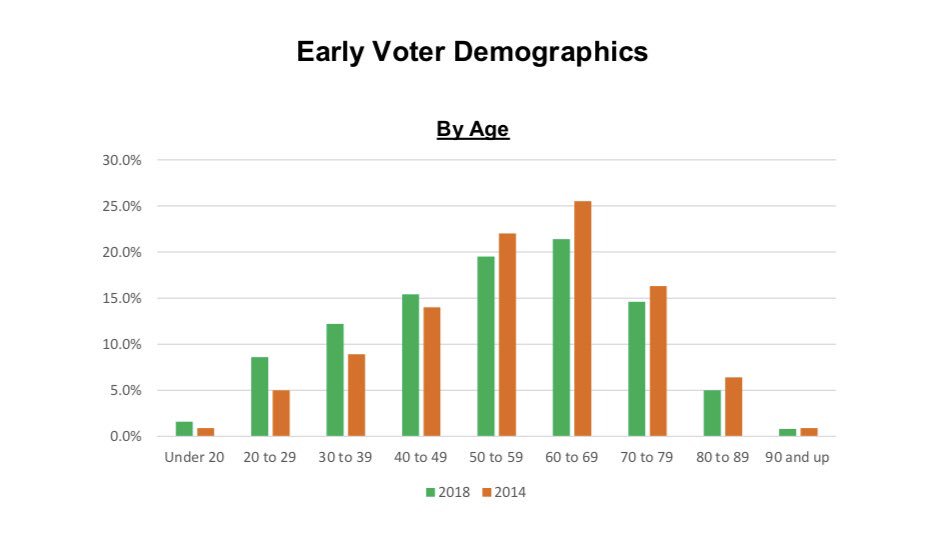 On the other hand, Gardner notes,
There are plenty of reasons for skepticism about an age group that typically performs dismally at the polls. In 2016, young Americans were expected to turn out heavily against Trump, but the actual share of voters under 30 who cast ballots was 43 percent of eligible voters — about the same as the previous presidential election in 2012 and lower than 2008. (Overall turnout in 2016 was 60 percent.)
Midterm performance is typically far worse: Just 16 percent of young Americans cast ballots in 2014. The highest midterm turnout among voters under 30 in the past three decades was a mere 21 percent in 1994.
And some of the tea leaves seem to foretell just a modest improvement:
In Nevada, young voters’ share of the electorate was 18.6 percent in August, up from 17.5 percent in September 2017, according to L2. In North Carolina, it was 18.3 percent in October, up from 16.7 percent in September 2017. And in Florida, it was 16.6 percent in September, up from 15.6 percent a year earlier.
Meanwhile, in Politico, Marc Caputo, Matt Dixon, and Isabel Dobrin write:
THE YOUNG PEOPLE WILL … STAY HOME? — Remember all that talk of how “the young people will win” and come out in force in Florida, especially after the Parkland massacre? So far, it’s not happening. Voters between the ages of 18-29 are 17 percent of the registered voters in Florida but have only cast 5 percent of the ballots so far. They tend to vote more Democratic. Meanwhile, voters 65 and older are 18.4 percent of the electorate but have cast 51.4 percent of the ballots. And older voters tend to vote more Republican.
Their analysis is based on Daniel Smith’s chart of the early votes so far in Florida, which shows all age groups rising but youth by the smallest amount:
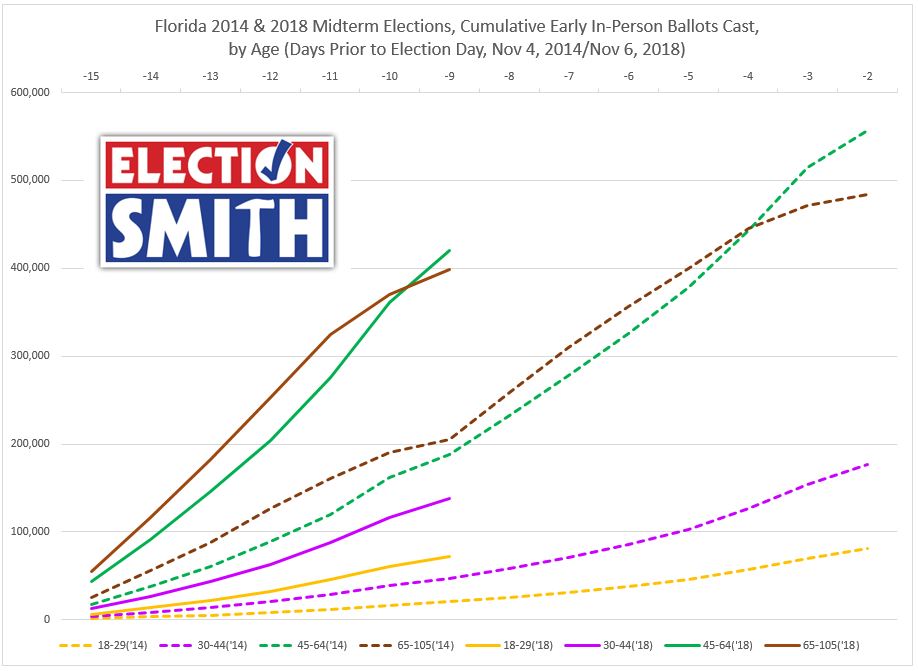
A bunch of different statistics are being cited here: the number of voters or registrants in various age groups, the turnout (the percentage of eligible people in each category who actually voted), and the share of the electorate (what proportion of all voters fit in each category). These articles also cite statistics about registration, early voting, and total voting. It’s easy to get confused.
I expect turnout to rise for the population as a whole, in large part because of the actual and perceived high stakes of the 2018 election. I think youth turnout will also rise but youth will face a challenge keeping pace with the general increase. The difference between them and older voters will probably look better than in Dan Smith’s chart, because early voting seems to appeal especially to older people.
But we could still see various scenarios.
If youth turnout and share of the electorate both rise, it will be a great year for youth voting. Youth turnout could actually fall, but that would really surprise me. If youth turnout rises but no faster than–or not as fast as–the turnout of older people, then youth share will shrink. This will be reported by many news outlets as a decline. That interpretation will not be an outright error. If you want to exercise more influence on the outcome, you must increase your share of the vote. A flat or shrinking share means having no more influence. Also, if turnout rises but youth turnout rises less than average, it will pose questions about the impact of the nonpartisan and partisan efforts specifically to engage youth.
But it will also be true that more youth have voted, which will be worth celebrating if you care about youth engagement. And it will break a pattern, because historically youth turnout has been remarkably flat in midterm elections. Breaking that pattern might be a small positive step even if youth share shrinks slightly.
