Friends, as a reminder, the 2019 SOURCES conference here at UCF is coming soon. This conference, hosted by UCF’s own Dr. Scott Waring and featuring support and resources from the Library of Congress, provides participants with pedagogy and resources around the use of primary sources and literature in the classroom. Folks from FJCC have both attended and presented before, and this year’s keynote is provided by the always excellent and engaging friend of FJCC and the Lou Frey Institute, iCivics’ own Dr. Emma Humphries. You can register for the conference here!
Don’t forget to register for SOURCES 2019!
SOURCES Annual Conference
University of Central Florida
Orlando, Florida
Saturday, January 19, 2019
SourcesConference.com
Here is a quick overview of the sessions:
Dr. Emma Humphries, of iCivics, will provide the Keynote Presentation, DBQuest: New Topic Modules, New PD, Same Effective Digital Tool. In this session, she will showcase access and functionality of the iCivics’ digital primary source analysis tool DBQuest, featuring the two NEW topic modules recently released on the Constitution and the Louisiana Purchase. She will provide information about new (and free) professional development opportunities and on-demand resources.
Additional session titles include the following:
Engaging Students in History Through Historical Fiction Paired With Primary Sources
Teaching the Arab-Israeli Conflict with Primary Sources
Teaching African American History and the Ongoing Struggle for Civil Rights
Who is to Blame for the Financial Crisis of 2007-2008?
Seeking the Seminole Indians
Portraits: Observe, Inquire and Infer -An Arts Integration Strategy
Infuse C-SPAN’s Video-Based Materials in Your Curriculum
Strategies for Successful Socratic Seminars
Yellow Roses, Sashes and Signs: Voices of the Women’s Suffrage Movement
Deep Dive Docs to Develop Disciplinary Literacy
Engaging Students in the Past in Order to Prepare Citizens of the Future
Hollywood or History? An Inquiry-Based Strategy for Using Film and Primary Sources to Teach United States History
Using Primary Sources as Bellringers
Primary Sources and Poetry
Durable Learning Routines to Analyze Primary Sources
Engaging Young Children in an Exploration of Inquiry-Based Primary Source Instruction with KidCitizen
The Fort Sumter Crisis: Options and Decisions
The Recollections of Belle Butler and A Birthday Cake for George Washington
Chronicling America With Voyant Text Mining Software
The 14th Colony: The American Revolution’s Best Kept Secret
Bimetallism Isn’t a Metallica Album: U.S. History Standards and Economics
History of the Microscope and Microscopic Images: Engaging High School Biology Students Using Primary Sources
Revealing Perspectives, Reforming through Activism
All sessions will be located in the Teaching Academy at UCF. You can get directions to the campus at the following address: https://map.ucf.edu/directions. Printable campus maps are available at the following address: https://map.ucf.edu/printable. You may park in Parking Garage A (PGA) or I (PGI). There is no need to pay, as tickets are not assessed on weekends, so parking is free, too! Registration will begin at 8:30 am on Saturday, January 19, 2019 in the lobby of the Teaching Academy. Come early, as refreshments will be served in the morning, as well as for a mid-afternoon break.
If you have any questions, concerns, etc., please do not hesitate to contact us at TPS@UCF.edu
I posted a first blog on January 8, 2003. For more than a decade, I was an obsessive blogger, posting once every single work day. Sometimes, while traveling, I would go to serious lengths to get online in order to post just before midnight to avoid breaking my streak.
Lately, I have slacked off. I posted 163 times this year, or a little more than three times per week.
I blame Donald J. Trump. In 2018, I spent too much time following the latest outrages, about which I had nothing unusual or useful to add. Nowadays, I’m not reading as much serious stuff as I used to, unless it’s directly relevant to research or teaching. For several decades, I read almost every article in every issue of The New York Review of Books, but now I watch a growing stack of unopened issues. Instead, I’m pouring my time into checking whether the Post says something different from CNN about Trump’s latest tweet or what happened to the S&P and the presidential approval polling average as a result of the day’s news.
Then again, maybe this is not Trump’s fault. We’re each responsible for how we deploy our attention, and there is still plenty of excellent new work to read and reflect on. A New Year’s resolution, then, is not necessarily to blog more but to squander less time on ephemeral outrages in order to understand their deeper causes, or else to appreciate more of the things that are wonderful about our world.
NCDD is excited to announce our January Confab Call featuring West Virginia Senator John Unger! This FREE call will take place Wednesday, January 16th from 1-2pm Eastern/10-11am Pacific. Make sure you register today to secure your spot!
On the call, Senator Unger will discuss the integral role of public engagement in his work as a state senator. He will talk with us about how he has been using dialogue and deliberation to engage with constituents in his district, and how he attributes that to his recent reelection bid against a well-funded opponent.
John Unger has committed his life to being a public servant-leader and bringing together his many experiences in theology and public life. Unger is currently serving as a West Virginia state senator representing Berkeley and Jefferson counties in West Virginia. Unger was first elected to the West Virginia Senate in 1998 at the age of 28 – making him one of the youngest elected state senators in West Virginia history. He is currently serving his fifth four-year term and is the Senate Minority Whip. Also, Unger is currently the pastor of the three historic Harpers Ferry Civil War churches: St. John Lutheran Church, Bolivar United Methodist Church, and the priest of St. John’s Episcopal Church. Unger has also done extensive work relating to international humanitarian issues in Asia, India, and the Middle East.
During his Senate tenure, Unger lead to make West Virginia one of the first states in the nation to have universal early childhood education through the West Virginia Early Childhood Education Act. He combated child poverty and hunger with the Feed to Achieve Act. Senator Unger also sponsored the creation of the State Division of Energy, Farmland Protection Act, Water Resource Protection Act, anti-animal cruelty legislation, anti-litter legislation and numerous education bills.
This will be an engaging conversation on a timely topic in our politics. Don’t miss out – register for our call today!
About NCDD’s Confab Calls
NCDD’s Confab Calls are opportunities for members (and potential members) of NCDD to talk with and hear from innovators in our field about the work they’re doing and to connect with fellow members around shared interests. Membership in NCDD is encouraged but not required for participation. Confabs are free and open to all. Register today if you’d like to join us!
These are brand-new or planned buildings within walking distance of our home in Cambridge, MA.
I see this kind of design all over Boston and have also noticed it as far away as Kyiv. The typical urban architecture of our decade seems as distinctive as that of the 1890s or the 1930s.
The facades are divided into rectilinear panels of various sizes, avoiding regular patterns and symmetry. To differentiate the panels, a range of materials is used–notably, exposed wood, painted wood, brushed steel, some concrete, and tinted or clear glass. Often the panels are set in different planes. The architectural elements use a modernist vocabulary (e.g., windows without moldings, flat roofs, no cornices), but the overall impression is anti-modernist because the patterns have decorative–not functional–purposes.
I don’t know what search terms to use to test this uninformed observation. If you search “architecture 2010s,” the results are all about marquee buildings by world-famous architects, and the trend is radical experimentation with materials and forms–usually organic rather than rectilinear. I’m not sure whether there is a name or a recognized handbook for the kinds of relatively routine (no offense) buildings shown above, but I think they all would have looked odd in 2000 and have become ubiquitous since 2010.
Good afternoon, friends. In this era of increased rancor in our schools, our communities, and in our halls of government, it remains vital that we as social studies educators continue to work to create an environment that allows students to engage with their learning. But this engagement should also allow space for students to feel comfortable with critical conversations around topics of relevance and importance. We are social studies teachers, and while we might seek to ensure that our students do not have a sense of our own politics and attitudes, we do have a responsibility to ensure that our classrooms allow them to engage intelligently and honestly and fairly with current and controversial issues connected to what they are learning and what they are shaped by.
This interactive workshop will help teachers explore strategies for facilitating critical conversations with students and colleagues. Participants will engage in personal reflection and examine some common beliefs and biases that can affect their ability to engage in productive conversations. They will learn strategies for creating supportive learning environments that encourage risk-taking during critical conversations. Finally, they’ll investigate methods of teaching about implicit bias, race and other critical topics.
Participants will learn to:
• Identify strategies and resources to create a positive and respectful learning environment where critical conversations can take place.
• Reflect on personal assumptions and learned biases and recognize their impact on classroom practice.
• Develop skills and confidence for engaging in and facilitating conversations about race and other critical topics.
This workshop is open only to educators. Participants may include:
• Current K–12 teachers, administrators and counselors.
• Pre-service teachers.
• Educators who teach or coach K–12 teachers, administrators and counselors.
Additional Information:
• Morning coffee, lunch, and all materials are provided.
• Check-in begins at 8:15 a.m.
• The program starts promptly at 9:00 a.m. and runs until 3:30 p.m.
• If possible, bring an electronic device (smart phone, tablet, laptop) that can access Wi-Fi.
• Space is limited. You must purchase a ticket on this website to reserve your seat!
• The registration fee covers materials and meals and must be paid by credit card. Unfortunately, we cannot process checks, purchase orders or cash payments.
• Teaching Tolerance will issue certificates of completion for participants who attend the full workshop.
Teaching Tolerance is one of the best organizations for both professional development and necessary curriculum, and we highly encourage you to check out what they offer.
Are you a fan of both golf AND civic education? Personally, I know I enjoy some time on the golf course AND reading and teaching about the Constitution. Sometimes at the same time!
Seriously though, the Lou Frey Institute, in collaboration with wonderful friends from the National Center for Simulation, is excited to announce the Sixth Annual Charity Golf Tournament. This a fundraiser for both the National Center Center for Simulation and for the Lou Frey Institute, helping both organizations continue in the work that they do.
If you are interested in signing up and participating as an individual golfer, you can! Check out the schedule of events below.
Sponsorship opportunities also exist!
For questions about sponsorship or participation, please contact George Cheros of the National Center for Simulation or Steve Masyada of the Lou Frey Institute.
First webinar round up of the New Year! Check out the list of webinars happening this coming week from NCDD member Living Room Conversations and IAP2. FYI there are more webinars happening later next week that we will share closer to the day, so stay tuned to the blog for more!
Do you have a webinar coming up that you’d like to share with the NCDD network? Please let us know by emailing me at keiva[at]ncdd[dot]org, because we’d love to add it to the list!
Webinar Roundup: Living Room Conversations and IAP2
Living Room Conversations webinar – “Free Speech, Fighting Words, and Violence”
Monday, January 7th
4-5:30 pm Pacific, 6-8:30 pm Eastern
Join us for a free online (using Zoom) Living Room Conversation on the topic of Free Speech, Fighting Words, & Violence. Please see the conversation guide for this topic. Some of the questions explored include:
How do we protect free speech and ensure public safety despite ongoing threats of violence?
Have you had a personal experience where free speech was inhibited? Or have you ever felt harmed by the speech of others?
How do we decide what our collective, social morality is? What is the federal government’s role?
You will need a device with a webcam to participate (preferably a computer or tablet rather than a cell phone).
Please only sign up for a place in this conversation if you are 100% certain that you can join – and thank you – we have many folks waiting to have Living Room Conversations and hope to have 100% attendance. If you need to cancel please return to Eventbrite to cancel your ticket so someone on the waitlist may attend.
A link to join the conversation and additional details will be sent to you by no later than the day before the conversation. The conversation host is Shay M.
Tuesday, January 8th
1:30-3 pm Pacific, 3:30-5pm Eastern
Join us for a free online (using Zoom) Living Room Conversation on the topic of Fake News. Please see the conversation guide for this topic. Some of the questions explored include:
What is fake news? What makes it fake?
Is fake news a problem? Why?
How do you decide what news sources to trust?
You will need a device with a webcam to participate (preferably a computer or tablet rather than a cell phone).
Please only sign up for a place in this conversation if you are 100% certain that you can join – and thank you – we have many folks waiting to have Living Room Conversations and hope to have 100% attendance. If you need to cancel please return to Eventbrite to cancel your ticket.
A link to join the conversation and additional details will be sent to you by no later than the day before the conversation. The conversation host is Leah S.
IAP2 Monthly Webinar – Diversity and Inclusion in P2
Tuesday, January 8th
11 am Pacific, 2 pm Eastern
Reaching as many people as effectively as possible is vital in any public participation process, and that’s especially true when an area is demographically diverse. TriMet, the public transportation agency serving the Portland, Oregon, region, had to “reach people where they were” as it expanded a transit service through neighborhoods of historically under-represented residents. The city of Surrey, BC, had to reach out to a wide range of ethnicities and interests in updating its Parks, Recreation and Culture Strategy. Join us and find out how these processes accomplished it: they won the IAP2 USA and IAP2 Canada (respectively) Core Values Awards for Respect for Diversity, Inclusion and Culture.
Remember the two-stage process when registering. Your confirmation email will contain a link to our webinar service provider. Follow that link and fill in the form to receive your login information.
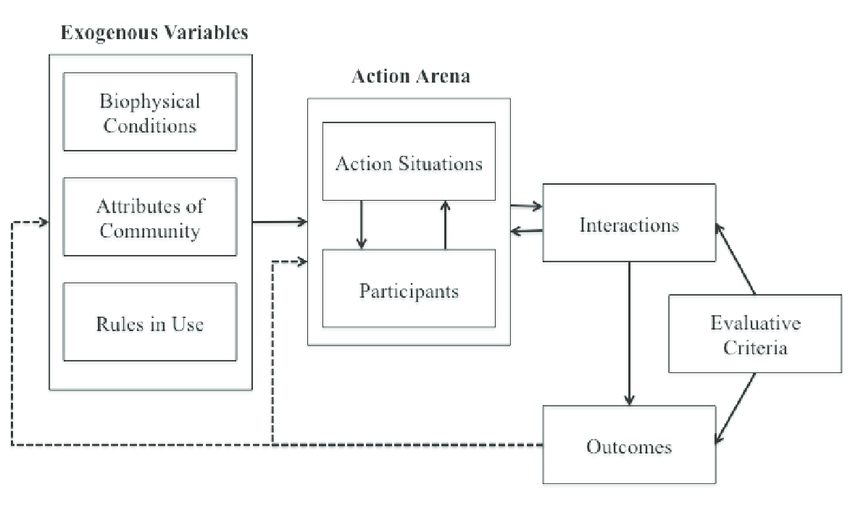
If you want to analyze an institution–whether it’s the local police department, marriage, or Facebook–an excellent guide is the Institutional Analysis and Development (IAD) Framework developed by Elinor Ostrom and colleagues, which is an encapsulation of the lifetime of work for which Ostrom won the Nobel Prize. It is shown below in a graphical form, and a very helpful, concise guide is McGinnis 2011.
The Institutional Analysis and Development (IAD) Framework (Schoon, 2015 after Ostrom et al., 1994, p. 37)
I would divide the analysis into the following 23 questions. These questions basically cover the same issues as in the diagram above, working from left to right, but they don’t match up precisely because I draw on my own idiosyncratic influences.
What is the institution? What is its name? How would you define it uniquely, and which people, resources, locations, etc. does it involve?
What problem or set of problems interests you about it? This problem may be a failure (the institution doesn’t yield the intended results) or an injustice (it has bad results), or it could be the intellectual problem posed by its success: why does this institution work and can we replicate it?
What other institutions are closely related to it, and how?
Which institutional form(s) does it reflect, e.g., a government, a firm, a market, a network, an association, a community?
What are important relevant biophysical conditions? What natural resources does it use, and which natural processes come into play? What characteristics of these resources and processes are relevant to the institution: e.g., scarcity, fragility, adaptability, ability to reproduce and grow, interdependence, tendency to move?
What are important technological conditions, where “technology” means the relevant affordances and limitations that have been created–or will predictably be created–by human beings?
What cultural meanings (in the sense of Geertz 1973) are involved? Are these meanings shared or disputed?
What official, formal, usually written rules govern the institution? What are its rules-in-use? (These may diverge from the official rules.)
Are the rules grounded in phenomena beyond the institution? For instance, an institution might use a currency whose value is determined by other institutions. Tufts runs on an academic calendar related to the solar calendar, which is grounded in the motion of the earth. (Grounding is different from causation.)
What goods are relevant? Who has which kinds of ownership over which goods? Are the goods subtractable? Are they excludable?
Who are the relevant actors?
What choices confront each actor? What does each actor know about the available choices?
What does each actor value, and why?
Under what conditions do the actors choose (e.g., with or without discussion, once or repeatedly, simultaneously or in turn, with or without knowledge of what the others are choosing)?
What are the consequences of the most important or most likely combinations of choices made by all the actors?
Are these consequences desired by the actors?
Are these outcomes desired by people who are not among the actors?
Are the outcomes fair or just by various normative criteria?
Are they sustainable–meaning a) literally repeatable many times, and/or b) good for nature?
How do the outcomes affect the issues raised in questions 1-15? In other words, do the outcomes of the institution change the institution itself, in a feedback loop?
What deliberate changes in institutional forms (4), technologies (6), meanings (7), rules (9-10), or values (13) would produce preferable outcomes according to the criteria raised in questions 17-19? (I focus on 4, 6, 9-10, and 13 on the ground that these are the factors we can most readily change. Factors like the biophysical conditions and the relevance of other institutions are harder to influence.)
How can we go about altering the institution in the light of 21?
Geertz, Clifford (1973) Thick description: Toward an interpretive theory of culture. The interpretation of cultures: Selected essays (pp. 3-30). New York, NY: Basic
Levine, C. (2015). Forms: Whole, rhythm, hierarchy, network. Princeton University Press.
Mcginnis, Michael. (2011). An Introduction to IAD and the Language of the Ostrom Workshop: A Simple Guide to a Complex Framework. Policy Studies Journal. 39. 169 – 183. 10.1111/j.1541-0072.2010.00401.x.
Great way to start off the new year reading this excellent write-up by NCDDer, Kevin Amirehsani, on the recent 8th National Conference on Dialogue & Deliberation. He shares some of the best practices in our field and highlights several gems from the conference. We are proud to work amongst such talented, dedicated, and inspirational individuals, and can’t wait to see the new heights this field will go! We encourage you to read Kevin’s piece below and find the original version on the UNC School of Government Blog here.
Sharing Dialogue and Deliberation Best Practices: NCDD 2018
Within the community engagement community, best practices are sometimes hard to identify.
The context of, say, a small-scale event dealing with restorative justice differs greatly from a packed city council meeting covering zoning permits. The message, audience, program design, and feedback mechanisms can be completely different, which makes standardizing a set of guidelines an oft-impossible task.
Still, there are a few gatherings that bring together enough diverse, experienced, and motivated engagement practitioners that something approaching best practices can be found across many of community engagements’ subfields, from productively navigating race relations to developing responsive digital platforms.
With more than 70 workshops and sessions available to choose from across four days, the hardest part was figuring out where to spend my conference time.
Here are some highlights from three sessions I attended.
Day 1 – D&D for Everyone: How do we get everyone to participate?
I decided to dive right into one of community engagement’s most difficult questions – how on earth do we maximize participation?
This session was relatively unstructured, which allowed small groups to come up with numerous ideas that were then shared with the room. One key takeaway many of us arrived at was on an issue that is often glossed over: language.
Language and Ideology – Who “Welcomes Dialogue”?
Let’s face it: community engagement and D&D initiatives are usually carried out by progressive/liberal practitioners. While this may have something to do with the innate differences between many conservatives and progressives, what it means is that much of the language we use to publicize our events, conduct them, and gather feedback from them may be imbued with a liberal bias.
Terms like “diversity”, “safe space”, or even “dialogue” itself are often viewed in a partisan light, which may skew the demographics of who shows up and who participates more frequently.
Luckily, there are some resources that can help us be more aware of our language, like the online Red Blue Dictionary or a growing number of political dialogue courses offered at universities.
Can we Dialogue with our Passion and Frustrations?
Another issue I found useful to discuss was the degree to which participants are encouraged or expected to check their frustrations and convictions at the door.
On paper, engagement projects often encourage a diversity of viewpoints, but some may be implicitly accepted more than others through, say, the responses that the facilitators choose to emphasize, or even the way a participant who expresses an unpopular opinion is glared at by others.
Many of us have probably witnessed well-intentioned D&D practitioners define numerous topics as “problems,” which implies that somebody’s at fault. This can be at odds with encouraging feedback from participants who may be afraid of being blamed if they speak up.
Day 2 – Don’t Avoid, Don’t Confront: Dialogue Skills for Anti-Racism Allies
I have never been to an anti-racism workshop, so I thought a workshop led by David Campt, the founder of the White Ally Toolkit, would be a great place to start.
As a veteran of the Clinton White House’s Initiative on Race and America Speaks, David knows how to distill a lot of information on how to have effective conversations on race into a short time period while keeping everybody in the room entertained. And he certainly did not disappoint.
While his anti-racism trainings are typically given to white participants, this was a mixed-race crowd that engaged him as he spoke on concepts ranging from the empirical – e.g. racial anxiety – to more practical tools, like the types of icebreakers that can be useful in reducing some of the tension that envelopes meetings on difficult topics (such as race).
One key takeaway that I walked away with was David’s quippy but powerful advice to find the “chocolate in the trail mix” of what a person is saying.
When we’re dealing with community members who have views that may be antithetical to ours, there are almost always remarks they make that we can relate to. For those of us who keep abreast of the literature, the power of small talk should not be a surprise. But David went a step further and emphasized the importance that positive acknowledgement has in ultimately changing people’s views.
Simply pointing out things you agree with by others who share an individual’s race, ethnicity, or politics, for example, markedly increases that person’s willingness to continue talking to you and, ultimately, their openness to gradually changing their views on thorny subjects.
Day 3 – Elevating Voices and Building Bridges: Community Trust and Police Relations
Finally, I capped off an inspiring time at NCDD 2018 with a discussion on police-community relations, in part since I sit on Denver Police Chief Paul Pazen’s Community Advisory Board.
The session saw a pair of practitioners – one from the Institute for Policy and Civic Engagement at the University of Illinois at Chicago, and the other from Illinois’ Attorney General’s Office – speak in depth about 14 “community roundtables” they organized across Chicago as part of the city police department’s ongoing federal consent decree. They were followed by Chief Pazen and Denver Office of the Independent Monitor (OIM) Community Relations Ombudsman Gianina Irlando, who described a novel program breaking down some of the barriers between police officers and youth.
Design – Sharing Ground, Empathy and Feedback Mechanisms
My impression after hearing these success stories was that both sides in some of the most intractable disputes can substantively cede some ground and gain some empathy for the other side if community meetings and the feedback mechanisms which follow them are effectively designed.
In the Chicago example, the meeting organizers spent a considerable amount of time recruiting participants from affected communities, hiring translators for each table, training facilitators, and designing the layout of their World Café-type engagement model so that everybody knew what ideas each table was bringing up, without fears of “problematic” points of view being forgotten.
Closer to home, the Denver collaborative model between law enforcement and their civilian oversight body emphasized how empathy-building can be quantitatively shown to increase if officers are given enough classroom training, local community leaders (and, in this case, a hip hop artist) help conduct the sessions, and youth are encouraged to participate through strategically placing them with officers in a safe environment whom they have had no personal contact with.
In July of 2013, I started writing publicly every (work) day. Then, after four and a half years, in November 2017, I stopped.
There are a lot of reasons why I started writing — and a lot of reasons why I let the habit go.
I was re-finding myself in 2013. After my father passed away in early 2012, I was absolutely shattered. I spent at least a year and a half just wandering the void; existing in the world without really living in it.
When at last I was ready to start thinking about picking up the pieces, I found I had become a very different person than I had been before. More caring, more compassionate, more acutely aware of the silent struggles we’ve all gotten so good at hiding from the world. And I felt more strongly than ever the need to put my own voice, skills, and energy to work towards the ongoing task of repairing the world.
This was a quandary for me. I’d long been committed to social justice; to doing what I could to make the world just a little bit better than I found it. But, at the same time, I had come to deeply internalize the belief which was consistently reinforced through so many of my experiences in the world: my voice didn’t matter. I didn’t matter.
I had aimed to put my time and energy towards good work simply because that was the right thing to do. It was laughable to think that anything I could do would ever amount to anything or that anyone would ever care for my opinion or insight.
It’s the sort of paradox which only makes sense within the bounded logic of one’s own head. I’d worked hard to elevate the agency of others; I’d argued that the voices and perspectives of all people are critical to building a more just world; I’d put so much of myself into advocating for these ideals — but I had never really believed them. How could I, if I didn’t believe in myself?
In my first post back in 2013, I described this challenge in relation to my plan to start writing publicly:
My struggle with blogging is that…in many ways, it requires a lot of ego. Well, I would say ego, but another may generously say “agency.” It requires standing up and saying, “I do have something to say, and I believe it’s worth your time to listen.” And that can be a lot to muster.
I see this challenge more broadly in the idea of being an active citizen, of truly engaging in public life…Even in smaller acts of engaging. To actively contribute to your community means believing that you have something to actively contribute.
Over the years, this sense of egoism continued to be the hardest struggle for me. Finding time and topics weren’t always easy, but those paled in comparison to the more fundamental challenge of constantly putting myself out there. Of acting like I had something worth saying even when I felt as though I were nothing at all.
But it was a good habit. It made me a better writer. It made me a better thinker. And doing all this writing publicly helped me find my voice. It helped me discovered who I am and showed me that, indeed — words do matter. Much to my surprise, I found that sometimes even my poor, broken words could help.
So I kept writing.
As foolish, egotistical, and self-important as it seemed. I kept writing.
But things changed over the years. I got busier with graduate school, I had other writing tasks I needed to prioritize, I needed to pass my qualifying exams and propose my dissertation. I have no end to my list of practical excuses.
There are reasons and there are reasons, though. Fundamentally, I was scared. I started meeting strangers who would seek me out to tell me how much they loved the way I write; who would tell me that I had somehow managed to put into words something they had been thinking or feeling. I started getting more pushback on every sloppy mistake I made as I rushed to fulfill my self-imposed quota of posting every single day. I started to more deeply appreciate the consequences of my words as actions — while it still seems impossible to imagine, I found that my voice did have power.
As I grappled with these issues in mid-2017, I reflected:
In some ways, public writing feels even more egotistical than before. Being a doctoral student raises the stakes of self-importance; I’m declaring a value for my contributions through my occupation before I even open my mouth. Doctoral students may be nobody in the fiefdoms of academia; but it remains a fairly fancy calling to the rest of the world. I can hardly consider myself to be a nobody while laying claim to the capacity to someday contribute to human knowledge.
This was a lot to take in. How could my voice matter? In what universe would people begin by assuming I was possessed by a comfortable air of self-confidence? What did it mean for me — a person holding so much privilege in this world — to be taking up space?
My writing started to feel like less of an exercise of civic duty and self-discovery and more of a venue for self-aggrandizement.
At the same time, I was becoming less impressed with the quality of my writing overall. I’d gotten tired, lazy — relying on tired tropes of self-righteousness without thorough thought or depth. This tone was popular in some circles, but it did little to advance the sort of dialogue I want to pursue. It didn’t reflect the sort of writer, scholar, or person I wanted to be.
So I stopped.
I’d once needed to find myself through writing in public and then I needed to find myself by reflecting in private.
But I’ve missed this. I’ve missed the intentional thought that comes from public writing. I’ve missed the ongoing learning I’ve gained through on- and offline conversations about my posts. I’ve missed hearing thoughtful criticism of my views and my writing — I remain grateful to every person who has trusted me enough to tell me when they think I’m wrong or when I could have expressed myself better. I’ve missed making time to think about things beyond what’s required of me.
Over the last few weeks, I’ve continually caught myself “writing in my head” as I used to do all the time. I’m not quite sure where that voice went in the fervor and anxiety of the past year, but I’ve started to realize that I need and value this space. Something has changed in me once again, it seems.
All of this is to say: I’m back. I won’t be posting every day, but I will be posting regularly — at least once a week.
I will write about science, math, social justice, and democratic theory. I will write about mental health and graduate school and random facts I picked up somewhere. I will write about whatever I need to say that week.
As always, I invite your thoughtful reflections as I continue this journey. We will certainly not always agree, but I will value your perspectives and consider your arguments seriously and genuinely.
They say that democracy is dead — that people can’t talk about anything of import any more. But I don’t believe that. I refuse to believe that. Democracy’s not dead — it’s only resting.


 On the call, Senator Unger will discuss the integral role of public engagement in his work as a state senator. He will talk with us about how he has been using dialogue and deliberation to engage with constituents in his district, and how he attributes that to his recent reelection bid against a well-funded opponent.






 Monday, January 7th
 Tuesday, January 8th