NCDD Confab with NCL and the Weekly Roundup!

We have a special announcement to add to the list of great events happening over the next week! On Wednesday February 13th, we are co-hosting our next NCDD Confab call with the National Civic League. This free call will be an opportunity to learn more about the All-American City Awards, hear from past awardees, and learn how to win this prestigious award. We encourage you to check these webinars happening earlier in the week from NCDD member orgs, National Issues Forums InstituteNew Directions CollaborativeLiving Room Conversations, International Associate for Public Participation, and National Civic League.

Do you have a webinar or other event coming up that you’d like to share with the NCDD network? Please let us know in the comments section below or by emailing me at keiva[at]ncdd[dot]org, because we’d love to add it to the list!


Online Roundup: the February NCDD-NCL Confab, NIFI, New Directions, Living Room Conversations, IAP2, National Civic League

National Issues Forums Institute – February CGA Moderator Training

Tues, Feb 5th and Weds, Feb 6th
9:30 am Pacific, 12:30 pm Eastern

Join this workshop on how to moderate a Common Ground for Action (CGA) deliberative forum.
Part one of the workshop is: Tuesday February 5th @ 12:30p ET/9:30am PDT; Part two is February 6th @ 12:30p ET/9:30am PDT. Please plan to attend both sessions.

In session one (February 5th) we will participate in our own CGA forum to get the participant experience. We will debrief when we meet again on Wednesday Feb 6th.

In session two (February 6th), we will discuss how to set up a CGA, what the responsibilities of a CGA moderator are, and hacks and tricks for moderating. We will then work in partners to set up and moderate a forum. We will conclude with a questions and answers about how to integrate CGA into your practice, classroom, and/or community work. For this session, we will use Zoom.

REGISTER: www.nifi.org/en/events/february-cga-moderator-training-workshop

New Directions Collaborative webinar  – Meetings That Do More

Wednesday, February 6
12 pm – 2 pm Eastern

Imagine leaving a meeting feeling inspired, energized by new ideas, with enhanced goodwill toward your colleagues and a shared sense of clarity on where to go next. In this interactive on-line workshop, you will learn practical tools for creating meetings that deliver multiple benefits. Key topics include:

  • How to clarify the strategic context and range of outcomes for a meeting
  • How to frame strategic questions for the group to explore
  • An introduction to, and experience of, participatory meeting methods that can also work on-line
  • How to structure an agenda with samples of agenda designs

The workshop will be held on Zoom video conferencing where you will experience how to host effective meetings virtually, including with small group conversations. You will receive several handouts full of resources and guidance to help you design and facilitate future meetings.

Beth Tener of New Directions Collaborative will facilitate, sharing methods she has practiced in work with over 150 organizations and collaborative initiatives, concerning socially responsible business, sustainability, local food systems, education, climate action, racial equity, and transportation.

This workshop is the first in a series. You can attend one or the series.

Workshop fee is $70. Please click below to register.

If this fee is a barrier to participating, please contact Beth at btener@ndcollaborative.com – discounts are available to make this accessible to all interested.

REGISTER: www.ndcollaborative.com/events/

Living Room Conversations webinar – Free Speech, Fighting Words, and Violence

Wednesday, February 6th
4:30-6 pm Pacific, 4-5:30 pm Eastern

Join us for a free online (using Zoom) Living Room Conversation on the topic of Free Speech, Fighting Words, & Violence. Please see the conversation guide for this topic. Some of the questions explored include:

  • How do we protect free speech and ensure public safety despite ongoing threats of violence?
  • Have you had a personal experience where free speech was inhibited? Or have you ever felt harmed by the speech of others?
  • How do we decide what our collective, social morality is? What is the federal government’s role?

You will need a device with a webcam to participate (preferably a computer or tablet rather than a cell phone).

Please only sign up for a place in this conversation if you are 100% certain that you can join – and thank you – we have many folks waiting to have Living Room Conversations and hope to have 100% attendance. If you need to cancel please return to Eventbrite to cancel your ticket so someone on the waitlist may attend.

A link to join the conversation and additional details will be sent to you by no later than the day before the conversation. The conversation host is Beth R.

REGISTER: www.livingroomconversations.org/event/online-living-room-conversation-free-speech-fighting-words-and-violence-2/

Living Room Conversations webinar – Status & Privilege

Thursday, February 7th
2-3:30 pm Pacific, 5-7:30 pm Eastern

Join us for a free online (using Zoom) Living Room Conversation on the topic of Status & Privilege. Please see the conversation guide for this topic. Some of the questions explored include:

  • What are the privileges of your status?
  • What do you value and how is that connected to your status or privilege?
  • How does status, or lack of status, affect your sense of personal dignity? How have you noticed it impacting others?

You will need a device with a webcam to participate (preferably a computer or tablet rather than a cell phone).

Please only sign up for a place in this conversation if you are 100% certain that you can join – and thank you – we have many folks waiting to have Living Room Conversations and hope to have 100% attendance. If you need to cancel please return to Eventbrite to cancel your ticket.

A link to join the conversation and additional details will be sent to you by no later than the day before the conversation. Lewis will be hosting.

REGISTER: www.livingroomconversations.org/event/online-living-room-conversation-status-privilege-4/

IAP2 Monthly Webinar – Large Scale P2 for Large Scale Projects

Tuesday, February 12th
11 am Pacific, 2 pm Eastern

Revamping an entire country’s criminal justice system … building an energy pipeline through 10 counties … huge scenarios with the potential to disrupt thousands – millions – of lives. In both cases, the proponents recognized the many ways people would be affected, and determined to engage the public at every stage, in order to achieve the best results all around.

In Canada, the Federal Department of Justice received over 10,000 contributions in a three-month period on the question, “How would you change our criminal justice system to better serve Canadians?” Two months after the public dialogue ended, the government announced a series of changes to the system that addressed some of the concerns raised in that dialogue.

In the USA, Williams Energy and Outreach Experts launched a huge public engagement campaign surrounding the building of the Atlantic Sunrise pipeline project. Since ten counties in Eastern Pennsylvania were in the path of the pipeline, Williams set out to make sure all interests were considered and addressed; dozens of route changes were made as a result of the consultations, and numerous grassroots organizations were part of the conversation.

IAP2 Members: Free
Non-IAP2 Members: $50

REGISTER: www.iap2canada.ca/event-3093140

National Civic League AAC Promising Practices Webinar –  Leveraging Education to Achieve Equity and Improve Futures

Wednesday, February 13th
11 am Pacific, 2 pm Eastern

Join the National Civic League to learn more about how two All-America Cities are utilizing education programs to achieve equity and improve economic and community futures.

Dillon Delvo, Executive Director, of Little Manila Rising in Stockton, CA will discuss Us History, an ethnic studies-based after school program that was wildly popular and has been incorporated into the local school district’s curriculum. Mark Pumphrey, Director of Libraries, in El Paso, TX will talk about the public library’s reimagined approach to adult education and economic development.

Us History- Stockton, CA:
In Stockton, like many cities, the legacies, histories, contributions and cultures of people of color have frequently been forgotten and marginalized. To combat this problem, in 2016, the Little Manila Rising started the ethnic studies-based “Us History” after school program. The goal was: “Putting ‘us’ back into U.S. History.” The program met once a week through the 2016-2017 school year and focused on Mexican American, African American, and Filipino American histories and cultures.

The program included discussions of the Chicano Movement, Black Feminist Theory, redlining, issues facing the undocumented community, among other topics. In April 2017, the Stockton school district discussed adopting Ethnic Studies as an elective. “Us History” students attended the meeting and spoke about what Ethnic Studies meant to them and what it could mean for their community if it was part of their school’s curriculum.

Career and Adult Education Opportunities- El Paso, TX:
Through its public libraries, the City of El Paso is working to provide basic educational and entrepreneurial services to traditionally underserved communities. Technology tools are available for business use, including copy machines with faxing, printing, and scanning capabilities, sound equipment, microphones, headphones, telephones and a SmartScreen accessible during all library hours of operation. Alternative work spaces are made available in library auditoriums, atriums, conference rooms and other spaces. The goals of these programs and service enhancements are to support the economic development efforts of the City of El Paso, give emerging workforces places to engage their customers and to sharpen their business and entrepreneurial skills and improve the quality of life of residents by providing skills and training.

REGISTER: www.eventbrite.com/e/aac-promising-practices-webinar-addressing-addiction-on-a-community-wide-level-tickets-53746857297

NCDD Confab Co-Hosted with National Civic League on the All-America City Awards

Confab bubble imageWednesday, February 13th
12 pm Pacific, 3 pm Eastern

This free call will offer space to learn more about the award, hear from past awardees, and ask questions. The award deadline is March 6th, so make sure you take advantage of this opportunity and register today to secure your spot on the call!

Since 1949, the National Civic League has recognized and celebrated the best in American civic innovation with the All-America City Award. The Award, bestowed yearly on 10 communities (more than 500 in all) recognizes the work of communities in using inclusive civic engagement to address critical issues and create stronger connections among residents, businesses and nonprofit and government leaders. The 2019 All-America City theme is “Creating Healthy Communities Through Inclusive Civic Engagement”. The 2019 All-America City Award is focused on celebrating examples of civic engagement practices that advance health equity in local communities.

Representatives from the award-winning city, Las Vegas, NV will join us on the call to speak about their experiences winning the All-America City Award in 2018. Las Vegas was recognized as an All-America City because they provide residents, stakeholders, staff and elected officials with a collective vision for a future of income equality and economic mobility, building programs and services that remove barriers and address challenges faced by their most vulnerable youth.

REGISTER: http://ncdd.org/29019
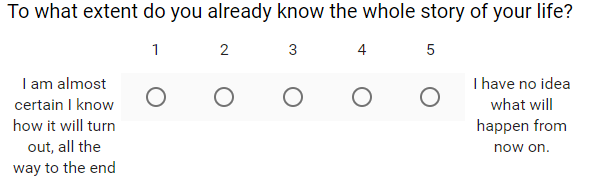
to what extent do you already know the story of your life?

If people were asked this question on a survey, I think the variations in responses would be significant and useful to know:

In general, people would give lower scores as they got older, but not always. The YouthBuild program (which we evaluated) serves disadvantaged adolescents and young adults. Before entering this 9-month program, participants predict that they will live to an average age of 40. Many believe that they already know the outlines of their lives. But upon completing the program, they think they will live to the age of 72: a 32-year increase (Hahn et al 2004). They now foresee decades of life that present unpredictable possibilities.

I agree with Kieran Setiya that “midlife” is best understood not as a span of years–say, ages 35-60–but as a subjective attitude to time that can occur at any age. Inspired by his book but departing a bit, I would measure midlife as a low score on the question shown above. By that definition, adolescents entering YouthBuild are already in midlife and even suffering from midlife crises. But for someone else, that state might never arise, or it might occur for the first time at age 90.

Is it good or bad to score high on this measure? That may depend on how well your life is going. If you expect to continue back-breaking labor for the rest of your life, still shackled to an uncaring partner, and suffering the regular deaths of loved-ones, you certainly would prefer not to be able to predict the rest of your life based on your story so far. But if you have retired in good health to a lovely seaside community, you may want nothing more than to run out the clock without seeing any unexpected changes to yourself or the people you care about. Priam had every reason to think that his life was a happy story until, as a very old man, he had to witness his hero son Hector being dragged dead around his besieged city.

I suspect we also vary in our subjective stances to change. For some people–almost regardless of their objective circumstances–predictability is comforting. But it is horrifying for others.

James Joyce published “The Dead” when he was 32. He had a long, dramatic, and hugely influential life ahead of him and surely couldn’t imagine that he’d become the Zurich-based author of Finnegans Wake by 1941. His protagonist, Gabriel, is also a “young man.” But I think “The Dead” is all about realizing that you know the whole course of your life. This is possible if you are a somewhat average bourgeois Dubliner, like Gabriel, or a budding international literary sensation, like James Joyce. Either way, to think you know your whole life-course is akin to being dead: you might as well just fast-forward to the end. That is the sense in which midlife is a depressing state rather than a comforting one.

I would predict that answers to this question would vary by age (but not in a lockstep correlation), by social circumstance (people with more opportunities will be less likely to think that they know their own futures) and by temperament.

Certain meditative experiences are intended to lower one’s score. For example, momento mori–meditating on death–is meant to remind you that you already know the important part of your story, how it ends. That is supposed to focus you on being pious. But Buddhism often reminds us that life is unpredictable, basically unstable, and that not being able to know the future should drive your attention to current experience. I vote for the latter although I am not very good at it.

Source: Hahn, A., Leavitt, T. D., Horvat, E. M., & Davis, J. E. (2004). Life after YouthBuild: 900 YouthBuild graduates react on their lives, dreams, and experiences. Somerville, MA: YouthBuild USA. See also Kieran Setiya on midlife: reviving philosophy as a way of life; nostalgia for now; rebirth without metaphysics.

Opportunity to Test Mismatch Spring 2019 Pilot, Grades 6-12

In case you missed it, NCDD member org Living Room Conversations and AllSides recently announced an opportunity to test out the Spring 2019 Pilot of Mismatch for grades 6-12! Mismatch is a platform that digitally connects classrooms with each other and facilitates structured conversation between students via video conferencing using Living Room Conversation topic guides. Last year, we featured Mismatch during one of our Tech Tuesday events and you can listen to the recording here! Read the details in the post below and find the original information on the LRC newsletter here.


Calling All Parents, Educators, and Students

We are excited to announce the Spring 2019 Pilot of Mismatch! And your (child’s) grade 6-12 classroom is invited to join!

AllSides for Schools is our joint project with the news site AllSides.comMismatch is a platform that pairs students from different schools around the U.S. and facilitates structured online video conversations between these students using Living Room Conversation topic Guides. You can learn more about Mismatch in the video you’ll find here.

Our goal is to make the Mismatch platform available for anyone interested in civil discussions with someone who thinks differently. We are looking forward to this and bet you are too!

How to join the Mismatch pilot? The AllSides for Schools team is currently looking for grade 6-12 educators in government, social studies, history, and related fields who would like to sign up their classrooms for our Spring 2019 Mismatch pilot. Joining the pilot entails these activities:

  • Completing a short pre-survey about your classroom
  • Providing feedback on our matching criteria, conversation guides, and web platform
  • Matching with another classroom and orchestrating realtime, F2F video conversations between students in your two classrooms (with our help)

92% of students surveyed after using Mismatch reported a positive shift in attitude after just one conversation, citing “great appreciation for the other perspective or other person.” 99% of students found the experience somewhat or extremely valuable.

Once the AllSides for Schools team receives your inquiry, you’ll be contacted for a 1:1 exploratory call to answer questions and describe the pilot program in more detail.  (Note: While every request to participate may not be able to be accommodated, due to matching constraints, the AllSides for Schools team will do its very best!)

Sign Up for FREE Here!

P.S. Do you know someone that would enjoy hearing from us? Please forward this email to friends and colleagues and encourage them to join our community.”

You can find the original version of this announcement on the Living Room Conversations newsletter at https://mailchi.mp/d44c68e7edd2/calling-all-parents-educators-and-students.

apply for the 2019 Summer Institute of Civic Studies

The Summer Institute of Civic Studies is an intensive interdisciplinary seminar that brings together faculty, advanced graduate students, and practitioners from many countries and diverse fields of study. In 2019 it will take place from the evening of June 20 until June 28 at Tufts University in Medford, MA, and Boston.

The Summer Institute was founded and co-taught from 2009 to 2018 by Peter Levine, Associate Dean of Academic Affairs at Tisch College, and/or Karol So?tan, Associate Professor in the Department of Government and Politics at the University of Maryland. The 11th annual Summer Institute will be taught by Peter Levine alongside several Tufts colleagues. Each year, it features guest seminars by distinguished scholars and practitioners from various institutions and engages participants in challenging discussions such as:

  • How can people work together to improve the world?
  • How can people reason together about what is right to do?
  • What practices and institutional structures promote these kinds of citizenship?
  • How should empirical evidence, ethics, and strategy relate?

A provisional draft of the 2019 syllabus is shown below. You can read more about the motivation for the Institute in the Civic Studies Framing Statement by Harry Boyte, University of Minnesota; Stephen Elkin, University of Maryland; Peter Levine, Tufts; Jane Mansbridge, Harvard; Elinor Ostrom, Indiana University; Karol So?tan, University of Maryland; and Rogers Smith, University of Pennsylvania.

The seminar follows a three-day public conference, Frontiers of Democracy, which takes place in downtown Boston on June 20-22. Participants in the Summer Institute are expected to participate in the conference (free of charge) and then the Institute on June 23-28. This year, the Summer Institute also follows the American Political Science Association Institute for Civically Engaged Research (ICER), which will take place on June 17-22, with ICER participants also taking part in the Frontiers conference.

Practicalities and How to Apply

Daily sessions take place on the Tufts campus in Medford, Massachusetts. Tuition for the Institute is free, but participants are responsible for their own housing and transportation. One option is a Tufts University dormitory room, which can be rented for $69/night (single room) or $85/night (double room). Credit is not automatically offered, but special arrangements for graduate credit may be possible.

The application consists of a resume, a cover letter about your interests, and an electronic copy of your graduate transcript (if applicable). The application deadline is March 31, 2019. You can sign up here to receive occasional emails about the Summer Institute, including a notification when we begin accepting applications.

For more information contact Peter Levine, Tisch College’s Associate Dean of Academic Affairs, at peter.levine@tufts.edu.

European Institute

The fifth annual European Institute of Civic Studies will take place in Herrsching, near Munich, Germany, from July 14th to July 27th 2019. It is open to graduate students and scholars in any discipline who are citizens of Armenia, Azerbaijan, Belarus, Georgia, Germany, Kazakhstan, Kyrgyzstan, Moldova, Poland, the Russian Federation, Tajikistan, Turkmenistan, Ukraine and Uzbekistan. To apply, send a letter of interest, a curriculum vitae, and an academic transcript (if applicable) to Prof. Tetyana Kloubert at Tetyana.Kloubert@ku.de by March 31, 2019, for best consideration.

***

2019 Summer Institute Syllabus

Subject to change

June 20 (evening) to June 22 (lunchtime): Frontiers of Democracy Conference

June 23 (afternoon): Informal gathering to get to know each other; some sharing of our backgrounds and goals

June 24

I. Inspirations for civic work

9 a.m.-Noon: A “feeling of personal responsibility for the world”

II. Problems of Collective Action: Forming and Maintaining Functional Groups at Various Scales

1:00-2:00 p.m.: A simulated Tragedy of the Commons; reflections on game theory as a method of modeling interactions

2:00-5:00 p.m.: The work of Elinor Ostrom and colleagues

June 25

9:00 a.m.-Noon:  The role of social capital

1:00-3:00 p.m.: Collective action problems at scale

  • James Madison, The Federalist #10
  • Jane Mansbridge, Beyond Adversary Democracy, pp. 3-35, pp. 163-82, 290-8
  • Friedrich Hayek, The Constitution of Liberty, Chapters 1, 4 and Postscript, pp. 11-2154-70397-411.
  • James C. Scott, Seeing Like a State: How Certain Schemes to Improve the Human Condition Have Failed,Introduction (pp. 1-8), Chapter 3 “Authoritarian High Modernism”

3:30-5:00 p.m.: Public Work

  • Harry C. Boyte, Reinventing Citizenship as Public Work: Citizen-Centered Democracy and the Empowerment Gap

June 26

III. Problems of Discourse: Discussing and Reasoning about Contested Value Issues

9:00-10:00 a.m.: Deliberation

  • The Harvard Pluralism Project’s case entitled A Call to Prayer. What should the people of Hamtramck, MI do?

10:00 a.m.-Noon, 1:00-2:00 p.m.: The Frankfurt School, Habermas, deliberative democracy

  • Lasse Thomassen, Habermas: A guide for the perplexed. A&C Black, 2010, pp. 63-96, 111-130.
  • Jürgen Habermas, “The Public Sphere: An Encyclopedia Article,” New German Critique, 3 (1974), pp. 49-55
  • Jürgen Habermas, Theory of Communicative Action (selection) 

2:00-5:00 p.m.: Critiques

  • Danielle E. Allen, Talking to Strangers: Anxieties of Citizenship Since Brown, v. Board of Education, pp. TBA
  • Jean L. Cohen, “American Civil Society Talk,” in Robert K. Fullinwider, ed., Civil Society, Democracy, and Civic Renewal, pp. 55-85
  • Nina Eliasoph, Avoiding Politics, pp. 1-22
  • Lynn Sanders, “Against Deliberation”

June 27

IV. Problems of Exclusion

9:00-11:00 a.m.: Boundaries, good and bad

  • The Book of Nehemiah
  • John Gaventa, Power and Powerlessness: Quiescence and Rebellion in an Appalachian Valley, pp. 3-32
  • Dec 4: Audre Lorde, “ The Master’s Tools Will Never Dismantle the Master’s House” and Steve Biko, “Black Consciousness and the Quest for True Humanity”

11:00 a.m.-Noon and 1:00-3:00 p.m.: Gandhi

2:00-4-00 p.m.: Martin Luther King

June 28

V. Solutions?

9:00-11:00 a.m.: Community organizing

  • Mark R. Warren, Dry Bones Rattling: Community Building to Revitalize American Democracy, pp. 4-70
  • Saul Alinsky, Reveille for Radicals, 1946 (1969 edition), pp. 76-81; 85-88; 92-100, 132-5, 155-158.
  • Myles Horton and Paulo Freire, We Make the Road by Walking, pp. 115-138

Noon-2:00 p.m.: Social movements and nonviolent campaigns

  • Charles Tilly, Social Movements, 1768-2004
  • Habermas, “New Social Movements,” Telos, September 21, vol. 1981, no. 49 (1981)
  • Marshall Ganz, “Why David Sometimes Wins: Strategic Capacity in Social Movements,” in Jeff Goodwin and James M. Jasper, Rethinking Social Movements: Structure, Meaning, and Emotion (Lanham, MD: Rowman and Littlefield, 2004) pp.177-98.
  • Erica Chenoweth and Maria J. Stephan, Why Civil Resistance Works: The Strategic Logic of Nonviolent Conflict, chapters 1 and 2 

2:00-3:00 p.m. Closing reflections

Announcing Co-Hosted Confab Call with Nat’l Civic League!

We are thrilled to announce that NCDD has teamed up with the National Civic League to offer the next exciting Confab call happening in February! Join us, February 13th at 3-4pm Eastern/12-1pm Pacific, as we discuss the upcoming All-America City Award and share tips for winning this prestigious award. This free call will offer space to learn more about the award, hear from past awardees, and ask questions. The award deadline is March 6th, so make sure you take advantage of this opportunity and register today to secure your spot on the call!

Since 1949, the National Civic League has recognized and celebrated the best in American civic innovation with the All-America City Award. The Award, bestowed yearly on 10 communities (more than 500 in all) recognizes the work of communities in using inclusive civic engagement to address critical issues and create stronger connections among residents, businesses and nonprofit and government leaders. The 2019 All-America City theme is “Creating Healthy Communities Through Inclusive Civic Engagement”. The 2019 All-America City Award is focused on celebrating examples of civic engagement practices that advance health equity in local communities.

Representatives from the award-winning cities, Las Vegas, NV and Decatur, GA will join us on the call to speak about their experiences winning the All-America City Award in 2018. Las Vegas was recognized as an All-America City because they provide residents, stakeholders, staff and elected officials with a collective vision for a future of income equality and economic mobility, building programs and services that remove barriers and address challenges faced by their most vulnerable youth. Decatur, GA was recognized as a 2018 All-America City for its commitment to civic engagement. Through their projects, Decatur showed that it is actively seeking to build an equitable and inclusive experience for its residents and visitors, focusing on racially-just community policing and building diverse and affordable housing.

Don’t miss out – register for our call today!

About NCDD’s Confab Calls

Confab bubble imageNCDD’s Confab Calls are opportunities for members (and potential members) of NCDD to talk with and hear from innovators in our field about the work they’re doing and to connect with fellow members around shared interests. Membership in NCDD is encouraged but not required for participation. Confabs are free and open to all. Register today if you’d like to join us!

an agenda for the dignity of work

Sen. Sherrod Brown’s theme of the “dignity of work” is powerful and important, for these four reasons:

1. A basic cause of unacceptable inequality is the worsening position of workers versus the owners of capital. That shows up in statistics on the share of income …

… and also in less tangible ways, such as a growing cultural and spatial distance between workers and investors and the rising deference or obsequiousness to the rich

2. Work, in the broadest sense—making things of value—is one basis of a good life for human beings. It is spoiled when work is alienated (split between decision-makers who don’t actually do anything and laborers who make no decisions) or replaced entirely by automation and AI. The availability of good work is probably shrinking and is certainly threatened by the next wave of automation.

3. The dignity of work can be a unifying theme. Yes, who has dignified work depends on gender, race, class, and age, so addressing this issue requires attention to inequality and difference. But people in very different social positions share a sense that dignified work is threatened.

4. Workers who are organized (in unions or the functional equivalents of unions) gain countervailing political power along with dignity. I’m of the school that it doesn’t matter much which policies Democratic candidates endorse, because their policy options are highly constrained once they’re in office. It matters how power is distributed. Strengthening workers’ organizations addresses the third level of power (“Who decides policies?”) rather than the first or second levels of power (What do particular people get? and “What policies are in place?”).

[For related arguments, see Harry C. Boyte, “The Shutdown Taught Us About the Dignity of Work: An Unanticipated Civics Lesson, Courtesy of President Trump” (The Nation, Jan 29) and Albert Dzur, “Teaching Citizenship” (The Boston Review, Jan. 30).]

Sen. Brown has a plan entitled “Working Too Hard for Too Little: A Plan for Restoring the Value of Work in America.” I think it’s an important contribution, but it’s mostly about raising pay per hour and improving the bargaining position of unions. We could add to his agenda, recognizing that some people just aren’t going to be unionized, that AI threatens employment for all, and that work faces crises of quality as well as pay and hours.

I can only offer vague thoughts because I am insufficiently informed, but I would consider:

  1. Federal support for associations of workers who would have a very hard time unionizing. Domestic workers are the prime case, and the National Domestic Workers Alliance is the leading example. When organized, domestic workers can advocate for favorable government policies, but they can also provide education, training, insurance, and other services for their members and speak to a range of audiences. In practice, they use their voice to advocate for their patients and clients as well as for themselves, and they demonstrate a concern for the quality of work as well as pay. I am not sure what federal policies would help them most, but possibly they should be eligible for grants for their service functions to subsidize their organizing efforts.
  2. A new look at accountability policies in a wide range of fields, from teaching and policing to medicine, to ensure that the drive to measure inputs and outcomes doesn’t ruin the quality of professional work. Often these accountability measures are driven by federal policy.
  3. A new look at the federal civil service, with an eye to making the jobs that are directly controlled by the national government as rewarding and substantive as possible.
  4. Funding for R&D that uses new technology to enhance and expand work (not to replace work).
  5. Federal programs modeled on the EPA’s now-defunct Community Action for a Renewed Environment CARE) that support a range of stakeholders who work on common problems. Typically, some of the stakeholders are paid to work full-time on these problems; others use some of their paid time to help out; and others are volunteers. For instance, in an environmental project, some participants may be government regulators, some may be local business people, and some may be unpaid activists. It’s important to see and name them all as working.

NCL Offers Free National Civic Review to NCDD Members!

As part of our new partnership with NCDD member org, The National Civic League, we are thrilled to announce that NCDD members will now have free access to the digital version of NCL’s National Civic Review! NCL is one of the longest running organizations in the dialogue, deliberation, and engagement world – celebrating their 125th year! This esteemed quarterly journal offers insights and examples on civic engagement and deliberative governance from around the country. We strongly encourage our members to check out this great resource and there is an open invite for NCDD members to contribute to the NCR! You can read about NCR in the post below and find it on NCL’s site here.


National Civic Review: Winter 2019 – 125th Anniversary Edition — Access Code: NCDD19

The focus of this edition is the capacity of communities to address difficult challenges by tapping the potential of an engaged public. Whether it is a “wicked problem” such as gentrification or an effort to improve local health outcomes, towns, cities and regions with ample “civic capital” find ways of bringing together diverse groups of associations and individuals in collaborative, community improvement initiatives.

To access this edition, go to the table of contents where you will be prompted to enter your unique access code: NCDD19

One of the Nation’s Oldest and Most Respected Journals of Civic Affairs
Its cases studies, reports, interviews and essays help communities learn about the latest developments in collaborative problem-solving, civic engagement, local government innovation and democratic governance. Some of the country’s leading doers and thinkers have contributed articles to this invaluable resource for elected officials, public managers, nonprofit leaders, grassroots activists, and public administration scholars seeking to make America’s communities more inclusive, participatory, innovative and successful.

Upcoming Opportunities at Tufts’ Tisch College of Civic Life

NCDDer Peter Levine shared this on the NCDD Main Discussion listserv yesterday and we wanted to lift it up here for the larger network. There are a lot of fantastic opportunities happening at Tisch College this year that we encourage you to check out! Some highlights – proposals are now being accepted for 2019 Frontiers of Democracy (June 20-22), applications are also being accepted for The Summer Institute of Civic Studies at Tisch and an opportunity to receive a postdoctoral fellowship, and more!

The NCDD Main Discussion listserv is a great place for engaging with folks passionate about dialogue, deliberation, and engagement! Learn how to join this list here.


Opportunities at Tufts’ Tisch College of Civic Life for Summer 2019

Please consider applying or submitting proposals for one or more of these 2019 opportunities

insights from the k-12 civic education System Map

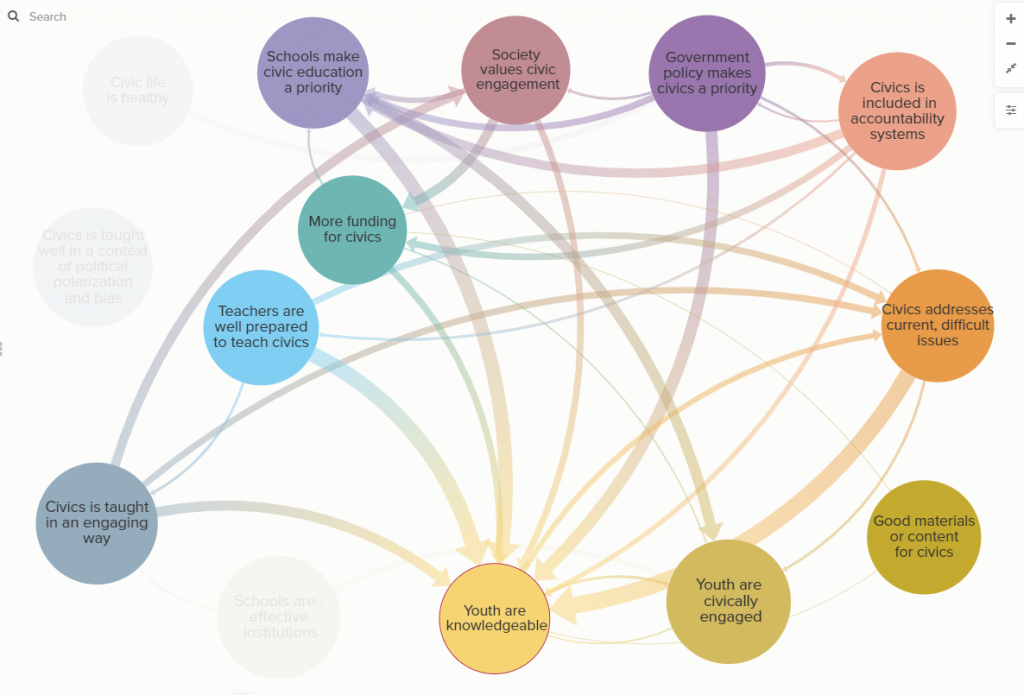
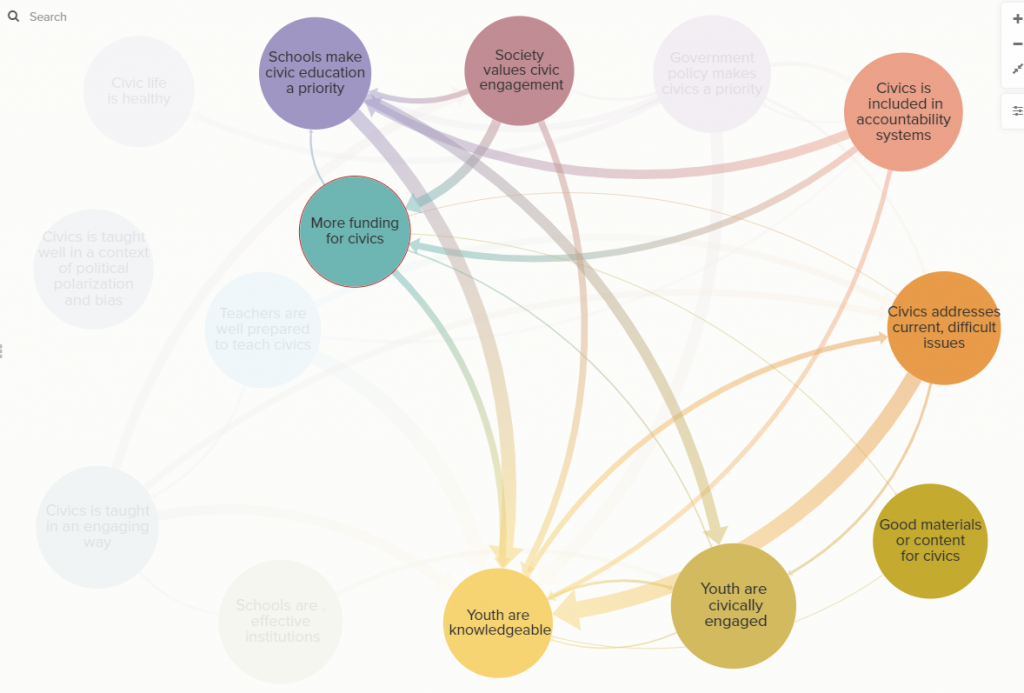
For CivXNow, we recently created a System Map of k-12 civics. Perhaps the greatest value of the map is that we didn’t decide what was on it or how things fit together. More than 7,500 people co-created it by answering survey questions. We didn’t ask them what strategy they favored but whether they thought that various specific factors influenced other specific factors, and we built a network from the results. More about the method and its rationale is here.

In this post, I would like to derive some substantive results from the map.

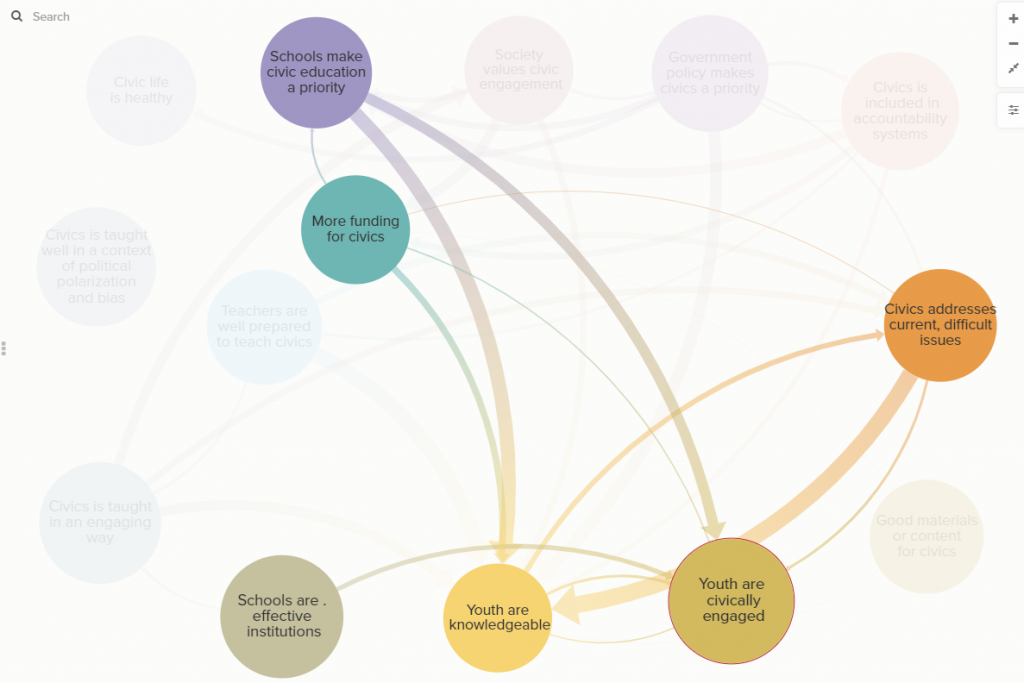
First, look at what is connected to two different possible outcomes of civic education: youth knowledge (on the left) and youth civic engagement (on the right). Almost the whole map has direct connections to knowledge; very little is connected to youth engagement. Of the causes of youth engagement, one is knowledge–which sends us back to the diagram on the left. Another cause is “schools are [generally] effective institutions,” which may seem beyond the power of the civic education community.

Overall, it appears that we have created much more of a “system” for generating youth knowledge than for empowering youth to act. To the extent that people are working on the latter goal, their efforts are not nearly as visible to our 7,500 respondents.

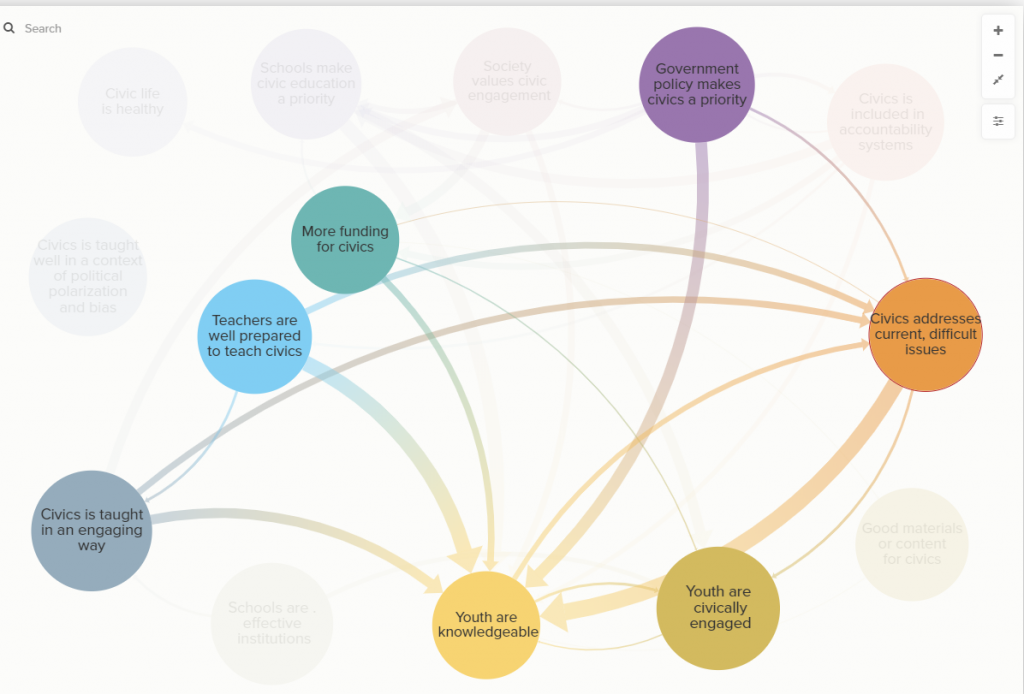
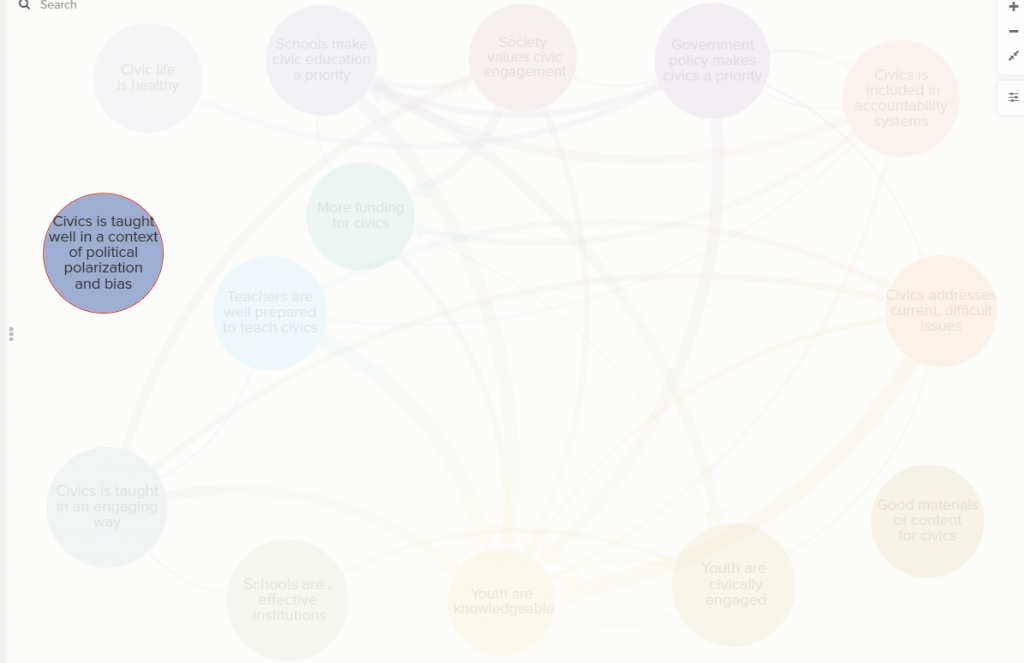
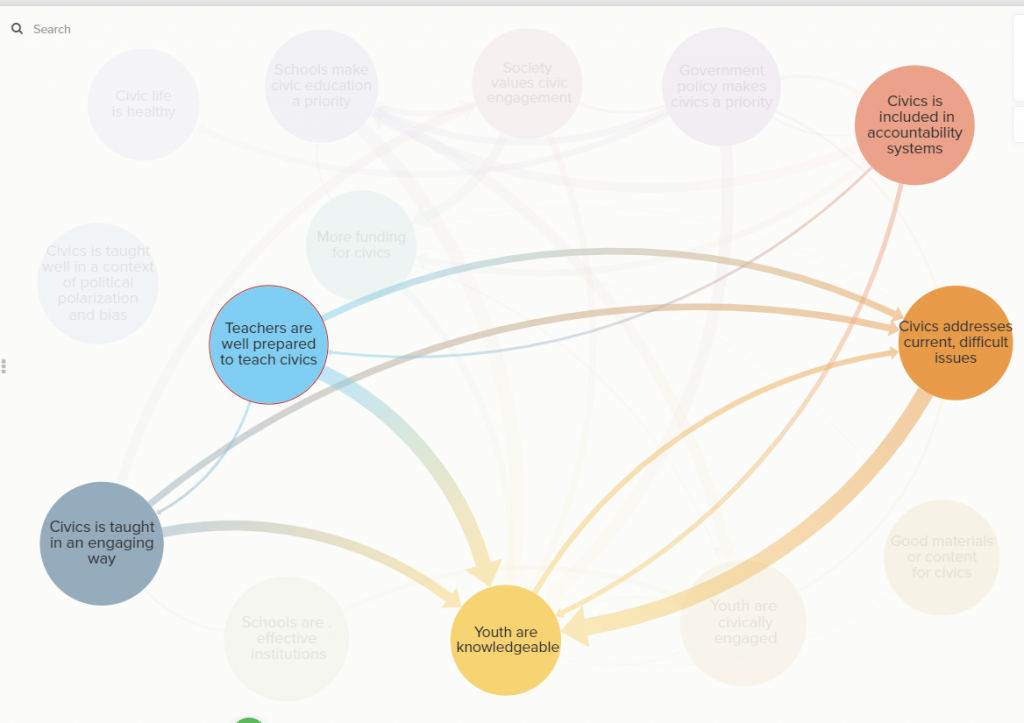
Second, compare two factors that have to do with the content and pedagogy of civics. On the left is whether civics addresses complex and current issues and controversies. On the right is whether teachers are able to present civics without bias and withstand a polarized political environment outside the classroom

Either goal may be very important. You might reasonably consider either (or both) to be your main concern. But the one on the left is highly leveraged, affecting many other outcomes. The one on the right has virtually no leverage at all. Our community doubts that if civics avoided problems of bias, then anything else would improve.

Third, take a look at funding. This was linked to more other factors than any other node on the map. I assume that is because it is relatively easy to envision that having more money would change a whole range of outcomes. We all know that money has value. (That’s why they call it “money.”)

The Role of Funding

But how would we get more money? This map rightly portrays funding as a “midstream” issue. Yes, money would help, but other factors–notably, including civics in accountability systems and making civic engagement more of a public priority–are what would yield more funding. The map suggests that even if money is an important means, it is likely not the best target for advocacy.

Now take a look at how people connected “Teachers are Well Prepared to Teach Civics” to other nodes. This is the factor that captures pre-service education, professional development, etc. Respondents did see it as a driver of more engaging pedagogy and of more current issue-discussions. But the ultimate outcome they expected was better knowledge, not more civic engagement.

How People View Professional Development

This could mean that most teacher education and PD presents student knowledge as the explicit goal, and engaging pedagogy as a means. Should it be otherwise?

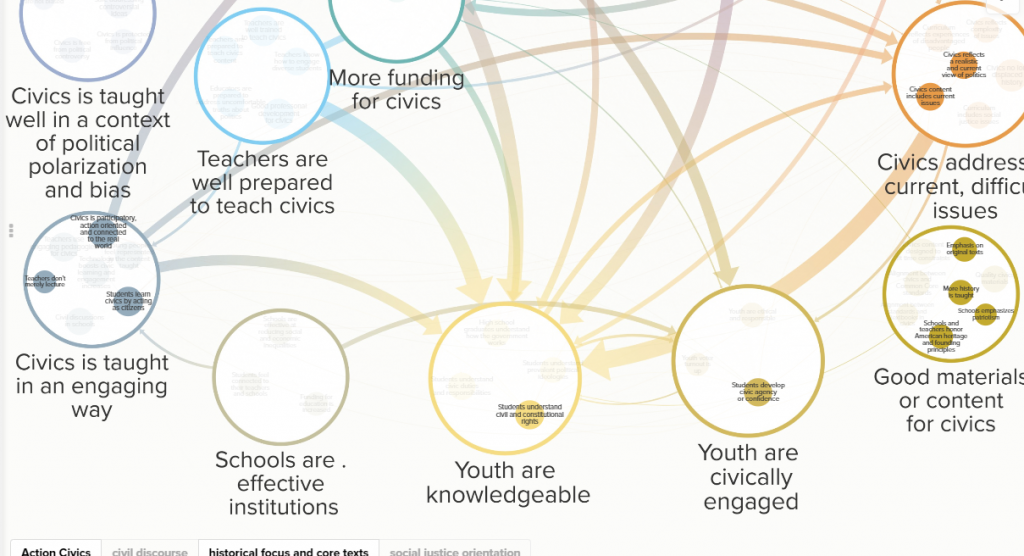
Finally, let’s zoom in for greater detail. This is a screenshot from the version of the map that displays 75 components clustered into larger factors. I have highlighted the components that may reflect a concern with history and classic texts (often coded as conservative) and those that reflect a desire for students to take action (sometimes seen as progressive).

Components Involving Action Civics and Historical Texts

The point I would like to emphasize is that these goals are not in conflict. They light up different parts of the map. It’s possible to work on both goals at once.

Another Fantastic D&D Online Event Roundup

There is a great variety of webinars and online events happening in the D&D world that we don’t want you to miss out on! Last week we mentioned, NCDDer Chris Santos-Lang has an upcoming webinar on making research transparent that we encourage you to check out. As well as, webinars from NCDD member orgs, MetroQuestBridge AllianceLiving Room Conversations, National Issues Forums Institute, and New Directions Collaborative!

Do you have a webinar or other event coming up that you’d like to share with the NCDD network? Please let us know in the comments section below or by emailing me at keiva[at]ncdd[dot]org, because we’d love to add it to the list!


Online Roundup: MetroQuest, Bridge Alliance, CSA’s Ethics Working Group, Living Room Conversations, NIFI, New Directions

MetroQuest webinar – “Public Engagement at All Scales | CMAP’s Winning Recipe”

Wednesday, January 30th
11 am Pacific | 12 pm Mountain | 1 pm Central | 2 pm Eastern (1 hour)
Educational Credit Available (APA AICP CM)
Complimentary (FREE)

For the Chicago Metropolitan Agency for Planning, award-winning comprehensive plans involve public engagement at all scales, collaboration with 284 communities, and a Local Technical Assistance program that’s admired nationally. Join us January 30th to get inspired!

CMAP Deputy Executive Director of Planning Stephane Phifer, Associate Outreach Planner Katanya Raby, and Senior Planner Lindsay Bayley will take you inside their local approach to online engagement for OnTo2050 – their comprehensive regional plan to improve quality of life and economic prosperity for 8.5 million people.

Public feedback was essential to exploring alternative futures for innovative transportation, climate change, walkable communities, a transformed economy, and constrained resources. You’ll learn how CMAP used a multi-phased approach to online engagement for a variety of local plans, including the downtown Aurora Master Plan.

Attend this complimentary 1-hour webinar to explore effective ways to:

  • Engage inclusively to build inclusive plans
  • Uncover the ideas, hopes, and concerns of residents
  • Take a multi-phase approach to online engagement
  • Think both locally and regionally for collaborative planning

This webinar will include a live Q&A session to help you prepare for 2019. Bring your public engagement questions for Stephane, Katanya, Lindsay, and Dave Biggs, Chief Engagement Officer at MetroQuest.

REGISTER: http://go.metroquest.com/Public-Engagement-at-All-Scales-CMAPs-Winning-Recipe.html

Bridge Alliance webinar – BridgeUSA Peer Learning Session – Achieving Diversity: An Example *this webinar is for Bridge Alliance members only – learn more here

Wednesday, January 30th
12 pm Pacific, 3 pm Eastern

Manu Meel will discuss how the Bridge Alliance and its members can achieve greater diversity in the revitalization movement. Specifically, he will present on:

  1. BridgeUSA’s lack of diverse leadership.
  2. The importance of diversity.
  3. How BridgeUSA is prioritizing diversity within its organization.
  4. What lessons other Bridge Alliance organizations can draw from its example.

We are very excited to host this event for Bridge Alliance member organizations through Zoom Video Conference, and we hope you will be able to join us.

If you wish to attend this event, please RSVP by January 24th.

RSVPwww.bridgealliancefund.us/bridgeusa_peer_learning_session

Ethics Working Group of the Citizen Science Association webinar – How to Make Your Research Transparent
* shared via NCDD member Chris Santos-Lang

Thursday, January 31st
9-10 am Pacific, 12-1 pm Eastern

A Webinar from CSA’s Ethics Working Group, presented by Chris Santos-Lang (Ethics Working Group Co-Chair)

This webinar is a practical how-to demonstrating some of the latest technologies developed to satisfy the transparency principles in the European Citizen Science Association’s Ten Principles of Citizen Science and the DIYbio Codes of Ethics. It will demonstrate two free solutions as examples: One is the Open Science Framework and the other is a homespun mixture of Google Drive, Google Docs, and FigShare. Both solutions leverage PubPeer, Creative Commons licenses, and research standards. This webinar also introduces the “APRICOT” mnemonic to map the range of transparency failures, and discusses the concerns that drive current negotiations between transparency and privacy.

About Chris: Chris Santos-Lang co-chairs the Ethics Working Group of the Citizen Science Association. He applies citizen science to ethics (e.g. studying moral psychology, machine ethics, and the sociology and political science of ethics).

If you experience any issues in registration, please email: info@citizenscience.org

REGISTER: https://citizenscience.member365.com/public/event/details/78a40bcdbcf4cbe1486b57996f0434fc336d9953/1

Training (free): The Nuts & Bolts of Living Room Conversations

Thursday, January 31st
This event begins at 1pm (PT); 2pm (MT); 3pm (CT); 4pm (ET)

Join us for 60 minutes online to learn about Living Room Conversations. We’ll cover what a Living Room Conversation is, why we have them, and everything you need to know to get started hosting and/or participating in Living Room Conversations. This training is not required for participating in our conversations – we simply offer it for people who want to learn more about the Living Room Conversations practice.

Space is limited to 12 people so that we can offer a more interactive experience.

Please only RSVP if you are 100% certain that you can attend.

This training will take place using Zoom video conferencing. A link to join the conversation will be sent to participants by Thurs 10am (PT) / 1pm (ET).

Questions and RSVP to Mary@LivingRoomConversations.org

Living Room Conversations webinar – Mental Health

Thursday, January 31st
1:30-3 pm Pacific, 4:30-6 pm Eastern

Join us for a free online (using Zoom) Living Room Conversation on the topic of Mental Health. Please see the conversation guide for this topic. Some of the questions explored include:

  • What experiences in your life, your work or your family inform your thinking about mental health?
  • Is mental health an important issue in your community, and if so, why?
  • In your experience, how are mental health issues affecting young people? (If you are a young person, how do mental health issues affect you and your peers?)

You will need a device with a webcam to participate (preferably a computer or tablet rather than a cell phone).

Please only sign up for a place in this conversation if you are 100% certain that you can join – and thank you – we have many folks waiting to have Living Room Conversations and hope to have 100% attendance. If you need to cancel please return to Eventbrite to cancel your ticket so someone on the waitlist may attend.

A link to join the conversation and additional details will be sent to you by no later than the day before the conversation. The conversation host is Lewis G.

REGISTER: www.livingroomconversations.org/event/online-living-room-conversation-mental-health-2/

National Issues Forums Institute – “A House Divided: Issue Guide Moderator Training

Friday, February 1st
9:30 am Pacific, 12:30 pm Eastern

Join us on Friday February 1st at 12:30p Eastern/9:30am Pacific time for an online workshop on how to moderate a NIF forum using the new issue guide on politics in America, “A House Divided: How Do We Get The Political System We Want? What Would We Have To Give Up To Get It?”

We will discuss each of the three options in depth, outline key deliberative questions you as the moderator could ask of participants to encourage quality dialogue, as well as ways to help your participants reflect on this controversial topic. We will also discuss the upcoming A Public Voice program NIFI collaboratively holds each year in Washington DC to share with policymakers how people are thinking about wicked issues. There will be additional time for any questions you may have about how to host a forum, how to encourage students to participate, and tips and hacks for moderating face-to-face and online with Common Ground for Action.

REGISTER: www.nifi.org/en/events/house-divided-issue-guide-moderator-training

Living Room Conversations webinar – Status & Privilege

Friday, February 1st
2-3:30 pm Pacific, 5-6:30 pm Eastern

Join us for a free online (using Zoom) Living Room Conversation on the topic of Status & Privilege. Please see the conversation guide for this topic. Some of the questions explored include:

  • What status do you enjoy? Education, wealth, gender, race, etc?
  • What are the privileges of your status?
  • What do you value and how is that connected to your status or privilege?

You will need a device with a webcam to participate (preferably a computer or tablet rather than a cell phone).

Please only sign up for a place in this conversation if you are 100% certain that you can join – and thank you – we have many folks waiting to have Living Room Conversations and hope to have 100% attendance. If you need to cancel please return to Eventbrite to cancel your ticket so someone on the waitlist may attend.

A link to join the conversation and additional details will be sent to you by no later than the day before the conversation. The conversation host is Shay M.

REGISTER: www.livingroomconversations.org/event/online-living-room-conversation-status-privilege-3/

Living Room Conversations webinar – Women and Political Leadership

Monday, February 4th
1-2:30 pm Pacific, 4-5:30 pm Eastern

Join us for a free online (using Zoom) Living Room Conversation on the topic of Women & Political Leadership. Please see the conversation guide for this topic. Some of the questions explored include:

  • Do you believe that having women in political leadership provides a different kind of voice? Why or why not?
  • Describe a powerful woman politician’s leadership moment you’ve experienced.
  • Are there issues around women’s political leadership that concern you?
  • What is your hope or aspiration for women in politics?

You will need a device with a webcam to participate (preferably a computer or tablet rather than a cell phone).

Please only sign up for a place in this conversation if you are 100% certain that you can join – and thank you – we have many folks waiting to have Living Room Conversations and hope to have 100% attendance. If you need to cancel please return to Eventbrite to cancel your ticket so someone on the waitlist may attend.

A link to join the conversation and additional details will be sent to you by no later than the day before the conversation. The conversation host is Steve F.

REGISTER: www.livingroomconversations.org/event/online-living-room-conversation-women-and-political-leadership-3/

Bridge Alliance #DemocracyChat [on Twitter]

Tuesday, February 5th
5 – 7 pm Eastern

On February 5th, @BrdgAllianceUS will ask supporters four questions about civic engagement. The event, titled #DemocracyChat, will give you and anybody else who is interested in the revitalization field the opportunity to connect with Bridge Alliance leaders and become part of the conversation. So make sure to follow @BrdgAllianceUS and use the hashtag #DemocracyChat once the questions are revealed next Tuesday.

New Directions Collaborative webinar  – Meetings That Do More

Wednesday, February 6
12:00 PM – 2:00 PM EDT

Imagine leaving a meeting feeling inspired, energized by new ideas, with enhanced goodwill toward your colleagues and a shared sense of clarity on where to go next. In this interactive on-line workshop, you will learn practical tools for creating meetings that deliver multiple benefits. Key topics include:

  • How to clarify the strategic context and range of outcomes for a meeting
  • How to frame strategic questions for the group to explore
  • An introduction to, and experience of, participatory meeting methods that can also work on-line
  • How to structure an agenda with samples of agenda designs

The workshop will be held on Zoom video conferencing where you will experience how to host effective meetings virtually, including with small group conversations. You will receive several handouts full of resources and guidance to help you design and facilitate future meetings.

Beth Tener of New Directions Collaborative will facilitate, sharing methods she has practiced in work with over 150 organizations and collaborative initiatives, concerning socially responsible business, sustainability, local food systems, education, climate action, racial equity, and transportation.

This workshop is the first in a series. You can attend one or the series.

Workshop fee is $70. Please click below to register.

If this fee is a barrier to participating, please contact Beth at btener@ndcollaborative.com – discounts are available to make this accessible to all interested.

REGISTER: www.ndcollaborative.com/events/

Living Room Conversations webinar – Free Speech, Fighting Words, and Violence

Wednesday, February 6th
4:30-6 pm Pacific, 4-5:30 pm Eastern

Join us for a free online (using Zoom) Living Room Conversation on the topic of Free Speech, Fighting Words, & Violence. Please see the conversation guide for this topic. Some of the questions explored include:

  • How do we protect free speech and ensure public safety despite ongoing threats of violence?
  • Have you had a personal experience where free speech was inhibited? Or have you ever felt harmed by the speech of others?
  • How do we decide what our collective, social morality is? What is the federal government’s role?

You will need a device with a webcam to participate (preferably a computer or tablet rather than a cell phone).

Please only sign up for a place in this conversation if you are 100% certain that you can join – and thank you – we have many folks waiting to have Living Room Conversations and hope to have 100% attendance. If you need to cancel please return to Eventbrite to cancel your ticket so someone on the waitlist may attend.

A link to join the conversation and additional details will be sent to you by no later than the day before the conversation. The conversation host is Beth R.

REGISTER: www.livingroomconversations.org/event/online-living-room-conversation-free-speech-fighting-words-and-violence-2/