Copy of Can We Handle the Truth? Trying to Re-establish a Working Infrastructure for News (Part II)
Reply

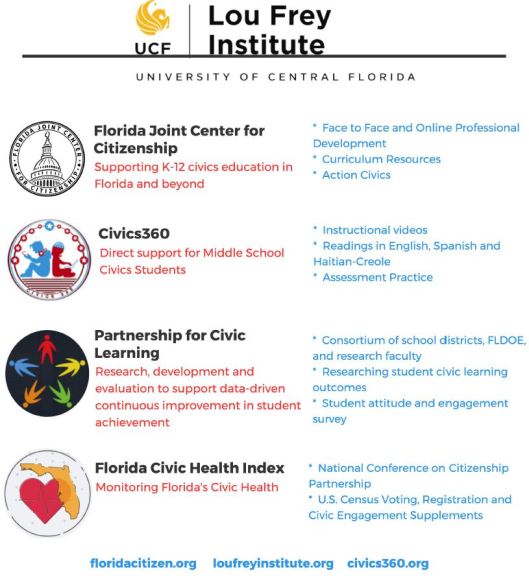
In last week’s post, we re-introduced ourselves and discussed the sorts of resources that we have developed and offer (for free) for civic education here in Florida and beyond. Today, let’s take a look beyond the ‘knowledge’ component of the ‘Civics Knowledge, Skills, and Dispositions‘ triad and discuss the ways in which we here at the Lou Frey Institute/Florida Joint Center for Citizenship are working to bring the skills and dispositions of component of effective civic education to classrooms.
Citizen Apprentices in Middle School
Chris Spinale, our Action Civics Coordinator, has referred to the work that we do with civic engagement as helping students in their roles as ‘citizen apprentices’ (and we will discuss more about the ‘citizen apprentice’ idea in a later post!). In doing so, we have begun a great deal of work and support around the Constitutional Rights Foundation’s Civic Action Project.
The Civic Action Project is an excellent tool to begin the work of citizen apprenticeships. Students have the opportunity to explore policy and develop solutions at all levels of community. It engages students in the deep and important task of thinking about civics from an engagement lens. How do I improve my community? How do I take what I have learned in civics and make a difference. It’s important to note, as well, that this is not inherently a conservative or liberal approach. Rather, it reflects what students themselves have identified as pressing issues in their community (and community may be a classroom, school, neighborhood, town, or more!). As an example, a couple of years ago, Citrus Ridge Civics Academy in Polk County did a CAP project to pursue policy change around domestic violence shelters. According to student research (a big part of CAP!), there was only one domestic violence shelter within the a certain radius of their community, and the students developed a presentation to try and convince policymakers to change that. Another simply powerful public service announcement dealt with an epidemic of suicide in the community (provided below; please be warned that it could be painful to watch for some folks).
Last spring, the Lou Frey Institute, in collaboration with the Boys and Girls Clubs of Central Florida, hosted the Civic Action Project Showcase. It gave groups of middle school students the opportunity to share their policy research, proposals, and recommendations to district superintendents, local leaders, and decision makers in their communities. You can read all about it here!
We are currently working, in some form or other, with schools in Brevard County, Polk County, Orange County, and even a school in Texas to implement some version of CAP in middle school.
Citizen Apprentices in High School
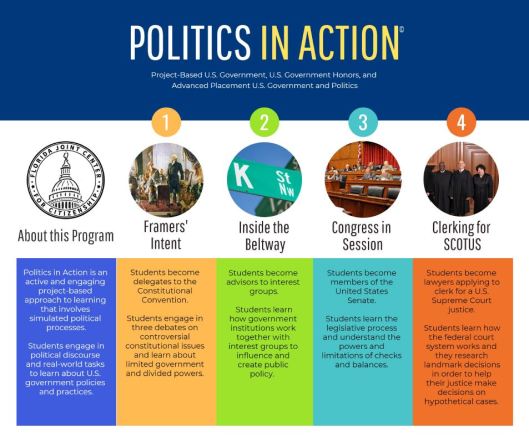
While we have launched the Middle School CAP effort already, we are currently working on and piloting something called Politics in Action (or PIA). This is based on the ‘Knowledge in Action’ work of Walter Parker and Jane Lo (and was developed for Florida in collaboration with Dr. Lo). This is essentially a simulation of American government that gives students the opportunity to really gain a deep (and necessary!) understanding of how American government is supposed to work. Take a look at the infographic below to see the 4 modules for this approach.
In the video below, Dr. Parker discusses this approach (though again, please note that we have adapted it for Florida!)
So that is just a couple of areas where we are moving beyond the ‘traditional curriculum’ of civic education and trying to bring civics in Florida to that next level of practicing skills and developing dispositions. If you are interested in either the Civics Action Project or Politics in Action, you can contact Dr. Steve Masyada or Chris Spinale of LFI/FJCC!
In a talk yesterday at Tufts, Eboo Patel, the founder and President of the Interfaith Youth Core, said that the guiding question of the field of Interfaith Studies is how to build a religiously diverse democracy. He defined a democracy as a place “where people can make their personal commitments public.” He said that diversity “is not just the differences you like.” It means being able to deal with people who disagree with you about important matters, including politics. And he defined religion as being “about ultimate concerns.”
Eboo made an explicit connection to Civic Studies, for which the defining question is “What should we do?” How to live democratically with religious diversity is an important branch of Civic Studies. It raises empirical questions (What are the roles of religious congregations in civil society? How will they change? How do human beings react to out-groups?) and normative questions (What is the place of faith in public deliberation? How should we respond to beliefs that are intolerant? When should we treat the transmission of practices from one tradition to another as appropriation?)
In January, I got a dose of Interfaith Studies–meaning the theory, the everyday practices, and the committed people–at a conference of the Pluralism Project. I’m eager to work with our chaplaincy and others to build a stronger strand of Interfaith Studies as a complement to Civic Studies.
See also: when political movements resemble religions; the political advantages of organized religion; are religions comprehensive doctrines?; on religion in public debates and specifically in middle school classrooms; churchgoing and Trump; and is everyone religious?
NCDD is happy to announce our April Tech Tuesday featuring Ethelo. This FREE event will take place Tuesday, April 23rd from 2-3pm Eastern, 11am-12pm Pacific. Don’t miss out – register today to secure your spot!
 Ethelo helps their clients to offer more transparency and participation on the hottest public issues in a way that creates better outcomes and stronger buy-in. Their participatory decision platform has been used by all levels of government as well as the private and non profit sector ensure inclusive, fair processes and defuse opposition. It’s unique algorithms and ability to solve solve complex problems while building support has been described by the Canadian government as “an exceptional advance that is clearly ahead of competitors.”Ethelo has been used for community planning, project design and evaluation, budgeting, grantmaking, and policy development in North America and abroad.
In this webinar, we will be joined by John Richardson, founder and CEO of Ethelo. John will give a quick overview of the software and walk through some real-world examples of how its been used by different clients to engage stakeholders in solving contentious, real-life problems. Ethelo is particularly helpful for stakeholder engagement and communications professionals in the government, business and nonprofit space who need to engage large groups of people on sensitive and challenging issues. When an upfront investment in a fair, inclusive process is critical to prevent opposition down the road, Ethelo provides a robust and proven solution.
“Ethelo is a dramatic new technology that can facilitate democratic citizen participation in political decision making. As people insist on more say in the decisions that can affect them, Ethelo can make modern citizen engagement possible and practical.”Judy Rebick, Founder Rabble
About our presenter
John Richardson is an internationally recognized social entrepreneur, with a background in mathematics, law, political policy and technology. In 2005, he was awarded an Ashoka Fellowship for his work in creating high-impact social initiatives. John and his colleagues founded Ethelo to develop online approaches for participatory decision-making that could scale to large groups. John is dedicated to advancing new approaches to digital engagement and direct democracy.
This will be a great chance to learn more about this . Don’t miss out – register today!

 Tech Tuesdays are a series of learning events from NCDD focused on technology for engagement. These 1-hour events are designed to help dialogue and deliberation practitioners get a better sense of the online engagement landscape and how they can take advantage of the myriad opportunities available to them. You do not have to be a member of NCDD to participate in our Tech Tuesday learning events.
Friends, the great folks over at the Civics101 podcast need your input! Contact information is in their communication below!
Civics 101 is looking for additional high school educators (i.e. History, Civics, Social Studies, or Journalism) in grades 8-12 who would like to participate in a 75-minute online focus group that will inform the development of a publicly available podcast about Civics.
Participants will join a 75 minute video call with 5-6 colleagues and an education researcher from EDC and:– Share their goals, challenges and successes in teaching with podcasts
– React and respond to proposed civics podcast content and format
– Receive a $100 gift card as a thank you
The focus groups will take place on Tuesday April 2, at 3:30, Thursday April 4, at 3:30 and Friday April 5 at 3:30. If you are interested, please respond with the time slot that works best for you.
Thanks!
Laura Bartel
Education Development Center, Inc
lbartel@edc.org
Our ability to suspend our judgments and engage our curiosity can have powerful ramifications in our personal lives and in the larger society. NCDD member Debilyn Molineaux discussed how our curiosity can be one of our many superpowers in the article she wrote, Rush to Curiosity — Judge Later, shared on the Bridge Alliance blog and reposted from AllSides. If you are looking for a place to get some conversational practice to strengthen your curiosity, then we recommend folks participate in the National Week of Conversation kicking off later this week. You can read the article below and find the original version on BA’s site here.
 We’ve all done it. We see or hear something (like a news story or meme/tweet) and are outraged — we MUST respond. We. Can. Not. Let. It. Go. Unchallenged.
Besides, we know we are smarter than whoever is offending us, right? (Cue music of self-righteousness.)
Whew. My blood pressure goes up just thinking about it! I’m not often caught up in outrage these days, but when I am, it may take me days to calm down again. And there is so much to be outraged about — from dehumanization to nasty rhetoric to all manner of injustice. It feels more dramatic and heightened than ever before.
So I’m curious — what would happen if we looked a little deeper, both into ourselves and into our society? Outrage isn’t part of who I want to be. What about you?
Our rush to judgment is biological. Our survival as early humans was not certain. Our judgement served us — protecting lives, families and communities. Our quick judgement was required. Is our personal and individual survival still at stake on social media? In our daily lives? Sometimes. Most often not.
Many people are living on the social or financial edge. So when we flood our brains with images via social media and the news, we react from a place of survival. As a result, our country experiences a collective hair trigger, both metaphorically and literally. Our fear means we will shoot to kill (with guns or with words) instead of pausing to check our judgement for possible errors. Pausing could literally save lives.
We seem to have forgotten our superpower of curiosity.
Curiosity is the mindset we use to:
Wouldn’t our lives be better if we employed more curiosity? Wouldn’t our country be better? I think so. It’s my daily aspiration and choice. What is yours?
What we do next will matter a lot. We can pull the trigger and respond with outrage. Or, we can hit “pause” and engage our curiosity to research if our anger is justified. Most often, it is not. Most of what we hear or see has an aspect of truth, but is far from the whole Truth. Most often, facts are selected and an interpretation is presented to provoke a fearful response in us. As a people, fear makes us more susceptible to manipulation.
The good news is we have the superpower of curiosity within us. And with practice, our ability to use it gets stronger. It’s easy! Once the “fear button” is pushed, stop and ask:
And here’s the real secret to curiosity. Even if we decide we should be afraid, there’s still time to use our judgement and act. But the same cannot be said of judging first and being curious second. Curiosity provides more options for our future. Use your superpower!
Rush to curiosity. Judge later.
Debilyn Molineaux is a transformation facilitator. She works with visionaries and movements in support of a new national and global social contract focused on personal dignity and sovereignty. Her work highlights the relationships between individuals, institutions and governments for conscious transformation. Debilyn is the Co-founder and Executive Director of Bridge Alliance, representing over 90 organizations. She also co-founded Living Room Conversations and National Conversation Project where people can learn skills to mend the frayed fabric of our nation. She has a Center bias.
You can find the original version of this article on the Bridge Alliance site at www.bridgealliance.us/rush_to_curiosity_judge_later.
Good afternoon, dear friends in civics. Today’s post is response to this positive and supportive piece published in recently in Florida Politics. As you are most likely aware, the Lou Frey Institute/FJCC has faced a continual budget issue for the past few years. The linked Florida Politics post argues for ensuring that the Florida Joint Center for Citizenship is fully funded:
According to the Lou Frey Institute, when teachers use their resources, students score 20-25 percent higher on Florida’s end-of-course civics assessment.
Civics education is at the core of everything we are as a society. It’s about the law and the Constitution. It’s about voting and free speech. It’s about free expression of religion and speaking up freely to the government itself. In other words, it’s about America.
The Legislature requires civics education for millions of Florida children. In light of that, cutting funding for a resource that’s shown long-term significant ability to improve civics education seems to be an unwise and uncivil course of action….
Legislators should not be punishing an outstanding institution that is working hard to right the ship. FJCC conducts civics education under the names of two of Florida’s most civic-minded leaders of the past 40 years. Bob Graham and Lou Frey, a Democrat and a Republican, understood how government can be an instrument for good when used properly and in a limited way to find creative, workable solutions to problems.
They certainly understood the importance of the saying long popular around the Capitol: ‘Don’t throw the baby out with the bathwater.’ The Florida Joint Center for Citizenship did nothing wrong — but rather does so much right.
It would be a shame to see it, and the children who benefit from its programs, penalized for mistakes and misdeeds unrelated to its fine work and mission.
We greatly appreciate this support. But it’s time, perhaps, for a refresher on the work we do here at LFI/FJCC, a proud partner of the Civics Renewal Network (and be sure to check out their materials!) So, just what do we do? What does this funding support?
K-12 Civic Education Resources


You may be most familiar with us from our resources, provided to teachers of all grade levels. Every resources or tool we develop is created in response to a request to meet a need and in collaboration with teachers, teacher educators, and social studies/civics professionals. These curricular resources, available on our main website, are 100% free (though registration is required) and include, but are not limited to:

Perhaps our most popular resource is Civics360. So what tools do you find on Civics360?


The site also includes a 60 question practice assessment that reflects the actual EOC in structure and format.

Be sure to check out the overview video!
The use of these resources in the middle school civics classroom does, we believe, have something of an impact, especially in conjunction with professional development.

In Monday’s post, we’ll explore some new directions for LFI/FJCC in the action civics arena and discuss the types of professional development that we can provide!
Here’s a fascinating sign that commoning is growing as a social and political form: new histories are being written to trace its recent evolution! The latest example is a new book released by The Institute for Political Ecology in Zagreb, Croatia, has recently published Commons in South East Europe: Case of Croatia, Bosnia & Herzegovina and Macedonia. (PDF file)
The book, published in cooperation with the Heinrich Böll Foundation and its office in Sarajevo, is a rigorous yet accessible 170-page introduction to the commons, with an accent on developments in the region of South East Europe (SEE). Its main editor and author is Tomislav Tomašević, with additional editing by Vedran Horvat and Jelena Milos, augmented by contributions from a number of individual authors and a larger team.
The Institute’s primary goal in preparing the book is to “put this part of Europe….on the landscape of international academic and political debate on the commons.” By synthesizing knowledge about the commons in the region, the book aims to “provide an interpretive and theoretical framework” for understanding “numerous political actions and mobilizations that have emerged across the region of South East Europe, mainly with the ambition of creating the commons or defending and resisting further enclosure of the commons. Since practice has preceded in-depth theoretical understanding in many cases, we felt a responsibility to start bridging this gap.”
I highly recommend the book. It’s a tight, well-written, and carefully documented overview of a region whose commons have not received enough attention.
The book starts with a “compact history of the commons” featuring the classical theory of the commons and newer “critical theory.” From these chapters, the book introduces the history of the commons in the region, cases of commons governance there, and significant political struggles against enclosure.
Like most places around the world, there is a rich history of commoning here that is not widely known:
Ethnologist Jadran Kale writes that the common pastures in Croatia and Slovenia were called gmajna, which obviously comes from the German word Gemeine meaning “common.” In the see countries under the Ottoman rule, there was an interesting concept of vakuf, which comes from the Arabic word waqf and was an inalienable endowment in land, building or other asset under Islamic law that could be freely used by all members of the community but in sustainable way. Despite some of the differences between the SEE countries, historian, and philosopher Maria Todorova writes about the regionally specific social form of extended family cooperative, which became well known in international anthropological literature as zadruga. This was an agricultural socio-economic communal organisation based mostly on kinship, with rather democratic governance and common property institutions.
This chapter of the book traces the history of commons following World War II to the present, noting the distinctive history of Yugoslavia as part of the Non-Aligned Movement (neither market-capitalist West nor state-socialist East). The country hosted a variety of self-governance experiments such as workers self-management and “social ownership” of all means of production. Of course, despite the nominal ownership by workers and citizens, decisionmaking remained in the hands of an elite.
This historical context is important because, as the book notes, “such a legacy is a major obstacle for advocating any forms of commons in the region today....Even words like ‘cooperative (zadruga), which are not controversial in Western Europe, are considered insulting and hostile by many people in the region” because of the previously mandated agricultural coops in socialist Yugoslavia.
With the past either vilified or bathed in nostalgia for a more stable time, it can be hard for contemporary minds to grasp the realities of peer governance. Would-be commoners in the SEE region must navigate the gap between the repressive totalitarian past, the bloody civil strife of the 1990s, and the fierce neocapitalist capitalist exploitation that has occurred under the auspices of representative democracy.
As the authors explain, the latter resulted in “de-industrialization, high unemployment and increasing poverty” while also disabling the instruments of direct and participatory democracy” that might have allowed citizens to control their elected governments.
So in grappling with the problems today, people in South East Europe confront problems of language, memories, and mindsets. “The neoliberal transition made many people in newly independent countries of South East Europe nostalgic about socialist Yugoslavia, while nationalist political elites still make some critical but honest evaluation of the self-governance practices impossible.”
However, over the past twenty years, there have been important theoretical elaborations of self-governance advanced by Elinor Ostrom and Yugoslav economist Branko Horvat. The book also notes the landmark work by the working group within Balkan Forum of the 2013 Subversive Festival. (See The Balkan Forum, a 2014 book by edited by Danijela Dolenec and others.)
Most commons in the South East Europe region tend to take two forms -- communities of users who have organized themselves in various sectors (health, education, culture, housing) and people struggling against enclosure -- “the commodification, privatization and statification of resources that should be accessible to all.”
Significantly, activist commoners have often embraced the governance practices of commoning in their struggles. In fighting to protect Varšavska Street against the construction of a shopping mall in downtown Zagreb, for example, and in student fights against the commodification of the education system, activist occupations self-governed themselves as commons.
There is much more in this book worth checking out – the case studies of pasturing commons, the Rojc Community Centre in the City of Pula, and the Luke water supply system in Bosnia and Herzegovina. The book also chronicles the struggles against enclosure in the region, such as the effort to protect Srđ Hill above the City of Dubrovnik from construction of a massive, upscale golf course, villas and hotels.
While there is clearly a commons movement in South East Europe, the authors of this book are candid in admitting that “commons theory, discourse and practice occur within a well-connected but still rather small community of scholars, activists and practitioners, which makes its impact limited. Expanding the commons movement in South East Europe and increasing the amount of research on commons, struggles over commons and governance of commons remains a challenge for the future.”
The report can be downloaded as a pdf file here.
“Civic Politics and Global Order”: A Special Issue of The Good Society: A Journal Of Civic Studies
More than a century ago, US President Woodrow Wilson asked Congress to declare a state of war with Germany—a radical step in pursuit of a radical objective. Seeking “no conquest” and expecting “no indemnities” for any life or treasure lost, Americans, Wilson declared, would fight “for democracy, for the right of those who submit to authority to have a voice in their own governments, for the rights and liberties of small nations, for a universal dominion of right by such a concert of free peoples as shall bring peace and safety to all nations and make the world itself at last free.”
The “concert of free peoples” that emerged from the Great War’s ashes—the League of Nations— never gave adequate international expression to such democratic civic ideals, nor could it prevent a second global conflict. Yet it laid grounds for a complex of institutions—among them the World Bank, United Nations, NATO, and European Union—that for decades after World War II embodied for millions of people the possibility of an increasingly stable and just world order. Now the prestige of that order has reached a historic low, and its continued existence has come into doubt.
Simultaneously, however, citizens and societies worldwide continue to seek ways of achieving Wilson’s essential vision: a vision of self-governing communities collaborating, despite conflicting interests, on the otherwise impossible task of creating a safe and just world.
Aware of such strivings and persuaded of their importance, the editorial board of The Good Society invites submissions from scholars and practitioners exploring the relationship between civic politics and global order. What interests do self-governing communities at the national, subnational, or transnational level have in maintaining international or global order? What normative commitments are required, and what independent and collaborative actions are advisable, to advance such interests while maintaining due regard for divergent local, cultural, and historical contexts?
What strategies and tactics—proven, novel, or forgotten—are ripe for implementation, experimentation, or rehabilitation? Above all hangs the question: Is there a regulative ideal of global order that self-governing aspirants and civic agents should adopt? If so, how can it be formulated, disseminated, theorized, and realized in a manner that respects the plural as well as universal interests and experience of humanity?
The editorial board invites papers of 6,000 to 8,000 words that address the questions above, as well as other relevant questions emerging from serious inquiry into the character of a good society and the conditions for achieving and maintaining it. Please submit papers by May 1, 2019 to: http://www.editorialmanager.com/gs/default.aspx
For more information regarding this call, write Trygve Throntveit, editor, tthrontv@umn.edu
The Good Society is the flagship journal for the interdisciplinary (between disciplines) and transdisciplinary (beyond disciplines) field of Civic Studies. For more information on Civic Studies, please visit http://civicstudies.org/about/ .
Is your city on the path to becoming an awarded All-America City? The National Civic League, one of our partner organizations, recently announced the finalists for the prestigious All-America City Award! This year’s award theme seeks to recognize the communities working to improve health equity in their cities. These finalists exemplify some of the most impactful and innovative civic engagement efforts happening in our cities, who are working to address local community issues around health equity. Winners will be announced the 70th Annual All-America City Awards and Conference at the end of June. You can read the announcement below and find the original version of this on the NCL site here.
 Announcing This Years’ Finalists! These 20 communities get the chance to be named an All-America City
The All-America City awards are an awards ceremony and networking event unlike any other! Through concrete examples, interactive discussions, and finalist presentations – you will walk away with the knowledge, skills, contacts, and inspiration you need to better strengthen your community.
The award, given to 10 communities each year, celebrates and recognizes neighborhoods, villages, towns, cities, counties, tribes and regions that engage residents in innovative, inclusive and effective efforts to tackle critical challenges.
2019 All-America City Award Finalists
in alphabetical order by city:
Battle Creek, Michigan
Clinton, North Carolina
Cornelius, Oregon
Doral, Florida
Dubuque, Iowa
Edinburg, Texas
El Paso, Texas
Gothenburg, Nebraska
Hallandale Beach, Florida
Livingston County, New York
Millcreek, Utah
Mission, Texas
Ontario, California
Pasco, Washington
Rancho Cordova, California
Rock Hill, South Carolina
San Antonio, Texas
Sumter, South Carolina
West Hollywood, California
Wichita, Kansas
“These finalist communities are building local capacity to solve problems and improve their quality of life. The National Civic League is honored to recognize these communities, and views their efforts as critical in addressing the challenge to communities issued by the 1968 Kerner Commission, ‘to make good the promises of American democracy to all citizens – urban and rural, white, black, Spanish surname, American Indians, and every minority group.’” – The National Civic League’s President, Doug Linkhart
You can find the original version of this announcement on the NCL site at www.nationalcivicleague.org/2019-finalists/.