
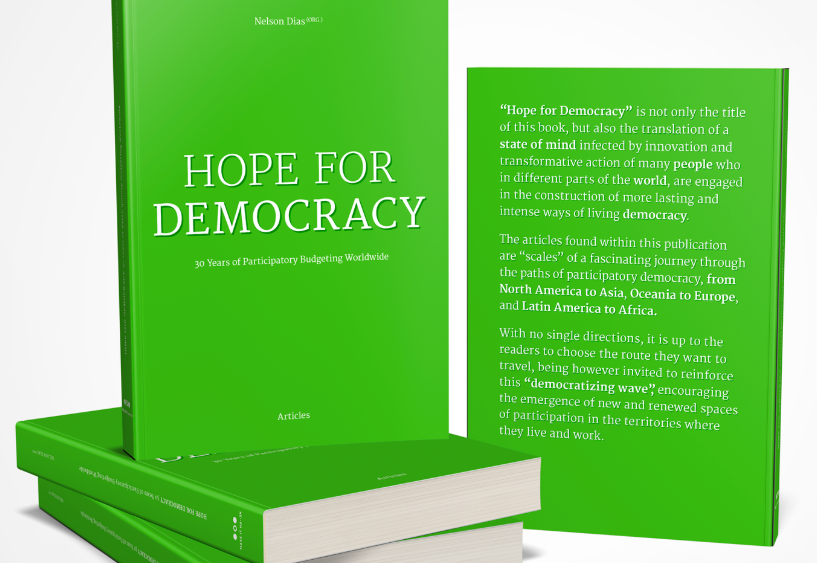
For our participatory budgeting enthusiasts out there (and we know there are a lot of you!), NCDD member org – the Participatory Budgeting Project, recently shared the exciting new book, Hope for Democracy: 30 years of participatory budgeting worldwide. The 600-page volume, edited by Nelson Dias, features over 60 authors on their experiences with PB across the world over the last 30 years and offers great insights for how to further grow the PB movement. We are thrilled to note that folks are able to download this book for free! You can read more about it in the post below and find the original announcement on the PBP site here.
Hope for Democracy: A New Book Reflects on 30 Years of Participatory Budgeting
An expansive new volume edited by Nelson Dias features dispatches by more than 60 authors from the frontlines of participatory budgeting’s (PB) growth around the world. This book, Hope for Democracy, could not have come out at a better time for PB supporters in North America. Next year will mark 10 years of PB in the US and new opportunities to take PB to the next level: a big citywide process approved in NYC, hundreds of new school PB processes, and growing political interest in strengthening democracy.
To make the most of these great opportunities to revitalize democracy, we need to first learn from PB’s growth internationally. Dias and his collaborators deliver countless insights in their 600-page panorama. (Download the book for free here.)
 We lift up the biggest lessons below…
Why have Hope for Democracy?
Dias begins with an overview of key trends in PB as it spread from Porto Alegre, Brazil in 1989 to over 7,000 localities around the world. PB experts Brian Wampler, Stephanie McNulty, and Michael Touchton note how in Brazil during the 1990s, leftist politicians and activists championed PB as a radical project to “broaden the confines of representative democracy, mobilize followers, and achieve greater social justice” (p. 55); over time, it attracted support from a wide range of actors, including international organizations like the World Bank, because of its potential to improve governance and promote civic engagement. Giovanni Allegretti and Kalinca Copello discuss how, as PB spread internationally, new processes often committed fewer funds, whether measured as lower PB spending per person or as a smaller share of PB in the overall budgets (p. 45).
Benjamin Goldfrank and Katherine Landes examine how this trend has played out in the U.S. and Canada. They report that PB has expanded more slowly than other regions in terms of the number of cities implementing it, the amount of participants, and the volume of funds (p. 161). Yet, Goldfrank and Landes demonstrate this is not due to a lack of public interest: “we find that where PB allocates larger pots of money, the rate of participation tends to be higher” (p. 172). In other words, the more dollars that a PB process allocates, the more people care about it. Moreover, two bright spots on the horizon indicate that PB may grow faster in coming years: its mounting presence in schools and its rising appeal among progressive activists and politicians.
In the light of the recent victories in NYC—PB in all public high schools and citywide PB approved into the city charter—this watershed may be closer than the Goldfrank and Landes anticipated. Chapters on Paris, Russia, and Portugal offer additional insights on how to scale up PB in North America.
Paris offers a model of PB going big
Paris currently runs the largest PB process in the world. Similar to NYC’s coming city-wide process, PB in Paris was championed by a progressive mayor, Anne Hidalgo, who successfully campaigned on bringing PB to Paris in her 2014 election. Mayor Hidalgo wasted no time in implementing her plan of dedicating 5% of the city’s capital budget to PB over the first five years (That’s roughly 500 million euros!). Tiago Peixoto and colleagues use the Paris case to study large-scale issues, like whether online voting improves the process or biases it towards more privileged residents. Their research finds that voting patterns between online voters and those who vote in person are remarkably similar.
PB in Russia innovates, expands rapidly
In 2015, Russia experienced a turning point after which the number of PB processes grew surprisingly fast. This occurred when the Ministry of Finance noted the positive outcomes in regional PB processes and created a framework known as Initiative Financing. The next year, 8,732 PB projects were implemented. By 2018, half of all regional governments in the country (the equivalent of U.S. states) decided to set up PB programs.
Why did so many regions begin PB so quickly, when the federal government did not provide financial incentives to do so? Ivan Shulga and Vladimir Vagin emphasize how the central framework and technical assistance provided by the Ministry of Finance and the World Bank made regional implementation much easier. These processes also made use of some innovative institutional designs. In some programs, municipalities, businesses, organizations, and citizens pledged to co-finance projects, increasing their chance of receiving regional funding. Another program used a form of sortition or citizen jury, in which a cohort of volunteer budget delegates was randomly selected, to work with experts to turn project ideas into full-fledged and feasible proposals.
Portugal leads the way with national PB
Portugal was the first country to run nation-wide PB. While the process is not particularly large in terms of public participation or budget, it does provide one model of a large-scale institutional design that bridges disparate regions.
Roberto Falanga outlines how the process collected nearly 1,000 ideas from each part of the country in 50 assemblies and winnowed them down into viable proposals for a vote. The process did not use budget delegates to revise the proposals. While this may streamline the process, it runs the risk of giving experts and officials more power than public participants. However, an effort was made to minimize this danger by requiring detailed reasons for rejecting proposals and re-including ones that could be revised and made feasible. Still, proposals that were backed by informal social networks may have received undue prominence. For example a bullfighting project won funding even though a majority of the Portuguese public believes that the practice should be banned.
Reflecting on what’s been done, ready for more
It’s an exciting moment to get involved with PB. And it’s an important time to reflect on how far different regions have taken PB. While there are currently around 100 active processes in the U.S. and Canada, Latin America and the Caribbean hosts around 2,500 processes and Europe 3,500. We have some catching up to do.
Donate here to help PB grow.
You can find the original version of this announcement on the Participatory Budgeting Project’s site at www.participatorybudgeting.org/hope-for-democracy-a-new-book-reflects-on-30-years-of-participatory-budgeting/.
 This is the sixth post in our blog series exploring democracy around the world, submitted by a diverse group of people interested in using deliberation, participation, and civic tech to solve challenges we face today. The following does not necessarily represent the views of the Jefferson Center or Jefferson Center staff.
 Lots of gratitude is in store for those who helped make #NCDD2018 the dynamic event that it was! An immense THANK YOU to our conference sponsors (and D&D champions) for your generous support – you truly help drive this work and this field forward, and we couldn’t do this without you!
 While the conference planning team worked hard to design a great event… it’s thanks to our fantastic attendees who really brought #NCDD2018 to life! It was wonderful to see so many familiar faces and also meet lots of new folks who have been doing this work (many of whom were first-timers to NCDD conferences!). It’s exciting to say that with over 450 attendees – #NCDD2018 was our largest event yet!
 The application due date is Tuesday, November 13, 2018 at 11:59pm PT. For details about the program, including a PDF of all application questions – read more below. If you have questions about this application, please contact Ben Phillips at ben@citizenuniversity.us.
 We hope these examples evoke excitement for the D&D community (and for the upcoming conference)! In true NCDD form, we want to engage this community of innovators in discussing how we build capacity for D&D in more communities and design action steps to make this happen moving forward. How have you succeeded in building capacity for engagement in the communities you serve? What do you think the next innovations might look like for dialogue, deliberation, and engagement? What do we need to discuss and think about together as a field, in order to succeed in broadening the use of D&D?
 On October 18, 2018 at the National Conference in Citizenship in Washington, D.C., six inspiring initiatives were honored as winners of the 2018 American Civic Collaboration awards.
 Here’s what you need to know:
  Do not miss the plenaries! Our opening plenary will feature “lightning talks” by civic innovators to spark inspiration and will include a networking activity to assist every attendee with identifying goals for the conference and beyond. On Saturday and Sunday, we will be focusing the plenaries almost exclusively on connecting, by using Open Space and Pro Action Cafe, respectively, for folks to propose the topics and ideas they most want to connect with others about!