NIF & Kettering Host Online Immigration Conversation Monday

We encourage NCDD members to join our partners with the National Issues Forums of Northern Virginia and the Kettering Foundation for a webinar conversation on immigration tomorrow, Sept. 29th. The conversation will use KF’s new online deliberation tool, Common Ground for Action, so make sure to join us and check it out! You can read the invitation from Bill Corbett of NIFNVA below or find the original here.


NIF-logoI’m writing invite you to an upcoming online National Issues Forum, a small, moderated, chat-based deliberation on a critical issue facing America.
It takes place on Monday, September 29 at 7:30 pm to 9:30 pm EDT. All you need to participate is a web browser and the willingness to use chat for conversation.

The topic is “Immigration in America — How Do We Fix a System in Crisis?” The issue guide is at this link. The issue guide provides the road map for our discussion and essential background. If you’d like to watch a three-minute video that previews the topic, you can view it on our website by clicking here.

You can register by reply to this message or by completing the online form at the new website of National Issues Forums of Northern Virginia. The forum is limited to twelve people…first-come, first-served…but more forums are coming.

The forum uses a new software tool from the Kettering Foundation that brings moderated deliberation on national issues to a wider audience.

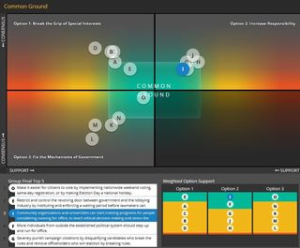
Below is a screen shot of a Common Ground graphic produced by an online National Issues Forum earlier this month. It is the product of ten people working through the issues together in a discussion about how to fix American politics.

I hope you are as interested as I am in helping to develop this new tool for more people to participate in political life.

Sincerely,

Bill Corbett National Issues Forums of Northern Virginia

Bill_Corbett_NIF_of_Northern_Vir@mail.vresp.com

NCDD 2014 Feature: “What’s Equity Have to Do with It?” Workshop

As we get closer and closer to NCDD 2014, we have asked our workshop presenters to share a bit more info about their sessions with you. So we are pleased to start by featuring “What’s equity have to do with it? Ensuring inclusive participation”, a great session being offered by Carrie Boron, Susan McCormack, and Valeriano Ramos. Read more about their workshop below and find out more about read about all of our NCDD 2014 sessions by clicking hereStill not registered for NCDD 2014? Make sure to register today


NCDD2014-blogimageNext month, my colleagues and I are co-presenting a session at the NCDD conference on the role of equity in public participation. Creating Community Solutions’ Susan McCormack and Everyday Democracy’s Valeriano Ramos, and me, Carrie Boron, and will join together with conference attendees to help answer the question, “What’s equity have to do with it?”

Taking on the topic of equity is challenging, confusing and conflicted, and requires much more time, knowledge and resources than are usually available. This is especially true given our limited session time at the conference. So, we thought we would give more “air time” to the subject here on the NCDD blog.

Those who work to bring people together in their communities to talk and find ways to make progress on various public issues often use the word “inclusive” to describe diverse participation. The aim is to have people from different ethnic, gender, age, sexual orientation, educational and socioeconomic backgrounds join the effort. Although such work is well-intentioned, organizers often miss the mark because they have not considered the societal structures and policies that perpetuate inequities.

Understanding the structures that support inequity (with a particular emphasis on structural racism) is essential for effective dialogue and long-term change on every issue. For instance, there are still many public and private institutions that exclude people of color. Schools in poor neighborhoods lack resources. Many police departments protecting and serving mostly people of color often lack ethnic diversity on their own force. Ferguson, MO, is the latest example of this scenario. We need to consider these structures and policies as we work to engage people in decisions that affect their lives.

Val, Sue, and I will be offering a tutorial on concepts related to equity, power and privilege; interactive discussions; and hands-on activities as well as best practices to use in engaging all kinds of people in your community. So, join us on Sunday, Oct.19, at 9 a.m. (bring your coffee!) for “What’s equity have to do with it? Ensuring inclusive participation” and dig into how we can ensure that people of all backgrounds have the opportunity to take part in civic life.

In the mean time, here are a handful of resources to help you create opportunities for equitable public engagement:

  • Race Forward’s “Racial Equity Impact Assessment Toolkit
  • RacialEquityTools.org, a website featuring tools, research, tips, curricula and ideas for those working to achieve racial equity
  • Everyday Democracy’s “Racial Dynamics to Watch For” – This handout provides a sampling of scenarios of power, privilege and inequity at play in organizing, facilitation and action planning, and asks organizers how they might avoid such situations.
  • Everyday Democracy’s “Focusing on Racial Equity as We Work” – This handout offers a set of questions for community organizing coalitions working to ensure that they’re working together in an equitable manner.
  • Everyday Democracy’s “Facilitators’ Racial Equity Checklist” – This handout outlines a set of debrief questions for small-group dialogue co-facilitators to use in debriefing and assessing their work together and in ensuring an equitable dialogue experience for participants.

“Text, Talk, Act” Mental Health Conversations Return Oct. 6

We are so pleased to announce that the Text, Talk, Act mental health conversation is returning, this time with a great contest element. TTA is part of the NCDD-supported Creating Community Solutions initiative, and we highly encourage our members, especially those of you who work with youth, to consider hosting your own conversations! Learn more below or visit www.creatingcommunitysolutions.org/texttalkact.


One in four adults suffer from this in any given year. If it were cancer, diabetes or heart disease, we’d label it an epidemic. The once silent killer has suddenly starting screaming at us everywhere we go. It’s rocking our communities, and it’s affecting our families.

“It” is the state of our mental health – and it’s time we all started talking about it. And given that 3/4 of all mental health problems begin between the ages of 14 and 24, young people desperately need to have this conversation. But how do you bring up the elephant in the room? And how do you talk about something that’s been left in the shadows for so long?

Right now, across the country, young people are finally having this conversation. Through text messaging, groups of emerging adults are receiving discussion questions to start the conversation, and are given resources to learn how to take care of themselves and how to help a friend in need. These brave young people are ending the silence and taking to social media to encourage others to talk about the elephant in the room.

On Monday, October 6th, this conversation will go nationwide. Anyone, anywhere, at any time can join this vital effort. It’s easy:

  1. Gather 3-4 people* and text START to 89800
  2. Talk with their group using the text-enable questions
  3. Be part of the change

To encourage the conversation, participants can win prizes for themselves or their schools/community organizations. One of 10 lucky winners (between the ages of 18-24) will receive $500, and three $1,000 prizes will go to a winning high school, college and community organization. In addition, three lucky participants will receive an iPad mini. Visit bit.ly/TTAcontest for more details and to register.
Groups that can’t join the nationwide discussion on Oct. 6th can host a Text, Talk, Act event any time from now through the end of October. Simply text START to 89800 to begin.**

This initiative was developed in concert with Creating Community Solutions, part of the National Dialogue on Mental Health, Lady Gaga’s Born This Way Foundation, The National Institute for Civil Discourse, Everyday Democracy, American Association of Suicidology, National Alliance on Mental Health, the National Campus Leadership Council, and Crisis Text Line.

*Don’t have 3-4 peeps with you on Oct 6? Join the discussion on Twitter using #TextTalkAct

**From Canada? Short codes blocked on your phone? Use 7785881995

Who do you want to meet at NCDD 2014?

We thought we’d create a space for attendees to jump-start their networking efforts before next month’s conference.

For the past 12 years, NCDD events have brought together more than 2,500 people in the dialogue and deliberation field―practitioners, scholars, public leaders, trainers, artists, activists, philanthropists, students and more―to learn, collaborate, and network. NCDD conferences are wonderful networking opportunities, with about 400 of the most active and influential people in public engagement coming together this year in the DC area.

NCDD2012-wFranKorten-borderMany friendships, professional relationships, and new partnerships have been hatched at NCDD conferences, and we suspect NCDD 2014 will be no different.

We chose the Hyatt Regency Reston, in part, because there are lots of cozy spaces for you to meet up during our three days together.  We’ll help you coordinate your meetings through a whiteboard and signage at various seating areas. But you can also start organizing meetings and dinners NOW!

Thursday night, the night before the conference begins, is a great time to hold 7pm dinner meetings or afternoon mini-trainings. You’re on your own for dinner on Friday night after 6pm (after the reception and showcase), so planning for 6:30 or 7pm that night would work as well. Saturday evening also offers some space for networking, whether you decide to participate in a field trip or not. And breakfast meetings would work on Saturday and Sunday morning.

Check out the conference schedule to determine what might work best for you and your colleagues. And look over the list of registrants at www.ncdd2014.eventbrite.com (scroll down; then click “show more” twice to see everybody).

NCDD2006-SteveAndSusanThere are lots of small meeting nooks in the hotel, as well as a nice restaurant, bar, and a Panera Bread. But for larger groups or for something outside of the conference space, check out the restaurant list and map for Reston Town Center. The Hyatt is marked as K on the map — so you can see there are tons of options right by the hotel.

So who do you want to meet up with? Use the comments to propose a breakfast for those interested in tech for engagement, or drinks on Thursday for folks from the West Coast. Perhaps you’d like to organize a dinner on Friday night for those who work in/with local government? Be creative, and make it happen!

We’ll keep pointing people to this post up until the conference.

Moderators Needed for “Keystone Crossroads” Forum in Altoona, PA

The Penn Project for Civic Engagement is working on a statewide journalism initiative with all of the public radio stations in PA called Keystone Crossroads.

Penn-PCEL-logoReporters in Philadelphia, Pittsburgh, Harrisburg and State College will fan out across the state to report on root causes and potential solutions for the Commonwealth’s urban challenges.

We are working with the folks at WPSU (State College Public Radio) to conduct a forum in Altoona and are looking for moderators. The forums are a chance for the public to give their input about the issues facing the places where they live, work and hang out.

Date, time and location for forum: Tuesday, October 7, 6:30 – 9:00 pm.

We usually ask moderators to arrive between 5:00 and 5:30 to give everyone an opportunity to meet and review the process. We will provide a pizza dinner. The location is the Devorris Downtown Center in Altoona.

Expectations of moderators – write a report (format attached) and submit within a week of forum, complete an invoice and W-9 form and give to Linda Breitstein.

Compensation of $250 should be received within 30 days of submitting report, invoice and signed W-9.

Click here to listen to the radio ad WPSU is airing for the forum in Altoona. You can also read about the first Keystone Crossroads forum we held in Philadelphia.

If you are interested, please contact Linda Breitstein asap at lindabre@gse.upenn.edu, 215-898-1112, or 610-945-7105.

Day One “Short Talks” at NCDD 2014

New to this year’s NCDD national conference, Friday’s Short Talks will provide conference participants the opportunity to hear directly from leading innovators and thought leaders in the field.   Scheduled from 1:00 to 2:00 pm on our first day, we’ll have ten rooms set aside for two “back-to-back” repeated sessions, so that attendees can choose two of the ten short talks.

short_talk_one

With topics including “lessons learned in the course of carrying out a multi-year, multi-project CDC public engagement initiative” presented by Roger Bernier and Caitlin Wills-Toker and Vinita Singh’s talk on “adapting the World Café method to an Indian context,” conference-goers will be exposed to a wide variety of pratical, on-the-ground dialogue & deliberation experiences.

Our presenters have been asked to prepare a 10- or 15-minute talk, facilitate some Q&A, and then repeat the talk and Q&A with a new group after a 20-minute break during which attendees can move to another room.   These speakers represent a wide variety of agencies including the Hawaii State Senate and the Center for Disease Control, are joining us from throughtout academia with faculty from Penn State, Colorado State, and the Universities of Georgia & Arizona, and are sharing the experiences of a variety of non-profits such as Journalism that Matters, the National Dialogue Network and We the People.

short_talk_two

For a full list of topics and speakers, visit the Short Talks page in the event’s section.  For an overview of Day One activities, including our plenary on “mapping our field” and our always popular D&D Showcase, check out the conference schedule.

On David Mathews… a featured speaker at NCDD 2014

We are thrilled to have David Mathews, President and CEO of the Kettering Foundation, joining us at the National Conference on Dialogue & Deliberation next month. David is our featured plenary speaker on the first day of the conference, Friday, October 17th. (See the full conference schedule here.)

Mathews-David-12-2009-248x300Many people in our field know David, and are familiar with his work at the Kettering Foundation. Under David’s leadership, Kettering plays a vital role in our field by advancing and funding leading edge democracy research. Because one of the key ways they conduct research is through in-person “learning exchanges,” Kettering also provides an important convening role in our field.

But I suspect fewer people are familiar with David’s work pre-Kettering, which is quite extraordinary.

Most prominently, David served as Secretary of the U.S. Department of Health, Education, and Welfare (HEW) during the Ford administration. We now know HEW as the Department of Health and Human Services (HHS).

As HEW secretary, David was the youngest member of the cabinet and head of the agency with the largest budget. While there, he worked on restoring public confidence in government and reforming the regulatory system. At his swearing in, Gerald Ford said, “Mathews brings to this new mission the strength of youth, a sense of purpose, the skills of a scholar, and the trusted record of a successful leader and administrator. That is an impressive inventory by any standard.”

ford_mathews

Born and raised in Grove Hill, Alabama, David studied history and classical Greek at the University of Alabama and earned a PhD in history from Columbia University. David returned to the University of Alabama to serve as president from 1969-1975 and then again from 1977–1980 after serving as HEW Secretary. This was an era of significant change and innovation, including the integration of the institution. At age 33, Mathews was the youngest president of a major university.

As mentioned above, David currently serves as President and CEO of the Kettering Foundation, a not-for-profit research foundation rooted in the American tradition of cooperative research. Kettering’s primary research question is “What does it take to make democracy work as it should?” Charles F. Kettering, best known for inventing the automobile self-starter, created the foundation in 1927.

Over the years, the foundation expanded its focus to look beyond scientific solutions, recognizing that problems like world hunger are not technical problems, but rather political problems. In the 1970s, the foundation began to concentrate on democratic politics, particularly the role of citizens. Mathews was elected to the Kettering Foundation board of trustees in 1972, and in 1981, he became its president and CEO.

Ecology-coverDavid Mathews has written extensively on such subjects as education, political theory, southern history, public policy, and international problem solving. His books include Why Public Schools? Whose Public Schools? (NewSouth Books, 2003); For Communities to Work (Kettering Foundation, 2002); Politics for People: Finding a Responsible Public Voice (University of Illinois Press, 1999); Is There a Public for Public Schools? (1996); and Reclaiming Public Education by Reclaiming Our Democracy (Kettering Foundation Press, 2006).

His most recent book, The Ecology of Democracy: Finding Ways to Have a Stronger Hand in Shaping Our Future (Kettering Foundation Press, 2014), focuses on how the work of democracy might be done to put more control in the hands of citizens and help restore the legitimacy of our institutions. As you may recall, Kettering generously extended the offer of a free copy of The Ecology of Democracy in April to any NCDD member who was interested in receiving a copy — and I know many of you have been enjoying the book!

This will be David’s first NCDD conference, and we are thrilled he will be joining us. David thinks highly of the NCDD network, so let’s be sure to give him a warm welcome!

Updates from the Deliberative Democracy Consortium

DDC logoWe recently received a newsletter from NCDD supporting member Matt Leighninger of the Deliberative Democracy Consortium (DDC), and we wanted to share it with you. The DDC has been working on some important and exciting projects, and they have 3 big announcements.

First, the DDC has released a significant new white paper:

Infogagement: Citizenship and Democracy in the Age of Connection is the latest white paper from PACE (Philanthropy for Active Civic Engagement). Written by the DDC’s Matt Leighninger, the report – downloadable here - describes the innovative collision of journalism, technology, and public engagement. It is based on interviews with PACE members and many other leading thinkers, and presents the main arguments in the form of six sections, a series of charts, and a two-act play. Leighninger, Paula Ellis, and Chris Gates will discuss the report in a PACE webinar next Tuesday, September 16th – register at www.pacefunders.org/events.html.

Second, the DDC is part of hosting a new round of the wonderful Text, Talk, Act initiative, which is jointly supported by NCDD:

Monday, October 6th, will be the next big day for “Text, Talk, and Act” – a nationwide, text-enabled, face-to-face on mental health. Thousands of people have taken part in “Text, Talk, and Act,” which is a Creating Community Solutions event in the National Dialogue on Mental Health. Participating is easy: just get together with 4-5 other people on the 6th and text “START” to 89800. For more information, see www.bit.ly/texttalkact.

Lastly, Matt is releasing a great new textbook soon that is sure to be a key work for those teaching about our field’s work:

Coming soon: Matt Leighninger and Tina Nabatchi (Maxwell School, Syracuse University) are hard at work on a textbook on Public Participation in 21st Century Democracy, to be released in early 2015 by Wiley/Jossey-Bass.

We encourage you to learn more about the Deliberative Democracy Consortium and their work at www.deliberative-democracy.net.

Not too late to sponsor the 2014 NCDD conference!

Leading organizations in the dialogue and deliberation community are really coming out to support the 2014 National Conference on Dialogue & Deliberation. It is so heartwarming to see this support, and we are indebted to our sponsors and partners for NCDD 2014.

Our sponsors are in many ways a “who’s who” in public engagement, and we’re thrilled they want to publicly support this year’s NCDD conference. See the full list of sponsors below the image, or visit this page for full descriptions.

There is still time to join their ranks and sign on as a sponsor or partner of the conference! See this page for details.

SponsorLogosAsOf9-7-14

The following organizations have signed on as All-Star Sponsors, Co-Sponsors, and Partners of NCDD 2014 — and we are so grateful for their generous support.

So far, our All-Star Sponsors (donated $3000) are the Democracy Fund, the Interactivity Foundation, Penn State’s McCourtney Institute for Democracy and Center for Democratic Deliberation (just heard the news this morning!) and the Public Conversations Project

Our Co-Sponsors ($2000) are the Center for Justice & Peacebuilding at Eastern Mennonite University, Everyday Democracy, the International Association of Facilitators, and the National Dialogue Network

And our Partners ($1000) are the Close Up Foundation, Healthy Democracy, the Institute for Civic Discourse and Democracy, the Institute for Local Government, the League of Extraordinary Trainers, Mid-Atlantic Facilitators Network (MAFN), PlaceSpeak, Public Agenda, and the William D. Ruckelshaus Center

Interested in joining their ranks and sponsoring the upcoming National Conference on Dialogue & Deliberation? We’d greatly appreciate your support — plus you get a lot of exposure and other benefits. Learn more about sponsor benefits and requirements here, or send me an email at sandy@ncdd.org to let me know you are interested in supporting this important convening through sponsorship!

Showcase Sessions at the 2014 NCDD Conference

We’re excited to share the almost-final list of our featured presenters in this year’s “D&D Showcase” — a highly anticipated, high-energy event held on the first night of the 2014 NCDD conference. The Showcase is a fun way for you to meet some of the movers-and-shakers in our field and learn about their leading-edge projects, programs and tools.

Showcase presenters are asked to prepare a brief spiel to use as a conversation starter during this un-timed session, to provide handouts so you can follow up after the conference, and to prepare an eye-catching poster so people can easily identify their topic. More about how the Showcase works is up at www.ncdd.org/15606.

Civil Dialogue

John Genette, President of the Institute for Civil Dialogue and Clark D. Olson, Professor in the Hugh Downs School of Human Communication at Arizona State University

For the past decade, Civil Dialogue has been used nationally as a technique to help people with varying opinions on controversial issues unstop the many blockages that preclude civil conversation and invites guided dialogue to increase understanding.

The Civity Initiative

Palma Strand and Malka Kopell, Co-Founders of The Civity Initiative

“Civity” is people working together to solve important civic problems — building and strengthening relationships to reach across social, political and organizational divides. The Civity Initiative offers the story of civity to counter prevailing stories of division and disempowerment. We also conduct projects that focus on bridging relationships, such as our current project in Silicon Valley with young leaders that uses transformative one-on-one Civity Conversations to reach across the tech/non-tech divide.

Common Ground for Action

Amy Lee, Program Officer at the Kettering Foundation and April McKay, Product Manager at Conteneo

Common Ground for Action (CGA) is a new online platform that is infused with the Kettering Foundation’s proven techniques for framing issues and practices of thoughtful deliberation.

Convergence Center for Policy Resolution

Laura Perrault, Director of Operations at Convergence

Convergence convenes diverse and influential stakeholders – who are either in conflict or working at cross purposes — to build trust, identify solutions, and form alliances for action on critical national issues. We call our process “dialogue-leading-to-action” and are currently organizing projects on nutrition, education, long-term care, and US-Pakistan relations. Learn more at www.convergencepolicy.org.

Ethelo Decisions

Kathryn Thomson, Consultant with Ethelo Decisions

Ethelo is an online decision making tool designed to promote group harmony by finding and ranking outcomes that optimize satisfaction and minimize the resistance due to unfairness and polarization. It can be used for corporate board decisions, large scale community stakeholder engagement and for any process where you have complex, contentious issues and need people’s input to provide a solid, inclusive way to move forward on the issue.

International Facilitation Week

Kimberly Bain, Global Chair of the International Association of Facilitators

Launched last year and taking place the week after the NCDD conference in 2014, International Facilitation Week is spearheaded by the International Association of Facilitators (IAF) to publicize the power of facilitation and create an international sense of identity and cohesion.

Liberating Structures

Amanda Buberger, Assistant Director, Academic Community Engagement Partnerships at the Center for Public Service, Tulane University and Julianna Padgett, Assistant Dean in the School of Social Work at Tulane University

Liberating Structures introduce tiny shifts in the protocols of how we meet, plan, decide and shape the future together. They put the innovative and facilitative power once reserved for experts only in the hands of everyone.

MetroQuest

Dave Biggs, Co-Founder of MetroQuest

MetroQuest is an online community engagement platform for planning projects. It’s a powerful, flexible and cost-effective way to collect informed input from the public and stakeholders. MetroQuest software enables the public to learn about your project and provide meaningful feedback using a variety of fun and visual screens.

No Labels

David Nevins, National Grassroots Coordinator at No Labels

No Labels is an American political organization composed of Republicans, Democrats, and independents, whose mission is to move America from the old politics of point-scoring toward a new politics of problem-solving.

Research & Evaluation of the Oregon Citizens’ Initiative Review

John Gastil, Director of Penn State University’s McCourtney Institute for Democracy and Katherine KnoblochAssociate Director of the Center for Public Deliberation at Colorado State University

Support from the National Science Foundation, Kettering Foundation, and public universities has enabled the intensive study and evaluation of the Oregon Citizens’ Initiative Review in 2010 and 2012. This showcase presents some of the research findings and explains how the research team built a successful research partnership with a not-for-profit organization and the Oregon state government.

Strong Towns

Jim Kumon, Executive Director of Strong Towns

Strong Towns is a national non-profit who mission is to advocate for policies and actions that allows America’s cities and towns to become financially strong and resilient. A Strong Town approach emphasizes obtaining a higher return on existing infrastructure investments, and ultimately requires a renewed understanding of what it takes to build and maintain a town or a neighborhood. Preview their work at curbsidechat.org and strongtowns.org

The Next Generation of Democracy Practitioners

Caroline Lee, Associate Professor of Anthropology & Sociology at Lafayette College

Based on 6 years of research on NCDD and other public engagement organizations, my forthcoming book Do-it-Yourself Democracy studies the everyday and extraordinary challenges of dialogue and deliberation practitioners.

UNCG Guide to Collaborative Competencies

Sarah Giles, Special Projects Manager for Policy Consensus InitiativeJohn B. Stephens, Associate Professor of Public Administration and Government at the University of North Carolina-Chapel Hill School of Government

The University Network for Collaborative Governance has identified specific collaborative competencies to help public officials and managers improve their own or their staff’s collaborative competence through continuing education and training.

Using Polarities to Explore Hidden Assumptions, Paradoxes, and Wholeness in Deliberation

Tom Murray, Senior Research Fellow at the University of Massachusetts Amherst

There are a number of process frameworks based on Polarities that help participants see a broad range of possibility, identify assumptions, manage tradeoffs, gain systemic perspectives, cope with paradox, and see more deeply and empathically into other’s views. The polarity framework can be applied in many ways, and can be added to many other methods to complement them.

Wisdom Council

Jim Rough, Co-Founder of the Center for Wise Democracy

The Wisdom Council is a social innovation that has the potential to facilitate the people of a community, state or nation, to get involved in solving difficult public issues, where “We the People” take thoughtful responsibility for our collective choices.
