Hawaii Senator Pursues “Collaborative Legislators Network”

Our partners with the Kettering Foundation recently published a great interview with Hawaii Senator Les Ihara Jr. – who we are proud to have as an NCDD supporting member – about some exciting work he’s doing to get legislators doing more and better public engagement work. Sen. Ihara’s ideas have great potential, and we encourage you to read more about them below or find the original here.


kf

Developing Our Civic Culture: State Legislators and Public Engagement

Hawaii state senator Les Ihara Jr. has found many state legislators interested in engaging, deliberating, and collaborating with citizens and stakeholders on public policy issues. Former Kettering Foundation research assistant Jack Becker recently sat down with Senator Ihara to talk about his work in supporting legislators’ citizen engagement interests.

Senator Ihara has served as majority policy leader with the Hawaii State Legislature since 2006. He entered the Hawaii State House in 1986 and the Hawaii State Senate in 1994. Senator Ihara is helping to organize a National Collaborative Legislators Network to support the state legislators citizen engagement research project of the National Conference of State Legislatures in partnership with the Kettering Foundation. In addition, he cochaired NCSL’s Legislative Effectiveness Committee from 2011 to 2014 and currently serves on the Kettering Foundation’s board of directors.

Jack Becker: When were you first exposed to public engagement?

Senator Ihara: In the late 1990s I attended a public forum using the National Issues Forums Institute (NIFI) framework. Since then I’ve organized a number of NIFI forums in Hawaii on legislative issues, such as gambling, death and dying, and campaign finance. During those forums I experienced public deliberation. A group of citizens were speaking together as a group about their problems rather than advocating a single solution. They were thinking through issues and problems and examining pros and cons. It was more of a learning community than I had experienced before.

At the Kettering Foundation’s 2014 Deliberative Democracy Exchange (DDEx), you said, “To me, citizen engagement is a reflection of the culture.” Could you talk about what you meant by this?

Having been involved with the Kettering Foundation, one of the things we’ve learned is that public engagement practices do not become ongoing until they become part of the culture of a community. If an organization simply does an event, a practice, it often stops. What it takes is a culture that values and has practical use of engagement in the community.

What exists now in society is a reflection of our culture. We’ve lost some of the habits that used to foster engagement. Kettering has learned this working with schools and connecting communities with schools. We’re interested in learning how a community’s culture can evolve to include public engagement practices as part of what it means to be a community.

Photo taken at the National Conference of State Legislatures & Kettering Foundation Citizen Engagement Workshop • Dayton, Ohio • July 9-10, 2014

How have you approached supporting a culture of engagement in Hawaii?

The civic culture in Hawaii doesn’t quite have the capacity to support ongoing engagement practices. Like other cities and states, it is not well developed. I’ve worked with many citizens groups as a member of the legislature, and I provide as much support as I can to them. I’ve created a number of citizen networks and supported others, but community support, funding, and energy for them has not been sustained.

Rather than promoting public engagement because of my interest, I’ve started to focus on the needs and interests of particular communities and demonstrate that engagement can help address their needs. For example, the monthly meetings of Hawaii Legislature’s Kupuna Caucus bring together senior citizen leaders, public and private agencies, and legislators to share information and develop legislation and other actions to address common concerns among our senior citizen community. We’ve been doing this for nine years, and there’s a sense of community among participants. Engaging together feels natural and essential for the well-being of this community.

What issues are ripe for more engagement?

An example would be a zoning issue, a development issue or something that negatively impacts a neighborhood. On these types of issues, engagement is often more reactive, rather than proactive. The opportunity and challenge is to mature the initial negative energy into ongoing efforts to promote the future we want as a community.

It’s unfortunate that it often takes a negative reaction to get people to do something. The reactions we see are a reflection of the culture that exists today. Our civic culture is very critical of government and doesn’t react as a partner with government and institutions, but more so in opposition to them. It would be helpful to have a government that emulates public collaboration in its management of our common resources and spaces. Neighborhoods would then have an important partner to join with in addressing the larger public issues and problems.

Is there some particular role for legislators during these forums?

I did a project in the early 2000s with Kettering examining this question. We were trying to encourage state legislators to conduct public deliberation-type activities and act as conveners for NIF forums. We didn’t yield many results then. Our thought now is to start where legislators are. We first identify the public engagement interests legislators have, and then support those interests. The earlier project focused on encouraging legislators to become interested in what we wanted, which may have been seen as competition for their limited time and resources.

State legislators are focused on state-level public policy issues and legislation. In the NCSL-Kettering project, I’m finding more legislators who have an interest in turning the policymaking process into a collaborative venture. One of my major efforts is to find and identify these types of legislators who have an interest in collaboration and figure out how to support their interests. I do this through a variety of organizations, including the Kettering Foundation, National Conference of State Legislatures, and others.

What are the biggest challenges you face identifying these people and supporting them in this work?

One of the challenges is that it takes time to identify legislators, get to know them, and then support them along the way. It’s a long process, and legislators are busy. But it’s encouraging that the legislators we work with suggest other legislators to contact. So I see promise in building this network.

During legislative sessions, it’s especially hard to get away from legislative work. And so one of the biggest challenges is to find time when legislators are available to meet. Face-to-face meetings are critical to building understanding and support. It is during these meetings that we identify the type of support that legislators want. This is critical.

The other challenge we face is in building capacity within non-legislator networks, such as the National Coalition for Dialogue and Deliberation, so that practitioners can engage legislators as partners and support them with what they need. Since legislative bodies have little capacity for public deliberation type work, the opportunity is to build capacity amongst external partners to provide group facilitation and deliberative experience to legislatures. Another opportunity is to facilitate connections and ongoing relationships between external facilitators and interested legislators.

At DDEx you went on to propose what you called a “collaborative legislators network.” What kind of space or association would this be?

I want to establish a group or network for state legislators from around the county—legislators who have a more collaborative approach to policymaking or want to learn more about being collaborative with citizens and stakeholder groups. What I’ve learned in the last several years is that there is a distinct leadership model that some legislators emulate that is more collaborative. These people use principles of facilitation and a partnership approach with the public when developing policy.

This leadership model is notable because collaborative legislators do this as opposed to wielding power and pushing through legislation with little engagement. The prevailing leadership culture in politics tends to be more about pushing for certain goals and outcomes. I believe there are many politicians who want to embody a more collaborative model. I am very hopeful after our meeting at DDEx that we met some of these people in Dayton, Ohio.

So far, I’ve been in contact with more than 100 legislators who could become part of a national network of legislators interested in public engagement and collaboration. My vision is for this network to become a national community of state legislators that serve as a model for collaborative, problem-solving leadership, as an alternative to traditional power-based leadership.

One of my upcoming projects is to help connect practitioners of public deliberation with legislators. For example, I’ve heard from members of the National Coalition for Dialogue and Deliberation who want legislators to do more public deliberation. My advice is that instead of pursuing this as an item on their agenda, they should start where legislators are and what their interests are. Legislators each have their own story on why and how they ran for office. For many, that includes an interest in an engaged citizenry and healthy democracy, which is a good starting place for practitioners and activists to build a supportive relationship with a legislator.

Jack Becker is a former Kettering Foundation research assistant. He currently works for Denver Public Schools Office of Family and Community Engagement. He can be reached at jackabecker@gmail.com. Follow him on twitter: @jackabecker

You can find the original version of this Kettering Foundation blog post at http://kettering.org/kfnews/developing-our-civic-culture.

Reflecting on the Movement at NCDD 2014

As we are watching the attendees gather today for the start of NCDD 2014 in Reston, VA, it is a sight to see. Over 400 dialogue, deliberation, and public engagement professionals are coming together to work and learn together, and we couldn’t be more excited!

In the spirit of honoring all that our wonderful NCDD community represents, we wanted to share a thoughtful piece adapted from a talk NCDD Board member Susan Stuart Clark gave at San Rafael City Hall on September 26, 2014 to a local community group about the movement we are building with NCDD. You can read it below or find the original here.


US-GoogleMap-outlined

Map of the National Coalition for Dialogue and Deliberation network

NCDD: The Invisible Movement

Shhh…can you hear that?

It’s the sound of an invisible movement.  Over 30,000 people across the U.S. and Canada are engaging thousands – and, at times, millions – in doing something that most people have no idea is happening.

What are they doing? They’re leading conversations – a different kind of conversation that challenges the assumption that our society is getting ever more divided.  This is a network of thousands of innovators who bring people together across divides to tackle today’s toughest challenges.

At the center of this growing network is the National Coalition of Dialogue and Deliberation. NCDD is a non-profit organization that provides resources for people who plan and lead meaningful conversations that help find common ground for action on important issues that affect all of us.

1. Who are these people and what are they doing?

The NCDD network is made up of a wide variety of group facilitators, professors, students, government officials, organizational development consultants and committed volunteers.  While the range of backgrounds is diverse, NCDDers share a common dedication to creating opportunities for people to talk, listen and act together in new ways – ways that build deeper understanding and create new openings for solving problems.

NCDD is non-profit and non-partisan.  We are not advocates for any particular position – instead we are advocates for more constructive and inclusive process.

NCDDers might be leading dialogues about health care, schools, land use decisions or the environment.  And these conversations can be taking place in community centers, in churches, county or town council chambers or in classrooms – with community members from all kinds of backgrounds and often with translation. What binds us together is that we believe that inclusive dialogue can generate shared understanding and shared goals – and that shared understanding is the “secret sauce” for new possibilities and new paths forward that can help us make progress as we join forces rather than waste energy on divisive debates.

The “deliberation” part of this work is when we frame up a topic by acknowledging the real choices and trade-offs at hand – whether it’s about the drought, increasing educational opportunities for all kids and the workforce of the future or what should get built where. In deliberation, we make sure that these tough choices are informed by the perspectives of everyone who is impacted and by the values we as a society decide will shape our decisions.

2. Why haven’t you heard of us?

Here are my theories:

A. Dialogue and deliberation are not embedded in the formal structures of our democracy.  We vote yes or no on ballot measures.  We often choose between two candidates.  We are well versed in a thumbs up/thumbs down kind of thinking that leads to winners and losers.  In a debate, you listen to hear your opponent’s weakness.  But in a dialogue you listen to learn from each other.

At the local level of our democratic systems, we have public hearings. But taking turns for three minutes at the microphone is not the same as a dialogue where community members can set the framework for what’s important and explore and ask for clarifications from each other to see where we agree and don’t agree.

B. If you want the kind of dialogue I’m talking about, someone has to go outside the norm to set it up, find the resources, plan it and convince people something good is going to come out of it.  But most people have rarely if ever had this experience of genuine public dialogue, which makes it harder to convince them to participate.

So our invisible movement of NCDDers is finding ways to set up these experiences so people can feel what it’s like to come together and learn from each other and discover that the “other” can be an ally.  The problems we face may not be easy – but there are solutions when we can talk about them in constructive ways with a broad range of the affected community.

C. Facilitators don’t draw attention to themselves. When I do my job well as a facilitator, I fade into the background as I let the group do its work.  When I first started out, my facilitation was more visible, like the old yellow version of scotch tape.  But the better I get, the more invisible I become and the meeting participants remember their experience rather than my expertise.

3. Why do we persist in this work?

Because we know that most people outside of the political system are looking for connection, and practical solutions to the pressing issues of our day.  And as the size and complexity of our challenges keeps expanding, we know that more inclusive and collaborative dialogue can generate more effective and longer lasting solutions.

As we go through yet another election season, with divisive campaigns that purposefully use wedge issues to isolate groups from one another, and a news industry perpetuating a tired old strategy of selling conflict and controversy, people are left to wonder if a new politics is possible. NCDD operates on the premise that it IS possible because we are planting and nurturing the seeds that we see growing every day in communities across the country.

4. What can you do?

Visit NCDD.org to see how we work to change how we do democracy. Look at the map and the extensive set of resources to see who in your area and/or on your issue of interest is working hard to make a difference.

Check out the amazing array of presenters and projects featured at our biennial conference this weekend (October 17-19) in the Washington DC area.  Over 400 leaders young and old are connecting our work and our passion for the “Democracy for the Next Generation.”

Consider joining NCDD – it’s just $50 between now and Election Day.  NCDDers are in the “parallel universe” of what democracy can be like.  Your membership is like a vote that makes this alternate reality more visible to all.

And, next time you hear someone say “that’s just politics” and throw up their hands, I ask you to instead engage them in a dialogue about what they think is important. Maybe you’ll find some common ground.  And that leads to new possibilities to change the world.

________________

Susan Stuart Clark is founder and director of Common Knowledge.  She serves on the board of the National Coalition for Dialogue and Deliberation. You can find the original version of this piece on her blog at www.ckgroup.org/2014/10/16/the-invisible-movement.

A Note from John Gastil, NCDD 2014 Co-Emcee

Before our wonderful community starts arriving in droves for NCDD 2014, we wanted to make sure you all see a message from our  co-emcee, John Gastil. NCDD has inspired John to complete revisions on his best-selling book on democratic methods, and he’s using it to help NCDD continue our work. Read more about it below, and we’ll see in Reston this week!


Gastil BookServing as co-emcee of the NCDD conference spurred me to bring to the finish line a project three-years in the making. I’ve brought into the digital world my very first (and best selling) book, Democracy in Small Groups. And in celebration of NCDD’s conference, all royalties from the first week of sales – from Oct 14-21 – go to NCDD.

Yup, all of ‘em.

Then again, it was NCDD attendees who convinced me to make my next book cheap enough for anyone to buy, so the royalties on a $2.99 book won’t go too far. But everyone needs to buy new office supplies, so it’ll pay for somethin’.

The book’s now available in Kindle format (which can be read via a free Kindle app on phones/PCs/Macs) at http://tinyurl.com/DSG2Kindle

The new edition is expanded and revised, with a special feature built just for online reading. As much as the Internet makes possible, the references link to original sources, so you can drill down as deep as you want while you read.

Twenty one years have passed since the first edition (blackjack!), so there are more than two decades worth of new sources filling out the book’s argument. If you want to make your own groups more democratic or better understand how small groups can change our larger world, this book might help you get there.

Versions for iBooks (I hear ya, iTooners), Nook (anyone using that?), and print will be following shortly.

John Gastil

Democracy Practitioners Under the Microscope?

We are happy to share the announcement below from NCDD Sustaining Member Caroline Lee of Lafayette College, which she submitted via our great Submit-to-Blog Form. Do you have news you want to share with the NCDD network? Just click here to submit your news post for the NCDD Blog!


As I get ready to head to the NCDD conference, I wanted to share with readers of the blog about a symposium on public engagement professionals I participated in at the International Political Science Association conference in Toronto in July. Organized by Canadian and French researchers Laurence Bherer, Mario Gauthier, Alice Mazeaud, Magalie Nonjon and Louis Simard in collaboration with the Institut du Nouveau Monde, the symposium brought together international scholars of the professionalization of public participation with leading practitioners of public participation from the US, UK, and Canada like Carolyn Lukensmeyer. You can find the program schedule and more details about how to access the papers here.

Topics covered participatory methods and strategies in a variety of public and private contexts in North and South America and Europe. The organization of the symposium made use of participatory methods such as Open Space and a dialogic round table format bringing the scholars and practitioners together to comment on each others’ work. There was honest discussion at the symposium over the areas where practitioners and researchers might collaborate with and learn more from each other, and the areas where the goals and aims of researchers and practitioners may diverge. Of course, there was also acknowledgment that some researchers are also practitioners, although there seemed to be near universal rejection of the awkward term “pracademic”!

As I have found in the past, despite some tough criticisms of participation efforts and their results on the part of scholars, practitioners were extremely generous and open to debate – with Simon Burall from INVOLVE and Peter MacLeod from MASS LBP in Canada both inviting interested researchers to study their organizations, practices, and processes in-depth (grad students, take note of this amazing opportunity!). Public engagement practitioners really are willing to “walk the talk” and be engaged on the larger politics and micropractices of the field—even when some of them acknowledged that being subjects of study themselves was an odd, and sometimes uncomfortable, experience.

Despite the overview of exciting international research on participation, I left the symposium with the sense that our work thus far has just scratched the surface of what it is like to be a democracy practitioner in an era of deep inequalities. The opportunities for additional research in the field and dialogue with practitioners are expanding—and even more essential at a time when participatory practices are proliferating across the globe.

I look forward to talking with researchers and practitioners about what these changes mean for the next generation of democracy practitioners at NCDD 2014!

Great Things Start at NCDD Conferences: The San Diego Deliberation Network

We know that amazing work in our field often begins with the connections made and synergies ignited during NCDD conferences, and we are so pleased to share a great example of how that happens. The piece below from NCDD supporting members Mary Thompson and Martha Cox tells the story of how, from a conversation at NCDD’s 2012 conference, the new San Diego Deliberation Network was born. We can’t wait to see what other great work will begin this week at NCDD 2014!


A new twist on a collaborative model of deliberation and dialogue has emerged in San Diego, based on the old adage: begin with the end in mind.  In this hotbed of bio-science, communications technology, security and defense innovations, San Diego has incubated a new development, a network of networks, to benefit the region by helping citizens develop their role as producers in the region’s democracy, building stronger communities.

The seedlings of the San Diego Deliberation NetworkA Regional Collaboration for Civic Conversation were planted when Kettering Foundation fellow and NCDD Board member Dr. Martín Carcasson connected with NCDD supporting member Henry Williams at NCDD’s 2012 conference in Seattle. The two soon collaborated to have Martín give a talk on deliberative democracy at a local library in San Diego in the summer of 2013. Among the attendees were a few representatives of local universities as well as the League of Women Voters who, excited by the ideas and potentials discussed during the event, began working together on bringing more deliberative practices to San Diego.

A couple months later, a meeting was convened where Martín, San Diego Mesa College political science professor Dr. Carl Luna, and executive director of the San Diego Foundation’s Center for Civic Engagement B.H. Kim sketched a vision of a network of academic institutions and good governance groups which would leverage each node’s strengths, factor in each node’s needs for affiliation and publicity, and ensure the robustness of the overall network, including a plan for growth.

The built-in network would encompass the San Diego Foundation’s Center for Civic Engagement, the League of Women Voters, and representatives from all of the major academic institutions in the San Diego region:

  • San Diego State University
  • University of San Diego
  • University of California San Diego
  • San Diego City College; Mesa College
  • Point Loma Nazarene College
  • California State University San Marcos.

The result was recognition of the San Diego group – the largest cohort ever accepted by the Kettering Foundation – as a learning exchange and member of their 2014-15 New Centers for Public Life.

A team of nine people representing six of the network’s members have traveled to three Kettering workshops, conducted community surveys and conversations, and laid its institutional framework.

SDDN photo

Feb. 26, 2014 • The San Diego Deliberation Network at the Kettering Foundation in Dayton, OH. From left: Dr. Leroy Brady, San Diego City College; Dr. Lindsey Lupo, Point Loma Nazarene College; Dr. Karen Shelby, University of San Diego; Mary Thompson, Martha Cox, League of Women Voters; BH Kim, Former Director, San Diego Foundation’s Center for Civic Engagement; Dr. Nancy Fredericks, San Diego City College; Dr. Kimber Quinney, California State University San Marcos; Tiveeda Stovall, University of California San Diego.

Mindful of another adage, the greatest strength can be the greatest weakness, the Network has worked hard to overcome its biggest challenge: a working organizational structure that would allow accountability of both the representing individual institution and the Network itself.  At monthly sessions, the Network has mapped out how decisions will be made in the network’s name.

Committed to the goals of strengthening communities through a partnership with academia and community, the prediction is that the Network will continue to grow.  Many of the Network members have joined NCDD as individuals and view NCDD in bio-science terms as an extension of its “genetic make-up!”

Though still in its infancy (neither a website nor a home base exists), given the San Diego Deliberation Network’s origins from NCDD 2012 onward and its growing affiliations, the future is so bright you’re going to need shades!

Mary Thompson & Martha Cox
League of Women Voters North County San Diego
San Diego Deliberation Network

Thanks so much to Martha & Mary for putting together this great piece and to Martín Carcasson for helping with it!

Help Move Us Beyond Partisan Polarization

We hope you will read the letter below from NCDD supporting member Mark Gerzon asking NCDD members to share their ideas and input for how we can transcend the partisan political divide of our times. Mark and the Center for Transpartisan Leadership will also be offering a chance to be part of the conversation in the “Co-Designing our Transpartisan Journey” workshop during NCDD 2014. Learn more about what the CTL is doing and comment with your ideas below.


Before we are Republicans or Democrats, liberals or conservatives, or any of the other labels that divide us as often as define us, we are Americans, all with a personal stake in our country. For some time now we’ve all fallen into a pattern of describing our choice as Left or Right. But is that really an accurate description of the choice before us? Isn’t our choice really not one of Left or Right, but of up or down?

CTL logo no wordsWhat do you think of the preceding sentences?

Whatever you reaction may have been, you should know that I didn’t write them. The author of the first sentence was one of the most liberal presidents in recent memory, Bill Clinton. The author of the second and third sentences was President Ronald Reagan, who spoke them exactly thirty years ago when accepting the Republican Party’s presidential nomination. George W. Bush in 2000 and Barack Obama in 2008 made very similar statements.

These leaders know that there is another dimension to political life. It is not all about a horizontal (Left-Right) ideological divide, but also about a vertical (Higher-Lower) axis. In other words:

There is a path that goes “up” toward collaboration, problem-solving and co-creation, not “down” toward cynicism, polarization, and national decline.

NCDD members collectively have both the knowledge and commitment to charting this path toward higher ground. For this reason, we at the Center for Transpartisan Leadership are convening a one-day dialogue immediately preceding the NCDD conference to explore how organizations engaged in cross-boundary, cross-partisan work might deepen our synergy and potentially increase our collective impact.

We are inviting you to share your ideas with us so that they can become part of our agenda.

Some of the converging factors that make now the time to explore this emerging opportunity are “positive” ones:

  1. Parallel visions among thought leaders of the D&D field
  2. Promising cross-partisan initiatives
  3. New methods for civic engagement
  4. The maturing field of dialogue, deliberation and conflict resolution

Other converging factors making now the time for this work appear as more “negative” ones:

  1. Sharply increased government dysfunction
  2. Record levels of public dissatisfaction
  3. Predictions of a unprecedentedly toxic 2016 election

In fact, both the “positive” and “negative” factors make this meeting extremely timely. Given this confluence of all these factors, we believe it is an extremely promising moment to explore greater synergy between and among key organizations and greater collective impact on public discourse, citizen engagement, and democracy reform.

We invite you, as NCDD members, to respond to this blog by sharing any specific action ideas you (or your organization) believe are part of this movement for transforming partisanship into genuine, collaborative problem-solving.

If this “transpartisan” work intrigues you, here are four steps you can take to start getting involved:

  1. Respond to this blog post in the comments section with your own specific proposal for actions that could transform partisanship.
  2. Join us at the reception (co-sponsored by us, Community Matters, and NCDD) on October 16th at 6 PM in the lobby of the Hyatt Regency during the NCDD 2014 officially begins to hear firsthand the results of our pre-conference dialogue with the major organizations in the field.
  3. Attend our NCDD 2014 workshop, “Co-Designing our Transpartisan Journey”, on October 17th from 11am-12:30pm where we can learn from each other how to build a transpartisan movement.
  4. Subscribe to our Transpartisan listserv and be part of the discussion on advancing this kind of work.

Sign up for the Morven Park Field Trip at NCDD 2014

We are excited to share an invitation from Abby Pfisterer, a member of our conference planning team, to join her for another great field trip during NCDD 2014 to Morven Park! Find out more below and read more about our field trips by clicking here or sign up here.

Join us during NCDD 2014 for a field trip to Morven Park on Saturday evening and explore a hidden gem in DC’s metro area! Located in Leesburg, Morven Park is a 200 year old historic mansion that has been a home of political leaders from the days of the early republic through the beginning of the 20th century. It’s the perfect setting to relax after a busy (and invigorating!) second day at the conference – plus there will be local wines to try.

I’ve been a part of Morven Park’s educational team for several years, and what I love is that it’s more than just a place for interesting history and wide open spaces. The story and the site are the base for the exciting and forward looking programs we get to create and share with our community.

One of my favorite initiatives here is our Center for Civic Impact, which teaches K-12 youth how to be active and thoughtful citizens. But there is also a small farm (home to the presidentially pardoned Thanksgiving turkeys), equestrian center, athletic complex, and three museums. To me, it is a place to come together to explore spaces and ideas.

We’d love to share this site and story with those of you traveling from outside the DC region and locals too. We have a mansion tour lined up that looks at the civic activism of the last owner – a former governor of Virginia, and then a chance to enjoy the view with wine, food, and good discussion. The topic – from rural to urban, and where dialogue fits in – is based on the history you’ll hear on the tour as well as the fact the Morven Park sits squarely on a dividing line between town and country. I have a feeling many of you will have similar stories to share!

The cost is $25 to cover transportation and food. We’ll head out at 4:30pm and take buses for the 25 minute drive to Morven Park. It will be a lot of fun – so sign up today!

Thanks! – Abby

Free 3-Part Webinar on Talking about Difficult Public Issues

We want to share the following announcement from the American Library Association Center for Civic Life, and the David Mathews Center for Civic Life about a great 3-part webinar on discussing public issues that starts next week. We found the announcement over at the NIF blog, and hope you will read it below or view it here.

Does your community have a problem that looks like this?

Join us to learn how you can help overcome deadlock and lead change in your community.

Session 1: “Beyond Deadlock: A Better Way to Talk about Difficult Issues”

Tuesday, October 14, 4 – 5 p.m. EDT / 3 – 4 p.m. CDT / 1 – 2 p.m. PDT

  • Learn to help people work together to talk about public issues and make choices.
  • Uncover the deeper concerns of our communities.
  • Register for Session 1 at http://bit.ly/namingframing1

Session 2: “Tools for Naming and Framing Public Issues”

Wednesday, December 3, 4 – 5 p.m. EDT / 3 – 4 p.m. CDT / 1 – 2 p.m. PDT

  • Learn the steps and processes for leading a “naming and framing” effort.
  • Apply tools that help people weigh options for moving forward together
  • Register for Session 1 at http://bit.ly/namingframing2

Session 3: Check-in (date TBD)

  • Share experiences with fellow participants in a follow-up webinar or conference call.
  • Registration is free, but space is limited. Participation in all three sessions is encouraged.

Questions? Contact Nancy Kranich, nancy.kranich@rutgers.edu.

CM Call on Rural Brain Drain, Oct. 9th

CM_logo-200pxWe are pleased to invite NCDD members to join our partners at CommunityMatters for the next of their monthly capacity-building calls series. This month’s call is titled “Rewriting the Rural Narrative”, and it will be taking place next Thursday, October 9th from 4-5pm Eastern Time. 

This month’s call will feature the insights of Ben Winchester, research fellow, University of Minnesota Extension. CM describes the upcoming call like this:

Brain drain – the loss of 18-29 year olds – dominates the conversation about rural population change. Yet at the same time, a lesser known migration is occurring. A majority of rural counties are, in fact, experiencing “brain gains” as newcomers age 30-49 move in.

Most communities aren’t tuned in to positive migration and miss out on the opportunities that come with newcomers. Ben Winchester, Research Fellow for the University of Minnesota Extension, Center for Community Vitality, has studied the trend and has great ideas for making the most of positive migration patterns.

Join our next CommunityMatters® and Citizen’s Institute on Rural Design™ webinar to hear Ben’s research on rural migration trends and the impacts they have on social and economic opportunity. Learn how communities are responding to these trends and what can be done in your town.

Make sure to register for the call today!

As always, we encourage you to check out the CommunityMatters blog to read Caitlyn Horose’s reflections on brain drain as a way to prime your mental pump before the call. You can read the blog post below or find the original by clicking here.

Brain Drain or Brain Gain? A New Narrative for Rural America

It seems the rural story has already been told. Small towns keep getting smaller. Schools and businesses are closing their doors. Young people are packing their bags for the city.

The loss of youth following graduation, the “brain drain,” dominates how we talk about rural population change. Hollowing Out the Middle describes the emptying of small towns. Fear feeds a narrative about rural areas “dying” or becoming “ghost towns.”

It is true that most counties – rural and urban alike – lose young people following high school graduation. Yet at the same time, a less recognized migration is occurring, and has been since the 1970s. Many rural counties are experiencing “brain gains” as newcomers age 30-49 move in. This migration is keeping small towns alive and contributing to a new narrative about rural places.

What is influencing brain gain? Research on newcomers points to quality of life as a driving force. Young professionals are looking for simpler schedules, better schools, affordable housing and recreational opportunities for themselves and their families. And, they are escaping the crime, congestion and fast pace of city life.

Surprisingly, jobs aren’t a chief motive. The quality of life factors appear to trump economic factors. However, telecommuting opportunities and the prevalence of rural broadband allows people to move into rural communities and stay employed through distant employers, even when local jobs aren’t plentiful. These trends have helped to diversify the local economic base across rural America.

Newcomers may be getting a better quality of life in small towns, but what do they bring in return? Rural communities can benefit from the unique skills and ideas of new residents. Newbies contribute to civic life - they volunteer, hold leadership positions and donate to charitable organizations. They spend money and start new businesses, aiding local economic development.

Most communities do little to recognize migration patterns or capitalize on them. What can your community do to build on this positive trend?

Join Ben Winchester, research fellow for the University of Minnesota Extension, Center for Community Vitality, for an hour-long CommunityMatters® and Citizen’s Institute on Rural Design™ webinar on rural migration trends and the impacts they have on social and economic opportunity. Learn how communities are responding to these trends and what can be done in your town. Register now.

NIF & Kettering Host Online Immigration Conversation Monday

We encourage NCDD members to join our partners with the National Issues Forums of Northern Virginia and the Kettering Foundation for a webinar conversation on immigration tomorrow, Sept. 29th. The conversation will use KF’s new online deliberation tool, Common Ground for Action, so make sure to join us and check it out! You can read the invitation from Bill Corbett of NIFNVA below or find the original here.


NIF-logoI’m writing invite you to an upcoming online National Issues Forum, a small, moderated, chat-based deliberation on a critical issue facing America.

It takes place on Monday, September 29 at 7:30 pm to 9:30 pm EDT. All you need to participate is a web browser and the willingness to use chat for conversation.

The topic is “Immigration in America — How Do We Fix a System in Crisis?” The issue guide is at this link. The issue guide provides the road map for our discussion and essential background. If you’d like to watch a three-minute video that previews the topic, you can view it on our website by clicking here.

You can register by reply to this message or by completing the online form at the new website of National Issues Forums of Northern Virginia. The forum is limited to twelve people…first-come, first-served…but more forums are coming.

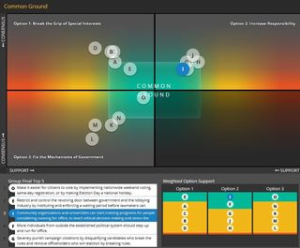
The forum uses a new software tool from the Kettering Foundation that brings moderated deliberation on national issues to a wider audience.

Below is a screen shot of a Common Ground graphic produced by an online National Issues Forum earlier this month. It is the product of ten people working through the issues together in a discussion about how to fix American politics.

I hope you are as interested as I am in helping to develop this new tool for more people to participate in political life.

Sincerely,

Bill Corbett National Issues Forums of Northern Virginia

Bill_Corbett_NIF_of_Northern_Vir@mail.vresp.com