Group Decision Tip: What’s the problem?

In principle, more often than not, a group will develop a great solution to the wrong problem. Before proceeding with a solution we need to see that it is aimed at the problem, and to do that we need to bring the problem into focus. Taking time to define the problem may seem annoying and unnecessary in the short term, but can save huge amounts of time and energy over the long run.

Group Decision Tips IconDefining the problem as a group also checks our shared expectations. It helps me decide, “Is this something that I want to participate in?”

Practical Tip: Before discussing solutions, discuss the problem. What are we trying to fix? What is the specific scope of the problem that we are willing to take on? How would we know if the problem were fixed? Are we the right group to fix it?

On paper, write something like, “The problem is that _____________.” It could be a sentence or it could be a paragraph.

Refrain from discussing solutions until you have agreement on the problem statement. Make sure that all those working on the problem are aware of the written problem statement and agree with it.

Before firing off solutions, make sure the problem is squarely in your sights.

PBP Co-Hosts Event at the White House

We want to congratulate the Participatory Budgeting Project (an NCDD organizational member) on the advancement of their work with the White House to spread participatory budgeting in the US. PBP was officially included in the White House’s Open Government Action Plan, and they recently blogged about the day-long meeting they just had as part of their participation in the initiative.


PBP-logoOn Tuesday, May 13th, The White House and the Participatory Budgeting Project co-hosted a day-long meeting on participatory budgeting, as part of the White House’s efforts to advance PB. “Promoting Innovation in Civic Engagement: Exploring Community‐Led Participatory Budgeting in the United States” brought together over 60 city leaders, community organizers, residents, funders, researchers and technologists to share best practices and identify next steps for expanding and deepening PB.

Invited experts, including PBP Executive Director Josh Lerner and Associates Gianpaolo Baiocchi and Madeleine Pape, spoke about the latest developments in PB and about research efforts to measure PB’s impact. Our partner organizations Community Voices Heard and the Community Development Project shared their experiences from PBNYC, and we discussed key engagement, implementation, and research strategies in small break-out groups with dozens of partners from across the country, as well as representatives from the White House and federal agencies.

“Five years ago participatory budgeting was an obscure idea in the US,” concluded Josh Lerner. “Now, as the White House has recognized, it’s a best practice for civic engagement, used by over 40 cities, districts, universities, schools, and other institutions across the country.” Thank you to everyone who has contributed to this rapid transformation!

You can find the original version of the above post at www.participatorybudgeting.org/blog/the-white-house-pbp-host-national-convening.

KF Interviews Imagining America Codirector

We recently read a fascinating interview with Imagining America codirector Timothy Eatman that our organizational partners at the Kettering Foundation published that we want NCDD members to see. IA’s work in bridging academia and public engagement is critical to advancing our field, so we encourage you to read Timothy’s thoughts on how we get there below. You can find the original interview here.

kfIn a recent column in the New York Times, Nicholas Kristof laments that scholars are too often unimportant and “irrelevant,” producing “gobbledygook . . . hidden in obscure journals.” Kristof goes on to say that “over all, there are, I think, fewer public intellectuals on American university campuses today than a generation ago.” Whether real or perceived, the sentiment that scholars are disengaged is shared by many.

However, on a number of fronts, higher education is enjoying a renewed commitment by scholars to community-centered research and teaching. The Kettering Foundation and many others have referred to this as “public scholarship.” The term “public scholarship” may strike you as a little funny: we don’t typically think of scholarship as public or even publicly accessible. So what’s this all about?

Imagining America: Artists and Scholars in Public Life (IA), a national consortium of publicly engaged scholars headquartered at Syracuse University, has for many years drawn attention to these challenges. The program was launched in 1999 at the White House. The founding partners were the University of Michigan, the Woodrow Wilson National Fellowship Foundation, and the White House Millennium Council, led by Hillary Clinton. Today, IA has more than 100 member institutions.

Imagining America LogoTimothy Eatman serves as codirector of IA and holds a faculty appointment at Syracuse University’s School of Education in the department of Higher Education. He also serves as an affiliate faculty member in the Communications and Rhetorical Studies Department. Jack Becker recently sat down with him for a couple of discussions before and after the 2013 Imagining America National Conference, which brought together several hundred participants from across the country and around the world to ask the powerful question, “How do we catalyze artists, designers, and humanists, and tap the power that their fields represent, to open us up to innovative, 21st century ways of demonstrating the relevance of the academy and of impacting our pipeline of young adults?”

Jack Becker: What kind of space does the Imagining America annual conference open up for thinking about democratic engagement?

Tim Eatman: It’s the space being used for over a dozen years to affirm this work. It helps connect graduate students and scholars to a conversation around civic engagement that they might not be able to have at their university or at their disciplinary conference.

We need a space to just be able to air some of these issues, particularly in the academy. Particularly in Research-One institutions. This is a traditional space. We think we are stimulating and catalyzing a community that sees room for scholarly research to thrive, but also feels that in the 21st century we can have a larger continuum of knowledge creation. This supports the idea of academic freedom and agency.

Part of the challenge is encouraging faculty to think of their pedagogy differently, in ways that harness the knowledge and thinking of students as colearners and colleagues; this orientation changes the dynamic of the classroom. We’re pushing for that as well. What does it look like when we position students as colearners? A lot gets left on the floor in terms of possibilities when we don’t engage students more deeply.

Promoting “publicly engaged scholarship” is one of Imagining America’s core activities. What is publicly engaged scholarship, and is it in tension with conventional forms of scholarship?

Publicly engaged scholarship has an emphasis on the reciprocal dynamic of knowledge making. An orientation of the campus that values the knowledge-making capabilities of the community; a posture that values community-located knowledge in ways that we don’t tend to do much of in the Ivory Tower. It also includes larger efforts to transform the culture of higher education.

So, the key question is, what is the impact our scholarship has on our community? It’s good to have ways to champion each other (faculty and scholarship), but what is the impact?

There has to be space for scholars who want to be engaged in clinical esoteric research and advance knowledge, and there has to be space for those that want to work with teachers, not as, to channel Harry Boyte here, not as experts on top but as experts on tap. When I go into a teacher’s classroom, I can’t tell them anything much about that environment; they know that environment. So it’s a different posture when you go into an environment and say, “you know what, I have some things to learn, I have some things to teach, yes, but how can we think together about what the consequence of our work is and can be?”

The challenge from a policy standpoint is, faculty are going to do some of that anyway, but not in a way they could if that work were valued in the rewards system. On that note, the Tenure Team Initiative has been an important program of IA that focuses on improving the rewards system in academe for faculty who practice engaged scholarship in the cultural disciplines and seeks to develop a broad understanding of the university’s public mission and its impact on changing scholarly and creative practices.

Issues of faculty rewards are among the most traditionally treated issues in the academy. Trying to create space to value something other than traditional forms of knowledge making is difficult work—look I don’t have any argument with that—I too was a master’s and doctoral student stationed with an assigned carrel in the stacks immersed in reading and rigorous theoretical and analytic work. But our relevance in the 21st century requires that we have to have more sophisticated options than collecting and discussing things; we have to engage that work, we have to be able to demonstrate the verity and impact of that work for purposes of societal amelioration.

So, we need our bench chemist, but there’s also space within the continuum of knowledge creation and practice for the engaged chemist that takes students into the community to examine homes with lead paint and analyze samples to explore the scientific principles that that analysis affords, but also takes the next step to connect with policymakers and community leaders to bring the kind of energy to bear that will make that situation better.

So much of the democratic engagement on our college campuses seems to pivot out of the liberal arts. Imagining America has broadened this focus to look at the humanities, arts, and design, among other areas. Particularly, how do the arts enter into the realm of democratic engagement?

One of our key questions is, how does art awaken that sense of civic agency? If we are a consortium that pivots on the arts, then we need some kind of expression of that. The D.R.E.A.M. Freedom Revival, led by IA associate director, Kevin Bott, is one avenue for this expression. Periodically, the Freedom Revival comes together to hold engaged musical performances where audience members are asked to join in; they might come on stage to testify to their dreams for their community as well as their struggles. We focus on all kinds of issues: education, healthcare, democracy, among others. In these performances we believe we are contributing to a broader democratic revival that encourages community members to commit to this revival.

Thinking about the idea of a revival of civic agency is powerful. We are trying to harness the notion that the oldest democracy in the world was here in Syracuse, the Onondaga Nation. In these performances, we use a community-engaged model to stimulate participants in an awakening of that history and connecting it to contemporary issues. This is one way IA is operating to connect to our understanding of the power of artistic expression, in addition to our work around tenure and other initiatives.

I think of IA’s work in the arts as creating spaces where hearts and spirits meet minds for deep, sustained, impactful, knowledge creation and healing. And we use words like spirit, heart, and healing because those things are achieved with the arts in a way that other disciplines don’t; art stimulates things that other disciplines don’t and creates spaces that aren’t otherwise there.

Syracuse University has worked very hard to strengthen ties with the broader community. For former chancellor Nancy Cantor, this investment in the community went well beyond the push to extend teaching and learning into the community, but to invest in physical infrastructure—buildings and pathways that connected the university and community, what she referred to as “third spaces of interaction.” How should this fit into our thinking about the spaces our campuses occupy?

This whole Connective Corridor and The Warehouse is developing a district that supports thinking about space—how we occupy space and how that space opens us up to the community. It’s one thing to understand the value of this, it’s another thing to get the resources. One of former Syracuse chancellor Nancy Cantor’s approaches has been to invest in space. Things that are attached to the ground mean something to the community. The Warehouse, in downtown Syracuse, was an eyesore in this community. As I understand it, there was a financial bond that Syracuse owed New York State from a residence hall they had built. So instead of paying the state through the bond, Syracuse University built a space to improve the community. This is leveraging resources and shifting mindsets and discourses. People begin to talk and think about what it means to be a Syracuse citizen and have their space and city expressed through the eyes of artists and citizens.

The Connective Corridor and Near Westside Initiative, [initiatives started by Syracuse University as a means of bolstering the community-university relationship and investing in space] means nothing without important partnerships in the area. They get grants to invest in community, and Syracuse doesn’t have total control of the money. Nancy Cantor understood a deeper commitment was needed. When you empower the community, it makes a difference. It’s a different way of thinking about institutions of higher education and creating third spaces, between the university and the community. Building relationship with strength and a sense of cohesion is difficult.

The point here is that there is something very important about the nexus between higher education institutions and the community that can be leveraged for good or for ill. I want to be part of a nexus of individuals that embolden the disciplines in a way that will expand knowledge creation and helps develop solutions to pressing public problems.

You can find the original version of this interview at http://kettering.org/kfnews/making-scholarship-tangible.

Davenport Accepting Public Engagement Grant Applications

We are excited to share with you that our organizational partners at the Davenport Institute have opened the application process for their 2014 Public Engagement Grant Program. The grant is perfect for NCDD members, and we highly encourage you to apply before the September 12 deadline. You can read more about the program below or find out more by clicking here


DavenportInst-logo If you have a public engagement project that could use some consulting help, now is the time to apply for the seventh annual Davenport Institute Public Engagement Grant Program! This year we will be awarding $25,000 in funded consulting services to cities, counties, special districts, and civic organizations looking to conduct legitimate public processes on issues ranging from budgets to land use to public safety to water policy.

The application deadline is Friday, September 12 and decisions will be announced by October 1.

The Davenport Institute’s Public Engagement Grants are service grants, funding well-qualified consultants selected jointly by grantees and the Institute to work with grantees on facilitated public forums.

This year the Davenport Institute will be awarding 2-4 grants, offering up to $10,000 per grant to be paid directly by the Institute to an approved consultant.  The total amount of grant awards for 2014 will be around $25,000 in funded consulting services.

Prior to beginning their public engagement campaign, grantees will receive training and consultation from the Davenport Institute to build understanding and support for the civic engagement effort among administrative and elected officials.

Davenport senior staff and consultants will then work with grantees to design public forum sessions and will facilitate deliberations among residents, stakeholders, and government representatives.

About the 2014 Public Engagement Grant Program

From difficult budget decisions to tough land use problems, municipal and civic institutions have recognized that legitimately engaging their citizens – from discovering their informed opinions, to inviting their participation in actual solutions – should be a pragmatic priority. Still, the tight budgets that most require these public discussions can also preclude them when municipalities decide that engaging residents is just “too expensive.”

Starting in 2008 (then conducted through Common Sense California), our grants have been used to support cities, counties, special districts and civic organizations as they have endeavored to engage their residents on a variety of issues.

Here’s a small sampling of the efforts we have supported:

See our application criteria here and our online application here.

Some FAQs:

Q1: Does the proposed public process need to occur immediately?

A: No. Most of our granted projects have taken place within one year of the application date.

Q2: Can we recommend a facilitator or web platform to receive support from the Grant Program?

A: Yes. Again, the purpose of our grants is to fund participatory (as opposed to “PR”) projects. Of course, we’d like to interview your recommended facilitator, but we’ve worked with designated consultants before. This actually helps us build our own “rolodex” of consultants!

Q3: Is the Davenport training an added expense?

A: No. Training for the grant recipient is now an integral part of the Grant Program, and is offered as part of the grant. All expenses – including travel – are assumed by Davenport.

Q4: How many grantees do you anticipate this year?

A: We tend to support between 2-4 grantees each year with the Grant Program.

Q5: Do you support “capacity building” efforts like “block captain”, “neighborhood watch”, “citizen academy”?

A: No. As a practice, the grants are intended to support actual public projects around “live” issues – from budgets to land use. We find with the training added, these grants build “civic capacity” through actual engagement.

The criteria are straightforward and the online application form is easy. After reviewed by members of our Advisory Council, our 2014 grantees will be announced by early October.

Please feel free to contact Ashley Trim at ashley.trim@pepperdine.edu or at 310-506-6878 with any questions.

You can find more information on the Davenport Institute’s grant programs at http://publicpolicy.pepperdine.edu/davenport-institute/grants.

C2D2 Climate Change Deliberation Webinar on Thursday

NCDD’s sister organization, the Canadian Community for Dialogue and Deliberation (C2D2), is hosting a great webinar this Thursday, June 5th, starting at 12pm Eastern/9am Pacific that we wanted to make sure you heard about. The webinar will focus on learning from a climate deliberation initiative in Alberta and will be facilitated by three NCDD members. You can read more about or find out more by clicking here, and make sure to register today by clicking here.


C2D2 Webinar: Climate Change, Dialogue, and Deliberation

C2D2-logoThis webinar will provide an opportunity to learn about the work of Alberta Climate Dialogue (ABCD). This five year initiative (2010-2015) brings together a group of researchers and practitioners who are exploring how citizen deliberation can contribute to shifting engagement and policy on climate change locally and internationally.

This webinar will be an opportunity to discuss in detail what is being learned about deliberative dialogue practice from the following three deliberations:

In the spirit of the ABCD collaboration, the webinar will be facilitated by three of its members:

  • Dr. David Kahane, principal investigator and project lead, University of Alberta
  • Dr. Gwendolyn Blue, researcher, University of Calgary
  • Jacquie Dale, practitioner, One World Inc. and C2D2 Board member

ABCD’s work is funded by a Community-University Research Alliance grant from the Social Sciences and Humanities Research Council of Canada as well as contributions from universities, governments, and NGOs that are partners. Deliberative events are co-funded with government, civil society partners, and further grants.

You can find the original version of this post at http://c2d2.ca/c2d2-webinar-climate-change-dialogue-and.

Constitutional Amendment for Campaign Finance Reform?

We are happy to share the announcement below from NCDD organizational member and NCDD Catalyst Award winner John Spady of the National Dialogue Network. John’s announcement came via our great Submit-to-Blog Form. Do you have news you want to share with the NCDD network? Just click here to submit your news post for the NCDD Blog!

Until June 14, 2014, the National Dialogue Network (NDN) is crowdsourcing ideas from as many people as possible about whether or not a constitutional amendment is necessary to either limit or protect current practices of election campaign spending. Please share this announcement and encourage participation using this link: http://ndn.codigital.com.

The Codigital process is the same one recently used by NCDD. Our own experience with Codigital can be reviewed at http://ncdd.org/14641

The purpose of the NDN project is to solicit statements from all sides, edit and rank them using Codigital, and create a summary of the results for delivery to the Senate Judiciary Committee that meets in June to debate the value of a constitutional amendment to limit (or not) election campaign spending.

After June 14 a follow on phase will repackage these results and create materials for local consideration, public engagement, and national feedback using the tools that the National Dialogue Network gives freely to collaborating individuals and organizations to roll up results from numerous local communities. NDN wants our political representatives to understand the opinions and values of those who care deeply about this issue — from all sides.

John Spady is a long time and sustaining member of NCDD. His vision for a National Dialogue Network received the 2012 Catalyst Award for Civic Infrastructure from NCDD voting members. Details about that award are available at: http://ncdd.org/10940. The website of the NDN is: http://NationalDialogueNetwork.org

If you have any thoughts or encouragements, please add your comments below.

Open Government Needs Public Trust

The piece below comes from the Gov. 2.0 Watch blog, a project of our organizational partners at the Davenport Institute. The reflections shared on building trust in government as a critical component of public engagement and open government initiatives are good food for thought, and we encourage you to read more below or find the original post here.

DavenportInst-logoIn the wake of recent scandals involving California lawmakers, this CA Fwd interview with Leon Panetta is a needed reminder of the importance of integrity in public service. Ed Coghlan comments:

Three months into 2014 and three California State Senators have had brushes with the law. Needless to say, public confidence in elected officials is shaken.

It’s understandable, but like any setback in life, it’s also an opportunity to reflect and change for the better.

Now is the time for our elected officials to enact immediate and meaningful reform in response to alleged state-level corruption that has gotten national media attention. Only then will public trust in government be on the road to recovery.

CA Fwd is attempting to “catalyze a conversation on rebuilding public confidence in government,” and released a roadmap called The Path Toward Trust in April. More information is available here.

The Huffington Post published a related article last month by Gavin Newsom and Zachary Bookman, highlighting successes in the “Open Government movement” in Palo Alto, Bell, San Francisco, and the California State Lands Commission, that they argue have helped to increase public trust and civic engagement:

As a sector, government typically embraces technology well-behind the consumer curve. This leads to disheartening stories, like veterans waiting months or years for disability claims due to outdated technology or the troubled rollout of the Healthcare.gov website. This is changing.

Cities and states are now the driving force in a national movement to harness technology to share a wealth of government information and data. Many forward thinking local governments now provide effective tools to the public to make sense of all this data.

New platforms can transform data from legacy systems into meaningful visualizations. Instant, web-based access to this information not only saves time and money, but also helps government make faster and better decisions. This allows them to serve their communities and builds trust with citizens.

You can find the original version of this post at http://publicpolicy.pepperdine.edu/davenport-institute/gov20watch/index.php/2014/04/public-trust-open-government.

Nominate Youth for GenUp Leadership Opportunity

We recently heard about an interesting leadership and development opportunity for young people that we think might suit some of our NCDD members or their connections well. The Thrive Fellows program, coordinated by Generation Waking Up, is accepting nominations for young people until June 10th and applications until June 15th, so we encourage you to learn more and nominate young leaders as soon as possible. You can read about the program below or find more information here


Thrive Fellows: A Year-Long Leadership Program in Social Innovation

July 2014 to June 2015
www.generationwakingup.org/thrivefellows
Apply or Nominate today!

We are living at a critical moment in history, facing complex challenges like no generation before and holding a profound opportunity to remake our world. It is a time that is calling for system-thinkers, bridge-builders, and creative innovators with bold new approaches to social change.

The Thrive Fellows program is a transformative “leadership-in-action” journey that supports a diverse cohort of young leaders in designing and implementing social innovation projects toward a thriving, just, and sustainable world. Social innovation is the process of generating novel and creative solutions to complex challenges. As Buckminster Fuller aptly stated, “You can never change things by fighting the existing reality. To change something, build a new model that makes the existing model obsolete.”

Each Thrive Fellow will embark upon a yearlong journey that includes personal development, team building, community engagement, collective learning, and collaborative action, by applying the most promising tools and capacities of our time to generate creative solutions to complex challenges.

AS A THRIVE FELLOW YOU WILL

  • Join a network of dynamic young leaders, changemakers, and innovators
  • Develop leadership skills for creating personal, interpersonal, and social change
  • Deepen your understanding of the interconnection of issue areas and how to create systemic change
  • Learn how to turn your ideas into action and create collective impact
  • Co-lead a social innovation project to address complex challenges
  • Receive mentoring from leading experts across multiple sectors of society
  • Connect your local efforts with wider movements of social change
  • Establish a Thrive chapter on your campus or in your community

WHO SHOULD APPLY

Young people ages 16 to 29 based in North America who are committed to growing as a leader and bringing social innovation to your campus and/or community. We strongly recommend finding one other person from your campus or community to apply too in order to strengthen the success and impact of your fellowship. If you are interested in applying as an international participant, please contact us at thrive@generationwakingup.org.

Additional criteria for becoming a Thrive Fellows include:

  • Passion for growing personally and creating social change
  • Representing a campus, community, or place-based context for implementing an ongoing social innovation project
  • An ability to commit an average of 6 – 10 hours a week
  • Demonstrated leadership skills and potential, ideally with a track record in community service, social activism, or social entrepreneurship
  • A willingness to cover and/or help raise the funds needed for your tuition cost
  • A commitment to diversity & team collaboration

APPLICATIONS

Application deadline is June 15th. Fill out an online training application here. Our team will contact you to confirm your participation.

NOMINATIONS

Nomination deadline is June 10th. If you know an ideal candidate, please fill out an online nomination form here. Our team will contact you to confirm your nomination.

If you have questions or want to know more, please visit www.generationwakingup.org/thrivefellows or contact Joshua Gorman at joshua@generationwakingup.org.

Seeking Collaborators for Sustainability Workshop at NCDD ’14 in Reston

We are happy to share the announcement below from NCDD supporting member Adolf Gundersen of the Interactivity Foundation, which came via our great Submit-to-Blog Form. Do you have news you want to share with the NCDD network? Just click here to submit your news post for the NCDD Blog!

IF-logo-onyellowMy Interactivity Foundation (IF) colleague Dennis Boyer and I are looking for collaborators to develop a proposal for a workshop on connecting exploratory discussion (our mission) with decisional deliberation at NCDD’s ’14 Conference in Reston. We’d like to focus on sustainability as a substantive theme, as IF also has discussion materials on related themes of climate change, energy, and city planning.

If you are interested in collaborating, please contact Adolf Gundersen at gundersen@interactivityfoundation.org or at (608) 467-6224.

Facilitating & Introversion: Tips for Engaging Quiet People

We recently read a great piece on bringing out the gifts of introverted people over at NCDD supporting member Janice Thomson’s blog, Citizenize-Citizenise. Janice has been working with the Chicago chapter of the International Association of Facilitators on developing resources for effectively engaging quieter folks, and we think they could be quite useful to our members. You can read Janice’s piece below or find the original here.


“Stop the madness for constant group work. Just stop it!” pleads Susan Cain, author of Quiet: The Power of Introverts in a World That Can’t Stop Talking. Group work, she claims, stifles some of the most insightful and creative thinkers and inflates the influence of extroverts. To generate the best ideas, workplaces and schools need to provide more solitude for deep reflection and creative thinking.

As a facilitator, her critiques made me wonder. Do the group processes I use marginalize important voices and perspectives? Is it possible to design meetings and workshops to fully involve introverted participants? I started a conversation around these questions with fellow facilitator Margaret Sullivan and together we designed a workshop to test our ideas and learn from others.

This blog summarizes learning from our “Facilitating Introverts” workshop held May 16, 2014 with the International Association of Facilitators (IAF), Chicago chapter. We warmly invite additional suggestions for how to include introverts in meetings and workshops!

What’s an introvert?

The concept of introversion originated with psychologist Carl Jung who noticed that people tend to be energized either by going inward in quiet reflection (introverts) or outward in interactions with people (extroverts). Later personality theorists added concepts like how one processes information, sensitivity to novelty and stimulation, and attitudes toward privacy and public attention.

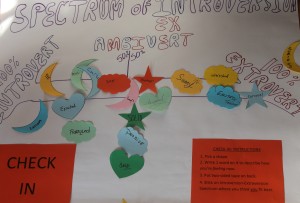
Spectrum of Introversion Photo: Al Rush

Introversion/extroversion is a spectrum (see top photo). The population is roughly equally divided between the two halves and most people fall somewhere toward the middle. Although most people can function in both introverted and extroverted ways, they prefer one or the other. So, traditional group work, which is designed for extroverts, can indeed disadvantage introverts. To rectify this imbalance, it is necessary to first understand the special needs and gifts of introverts.

Importantly, since nobody functions exclusively as an introvert or extrovert, it would in fact be more accurate to discuss facilitating introversion or incorporating introverted processes into group work. This however is linguistically and conceptually cumbersome. So, for clarity, we simply use the term “introverts”.

Needs and gifts of introverts

Reflecting on the ideas of personality theorists and considering group situations that challenge introverts, we created a list of needs and gifts of introverts relevant to group work.

Important themes include:

  • Managing energy. Introverts are drained by social interaction and need alone time to recharge.
  • Processing time. Introverts take in lots of multi-layered information. They may therefore need more time than extroverts to process information, reflect, and decide what to say. They also need to understand expectations so they may prepare in advance.
  • Privacy and caution. Introverts do not like to call attention to themselves and can be reticent to share their ideas — especially if they are not yet fully formed or may provoke conflict.
  • Meaning and focus. Introverts are drawn to meaningful conversations and can go deep into subjects. Conversely, they get overwhelmed when multiple themes are discussed simultaneously.
  • Deep listening. Introverts can be very attentive listeners. They may notice things and make connections that extroverts miss. They also ask great questions.
  • Writing and non-verbal expression. Many introverts prefer to communicate in ways other than talking and may be skilled at writing or drawing.
  • Creativity and imagination. Introverts have rich inner lives which can lead them to uncover valuable insights and generate creative solutions.

Tools and techniques to involve introverts

Using these needs and gifts, we brainstormed tools and techniques to help introverts feel comfortable, meet their needs, and share their gifts in group work. We then added ideas culled from online facilitator forums and workshop discussions. We offer this initial list of tools and techniques for facilitating introverts to facilitators as thought-starters in designing group processes.

An introvert-friendly workshop

To demonstrate what an “introvert-friendly” workshop might look like, the methods we used in our own “Facilitating Introverts” workshop and why we chose them are described below.

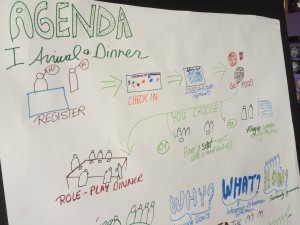
I. Arrival and Dinner

Arriving at a meeting or workshop can be uncomfortable for introverts, especially if they don’t know anyone. So it’s important to consciously design an experience to put them at ease. We provided:

Photo: Al Rush

Visible agenda. Introverts like to know what to expect, including when they may need to contribute. We displayed a large visual agenda at arrival and reviewed it at the start of the workshop.

Greeter and host. While extroverts can just dive into unstructured social situations, introverts welcome some assistance. Participants were met by a greeter at a registration table and a “host” who mingled and made sure everyone was comfortable – e.g., introducing people and suggesting activities.

Nonverbal check-in. Fun, non-verbal activities done at one’s own pace can be an easy warm-up and help facilitate connections. We invited participants to write their mood on a colored shape and place it on an introversion-extroversion spectrum chart. This also introduced a core concept of our workshop, showed who was in the room, and provided a “temperature check”.

Reflection pond. This served as both “graffiti wall” and “parking lot”. Introverts don’t like to draw attention to themselves or provoke conflict so it’s good to offer ways to share anonymously. They can also get overwhelmed when multiple topics are discussed simultaneously. So it’s useful to use methods like “parking lots” to keep conversations focused.

Dinner choices. It’s important to never label a person or activity as “introvert” or “extrovert”, but rather to offer choices that allow participants to manage their own energy. For dinner, we offered three options: mingling informally, sitting in small groups, or participating in a facilitated “role play” game. We also kept novelty and stimulation low by providing familiar food (pizza) and calming music.

Role play dinner. Since introverts may be reticent to draw attention to themselves, role play games can help them speak more freely. We created a scenario where five famous introverts and five famous extroverts worked together on a project team. Participants described how their character (e.g., Eleanor Roosevelt, Marie Antoinette, etc.) would feel and behave in different group situations. This provided both structured group interaction and a playful introduction to workshop themes.

Flexible meeting space. We chose a meeting space, the Thinkubator, that provides many seating options, nooks and crannies, and an outdoor deck for different types of group interaction and solo breaks.

II. Opening

After introducing the topic, we created community agreements that included:

  • Moment of silence. Because introverts take in so much information, they sometimes need extra time to “catch up”. To create opportunities for this, we created “silence” signs anyone could use to request the group to be quiet for a few minutes – no explanation needed.
  • Breaks. Introverts sometimes need alone time to recharge. So we gave participants permission to take a break at any time, for any reason, no questions asked.
  • OK to pass. Introverts sometimes need additional time to formulate their thoughts. So, in structured go-arounds and sharing times, participants can “pass” and talk later.
  • Don’t hold back. “Quieter people” were reminded that they too have contributions valuable to the group and not to “hold back” sharing.

Homework and paired sharing. Introverts like to come prepared to meetings. Assigning homework is one way to achieve this. We asked participants to watch Susan Cain’s TED Talk to prepare. The first social interaction was low-key: sharing one thing learned from this video with one’s neighbor.

III. Needs and Gifts

An individual “scenario reflection” exercise was used to identify introverts’ needs and gifts. Three situations were described that can be challenging to introverts: 1) arriving at a meeting of strangers, 2) being asked to share one’s viewpoint early in a meeting, and 3) a meeting on a contentious issue.

To share ideas, we planned a structured go-around using a talking stick. This gives introverts the floor without them having to ask for it, but also lets them “pass” and speak later if they aren’t ready to talk.

IV. Tools and Techniques

We began with individual brainstorming, followed by a 20 minute discussion in groups of 3-4 people to modify and add to our initial list of tools and techniques. Especially with introverts, it’s important to begin brainstorming individually. A group size of 3-4 people allows sharing, but is comfortable to introverts.

Here’s a 1 minute video of the entire workshop (thanks to Gerald and Steve at the Thinkubator):

V. Post-event

Introverts often get their best ideas after a meeting or workshop – i.e., once they’ve had time to fully process its content and reflect alone on its meaning. So it’s important to provide a method, such as an online forum, to continue sharing and discussion after the event. That is one goal of this blog.

What do you think?

Margaret and I are sharing this blog with both the Chicago IAF workshop participants and the broader facilitation community. We invite suggestions of additional tools and techniques, needs and gifts, and thoughts on “facilitating introverts”. Please leave your comments below in “Leave A Reply”. You may also post a comment on the Chicago IAF Facebook page or Linked In group.

If there is sufficient interest, we might offer this workshop again, perhaps in modified or expanded form. Please use the contact form to let me know of your interest in organizing or assisting with a future workshop.

You can find the original version of this blog piece at www.janicethomson.net/facilitating-introverts-eliciting-the-gifts-of-the-quiet-ones.