Fall Public Participation Trainings from LET

There are some great trainings being offered this Fall by the League of Extraordinary Trainers, an NCDD org member and sponsor of the 2014 NCDD conference. We want to make sure NCDDers know not only that these great IAP2 certificate trainings are happening, but there is a discount on registration for NCDD members! Make sure to take a look at LET’s announcement about the trainings below or to find their full training schedule here.


LeagueOfExtraordinaryTrainers-logoIAP2’s Certificate Program has been revitalized to incorporate more international perspectives and to address and incorporate many thoughts and ideas provided as feedback from more than 6,000 participants who have taken the program since 2000. The updated curriculum, newly named Foundations in Public Participation, launched July 1, 2014. The Planning for Effective Public Participation course has been extended to three days, incorporating communications planning into the Planning course. An increased focus on deliberative dialogue, plus the addition of web-based and social media engagement tools were added.

Public anger is an increasing fact of society. Growing global citizen outrage causes government gridlock, lawsuits, stopped projects, election losses, loss of time, money, and destroyed credibility. Emotion, Outrage and Public Participation is a two-day workshop that builds on IAP2’s global best practices in public involvement and the work of Dr. Peter Sandman, a foremost researcher and expert in public outrage and risk communication. This course will help you move people from rage to reason and engage stakeholders in building consensus for better decisions.

If you work for or are involved in public participation and community engagement outreach projects in: government – municipalities, state and federal agencies; corporations; utilities; environmental agencies; community organizations; universities; advocacy and lobbying these courses can broaden your toolkit and bring greater creativity to your approach. The hands-on design of these courses and the expertise of the IAP2 Licensed Trainers ensure that you’ll be receiving the best public participation and community engagement training available globally.

LET Event Dates, Locations, Brochures and On-Line Registration are always available at to view www.extraordinarytrainers.com/schedules.

Certificate Program – Foundations In Public Participation (2 courses) –

Planning – (Mon-Wed, 3 days) Techniques – (Thu-Fri, 2 days)

  • Fort Worth, Texas – September 8-12
  • Chicago, Illinois – October 27-31

Emotion, Outrage and Public Participation – Moving from Rage to Reason (2-Days)

  • Las Vegas, Nevada – October 6-7
  • Austin, Texas – October 16-17
  • Chicago, Illinois – December 4-5

LET offers Early Bird Registration Discounts. Dues-paying NCDD members receive a discounted rate on all trainings. Email us directly to receive a Promo Code for the NCDD member discount: info@extraordinarytrainers.com.

New Study Finds Surprising Lack of Red-Blue Divide

We want to share the announcement on an insightful new study that we know will interest NCDD members that comes from NCDD supporting member Steven Kull of Voice of the People. VOP teamed up with the Program for Public Consultation to conduct a study on public policy opinions that has some pretty surprising results. You can learn more about the study in Steven’s announcement below or find the study by clicking here.


vop logoA new study conducted by NCDD members at Voice of the People and the Program for Public Consultation finds remarkably little difference between the views of people who live in red (Republican) districts or states, and those who live in blue (Democratic) districts or states on questions about what policies the government should pursue. The study analyzed 388 questions asking what the government should do in regard to a wide range of policy issues and found that that most people living in red districts/states disagreed with most people in blue districts/states on only four percent of the questions.

The study titled, “A Not So Divided America,” contradicts the conventional wisdom that the political gridlock between Democrats and Republicans in Congress arises from deep disagreements over policy among the general public.

The study analyzed questions from dozens of surveys from numerous sources including the National Election Studies, Pew, major media outlets, the Chicago Council on Global Affairs as well as the Program for Public Consultation. Responses were analyzed based on whether the respondents lived in red or blue districts or states.

  • On only four percent of the questions (14 out of 388) did a majority or plurality of those living in red congressional districts/states disagree with the majority or plurality in the blue districts/states.
  • For a large majority of questions – 69 percent – (266 of 388), there were no statistically significant differences between the views in the red districts/states and the blue districts/states.
  • For 23 percent, or 90 questions, there were statistically significant differences in the size of the majority or plurality, but the dominant position in both the red and blue districts/states was on the same side of the issue.
  • Thus for 92 percent of questions people in red and blue districts and states basically agreed.

The full study can be found at http://vop.org/wp-content/uploads/2014/07/Red-Blue-Report.pdf.

The report’s appendix with the survey questions analyzed can be found at http://vop.org/wp-content/uploads/2014/07/Red-Blue-Appendix.pdf.

New Job Opening at Public Agenda

PublicAgenda-logoWe are excited to share that our organizational partners at Public Agenda are hiring!

PA is seeking a Senior Public Engagement Associate to work with them in New York City, and we know that many of our NCDD members could be a great fit for the position. The position is described like this:

The Senior Public Engagement Associate works with the Public Engagement (PE) team to develop, coordinate and implement engagement projects across a range of issues areas around the country. The senior associate will lead various types of field-based engagement projects – including project design, field logistics, research, facilitation, report writing and evaluation. The PE Department is busy and fast moving. The applicant must be comfortable leading multiple projects independently with minimal supervision, while maintaining an ability to work as part of a team. The Senior Public Engagement Associate contributes to Public Agenda’s mission to create opportunities for collaboration and to facilitate problem solving for our nation’s most pressing issues. We are looking for a highly motivated individual who is interested in contributing to our work across the country. This position reports directly to the Director of Public Engagement Programs.

You can find the full job description and info on how to apply by clicking here. Good luck to all the applicants!

Six Simple Changes for Better Public Engagement

NCDD supporting member Jennifer Wilding of Consensus and her team have been working to increase civility in Kansas City, and we love their infographic on what KC residents told them officials can do to improve public engagement. Learn more about Consensus’ Civility Project at www.consensuskc.org/civilityproject/ and in Jennifer’s write-up below the image.

SixChangesForOfficials-infographic

Old Habits for Engaging the Public Make it Harder to Be Civil

Americans have talked a lot about civility the last few years. Along with exploring the way individuals behave, it’s important to pay attention to the processes that are used to engage the public. Outmoded habits are ineffective with a population that increasingly expects to be consulted, and can be disastrous in situations where values are in conflict.

It’s possible to change these habits, though. Specific, relatively simple changes can move people’s behavior from angry to productive. The Civility Project helps inform and advocate for building new habits that increase civility.

Consensus, a Kansas City-based nonprofit that focuses on public engagement, launched The Civility Project out of frustration with the way the 2009 health-care town hall meetings were conducted. Using the public hearing model meant that meetings intended to give people a voice ended up driving them further apart.

The project so far includes awards for people who bring civility to life and a one-day class on building civility into public engagement based on findings from 20 focus groups with local citizens. In addition, Consensus has held public forums co-sponsored by KCPT Public Television, the Congressional Civility Caucus and the Dole Institute.

Consensus held 20 focus groups across metro Kansas City and in Lawrence to talk about civility in public life and how it affects our ability to solve problems. The groups represented the entire political spectrum, but were in perfect harmony when they described what concerns them about our public processes and what would make things better.

Detailed findings are available at www.consensuskc.org/civilityproject, and we have distilled what people want into six simple changes elected officials can make to engage their constituents more productively.

For more information: Jennifer Wilding, jenwilding@consensuskc.org.


Jefferson Center Hosts Rural Climate Dialogues

Our NCDD organizational members at the Jefferson Center recently shared a write up on a series of deliberations on climate issues in rural Minnesota. The project produced positive results and a detailed report with recommendations for moving forward. We hope you will read their write up below or find the original version by clicking here.


JeffersonCenterLogoWay back in March, we talked about our plans to engage citizens in rural communities in Minnesota to discuss climate and extreme weather. Our first conversation, the Morris Area Climate Dialogue, took place at the beginning of June. Fifteen Morris Area residents came together in a Citizens’ Jury to study and deliberate on the local impacts of extreme weather and shifts in climate. Community members heard from local experts on weather and climate trends, energy & energy efficiency issues, insurance industry concerns, potential changes in agricultural production, impacts on local infrastructure, and opportunities to build a stronger, more resilient community.

Community members analyzed the knowledge gained during presentations and prioritized critical concerns, key opportunities, and potential action steps. Principal concerns include limited public awareness of changes in extreme weather and climate, disproportionate impacts on low- or fixed-income residents, and strains on local agricultural production. Opportunities for community responses include adapting local agricultural systems, developing new economic opportunities, and utilizing the skills and resources of community members. You can read their full statement, along with community action recommendations, in the MACD Final Report. You can also find more information at our Morris Area Climate Dialogue page.

Briefly, here’s what a few participants thought of the event:

“I’d like to say thank you for the information. I kinda came into this warily, but I enjoyed the presentations and information. I also really appreciated the level of intelligence and the intensity that everybody put into this. It was thought-provoking, it was challenging at times with the subjects that were coming at us, and yet everyone was very professional, very open, and very intelligent.”

“I wasn’t sure what to expect. I thought it’d be a bunch of people who were very adamant about this topic and would want to get together and “hurrah” about it. I was very impressed with this group’s ability to come together as community members, as neighbors, and talk about these things in an open, civil, and friendly manner. I thought the whole thing was very well coordinated and run in a very unbiased way. A way that definitely encouraged that openness.”

“I was impressed with the group and how we worked together, everybody contributed.”

The priorities and recommendations of citizens are only the beginning. Along with our partners at the Institute for Agriculture and Trade Policy, we’ll continue to work with participants, community members, local partners and community organizations, public officials and agencies, and other interested stakeholders to pursue and realize the ambitions of the Morris Area community as citizens work to address climate and weather issues.

For more information about the Morris Area Climate Dialogue, including daily summaries and the full list of community concerns, opportunities, and actions, check out the Dialogues page of the Rural Climate Network.

You can find the original version of this blog post at http://jefferson-center.org/morris-area-climate-dialogue.

Public Agenda Convenes Scientists, Evangelical Pastors for Dialogue

Public Agenda, an NCDD organization member, recently shared the piece below on their blog that we wanted to share with you. It is part of a series of pieces from the PA team reflecting on the experience of facilitating dialogue sessions between scientists and evangelical Christian pastors, and it’s fascinating. You can read the piece below or find the original here.

PublicAgenda-logoWhen I told people that I was headed to LA to facilitate a conversation between evangelical pastors and scientists, most reactions fell somewhere between surprise and cynicism. “Why bother,” asked a friend, “when they’re never going to agree on anything anyway?”

But a strange thing happens when you get a small group of people together in a room for a facilitated dialogue: they listen to one another. And instead of trying to persuade the group to support their worldviews, the pastors and scientists each respectfully introduced themselves and explained why they do what they do for a living. Similarities emerged right off the bat: curiosity, compassion and an unyielding search for truth.

It wasn’t long before the conversation took on a lighter tone. One participant, a reproductive biologist, acknowledged the tension in the room as he explained his research: “We already covered religion and politics,” he said, “so I figured I’d throw sex in there too.”

And there were profound moments as well, like when a scientist explained that he wasn’t 100 percent certain of anything, and that all scientific theories exist only until proven false. “What you just said makes me feel safe,” a pastor replied, “because many of the scientists I know seem so definite in their beliefs, so I don’t feel comfortable expressing my faith.”

Three hours later the group had hammered out areas of common ground and ideas for next steps to foster collaboration between the two communities. But more importantly, the conversations continued well past the end of the formal discussion. Most participants lingered in the room and talked, exchanging contact information and discussing how to keep the conversation going.

As a facilitator, it was humbling to witness a group of people overcome significant differences to explore how to work together to improve their community. Let’s hope that they can continue to defy expectations and set an example for the rest of us.

The original version of this piece is available at www.publicagenda.org/blogs/defying-expectations.

Two New Issue Guides from NIF

NIF-logoOur partners at the National Issues Forums Institute – an NCDD organizational member – have just released two new issue guides for helping facilitate dialogue and public deliberation around two important issues: mental health and alcohol abuse. As always, NIFI’s discussion guides present three different approaches to addressing the problem at hand for participants to weigh.

In the mental health guide, “Mental Illness in America: How Do We Address a Growing Problem?“, the three options presented are as follows:

Option One: “Put Safety First” - This option would make public safety the top priority and support intervention, if necessary, to provide help for those with serious mental illness.

Option Two: “Expand Services” - This option would make mental health services as widely available as possible so that people can get the help they need.

Option Three: “Let People Plot Their Own Course” - This option would reduce the number of mental illness diagnoses and curtail the use of psychiatric medications, allowing for more individuality.

And in the alcohol abuse guide, “Alcohol in America: What Can We Do about Excessive Drinking?“, the options are framed this way:

Option One: “Protect Others from Danger” – Society should do what it takes to protect itself from the negative consequences of drinking behavior.

Option Two: “Help People with Alcohol Problems” - We need to help people reduce their drinking.

Option Three: “Change Society’s Relationship with Alcohol” - This option says that solutions must address the societal attitudes and environments that make heavy drinking widely accepted.

To find out more about these and other issue guides, you can visit the NIFI issue books store here.

CM Conference Call on Grassroots Grants, July 31

CM_logo-200pxIt’s time again for another capacity-building conference call from our organizational partners at CommunityMatters, which is coming up this Thursday, July 31st from 4-5pm EST.

The topic of this latest call is “Grassroots Grants“, and CM will be partnering with Janis Foster Richardson, the Executive Director of Grassroots Grantmakers, to host it. They introduce the call’s topic like this:

Is your community a place for possibilities? Can residents bring their ideas to life, take risks, make connections and ply their creative skills? Grassroots grantmaking focuses on helping organizations turn possibilities into realities.

Through small grants, residents move from dreaming to doing and become critical change makers in their community.

Janis Foster Richardson, executive director of Grassroots Grantmakers, joins CommunityMatters on Thursday, July 31 for an hour-long webinar on how local governments, nonprofits, foundations and other community groups are supporting everyday people in making positive change through small grant programs.

Register today by clicking here, and we hope to hear you on the call!

Before the call, we encourage you to check out the accompanying piece on the CM blog by Caitlyn Horose, which is cross posted below. You can find the original piece here.

Investing in “What Ifs” With Grassroots Grants

No matter how rich or poor, every community has a wealth of ideas, often nascent, for making things better. What if we timed the traffic lights differently? What if we added more trashcans, or lights or widened our sidewalks? What if we turned that blank wall or fence into something more beautiful?

Despite the multitude of improvement ideas, people rarely act on them. Residents may feel limited by time, money, or uncertainty about whether formal permits are required. Grassroots grantmaking is the business of investing in “what ifs” and crazy ideas.

Grassroots grants focus on what people can do better together rather than what agencies or institutions can do for them; help people move from dreaming to doing; and invest in people and associations as critical change-makers in a community.

Municipalities, nonprofits, and community foundations are supporting and stimulating citizen-driven efforts through these small grants.

Here are two organizations doing this work:

The Vancouver Community Foundation’s Neighborhood Small Grants program in Canada supports diverse projects like “Host a Hope” murals to increase community connectedness, a mobile Truck Farm to promote local produce and a digital storytelling project for youth called Callingwood Snapshots. Efforts funded by the initiative encourage neighborhood connections and engagement. Learn more. View the video:

Neighborhood Connections, a 10 year old community building and small grants program of the Cleveland Community Foundation has provided resources for nearly 2,000 projects—public murals, after school programs and even a marching band. All funding decisions are made by a resident grantmaking committee. Watch the video below to learn more.

While many grassroots grant programs are affiliated with community foundations and other funding entities, local governments and nonprofits are also establishing them.

After completing the Golden Vision 2030 and Community Heart & Soul™ planning process, city employees and elected officials in Golden, Colorado wanted residents to take action. Golden created the i-Golden Neighborhood Grants program, offering small grants for resident-led projects that support community values. Through i-Golden grants, the city supports many local efforts including beautification, block parties, and pedestrian safety improvements.

The North Fork Valley Heart & Soul Project in Western Colorado featured a mini-grant program to involve residents in their new community vision. Ten thousand dollars was split between seven winners. Projects included the installation of a community bulletin board, creation of a seed library, and a community kitchen feasibility study.

The Youth Leadership and Philanthropy Initiative of Perry County, Kentucky engages youth through community service, leadership development and small grants. The program helps stem outmigration by teaching the value of investment in the local community. In its first year, the initiative awarded four $500 grants raised from individual donations and fundraising events.

Grassroots Grantmakers is a network of many different types of organizations that share a commitment to the values and principles of asset-based community development and a belief in the power of everyone to be contributing, active citizens and changemakers.

On Thursday, July 31, Janis Foster Richardson, executive director of Grassroots Grantmakers, will join CommunityMatters to share how local governments, nonprofits, foundations and other community groups are supporting positive change through small grant programs.

Register now.

Announcing Next Stage Facilitation Intensives in Montreal and Boulder

We are happy to share the announcement below from NCDD Sustaining Member Rebecca Colwell of Ten Directions. Rebecca’s announcement came via our great Submit-to-Blog Form. Do you have news you want to share with the NCDD network? Just click here to submit your news post for the NCDD Blog!


Integral Facilitator® Next Stage Facilitation™ Intensives are 3-day workshops introducing the core competencies of an Integral approach to facilitation designed to enhance your capacity to generate greater coherence and increased collaboration and dialogue in the groups you work with.

In this three-day workshop, you’ll learn:

  • How to maintain presence in the face of challenging situations.
  • How to work effectively with group energetics and emotional states.
  • How to effectively build connection and working with tension to deepen coherence and intimacy.
  • How to engage tension, power dynamics and conflict in a group.
  • How to increase the positive impact you have on others.
  • How to bring an integral approach to your work.

As a Next Stage participant, you’ll learn directly from master facilitator, mediator and former Director of Dispute Resolution for the Utah State Judiciary, Diane Musho Hamilton.

Your participation will include a deep dive into your personal presence as a facilitator, including how bring an Integral approach to your work with groups, and opportunities to practice new approaches that will stretch your development as a skilled facilitator. Masterful facilitators with depth and presence are more responsive to the subtleties of group dynamics and can create more rewarding and effective dialogue and collaboration.

Next Stage Facilitation Intensives will be taking place September 8 – 10 in Montreal, Quebec, and October 6 – 8 in Boulder, Colorado.

Sign up for an upcoming Integral Facilitator Next Stage Facilitation Intensive.

Praise from workshop participants:

“The workshop has shifted my perception of issues such as power, and allowed me to understand where my choices lie. I feel confident to run with those issues now as opposed to fighting against them and using up all my energy.” – Marissa Moore, Senior Finance Executive

“This has been my best experience ever in a 3 day training. Diane is an amazing facilitator! I’m currently figuring out how to get myself in the 1 year program as the 3 days were so exciting and promising in terms of my personal growth.” – Tremeur Balbous, Consultant & Integral coach

“Take facilitation to a whole other level. The Next Stage Facilitation three day intensive shakes you out of conventional and stifled facilitation modes and expands your view to multi-perspectival, grows your competencies toward integral–exploring what it means to work with individuals, the collective and the topic at hand in a balanced, elegant and effective way, and, it strengthens your intuitive faculties to sense and trust the energetic field of the room and respond.” – Michelle Elizabeth, Consultant

Watch Integral Facilitator Lead Teacher Diane Musho Hamilton’s recent Google Book Talk on conflict resolution:

For more information, visit https://tendirections.com/next-stage-facilitation-3-day-intensive.

Community-Building Arts Project from Tamarack

We wanted to share a write up from Axiom News that featured a great initiative in Canada led by NCDD organizational member Tamarack. The lessons learned from this arts-based project to support community building are valuable for all of us, so we hope you’ll take a moment to read the Axiom piece below or find the original version here.


Massive, Main Street Photo Exhibit ‘Shifts Feelings’ in Alberta Community

The Village of Delburne, located halfway between Calgary and Edmonton, Alberta provides a model for communities looking to engage residents in setting priorities and making decisions on what matters.

Earlier this year the village engaged in the “1,000 Conversations Across Canada” initiative championed by Tamarack, the Institute for Community Engagement.

The intent of the 1,000 Conversations campaign is to help shape communities by promoting the idea that citizens can collaborate and communicate with one another to create positive change.

Close to half the village population of about 830 representing a broad cross-section of the community participated in the conversations, a related survey, and an art project geared to strengthening the community’s sense of connection.

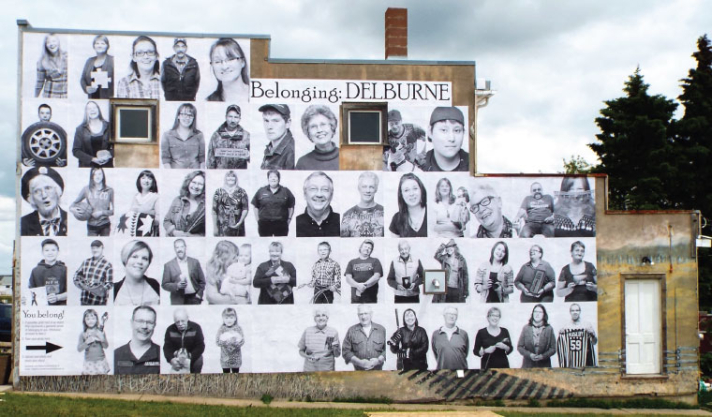
For the art project, internationally renowned portrait artist John Beebe collaborated with the village to create gigantic photos of local residents. These were then wheat-pasted on multiple exterior building surfaces throughout the village. The village school featured a collection of about 140 portraits.

Delburne Family and Community Support Services (FCSS) community worker Nora Smith has been a key champion of all of these efforts, but has been especially struck by the possibilities in art as a community-building tool.

“There’s something incredibly powerful in tying the art element into the community development piece,” says Nora. “I can’t really put my finger on it, but I know it’s there just by the way I watched the community members stop and appreciate each other.”

The art project is “shifting the feeling” in the community, which testifies to the foundational level of change that Nora and others are investigating through this community engagement process. The work is largely about the biases and prejudices that shape one’s thinking and therefore one’s way of being in society. “If we can start shifting people at that level, that would be fantastic,” Nora says.

Delburne residents have now identified and voted on the following four priorities for their community:

  • Main Street revitalization
  • Health and Wellness
  • A Belonging Delburne project (which includes the art project)
  • A communication project
  • Plans are underway to re-engage in the Fall to flesh out tangible action plans within each of these four priorities. These plans will be revisited on a yearly basis to gauge accomplishments and reevaluate priorities.

Delburne represents a growing shift amongst communities and neighbourhoods in Canada to focus on stronger resident engagement, reducing the “role” of the local government in deciding what gets done and what doesn’t.

What other communities can learn from Delburne:

  • Be strategic about engaging people. Paul Born’s book, Community Conversations, offers valuable insights on how to ensure everyone who should be at the table is there.
  • People inviting those they have a relationship with to participate in the community engagement process is critical to ensuring strong engagement.
  • Trust the process. “It’s so easy as someone working in community development to want to give the answers,” Nora says. “Have faith that the answers are eventually going to come out of the community itself.” It’s important that the answers do emerge this way, to ensure sustainability as residents “own” the actualization of these answers.
  • Strengthening community engagement is a process: it takes time and work.
  • Strongly consider integrating the art element into community development efforts.

This story is part eight of a series focused on placemaking and other citizen led initiatives. To read the other entries in this series, visit the original post here.

You can find the original version of this Axiom News piece at www.axiomnews.com/massive-main-street-photo-exhibit-%E2%80%98shifts-feelings%E2%80%99-alberta-community.