NIF Caucus at NCDD 2014 – Friday Dinner

We want to make sure that all of you who are attending NCDD 2014 this week know that there is going to be a dinner for past or present affiliates of our partners at the National Issues Forums Institute. Learn more in the note below from Nancy Gansender and RSVP to her.

NIF-logoAre you an NIF moderator/facilitator? Are you part of the NIF network, past or present? Do you remember the PPIs or are you part of its successors, Centers for Civic Life?

Can we talk? Let’s do so over dinner this Friday, October 16 at the NCDD 2014 conference.

Let’s share our common past, and build on our rich experience and chart a bright future.

Conveners: Patty Dineen, Craig Paterson and Nancy Gansneder.

Plan to join us? Shoot Nancy an email (nancyg@virginia.edu) so we can make reservations.

Help Move Us Beyond Partisan Polarization

We hope you will read the letter below from NCDD supporting member Mark Gerzon asking NCDD members to share their ideas and input for how we can transcend the partisan political divide of our times. Mark and the Center for Transpartisan Leadership will also be offering a chance to be part of the conversation in the “Co-Designing our Transpartisan Journey” workshop during NCDD 2014. Learn more about what the CTL is doing and comment with your ideas below.


Before we are Republicans or Democrats, liberals or conservatives, or any of the other labels that divide us as often as define us, we are Americans, all with a personal stake in our country. For some time now we’ve all fallen into a pattern of describing our choice as Left or Right. But is that really an accurate description of the choice before us? Isn’t our choice really not one of Left or Right, but of up or down?

CTL logo no wordsWhat do you think of the preceding sentences?

Whatever you reaction may have been, you should know that I didn’t write them. The author of the first sentence was one of the most liberal presidents in recent memory, Bill Clinton. The author of the second and third sentences was President Ronald Reagan, who spoke them exactly thirty years ago when accepting the Republican Party’s presidential nomination. George W. Bush in 2000 and Barack Obama in 2008 made very similar statements.

These leaders know that there is another dimension to political life. It is not all about a horizontal (Left-Right) ideological divide, but also about a vertical (Higher-Lower) axis. In other words:

There is a path that goes “up” toward collaboration, problem-solving and co-creation, not “down” toward cynicism, polarization, and national decline.

NCDD members collectively have both the knowledge and commitment to charting this path toward higher ground. For this reason, we at the Center for Transpartisan Leadership are convening a one-day dialogue immediately preceding the NCDD conference to explore how organizations engaged in cross-boundary, cross-partisan work might deepen our synergy and potentially increase our collective impact.

We are inviting you to share your ideas with us so that they can become part of our agenda.

Some of the converging factors that make now the time to explore this emerging opportunity are “positive” ones:

  1. Parallel visions among thought leaders of the D&D field
  2. Promising cross-partisan initiatives
  3. New methods for civic engagement
  4. The maturing field of dialogue, deliberation and conflict resolution

Other converging factors making now the time for this work appear as more “negative” ones:

  1. Sharply increased government dysfunction
  2. Record levels of public dissatisfaction
  3. Predictions of a unprecedentedly toxic 2016 election

In fact, both the “positive” and “negative” factors make this meeting extremely timely. Given this confluence of all these factors, we believe it is an extremely promising moment to explore greater synergy between and among key organizations and greater collective impact on public discourse, citizen engagement, and democracy reform.

We invite you, as NCDD members, to respond to this blog by sharing any specific action ideas you (or your organization) believe are part of this movement for transforming partisanship into genuine, collaborative problem-solving.

If this “transpartisan” work intrigues you, here are four steps you can take to start getting involved:

  1. Respond to this blog post in the comments section with your own specific proposal for actions that could transform partisanship.
  2. Join us at the reception (co-sponsored by us, Community Matters, and NCDD) on October 16th at 6 PM in the lobby of the Hyatt Regency during the NCDD 2014 officially begins to hear firsthand the results of our pre-conference dialogue with the major organizations in the field.
  3. Attend our NCDD 2014 workshop, “Co-Designing our Transpartisan Journey”, on October 17th from 11am-12:30pm where we can learn from each other how to build a transpartisan movement.
  4. Subscribe to our Transpartisan listserv and be part of the discussion on advancing this kind of work.

Sign up for the Morven Park Field Trip at NCDD 2014

We are excited to share an invitation from Abby Pfisterer, a member of our conference planning team, to join her for another great field trip during NCDD 2014 to Morven Park! Find out more below and read more about our field trips by clicking here or sign up here.

Join us during NCDD 2014 for a field trip to Morven Park on Saturday evening and explore a hidden gem in DC’s metro area! Located in Leesburg, Morven Park is a 200 year old historic mansion that has been a home of political leaders from the days of the early republic through the beginning of the 20th century. It’s the perfect setting to relax after a busy (and invigorating!) second day at the conference – plus there will be local wines to try.

I’ve been a part of Morven Park’s educational team for several years, and what I love is that it’s more than just a place for interesting history and wide open spaces. The story and the site are the base for the exciting and forward looking programs we get to create and share with our community.

One of my favorite initiatives here is our Center for Civic Impact, which teaches K-12 youth how to be active and thoughtful citizens. But there is also a small farm (home to the presidentially pardoned Thanksgiving turkeys), equestrian center, athletic complex, and three museums. To me, it is a place to come together to explore spaces and ideas.

We’d love to share this site and story with those of you traveling from outside the DC region and locals too. We have a mansion tour lined up that looks at the civic activism of the last owner – a former governor of Virginia, and then a chance to enjoy the view with wine, food, and good discussion. The topic – from rural to urban, and where dialogue fits in – is based on the history you’ll hear on the tour as well as the fact the Morven Park sits squarely on a dividing line between town and country. I have a feeling many of you will have similar stories to share!

The cost is $25 to cover transportation and food. We’ll head out at 4:30pm and take buses for the 25 minute drive to Morven Park. It will be a lot of fun – so sign up today!

Thanks! – Abby

Submit Nominations for the 2015 Brown Democracy Medal

We want to encourage NCDD members to consider submitting nominations for this year’s Laurence and Lynn Brown Democracy Medal. The award is offered every year by Penn State’s McCourtney Institute for Democracy, and we know many of our members would be a great fit for the award. Learn more in the announcement below and submit your nominations before Dec. 10th.


Seeking Nominations for the 2015 Penn State Democracy Medal

Each year, the Pennsylvania State University McCourtney Institute for Democracy gives a medal and $5,000 award for exceptional innovations that advance the design and practice of democracy. The medal celebrates and helps to publicize the best work being done by individuals or organizations to advance democracy in the United States or around the globe.

The Institute gives medals in even-numbered years to recognize practical innovations, such as new institutions, laws, technologies, or movements that advance democracy. In odd-numbered years, the awards celebrate advances in democratic theory that provide richer philosophical or empirical conceptions of democracy. The Participatory Budgeting Project won the first medal in 2014 for the best innovation in the practice of democracy (see details at democracyinstitute.la.psu.edu).

Nominations will be accepted through December 10, 2014, and the awardee will be announced in the spring of 2015. The winning individual (or representative of a winning organization) will give a talk at Penn State in the fall of 2015, when they also receive their medal and $5,000 award.

Between the spring announcement of the winner and the on-campus event in the fall, the Institute provides the recipient with professional editorial assistance toward completing a short (20-25 page) essay describing the innovation for a general audience. Cornell University Press will publish the essay, which will be available to the general public at a very low price in electronic and print formats to aid the diffusion of the winning innovation.

Award Review Process for Innovations in Democratic Theory

This year’s Brown Medal competition will recognize an exceptional advance in democratic theory, broadly construed. Submissions can include conceptual advances, moral philosophical insights, rhetorical, interpretive or historical theories, empirical or causal models, and/or innovations in the design of democratic processes. Innovating ideas, models, and designs have been instrumental in advancing democracy on both large and small social scales, both in recent years and over the centuries of democratic practice. Examples include new methods of voting and representation, new notions of civil and human rights, theories of political communication, polarization, social capital, and social movements, models of democratization and its impediments, and deliberative and participatory re-conceptualizations of democracy.

Nominations will be accepted through December 10, 2014, and the awardee will be announced in the spring of 2015. Recipients may be scholars, civic reformers, non-governmental organizations, or any other individual or entity responsible for the theoretical innovation. The winner (or the representative of the winning organization) will give a talk at Penn State in the fall of 2015, when we will also present their medal and $5,000 award. Between the spring announcement of the winner and the on-campus event in the fall, the Institute will provide the recipient with professional editorial assistance toward completing a short (20-25 page) essay describing the innovation for a general audience. In the fall, Cornell University Press will publish the essay, which will be available to the general public at a very low price in electronic and print formats to aid the diffusion of the winning innovation.

All nomination letters must be emailed by December 10, 2014 to democracyinst@psu.edu to guarantee full review. Initial nomination letters are simply a one-to-two page letter that describes the innovation, its author(s), and the accessible location of its fullest expression (e.g., in a scholarly article, magazine essay, or on the Internet). Both self-nominations and nominations of others’ innovations are welcomed. In either case, email, phone, and postal contact information for the nominee must be included.

By January, 2015, a panel composed of Penn State faculty and independent reviewers will screen those initial nominations and select a subset of nominees who will be notified that they have advanced to a second round. By the end of February, those in the second round will be invited to provide further documentation, which includes the following: biographical sketch of the individual or organization nominated (max. 2 pages); two letters of support from persons familiar with their theoretical innovation, particularly those who work independently from the nominee; a basic description of the innovation and its efficacy, with a maximum length of 30 pages of printed materials and/or 30 minutes of audio/video materials; and a one-page description of who would come to Penn State to receive award and who would draft the essay describing the innovation. The review panel will then scrutinize the more detailed applications and select an awardee by the end of April.

Review Criteria

The theoretical innovation selected will score highest on these features:

  1. Novelty. The innovation is precisely that—a genuinely new way of thinking about democracy. It will likely build on or draw on past ideas and practices, but its novelty must be obvious.
  2. Systemic change. The theory, concept, or design should be able to change systematically how we think about and practice democracy. Conceptual insights should be of the highest clarity and quality, and empirical models should be rigorous and grounded in evidence. The practical significance of the innovation should be systematic, in that it can alter the larger functioning of a democratic system over a long time frame.
  3. Potential for Diffusion. The innovation should have general applicability across many different scales and cultural contexts. In other words, it should be relevant to people who aspire to democracy in many parts of the world and/or in many different social or political settings.
  4. Democratic Quality. The spirit of this innovation must be nonpartisan and advance the most essential qualities of democracy, such as broad social inclusion, deliberativeness, political equality, and effective self-governance. Nominees themselves may be partisan but their innovation should have nonpartisan or trans-partisan value.
  5. Recency. The award is intended to recognize recent theoretical accomplishments, which have occurred during the previous five years. The roots of an innovation could run deeper, especially as an idea or theory is developed and tested over time, but within the past five years, there must have been significant advances in its refinement or expression.

When choosing among otherwise equally qualified submissions, the review panel will also consider two practical questions. Who would give the lecture on campus and meet with the PSU community? Who would write the essay about the innovation? Neither needs to be the nominee, nor the nominator.

Individuals or organizations who have worked closely with the Institute’s director (Dr. John Gastil) or associate director (Dr. Mark Major) in the past five years are not eligible. For the first five years of the award (i.e., until 2019), Penn State alums or employees are also ineligible.

Questions and Further Information

Any questions or requests for more information should be sent to democracyinst@psu.edu.

The Pennsylvania State University McCourtney Institute for Democracy (democracyinstitute.la.psu.edu) promotes rigorous scholarship and practical innovations to advance the democratic process in the United States and abroad. The Institute pursues this mission in partnership with the Center for Democratic Deliberation (CDD) and the Center for American Political Responsiveness (CAPR). The CDD studies and advances public deliberation, whereas CAPR attends to the relationship between the public’s priorities and the actions of elected bodies.

Whereas each center focuses on the questions most salient to its mission, the Institute tends to larger issues and connections between those questions. The Institute examines the interplay of deliberative, electoral, and institutional dynamics. It recognizes that effective deliberation among citizens has the potential to reshape both the character of public opinion and the dynamics of electoral politics, particularly in states and local communities. Likewise, political agendas and institutional processes can shape the ways people frame and discuss issues. The main activities of the institute include giving a major annual award for democratic innovation, bringing speakers to campus, sponsoring faculty roundtables and workshops, and financially supporting student research.

Free 3-Part Webinar on Talking about Difficult Public Issues

We want to share the following announcement from the American Library Association Center for Civic Life, and the David Mathews Center for Civic Life about a great 3-part webinar on discussing public issues that starts next week. We found the announcement over at the NIF blog, and hope you will read it below or view it here.

Does your community have a problem that looks like this?

Join us to learn how you can help overcome deadlock and lead change in your community.

Session 1: “Beyond Deadlock: A Better Way to Talk about Difficult Issues”

Tuesday, October 14, 4 – 5 p.m. EDT / 3 – 4 p.m. CDT / 1 – 2 p.m. PDT

  • Learn to help people work together to talk about public issues and make choices.
  • Uncover the deeper concerns of our communities.
  • Register for Session 1 at http://bit.ly/namingframing1

Session 2: “Tools for Naming and Framing Public Issues”

Wednesday, December 3, 4 – 5 p.m. EDT / 3 – 4 p.m. CDT / 1 – 2 p.m. PDT

  • Learn the steps and processes for leading a “naming and framing” effort.
  • Apply tools that help people weigh options for moving forward together
  • Register for Session 1 at http://bit.ly/namingframing2

Session 3: Check-in (date TBD)

  • Share experiences with fellow participants in a follow-up webinar or conference call.
  • Registration is free, but space is limited. Participation in all three sessions is encouraged.

Questions? Contact Nancy Kranich, nancy.kranich@rutgers.edu.

Register TODAY for NCDD 2014 before the Late Fee Starts!

Look, we know everyone procrastinates. I do it, you do it, we all do it.

But if you haven’t registered yet for the NCDD 2014 conference yet, today is your last day to get registered before the extra $100 late fee kicks in. So if you’ve been putting it off until the last minute, now is the last minute!

Make sure to get registered before midnight tonight at www.ncdd2014.eventbrite.com.

You wouldn’t want to miss all of our great workshops, the D&D Showcase, our brand new Short Talks, the exciting field trips, or our wonderful plenary speakers, would you? So stop procrastinating and register already!

We can’t wait to see all of you at NCDD 2014 in just over a week – it’s going to be our best conference yet!

Sign Up for an NCDD 2014 Field Trip to “Toast”

We are excited to share the invitation below from Marla Crockett – NCDD Board member and one of our DC site coordinators for NCDD 2014 – to join her for a great field trip during NCDD 2014! Find out more below and read more about our field trips by clicking here.

Join us for Toast during the NCDD Conference!

Wondering what to do on Saturday night during the NCDD Conference? Tickets are still available, so sign up for our field trip to Capitol Hill to see Toast. Produced by the highly respected theatre group, dog & pony dc, the show is described as a “participatory-performance-meets-science-fair.” You and other members of the audience will get drafted by a “secret society of inventors” to help push the boundaries of technological invention. It’s a fun and creative way to explore engagement and innovation, a few things we’re all interested in.

I saw a performance of dog & pony’s Beertown a few years ago and loved how they got the audience involved. We all became citizens of this fictional community in order to help the cast, playing city officials, determine which items should come out of Beertown’s time capsule and which ones should go in. We made up characters and played our parts seamlessly, arguing and weighing how to best represent life in “our” community. I would expect the same sort of role-playing and interaction with the actors during Toast.

In addition, dog & pony will be helping us integrate the arts during our conference, so you can reciprocate by helping them finish their show!

We’ll get started around 4:30, take the Metro to Capitol Hill, have dinner in the neighborhood, and then head to the theatre for the 7:30 performance. Tickets are $15, and transportation and dinner are on you, so join our group for a fun evening on beautiful Capitol Hill!

We have a limited number of tickets, so register for the field trip soon at http://ncdd.org/16398. Thanks!

CM Call on Rural Brain Drain, Oct. 9th

CM_logo-200pxWe are pleased to invite NCDD members to join our partners at CommunityMatters for the next of their monthly capacity-building calls series. This month’s call is titled “Rewriting the Rural Narrative”, and it will be taking place next Thursday, October 9th from 4-5pm Eastern Time. 

This month’s call will feature the insights of Ben Winchester, research fellow, University of Minnesota Extension. CM describes the upcoming call like this:

Brain drain – the loss of 18-29 year olds – dominates the conversation about rural population change. Yet at the same time, a lesser known migration is occurring. A majority of rural counties are, in fact, experiencing “brain gains” as newcomers age 30-49 move in.

Most communities aren’t tuned in to positive migration and miss out on the opportunities that come with newcomers. Ben Winchester, Research Fellow for the University of Minnesota Extension, Center for Community Vitality, has studied the trend and has great ideas for making the most of positive migration patterns.

Join our next CommunityMatters® and Citizen’s Institute on Rural Design™ webinar to hear Ben’s research on rural migration trends and the impacts they have on social and economic opportunity. Learn how communities are responding to these trends and what can be done in your town.

Make sure to register for the call today!

As always, we encourage you to check out the CommunityMatters blog to read Caitlyn Horose’s reflections on brain drain as a way to prime your mental pump before the call. You can read the blog post below or find the original by clicking here.

Brain Drain or Brain Gain? A New Narrative for Rural America

It seems the rural story has already been told. Small towns keep getting smaller. Schools and businesses are closing their doors. Young people are packing their bags for the city.

The loss of youth following graduation, the “brain drain,” dominates how we talk about rural population change. Hollowing Out the Middle describes the emptying of small towns. Fear feeds a narrative about rural areas “dying” or becoming “ghost towns.”

It is true that most counties – rural and urban alike – lose young people following high school graduation. Yet at the same time, a less recognized migration is occurring, and has been since the 1970s. Many rural counties are experiencing “brain gains” as newcomers age 30-49 move in. This migration is keeping small towns alive and contributing to a new narrative about rural places.

What is influencing brain gain? Research on newcomers points to quality of life as a driving force. Young professionals are looking for simpler schedules, better schools, affordable housing and recreational opportunities for themselves and their families. And, they are escaping the crime, congestion and fast pace of city life.

Surprisingly, jobs aren’t a chief motive. The quality of life factors appear to trump economic factors. However, telecommuting opportunities and the prevalence of rural broadband allows people to move into rural communities and stay employed through distant employers, even when local jobs aren’t plentiful. These trends have helped to diversify the local economic base across rural America.

Newcomers may be getting a better quality of life in small towns, but what do they bring in return? Rural communities can benefit from the unique skills and ideas of new residents. Newbies contribute to civic life - they volunteer, hold leadership positions and donate to charitable organizations. They spend money and start new businesses, aiding local economic development.

Most communities do little to recognize migration patterns or capitalize on them. What can your community do to build on this positive trend?

Join Ben Winchester, research fellow for the University of Minnesota Extension, Center for Community Vitality, for an hour-long CommunityMatters® and Citizen’s Institute on Rural Design™ webinar on rural migration trends and the impacts they have on social and economic opportunity. Learn how communities are responding to these trends and what can be done in your town. Register now.

Harwood: Is Focus on “Impact” Distracting from Change?

We are pleased to share a thought-provoking blog piece penned by Rich Harwood, director of The Harwood Insitute – an NCDD member organization. Rich reflects on a significant trend in the non-profit world that is familiar to many of us, and how our thinking around it can change. We encourage you to read the piece below or find the original here


HarwoodLogoThe watchword for community change nowadays is “impact.” This little, two-syllable word seemingly insinuates itself into every discussion about change. In doing so, it has redirected everyone’s attention, but not always in the right direction. If we’re not careful, we’ll lose sight of our most precious mission: to help people transform their lives and build stronger communities.

Don’t get me wrong: I’m all for “impact.” Who isn’t? I’ve spoken before hundreds of funders at an Aspen Forum for Community Solutions conference, published in the Stanford Social Innovation Review on this topic, engaged in various roundtables and webinars, and developed thousands of “public innovators” to create collective change in communities across the U.S. and overseas. But the impact of this seemingly little word is not always so productive or positive.

My experience working with people in communities, with foundation leaders, with various national initiatives, and with a variety of others is that the deifying of this word has produced a cascading effect of collective responses that endanger our mission. Consider the kind of discussion that ensues when we all start to talk about impact:

  • Our frame instantly becomes that of metrics and measurement – in other words “data.”
  • We then lunge toward enlisting large numbers of professionals and organizations to sit around a table and develop the right answers to whatever the data tell us.
  • Then we generate committees and workgroups and initiatives to implement the answers.
  • Our focus is then transfixed on the mechanics of managing all of these moving parts.

On the surface, nothing I’ve written sounds blatantly wrong. And as I’ve travelled the country, I have become convinced – indeed, moved – that those of us engaged in this work are excited about it because we so deeply want change. We believe that we, as a society, can do better. We have come to the conclusion that only by working together can we build stronger and more resilient communities and lives.

But the notion of “impact” can drive and distort our mindset and behaviors in ways I doubt most of us either intend or want.

The word immediately drives us to focus on data, activity and the mechanics of change. In the process, we can lose sight of the actual pain and suffering of people in our communities. We can forget that people not only want to alleviate their pain, but they also hold aspirations to move their lives forward.

We can get so lost in the mechanics that we fail to actually build different community relationships, norms and practices that change how a community works together – not just now, but in the future. We can wholly buy in to our own plans and initiatives without paying attention to how change truly occurs in communities.

The idea of impact can cast a spell over us. It shapes what we do and say. But if we want to create impact – to help people transform their lives and build stronger communities – we’ll need to break this spell.

Let’s make sure that in our quest for impact we keep communities and the people who live in them as our reference points.

NIF & Kettering Host Online Immigration Conversation Monday

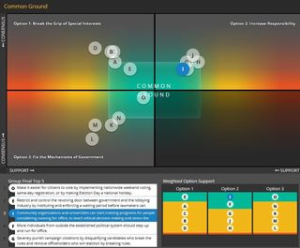
We encourage NCDD members to join our partners with the National Issues Forums of Northern Virginia and the Kettering Foundation for a webinar conversation on immigration tomorrow, Sept. 29th. The conversation will use KF’s new online deliberation tool, Common Ground for Action, so make sure to join us and check it out! You can read the invitation from Bill Corbett of NIFNVA below or find the original here.


NIF-logoI’m writing invite you to an upcoming online National Issues Forum, a small, moderated, chat-based deliberation on a critical issue facing America.

It takes place on Monday, September 29 at 7:30 pm to 9:30 pm EDT. All you need to participate is a web browser and the willingness to use chat for conversation.

The topic is “Immigration in America — How Do We Fix a System in Crisis?” The issue guide is at this link. The issue guide provides the road map for our discussion and essential background. If you’d like to watch a three-minute video that previews the topic, you can view it on our website by clicking here.

You can register by reply to this message or by completing the online form at the new website of National Issues Forums of Northern Virginia. The forum is limited to twelve people…first-come, first-served…but more forums are coming.

The forum uses a new software tool from the Kettering Foundation that brings moderated deliberation on national issues to a wider audience.

Below is a screen shot of a Common Ground graphic produced by an online National Issues Forum earlier this month. It is the product of ten people working through the issues together in a discussion about how to fix American politics.

I hope you are as interested as I am in helping to develop this new tool for more people to participate in political life.

Sincerely,

Bill Corbett National Issues Forums of Northern Virginia

Bill_Corbett_NIF_of_Northern_Vir@mail.vresp.com