Winter Updates from AASCU’s American Democracy Project

For those working with civic engagement and higher ed, we wanted to share these recent updates from AASCU’s the American Democracy Project about several exciting opportunities! Coming up this Wednesday, February 28th from 1-2pm Eastern, is a free webinar on assessing civic competency and engagement, and how these efforts translate to student learning. Second, there are three different national ADP awards nominations that are now open and are due by March 30. Finally, check out the upcoming 2018 Civic Learning and Democratic Engagement Meeting (#CLDE18) on June 6-9, hosted by the American Democracy Project (ADP), The Democracy Commitment (TDC), and the NASPA Lead Initiative. You can read the announcement below or find the original on ADP’s site here.


ADP Winter 2018 Updates & Announcements

With our recent effort to significantly increase our ADP programming, you might be interested in some of the upcoming ADP activities, including opportunities to get national recognition for deserving folks on your campuses.  Please pass along to those who might be interested as well.  Thank you in advance for your support

Free Webinar Featuring Assessment of Civic Competency and Engagement
Wednesday, February 28 | 1 p.m. – 2 p.m. EST
Register now

Walking our Talk: Converting Civic-Focused Mission Statements to Student Learning
Many higher education institutions include complex civic concepts as part of their missions, but how do we know if we are translating these lofty goals into student learning? Assessment is often viewed as a secondary or even bureaucratic institutional practice but done well it supports learning improvement processes that prioritize student development, organize institutional efforts, and direct change. This session will discuss recent ETS research initiatives focused on national trends in the assessment of civic competency and engagement as well as an institutional perspective on assessing and addressing these skills in students.

Presenters: Ross Markle, Senior Assessment Strategist for Higher Education, ETS; and Kara Owens, Special Assistant to the President for Institutional Effectiveness and Assessment, Salisbury University (Md.)

Nominations for Three ADP National Civic Engagement Awards Due March 30, 2018

  • The William M. Plater Award for Leadership in Civic Engagement is given each year to an AASCU chief academic officer in recognition of his or her leadership in advancing the civic mission of the campus. Chief academic officers may be nominated by anyone. The president or chancellor must endorse the nomination. Nomination materials for the 2018 Plater Award must be submitted electronically by March 30, 2018. For information and cover sheet: http://www.aascu.org/programs/adp/awards/WilliamPlater/
  • The John Saltmarsh Award for Emerging Leaders in Civic Engagement is presented annually to an emerging leader (e.g., early career faculty/staff) in the civic engagement field from an AASCU institution. Emerging Leaders may be nominated by anyone. Nomination materials for the 2018 Saltmarsh Award must be submitted electronically by March 30, 2018. For information and cover sheet: http://www.aascu.org/programs/adp/awards/JohnSaltmarsh/
  • The Barbara Burch Award for Faculty Leadership in Civic Engagement is presented annually to a senior faculty member in the civic engagement field from an AASCU institution. Senior ADP faculty members may be nominated by anyone. The provost or chief academic officer must endorse the nomination. Nomination materials for the 2018 Burch Award must be submitted electronically by March 30, 2018. For information and cover sheet: http://www.aascu.org/programs/adp/awards/BarbaraBurch/

Participate in ADP’s National Conference: The 2018 Civic Learning & Democratic Engagement (CLDE) Meeting
Wednesday, June 6, 2018 to Saturday, June 9, 2018
Hyatt Regency Orange County • Anaheim, California

The American Democracy Project (ADP), The Democracy Commitment (TDC), and NASPA are committed to advancing the civic engagement movement in higher education. Join us in Anaheim, California for our annual conference which brings together faculty, student affairs professionals, senior campus administrators, students and community partners. Together we will ensure that students graduate from our colleges and universities–both public and private–prepared to be the informed, engaged citizens that our communities and our democracy need.

Learn more about ADP and how to be engaged during our ADP Organizing Meeting on Thursday, June 7 from 9 a.m. – Noon. Annual awards will be presented during this meeting.

For more information: http://www.aascu.org/meetings/clde18/
Register now for the best rates.

You can find the original version of this ADP blog post at: https://adpaascu.wordpress.com/2018/02/15/adp-winter-2018-updates-announcements/.

Digital Engagement Census Deadline Extended to Mon. 2/26

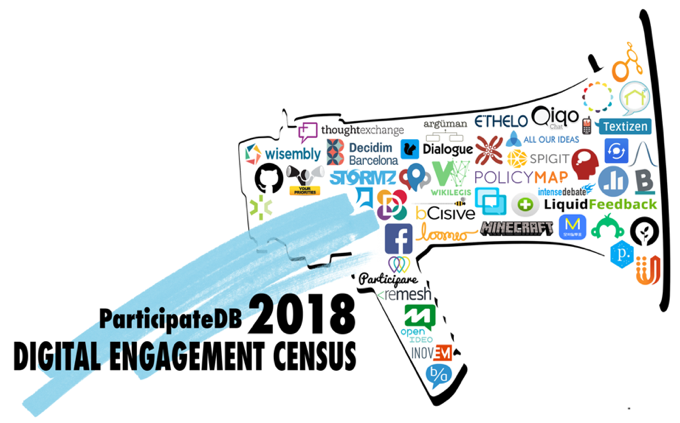
Shared with us by NCDD member, Tim Bonnemann on our Main Discussion listserv, the ParticipateDB 2018 Digital Engagement Census deadline has been extended until this coming Monday, February 26th. The survey, hosted by several international partner organizations, seeks to identify the digital engagement tools that people have been using and for folks to provide feedback on their experience using the tools. You can read more about the survey in the post below or find the original on ParticipateDB’s site here.


ParticipateDB 2018 Digital Engagement Census

Today, after extensive prep work since we first floated the idea back in 2016, we are excited to launch the ParticipateDB 2018 Digital Engagement Census, a global practitioner survey aimed at improving our understanding of how technology is shaping community engagement today.

Over the next ten days, we hope to hear from people working in community engagement and public participation in places all around the world to answer two basic questions:

  • Which digital engagement tools or services have you used in your work lately?
  • What were your experiences and lessons learned?

Respondents who leave us their contact information will:

  • be among first to get their hands on the interim report (to be issued later this month),
  • receive an invitation to our exclusive follow-up event, and
  • receive an electronic copy of the final report free of charge (to be issued later in March).

We are exceptionally pleased to be partnering with a group of renowned international organizations and practitioner networks in this field. This project wouldn’t be possible without their support and guidance. Thank you!

Please head to the project page for more details. When you get a chance, please take a few minutes to complete the online survey and share it with your colleagues near and far: ParticipateDB 2018 Digital Engagement Census

You can find the original version of this article at http://blog.participatedb.com/2018/02/09/welcome-to-the-participatedb-2018-digital-engagement-census/.

Working in Consensus Around Challenging Issues

As collective heartache and anxiety takes the nation in waves due to recent tragedies, dialogue offers a place where folks can come together in conversation to process and better understand one another on challenging issues like gun access. Written by NCDD member Larry Schooler, he shares the need to talk with each other from a place of consensus as opposed to compromise; and lifts up some of the core tenets of dialogue in a beautiful analogy of a dinner party, in which we come to the table open-minded and open-hearted. We encourage you to read the article below or find the original version posted here.


I’m a Broward County Schools parent. Time to talk.

Any parent would feel shaken by a shooting at a school anywhere in the world. But when it happens less than 30 miles from where you live, and your own child attends a school in the same district, it felt different to me.

It reminded me of both what I have, and have not, done to keep my own children safe, to talk to them about the issues around violence, guns, mental health, and the like. It also reminded me of what I could do to help.

I am a conflict resolution professional, but it does not take an expert to see we have conflict around gun ownership and usage that needs resolving. If you are looking for policy proposals on gun control, look elsewhere. But if you want to be part of the resolution to these conflicts, consider this: compromise may be less important than consensus.

What’s the difference? Think of the contexts in which we use the word “compromise.” “The mission was compromised and had to be abandoned.” “Her immune system was compromised making her more susceptible to infection.” Usage in these cases connotes weakness, defeat, vulnerability. In the context of resolving a conflict, some scholars argue compromise generally involves loss–the surrender of something important to one party in service of an agreement.

Would a passionate advocate for gun rights or gun control want to give in on any of their core values in the spirit of any agreement? Would a leader of the National Rifle Association or Everytown for Gun Safety want to “lose” on any aspect of their principles in pursuit of a deal? No one wants the perfect to be the enemy of the good, as the saying goes in public policymaking, but no one wants to feel as if he or she has to lose in order to get a win, either–or, as one dictionary puts it, engage in “the acceptance of standards that are lower than is desirable.”

But consensus differs in key ways. It connects to the perhaps overused but highly significant concept of a “win-win” outcome. It holds out hope that with enough understanding of each other’s goals and viewpoints, an agreement can emerge that everyone can actively support. Debate does not yield consensus; dialogue and discussion do. We seem incredibly eager to debate–in government, online, and beyond–and far less eager, or even able, to discuss.

Imagine if you found someone whom you knew had a very different perspective on guns than you do. Maybe you’ve never owned or even fired a gun, and a good friend is a hunter. Maybe you’ve defended yourself or someone else using a gun, and a good friend or relative thinks you are endangering yourself or others by having one. Sit down with that person, as soon as possible.

Start by listening to understand, not to respond. Start by asking what makes the issue of guns important to the other person–why does it matter, what personal connections might there be. Start by considering what you can learn from the other person’s perspective that you did not know or had not fully considered before–why guns do more than just hurt, why gun ownership inspires fear rather than safety.

From that place of curiosity and interest, list the core values you each hold, without judgment; do it individually and then share. Maybe you both care about safety for all, the right to self-defense, the need for gun owners to receive training or licensure. Even if the lists of values stay separate, the act of acknowledging the importance of each other’s values matters. If you find common ground at this stage, so much the better; momentum emerges.

Now that you’ve set the table, you can begin adding the food for thought–ideas to carry out the values. When you go to a dinner party, you are unlikely to reject a dish as it comes out; so, too, should all ideas be welcomed, at this stage. So, if your counterpart says no one should own a gun before the age of 25, keep your concerns about that suggestion to yourself, for now.

When the food comes out–and, chances are, you and your counterpart will have prepared a feast of ideas, given the chance to do so without fear of immediate judgment–you evaluate those ideas based on what matters to each of you individually and both of you collectively. If you have agreed that safety for all matters, does the suggestion to restrict gun ownership based on age achieve that? If you have agreed that a person reserves the right to self-defense, does that suggestion help? Even at this stage, when you are determining what you can and cannot support, you search for what you can support, actively, in consensus, rather than what you must “give up” in compromise. If you feel determined to “defeat” a proposal, be prepared to offer an alternative. If age-based restrictions on gun ownership don’t work, what restrictions would? If the presence of an armed guard in a school doesn’t make sense to you, what protections would?

It would be easy to dismiss this process as far-fetched, unrealistic, for the moment when pigs fly. Frankly, it is hard to know whether we are capable of this kind of civil discourse–we rarely, if ever, have undertaken it, though participants from both sides of the abortion debate have triedwith some success. I can only state, with some empirical evidence, that our previous tactics have not worked. No matter how tragic or unthinkable prior incidents have been, efforts to defeat the other side have produced few results.

Dare we, as a nation, risk failure in order to achieve lasting success? Our past victories have seldom come out without that risk, and we undoubtedly risk greater bloodshed and broken hearts through a repetition of our past failures.

You can find the original version of Larry School’s article at www.linkedin.com/pulse/im-broward-county-schools-parent-time-talk-larry-schooler/.

Public Agenda on the Importance of Measuring Engagement

One of the many ways to express the importance of engagement is to have effective ways to measure engagement efforts. In a recent piece by Matt Leighninger of NCDD member organization Public Agenda, he wrote on some of the challenges to engagement and why the need exists to be more effective at how engagement is measured, both qualitatively and quantitatively. This article is part 6 in the series on ways that public engagement needs to improve and the links to the 5 previous installments are at the bottom of the page. You can read the article below or find the original on Public Agenda’s site here.


How Public Engagement Needs to Evolve, Part 6

How can public engagement evolve in order to meet the needs and goals of citizens today? My previous post explored how public institutions may collaborate in their efforts to support engagement so that it becomes more efficient, systemic and sustained. For this final installment in the series, I’ll address the need for better ways to measure the perceptions, processes and outcomes of engagement, so that people know how to continually improve it.

Measuring engagement, especially in quantifiable ways, has always been difficult. There are a number of challenges, including:

  • Difficulty in defining engagement. Many leaders understand engagement to mean the one-way dissemination of “correct” information to the community, in order to disprove “incorrect” information. Some see it as purely meaning face-to-face meetings, while others are focused mainly on online interactions.
  • Differing forms of intensity. Engagement varies in intensity, from “thick” forms that are deliberative, labor-intensive and action-oriented, to “thin” forms that are fast, easy and potentially viral. Both are valuable, but for different reasons. Counting website hits or social media impressions may overemphasize the thin forms, while counting participation in meetings may overemphasize the thick forms.
  • Just counting heads may give you the wrong impression. Counting participants in any setting may be deceptive because in places where conventional forms of engagement are the only ones being used, people tend to mostly engage when they are angry or fearful about decisions being made by government. In this sense, higher numbers of people “engaging” can be a sign that governments are failing to practice more proactive, productive forms of engagement.
  • Inexperienced engagement staff. Counting staff positions dedicated to engagement as an indicator of government’s commitment can be misleading – since engagement is often defined in limited ways, these “engagement” job positions are often devoted to traditional PR or stakeholder relations. These jobs are often given by public officials to people who were particularly active campaign volunteers, but who have only a narrow and limited background in what engagement can do for governance and problem solving, and the many forms it can take.
  • Inability to measure impact. One of the most critical measures of engagement, especially to citizens, is whether public input has some kind of meaningful influence on public policies and practices. This is a particularly difficult thing to assess; it defies quantitative measurement and is subject to many different variables.

Despite these challenges, it is possible – and, in fact, critically important – to assess public engagement, including quantitative measures of both processes and outcomes. (Leighninger and Nabatchi, “How Can We Quantify Democracy?” Dispute Resolution, Fall 2015). Engagement practitioners have been able to measure how many and what kinds of people are participating. They’ve also been able to examine if people value the engagement, how the experience affects them, and whether engagement inspires and supports volunteerism, voting and other civic measures.

However, in most places, these kinds of measurement practices are done only sporadically and on a project-by-project basis. Leaders and practitioners are more likely to be focusing on the basics – how many people are participating, and the demographics of those participants – and have not begun assessing community members’ perceptions of engagement opportunities, or evaluating the impacts of engagement on volunteerism or policymaking. When measurement does occur, the findings are often not shared with the community and community members are rarely asked to help gather, analyze or act on the data.

If we can do better measuring on a more regular basis, we may connect the findings about engagement with some of the high-level indicators that are being used to track community success. These include the Civic Index that the National Civic League has maintained for over 25 years, the Civic Health Index developed by the National Conference on Citizenship a decade ago, and the Soul of the Community research produced by the Knight Foundation. There are also specific community examples like the Wellbeing Index in Santa Monica, California. While these indexes are interesting and helpful for assessing where the community stands, it’s unclear whether and how a community’s engagement level impacts the overall scores.

We probably need a family of measurement tools in order to bridge the gap between narrow evaluations and broad indicators. I’ve written about potential tools and have also been involved in creating others. One example is the Participatory Democracy Index, which is being piloted in beta by the World Forum on Democracy in Europe. The more that we can connect people who are building new tools, the more we can learn from one another and ensure that we are on the same page about fundamental questions, like how we are defining engagement. Public Agenda convened an online dialogue among people who are grappling with the measurement challenge, so that we could compare notes and see if there are common themes in our work. Later in the year, the Knight Foundation will release a white paper based on what we found.

By doing a better job of measuring engagement, we can help clear up some of the confusion about what engagement means and why it is important. Many public officials and other leaders use the rhetoric of community building, citizenship and democracy, but the language often seems to be used mainly as a window dressing, making it difficult for citizens to monitor their progress or hold public officials accountable for their rhetoric. Finding new ways to measure these interactions can be a powerful way of making engagement more meaningful and productive.

You can find the original version of this article on Public Agenda’s blog at www.publicagenda.org/blogs/how-public-engagement-needs-to-evolve-part-6.

Civility Lessons from Washington in Honor of President’s Day

In honor of President’s Day, we wanted to share this piece by Big Tent Nation on some lessons from George Washington that was posted on NCDD member org, the Bridge Alliance‘s website. This post lifts up some of the gems the first president wrote about on the power of dialogue and importance of civility especially within conversation. In addition to BTN and BA, there are several organizations in the NCDD network like the National Institute for Civil Discourse and The Village Square, have been working to improve civility just as G.W. advised. You can read the post below or find this version on the BA’s site here.


Lessons from George Washington: It’s Time We Listened!

We all want America to flourish and prosper, but disagreements on “how” keep tripping us up. How is much more than picking between policy prescriptions – at its core it involves how we treat each other, and particularly those we disagree with.

The person most essential to realizing America in the first place thought about this issue a lot. It’s time to revisit his legacy.

George Washington was incredibly wealthy, physically imposing and a war hero of epic proportions. He probably could have gotten away with being a total jerk and still been revered! The fact is, many Americans wanted to give him almost limitless power. Some even wanted to make him a king.

His response? To a degree unprecedented in history (with all due respect to Cincinnatus), he put nation ahead of personal power and glory.  Was it because he wasn’t ambitious? Was it because he never felt like knocking Jefferson’s and Hamilton’s heads together and telling them to just behave? Absolutely not. He had the same desires and frustrations we all struggle with.

In fact, Washington was a highly emotional person who worked incredibly hard to manage his impulses.

He started cultivating self-control and interpersonal wisdom at an early age.  At just 16, he created a book for himself now called “Rules of Civility and Decent Behavior in Company and Conversation.” In it he transcribed 110 guidelines for personal conduct, manners and social relations. Reading them now, I’m struck by how relevant they are to today’s political challenges – and the degree to which we’re systematically ignoring them.  Below are a few that would contribute enormously to authentic American greatness, if only we put them into practice:

At a profound level, Washington recognized that discipline and respect for others are essential to achieving greatness as a person or a nation.  We’ve strayed too far from these principles – and that represents an existential threat to our democracy.

Too many of us have allowed “our side” winning to triumph over the best interests of America as a whole.  The political dysfunction we suffer today has its roots in this toxic, zero sum mentality. Is there a way forward? The jury is out, but I can’t think of a better guide for all of us than the saying George Washington wrote down last:

You can find this version of the Big Tent Nation’s blog piece on the Bridge Alliance site at  www.bridgealliance.us/lessons_from_george_washington_it_s_time_we_listened.

MetroQuest Webinar on Finding Common Ground, Feb. 28th

Coming up at the end of February, NCDD member org MetroQuest will be hosting the webinar, How to Design Public Engagement to Find Common Ground; co-sponsored by NCDD, IAP2, and the American Planning Association (APA).  This webinar will be an opportunity to learn more on how to design public engagement efforts that uplift the common ground amongst the community and create solutions that demonstrate these shared ideals. You can read the announcement below or find the original on MetroQuest’s site here.


MetroQuest Webinar: How to Design Public Engagement to Find Common Ground

A 5-star recipe for public engagement – how to find common desires and build a winning plan!

Wednesday, February 28th
11 am Pacific | 12 pm Mountain | 1 pm Central | 2 pm Eastern (1 hour)
Educational Credit Available (CM APA AICP)
Complimentary (FREE)

REGISTER HERE

When it comes to urban and transportation planning, motivated groups with competing demands often emerge in community outreach efforts. On February 28th, learn how online community engagement can help find common ground to build a plan citizens will support.

Mark Evans from BartonPartners and Mary Young with the Town of Westport will share their success in engaging the public to inform the Saugatuck Transit Oriented Design Master Plan. Find out how online engagement provided a fun and safe way for citizens to provide input without fear of reprisal from local insurgent groups. The result? A master plan that meets the common desires of the local community.

Register for this complimentary 1-hour live webinar to learn how to …

  • Create a public engagement process to find common goals
  • Ensure privacy in the process to uncover the true priorities
  • Optimize citizen engagement to go beyond motivated groups
  • Collect informed, constructive input from all demographics
  • Find the balance between livability, character, and transportation
  • Gain transparency with actionable data to support your plan

You can find the original version of this announcement on MetroQuest’s site at http://go.metroquest.com/Westport-City-Plan-Barton-Partners

NCDD at Innovations in Participatory Democracy Conference

We are thrilled to let folks know that NCDD staff, Courtney Breese and I will be at the Innovations in Participatory Democracy Conference, which is happening on March 8th – 10th in the Phoenix area. This conference will be a fantastic opportunity to learn about the top innovations in civic engagement and democracy, and to network with leaders in the field doing this powerful work.

We are especially excited to announce we will be presenting a session in collaboration with two fellow NCDD members: Cassandra Hemphill of the IAP2 Federation and adjunct faculty at Missoula College of the University of Montana, as well as, Annie Rappeport of the University of Maryland where she serves as a PhD Student and Research Assistant. In this interactive workshop, we will use art to explore participants’ individual connections to participatory democracy, what led us to our work on improving our democracy, and what each of us offer to the field. We’ll explore how we are connected in our communities and how we might connect with others to strengthen participatory democracy. If you are attending IPD, we hope you will join us for our session during Block 1 on Thursday, March 8th from 3-4:30pm.

While we are in town, we would love to meet up with NCDDers in the area (and those attending the conference)! We are working to identify a location that could accommodate a meetup on Friday night (March 9th) after the IPD events that evening. If you are in town on the 9th and would like to join us, send Courtney an email at courtney[at]ncdd[dot]org and we’ll keep you in the loop as we firm up our plans!

IPD is being hosted by NCDD member organizations – the Participatory Budgeting Project and the Jefferson Center, as well as, the Center for the Future of Arizona, the Katal Center, the Participatory Governance Initiative at Arizona State University, Phoenix Union High School District, and the Policy Jury Group. If you’ve never been to a conference hosted by PBP and these fine organizations, you are in for a special treat! Tickets go up February 28th – so make sure you get yours ASAP.

There are several pre-conference trainings planned for Wednesday, March 7th, like a training on participatory budgeting (PB) hosted by the Participatory Budgeting Project, or a training on citizen juries, citizen assemblies, sortition, and more hosted by the Jefferson Center and the Policy Jury Group. Click here to learn more and register for these pre-conference trainings, and to see the full IPD conference schedule.

Remember to keep an eye out for Courtney and I if you are attending the conference because we would love to see you!

NIFI Deliberation Day Coming up Monday, February 19th

NCDD member org – the National Issues Forums Institute, will be hosting Deliberation Day on Monday February 19th, where folks will have five back-to-back opportunities to participate in an online deliberative forum on immigration. Participants will have a chance to use NIFI’s Common Ground for Action online forum, where the results will then be part of A Public Voice 2018; an annual event hosted by Kettering Foundation and NIFI that bring Congressional and agency staffers together in a working meeting to discuss results from the deliberative forums (learn about APV 2017 here). NIFI is offering complimentary copies of their issue guide, Coming to America, before April 11th and have a free recorded webinar available on moderating these deliberative forums. We encourage you to read the announcement below or you can find the original here.


Join Us for Deliberation Day – Monday, February 19, 2018

Five Back-to-Back Online Forums about Immigration

Moderators and conveners around the country are planning and holding public deliberative forums about the issue of immigration to help kick off the 2018 A Public Voice forum series. At least 40 forums are already being scheduled, and more are in the works. A notable feature of this year’s forums, Deliberation Day, scheduled for Monday, February 19th, will include five, back-to-back Common Ground for Action online forums.

You are invited to choose a time that works best for you and participate in one of the online forums on February 19th. And you can help by sharing this invitation and the registration links below with your friends, family, and communities. All forums will use the brand-new Coming to America: Who Should We Welcome, What Should We Do? issue framework.

All forums will be held on Monday, February 19th (Presidents’ Day)

Click on a link to register:

Forum 1: 10:00 am – 12:00 pm EST
Forum 2: 1:00 pm – 3:00 pm EST
Forum 3:  3:30 pm – 5:30 pm EST
Forum 4:  6:30 pm –   8:30 pm EST
Forum 5:  9:00 pm – 11:00 pm EST

If You’re Planning to Hold a Forum – FREE Materials Offer

For a limited time, the National Issues Forums Institute (NIFI) is offering complimentary sets of 20 Coming to America issue guides and questionnaires to conveners holding forums before April 1, 2018. Click here or contact Darla Minnich at dminnich@nifi.org to sign up to receive your free materials.

Please let us know about your forums. When you’ve scheduled your forum (either before or after April 1, 2018), please let us know about it by posting your information on the NIFI web site in the Events section. You must log in to submit an event; or send your forum details (contact name and email address, date, time, location, city, state, zip code) to Patty Dineen at dineenp@msn.com.

Watch a Webinar about Moderating Coming to America Forums

On January 30, 2018, Kara Dillard presented a one-hour webinar about convening and moderating forums using the new National Issues Forums Institute (NIFI) issue guide titled, Coming to America: Who Should We Welcome, What Should We Do? The webinar, Moderating the Coming to America Deliberative Forums, was recorded and has been archived. Click here to watch the webinar.

You can find the original version of this blog post from NIFI at http://conta.cc/2G94kX4.

Strengthening Public Engagement with Volunteers

Public engagement practices can be best accomplished with the help of volunteers as NCDD member org Everyday Democracy points out in this article. Volunteers can provide several benefits to public engagement, because of their community expertise and additional support for the work that needs to be done. In the article, Evdem gives examples from across the country of engagement work being done with the help of volunteers to drive a more participatory democracy. You can read the article below or find the original on Everyday Democracy’s site here.


A New Take on the Role of Volunteers in Public Engagement

EvDem LogoFor every one professional athlete, thousands of amateurs play pickup games in the spare time.  For every Broadway actor, hundreds take up theater as a hobby on a community stage.  For every band with a hit single, there are dozens of musicians jamming in garages or playing covers in bars.

The “professionalization” of these activities, or forms of art, has obviously not stopped those with far less training and skill from taking up the craft.  If anything, we often see an upsurge in hobbyists when a professional rises to prominence–think of the impact Tiger Woods had on golfing, or how American Idol inspired shower singers to take the stage.

This all has relevance in the context of deliberative democracy and public engagement for a few reasons.  In the last few decades, this field has experienced significant growth in the number of practitioners focusing on public engagement as a profession or occupation; that is, receiving specialized training and making their living in the design and convening of public engagement.  More and more governments–particularly at the local level but also in counties, regions, and states–have worked with such professionals to evolve their public engagement strategies away from the “three minutes at the microphone” public hearings that satisfy few citizens’ needs.  The profession has helped governments involve citizens earlier and more robustly and meaningfully than hearings held the night of a vote.  Decisions made by those governments incorporate more of the public’s interest and often prove more politically sustainable.

So, where might that leave those who care deeply about including the public in political deliberation but who have another professional calling?  What about those who have retired and lack the stamina for a full-time job but would love to be involved?  What about full-time students focused on academics but interested in internships, course credit, or community.

The number of public engagement “professionals” (defined as those who make most or all of their living doing this work) does not seem to meet the demand for public engagement nationwide–especially in cities where engagement may happen on multiple topics simultaneously.  But that does not necessarily mean government agencies have been willing to fund the amount of public engagement that they believe they need.  Elected officials often pay lip service to the need for better, more expansive public engagement, without budgeting funds for that purpose.

Consider the difference between what a professional and a volunteer (or an “amateur”) might bring to their work in this field.  Those who come to this work as volunteers often bring the perspective of their other profession or career and a different way of framing questions to discuss with the public or respond to comments made during dialogue.  They may also bring a special level of passion and commitment to their opportunity to facilitate; they may view it as a unique opportunity for them in ways that professionals doing the work every day might not.

Additionally, while many public engagement professionals or volunteers do work in their own communities and are recognized and trusted by community members, they often “parachute into” a community where they lack relationships that local volunteers might have.  Those volunteers may make community members participating in a public dialogue feel more at ease, particularly if the volunteers are hosting dialogue in their homes or in familiar local hangouts, rather than governmental facilities.

All of these assets (and others) have led several communities to embrace the role of volunteers in public engagement. For instance: in Arizona, Project Civil Discourse has involved volunteers as facilitators of small group discussions held at forums on issues affecting quality of life in the state.  They call upon all participants to follow a pledge: “I pledge to engage in the basic principles of civil discourse: to respect diverse points of view, listen with an open mind and speak with integrity. I call upon all civic leaders to meet the challenge of solving difficult social issues by adhering to these principles, thereby creating a better world for ourselves and future generations.”

In the Pacific Northwest, the Countywide Community Forums empowered residents in the greater Seattle area to discuss local issues facilitated by volunteer hosts.  Participants could register online to find conveniently located meetings and join a group of between 4 and 12 participants discussing a common topic, introduced by a video.  Participants and their volunteer host even decide on a meeting place and time.  In an evaluation of the program, the King County Auditor’s Office reported, “Overall, participants are satisfied with this engaging, nonpartisan effort and report that they learn about the topic and King County policies.”  The auditor recommended that the Forums “engage [volunteer] citizen councilors and others in providing feedback and ideas and helping make the program more attractive to users.”

Chicago developed a model replicated in other cities (including Columbus, OH) known as “On the Table,” in which thousands of volunteers host dinner dialogues to discuss the challenges and opportunities facing the local community.  Some 55,000 people participated in roughly 3,500 volunteer-led dialogues in 2016, with dinners occurring in private homes or offices and public spaces (up to the host’s discretion).  The Chicago Community Trust, which helped organize the day of dinners, reported that out of the respondents from 2016 who participated in On the Table in previous years, 57 percent  participated in follow-up conversations over the past year, 46 percent stayed in contact with other attendees and 24 percent worked with one or more attendees on an idea.  One third of surveyed 2016 participants also said they made specific plans to work with one or more attendees.  More than three-fourths of those surveyed said the dinners helped them better understand both community issues and how to address them.  Everyday Democracy’s Anchor Partner InterFaith Works in New York hosts a similar dinner dialogue program, aimed at promoting deep inter-faith conversations.

In nearby Oak Park, Illinois, Dinner & Dialogue gave community volunteers a chance to host discussions in their homes over meals paid for by the City of Oak Park on topics including diversity, race, and inclusion.

In Portsmouth, New Hampshire, and other communities across the state, Everyday Democracy Anchor Partner New Hampshire Listens,  and its affiliate Portsmouth Listens, recruit volunteer facilitators to host multiple dialogue sessions, often in their homes and on consecutive weeks, and to guide their small groups towards consensus on a local issue.  Portsmouth’s process involves volunteers from the get-go:

“Portsmouth Listens volunteers and city officials form a Steering Committee drawing together stakeholders in the question or issue.  This committee frames the dialogue question to be given to the study circles. For example, ‘How do we balance the tax burden and level of services needed to make Portsmouth the best place to live and work for everyone?’ (Dialogue on FY12 city budget)…Portsmouth Listens recruits and trains neutral facilitators and develops a study guide for the four two-hour sessions that the study circles will deliberate….Citizens in the small groups or Study Circles deliberate for two hours a night over four weeks to answer the question….The individual Study Circles write their conclusions in a report, and present their findings. The reports are presented to relevant government bodies (city council, planning board, etc.) in person and their written reports are published in the newspaper.”

Building on New Hampshire’s model, in Austin, “Conversation Corps” has recruited and trained hundreds of volunteers to host dialogue throughout the city on topics recommended by the City of Austin, the Austin Independent School District, and the public transit agency, Capital Metropolitan Transportation Authority.  Through carefully designed discussion guides, volunteers could give participants an overview of the topic and some background statistics and pose specific questions that agencies felt would yield information helpful to their policymaking.  As Austin transitioned into a single-member district City Council, with ten members representing districts instead of six members elected at-large, conversations in all ten districts helped better connect voters to their elected officials and gave a more accurate picture of public opinion across the city.  To date, more than 200 volunteers completed training.

Additionally, models like the “meeting in a box” utilized in multiple cities and “Text, Talk, Act,” a project of Everyday Democracy and several other partners, drew upon the energy of volunteers to bring topics that would have been discussed at a public meeting into their circles of friends, community organizations, and the like.  These self-facilitated discussions did not require host training or volunteer coordination as much as a willingness on the part of the initiating participant to report their group’s findings back to the sponsoring entity at the conclusion.  In an evaluation of the Text, Talk, Act dialogue on mental health, a study found:

“participating in Text, Talk, Act leads to an increase in participants’ ability to recognize a peer in need, ability to reach out to a peer in need, ability to talk about the topic of mental health, likeliness to seek additional information, and likelihood to implement information or skills from TTA. Furthermore, participants reported positive experiences based on the technology used by TTA, clarity of TTA purpose, and the relevancy/usefulness/quality of TTA content. These satisfaction indicators support the participants’ likelihood to recommend TTA to others…Also, when participants were asked, ‘what are the best ways to engage youth on the topic of mental health, TTA was voted to be the third most effective or popular method (after face to face conversation and social media).”

Countless other examples exist of volunteers contributing to the work of public engagement, but this survey illustrates the variety of ways in which those charged with engaging the public can multiply their forces and improve their reach into their target populations.  While volunteers may lack the time and expertise that public engagement professionals bring to the table, they can entice those disinclined to participate to change their minds, and they can bring about a revolution in the ways the public engages.

You can find the original version of this article on Everyday Democracy’s site at www.everyday-democracy.org/news/new-take-role-volunteers-public-engagement.

Attend the 2018 IAP2 USA Skills Symposium in Austin, Texas

Are you looking to brush up on your IAP2 skills or really want to dive deep into learning public participation tools and techniques? We wanted to give folks in our network a heads up about the 2018 IAP2 USA Skills Symposium hosted by NCDD member org IAP2, happening in Austin from February 26 – March 2. This will be a great chance to take some of the classic courses from IAP2, as well as, several more recent training opportunities which you can read about below. They will also be hosting a National Dialogue event on February 28th exploring “How and why should the public be engaged in highly technical and complex projects?”. You can read the announcement below and find more information on the IAP2 site here.


Join us at the 2018 IAP2 USA Skills Symposium in Austin, Texas!

You’re invited! This year’s IAP2 USA Skills Symposium will feature a wide range of courses of varying duration and topics exploring skills, tools, and techniques that support effective public participation. This training will be undertaken in a rich learning environment, with activities building a creative and supportive space for participants whether they spend a day or the week at the event!

We will also be hosting a National Dialogue event on February 28, 2018 at the University of Texas at Austin talking about “How and why should the public be engaged in highly technical and complex projects?” See attached flyer for more details or register now!

Courses include but are not limited to…

Social Media And P2: How to design and host effective online engagement –  We know that online tools reach new participants and enable different kinds of conversation. But, it’s an emerging field and there is still much trial and error, so this course will give you a leg up by examining what’s worked and what’s failed. This interactive course will teach you to create social media campaigns that gather input creatively, enable collaborative online interactions, and sustain participation over time. You’ll also learn how to use social media for participant recruitment, and how to integrate mobile communication into your participation strategy. Bring your computer; this course gives you an opportunity to experience both the host and participant sides of online participation.

Evaluating & Measuring P2 – Evaluation should always be useful, and this introductory course will cover theories and practical strategies to help you evaluate your public participation efforts. In this hands-on course, you will apply foundational tools like logic models, examine the differences between process and impact evaluation, and review the components of an evaluation plan. You will craft evaluation questions, and identify indicators and sources of information to help you answer those questions. Overall, you will learn how to employ evaluative thinking as a learning strategy, in order to strengthen your work and achieve greater impact.

When Things Go Sideways: How to embrace emotion & outrage, and change results – Building on EOP2 (but not a pre-requisite) this highly participatory course will have participants uncover what’s driving emotion and outrage in P2 processes and discover what triggers these natural responses. Through exercises, discussion and multi-media presentation, participants will learn about AND PRACTICE highly effective, collaborative strategies to transform conflict and outrage and create an environment for constructive engagement.

Toolz For Tough Conversations – This conflict de-escalation and civil discourse training program prepares individuals, organizations, and communities for difficult discussions, cross-sector deliberations and collaborative decision-making. The unique, multi-track engagement framework, body-based mindfulness strategies, and powerful conflict communication skills are useful throughout all phases of creating dynamic, inclusive, community engagement programs. This highly-experiential training demonstrates mindfulness strategies and provides time to apply key concepts in all phases of project design: scoping, invitation, implementation, evaluation, and continuous improvement and shared leadership.

That’s not all! See our online Schedule to about the other courses that we have to offer! Spaces are limited. Check out our website for more information.

Courses are offered at $300/person/day for IAP2 members and $375/person/day for non-members with the following exceptions: IAP2 Foundations and “Strategies for Dealing with Opposition & Outrage in P2” courses are offered at $350/person/day for IAP2 members and $425/person/day for non-members. There will be a special rate for full-time students, see the website. The daily rate includes mid-morning beverages and lunch.

We hope to see you in Austin! Feel free to email us at info@iap2usa.org.

You can find this information on the IAP2 site at www.iap2usa.org/2018symposium.