Taylor Willingham Award Winner Announced for 2018

The National Issues Forums Institute – an NCDD member organization – recently awarded their annual Taylor L. Willingham Legacy Award given in loving memory of our friend Taylor and her work in the field. We’d like to invite you to join us in congratulating Matt Miller, the recently re-elected mayor of Ashland Ohio. The award is given to those who are working to advance deliberative democracy in their communities, and you can read more about Matt’s work in the NIFI announcement below or find the original here.


Matt Miller is the 2018 Recipient of the Taylor L. Willingham Legacy Award

Matt Miller, of Ashland, Ohio, is this year’s recipient of the Taylor L. Willingham Legacy Award. The award, which is administered by the National Issues Forums Institute (NIFI), is intended to help people who are interested in promoting deliberative forums in their communities as a way to help people talk about difficult public issues.

Miller, the recently-elected mayor of Ashland, Ohio, is especially interested in helping the community talk about the opioid epidemic, among other issues.

The following is more information about Miller’s interest in deliberative forums and his plans for using the Taylor L. Willingham Legacy Award:

Matt is a new member of the Advisory Committee for the Center for Civic Life at Ashland University. In November, he was elected as Mayor of Ashland, Ohio, and he is enthusiastic to learn more about the deliberative process and to use it to gain a public voice on major issues in the city. Additionally, people in the community will have a chance to learn about the power of democratic deliberation to engage them as citizens.

Matt’s plan for becoming involved in democratic deliberation is to host a moderator training for himself and other city officials to learn how to moderate forums, followed by forums on city issues. Grant money will be spent on the moderator training, as well as the first deliberative forum.

Click here for more information, or to contact Miller about his work.

You can find the original version of this NIFI blog post at www.nifi.org/en/matt-miller-2018-recipient-taylor-l-willingham-legacy-award.

Participatory Budgeting Coming to NYC High Schools

Very exciting news from NCDD member org – the Participatory Budgeting Project, Mayor Bill de Blasio recently announced that participatory budgeting will soon be happening in all NYC public high schools. With over 400 high schools, this is bringing PB to schools in a way that sets a powerful precedent for youth engagement and participation in democracy. Friendly reminder about the Innovations in Participatory Democracy conference happening next week and we encourage folks in the NCDD network to attend!

For those that will be at IPD, NCDD will be co-presenting a session on the first day which you can learn about in our blog post here and we also plan on having an NCDD meet up on Friday night – which we would love for you to join! You can read the PBP announcement below or find the original here.


BIG News for PB in Schools – and a BIG invitation!

Did you hear? Just this week Mayor Bill de Blasio announced the launch of Participatory Budgeting (PB) in all public high schools in New York City!

That’s over 400 schools in total!

In his State of the City address, Mayor de Blasio emphasized:

“We’ve got to prove to our young people that they’ve got the power to change the world around them. When people feel empowered they participate. When they can see the impact they’re making they come back for more. So starting next school year public school students will learn how to stay civically engaged and to fight for the future they believe in with our Civics for All initiative.”

At the Participatory Budgeting Project (PBP), we’re fighting for this future alongside young leaders like Jacinta Ojevwe and Vanessa Gonzalez – two of our youth scholarship recipients for the Innovations in Participatory Democracy Conference.

To continue growing this work, we’re hosting many conference sessionson how to engage, support, and empower youth leadership in reimagining democracy. I’m especially excited to open our conference at Phoenix’s Central High School during their PB vote – where we’ll hear from students and teachers and see nearly 3,000 students cast their ballots on how to spend part of the school district budget.

We’re eager to continue scaling and deepening the impacts of PB because, as Mayor de Blasio said:

“We know that when students feel that opportunity to make a difference it will be the beginning of a long lifetime of participation.”

Will you join us in empowering even more young leaders, and celebrating with them at our Innovations in Participatory Democracy Conference?

For a preview of the PB vote in Phoenix, see (and share!) our PB in Schools Video.

Hope to see you there!

You can find the original version of this PBP blog post at www.participatorybudgeting.org/big-news-pb-schools-big-invitation/.

Winter Updates from AASCU’s American Democracy Project

For those working with civic engagement and higher ed, we wanted to share these recent updates from AASCU’s the American Democracy Project about several exciting opportunities! Coming up this Wednesday, February 28th from 1-2pm Eastern, is a free webinar on assessing civic competency and engagement, and how these efforts translate to student learning. Second, there are three different national ADP awards nominations that are now open and are due by March 30. Finally, check out the upcoming 2018 Civic Learning and Democratic Engagement Meeting (#CLDE18) on June 6-9, hosted by the American Democracy Project (ADP), The Democracy Commitment (TDC), and the NASPA Lead Initiative. You can read the announcement below or find the original on ADP’s site here.


ADP Winter 2018 Updates & Announcements

With our recent effort to significantly increase our ADP programming, you might be interested in some of the upcoming ADP activities, including opportunities to get national recognition for deserving folks on your campuses.  Please pass along to those who might be interested as well.  Thank you in advance for your support

Free Webinar Featuring Assessment of Civic Competency and Engagement
Wednesday, February 28 | 1 p.m. – 2 p.m. EST
Register now

Walking our Talk: Converting Civic-Focused Mission Statements to Student Learning
Many higher education institutions include complex civic concepts as part of their missions, but how do we know if we are translating these lofty goals into student learning? Assessment is often viewed as a secondary or even bureaucratic institutional practice but done well it supports learning improvement processes that prioritize student development, organize institutional efforts, and direct change. This session will discuss recent ETS research initiatives focused on national trends in the assessment of civic competency and engagement as well as an institutional perspective on assessing and addressing these skills in students.

Presenters: Ross Markle, Senior Assessment Strategist for Higher Education, ETS; and Kara Owens, Special Assistant to the President for Institutional Effectiveness and Assessment, Salisbury University (Md.)

Nominations for Three ADP National Civic Engagement Awards Due March 30, 2018

  • The William M. Plater Award for Leadership in Civic Engagement is given each year to an AASCU chief academic officer in recognition of his or her leadership in advancing the civic mission of the campus. Chief academic officers may be nominated by anyone. The president or chancellor must endorse the nomination. Nomination materials for the 2018 Plater Award must be submitted electronically by March 30, 2018. For information and cover sheet: http://www.aascu.org/programs/adp/awards/WilliamPlater/
  • The John Saltmarsh Award for Emerging Leaders in Civic Engagement is presented annually to an emerging leader (e.g., early career faculty/staff) in the civic engagement field from an AASCU institution. Emerging Leaders may be nominated by anyone. Nomination materials for the 2018 Saltmarsh Award must be submitted electronically by March 30, 2018. For information and cover sheet: http://www.aascu.org/programs/adp/awards/JohnSaltmarsh/
  • The Barbara Burch Award for Faculty Leadership in Civic Engagement is presented annually to a senior faculty member in the civic engagement field from an AASCU institution. Senior ADP faculty members may be nominated by anyone. The provost or chief academic officer must endorse the nomination. Nomination materials for the 2018 Burch Award must be submitted electronically by March 30, 2018. For information and cover sheet: http://www.aascu.org/programs/adp/awards/BarbaraBurch/

Participate in ADP’s National Conference: The 2018 Civic Learning & Democratic Engagement (CLDE) Meeting
Wednesday, June 6, 2018 to Saturday, June 9, 2018
Hyatt Regency Orange County • Anaheim, California

The American Democracy Project (ADP), The Democracy Commitment (TDC), and NASPA are committed to advancing the civic engagement movement in higher education. Join us in Anaheim, California for our annual conference which brings together faculty, student affairs professionals, senior campus administrators, students and community partners. Together we will ensure that students graduate from our colleges and universities–both public and private–prepared to be the informed, engaged citizens that our communities and our democracy need.

Learn more about ADP and how to be engaged during our ADP Organizing Meeting on Thursday, June 7 from 9 a.m. – Noon. Annual awards will be presented during this meeting.

For more information: http://www.aascu.org/meetings/clde18/
Register now for the best rates.

You can find the original version of this ADP blog post at: https://adpaascu.wordpress.com/2018/02/15/adp-winter-2018-updates-announcements/.

What would you like to see at NCDD 2018?

NCDD’s staff is in the beginning stages of conference planning, and as we do each conference year, we’d like to hear from the D&D community about what you’d like to see, do and experience at this year’s National Conference on Dialogue & Deliberation. Over the next twelve days (through March 9th), we’ll be seeking ideas from the NCDD community via email, social media, and the blog.

NCDD conferences look and feel a bit different each year because our events are experiments in collaborative planning, and our planning team is highly responsive to our community’s needs and energy.

NCDD’s national conferences bring together 400+ of our community’s most exciting leaders, innovators, learners, and doers, for an event that enables us not only to network and learn from each other, but to tackle our greatest collective challenges head-on, and to set the direction for our field.

What we cover at our conferences, and how we cover it, is important for this ever-growing, ever-changing field — and we want your input!  Everyone in the NCDD community (members, past conference attendees, subscribers, social media friends) is welcome to participate.

To help you get started, NCDD’s staff and board would like to share some of our thoughts with you and get some feedback. We notice that with the extreme partisan rancor of our current political environment, coupled with the continuous tragedies around gun violence and so much more – has many in this country calling for the need to be able to better listen to each other with more understanding and civility, to work more effectively across differences, and to improve the way people engage in democracy.

Just what our field specializes in.

So for the 2018 conference, we think making space at this year’s conference to dig deep into how we can bring the work of the dialogue, deliberation, and public engagement field out from what seems like the “fringes” and into greater visibility and use. There are so many valuable processes and resources that our field works on, and we’d like to explore the ways in which we can further make this work commonplace and bring it into widespread practice. We’d like to hear from you whether this resonates, and what ideas you might have for how we might explore this together.

We’re also seeking more ideas. As you consider our intentionally broad framing question, “What would you like to see happen at NCDD 2018?”, think about…

  • What do you think about the idea above?
  • What topics would you like to see covered?
  • What ideas do you have for awesome activities?
  • What would you like to contribute to this year’s event?
  • What could we do this year that might improve your work?
  • What could we do that would help us move the field forward?
  • What can we do while we’re together that we can’t easily do virtually?
  • Dream big, or be specific… it’s all good!

Please share your responses to these questions in the comments below, via our discussion listserv, and on social media.

If you’re interested in playing a role at the conference, helping with planning, or just attending, be sure to fill out our interest form for NCDD 2018, too!

We’re excited to hear your ideas and to get working on putting together another great conference!

Digital Engagement Census Deadline Extended to Mon. 2/26

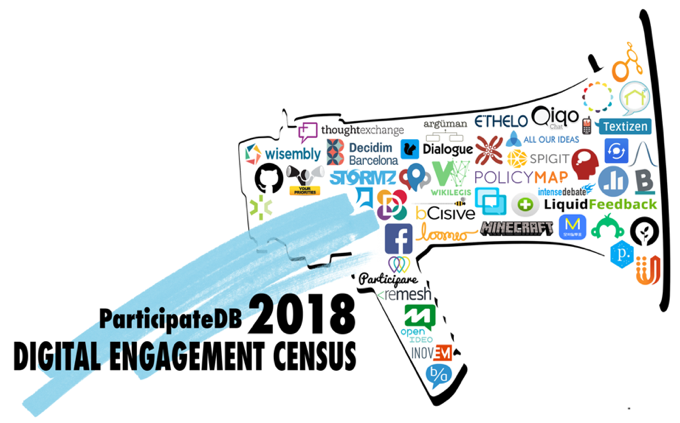
Shared with us by NCDD member, Tim Bonnemann on our Main Discussion listserv, the ParticipateDB 2018 Digital Engagement Census deadline has been extended until this coming Monday, February 26th. The survey, hosted by several international partner organizations, seeks to identify the digital engagement tools that people have been using and for folks to provide feedback on their experience using the tools. You can read more about the survey in the post below or find the original on ParticipateDB’s site here.


ParticipateDB 2018 Digital Engagement Census

Today, after extensive prep work since we first floated the idea back in 2016, we are excited to launch the ParticipateDB 2018 Digital Engagement Census, a global practitioner survey aimed at improving our understanding of how technology is shaping community engagement today.

Over the next ten days, we hope to hear from people working in community engagement and public participation in places all around the world to answer two basic questions:

  • Which digital engagement tools or services have you used in your work lately?
  • What were your experiences and lessons learned?

Respondents who leave us their contact information will:

  • be among first to get their hands on the interim report (to be issued later this month),
  • receive an invitation to our exclusive follow-up event, and
  • receive an electronic copy of the final report free of charge (to be issued later in March).

We are exceptionally pleased to be partnering with a group of renowned international organizations and practitioner networks in this field. This project wouldn’t be possible without their support and guidance. Thank you!

Please head to the project page for more details. When you get a chance, please take a few minutes to complete the online survey and share it with your colleagues near and far: ParticipateDB 2018 Digital Engagement Census

You can find the original version of this article at http://blog.participatedb.com/2018/02/09/welcome-to-the-participatedb-2018-digital-engagement-census/.

Get Involved in the National Week of Conversation

We’re excited announce the upcoming National Week of Conversation (NWOC), which is taking place this April 20-28.

The National Week of Conversation is designed to:

  • Turn the tide of rising rancor and deepening division
  • Begin mending the frayed fabric of America by bridging divides
  • Bring people together again–from ‘us vs. them’ to ‘me and you’
  • Build relationships by listening first to understand the other

NCDD took part in the initial planning meeting for this project last October, which was convened by the Bridge Alliance and sponsored by the Chicago Community Trust, and we’re excited to continue supporting it and hopefully mobilize many in our community to get involved!

Organizations coast to coast can host an event or activity, share NWOC with their members, build public awareness through press and social media, recruit others and more. You do not want to miss out on this landmark event, for America and for the growth of this movement — so please complete the Partner Sign-up Form today!

Here are a few things that are ALREADY in the works for NWOC:

  • April 20: The Village Square will be hosting Jefferson Dinners in Charlottesville, VA at which diverse groups will enjoy enriching conversation on topics of their choice.
  • April 21: Listen First Project will be hosting Listen First in Charlottesville to support the progress of healing and reconciliation in Charlottesville with a number of local and national influencers.
  • April 20-22: bridgeUSA and Future 500 will be co-hosting the Bridge Summit in Dallas, Texas that will bring together groups and people to advance a national movement.
  • Throughout the week, large libraries such as the Boston Public Library and Kansas City Public Library as well as small public libraries and schools will bring conversation programs to people across the country.

NCDD will work with our members offer in-person facilitation at some libraries.
Mismatch will assist online conversations between people with different backgrounds.
There will be “take-home” options such as Living Room Conversations and Civic Dinners from the library events.
– AllSides for Schools will help teachers and classrooms participate.

Email NWOC@BridgeAlliance.US with any questions you may have.

NCDD at Innovations in Participatory Democracy Conference

We are thrilled to let folks know that NCDD staff, Courtney Breese and I will be at the Innovations in Participatory Democracy Conference, which is happening on March 8th – 10th in the Phoenix area. This conference will be a fantastic opportunity to learn about the top innovations in civic engagement and democracy, and to network with leaders in the field doing this powerful work.

We are especially excited to announce we will be presenting a session in collaboration with two fellow NCDD members: Cassandra Hemphill of the IAP2 Federation and adjunct faculty at Missoula College of the University of Montana, as well as, Annie Rappeport of the University of Maryland where she serves as a PhD Student and Research Assistant. In this interactive workshop, we will use art to explore participants’ individual connections to participatory democracy, what led us to our work on improving our democracy, and what each of us offer to the field. We’ll explore how we are connected in our communities and how we might connect with others to strengthen participatory democracy. If you are attending IPD, we hope you will join us for our session during Block 1 on Thursday, March 8th from 3-4:30pm.

While we are in town, we would love to meet up with NCDDers in the area (and those attending the conference)! We are working to identify a location that could accommodate a meetup on Friday night (March 9th) after the IPD events that evening. If you are in town on the 9th and would like to join us, send Courtney an email at courtney[at]ncdd[dot]org and we’ll keep you in the loop as we firm up our plans!

IPD is being hosted by NCDD member organizations – the Participatory Budgeting Project and the Jefferson Center, as well as, the Center for the Future of Arizona, the Katal Center, the Participatory Governance Initiative at Arizona State University, Phoenix Union High School District, and the Policy Jury Group. If you’ve never been to a conference hosted by PBP and these fine organizations, you are in for a special treat! Tickets go up February 28th – so make sure you get yours ASAP.

There are several pre-conference trainings planned for Wednesday, March 7th, like a training on participatory budgeting (PB) hosted by the Participatory Budgeting Project, or a training on citizen juries, citizen assemblies, sortition, and more hosted by the Jefferson Center and the Policy Jury Group. Click here to learn more and register for these pre-conference trainings, and to see the full IPD conference schedule.

Remember to keep an eye out for Courtney and I if you are attending the conference because we would love to see you!

NIFI Deliberation Day Coming up Monday, February 19th

NCDD member org – the National Issues Forums Institute, will be hosting Deliberation Day on Monday February 19th, where folks will have five back-to-back opportunities to participate in an online deliberative forum on immigration. Participants will have a chance to use NIFI’s Common Ground for Action online forum, where the results will then be part of A Public Voice 2018; an annual event hosted by Kettering Foundation and NIFI that bring Congressional and agency staffers together in a working meeting to discuss results from the deliberative forums (learn about APV 2017 here). NIFI is offering complimentary copies of their issue guide, Coming to America, before April 11th and have a free recorded webinar available on moderating these deliberative forums. We encourage you to read the announcement below or you can find the original here.


Join Us for Deliberation Day – Monday, February 19, 2018

Five Back-to-Back Online Forums about Immigration

Moderators and conveners around the country are planning and holding public deliberative forums about the issue of immigration to help kick off the 2018 A Public Voice forum series. At least 40 forums are already being scheduled, and more are in the works. A notable feature of this year’s forums, Deliberation Day, scheduled for Monday, February 19th, will include five, back-to-back Common Ground for Action online forums.

You are invited to choose a time that works best for you and participate in one of the online forums on February 19th. And you can help by sharing this invitation and the registration links below with your friends, family, and communities. All forums will use the brand-new Coming to America: Who Should We Welcome, What Should We Do? issue framework.

All forums will be held on Monday, February 19th (Presidents’ Day)

Click on a link to register:

Forum 1: 10:00 am – 12:00 pm EST
Forum 2: 1:00 pm – 3:00 pm EST
Forum 3:  3:30 pm – 5:30 pm EST
Forum 4:  6:30 pm –   8:30 pm EST
Forum 5:  9:00 pm – 11:00 pm EST

If You’re Planning to Hold a Forum – FREE Materials Offer

For a limited time, the National Issues Forums Institute (NIFI) is offering complimentary sets of 20 Coming to America issue guides and questionnaires to conveners holding forums before April 1, 2018. Click here or contact Darla Minnich at dminnich@nifi.org to sign up to receive your free materials.

Please let us know about your forums. When you’ve scheduled your forum (either before or after April 1, 2018), please let us know about it by posting your information on the NIFI web site in the Events section. You must log in to submit an event; or send your forum details (contact name and email address, date, time, location, city, state, zip code) to Patty Dineen at dineenp@msn.com.

Watch a Webinar about Moderating Coming to America Forums

On January 30, 2018, Kara Dillard presented a one-hour webinar about convening and moderating forums using the new National Issues Forums Institute (NIFI) issue guide titled, Coming to America: Who Should We Welcome, What Should We Do? The webinar, Moderating the Coming to America Deliberative Forums, was recorded and has been archived. Click here to watch the webinar.

You can find the original version of this blog post from NIFI at http://conta.cc/2G94kX4.

Attend the 2018 IAP2 USA Skills Symposium in Austin, Texas

Are you looking to brush up on your IAP2 skills or really want to dive deep into learning public participation tools and techniques? We wanted to give folks in our network a heads up about the 2018 IAP2 USA Skills Symposium hosted by NCDD member org IAP2, happening in Austin from February 26 – March 2. This will be a great chance to take some of the classic courses from IAP2, as well as, several more recent training opportunities which you can read about below. They will also be hosting a National Dialogue event on February 28th exploring “How and why should the public be engaged in highly technical and complex projects?”. You can read the announcement below and find more information on the IAP2 site here.


Join us at the 2018 IAP2 USA Skills Symposium in Austin, Texas!

You’re invited! This year’s IAP2 USA Skills Symposium will feature a wide range of courses of varying duration and topics exploring skills, tools, and techniques that support effective public participation. This training will be undertaken in a rich learning environment, with activities building a creative and supportive space for participants whether they spend a day or the week at the event!

We will also be hosting a National Dialogue event on February 28, 2018 at the University of Texas at Austin talking about “How and why should the public be engaged in highly technical and complex projects?” See attached flyer for more details or register now!

Courses include but are not limited to…

Social Media And P2: How to design and host effective online engagement –  We know that online tools reach new participants and enable different kinds of conversation. But, it’s an emerging field and there is still much trial and error, so this course will give you a leg up by examining what’s worked and what’s failed. This interactive course will teach you to create social media campaigns that gather input creatively, enable collaborative online interactions, and sustain participation over time. You’ll also learn how to use social media for participant recruitment, and how to integrate mobile communication into your participation strategy. Bring your computer; this course gives you an opportunity to experience both the host and participant sides of online participation.

Evaluating & Measuring P2 – Evaluation should always be useful, and this introductory course will cover theories and practical strategies to help you evaluate your public participation efforts. In this hands-on course, you will apply foundational tools like logic models, examine the differences between process and impact evaluation, and review the components of an evaluation plan. You will craft evaluation questions, and identify indicators and sources of information to help you answer those questions. Overall, you will learn how to employ evaluative thinking as a learning strategy, in order to strengthen your work and achieve greater impact.

When Things Go Sideways: How to embrace emotion & outrage, and change results – Building on EOP2 (but not a pre-requisite) this highly participatory course will have participants uncover what’s driving emotion and outrage in P2 processes and discover what triggers these natural responses. Through exercises, discussion and multi-media presentation, participants will learn about AND PRACTICE highly effective, collaborative strategies to transform conflict and outrage and create an environment for constructive engagement.

Toolz For Tough Conversations – This conflict de-escalation and civil discourse training program prepares individuals, organizations, and communities for difficult discussions, cross-sector deliberations and collaborative decision-making. The unique, multi-track engagement framework, body-based mindfulness strategies, and powerful conflict communication skills are useful throughout all phases of creating dynamic, inclusive, community engagement programs. This highly-experiential training demonstrates mindfulness strategies and provides time to apply key concepts in all phases of project design: scoping, invitation, implementation, evaluation, and continuous improvement and shared leadership.

That’s not all! See our online Schedule to about the other courses that we have to offer! Spaces are limited. Check out our website for more information.

Courses are offered at $300/person/day for IAP2 members and $375/person/day for non-members with the following exceptions: IAP2 Foundations and “Strategies for Dealing with Opposition & Outrage in P2” courses are offered at $350/person/day for IAP2 members and $425/person/day for non-members. There will be a special rate for full-time students, see the website. The daily rate includes mid-morning beverages and lunch.

We hope to see you in Austin! Feel free to email us at info@iap2usa.org.

You can find this information on the IAP2 site at www.iap2usa.org/2018symposium.

NCDD Orgs Team up for Utah Civic Engagement Fellowship

For Utah folks in our network, there is an exciting endeavor underway that we wanted to share with you! Several NCDD member orgs – Essential Partners, Village Square, and Living Room Conversations – in partnership with Salt Lake Civil Network and Utah Humanities, have teamed for a year-long Civic Engagement Fellowship, with a focus on further building Utah as a hub for civil discourse. The fellowship will kick off with two-day training in dialogue facilitation by Essential Partners on March 2 & 3, then the following year will be dedicated to designing and implementing a civic engagement plan and facilitating civil dialogues. The deadline to apply is February 23rd, so make sure you apply ASAP! We encourage you to read the announcement below or find the original on EP’s site here.


Announcing the Utah Civic Engagement Fellowship

In partnership with Village SquareLiving Room ConversationsSalt Lake Civil Network, and Utah Humanities, we are building a statewide network in Utah for citizens seeking to become skilled leaders in designing and facilitating civil dialogues in their communities.

The year-long Civic Engagement Fellowship for Utah begins with a comprehensive two-day training in dialogue facilitation, provided by Essential Partners, from March 2-3 in Salt Lake City (venue TBD). Over the following year, Fellows will be connected to a larger collective impact initiative focused specifically on Utah as an ideal hub for shifting the culture of civic discourse. With support from skilled practitioners and a network of other trainees, Fellows will develop and implement community engagement plans centered on civil, connective dialogues.

To apply, please complete and submit the form at this link by no later than February 23, 2018.

About the 2-day Fellowship Training:

The Fellowship builds on a foundational two-day comprehensive training, Facilitating Dialogue Across Divides, provided by Essential Partners.

Are you witnessing an increase in divisiveness in your community? Do you see the need for us to talk across our divides? Do you want to be able to help your community have the difficult conversations it needs to have to move forward together? Facilitating Dialogue Across Divides is designed to help you build skills to facilitate tough conversations, whether in your daily life or in formal dialogues. This workshop is intended to be an introductory workshop for those new to facilitation, or to Essential Partners’ model.

Community is an act of courage. We believe that behind every belief is a person with a story. 27 years ago, Essential Partners created a unique approach to dialogue that promotes connection and curiosity between those who see one another as enemies. Our approach, Reflective Structure Dialogue (RSD), has transformed conflicts across the country and the world, and is widely applicable to the vital conversations that communities need to have to do the work they need to do. An intentional communication process can help individuals, groups, and communities rebuild trust, enhance resilience, address challenging issues, and have constructive conversations with people from different perspectives or those they otherwise would avoid or fight with.

Beginning with this training, Fellows will embark on a rigorous program to cultivate facilitation skills through practice and direct engagement of their communities in Utah.

Benefits of Fellowship:

  • Two-day training in facilitating civic dialogues
  • Monthly webinars and support gatherings
  • Updates about opportunities to facilitate
  • One-on-one coaching for community projects
  • Training for facilitating Village Square forums and smaller Living Room Conversations

Fellowship requirements:

We encourage candidates to come with a connection to a community, institution, or group in which they could use these skills. Because this work involves collaboration, we strongly encourage candidates to apply with partners, working together to help facilitate conversations. We can help pair people who do not have partners. Teams may be as large as 4. Call with questions.

This Fellowship requires:

  • Training completion and monthly webinars
  • Design/execution of a plan for using this work in each team’s home community or group
  • Facilitating at least one civic dialogue
  • Participating in a Village Square event
  • Hosting a Living Room Conversation
  • Supporting other Fellows in their work
  • A refundable $100/person deposit

Skills taught in the training:

  • Designing & structuring conversations for civic engagement: focusing on curiosity, community, and connection across difference
  • Achieving clarity of purpose & expectations
  • Utilizing agreements, structures, preparation, and inquiry
  • Practicing competence and confidence in facilitating through challenging moments

As a result of training, Fellows will be able to:

  • Create a context for people to communicate with self-confidence about difficult or divisive topics
  • Break destructive communication habits (e.g., avoidance, silence, or reactive responses, enabling people to feel heard
  • Design conversations, dialogues, or meetings with clear purpose, full participation, and a structure for moving forward together
  • Introduce a dialogue circle
  • Intervene to support a group through rough spots

Who might be a Fellow?

  • Community or nonprofit leaders, clergy
  • Gov’t officials seeking to drive collaboration
  • School administrators, professors, teachers
  • Directors of community engagement, diversity, and inclusion

To learn more about the Fellowship (application, requirements, program elements and expectations), please download the program description here.

You can find the original announcement on Essential Partner’s site at www.whatisessential.org/utah