Evolving Infogagement for More Democratic Public Life

As technology and the needs of our society continue to evolve, the ways in which we engage each other and utilize information when participating in public life will also continue to change. The paper, Infogagment: Citizenship and Democracy in the Age of Connection, written by NCDDer Matt Leighninger in collaboration with Philanthropy for Active Civic Engagement (PACE), was recently re-released to reflect the ways in which these changes are shaping. We encourage you to read more in the post below and find the full original report on PACE’s Medium site here.


Infogagement: Citizenship and Democracy in the Age of Connection

PACE LogoTable of Contents

Executive Summary

Our traditional notions about the “public square” are out of date. In thinking about information, engagement, and public life, we have generally put information first: people need to be educated, and then they will become politically involved (the original title of this PACE project was, accordingly, “Information for Engagement”). But as we interviewed leading thinkers and practitioners in the fields of journalism, civic technology, and public engagement, it became clear that the sources of information and the possibilities for engagement have diversified dramatically. Instead of a linear progression from education to involvement, public life seems to seethe and spark with connections and reactions that are often unexpected and always hard to map. Our Norman Rockwell image of public life has become something more like a Jackson Pollock painting.

Another question animating this PACE project was how to bring “new voices” — meaning young people, poor people, recent immigrants, and people of color — into the public square. But because public officials, journalists, technologists, and citizens (both new voices and established ones) are playing different roles, and interacting in different ways, this too is a more complex question than it first appears. The real challenge is figuring out what the new public squares might look like, how they can be equitable and democratic places, and how they should be built.

Through interviews and small-group discussions, we have identified and clarified a number of key trends:

  • Thinking of citizens mainly as voters, volunteers, and writers of letters to the editor is no longer sufficient. Civic engagement has changed radically over the last twenty years, spooling out into thick and thin strands of participation. “Thick” engagement happens mainly in groups, either face-to-face, online, or both, and features various forms of dialogue, deliberation, and action planning; “thin” engagement happens mainly online, and is easier, faster, and potentially more viral — it is done by individuals, who are often motivated by feeling a part of some larger movement or cause.
  • The institutions of journalism are going through a painful transition period, but new collaborative practices, “hyperlocal” innovations, and engagement activities (including the use of engagement as a revenue source) may be signaling the rebirth of the field. Meanwhile, in their profession, journalists are employing a greater range of skills and playing a wider range of roles.
  • Despite the early optimism, the new Internet-connected world of information and engagement has not (so far) been a more equitable and empowering environment for people of color, low-income people, and other marginalized groups. Addressing this challenge will require a better understanding of community networks, how they map cultural differences, and how they channel information and engagement.
  • Storytelling is more powerful and ubiquitous than ever: a much higher percentage of people can share their opinions and experiences, and hear the opinions and experiences of others, in ways that are more convenient, continuous, and public. By comparing notes on what we mean by storytelling — and listening — we might come to a better, shared understanding of why people want to take part in public life, and better recommendations for how to facilitate and support their efforts.
  • Big data, once the domain of experts, is now part of the public engagement picture. The opportunities and challenges of big data may require a set of intermediaries — people and organizations that can curate and interpret data for everyday citizens. The future of big data may depend less on the skill and expertise of these intermediaries, and more on whether citizens trust them.

In the past, discussions of information and engagement revolved around the wrong questions. “I’m pretty tired of the ‘How do we save newspapers?’ discussion, as well as the ‘What’s the latest techno gizmo that will save the world?’ discussion,” says Jon Funabiki, a journalism professor who directs the Renaissance Journalism center at San Francisco State. It doesn’t seem sensible or compelling to ask how we can bring back the past in the newspaper industry, or how we can realize an unrealistic future with technology.

Furthermore, we can’t keep thinking of the public square as a place that is dominated by civic professionals, where citizens occupy a limited set of predictable roles. That vision, which originated with Progressive thinkers like John Dewey, is no longer viable. To help communities build new public squares, we should focus on four questions:

1. What kinds of infogagement infrastructure and institutions at the community level would support the best flow of news, information, and engagement?

2. How can such an infrastructure support a high level of democratic engagement across the community, especially for people who have borne the brunt of past injustices and inequalities?

3. What should be the complementary, constructive, yet independent roles of journalists, public officials, and technologists?

4. What are the core democratic skills needed by people in each of these professions, and how can we provide them?
You can find the original version of this on the Medium site for Philanthropy for Active Civic Engagement (PACE) at www.medium.com/infogagement/infogagement-citizenship-and-democracy-in-the-age-of-connection-cdf849610381.

Dig into this Democracy Summer Reading List

Now that summer is in full swing, we are hoping folks are getting some down time to enjoy the season. Whether you are relaxing or needing a break from work, check out this summer reading list gathered by Democracy Works, a podcast created by NCDD member org, the McCourtney Institute at Penn State. Let us know in the comments if you are reading any of these and please let us know your recommendations for books on democracy, dialogue, deliberation, and/or public engagement! You can read the article below and find the original version on the Democracy Works site here.


Season 1 finale: A democracy summer reading list

Ah, summer. Time to kick back and relax with a good book or two.If you’ve been to a book store or the library lately, then you’ve probably seen at least a few books on democracy on the shelves. The 2016 presidential election spurred a lot of conversation about the current state of our democracy and where things go from here. These books are not what most people would call beach reading, but they are important to understanding what’s happening in the U.S. and around the world right now.

We know you probably don’t have time to read all of them. Hopefully this episode will help you choose one or two to tackle this summer. Here’s the rundown of the books we discuss:

And here are a few others\ we recommend but didn’t have time to discuss in this episode:

Thank you to everyone who supported us on the first season of Democracy Works. Season two will begin in mid-August with a look at Confederate monuments and public memory on the anniversary of last summer’s riots in Charlottesville.

You can find the original version of this article on Democracy Works site at www.democracyworkspodcast.com/2018/07/09/season-1-finale-a-democracy-summer-reading-list/.

Ensuring Engagement is Inclusive and Fair

In order to have engagement that is fair and equitable to all members of society, it is vital to be intentional when designing and facilitating those processes by asking, “who shows up?”. NCDD member org the Participatory Budgeting Project recently shared this article on how to make PB inclusive and fair, and there are some great tips to keep in mind for all our work. We encourage you to read the post below and find the original on PBP’s site here.


Making PB Inclusive and Fair

Typically, when we want to know how inclusive and fair a Participatory Budgeting (PB) process is, we ask “Who shows up?” While this is a good starting point, it’s not enough. To meaningfully assess equity, we need to dig deeper.

Celina Su, Chair of Urban Studies at the City University of New York (CUNY) and Frankie Mercedes, former Communications Strategist with the Participatory Budgeting Project (PBP), joined forces to lead a stellar PBP Network Study Session, which addressed issues of equity and fairness in PB.

This blog post reviews the main points of their conversation, identifies common barriers to equal participation in PB, and suggests how to make PB more accessible to people with low incomes and to people of color.

“Who shows up?”

Public Agenda’s report on PB in North America found that during the PB vote, “In nearly all communities, black residents were overrepresented or represented proportionally to the local census among voter survey respondents.” In contrast, PBP’s internal evaluation data shows that white people, people with high or moderate incomes, and people with advanced degrees tend to be overrepresented in the steering committee and budget delegate role. The populations in the second group tend to have more time, flexibility, and financial security—factors that make them more likely to participate in more intensive aspects of PB.

To create truly inclusive PB processes, low-income residents and people of color must be well represented on the steering committee and as budget delegates. The steering committee sets the rules for a PB process, and these rules ensure an inclusive and fair process. When low-income people and people of color are not in the room, steering committees miss valuable ideas on how to create a fair process.
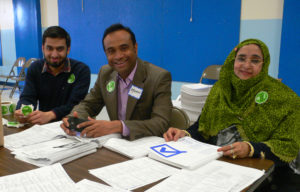
Here’s how you can make sure everyone shows up:

  • Publicize and do outreach for all phases of the PB process—not just for idea collection and the vote.
  • Provide 2-way transit fare for people who’ve identified need.
  • Offer free, on-site childcare and food at PB events to boost engagement of women, parents, and low-income residents.
  • Consider the location of PB events—Fancy venues or gentrified areas in a city may feel unwelcoming to some. Switch up the location of PB events to make sure that everyone feels welcome and feels ownership of their PB process.

“Who gets heard?”

Celina Su interviewed several PB participants about their experience in PBNYC, and she saw a pattern. People of color and people with low incomes felt that the PB process was frustrating and unfair. Highly organized groups, like parent-teacher associations from high-income neighborhoods, had a set agenda and dominated the budget delegate process.

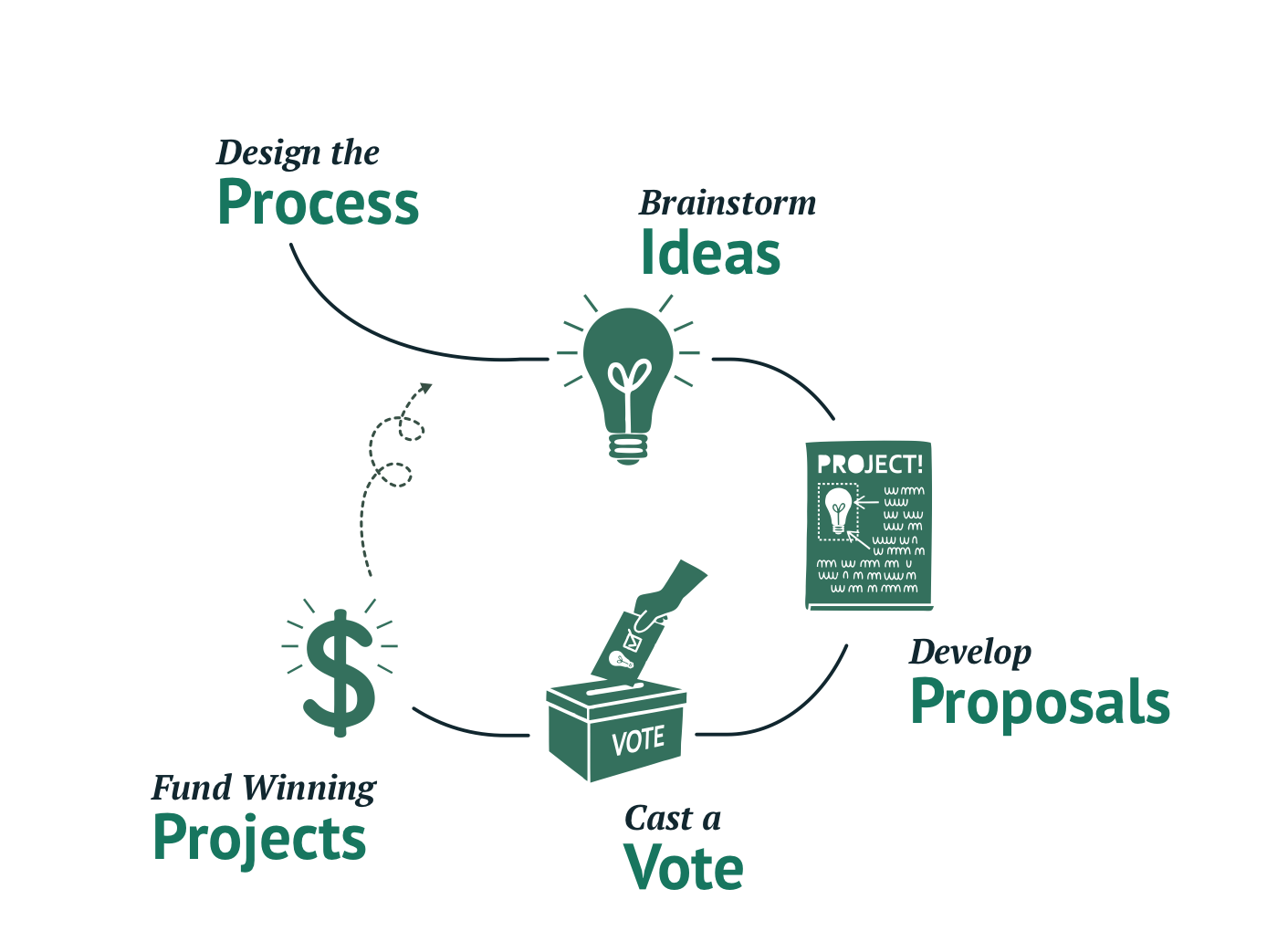
The budget delegate stage is a very important part of PB. As volunteers, budget delegates select ideas from the idea collection phase and turn them into proposals that PB participants vote on. While residents can voice any priority during the idea collection phase, budget delegates work with staff to determine which ideas are eligible for PB funding.

In many cases, PB funding comes from an elected official’s capital budget. This means that a PB proposal has to be a capital project in order it to be eligible for funding. A capital project is a physical purchase (e.g. computer), construction, or renovation (e.g. a building).

When residents think about what their community needs, they may not think of physical infrastructure; they might think of training, programs, or other non-physical investments. Residents may struggle to think of physical changes that can address their community’s most pressing needs—like quality education and job access. And, because low-income residents and people of color are often underrepresented as budget delegates, they don’t have the same opportunities to pick ideas and tweak non-eligible ideas so that they fit into PB’s rules. This is why projects that benefit marginalized communities can fall off the table during the budget delegate phase.

During Celina’s interviews, residents also said it was intimidating to talk with elected officials and city staff. Many people don’t have experience talking with elected officials or speaking in the language of government and law. Without sufficient support mechanisms, this imbalance fosters an environment that privileges those with more education and knowledge of government and law.

Here’s how you can make sure that everyone’s voice is heard:

  • Pay budget delegates and steering committee members

People who have the time and extra cash to volunteer tend to be of mid to high socioeconomic status. Paying residents for their time will incentivize people of all income backgrounds to participate in the time and energy intensive aspects of the PB process.

  • Provide space for in-group deliberation

In-group deliberation gives residents from similar backgrounds (e.g. public housing, immigrant, age group, etc.) the opportunity to discuss, solidify and agree on priorities. For example, non-English single language meetings have been very successful.

  • Offer training for government representatives

Government representatives should make themselves open and available to their community. Simple changes in tone and body language can mean the difference between intimidating residents and engaging them.
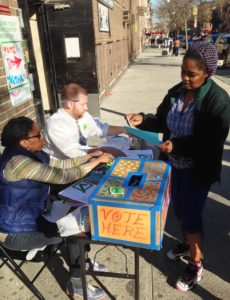
  • Bring in facilitators

Facilitators can help participants shape and develop their ideas and to ensure that certain groups don’t dominate speaking time.

“How does PB interact with society and government institutions?”

In her research on inclusion and PB in New York City, Celina notes that surveillance cameras are among the most popular projects in PBNYC. According to her report, they have “won funding every year so far.”

Celina sought to find out why cameras were so popular among NYC residents. She found that residents who wanted security cameras envisioned the cameras as part of a much broader program of public safety. Some residents’ vision of community safety included “greater police accountability and economic support as well as surveillance, and they crucially included bottom-up accountability and access to… [the video footage] captured by cameras.” But some residents were not aware that the New York City Police Department does not routinely make surveillance footage available to the public. On top of that, the economic and jobs programs that residents wanted did not qualify as capital projects and were therefore ineligible for PB funding. By the time PB voting began, NYPD-controlled surveillance cameras were the only thing left of residents’ vision for community safety.

Here’s some tips to equalize benefits from PB:

  • Make equity and inclusion an explicit goal of the PB process

PB is about making communities stronger and more civically engaged. PB participants want to help make that goal a reality. When PB leaders encourage participants to center equity, they create an environment where participants actively consider the needs of other residents.

  • Find or create a district profile

A district profile should describe the most important aspects of a community (e.g. educational achievement, income, ethnic composition). This will help residents identify what is going well in the district and locate areas for improvement. PBP’s list of community resources called Data for the People is a great starting point for gathering information about your community, as is the new tool developed by PBP, myPB.community.

  • Let participants know how government agencies implement PB projects

Some residents told Celina that they would not have voted for surveillance cameras had they known that the community would not have had control over the footage. It’s critical that PB participants understand the ramifications of what they are voting for so that they can make an informed decision.

As a tool, PB is susceptible to the same challenges faced by any other civic process. However, because it’s flexible and includes community involvement at high levels, PB leaders and residents have the opportunity to design a PB process that’s both inclusive and fair.

Want more info on PB and Inclusion? You can find more resources below:

Report: Celina Su’s Research on Inclusion in PB

PB Study Session: Equity and Inclusion in PB (Video)

PB Community Tools: Data for the People

PB Tool: Outreach Toolkit

PB Study Session: Budget Delegates (Video)

Report: Celina Su’s Research on PB

Blog Post: Black Power through Participatory Budgeting

You can find the original version of this post on the Participatory Budgeting Project’s site at www.participatorybudgeting.org/making-pb-inclusive-and-fair/.

DMC Hosts Third Annual Civic Institute on August 17th

The third annual Civic Institute is happening Friday, August 17th, hosted by NCDD member org the David Mathews Center for Civic Life. This will be one of the premier events dedicated to strengthening civic life in Alabama and will be a fantastic opportunity for those doing civic engagement work throughout the state.  DMC recently announced the session line up which you can read more below and on the DMC’s site here.


2018 Civic Institute: Be Together Differently

We’ve added new sessions to our third annual Civic Institute! Please join us Friday, August 17, for some deep conversations on strengthening civic life in Alabama – not for a day, but for the duration.

Each year, our hope at the Civic Institute is that Alabamians doing good, sustainable work in their neighborhoods and hometowns connect with each other in new ways. Every place has a unique story and faces a distinct set of challenges, yet across the state, the Mathews Center sees increasingly that Alabama residents and civic leaders often face similar issues. Through Alabama Issues Forums we see that when people desire to address an issue they all face – rather than politics or personalities – deliberative conversations can be especially suited for the uncommon and transformative experience of working together across difference. Wicked problems don’t tend to disappear overnight, and so the everyday habit of talking with each other as citizens – not circling issues, but working towards creating solutions we can all live with – often proves to be, simultaneously, one of the most effective and the most accessible approaches to sustainable community development.

At this year’s Civic Institute, we hope to find deeper ways to support Alabamians practicing such fundamental aspects of democracy as having sustained conversations on difficult issues, practicing innovations in journalism, bringing underrepresented groups to the table, and recognizing the potential each individual holds to make their communities better for everyone. More than ever, this year, we seek to continue modeling our call to listen first and to “pass the mic” by highlighting the following speakers and topics:

The Elephant in the Room: Talking About Difficult Issues: Talking about challenging issues in a divided political climate is hard. Listening to those we disagree with is difficult. Finding opportunities to bridge divides and discuss the “elephants in the room” in a productive, civil manner that prioritizes understanding over consensus is even more challenging. During this interactive session, learn from Alabama communities that are engaging citizens in deliberation on some of the most divisive public issues facing communities today. Discover tools and resources you can use to tackle the issues facing your community. Chris McCauley of Markstein will moderate; additional speaker details are forthcoming. This session is made possible by a generous donation from The Blackburn Institute at the University of Alabama.

“Public life is bigger than political life. We have narrowly equated the two in recent years, and we’ve impoverished ourselves in the process. Public life includes all of our disciplines and endeavors, including ourselves as citizens and professional people and neighbors and parents and friends. The places we’ve looked for leadership and modeling have become some of the most broken in our midst. And so it is up to us, where we live, to start having the conversations we want to be hearing and creating the realities we want to inhabit.”

– Krista Tippet, On Being

Who Remembers? Collective Memory and Public Life: The issue of monuments and memorials in public spaces divides communities around the nation, and people of goodwill on all sides of the issue struggle to hear each other productively.  In this facilitated discussion, participants will discuss what concerns them the most regarding this issue and whether they can imagine opportunities for deliberation within their communities and networks. This session will be moderated by Dr. Mark Wilson, Director of the Caroline Marshall Draughon Center for the Arts and Humanities at Auburn University. Our thanks to the Alabama Bicentennial Commission for generously sponsoring this session.

“A community is the mental and spiritual condition of knowing that the place is shared, and that the people who share the place define and limit the possibilities of each other’s lives. It is the knowledge that people have of each other, their concern for each other, their trust in each other, the freedom with which they come and go among themselves.”

– Wendell Berry

The Front Doors of Fellowship: Engaging with Difference Through Faith: What is the role of faith communities in public life? What do we find at the intersection of faith and civic engagement? How can we cultivate the physical and conceptual spaces that houses of worship occupy, in order to bring people together in new ways that connect our individual experiences and our rich inner lives with the work that we must all do, collectively, as a public? Faith communities, for many Alabamians, not only feed the spiritual life, they also serve as a hub of community life. This session will focus on stories, challenges, and opportunities in bringing faith communities together across divides to address key issues and challenges facing our hometowns and our state.

“The power of belonging creates and undoes us both; if spirituality does not speak to this power, then it speaks to little.”

-Pádraig Ó Tuama, Irish Theologian

Urban Perspectives on Civic Engagement in Alabama: The University of Alabama at Birmingham’s Woodlawn Project and Spring Hill College’s Foley Fellowship in Civic Leadership are experiential learning opportunities that seek to work alongside neighboring communities to better understand and address the complex effects that poverty and other related disparities have on their quality of life. The effectiveness of each project is rooted in its being tailored to fit the particular contexts in which each institution operates. Attendees of this session will take part in a dialogue that compares and contrasts the unique challenges, approaches, and learning outcomes that these programs have yielded working with community partners in urban contexts on opposite sides of the state.

“As we internalize the view of others, we change. And as our perception of others changes, we see possibilities for acting together that we didn’t see before.”

-Dr. David Mathews

Who’s Not At the Table? Engaging Youth in Civic Deserts: Over the past decade, civic engagement and volunteering rates among young Americans have declined across race, income, and education levels. However, youth and young adults living in “civic deserts” are disproportionately represented among the disengaged.  Civic deserts are communities that lack adequate opportunities for young people to learn about and participate in civic and political life. Over 40% of American youth and young adults live in “civic deserts.” In rural areas, the percentage of young people living in civic deserts climbs to nearly 60%. Youth in civic deserts are less engaged in politics, are less likely to vote in elections, and are less likely to believe in the influence of their own voice and the collective potential of their community. While the statistics can be harrowing, there are leaders, educators, and organizers across Alabama who are working to revive youth engagement within rural and urban civic deserts. By capitalizing on the assets within their community to create leadership opportunities, mentorship programs, career training, and youth programming, the guest speakers in our Engaging the Disengaged: Youth in Civic Deserts session are creating innovative avenues for youth engagement. This session is made possible thanks to the generous sponsorship of Alabama Public Television.

Passing the Mic: Representation & Empathy in Civic Media: The digital disruption of traditional news and media outlets has become an accepted, albeit cliche, archetype for the twenty-first century. The fourth estate that so many Americans revered throughout our history has been faced with growing distrust, diminished resources, and has struggled to translate its traditional structure and function into an increasingly viral model of news and journalism. At the same time, digital technologies have enabled millions to tell their own stories in a way that is diffuse, yet direct.

The rise of citizen journalism and social media has emerged as a critical component of what we today characterize as “civic media.” The centuries-long interpolation of citizen and journalist is newly-malleable, and calls for a radical reconceptualization of the citizen-journalist relationship. “I just want to be a voice for the voiceless,” is a refrain that is increasingly unable to bear the complex weight of citizens ready to speak for themselves. Why be a voice for the voiceless when you could just pass the mic?

This session will explore ways of passing the mic and equipping others to tell their own story through digital media as well as traditional journalistic outlets. From Twitter to the town square, we will consider examples of intergenerational cooperation amongst communities, local professors, and their students, as they reimagine what community journalism and self-representation can accomplish in our time.

To register, visit 2018civicinstitute.eventbrite.com. Please contact Rebecca Cleveland at rcleveland@mathewscenter.org if the cost of attending presents a burden; we have some scholarships available. To become a sponsor, contact Cristin Brawner at cfoster@mathewscenter.org. 

 You can find the original version of this announcement on the David Mathews Center blog at www.mathewscenter.org/2018-civic-institute-sessions/.

NIFI Common Ground for Action Events This Summer

NCDD member org, the National Issues Forums Institute, has several events and opportunities coming up this summer for their online platform, Common Ground for Action (CGA), that we wanted to share with the network. In July, there are CGA open practice sessions and several forum series events around the issues guides: Shaping Our Future, Coming to America, and The Changing World of Work. On August 15th, there is a CGA New Moderator Training Workshop for educators, which will be hosted by NCDD member Kara Dillard. We encourage you to read about the events below and find them on NIFI’s site here.


Upcoming Common Ground for Action Forums

KF and NIFI are convening four open Common Ground for Action forums in July— these are great opportunities to share with people you’d like to experience a deliberative forum: teachers who might want to use deliberation in the classroom, partners on an issue who are new to forums, all kinds of folks!  Please share this post widely with your networks and on social media!

Register below to participate in any of the following CGA forums!

“Shaping Our Future: How Should Higher Education Help Us Create the Society We Want?”
Monday,  July 9th | 7pm EST/4p PDT I REGISTER

“Coming to America: Who Should We Welcome, What Should We Do?”
Saturday July 14th |  7pm EST/4p PDT I REGISTER

“The Changing World of Work: What Should We Ask of Higher Education?”
Wednesday,  July 18th |  3p EST/12p PDT I REGISTER

“Coming to America: Who Should We Welcome, What Should We Do?”
Friday July 27th |  11am EST/8a PDT I REGISTER

Also, if you have been trained to moderate a CGA forum but are looking for chances to practice, please check out the following open practice sessions:

Wednesday July 11 | 3-5p EST | PRACTICE

Wednesday July 25th | 3-5p EST | PRACTICE

And lastly, our CGA Moderator Training Specialist, Kara Dillard, also keeps “office hours” every Friday at 3:30 pm ET/12:30 PT. Have questions about using CGA in the classroom, or remembering how to use the Gala function, or want to draft a moderator to help out with a big forum event? Register here, or just email Kara anytime!

August 2018 CGA New Moderator Training Workshop for Educators
Wednesday Aug 15th |  12pm EST/9a PDT | REGISTER

You can find the original version of this announcement on the National Issues Forums Institute’s blog at www.nifi.org/en/july-cga.

Get Your Early Bird Tickets to NCDD2018 by July 15th!

We wanted to give everyone a friendly reminder that the early bird registration is available until Sunday, July 15th for the upcoming 2018 National Conference for Dialogue & Deliberation! After that date, the prices will go up to our regular registration of $450 so we encourage you to act fast to take part in this low rate while it lasts!

We are so excited for NCDD2018 which will be happening from November 2-4 in Denver at the downtown Sheraton. NCDD conferences are an exciting and engaging experience that convenes over 400 leaders, practitioners, and enthusiasts in the dialogue, deliberation, and public engagement field. The theme of the conference is Connecting and Strengthening Civic Innovators, where we hope to come together to explore, learn, and work toward further bringing D&D work into greater visibility and widespread practice.

For folks who submitted workshop proposals, we are finalizing decisions now and will be letting people know ASAP. We received over 120 proposals, twice the amount we have space for, and are giving each proposal our careful consideration. Thank you so much for your patience as we review these incredible session ideas! Keep a lookout in your inbox for an email coming soon from the NCDD team!

There is another exciting opportunity we want to remind you of and that is our D&D showcase! The D&D Showcase is a lively cocktail networking event that provides an opportunity for select individuals and organizations in our field to share some of the leading ideas, tools, projects, and initiatives in dialogue & deliberation with conference participants all in one space. It’s an interactive space to share your work with hundreds of passionate fellow D&Ders. Learn more about the showcase and the requirements for being a presenter by clicking here.

If you are looking to heighten the profile of your work and/or organization – become an NCDD2018 conference sponsor! We offer many benefits for varying levels of sponsorship, as well as, the ability to sponsor specific parts of the conference.  Click here to learn more about the tiers and benefits when you become an NCDD sponsor! If you have any questions about sponsorship, or would like to discuss other ideas about how your organization can support the conference, send an email to NCDD founding director Sandy Heierbacher at sandy[at]ncdd[dot]org and suggest a few times you’re available for a call.

You can learn much more about this year’s national conference at www.ncdd.org/ncdd2018, and register today at www.ncdd2018.eventbrite.com to take advantage of the Early Bird rate.

Want to get a better sense of what our conferences are like? Watch the video of NCDD2016 and NCDD2014 and learn even more about our past conferences by clicking here.

Recap of our NCDD Confab Featuring Undivided Nation

We had great Confab call last week featuring NCDD members David and Erin Leaverton of Undivided Nation – and you missed an excellent call if weren’t able to join! The Leavertons shared with the 40 participants on the call, about their experience traveling to every state in the US to listen to folks throughout the country and find ways where people can be united. We strongly encourage you to check out the recording to hear about their transformative adventure and learn of the powerful takeaways.

With the beautiful Lake Champlain in the background, David and Erin joined us via video call during their stop in Vermont, to share about their journey so far and some of the humbling learning opportunities they ‘ve experienced. Just before the beginning of the year, the Leavertons sold their house, bought an RV, and have been traveling state-to-state with their three children. Spurred by the fierce partisanship David experienced while working in politics, they sought to talk with folks from all parts of the US and better understand the roots of this country, in order to hopefully find ways to unify the deep divisions. Initially, they began their journey thinking people would be focused on the political divisions in this country, and yet they found that most have shared about the deep racial and socio-economic divisions they experience.

Halfway through their trip, the Leavertons have already had profound learning and said that every person they’ve connected with has impacted them. With humility, they shared how their understanding of the racial realities in this country has shifted and recognized how much more complex the issues in the US are than they previously believed. As their understanding has grown of the deep inequities some folks in this country experience, they noted the need to genuinely address these inequalities in order to work toward a country that is just and provides the constitutional ideals of life, liberty, and the pursuit of happiness – to all people.

We were live tweeting during the call and here are some of our favorites from the Confab:

  • “We wanted to help bring unity…My heart was breaking about what was going on in the country and I had a desire to be part of the change I wanted to see, that’s what set off this journey.”
  • “We asked ourselves – how can you begin to bring unity to people you’ve never met before? So we sold our house, got an RV to travel to every state and talk to people.”
  • “We invite people to come along with us and share what we’re learning, it’s too good not to share. It’s radically changed our understanding of our county and it was important for us to do it this way.”
  • “We’re traveling to a new state every Mon, we started the journey thinking ppl would focus on political divisions, but people have been more focused on racial and social-economic divisions.”
  • “Many people have a fear of other people… on some level… and have to get past this fear of people to be able to listen. You don’t have to sacrifice your truth to understand another.”
  • “To tell people who have experienced violence to forgive or be civil, it’s not just civility and while forgiveness is a part of it, we need to understand the reality before we preach forgiveness.”
  • “We need a candid conversation about the history of this country and when we come to terms with our true story, there’ll be a day of mourning – we need to come clean and acknowledge, before we, as a country, can move forward.”
  • “You can’t force people to interact… but you can invite people. Curiosity is the key ingredient, and it will help get you through the face of fear”

We recorded the whole presentation in case you weren’t able to join us, which you can access on the archives page by clicking here. We had several insightful contributions to the chat, which you can find the transcript of here. Access to the archives is a benefit of being an NCDD member, so make sure your membership is up-to-date (or click here to join).

Confab bubble image

We want to thank David, Erin, and all the Confab participants for contributing to this informative conversation! To learn more about NCDD’s Confab Calls and hear recordings of others, visit www.ncdd.org/events/confabs.

Finally, we love holding these events and we want to continue to elevate the work of our field with Confab Calls and Tech Tuesdays. It is through your generous contributions to NCDD that we can keep doing this work! That’s why we want to encourage you to support NCDD by making a donation or becoming an NCDD member today (you can also renew your membership by clicking here). Thank you!

Evdem with Undivided Nation & Join NCDD Confab Tomo

Leading up to our NCDD Confab call tomorrow featuring NCDD member org Undivided Nation, we wanted to share this piece from fellow NCDD member org, Everyday Democracy. Written by Sandy Rodriguez, the piece shares the story of the Leavertons’ journey to every state across the US to listen to folks’ stories, better understand our Nation’s history, and ultimately help bring people together across divides.

We are thrilled to talk with the Leavertons’ on our Confab call tomorrow, Thursday, June 28th from 2-3pm Eastern/11am-Noon Pacific. Register to join us for this free call by clicking here! You can read the post below and find the original on EvDem’s site here.


The Road to an Undivided Nation—Discovering How Race Divides Us

EvDem LogoImagine quitting your job, selling your home and taking your three small children on the road for a year in an RV to visit all 50 states in our nation, with the goal of understanding our current divides and finding ways to bridge them toward an undivided nation.

This is the Leaverton’s American Dream and they are living it, state by state, from south, to north, east to west, community by community on a yearlong, enlightening and heartfelt listening tour. Since January 2018, the family of five has embarked on a cross-country tour, meeting with American people, from all walks of life in the nation’s cities and towns. The purpose of their meetings is three-fold: First, it is to listen to them to gain a deeper understanding of the challenges in each community. Second, it is to collectively explore the roots of the nation’s divides. And last, it is to search for ways that can connect us all, across the many divides. They were 18 states into their journey, when they visited, learned from and shared their story with the Everyday Democracy team in Hartford, Connecticut.

“We were led to take on this journey after the 2016 Presidential election,” said David Leaverton when the issues that were dividing our country became front and center. “We started in Tulsa, Oklahoma expecting to hear about and talk about the political divisions that exist between liberals and conservatives. It was then, that we began to discover a deeper division, more foundational than our political differences that run along racial lines. Injustice and inequality was the key issue that so many people wanted to talk about. Conversations with people across the country have taught us so many things that we weren’t taught in our history books. We got more than we bargained for in these conversations, and that continued as a theme as we moved into Arkansas, Mississippi, Louisiana, Alabama, Florida, Georgia, South Carolina, North Carolina, Tennessee, Kentucky, West Virginia, Virginia, Maryland, Delaware, New Jersey and Pennsylvania before landing in Connecticut.

In almost every community we have visited, when we opened the conversation on what is dividing our nation, unilaterally, people often wanted to talk about racism. They wanted to share stories related to justice and inequality relating to skin color. They wanted to talk about race.”

“The challenge is,” said David Leaverton, “reaching the white moderates like us. White moderates who believe more in order than in justice, as so poignantly put by Martin Luther King in his “Letter From a Birmingham Jail.”

Here is an excerpt:
First, I must confess that over the past few years I have been gravely disappointed with the white moderate. I have almost reached the regrettable conclusion that the Negro’s great stumbling block in his stride toward freedom is not the White Citizen’s Council-er or the Ku Klux Klanner, but the white moderate, who is more devoted to “order” than to justice; who prefers a negative peace which is the absence of tension to a positive peace which is the presence of justice; who constantly says: “I agree with you in the goal you seek, but I cannot agree with your methods of direct action”; who paternalistically believes he can set the timetable for another man’s freedom; who lives by a mythical concept of time and who constantly advises the Negro to wait for a “more convenient season.” Shallow understanding from people of good will is more frustrating than absolute misunderstanding from people of ill will. Lukewarm acceptance is much more bewildering than outright rejection.

Martin Luther King, Letter From a Birmingham Jail, April 16, 1963
http://okra.stanford.edu/transcription/document_images/undecided/630416-019.pdf

Erin and David provided many examples of how racism is alive and well in our country, gathered from their listening sessions so far. Erin talked about Mechelle, a pregnant black woman in her early 20s who was ignored and mistreated when she went to the local hospital to deliver her baby. Mechelle lost her baby and almost lost her own life. You can read more about Mechelle and her story here.

You can read many more stories on the Leaverton’s blog:
https://undividednation.us/road-trip/.

In the intimate community conversation in Hartford, Connecticut hosted by Everyday Democracy one person asked, “Why can’t we just all be one race, and get past this? Just take the race and ethnicity question off the census?” David Leaverton responded. “I believe that before we “get past” the racial labels that have divided our population, we first need to acknowledge what has happened historically and what is still going on today.” Only after recognition and a true effort for reconciliation has occurred, can we, as a people, move forward in a way that will transform our culture to one of inclusion and equity for all.

The Leavertons are hoping that through the simple act of listening and sharing stories, that diverse opinions, backgrounds and viewpoints that have kept Americans so deeply divided can give way to cross-cultural understanding, authentic forgiveness, and an unprecedented level of justice and unity in America. They are inspired by the people they are meeting and organizations, like Everyday Democracy, that are working tirelessly to bridge the divides, toward a truly united nation.

PBP Announces PBNYC Results and Launches Data Tool

There are some exciting updates from NCDD member org – The Participatory Budgeting Project, who recently completed another successful round of participatory budgeting in NYC (PBNYC) and announced the launch of their new data tool, myPB. Over the last 7 years, the PBNYC process has allowed residents to decide on how to spend $210 million on 706 community projects. As part of a pilot program in NYC, PBP announced their new data tool, myPB, which allows residents to research their districts, find out if PB is in their communities, the status of PB projects, and more. We encourage you to read the post below and find the original version on PBP’s site here.


Participatory Budgeting in NYC: $210 million for 706 community projects

For the 7th straight year, New Yorkers just decided part of the city budget. We’re excited to share the impressive results from 2018 – and a new tool that brings past results of Participatory Budgeting in New York City (PBNYC) to your fingertips!

2018 Vote Results

More than 99,250 residents age 11 and older participated in the largest local civic engagement program in the US, deciding how to spend $36,618,553 across NYC. They developed hundreds of spending proposals and funded 124 community improvement projects for schools, parks, libraries, public housing, streets, and other public spaces.

The impacts of PB are even greater over time. Since 2012, New Yorkers have decided how to spend $210 million on 706 projects. PBNYC has also sparked over $180 million in additional spending on city-wide improvements such as school air conditioning and bathroom repairs.

PB is building the governing power of hundreds of thousands of everyday New Yorkers. As Council Member Carlos Menchaca reflected,“PB isn’t just about choosing winning projects, it is also about creating opportunities for civic participation and building stronger communities. New Yorkers are eager to lead the decision processes on topics that directly affect them.”

For more information on PBNYC Cycle 7 see the full results here and this video of highlights from the results announcement and celebration:

myPB – A New PB Data Tool

We’re thrilled to share not only 2018 vote results, but also a tool – myPB – that we’ve created to keep you updated on the status of projects and the impacts of PB.

Deciding how to spend public dollars through PB can be refreshing and exciting. Implementing the winning projects, however, can be frustratingly slow. Although staff share occasional updates about funded projects on the district level, there is no comprehensive, city-wide view of the status of PB-funded projects.

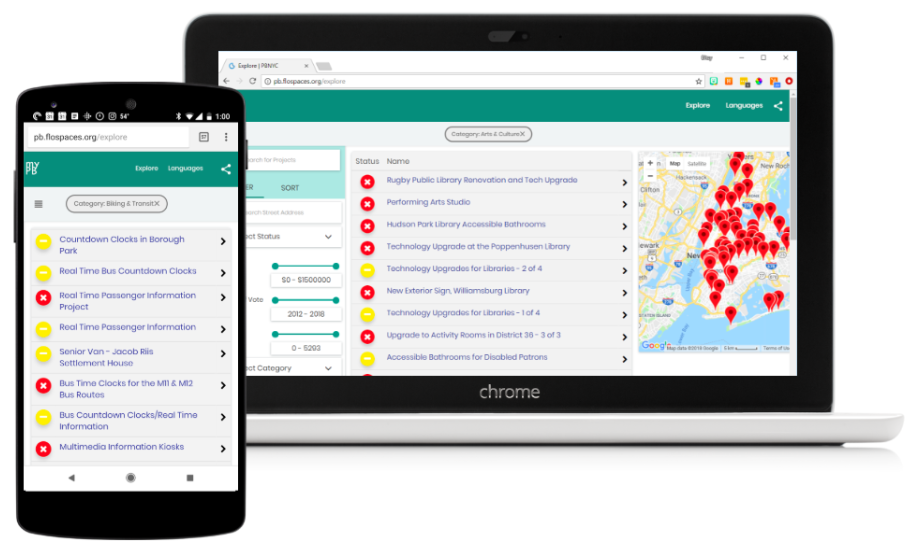
Now we have an exciting new data tool for tracking PB projects and outcomes: myPB.community. So far it includes all project data through 2017. We’re piloting it in NYC, with plans to include many more cities in the future—maybe yours?

Powered by NYC Open Data, community members can now use their smartphone or computer to:

  • find their district,
  • see if their district has participated—or is participating in—PB,
  • contact their district office,
  • search, sort, and filter PB projects that made it to the ballot
  • share information on PB projects on social media,
  • and see how much money has been allocated to various city agencies and issues.

This award-winning data platform tells lots of stories, revealing city-wide and district-specific priorities.

In June 2018, myPB.community won awards in Mayor’s Civics and Open Data from NYC Open Data, for its use of open data to support civic work, like how policy groups and advocates across the city can use mypb.community to understand community needs.

Sorting projects by category indicates what people prioritize when it comes to improving their city.

Since 2012, the NYC School Construction Authority has implemented an overwhelming majority of PBNYC projects, followed by the Department of Parks and Recreation.

Community groups can get more specific information about needs and priorities in their district, to better advocate for specific neighborhood needs.

For example, of the 982 projects for libraries and schools on NYC ballots since 2012,

  • 236 mention ‘tech’
  • 61 mention ‘library’
  • 56 mention ‘bathroom’
  • 50 mention ‘air conditioning’
  • 41 mention ‘electric’
  • 20 mention ‘security’
  • 13 mention ‘ADA’
  • 11 mention ‘music’
  • 10 mention ‘water’

This breakdown lifts up top priorities for improving schools and libraries across the city.

You can find the original version of this blog post on The Participatory Budgeting Project’s site at www.participatorybudgeting.org/participatory-budgeting-in-nyc/.

NCDD Member with Tips to Expand Your Information Bubble

The engagement field knows the value of folks being able to reach outside of their usual information bubble in order to understand other perspectives, build empathy, and expand your mind. Which is why we wanted to share this piece by Annie Pottorff of The Jefferson Center – an NCDD member organization, which shared some excellent tips for bursting your info bubble. We encourage you to share your additional ideas in the comments section below. You can read the article below and find the original on The Jefferson Center’s site here.


How to Burst Your Information Bubble

If you’re reading this, we’d bet that you care about the future of democracy, the forces that damage it, and the work that strengthens it. If you do, then chances are also good that you’ve heard the phrases “information bubble” and/or “filter bubble” as topics of concern. To provide a (very) brief overview: as humans in the digital age, we tend to seek out people and publications with similar opinions to ours, which is a pretty good way to avoid conflict. When we can get our news feed tailored exactly to our tastes, providing only information we’ll appreciate and relate to, why would we want anything else?

These bubbles can also be dangerous: when we remain inside, we don’t interact with those who disagree with us or with the information they consume. That may sound great on the surface, but this makes it easier for us to dismiss opposing opinions as being in the minority (even though that may not be the case), since we aren’t seeing them on a daily basis. Making things worse, actually escaping the bubble is pretty difficult. Our social media algorithms have been programmed specifically to show us stories we’ll generally like and agree with. Plus, we’ve all seen (or maybe even gotten involved with), political Facebook fights with distant relatives, or stumbled down the rabbit hole of our local newspaper comments section. Seeing these extreme views from people on the internet can make it difficult to even want to listen to anyone who may have different thoughts than us.

But at the Jefferson Center, we’ve found that when people have their beliefs challenged, it can be a good thing. We host Citizens Juries–deliberative events where a group of randomly-selected citizens are given the knowledge, resources, and time they need to create solutions to community issues. People often find themselves sitting across from complete strangers, and quickly realize that not everyone from “the other side” is as extreme as the pundits we see on TV and the trolls in the comment section. Instead, many people have a spectrum of beliefs, shaped by their own experiences, and aren’t easily labelled. Especially when it comes to local issues, participants find that partisan politics disappear when it comes to things like improving city government communication. As one citizen said “It’s really refreshing to sit down with a bunch of community members and realize you share the same core values and are united.”

If we choose to burst our information bubbles and listen to each other, we will let in not only new information, but new people, ideas, and experiences. Here are a few easy ways you can start:

1. Visit websites that present different takes

On allsides.com, you’ll find today’s biggest headlines and coverage from the left, center, and right. They also provide media bias ratings and a “balanced dictionary”, because certain news terms have come to mean different things to different people.

If you’re a reddit user, you can also submit and post in r/change my view. It’s pretty much what it sounds like–you submit an opinion, and ask people to present other viewpoints. The page is focused on having respectful, engaged discourse, rather than fighting.

2. Sign up for a well-rounded news digest

The Echo Chamber Club newsletter delivers a variety of viewpoints and contrary opinions on relevant news. Their goal is to offer an alternative to the personalized articles we see via social media algorithms, and instead showcase the nuances in today’s tough issues.

3. Curate a well-rounded list of reputable news sources

Here’s a great starter list of well-regarded news sites across the political spectrum, curated by Patrick Kulp at Mashable:

Conservative-leaning prestige media:

  • The National Review
  • The Weekly Standard
  • The American Conservative

Conservative-leaning new media:

  • Independent Journal Review
  • Heat Street
  • The Daily Caller

Liberal-leaning prestige media:

  • The New Yorker
  • The Nation
  • Mother Jones

Liberal-leaning new media:

  • Salon
  • AlterNet
  • Talking Points Memo

International Perspective:

  • Al Jazeera
  • The Economist
  • Der Spiegel

4. Analyze your social media and browsing settings

Did you know you can adjust your news feed preferences on Facebook? Just click on the drop down arrow in the upper right corner of your homepage, select “news feed preferences”, and choose a variety of news sources to appear at the top of your feed.

There are also browser extensions you can download that pop your information bubble for you! Escape Your Bubble, available on Chrome, automatically inserts articles and issues that may challenge your current political views into your feed, after taking time to learn your personal news consumption habits and preferences.

5. Read your local newspaper, including the editorials!

Checking out your local op-ed section will give you good insight into what your neighbors are thinking about local and national issues. Plus, if you disagree, you can shake things up and provide a few counterpoints in the next edition.

6. Be critical

Learn how to identify fake news sites and bots before you share, like, or comment. Sometimes these fake articles can travel around Facebook or Twitter for days, because people don’t investigate beyond the headline. Here are a few ways to root them out:

  • Fake articles usually use all caps, and are hyperbolic. Most legitimate news sites don’t write headlines like this.
  • Actually click the article–if the page doesn’t exist or is unavailable, it’s probably fake.
  • Double check the URL. Fake news sites thrive off of having almost legitimate names, like cnn-news.com.co
  • Skim the article. If it seems unprofessional, is riddled with errors, or presents information on a topic completely different from what the headline promised, you should move on.
  • It’s also important to be critical of your favorite news sources. Recognize when your go-to sites use clickbait tactics or present their partisan opinions as fact.

7. Attend community meetings

Because of TV shows like Parks & Rec, we’re inclined to picture community meetings as full of impassioned people yelling about pretty mundane issues.
But what if more and more people began to show up? We’d probably have a more diverse approach to many community issues and understand our neighbors a little better.

8. Have a few uncomfortable conversations

On Mismatch.org, you answer a few questions about yourself and your views, and they automatically match you with someone across the country with different views for a guided video conversation.

Living Room Conversations provides a local model for respectful discourse: you find someone to act as your co-host that has a different perspective than you on a given topic. Both of you find two other people to join. Then you meet for a guided conversation in a living room, church, school, or other community meeting place.

Did you notice anything missing from this list? Let us know so we can add it!

You can find the original version of this article on The Jefferson Center’s site at www.jefferson-center.org/how-to-burst-your-information-bubble/.