School and Society in the Age of Trump

John Rogers and the research team of Michael Ishimoto, Alexander Kwako, Anthony Berryman, and Claudia Diera have produced a landmark study entitled “School and Society in the Age of Trump,” based on their survey of 505 high school principals and follow-up interviews of 40 principals.

The principals offered evidence about five challenges that confront schools at this moment: 1. “Political division and hostility,” 2. “Disputes over truth, facts, and the reliability of sources,” 3. “The crises posed by opioid addiction,” 4. “Vulnerabilities associated with threats of immigration enforcement” and 5. “The perils and frequency of gun violence.”

The report explores the frequency of these issues in various types of school: those with predominantly students of color, racially-mixed schools, and schools with mostly white students; schools in Trump, anti-Trump, and politically mixed communities; and schools in different regions of the country. Principals were also also asked how their schools respond. For instance, do they communicate the importance of respecting new immigrants? Do they discipline students for uncivil or demeaning behavior?

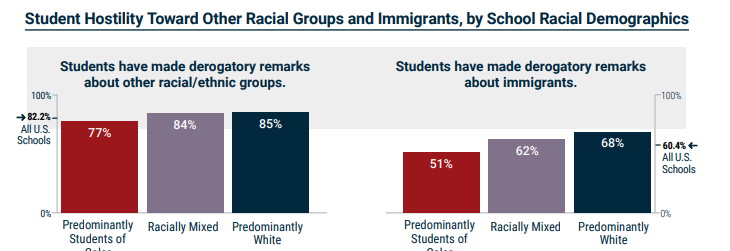
All the results make sense, but they are not always immediately intuitive. For instance, derogatory remarks about other racial/ethnic groups are more common than derogatory remarks about immigrants, and both are most common in predominantly white schools, but far from absent in the other schools. (See below.)

Principals are also most likely to report disciplining students for insensitive remarks in mostly-white schools, but they are much less likely to talk with their students about the importance of respecting immigrants in the mostly-white schools.

Many principals report proactive responses, such as meeting with student groups to ask for their help in promoting civility and respect or meeting with parents for similar purposes. But those responses vary greatly. Sixty-two percent of principals serving mostly youth of color met with parents for this reason, versus 37% of principals in mostly white schools.

It’s common today for parents to challenge the information or news sources that teachers assign or for students to reject assigned sources. The frequency of those events doesn’t differ dramatically depending on the schools’ demographics (although I imagine that the sources that are distrusted differ).

According to the report, “A little more than a quarter of principals report they have restricted topics or information sources in order to diminish the flow of unreliable or contentious information.”

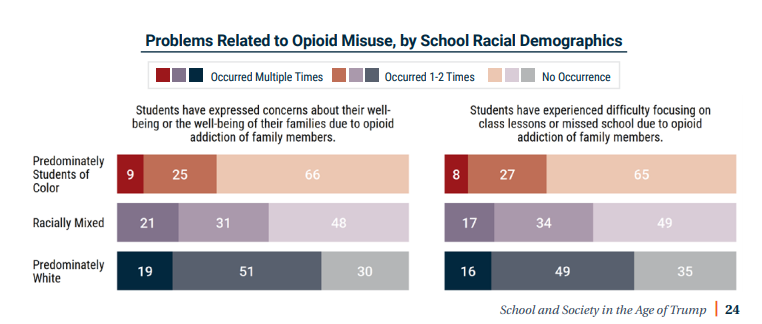
A different kind of stress comes from the opioid crisis. It is worst in predominantly white schools but definitely present in racially-mixed schools and those that serve mostly youth of color.

Rogers and colleague write that “Sixty-eight percent of the principals we surveyed report that federal immigration enforcement policies and the political rhetoric around the issue have harmed student well-being and learning, and undermined the work of their schools in general.”

Students across the board are fearful of gun violence, but more so to the degree that their students are people of color.

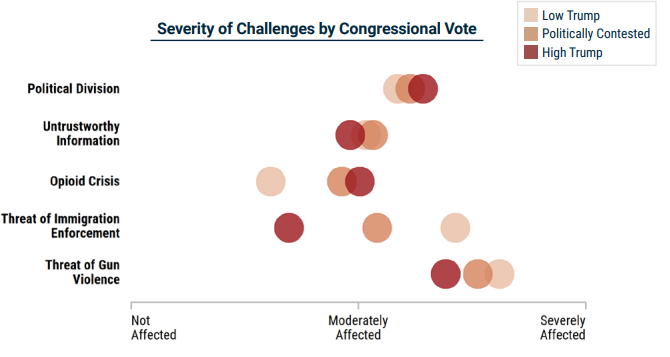
These challenges vary by demographics and region, but I’ll show a final graph about politics. The opioid crisis is most widely reported in Trump country. Political division is also more often reported there than elsewhere, but by small margins. In Trump country, far fewer principals report immigration enforcement as a challenge for their students. (That is either because of where most immigrants live or because of problems of under-reporting in Trump districts, as Rogers notes.) Untrustworthy information is seen as a challenge everywhere, to about the same degree, but I am sure that what counts as untrustworthy varies.

These are just some snapshots from a rich and compelling report.

What You Missed on the March Confab Call – Listen Now!

NCDD was thrilled to co-host our March Confab call last week with the National Conversation Project, featuring Net Impact and The National Issues Forums Institute! We were joined by 40 participants for this dynamic call to learn more about Net Impact’s youth engagement programs and their recent work with NIFI on a newly-revised national debt issue guide, the paid opportunity to host forums on this guide and how this can be part of the upcoming National Week of Conversation happening April 5-13.

Confab bubble imageOn the call, we were joined by Net Impact’s Program Manager Christy Stanker who gave us an overview of Net Impact’s work and how the nonprofit works to inspire and equip emerging leaders to build a more just and sustainable world. Net Impact’s programs help new leaders broaden their thinking, build their networks, and scale their impact beyond just individual actions. Christy highlighted one of their particularly stand-out programs, Up to Usa partnership between Net Impact, the Peter G. Peterson Foundation, and the Clinton Global Initiative University. Up to Us, is a rapidly growing, nonpartisan movement of young people who recognize that when it comes to securing their future opportunities, they have no better advocates than themselves. Amid high-profile debates over jobs and the economy, social mobility, healthcare, and tax reform, Up to Us is the only nationwide, campus-based campaign focused on building a sustainable economic and fiscal future for America’s next generation. 

Christy shared more about the funding opportunity to host forums on the “A Nation in Debt” issue guide that Net Impact recently co-produced with NIFI. If you are a student, faculty, or administrator at an accredited U.S.-based college or university, then you are eligible to receive a $150 microgrant for hosting a deliberative dialogue forum using this newly updated national debt issue guide. All you have to do to receive the funding and free guide is fill out this form by May 15, 2019 and host a forum using the “A Nation in Debt” issue guide before June 31, 2019. Once you fill out the form, staff at Net Impact will follow-up with resources including a moderating training and the moderator “cheat sheet.” Don’t miss out on the opportunity to contribute to this meaningful dialogue! Reach out to Christy at cstanker[at]netimpact[dot]org with any questions. Apply for the microgrant here!

Pearce Godwin, Executive Director of our Confab co-hosting organization, The National Conversation Project, discussed the exciting application of this opportunity during the second annual National Week of Conversation (NWOC) happening Friday, April 5th to Saturday, April 13th. NWOC will be a week of intentional conversation, where folks around the country will be hosting or joining conversations, in hopes to better address the intense divisions in our society through dialogue, deepening understanding, and building relationships. Learn more here!

Here are some of our favorite snippets from the Confab:

  • On hosting NIFI forums “maybe you start with people with different opinions but through structured conversation can find common ground” – Christy Stanker
  • “The feedback we get from teachers who use NIFI forums ID 3 benefits: helps students develop critical thinking skills, communication skills, & collaboration skills.” – Bill Muse
  • Resources available to support moderating forums on NIFI’s National Debt issue guide at https://www.nifi.org/en/announcing-micro-grant-program-nation-debt-how-can-we-pay-bills
  • “Everyone has an opportunity to intentional convene and host or join a conversation from April 5-13 during the National Week of Conversation” – Pearce Godwin

We recorded the whole presentation in case you weren’t able to join us, which you can access on the archives page by clicking here. Access to the archives is a benefit of being an NCDD member, so make sure your membership is up-to-date (or click here to join). We saved the transcript of the chat discussion and it can be found here.

Confab bubble image

We want to thank Christy, Darla and Bill at NIFI, and Pearce and Jaclyn at NCP, for making this call happen! And an equally large thank you to all the Confab participants for contributing to this conversation! To learn more about NCDD’s Confab Calls and hear recordings of others, visit www.ncdd.org/events/confabs.

Finally, we love holding these events and we want to continue to elevate the work of our field with Confab Calls and Tech Tuesdays. It is through your generous contributions to NCDD that we can keep doing this work! That’s why we want to encourage you to support NCDD by making a donation or becoming an NCDD member today (you can also renew your membership by clicking here). Thank you!

how to think about other people’s interests: Rawls, Buddhism, and empathy

Last week, my colleague Erin Kelly and I taught excerpts from John Rawls’ Theory of Justice along with Emily McRae’s chapter, “Empathy, Compassion, and ‘Exchanging Self and Other’ in Indo-Tibetan Buddhism,” from the Routledge Handbook of Philosophy of Empathy. I then attended a conference on empathy. As a result, I’ve been thinking about Rawls’ famous thought-experiment, Buddhist exercises for moral improvement–and how empathy relates to both.

Rawls argues that to know what justice demands, you should collect all the relevant available information about how the society in general works, but you should then imagine that you don’t know your own position in the society and ask what rules and institutions you would favor–in your own interest–under this “veil of ignorance.”

To make that method seem intuitive, imagine that I am considering (in the light of last week’s scandalous news about college admissions) whether it is desirable for such institutions as Yale University to exist. I should try to understand how Yale functions, today and in the past, in the broader society. But I should try not to be influenced by the fact that I was admitted to Yale and graduated from there. I should ask whether the existence of Yale would be a good thing if I did not know whether I would ever get anywhere near it. Thus general knowledge plus self-interest plus ignorance about my own circumstance equals justice.

We could think of this thought-experiment as a way of modeling justice. Just as we test a model of a new airplane in a wind tunnel, so we test a theory of justice by using Rawls’ veil of ignorance, because that will yield the same results as justice itself would yield if we could know directly what justice says.

Now compare Rawls’ method to those developed in Indo-Tibetan Buddhism. McRae begins her chapter: “Imagine yourself as an old yak … your back weighed down with a load far too heavy, a rope pulling you by the nostrils, your flanks whipped, your ribs bruised by the stirrups.” She is quoting the nineteenth-century Tibetan master Parrul Rinpoche, who offers it as an exercise in empathy.

McRae defines bodhicitta as a “radically altruistic moral orientation that centrally involves cultivating oneself in order to be the kind of person who can reliably, effectively, and wisely benefit others… . The cultivation involved in becoming a person with bodhicitta–a bodhisattva — … includes developing virtues such as patience, generosity, and wisdom, and moral skills such as mindfulness, moral reasoning, responsiveness, and, arguably, empathy. … .Empathy practices [such as imagining that you are a yak] are traditionally presented in the context of cultivating bodhicitta, since empathy triggers both virtuous emotionality (through the Four Immeasurable Qualities practices) and the realization of no-self (through exchanging self and other practices), both of which are necessary for bodhicitta.”

Here are some differences:

  • Rawls tries to make moral reasoning as impersonal as possible, whereas the Indo-Tibetan Buddhist tradition strives for maximum concrete identification with other sentient beings.
  • In the Buddhist tradition, you cultivate empathy. Rawls provides a way of determining justice that does not require empathy–in part because empathy can be biased, manipulated, and otherwise untrustworthy.
  • Rawls treats every person as equal, whereas a stance of “radical altruism” implies that the thinker should count everyone else as more important than herself.
  • Rawls’ theory is limited to “persons” (probably human beings), whereas Buddhism extends to all sentient life.
  • Rawls offers a technique for deciding what justice is, whereas for the Buddhist theorists, the problem is not deciding what is right–they presume that we should be as altruistic as possible–but rather motivating people to act right. “Exchanging self and other is not simply a heuristic for determining the limiting condition on action (“how would you like it if someone did that to you?”) or a mental exercise in perspective taking. It is a transformative practice that uses empathic imaginative projection to chip away at self-clinging by softening the boundaries of self and other.”

And here are some similarities:

  • Both methods are conducted by the thinker alone. Neither is dialogic, involving an actual exchange of opinions. You imagine you’re a yak, but you don’t ask the yak if you got that right.
  • Like the Buddhist teachers, Rawls also softens “the boundaries of self and other,” but he does so by asking you what you’d want if you did not know who you were.

If you happen to find both arguments persuasive, you’re left with an odd proof:

1. Self-interest plus [a specific form of ] ignorance = justice (Rawls)

2. Compassion plus radical altruism = justice [Buddhism]

So

3. Self-interest plus ignorance = Compassion plus radical altruism

True?

See also: empathy, sympathy, compassion, justice; empathy: good or bad?; “Empathy” is a new word. Do we need it?; Owen Flanagan, The Bodhisattva’s Brain: Buddhism Naturalized; the grammar of the four Noble Truths; avoiding the labels of East and West; Philosophy as a Way of Life (on Pierre Hadot)

Democracy Works Podcast Celebrates First Anniversary

We want to wish our friends at the Democracy Works Podcast a happy birthday as they ring in their one year anniversary! If you haven’t listened to this podcast yet, a great place to start is the much-anticipated episode released today: Jonathan Haidt on the psychology of democracy – click here to listenDemocracy Works is produced by NCDD member organization The McCourtney Institute for Democracy at Penn State and the podcast examines all things related to making a healthy democracy work. We encourage you to read the announcement below, shared with us by McCourtney Institute’s Communications Specialist Jenna Spinelle, and to listen to the Democracy Works podcast here.


One Year of the Democracy Works Podcast: Lessons Learned and Looking Ahead

by Jenna Spinelle

This time last year, my colleagues and I in the McCourtney Institute for Democracy at Penn State launched our podcast, Democracy Works. We wanted to take a minute to thank the NCDD community for all of your help spreading the word about the podcast. We are honored to be included among shows like Find the Outside and Dialogue Lab.

As we enter year two, we also want to know who we should be talking to and what we should be talking about. Over the past year, we’ve talked with all types of thinkers and doers, from The Atlantic’s David Frum to Healthy Democracy Executive Director Robin Teater. We’ve covered civics education, economic inequality, and criminal justice — just to name a few.

Along the way, we’ve been surprised to see how much of a desire there is for political content that’s nonpartisan and educational. Reading comments from our listeners around the world makes me feel hopeful about the work that NCDD is doing to bring people from across the political spectrum together to tackle some of our most pressing issues through conversation.

As one listener from California told us, the podcast “helps soothe my worries for our democracy by creating the feeling that we are making progress toward understanding what’s going wrong, building the necessary bridges, and making the necessary repairs.”

In the coming weeks, we’ll be talking with Tim Shaffer about the new book “A Crisis of Civility?’ and Srdja Popovic, founder of Serbia’s Otpor! movement, about how to organize in turbulent political situations.

New episodes are released each Monday at democracyworkspodcast.com, along with Apple Podcasts, Spotify, and many other podcast apps. We hope you’ll check it out, then get in touch to let us know what you think and who we should be talking to next. Happy listening!

You can find the Democracy Works podcast at www.democracyworkspodcast.com/.

Civic Education: Is There Common Ground?

[The video just plays the introduction. Here is a link to all the separate talks.]

This is the video from a panel at the American Federation of Teachers’ Albert Shanker Institute on Wednesday. The panelists are: Leo Casey, Executive Director, Albert Shanker Institute, Jessica Marshall, co-author, “Let’s Go There: Making A Case for Race, Ethnicity and a Lived Civics Approach to Civic Education;” doctoral candidate, Northwestern University; former Director of Social Science and Civic Engagement for the Chicago Public Schools, Robert Pondiscio, Senior Fellow and Vice President for External Affairs, Thomas B. Fordham Institute, Joe Rogers, Director of Public Engagement and Government Affairs, Center for Educational Equity, Teachers College, Columbia University, and me. The moderator is Marla Ucelli-Kashyap, Assistant to the President for Educational Issues, American Federation of Teachers.

I thought the panel reflected some real diversity of perspectives, backgrounds, and opinions, yet we managed to stay focused on a common question: Is there common ground for civic education? My colleagues offered many important insights. My own view, for what it’s worth, is that common ground is available so long as we focus on the vessel into which the content of civics is poured: the need for courses, prepared teachers, funding for materials, etc. Once we begin to discuss how America should be presented to students, disagreements inevitably–and appropriately–arise. Content is the question that excites the most popular interest and concern, from a range of perspectives, and it must be addressed. But we don’t really know to what extent the content of robust civics programs would differ if they developed in more conservative and progressive communities.

Knight Public Spaces Fellowship Open Until March 22nd

We wanted to make sure folks in the network were informed about the Knight Foundation offering their Knight Public Spaces Fellowship and that submissions are being accepted until next Friday, March 22nd. From the site, “The fellowship recognizes leading civic innovators who have created or influenced great public spaces in U.S. communities, creating more opportunities for connection and civic engagement. Chosen fellows will share up to $1 million in grants to continue their work”. We know there are a lot of fantastic candidates in the Coalition and we encourage you to apply for a portion of that significant support. You can find more information in the post below and find the original information on the Knight Foundation’s site here.


Knight Public Space Fellows: Leading Change, Connecting People to place

Knight Foundation is inviting nominations for its inaugural Knight Public Spaces Fellowship.

The fellowship recognizes leading civic innovators who have created or influenced great public spaces in U.S. communities, creating more opportunities for connection and civic engagement. Chosen fellows will share up to $1 million in grants to continue their work.

From Feb. 21 to March 22 at 11:59 p.m. ET, we are inviting people to nominate their candidate of choice. Individuals can also nominate themselves. Those who choose to nominate a candidate are encouraged to alert the nominee about the opportunity.

WHO WE’RE LOOKING FOR
We seek fellows with an exemplary track record of crafting public spaces—trails, parks, plazas and streets—that create opportunities for connection and civic engagement. The fellowship is open to a wide range of talented civic innovators with experience in urban design, planning, architecture, landscape architecture, engineering, government, technology, policy and programming.

Individuals with exceptional talent and leadership qualities who craft, develop, design, plan, manage and implement the use of public spaces to build the type of communities where people want to live and work are eligible to apply. Fellows must show potential to create larger, innovation and strategic momentum within the community.

FELLOWSHIP BENEFITS
In addition to the opportunity to create real impact in their city and beyond, fellows will receive:

  • Support: A small group of fellows will share up to $1 million grants which can be used for innovative, flexible projects, distributed over approximately two years.
  • Network-building opportunities: Support to work directly with peers and other experts who are passionate about using public space to transform communities.
  • Mentorship: Insight and guidance from experts to refine ideas and new thinking around public space work.
  • Public exposure: Fellows will be invited to present at Knight-supported events and other gatherings, and given opportunities to publish and share their work.

If you have questions about the application, you can watch a recorded informational webinar.

For additional questions, please email psfellows@kf.org. Follow #knightcities on Twitter for updates.

You can find the original version of this announcement on the Knight Foundation site at www.knightfoundation.org/challenges/public-spaces-fellowship.

Submit Nominations for Leadership in Democracy Award

In case you missed it, NCDD member org Everyday Democracy, recently announced they are accepting nominations for the third annual Paul and Joyce Aicher Leadership in Democracy award! The $10K award will be granted to those 16 and older who embody the values of Paul and Joyce Aicher. Nominations are due April 15th, so make sure you get yours in ASAP! We encourage you to learn more about the award criteria and how to submit a nomination in the announcement below and on the Everyday Democracy site here.


Nominations Open for the 2019 Paul and Joyce Aicher Leadership in Democracy Award Now

EvDem LogoEvery year, Everyday Democracy recognizes a standout community change agent —a person or organization whose work in their community exemplifies the values on which we were founded – voice for all, connection across difference, racial equity, and community change.

The Paul and Joyce Aicher Leadership in Democracy Award provides recognition and a $10,000 award to an individual or organization in the U.S. whose achievements inspire us and can be lifted up for many others to aspire to.

Who comes to the top of your mind when you think about exceptional people or local organizations that create opportunities for people to talk to and listen to each other, work together for equitable communities, and help create vibrant communities that work for everyone? Show how much you understand and appreciate their contribution to society by nominating them for the 2019 Aicher Award!

For more than 25 years, Everyday Democracy has worked in communities across the country to foster a healthy and vibrant democracy – one that is characterized by strong relationships across divides, racial equity, and widespread leadership and voice.

Paul and Joyce Aicher’s generosity and creative genius have had a profound impact on individuals and organizations in every part of this country. Their passion and diligent effort inspired the dialogue guides, organizing and facilitating training, and community coaching that Everyday Democracy is so well known for delivering. In 2017, we launched the inaugural Paul and Joyce Aicher Leadership in Democracy Award to carry on their legacy after the passing of Joyce Aicher.

Our 2018 award winner was Beth A. Broadway, President of InterFaith Works of Central New York, who has worked for more than 40 years as a force for justice, raising voice to issues of oppression and advancing racial and social equity through the process of dialogue and action. Her racial equity work has directly impacted thousands of individuals and families and has markedly improved Syracuse and surrounding communities. Learn more about Beth’s extraordinary work here. Read more about past honorees.

Nominations are due April 15, 2019. See below for full details about eligibility and the nomination process.

We can’t wait to see your nominations!

Awards

The recipient of the Paul and Joyce Aicher Leadership in Democracy award will receive $10,000 at the award reception in December 2019. Finalists will receive one day of community assistance to help them implement Everyday Democracy’s principles into their community engagement work.

Who is eligible

Individuals 16 years of age and older, coalitions, and organizations conducting projects at the community level in the U.S. are eligible to be nominated. Organizations do not have to be a registered 501(c)3 and do not need to be affiliated with Everyday Democracy or its Dialogue to Change process to qualify. Current Everyday Democracy employees and board members are excluded from being nominated. People/organizations may not nominate themselves. If you wish to be considered for the award, please encourage a colleague or friend to nominate you.

Nomination process

Anyone may nominate any person or organization that meets the criteria for this award. You will need to provide contact information for yourself and your nominee, a short summary of their work, and a description of how they embody our values in a 500-1,000 word essay that provides examples of specifically what they have done. Send this completed nomination form to aichernomination@everyday-democracy.org and cc the nominee. The nomination form is due April 15, 2019.

Download the nomination form.

We will confirm the nominations when they are received. Nominees will be asked to supplement their nomination with evidence of the things they have done that demonstrate how they exhibit our core values. Supplemental information is due by May 15, 2019, at 11:59pm ET. Submissions will be evaluated by a panel put together by Everyday Democracy.

Once a final decision is made, the winner and others will be notified.

The 2019 Aicher Award winner will be expected to attend the award reception in December. (Transportation to the reception and lodging will be provided.)

A brief history of Paul and Joyce Aicher

Paul J. Aicher’s motto, “Don’t just stand there, do something,” marked all that he did. Before founding the Study Circles Resource Center (now called Everyday Democracy) in 1989, he was a model for civic engagement. Shortly after graduating from Penn State, he participated in a discussion course which helped him find his voice in civic life and sparked his lifelong interest in helping others find their own. He saw a direct connection between his early experiences as a participant and a facilitator and his later vision for embedding these kinds of opportunities into American political life and culture.

Throughout his life, he spent his free time volunteering. Early in their marriage, he and his wife Joyce got involved with a refugee resettlement project in Illinois; Paul then served as president of the North Shore Human Relations Council. Back in Pennsylvania in the mid-1960s, he started the World Affairs Council of Berks County and led his neighbors in discussions of the “Great Decisions” guides published by the Foreign Policy Association. Through his long-time work and friendship with Homer Jack, an American Unitarian Universalist clergyman and social activist, Paul developed a passion for racial justice and international peace, both of which would inspire his later social action.

In the 1970s, he devoted his energies to launching his company Technical Materials and raising four children with Joyce. But he always returned to activism. In the early 1980s, after moving to Pomfret, Connecticut, Paul joined the local anti-nuclear freeze movement. In 1982, he formed the Topsfield Foundation, which was renamed The Paul J. Aicher Foundation after Paul’s passing in 2002. It began with making grants to advance a number of causes: affordable housing; educating and engaging the public on international security issues; and networking grass-roots peace and justice groups across the U.S. As it became an operating foundation, it focused all of its efforts on its current mission – to strengthen deliberative democracy and improve the quality of life in the United States. In the past twenty-five years, it has been best known through the work of its primary project, Everyday Democracy, which supports communities across the U.S. in implementing Paul’s vision of public dialogue that enables everyone to have a voice and be heard.

Joyce shared Paul’s commitment to civic engagement, community activism, and social justice. With her quiet strength and humor, she often worked behind the scenes to make the work of the Foundation possible. She also strengthened the local community through her numerous volunteer efforts. She and Paul shared a love of nature, books, and the arts and were self-effacing advocates of democratic values. Joyce passed away in 2016.

You can find the original version of this Everyday Democracy announcement at www.everyday-democracy.org/aicher-award.

conservatism as gratitude or humility?

(DCA) Yuval Levin offers this definition (h/t Robert Pondiscio):

To my mind, conservatism is gratitude. Conservatives tend to begin from gratitude for what is good and what works in our society and then strive to build on it, while liberals tend to begin from outrage at what is bad and broken and seek to uproot it.

You need both, because some of what is good about our world is irreplaceable and has to be guarded, while some of what is bad is unacceptable and has to be changed. 

This is a thoughtful effort to describe left and right evenhandedly, but I don’t think it is the best way to define or defend conservatism.

The problem is that people differ greatly in the degree to which they can reasonably be grateful to any particular polity. Consider, as one of several extreme examples, Native Americans. They can adopt any view of the USA that they want, but they have much less objective reason to be grateful to this republic than I have. They may well feel deep gratitude to their own communities. That gratitude is particularistic. Conservatism would then imply a particularistic ideal: a commitment to the specific communities that deserve each person’s gratitude. Some versions of conservatism have in fact been particularistic–but not Levin’s. He wants Americans (all Americans, I presume) to feel grateful to the nation-state:

But we can also never forget what moves us to gratitude, and so what we stand for and defend: the extraordinary cultural inheritance we have; the amazing country built for us by others and defended by our best and bravest; America’s unmatched potential for lifting the poor and the weak; the legacy of freedom—of ordered liberty—built up over centuries of hard work.

In the same essay, Levin suggests a more secure and persuasive core principle for conservatism—humility:

Conservatives often begin from gratitude because we start from modest expectations of human affairs—we know that people are imperfect, and fallen, and weak; that human knowledge and power are not all they’re cracked up to be; and we’re enormously impressed by the institutions that have managed to make something great of this imperfect raw material. So we want to build on them because we don’t imagine we could do better starting from scratch.

This reminder of “modest expectations” is what conservatism valuably contributes to public debates. Because people are “imperfect, and fallen, and weak”–or, we could say, cognitively and motivationally limited and biased–we should always be somewhat skeptical of ambitious reform proposals, of original designs for complex things (cities, welfare programs, markets), and of the likelihood that any person can dramatically improve things for any other person.

Humility, in this sense, is the common thread that unites libertarians (skeptical of central planning), religious conservatives (skeptical of human reason and motivation), and communitarians (skeptical of formal institutions). It also encourages all three types of conservatives to admire complex phenomena that have emerged and that seem to function well enough–“that have managed to make something great of this imperfect raw material.”

Levin argues that humility implies gratitude, but that connection is contingent. It depends on whether what has emerged so far is good enough for you and the people you care most about. Answers to that question will reasonably differ. Humility is the premise; gratitude is a consequent that depends on the circumstances. Humility is something that everyone has a reason to endorse, although everyone should also be open to the possibility of change.

See also: what defines conservatism?; a plea to conservatives; and from classical liberalism to a civic perspective

Online D&D Event Weekly Roundup & NCDD Confab TODAY

We’re excited for our March Confab call TODAY from 3-4 pm Eastern, 12-1 pm Pacific, in collaboration with Net Impact, National Issues Forums Institute, and the National Conversation Project! This free 1-hour webinar will be an opportunity to learn more about Net Impact’s youth engagement work, the new national debt issue guide they created with NIFI, information on a paid opportunity to host forums, and more about the upcoming National Week of Conversation. Register ASAP to save your spot on this dynamic and informational call here.

Please also check out the webinars below from NCDD partner org National Civic League, NCDD member orgs Living Room Conversations, Bridge Alliance, and National Issues Forums Institute, and from Philanthropy for Active Civic Engagement (PACE), Zehr Institute for Restorative Justice, Global Partnership for the Prevention of Armed Conflict (GPPAC), and the new webinar series #ThisIsGovtech by CivicMakers and GovTech Fund.

Do you have a webinar or other event coming up that you’d like to share with the NCDD network? Please let us know in the comments section below or by emailing me at keiva[at]ncdd[dot]org, because we’d love to add it to the list!


Online Roundup: NCDD March Confab, Living Room Conversations, Bridge Alliance, NIFI, PACE, Zehr, GPPAC, and #ThisIsGovtech

NCDD March Confab with Net Impact, NIFI, and National Conversation Project

Confab bubble image

Wednesday, March 13th
12 pm Pacific, 3 pm Eastern

This free one-hour webinar will be a great opportunity for anyone passionate about cultivating the next generation of leaders, those interested in learning how to apply for the microgrant to host forums, more about the new national debt issue guide, and/or hosting a conversation during the upcoming National Week of Conversation. You won’t want to miss out on this discussion – register today!

REGISTER: http://ncdd.org/29225

Living Room Conversations webinar – Tribalism 101: Next Door Strangers

Wednesday, March 13th
12:30 pm Pacific, 3:30 pm Eastern

Join us for a free online (using Zoom) Living Room Conversation on the topic of Tribalism. Please see the conversation guide for this topic. Some of the questions explored include: Name one or more groups you feel at home or strongly identify with (where you find a sense of belonging and/or feel stronger together)What generalizations do you make about other groups? How do you evaluate or check the validity of your generalizations, if at all? How important is it to you that your generalizations are accurate? Some groups come together based on sharing a common culture, vision, or enemy. What is the commonality for your group? What need does your group fulfill in your life?

REGISTER: www.livingroomconversations.org/event/online-living-room-conversation-tribalism-101-next-door-strangers-4/

Living Room Conversations Training (free): The Nuts & Bolts of Living Room Conversations

Thursday, March 14th
12 pm Pacific, 3 pm Eastern

Join us for 60 minutes online to learn about Living Room Conversations. We’ll cover what a Living Room Conversation is, why we have them, and everything you need to know to get started hosting and/or participating in Living Room Conversations. This training is not required for participating in our conversations – we simply offer it for people who want to learn more about the Living Room Conversations practice.

Space is limited to 12 people so that we can offer a more interactive experience. Please only RSVP if you are 100% certain that you can attend. This training will take place using Zoom videoconferencing. A link to join the conversation will be sent to participants by Wednesday 10am (PT) / 1pm (ET).

REGISTER: www.livingroomconversations.org/event/training-free-the-nuts-bolts-of-living-room-conversations-3/

Living Room Conversations webinar – American Culture: Melting pot or salad bowl or something else?

Saturday, March 16th
11:30 am Pacific, 2:30 pm Eastern

Join us for a free online (using Zoom) Living Room Conversation on the topic of American Culture: Melting pot or salad bowl or something else?. Please see the conversation guide for this topic. Some of the questions explored include: What is your cultural heritage? Have you experienced cultures other than your own? What did you appreciate? What made you uncomfortable? What value do you see in having a single, shared American culture? What would that culture look like?

REGISTER: www.livingroomconversations.org/event/online-living-room-conversation-american-culture-melting-pot-or-salad-bowl-or-something-else/

Bridge Alliance webinar – Peer Learning Session: Get to Know the 116th Congress with the Congressional Management Foundation *this webinar is for Bridge Alliance members only – learn more here

Monday, March 18th
10 am Pacific, 1 pm Eastern

A new Congress means new committee and subcommittee chairs, new alliances, and significant changes in the political terrain on Capitol Hill. With the shift in power, and term limits for committee chairs in the House and Senate, an advocate who may have been represented by an anonymous back-bencher last year might now be the conduit to the most important legislator for your cause. This webinar will offering a snapshot of the 116th Congress, offering participants a window into how to build relationships with lawmakers. The presentation will be conducted by Bradford Fitch, President and CEO of the Congressional Management Foundation (CMF).

RSVPwww.bridgealliancefund.us/cmf_peer_learning_session

National Civic League AAC Promising Practices Webinar – Community Collaborations to Improve Student Health

Tuesday, March 19th
11 am Pacific, 2 pm Eastern

Join the National Civic League to learn more about how two All-America Cities are bringing their communities together to address student health with in-school interventions. Susan Witkowski, CHCQM, CEO of Community Medical Clinic of Kershaw County will discuss the offerings of their school-based health center. Lisa Campbell, CEO of Create a Change in Las Vegas, NV will discuss their Healthy School, Healthy Life Program.

REGISTER: www.eventbrite.com/e/aac-promising-practices-webinar-community-collaborations-to-improve-student-health-tickets-54558819899

Philanthropy for Active Civic Engagement Webinar – Health Equity & Community Safety: How Funders Can Embrace the Power of Youth Civic Engagement

Wednesday, March 20th
10 am Pacific, 1 pm Eastern

Foundations and funders committed to building healthier, safer, and more equitable communities may be overlooking or undervaluing a key strategy: youth civic engagement. In light of recent findings from PACE’s Health & Safety working group, this webinar will highlight why and how investments in youth civic engagement can be key to improving community health and safety. The event will illustrate specific ways funders can support youth civic engagement, share stories and case studies of successful health and safety initiatives involving youth, and explore how incorporating youth into health and safety strategies can have an impact on equity in community outcomes..

REGISTER: www.pacefunders.org/webinar-health-equity-community-safety-how-funders-can-embrace-the-power-of-youth-civic-engagement/

Zehr Institute for Restorative Justice – Restorative Circles for Health: RJ as an Approach to Health Justice

Wednesday, March 20th
1:30pm Pacific, 4:30pm Eastern
Guest: Ivelyse Andino and Jason Walsh
Host: Johonna Turner

Join Ivelyse Andino and Jason Walsh for a discussion on the use of restorative practices to achieve health justice for marginalized communities. Andino, the CEO of Radical Health, and Walsh, who facilitated “Circle of Knowledge,” are on the cutting edge of this burgeoning application of RJ.

REGISTER: http://zehr-institute.org/webinars/restorative-circles-for-health.html

Global Partnership for the Prevention of Armed Conflict (GPPAC) webinar – Peace Education: Culture of Good Neighbourhood and 15 years of Multicultural education in school; how can I be recognized in my school if I’m a minority?

Wednesday, March 20th
5 am Pacific, 8 am Eastern

In this webinar, expert Dr. Iryna Brunova-Kalisetska will present an example of system work from kindergarten to university levels of education for the multicultural societies, both as a preventive tool and post-conflict peacebuilding measure. Main principles of the “Culture of Good Neighbourhood” inclusive approach for various levels of education and multicultural contexts will be presented and discussed at the webinar.

REGISTER: www.gppac.net/peace-education-webinar-series?fbclid=IwAR371vw1Gxi_tpRI3NZsCMRgbf7Rd_IlD1keNf2KuT30iUwHzMDCiw6t1541

#ThisIsGovtech Webinar – Access & Accessibility for All! *this webinar is free for gov’t  employees and requires a gov’t email

Thursday, March 21st
11 am Pacific, 2 pm Eastern

What is govtech? It is new technologies that empower government employees, improve public services, and make a real difference in everything from the housing crisis to climate change. It is a growing market worth over $400 billion that is attracting a new generation of technologists, designers and mission-driven entrepreneurs who are collaborating with government partners to help drive a movement. As paper processes shift to digital workflows full of big data, governments are gaining new visibility and actionable insights into sticky problems and seeing their role evolve to become dedicated enablers of change. #ThisIsGovtech is a new webinar series exploring the govtech movement. If you work in government, join us to be inspired by the passion, creativity and impact of this growing field.

REGISTER: www.eventbrite.com/e/thisisgovtech-webinar-series-access-accessibility-for-all-registration-41804299786?mc_eid=6347eb7d50&mc_cid=71f141c3f8

National Issues Forums Institute – March CGA Forum Series: America’s Energy Future

Thursday, March 21st
9:30 am Pacific, 12:30 pm Eastern

Join us in March for a Common Ground for Action forum on “America’s Energy Future” We’ll be talking about how to fix our broken political system in three different options: (1) Produce the Energy We Need to Maintain Our Way of Life: We must produce more of the energy we need, while making sure that as much imported energy as possible comes from stable, friendly countries, such as Canada; (2) Put More Renewables and Clean Energy Sources into the Mix: We need to find and use more sources of renewable energy. And, because we will inevitably have to move to renewables at some point, we should start down that path now; and (3) Find Ways to Use Less Energy: Energy produced by fossil fuels will, eventually, run out and, in the meantime, we continue to do great damage to the air, water, and earth that sustain us. If you haven’t had a chance to review the issue guide, you can find a downloadable PDF here.

REGISTER: www.nifi.org/en/events/march-cga-forum-series-america%E2%80%99s-energy-future-0