#PpediaTeam Livestream Schedule

On June 6th - 9th, 2016 researchers and practitioners from around the world will gather at the University of British Columbia, Vancouver for the first large-scale meeting of the Participedia project. Project partners who have been working together for over a year via email and Skype will come together to share knowledge and resources as they refine plans for the next four years of a SSHRC Partnership Grant

an alternative to Moral Foundations Theory

Jonathan Haidt’s Moral Foundations Theory is one of the most influential current approaches to moral psychology and it exemplifies certain assumptions that are pervasive in psychology more generally. I have been working lately with 18 friends and colleagues to “map” their moral views in a very different way, driven by different assumptions. As part of this small pilot project, I gave the 18 participants Haidt et al’s, Moral Foundations Questionnaire. Although my sample is small and non-representative, I am interested in the contrasting results that the two methods yield.

Haidt’s underlying assumptions are that people form judgments about moral issues, but these are often gut reactions. The reasons that people give for their judgments are post-hoc rationalizations (Haidt 2012, pp. 27-51; Swidler 2001, pp. 147-8; Thiele 2006). “Individuals are often unable to access the causes of their moral judgments” (Graham, Nosek, Haidt, Iyer, Koleva, & Ditto 2011, p. 368). Hence moral psychologists are most interested in unobserved mental phenomena that can explain our observable statements and actions.

Haidt et al ask their research subjects multiple-choice questions about moral topics. Once they have collected responses from many subjects, they use factor analysis to find latent variables that can explain the variance in the answers. (Latent variables have been “so useful … that they pervade … psychology and the social sciences” [Bollen, 2002, p. 606]). The variables that are thereby revealed are treated as real psychological phenomena, even though the research subjects may not be aware of them. Haidt and colleagues consider whether each factor names a psychological instinct or emotion that 1) would have value for evolving homo sapiens, so that our ancestors would have developed an inborn tendency to embrace it, and 2) are found in many cultures around the world. Now bearing names like “care” and “fairness,” these factors become candidates for moral “foundations.”

Because Haidt’s method generates a small number of factors, he concludes that people can be classified into large moral groups (such as American liberals and conservatives) whose shared premises determine their opinions about concrete matters like abortion and smoking. “Each matrix provides a complete, unified, and emotionally compelling worldview” (Haidt 2012, p. 107). In this respect, Haidt’s Moral Foundations theory bears a striking similarity to Rawls’ notion of a “comprehensive doctrine” that “organizes and characterizes recognized values to that they are compatible with each other and express an intelligible view of the world.”

In contrast, I have followed these steps:

  1. I recruited people I knew. These relationships, although various, probably influenced the results. I don’t entirely see that as a limitation.
  2. I asked each participant to answer three open-ended questions: “Please briefly state principles that you aspire to live by.” “Please briefly state truths about life or the world that you believe and that relate to your important choices in life.” “Please briefly state methods that you believe are important and valid for making moral or ethical decisions.”
  3. I interviewed them, one at time. I began by showing each respondent her own responses to the the survey, distributed randomly as dots on a plane. I asked them to link ideas that seemed closely related. When they made links, I asked them to explain the connections, which often (not always) took the form of reasons: “I believe this because of that.” As we talked, I encouraged them to add ideas that had come up during their explanations. I also gently asked whether some of their ideas implied others yet unstated; but I encouraged them to resist my suggestions, and often they did. The result was a network map for each participant with a mean of 20.7 ideas, almost all of which they had chosen to connect together, rather than leaving ideas isolated.
  4. We jointly moved the nodes of these networks around so that they clustered in meaningful ways. Often the clusters would be about topics like intimate relationships, views of social justice, or limitations and constraints.
  5. I put all their network maps on one plane and encouraged them to link to each others’ ideas if they saw connections. That process continues right now, but the total number of links proposed by my 18 participants has now reached 1,283.
  6. I have loosely classified their ideas under 30 headings (Autonomy, Authenticity/ integrity/purpose, Balance/tradeoffs, Everyone’s different but everyone contributes, Community, Context, Creativity/making meaning, Deliberative values, Difficulty of being good, Don’t hurt others, Emotion, Family, Fairness/equity, Flexibility, God, Intrinsic value of life, Justice, Life is limited, Maturity/experience, Modesty, No God, Optimism, Peace/stability, Rationality/critical thinking, Serve/help others, Relationships, Skepticism/human cognitive limitations, Striving, Tradition, Virtues). Note that some of these categories resemble Moral Foundations, but several do not. The ones that don’t tend to be more “meta”–about how to form moral opinions.

My assumptions are that people can say interesting and meaningful things in response to open-ended questions about moral philosophy; that much is lost if you try to categorize these ideas too quickly, because the subtleties matter; and that a person not only has separate beliefs but also explicit reasons that connect these beliefs into larger structures.

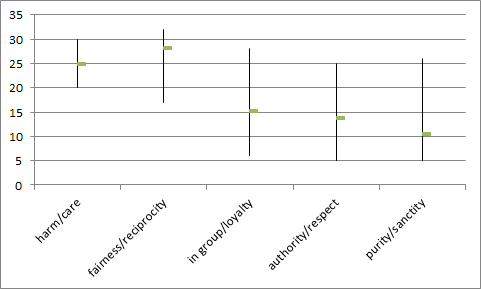
Since I also gave participants the Moral Foundations Questionnaire, I am able to say some things about the group from that perspective. This graph shows the group means and the range for their scores on the five Moral Foundations scales. For comparison, the average responses of politically moderate Americans are 20.2, 20.5, 16.0, 16.5, and 12.6. That means that my group is more concerned about harm/care and fairness/reciprocity than most Americans, and not far from average on other Foundations. But there is also a lot of diversity within the group. Two of my respondents scored 5 out of 35 on the purity scale, and two scored 20 or higher. The range was likewise from 6 to 28 on the in-group/loyalty scale.

MoralFoundations

You might think that this diversity would somehow be reflected in the respondents’ maps of their own explicit moral ideas and connections. But I see no particular relationships. For instance, one of the people who rated purity considerations as important–a self-described liberal Catholic–produced a map that clustered around virtues of moral curiosity and openness, friendship and love, and a central cluster about justice in institutions. She volunteered no thoughts about purity at all.

This respondent scored 20 on the purity scale. A different person (self described as an atheist liberal) scored 9 on that scale. But they chose to connect their respective networks through shared ideas about humility, deliberation, and justice.

The whole group did not divide into clusters with distinct worldviews but overlapped a great deal. To preserve privacy, I show an intentionally tiny picture of the current group’s map that reveals its general shape. There are no signs of separate blocs, even though respondents did vary a lot on some of the “Foundations” scales.

moralmap

A single-word node that appears in five different people’s networks is “humility.” It also ranks fourth out 375 ideas in closeness and betweenness centrality (two different measures of importance in a network). It is an example of a unifying idea for this group.

Many of the ideas that people proposed have to do with deliberative values: interacting with other people, learning from them, forming relationships, and trying to improve yourself in relation to others. Those are not really options on the Moral Foundations Questionnaire. They are important virtues if we hold explicit moral ideas and reasons and can improve them. They are not important virtues, however, if we are driven by unrecognized latent factors.

One way to compare the two methods would be to ask which one is better able to predict human behavior. That is an empirical question, but a complex one because many different kinds of behavior might be treated as outcomes. In any case, it’s not the only way to compare the two methods. They also have different purposes. Moral Foundations is descriptive and perhaps diagnostic–helping us to understand why we disagree. The method that I am developing is more therapeutic, in the original sense: designed to help us to reflect on our own ideas with other people we know, so that we can improve.

[References: Bollen, Kenneth A. 2002. Latent Variables in Psychology and the Social Sciences. Annual Review of Psychology, vol. 53, 605-634; Graham, Jesse, Nosek, Brian A., Haidt, Jonathan, Iyer, Ravi, Koleva. Spassena, & Ditto, Peter H. 2011. Mapping the Moral Domain. Journal of Personality and Social Psychology, 101:2; Haidt, Jonathan. 2012. The Righteous Mind: Why Good People Are Divided by Politics and Religion. New York: Vintage; Swidler, Ann. 2001. Talk of Love: How Culture Matters. Chicago: University of Chicago Press; Thiele, Leslie Paul. 2006. The Heart of Judgment: Practical Wisdom, Neuroscience, and Narrative Cambridge University Press.]

Embracing Behinity

Throughout the week, I’ve been reflecting on Sándor Szathmári’s great work of social satire, Voyage to Kazohinia. The work critiques a number of social institutions, but largely seems to focus on a broader question: is an ideal society one at equilibrium or one which embraces extremes?

Szathmári presents this question by introducing us, through the shipwrecked Englishman Gulliver, to two contrasting societies: the brilliant, efficient and loveless Hins and the backwards, chaotic, and destructive Behins.

Given the Hin’s complete lack of love, art, and unique character, one might be inclined to favor the mad but passionate world of the Behins, though Szathmári clearly seems to favor the ordered society of the Hins.

Following the principal of kazo – mathematical clarity – the Hins naturally act “so that the individual, through society, reaches the greatest possible well-being and comfort.” The Behins, on the other hand, are “kazi” – a term for the irrationality which captures everything not kazo.

While I have commented this week on the arguments favoring both types of communities and on reasons why we might want to force a choice between the two rather than just rejecting the premise all together, I have yet to actually answer the question for myself.

On this topic, I have found myself greatly torn.

On the one hand, the peaceful, equitable, and rational world of the Hins is clearly the more reasonable of the two societies. Nearly every logical thought argues in its favor.

Yet the Hin’s lack of art, of passion, of love seems too much to bear. It nearly seems worth sacrificing peace and equity for these peculiarities that make us so deeply human.

Furthermore, being generally inclined to favor unpopular opinions makes me want to argue for the Behinistic perspective on principle. If the kazo world of the Hins is so clearly the rational choice, the troublemaker and contrarian in me just has to push against it.

This instinct is quite clearly kazi.

Additionally, that proud desire to be kazi in the face of all reason strikes me as potentially little more than an arrogantly American trait.

One of my Japanese teachers once told me that she couldn’t understand why Americans took such pride in being individualistic. We fancy ourselves as standing up against the crowd, as being brave radicals willing to boldly buck conventional norms. My teacher just laughed. You think doing what you want is hard? Doing what’s best for others is harder.

As something of an aside here, I would be remiss if I didn’t mention that in addition to being a clever critique of western society at large, Szathmári’s novel brilliantly satirizes the west’s Orientalism.

The Hins – whose philosophy I previously compared to Lao Tzu‘s – encapsulates everything “the west” thinks of “the east.” They do not, of course, reflect any real culture existing in the world, but our English Gulliver views them exactly as he might if he had found himself among any of the real peoples of East Asia.

Gulliver comments that “the Behins respected the Hins very much even though they loathed them,” a sentiment which perfectly encapsulates Gulliver’s own attitude. He is impressed by their efficiency and technological innovations, but hates their uniformity and dispassion.

This duality epitomizes the sentiments of Orientalism, and is particularly resonant of western views of Japan around the second world war, when Kazohinia was written. It is no accident that Gulliver was being deployed to Japan when he was shipwrecked.

The Behins, on the other hand, represent the west as it is, disrobed from the vain glory in which it sees itself. One could also make a strong argument that the Behins represent eastern views of the west, but either way Szathmári seems to write in the hopes of convincing his Behinistic western audience to be a little less kazi – using our own stereotypes to highlight our failings and the true ideal we neglect.

And thus I come to my final conclusion. While I put little stock in the gross over-generalizations of cultures, whether as a product of my culture or a product of my experiences, I find myself irreparably kazi. I know rationally that the kazo life is better, but I cannot accept it; I could not survive.

Like Foucault, I’m inclined to find that madness is little more than a social construct and, like Lewis Carroll, I’m inclined to believe we are all mad here.

The whole world is kazi, and – while I’d like to work to make the world a little more kazo – I’m no less Behin than anyone else.

Ironically, it would be kazi to assume otherwise. Throughout Gulliver’s time among the Behins he finds people who rightly mock the foolish beliefs and invented norms of their kazi peers. The greatest error comes, though, when these Behins don’t recognize the same foolishness within themselves. They simply substitute one kazi belief for another.

To not recognize one’s own Behinity, then, seems the height of madness.

At the end of the novel, Szathmári tells as about a certain kind of Behin “whose only Behinity is that he doesn’t realize among whom he lives; for it could not be imagined, could it, that someone aware of the Behinistic disease would still want to explain reality to them?”

I take this as a direct appeal to the reader: having been enlightened as to the Behinistic disease and possibly identifying Behinistic traits within ourselves, we are urged to move beyond our kazi instincts and embrace the better path of kazo. The Hins, we learn, were once Behins themselves.

This is, perhaps, a wise argument, but, in typical fashion, I find myself siding with Camus. The world is indeed absurd and the only thing left is to embrace that absurdity.

facebooktwittergoogle_plusredditlinkedintumblrmail

Equilibrium vs. Extremes: Rejecting the Premise

In my post yesterday I posed a question raised by Sándor Szathmári’s Voyage to Kazohinia: Is an ideal society one at equilibrium or one which embraces extremes?

In Kazohinia – as well as in some other social satires – these opposite choices are presented as mutually exclusive; a society can not have both. Both options seem to have pros and cons: the society at equilibrium is efficient and stable, but lacking in art, love, and life in its richest sense. The society with extremes has creativity, growth, and change but also has war, poverty, and injustice.

So which is better?

I was careful yesterday not to answer this question for myself: partly out of a interest in trying to define both sides of the argument, and partly because I’m not entirely satisfied with my answer.

I will also not answer that question today, instead exploring an alternate approach. Frankly, my instinct is to reject the premise of the question – why must we see these choices as exclusive? Surely there is some way to embrace the best of both models?

That is a tempting out of this debate, and would surely be the best option. This, however, quickly leads to a host of other questions: is a balance between these models possible? What would that look like?

A core argument for an equilibrium society is that so-called good things necessarily create so-called bad things: that the existence of love intrinsically means the existence of hate. Therefore, finding a proper mix of these two social models means finding a path that allows for some close relationships while preventing apathy towards the broader populace.

You’ll note that I’ve softened the contrast here: perhaps love does not necessitate hate, but favoring some people – through the simple realities of one’s energy and resources – does seem to necessitate not favoring others. In a wealthy country where the global populations we don’t favor are starving to death in poverty, this presents a real conundrum – even if you generously assume that not favoring these populations is completely separate from issues of hate and racism.

This is exactly the issue philosopher Peter Singer tackles in his book, One World. In lecturing to his students, Singer quotes Victorian philosopher Henry Sidgwick:

We should all agree that each of us in bound to show kindness to his parents and spouse and children, and to other kinsmen in a less degree: and to those who have rendered services to him, and any others whom he may have admitted to his intimacy and called friends: and to neighbors and to fellow-countrymen more than others…

Singer comments that his students nod their heads in agreement with these words. This is the existence of love. We should love our family more than our friends, and love our friends more than strangers. One might sense a nagging doubt at these circles of concern, but on the whole it seems reasonable: we might care for humanity at large, but it seems improper and unnatural to love a stranger as much as your own child.

But while this demarcation may seem reasonable and morally valid, Sedgwick quickly goes off the rails:

…and perhaps we may say [we are bound to show kindness] to those of our own race more than to black or yellow men, and generally to human beings in proportion to their affinity to ourselves.

Singer’s students “sit up in shock.” This completely reasonable moral perspective to which they found themselves agreeing suddenly turned into a racist manifesto. Good people certainly don’t endorse that last sentence!

Singer shares this story to challenge the notion that “it self-evident that we have special obligations to those nearer to us, including our children, our spouses, lovers and friends, and our compatriots.”

His work, then, centers around answering the question, “How can we decide whether we have special obligations to ‘our own kind’ and if so, who is ‘our own kind’ in the relevant sense?”

For his part, Singer finds moral justification for preferential treatment of family members and friends:

Very few human beings can live happy and fulfilled lives without being attached to particular the human beings. To suppress these partial affections would destroy something of great value, and therefore cannot be justified from an impartial perspective.

Furthermore, while these relationships do require partiality, they may not necessarily result in the sort of broader injustice that should cause us concern. Friendships, after all:

…are stronger where there are shared values, or at least respect for the values that each holds. Where the values shared include concern for the welfare of others, irrespective of whether they are friends or strangers, then the partiality demanded by friendship or love will not be so great as to interfere in a serious way with the capacity for helping those in great need.

So there are grounds for accepting these intimate relationships. After that, though, the circles of concern break down.

I am inclined to agree with Singer in finding “few strong grounds for giving preference to the interests of one’s fellow citizens, and none that can override the obligation that arises whenever we can, at little cost to ourselves, make an absolutely crucial difference to the well-being of another person in real need.”

It is good to love ones friends and family, but nationalism is a step too far.

This all seems good and rational, but there’s something seemingly arbitrary in determining where we draw our lines. Nationalism, for example, doesn’t quite seem to capture the international biases we show in our daily lives. In the US, for example, media attention and public concern are biased first towards our own affairs, and then towards European countries we find, though some ineffable metric, to be like us. Those people we find least like us are then shown the least concern.

Singer resolves this issue by arguing that what we think of as “community” is really a made up concept. Being “American” or even “Somervillian” really just means being part of an imagined community. Building off Benedict Anderson, Singer explains:

Though citizens never encounter most of the other members of the nation, they think of themselves as sharing an allegiance to common institutions and values, such as a constitution, democratic procedures, principals of toleration, the separation of church and state, and the rule of law.

And if our nationalism is little more than an imagined community, we can, with a little effort, imagine ourselves as part of a different community. A global community.

This is an inspiring thought, but Singer has far to go in illustrating that such a thing were broadly possible. If everyone saw this as the clear moral path, one might imagine we’d have accomplished it already.

Furthermore, given the deep racial and social injustices we see within our own ‘American’ community, it is hard to imagine that we are anywhere close to collectively embracing our international identities. If our current imagined community is so narrow as to only accept people of similar race, class, ideology, and national identity, how are we ever – on a collective scale – to move beyond that?

Thus Singer’s solution leaves me somewhat disenchanted. In theory, his approach provides a map for integrating cultures of equilibrium and extreme. We ought, one might hope, to be able to love select people a little bit more, while loving the vast mass of humanity all the same. However, the mere fact that Singer has put so much effort into answering this question – and that the answer is disputable – illustrates that, even if balance is possible, it is neither easy nor self-evident.

As much as we may resist it, we may, indeed, be left with the choice: equilibrium or extremes?

facebooktwittergoogle_plusredditlinkedintumblrmail

Bridging Divides in the Methodist Church on LGBTQ Issues

As we prepare to think together about how we can bridge our nation’s divides during our NCDD 2016 conference, there’s much to be learned from the piece we’ve shared below from the Public Conversations Project, an NCDD member organization. In it, PCP’s Jessica Weaver reflects on key lessons that can be learned how the Methodist Church has been dealing with its perennial conflict about LGBTQ people in the church. You can read her article below or find the original piece here.


Three Lessons About Embracing Difficult Conversations from The Methodist Church

PCP new logoAs you may have read in the last few weeks, a deep conflict within the Methodist Church has surfaced once again. More than 750 congregations within the Church have formed the Reconciling Ministries Network, which advocates for the inclusion of LGBT people in a denomination that has barred them from being ordained, and from marrying a person of the same sex.

“It’s the perennial issue that will not go away, and for better or for worse, it’s the main battle flag issue between the liberal side of the Church and the conservative side of the Church,” said Mark Tooley, president of the Washington, D.C.-based Institute on Religion & Democracy, as quoted in the Religion News Service.

Understandably, this conversation has a history of being emotionally and politically fraught, disrupting conversations, gatherings, and relationships. The narrative I’ve noticed emerging from major media outlets about this movement is that it’s a sign of struggle, of irrevocable conflict, of failure. But I look at this story and I see something beyond a deeply emotional, and seemingly intractable conflict. I see resilience, a willingness to come to the table in the midst of deep differences, and an intentional approach, not only to the outcome of this critical discussion, but to how those conversations take place and how relationships can be preserved. Here are three strengths I think we should celebrate amidst this very difficult – and very public – divide.

1. A perennial conflict isn’t a sign of failure, it’s a fundamental reality of being part of any human community: there are differences we have to live with, not overcome.

The mainstream media has drawn out notes of exasperation in its coverage of this resurfacing issue. From within the U.S., where same-sex marriage is legalized and supported by the majority of the American public, the Church’s struggle is being criticized as backwards and behind the times. Research reveals, however, that almost two-thirds of church members accept homosexuality in society, simply not within the Church (i.e. would not want the Church to ordain someone who identifies as LGBTQ). Broader social acceptance of gays and lesbians in American society is complicated by the Church’s recent expansion into regions of the world where homosexuality is flatly banned.

In other words, it’s far more complicated than “liberals vs. conservatives,” as a number of factors are pulling factions of the church in different directions. That it is once again up for debate is not a sign of the Church’s failure to engage in a difficult conversation, or a sign that previous conversations have failed. There will always be differences in identity: in sexual orientation, faith, and relationship to scripture. What matters most is the community’s continued willingness to engage in these difficult conversations; to keep listening through the hard conversations.

2. How the conversation happens is just as important as the outcome.

Before diving into the specifics of the issue, the Church’s top lawmaking assembly (the Commission on the General Conference) decided to define a structure for discussing this divisive and often emotional issue. “We need to expand the ways that we can make decisions and be in conversation with each other,” said Judi Kenaston, the commission’s chair. The resulting “Group Discernment Process” called for smaller committees to meet and draft petitions to be submitted to a larger body of elected members. On Wednesday, however, that process was voted down.

While deep disagreements persist around how to even have this conversation, at least the “how” is being broached with intentionality and transparency. That’s not the case for so many divisive community issues. So it seems the Methodist Church acknowledges something critically important: no constructive conversation can proceed without an effective process in place.

3. “Togetherness” isn’t a monolith, and it doesn’t mean consensus.

In such a divided environment, talk of schism or splintering has inevitably arisen. Prominent leaders in the Church have openly admitted that it’s a possible outcome, especially in the midst of such a polarized age, when the “nation’s third-largest denomination and many of the political and theological divisions that divide America into its red and blue camps.” Those same leaders, and many more, are also exploring the nuances of what “unity” means and are unwilling to prematurely name the future of the Church. Said the president of the Methodist Council of Bishops, “we remain open to new and innovative ways to be in unity. We will remain in dialogue with one another and others about how God may be leading us to explore new beginnings, new expressions, perhaps even new structures for our United Methodist mission and witness.”

So what we have here is messy. It’s the hard, raw stuff of deep differences and human pain. But it’s worth noticing when public conflicts are handled with resilience and curiosity instead of posturing and accusation. This is a community struggling to remain intact and understand exactly what that means, how to reconcile individual beliefs with a community’s story. Let’s not shame them; let’s name what they’re doing right.

You can find the original version of this Public Conversations Project piece at www.publicconversations.org/blog/three-lessons-about-embracing-difficult-conversations-methodist-church.

job openings in civic renewal (11)

This is the eleventh in an occasional series.

Ford Foundation:

The overall goal of Ford’s Civic Engagement and Government (CEG) thematic area is to make civic engagement more powerful and strategic, and government more representative, responsive and accountable.

We seek one CEG Program Officer (United States) to inform work on expanding participation—promoting increased and greater representation in elections and agendas which reflect the public interest– particularly to develop a body of work focused on promoting voting rights and other aspects of non-partisan democratic practice in the US—registering voters, increased participation/debate in primaries, connecting voting to issues people care about– and contributing to efforts on to reduce the undue influence of money in politics; and develop/test/demonstrate models of powerful civic engagement with governments in the US.

We seek a second CEG Program Officer (Global) to inform work on encouraging development of more progressive tax and budget systems; advancing fairer frameworks/specific proposals for reducing global tax avoidance; and building legitimacy of civil society in communities globally and testing models of powerful civic engagement with government.  The Global CEG Program Officer will also help link the CEG work of Ford’s eleven offices globally and engage in relevant global platforms in a manner which draws in voices and perspectives from the Global South. See www.fordfoundation.org/careers

Everyday Democracy:

Everyday Democracy, a national leader in civic participation and community change, works to strengthen democracy in neighborhoods, towns, cities, states and the United States. We have more than 25 years of experience working with grass-roots organizers and public officials to bring people together to talk about and work on critical public issues, using a racial equity lens.

We are seeking a full-time Associate for the Evaluation and Learning Unit. This position works closely with the Director of Evaluation and Learning to implement the primary functions of the Evaluation and Learning unit. This person contributes high level evaluation thinking and skills to the team in support of the organization’s mission and goal. Job description here.

Street Law, Inc.

Street Law is now seeking qualified applicants for a Program Director to implement our Legal Diversity Pipeline Programs with law firms and corporate legal departments.

The Florida Joint Center for Citizenship

The FJCC is looking for an Action Civics Coordinator!

The Lou Frey Institute at the University of Central Florida is recruiting a fulltime instructional specialist in civics education. The individual in this position will be based in the institute’s Orlando office and will coordinate and support action civics programs for the Florida Joint Center for Citizenship (FJCC) – a
Lou Frey Institute/Bob Graham Center partnership. The action civics coordinator will be responsible for working with K-12 districts, schools and teachers throughout Florida to implement service learning and other active civic learning initiatives. This position will also manage the institute’s partnership with Kids Voting and will support statewide mock elections. The individual in this position will work as part of a team to design and deliver professional development that supports classroom implementation of a wide range of active civic learning strategies. Long-term outreach and support for
individual schools – including low performing schools – may be required.

Diversity, Equality, and Realignment

Though we like to think of political parties in the US on a single dimension, this obviously doesn’t capture the true range of political views. Yet even though we can conceive of massively more multifarious policy differences than this, only two dimensions explain the vast majority of political behavior in the US: one largely concerned with the distribution of economic resources and another with the treatment of African-Americans and other racial minorities.

Yet even the four permutations of these views are too many to perfectly represent within the US’s two viable political parties. The US political system seems almost to have been designed so that most citizens will hate the dominant political parties, and thus find politics vaguely distasteful.

Big Tents and Third Party Spoilers

Why should this be so? Why not have three or four parties, to segregate those dimensions or hit all the possible permutations? It is a truism that the US electoral system requires two big-tent parties, but that’s not quite right. What’s true is that the system has very strong incentives in place to encourage party elites to find a way to force very different interests to share policy goals and ideology: a third party will tend to disempower its voters by splitting its big tent, as famously happened at the outset of the Civil War and during the salad days of the Progressive Movement. Yet for some policy issues, such a split may not be avoidable!1

What’s more, the US political system has pretty good methods for allocating voters to its two main political parties in roughly equal numbers. Like your favorite sports league’s revenue sharing or draft-picking arrangements, the party system tends to reward short-term victories with unsatisfiable constituencies that undermine the party’s lead, which produces future upsets and reversals. Incumbency advantages turn into incumbency fatigue; midterm elections draw different demographics than presidential elections; victorious parties engage in divisive self-destruction over exactly which part of the big tent will dominate.

A Party for the Anti-Political Majority

Yet there are hints (if not evidence) that this may be changing, in a way that is partly inspired by the rise of Donald Trump and partly contributed to that rise. Voter turnout has been stuck below 60% of the voting age population since 1968, and is even lower in primaries, so a candidate who can get out the vote from a unique part of the demographics of his party or the nation has a strong chance of surprising us, as Trump did.

Jason Stanley called attention to the particular role of Trump’s demagoguery in reorienting the primaries last October:

But there is a way a politician could appear to be honest and nonhypocritical without having to vie against other candidates pursing the same strategy: by standing for division and conflict without apology. Such a candidate might openly side with Christians over Muslims or atheists, or native-born Americans over immigrants, or whites over blacks, or the rich over the poor. In short, one could signal honesty by openly and explicitly rejecting what are presumed to be sacrosanct political values.

Trump, it seems, carries the promise of engaging the previously disengaged, those who have no stomach for politicians’ attempts to preserve a big tent by mobilizing disparate interests together. It’s difficult to pretend that business interests and “values” voters have much in common, and that you are adequately representing both without preference. Voters are smart enough to see through those efforts, if not willing to recognize the structural reasons why American politicians continue to try to straddle those fences.

There are always disaffected voters who give up on both parties. Usually, neither party can figure out how to reliably get out the vote from these truly independent voters while keeping the support of its base. These voters are largely mythical in third-party bids and usually for in-party insurgencies as well, but the idea that disaffected voters could show up at the polls in large numbers and destroy all the pollsters “likely voter” modeling is tenacious. We know it’s possible, and that when it happens we see surprisingly anti-establishment results. As the political participation of disaffected, unrepresented voters drops, this reserve army of the unallied gets bigger. It’s especially potent in party primaries, which are very low turnout events.

My suspicion is that if a group of disaffected voters could be reliably re-engaged, the parties would likely find wedge issues to divvy them up over a relatively short set of elections. But they may well divvy them up differently than the parties had previously done. This would be the seed of a realignment.

Party Platforms are Contingent; So Is the Meaning of “Liberal” and “Conservative”

How far could this go? We frequently joke that the Republican Party switched places with the Democratic Party between the Civil War and the passage of the Civil Rights Act. But so many of the relevant policy questions are different that this has always been a bit inexact.

Far too many of my friends and colleagues believe that there’s a natural connection between cosmopolitan attitudes towards other races and cultures and egalitarian economic preferences. There really isn’t; in fact, there’s just as often a tension! Terms like Republican and Democrat and conservative and liberal are free-floating signifiers that don’t really track particular policy preferences or ideologies over time.

Just one example: there’s a whole host of people who think that government should not offer certain sorts of assistance that they call “welfare.” But what they mean by “welfare” varies a lot, includes and excludes a lot of different services and cash transfers and tax treatments. Worse still, many people who oppose “welfare” think that the same program is justified or unjustified based on who will get it, and don’t think that their brother-in-law’s disability check is welfare while a stranger’s disability check is, nor see their home owner’s tax credit as similar to a poor person’s food stamp support.

The same thing goes for the Affordable Care Act: many of the Republicans who oppose it (and have voted to repeal it repeatedly) want to abolish something they call “ObamaCare” and replace it with an almost exactly identical program (i.e. RomneyCare). So at least for the vast plurality of Republicans elected to federal office, it’s clear that what is at stake is not a real difference in thinking or policy preference, but rather a partisan fight over votes which everyone is pretending is actually a deep ideological difference.

What we know is that we and our fellow citizens tend to seize on a few policy issues that matter to us, select a party on that basis, and then adopt a lot of the other policies of that party as equally important. This gets odd when the parties change policy positions (for electoral reasons) and partisans change their own views as if these things were demanded by rationality (often backdating their new policy beliefs as if they hadn’t changed at all) rather than merely a response to politicians competing for votes.

So while historically we can observe both massive and bipartisan shifts around specific policies (remember when the Democratic Party opposed same sex marriage?) and realignments (remember when the Republican Party was the party of Lincoln and Black people?) it is quite obvious that many people don’t have an accurate phenomenological or narrative account of what is happening in the moment. We think in terms of urban and rural, in terms of our neighbors and our transportation preferences and our religious traditions.

It’s a unique kind of privilege to be able to maintain strong coherence between our different beliefs, and indeed it’s actually presumptuous to pretend that only a couple of coherent ways to hold these beliefs together.

Realignment May Be Unpredictable But Formulaic

We may not know when a realignment has arrived, but we do have some information on what it is likely to do when it does. Jennifer N. Victor from Vox’s Mischiefs of Faction blog detailed a famous theory of party realignment to try to explain why Trump and Sanders were doing so well against more traditional candidates, bringing attention back to the 2003 paper by Gary Miller and Norm Schofield detailing shifts in party policy platforms. Here’s Victor’s gloss:

the party that loses an election has a strong incentive to try to peel away voters from the winning party. This is how a party grows its coalition to win in the next round. The party does this by taking policy positions that appeal to voters who may only weakly identify with the winning party. Think of these voters as the ones at the edges of the cleavage lines.

So losing leads to strategizing and better political competition for ignored voters at the winning party’s “rump,” which leads to winning. If one party’s “big tent” gets too large, the other party finds an opportunity to compete for some of the voters whose policy goals have been most ignored.

Yet neither party has had to actually compete for unallied voters for the last twenty-five years or so. They’ve been depending instead on GTFO efforts and incumbency-fatigue to restore them to power. This is why the Republican party has spent the last three decades working on “fusionism” to combine conservative Christianity with business-oriented small-government rhetoric. The Democratic party has spent those same three decades trying to keep mostly-white-male working class voters together with urban minorities and rich cultural cosmopolitans.

Thus the “clockwork” of party realignment has been momentarily frozen, and we can’t even say if we are now in one or if both parties will simply revamp their rule to prevent insurgencies in the future. Yet if we are in a realignment period, the model predicts which “side” will be the rump:

Miller and Schofield show that this cleavage line rather naturally rotates in a clockwise fashion across time. Bill Clinton broke up the previous partisan alignment when he proposed more conservative economic policies, like those of the cosmopolitans, moving the Democratic coalition from the liberal position more to the cosmopolitan one.

The “clockwise” directionality comes from a supposedly natural movement of the cleavage line in this chart over time:

Party Realignment

So we should expect that the Republicans will lose cosmopolitan pro-business types represented by the likes of Michael Bloomberg, while the Democrats will lose the remaining supply of white men without college degrees who are economically liberal but “socially” conservative (here meaning: they are anti-diversity.) And indeed, this is basically what seems poised to happen.

The fact that state support for the poor and working class is orthogonal to the state’s treatment of African-Americans and other racial minorities is certainly vexing: it seems to extend from the American experience with slavery and persistent white supremacy, yet we see similar trends in Europe towards immigrants and Jews. But the key here is that attitudes towards racial difference just are unmoored from attitudes towards the distribution of economic assets among whites, and so we need these two dimensions (and yet oddly: not much more than that) to explain most of American political behavior, especially in the legislature.

There Will Always Be Elites; Who They Are Matters

Freddie deBoer is also thinking about realignmnent:

Today, there is a least an ostensible connection between the liberalism of diversity and the leftism of equality. Tomorrow, even that thin thread might be cut forever, and so much the worse for us.

Basically, deBoer imagines a future where the boot forever stomping on the face of humanity is gender equitable and racially diverse. But what if having a more Black or female Senators–or a Black President–isn’t necessarily better for that President’s or Senator’s female or Black constituents?
The impetus of deBoer’s piece seems to be this zinger of a tweet from Dan O’Sullivan):

“Our political future: a snakepit of insane fascists on one side, & on the other, a Wall Street party that’s culturally liberal & nothing more.”

I think this is really the crux of deBoer’s piece, as an elaboration of that perfect tweet, and I think there’s something odd about it. Is it possible for realignment to turn today’s educated leftists into completely alienated voters with no party to support at all? As I’ve tried to show above, the answer is probably not: one or another party will almost always have something to offer the educated people who currently self-identify as Leftists. If Democrats really start leaving the Left, the Left will learn how to get along with nationalists and chauvinists, like they did when nationalists and chauvinist were running labor unions. And perhaps this is where the oddness in deBoer’s view emerges:

“The entire purpose of the elite-building mechanisms of our country is to keep that elite small. There’s only room for 1% of people within the 1%, after all.”

Every society has a top 1%, whether it’s the billionaire class or the Politburo. It has been the case that the people with the PhDs were among that class of elites, but not recently. It’s an open question who the elites should be. It’s historically been the case that US elites were white men, and while that’s changing, it’s not actually changed very much yet. Harvard, Yale, Princeton, and Stanford will achieve truly representative diversity, but without expanding their first year classes. Perhaps tomorrow’s elites will be truly representative of the rest of the country.

It’s also an open question for political debate how much better off the elites should be than the people below them: I tend to favor egalitarian distributions of well-being, myself, but I recognize that there are lots of people who disagree, and for something approaching good institutional reasons. Specifically, the existence of a top 1% doesn’t actually tell us anything about the material conditions of the bottom 99%.

There’s good reason to believe that social justice work to ensure diversity has largely helped contribute to what Deirdre McCloskey calls the Great Enrichment. The American 99% are much better off than most precisely because we have been forced to diversify both our elites and our middle-class. We can expect to reap further wealth gains if we continue to diversify our elites, so we obviously should.

US Political Parties Could Be Better

A few things follow from all this. First, it seems highly desirable to have two healthy, reasonable parties at all times. Constitutional hardball is dangerous in a way that threatens to shatter the conditions of possibility for our overt disagreements. Yet the best evidence suggests that the Republican Party has been growing increasingly extreme for almost twenty years. This is easy for opponents to celebrate, as it tends to render Republican politicians and Republican voters less effective at making progress on their policy goals, and might well help Democrats win in November. But in the medium and long-term, it’s deeply unstable (it has already been destabilizing.) The survival of a political order has to be compatible with either party losing elections.

Second, the ideal should not be to have a permanent victory that utterly destroys the other party; we should aspire to the Aaron Sorkin West Wing fantasy of principled idealists representing the divergent but reasonable views of the Good Life and the Good Society. Reasonable pluralism is better than a fragile modus vivendi; deliberative disagreement that preserves the possibility of compromise and collaboration is better than dirty tricks and pitched winner-take-all political battles.2

The problem, of course, is that without a healthy and rational opposition party, we’re going to have a hard time living up to that fantasy of democratic deliberation.

Economic Equality and Nationalism

Insofar as nationalism in the US is understood as a kind of jingoistic, nationalist chauvinism–a defense of the traditional perquisites of white men–we will all be better off and richer insofar as the political parties can find a way to preserve the disaffection and disengagement of the anti-diversity voters.

Politicians and pundits shouldn’t court them, even with coded language or some account of what their “true” interests and resentments are. But they will. (Perhaps some of the reactionaries are coalescing around the financial crisis, but then why not vote for Bernie Sanders instead of Donald Trump, who claims to be a billionaire?) Trumps’ supporters aren’t the folks who lost their jobs to the financial crisis; they’re the long-term unemployed who fell out of the economy long before: the unnecessariat:

This is the world highlighted in those maps, brought to the fore by drug deaths and bullets to the brain- a world in which a significant part of the population has been rendered unnecessary, superfluous, a bit of a pain but not likely to last long. Utopians on the coasts occasionally feel obliged to dream up some scheme whereby the unnecessariat become useful again, but its crap and nobody ever holds them to it. If you even think about it for a minute, it becomes obvious: what if Sanders (or your political savior of choice) had won? Would that fix the Ohio river valley? Would it bring back Youngstown Sheet and Tube, or something comparable that could pay off a mortgage? Would it end the drug game in Appalachia, New England, and the Great Plains? Would it call back the economic viability of small farms in Illinois, of ranching in Oklahoma and Kansas? Would it make a hardware store viable again in Iowa, or a bookstore in Nevada? Who even bothers to pretend anymore?

By linking education to jobs in the way that we have, we’ve guaranteed that a large number of our citizens will not be qualified for the majority of dignified work. It’s hard not to fault their resentment, even as it seems misguided for failing to understand a hypothetical Kaldor-Hicksian analysis of their error.

The whole problem is that the loss of dignified work is concentrated among people who can’t readily understand such arguments. This allows us to pretend that the correlation between education and income is noble and meritocratic without challenge. But in fact, we’ve installed an invidious systematic bar to recognizing the real pain of poor people without college educations, especially men. We hold out the promise of both self-sufficiency and effective citizenship only to those who can jump through all the hoops between kindergarten and a Bachelor’s degree.

In the best of all possible worlds, maybe both parties would ignore anti-diversity interests and find a way to make economic policies that reduce racist and sexist resentments. That’s right: I’m suggesting that maybe we should not hope for 100% political participation, at least insofar as that requires that white supremacists and chauvinists find viable politicians who will court them openly. In the second-best world, both parties would court the anti-diversity vote while remaining conveniently but systematically paralyzed in the realization of their anti-diversity policy preferences, and thus blunt their power.

Yet with Trump poised to run as a populist nationalist demagogue explicitly recognizing and courting this demographic, it may already be too late even if he loses. The neo-reactionary movement will become self-aware and have a single partisan home.

So in the third-best world we actually inhabit (or is it even worse than that?), the uneducated white vote (call them George Wallace Democrats) is lost to the Democratic Party. Miller and Schofield point out that this had already mostly happened by 1996, and called it “The Decline of Class and the Rise of Race.”

Perhaps deBoer shouldn’t worry so much: if the clockwork thesis continues to hold up, we should expect the next few elections to reverse the focus on race and develop conflicts along the very dimensions of class inequality that the Left has championed. Soon the Republican Party should begin courting disaffected economic liberals who are willing to overlook the party’s racism. In fact: they’re ahead of schedule:

Trump: GOP will become “worker’s party” under me


1. Of course, there were actually four serious parties competing in the 1860 election before the Civil War. If there had been three, though, the result would have been quite different. Both the Republican and Democratic parties’ inability to ally behind a single candidate because of regional differences over slavery and unity produced not two but four Presidential candidates. Lincoln’s victory was thus mostly a matter of chance, and indeed Stephen Douglas and John Bell together–both “centrists” convinced that avoiding the slavery issue could stave off secession–received more votes than Lincoln did, as many Southerners preferred union to secession. With their influence split, one of the more radical parties was victorious; but it could have gone differently.
2. I’m being inexact: what I’m describing could easily be understood as simply a much more desirable modus vivendi than our current equilibrium between neoliberalism and nationalism.