Register for IAP2 Trainings from the Participation Company

Our friends at the Participation Company are offering three great trainings this year, all of which NCDD members can get a discount on! The trainings are given within the International Association of Public Participation (IAP2) framework and are a great opportunity to earn an official IAP2 certification. Learn more about the trainings in the announcement below or by clicking here.


Upcoming IAP2 Training Events in 2015-16

If you work in communications, public relations, public affairs, planning, public outreach and understanding, community development, advocacy, or lobbying, this training will help you to increase your skills and to be of even greater value to your employer.

This is your chance to join the many thousands of practitioners worldwide who have completed the International Association for Public Participation (IAP2) certificate training.

Foundations in Public Participation certificate program (5-Day):

PLANNING for Effective Public Participation (3-Days) and/or *TECHNIQUES for Effective Public Participation (2-Days).

  • December 14-18, 2015 Chicago, IL     Trainer: John Godec
  • February 1-5, 2016 Arlington, VA      Trainer: Doug Sarno

*The 3-Day Planning is a prerequisite to TECHNIQUES

Learn more about the Foundations training and registration clicking here.

Emotion, Outrage and Public Participation (EOP2): Moving from Rage to Reason (2 days):

  • October 28-29, 2015 Orlando, FL     Trainer: John Godec

Learn more about the EOP2 training and registration by clicking here.

The Participation Company (TPC) offers discounts to NCDD members. Visit www.theparticipationcompany.com/training for more information and on-line registration.

The Pope and Civic Studies

In Laudato Si', the climate encyclical, Pope Francis challenges a narrow view of science and technology called positivism which holds that sound knowledge involves standing "outside" the world. In recent years, I have been involved in a parallel effort called "civic studies."

Positivist philosophers argue that a particular view of science, resting on the discovery of permanent, atemporal standards of rationality that can be found and then applied, forms the basis for sound knowledge. Scientific method is purported to be pure, its aim is to find abstract, universal truths "out there" that can be brought back to enlighten the masses, like the philosopher king returning to Plato's cave. Positivism assumes the detached, rational observer as the highest judge of truth and the most effective problem solver.

Even though it has long been challenged philosophically, as I argued in an essay some years ago in Academe, positivism continues to structure much of higher education's research, our disciplines, our teaching, and our institutions. It is like a genie that academia let loose long ago, now lurking below the surface and threatening our destruction.

Faculty members and other educators often undergo an insidious socialization, especially in graduate school, learning a stance of ironic detachment from our fellow citizens, seeing ourselves outside what the settlement house leader Jane Addams called "the common lot." The image of the detached and objective scholar and teacher leads to the expert stance of "fixing problems," "discovering truths," and "dispensing knowledge."

In his educational manifesto, The Courage to Teach, Parker Palmer has vividly described the human cost. "This mode...portrays truth as something we can achieve only by disconnecting ourselves, physically and emotionally, from the thing we want to know...The subjective self is the enemy most to be feared--a Pandora's box of opinion, bias, and ignorance that will distort our knowledge once the lid flies off."

In 2007 a group of us including Stephen Elkin, Peter Levine, Jane Mansbridge, Elinor Ostrom, Rogers Smith, Karol Soltan, and myself brought together by the journal of engaged political theory, The Good Society, launched civic studies as an interdisciplinary field. Civic studies emphasizes humans as agents and citizens as co-creators of communities at different scales. Tufts University's Tisch School of Citizenship is a host for many of our materials, including the framing statement and the curriculum for the Summer Institute of Civic Studies, each year organized by Levine and Soltan.

In 2009 Ostrom won the Nobel Prize in Economics for the work she and her husband Vincent, working with an international group of researchers, had done on citizen-centered governance of common pool resources like irrigation systems, forests, and fisheries.

Civic studies is a movement to challenge detachment. We seek to reintegrate what the modern world and theories of knowledge based on the stance of being "outside the world" have split apart.

In particular civic studies emphasizes that we all are citizens. As Levine puts it in his essay "The Case for Civic Studies," "scholars [are] citizens, engaged with others in creating [our] worlds...accountable for the actual results of their thoughts and not just the ideas themselves."

Levine points to far-ranging implications for education and higher education. He argues that it is a mistake to make sharp distinctions between disciplines based on "facts," such as natural and social sciences, disciplines based on "values," such as the humanities, and disciplines based on strategies for action, such as the professions. All, from a civic studies perspective, should aim at improving our capacities to act collectively, effectively, and ethically.

We draw on relational strands of science, as well as other fields. Thus Barbara McClintock, the Nobel Prize winning biologist who laid foundations for modern genetics, based her method on positing the interdependent and relational qualities of all living organisms. For McClintock, her own relationship to the object of study was as important as the relationship genes had with each other. "Over and over again, she tells us one must have the time to look, the patience to 'hear what the material has to say to you,' the openness to 'let it come to you," said her biographer Evelyn Fox Keller. "Above all, one must have 'a feeling for the organism.'"

A similar science also is found in experimental psychology that emphasizes humans as unique, relational agents of their development even in early childhood. Infants create ideas drawing from diverse sources, as they seek and learn to shape their environments. This science points toward an open, dynamic concept of contexts and of the humans who make them.

The late Esther Thelen pioneered in such science. Thelen's science was based on a relational, interactive, emergent understanding of complex systems and how to theorize them. She challenged views of infants as passing through predetermined "stages" of development. Thelen argued instead that infants are experimental, self-realizing agents, profoundly relational and interactive with their contexts.

Drawing on many of her experiments, a group of former students and colleagues concluded that infants are constantly assembling holistic patterns, such as reaching or walking, out of many elements, including testing, perceiving, feedback, and experimenting with ideas. "[An] integration of body and mind is a fundamental characteristic of all goal-directed activities," they argued. "Thought is always grounded in perception and action."

Laudato Si' and the civic studies movement both seek a reintegration of body and mind.

We both also seek to reconnect educators and citizenship.

The Pope and Civic Studies

Civic studies is a movement to challenge detachment. We seek to reintegrate what the modern world and theories of knowledge based on the stance of being "outside the world" have split apart. Laudato Si' and the civic studies movement both seek a reintegration of body and mind.

The Pope and Civic Studies

Civic studies is a movement to challenge detachment. We seek to reintegrate what the modern world and theories of knowledge based on the stance of being "outside the world" have split apart. Laudato Si' and the civic studies movement both seek a reintegration of body and mind.

Participatory Budgeting in La Marsa, Tunisia

Author: 
Summary Participatory budgeting (PB) in Tunisia has been implemented in four municipalities, La Marsa, Menzel Bourguiba, Tozeur and Gabès. This case will focus on La Marsa, as there is very little information on the use of PB in other municipalities. The PB in La Marsa began in 2014 and is...

St. Margaret of Cortona and medieval populism

Screen Shot 2015-07-27 at 9.55.07 AM

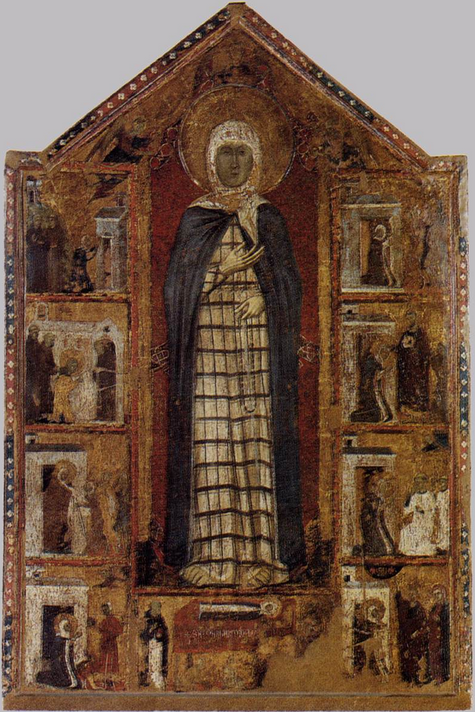
This is highlight #3 from our recent vacation in Italy. St. Margaret of Cortona was a remarkable person–more on her in a moment. The picture is a narrative of her life painted around 1298, or just one year after she died. She wasn’t canonized until 1728. In her own community of southeastern Tuscany, she was treated from the moment of her death (and perhaps even while she was still alive) as a saint to be venerated and depicted on par with St. Clare or St. Agnes. A major local church was immediately renamed in her honor, and her mummified body was placed under its altar. Those actions offer insights into medieval Catholicism, which was much more populist and decentralized than we assume on the basis of recent centuries of Church history and governance.

Margaret’ story would work for a novel (and has inspired an opera and a film). A beautiful peasant girl, she quarreled with her stepmother and ran away to live in sin with a nobleman in his castle. One day, his most loyal hound returned alone from the hunt and led Margaret to the scene of his death at the hands of a murderer. Deeply shaken, Margaret became a Franciscan sister, thus joining the most radical and compelling  religious/political movement of the era. She swore personal poverty but may have used her ex-lover’s wealth for philanthropy; we know that she obtained the resources to found a hospital and a convent. No wallflower or passive penitent, she twice challenged the bishop of Arezzo for acting like a warlike lord instead of a man of God. Her example and the force of her thought and personality must have resounded powerfully.

The post St. Margaret of Cortona and medieval populism appeared first on Peter Levine.

Future Search Learning Exchange Offers NCDD Discount

The Future Search Network, an NCDD member organization, recently shared the opportunity for NCDDers to get a great discount on two workshops they are offering later this year. These two workshops will be offered this Aug. 17-23 in Berlin, Germany and again from Dec. 7-11 in Philadelphia, PA. The early bird deadline ends August 4th for NCDDers, so make sure to register ASAP. You can learn more from the FSN announcement below.


FutureSearch-logo

The Annual Future Search Learning Exchange

We hope you can join us! Future Search has events scheduled for August in Berlin, Germany and for December in Philadelphia, PA.

The theme of this year’s Learning Exchange is “Working With Future Search to Address our World’s Challenges”.

The Learning Exchange is for anyone who is interested in applying Future Search principles in their work and their lives – not only for those who regularly lead Future Searches. This event is open to members of the Future Search Network and to practitioners working with the principles of Future Search across other large scale, whole systems approaches to change.

As always, the Learning Exchange is your opportunity to:

  • Meet Future Search practitioners and advocates and hear their stories
  • Share your experience of Future Search and exchange ideas
  • Learn about what we are doing as a Network around the world
  • Reflect on who we are touching through our work
  • Explore how people are using the principles and philosophy of Future Search in meetings of all sizes, every day
  • Re-energize your practice and yourself, and have fun!

***We will extend both workshop early registration rates to August 4th for NCDD Members – SAVE up to $700 on tuition!*** 

The Learning Exchange will include two separate workshops in both locations. Here are the details on both:

Managing a Future Search – a Leadership Workshop
August 17-20, Berlin, Germany
December 7-9, Philadelphia, PA, USA .

This workshop is for leaders and facilitators who want to learn how applying Future Search principles and methodology enables an organization or community to transform its capability for action. You will experience this highly successful strategic planning method used worldwide by organizations and communities for social, technological and economic planning.
Learn more & register

Lead More, Control Less – a Master Facilitation Class
August 22-23, Berlin, Germany
December 10-11, Philadelphia, PA, USA

Based on the upcoming new book by Sandra Janoff and Marvin Weisbord, “Lead More, Control Less: 8 Advanced Leadership skills that Overturn Convention”. Learn about personal and structural issues for leading interactive meetings. Explore the realms of practice beyond traditional models, methods and techniques.
Learn more & register


The Pope and Civic Studies

Civic studies is a movement to challenge detachment. We seek to reintegrate what the modern world and theories of knowledge based on the stance of being "outside the world" have split apart. Laudato Si' and the civic studies movement both seek a reintegration of body and mind.