New IDS Journal – 9 Papers in Open Government

2016-01-14 16.51.09_resized

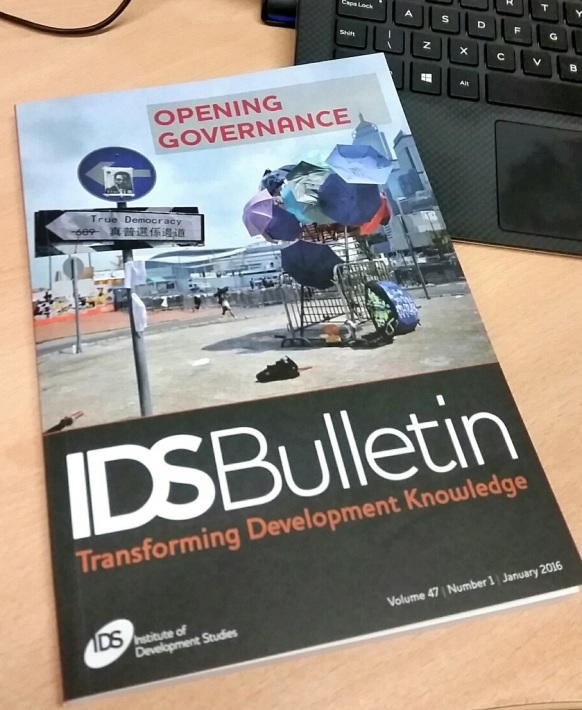
The new IDS Bulletin is out. Edited by Rosemary McGee and Duncan Edwards, this is the first open access version of the well-known journal by the Institute of Development Studies. It brings eight new studies looking at a variety of open government issues, ranging from uptake in digital platforms to government responsiveness in civic tech initiatives. Below is a brief presentation of this issue:

Open government and open data are new areas of research, advocacy and activism that have entered the governance field alongside the more established areas of transparency and accountability. In this IDS Bulletin, articles review recent scholarship to pinpoint contributions to more open, transparent, accountable and responsive governance via improved practice, projects and programmes in the context of the ideas, relationships, processes, behaviours, policy frameworks and aid funding practices of the last five years. They also discuss questions and weaknesses that limit the effectiveness and impact of this work, offer a series of definitions to help overcome conceptual ambiguities, and identify hype and euphemism. The contributions – by researchers and practitioners – approach contemporary challenges of achieving transparency, accountability and openness from a wide range of subject positions and professional and disciplinary angles. Together these articles give a sense of what has changed in this fast-moving field, and what has not – this IDS Bulletin is an invitation to all stakeholders to take stock and reflect.

The ambiguity around the ‘open’ in governance today might be helpful in that its very breadth brings in actors who would otherwise be unlikely adherents. But if the fuzzier idea of ‘open government’ or the allure of ‘open data’ displace the task of clear transparency, hard accountability and fairer distribution of power as what this is all about, then what started as an inspired movement of governance visionaries may end up merely putting a more open face on an unjust and unaccountable status quo.

Among others, the journal presents an abridged version of a paper by Jonathan Fox and myself on digital technologies and government responsiveness (for full version download here).

Below is a list of all the papers:

Rosie McGee, Duncan Edwards
Tiago Peixoto, Jonathan Fox
Katharina Welle, Jennifer Williams, Joseph Pearce
Miguel Loureiro, Aalia Cassim, Terence Darko, Lucas Katera, Nyambura Salome
Elizabeth Mills
Laura Neuman
David Calleb Otieno, Nathaniel Kabala, Patta Scott-Villiers, Gacheke Gachihi, Diana Muthoni Ndung’u
Christopher Wilson, Indra de Lanerolle
Emiliano Treré


Private and Public Voting

So here’s a fun thing. At the Iowa Caucuses next week, following the discussion and speeches for candidates, some voters will cast a secret ballot while others will vote publically.

In a caucus setting, with its ideals of community and dialogue, a public vote doesn’t seem too jarring. Yet – it is a little strange. Voting, in this country, is almost synonymous with a private act.

So why the divide in private and public voting at the caucus?

Well, first of all – regardless of how you feel about the ideological differences of the parties – they are in fact different organizations. Each party has their own infrastructure, history, and traditions.

We often forget this as we consider them two halves of the same whole – but the simple truth is that at Republicans have a private caucus ballot while Democrats do not because the parties evolved separately and have different bureaucratic structures.

Interestingly, most voting in the U.S. used to be done publicly – and out loud. Amidst what I can only imagine was great fanfare amongst the old boys’ network, voters would cast their vote by publicly announcing their candidate preference.

Your neighbors knew who you were for and you knew who your neighbors were for. Party pride ran high.

Of course, corruption was also rampant, as – pre-prohibition – voters were often rewarded with alcohol.

The so-called “Australian ballot” – a secret ballot printed at the public’s expense – didn’t become popular until the late 1800s. It was first, adopted, of course, in Massachusetts.

The secret ballot didn’t become universal in the U.S. states until 1892. …and prohibitions against paying people for votes weren’t instituted until 1925.

facebooktwittergoogle_plusredditlinkedintumblrmail

The Value of Work — Reflections on Building an Interracial Political Coalition

Last Sunday, January 17, in a sermon, "Prophecy and Politics," for Martin Luther King Day at Prospect Park United Methodist Church about my experiences as a young man in the civil rights movement, I addressed prejudices against working class whites.

My experiences in the civil rights movement made me conscious of such prejudices, especially among progressive professionals.

Martin Luther King, for whom I worked as a young man in the movement, was also aware of them -- and also deeply political in the older sense of politics, engaging the interests and perspectives of one's opponents. This led to understanding white prison guards whom many liberals saw simply as racist. As he put it in the "Drum Major Instinct" in 1968,

"When we were in jail in Birmingham the other day, the white wardens [came to] the cell to talk about the race problem. And when those brothers told me what they were earning, I said, 'Now, you know what? You ought to be marching with us. You're just as poor as Negroes! The same forces that oppress Negroes oppress poor white people.'"

Politics like King's were at the heart of the grassroots "organizing" parts of the movement. When King assigned me to do community organizing among poor whites, I took these lessons about politics from King and others into the white mill village of East Durham.

Certainly I saw racial prejudice, which I also knew from my extended working class southern family. I also saw people like Basie Hicks, the community leader in East Durham who battled racial prejudice her whole life. She chased away the Klu Klux Klan when they came after me.

I also saw capacity for generosity. After people experienced collective power, when we were able to get action from the city on dirt streets, the neighborhood made connections with the black community across the tracks. I realized that narrow prejudices among poor whites often are rooted in powerlessness.

Perhaps most important, I saw the dignity and value of hard work, and also the invisibility and even contempt liberal professionals had for such work.

This was a community of mill workers and hair dressers, secretaries and police. People's identities drew from their sense that they made contribution to their families and also to their communities and the society. We got a glimpse of such grit and spirit on 9-11, when police and firefighters rushed into the collapsing buildings.

But more generally, blue collar work is devalued, and along with it blue collar workers. This was true in my experiences in organizing. Teachers across the street from Edgemont, the mill community, were very condescending toward "mill kids." At Duke, when I described the people in East Durham, faculty would ask, "Why in the world are you working with racist rednecks?"

Work, itself, especially manual work, has become even more an object of prejudice today. In Getting the Left Right, the political scientist Thomas Spragens shows how respect for work and working people among progressives in America has declined since the 1930s, replaced with pity for the poor. In a similar vein, Mike Rose in The Mind at Work shows the hidden intelligence and creativity at play in many different kinds of blue collar labor, from waitresses and hairdressers to plumbers and welders. He also shows the invisibility and devaluation of such labor across the popular culture.

Such devaluation has large cultural, psychological and political effects. Barbara Ehrenreich observes in the Nation that while blacks face harsh discrimination, they sometimes fare better in the popular culture:

"At least in the entertainment world, working-class whites are now regularly portrayed as moronic, while blacks are often hyper-articulate, street-smart, and sometimes as wealthy as Kanye West."

Last year Anne Case and Angus Deaton won the Nobel Prize in economics through research that discovered working class white men 45- to 54-years old are the only group in America with declining life spans.

Declining respect as well as stagnating wages and loss of many blue collar jobs are the discontents which demagogues play upon with their divide and conquer strategies. Timothy Egan in his New York Times column, "Giving Obama His Due," last Saturday showed how liberals contribute through their stereotypes. He describes supporters of Trump as "xenophobers, defeatists and alarmists, the Eeyore Party with a Snarl." Not a hint of the idea that they may have legitimate grievances.

Though they may be objects of solicitude from professionals and in the mass culture, blacks, as well as working class whites, experience such devaluation.

There may well be grounds here for a new interracial political coalition that reaffirms the dignity and the value of work and working people.

Register for Feb. Tech Tuesday Event feat. Balancing Act, co-hosted by IAP2!

Registration is now open for a special Tech Tuesday event co-hosted by NCDD and IAP2, featuring the platform Balancing Act. Join us for this FREE event Tuesday, February 9th from 3-4pm Eastern / 12-1pm Pacific.

balancing-act-logoBalancing Act is a tool for learning about public budgets and the choices elected officials face in the budgeting process. It allows participants to try allocating funds – expressing their priorities and preferences – but also requires them to balance spending and revenue. Balancing Act brings people and government officials closer together in an informed conversation about what priorities are in everyone’s best interests. Because it is online, it is accessible to anyone at anytime and is far more convenient than a traditional public meeting or budget hearing.

Balancing Act was created by Engaged Public, a public policy consulting firm specializing in engagement-driven strategies. On this call we will be joined by Chris Adams, President of Engaged Public, who will tell us more about Balancing Act and how it has been used by governments and communities. Chris will also highlight its application for participatory budgeting efforts and talk about a special offer for participatory budgeting projects.

This tool is available for cities, counties, school districts, libraries, non-profits, states and others, and Engaged Public will soon offer a Federal budget tool as well! The tool can be used with different currencies and in some different languages (English, French and Spanish, currently).

Don’t miss out on this opportunity to learn more about this fun, exciting tool – register today!


Tech_Tuesday_BadgeTech Tuesdays
 are a series of learning events focused on technology for engagement. These 1-hour events are designed to help dialogue and deliberation practitioners get a better sense of the online engagement landscape and how they can take advantage of the myriad opportunities available to them. You do not have to be a member of NCDD or IAP2 to participate in this event.


About NCDD
The National Coalition for Dialogue & Deliberation is a network of thousands of innovators who bring people together across divides to tackle today’s toughest challenges. NCDD serves as a gathering place, a resource clearinghouse, a news source, and a facilitative leader for this extraordinary community. Learn more about NCDD here.

About IAP2
The International Association for Public Participation is an international association of members who seek to promote and improve the practice of public participation in relation to individuals, governments, institutions, and other entities that affect the public interest in nations throughout the world. Learn more about IAP2 here.