Engaging Ideas – 3/18
Reply

I have been quite busy this week trying to capture all the rules of the English language.
As you might suspect, this is a non-trivial task.
Having benefited from being a native English speaker and having studied far more regular languages (Latin and Japanese), I always knew that English was a crazy mishmash of rules – but I find I am getting a whole knew appreciation for it’s complexity.
As it stands, my grammar – which has a tiny vocabulary and only rudimentary sentences – has nearly 500 rules. Every time I try to generalize, I find those nagging English exceptions which create a cascade of special case rules.
All this highlights how impressive the advances of Natural Language Processing are – correcting spelling and grammar is hardly easy, much less building an assistant such as Siri which can understand what you say.
It also seems to highlight the concerns of the natural language philosophers – when constructing a thought as an expressible sentences is so hard, how can we be confident our meanings are understood?
Of course, our meanings are very often not understood, which leads to no end of drama and miscommunication. But, putting basic miscommunications aside, what does it really mean to communicate or to understand another person?
Ludwig Wittgenstein poses this questions frequently throughout his work. In Philosophical Investigations he tests numerous thought experiments. If I say I am in pain and you have experienced pain, do I understand your pain?
For practical purposes, we generally have to act as if we understand each other, whether or not some deeper philosophical measure of True understanding has been met.
Wittgenstein also uses a lovely metaphor to describe the complex architecture of human language:
“Our language can be regarded as an ancient city: a maze of little streets and squares, of old and new houses, of houses with extensions from various periods, and all this surrounded by a multitude of new suburbs with straight and regular streets and uniform houses.”


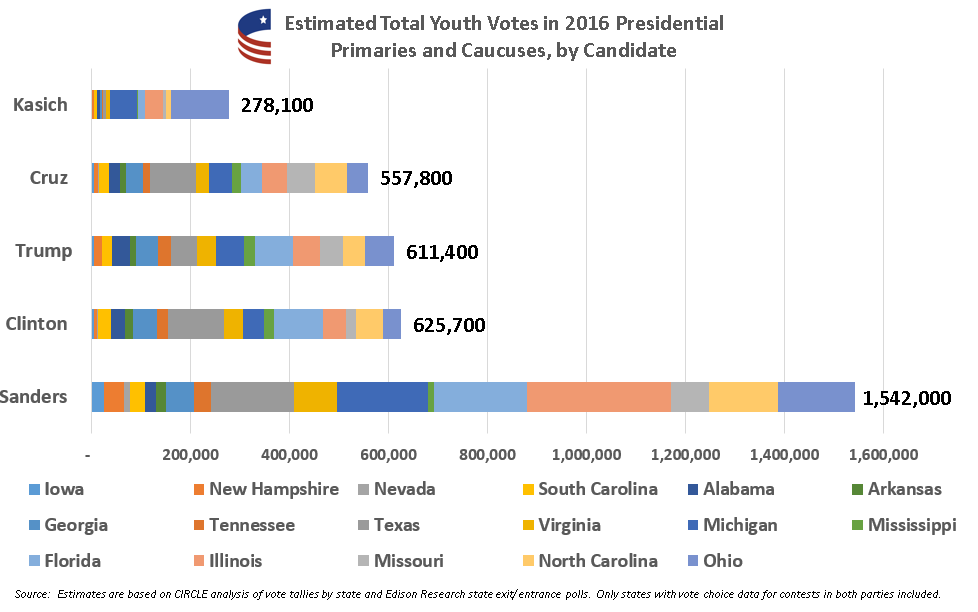
This graphic is the focus of Aaron Blake’s Washington Post article entitled “74-year-old Bernie Sanders’s remarkable dominance among young voters, in 1 chart.” As Blake writes, “Hillary Clinton and Donald Trump are well on their way to becoming their parties’ 2016 nominees for president. Among young voters, though, Bernie Sanders has more votes than both of them — combined.” The source is CIRCLE’s analysis released today.
As healthcare insurance prices in the US have skyrocketed, despite passage of President Obama’s Affordable Care Act in 2010, many Americans are turning to a new/old solution: mutualized self-help. As reported in the New York Times, many Christian groups in the US are forming their own unregulated insurance pools to pay the medical bills of their members. Nearly 200,000 people in 58,000 households are now paying their medical expenses in this fashion, to the tune of over $20 million a month. They constitute self-organized financial commons for healthcare.
This trend raises some fascinating questions about state/corporate bureaucracies vs. social commons: Which offers the better value? Which is more reliable and satisfying? Could social commons help bring down the cost of conventional insurance while introducing a more human, caring dimension to healthcare?
Reporter Abby Goodnough tells the story of a family that was priced out of the insurance market, and so decided to cover their potential medical bills through a “sharing ministry.” Instead of paying $600 per month for insurance with a $10,000 family deductible, the Doyle family in San Antonio, Texas, now pays $405 per month. They also pay the first $300 for any medical bill they receive, and there is a spending cap of $250,000 for any illness or injury.
We wanted to share a friendly reminder that we are hosting out next NCDD Confab Call this Wednesday, March 23rd from 2-3pm Eastern / 11am-12pm Pacific, and you won’t want to miss it! This month’s Confab will focus on the Participatory Budgeting Project (PBP), an NCDD member organization and the leading US group working with participatory budgeting.

On this Confab, we will hear from PBP’s Communications Director David Beasley about participatory budgeting, and PBP’s work to bring this approach to managing public money to cities, districts and schools. PB is one of the fastest-growing D&D processes today, and David will talk with us about the that has  created both successes challenges for PBP. We’ll also hear about PBP’s current PB Squared initiative (PB^2) which uses the participatory budgeting process to bring forward ideas on improving participatory budgeting practices. And of course, we’ll preview the upcoming Participatory Budgeting Conference in Boston.
The Confab will also feature Allison Rizzolo from Public Agenda, who will share about PA’s project aimed at evaluating participatory budgeting processes around the country. Come ready to learn more about this exciting work and to contribute your ideas about how PB can continue to develop and advance our field as a whole.
Register today to secure your spot for this great conversation!
Political scientist Markus Prior has long argued that inefficiency benefits democracy. In much of his work studying the effects of media on political knowledge and participation, Prior has found that an inefficient media environment – in which people have little choice over their entertainment options – is actually conducive to improving political knowledge.
In Efficient Choice, Inefficient Democracy?, Prior explains: “Yet while a sizable segment of the population watches television primarily to be entertained, and not to obtain political information, this does not necessarily imply that this segment is not also exposed to news. When only broadcast television is available, the audience is captive and, to a certain extent, watches whatever is offered on the few television channels. Audience research has confirmed a two-stage model according to which people first decide to watch television and then pick the available program they like best.”
That is, when few media choices are available, people tend to tune in for entertainment purposes. If news is the only thing that’s on, they’ll watch that over turning the TV off.
In a highly efficient media environment, however, people can navigate directly to their program of choice. Some people may choose to informational sources for entertainment, but the majority of people will be able to avoid exposure to any news, seeing only the specific programming they are interested in. (I should mention here that much of Prior’s data is drawn from the U.S. context.)
As Prior further outlines in Post-Broadcast Democracy, an inefficient media environment therefore promotes what Prior calls “by-product learning”: people learn about current events whether they want to or not. Like the pop song you learn at the grocery store, inefficient environments lead to exposure to topics you wouldn’t explore yourself.
Interestingly, it seems that a similar effect may take place in the context of group problem solving.
In a problem-solving setting, efficiency can be considered as a measure of communication quality. In the most efficient setting, all members of a group would share the exact same knowledge; in an inefficient setting group members wouldn’t communicate at all.
Now imagine this group is confronted with a problem and works together to find the best solution they can.
As outlined by David Lazer and Allan Friedman, this context can be described as a trade off between exploration and exploitation: if someone in your group has a solution that seems pretty good, your group may want to exploit that solution in order to reap the benefits it provides. If everyone’s solution seems pretty mediocre, you may want to explore and look for additional options.
Since you have neither infinite time nor infinite resources, you can’t do both. You have to choose which option will ultimately result in the best solution.
The challenge here is that the globally optimal solution is hard to identify. In a bumpy solution landscape, a good solution may simply point to a local optimum, not to the best solution you can find.
This raises the question: is it better have an efficient network where members of a group can easily share and disperse information, or is better to have an inefficient network where information sharing is hard and information dispersal is slow?
Interestingly, this is an open research question which has seen mixed results.
Intuition seems to indicate that efficient information sharing would be good – allowing a group to seamlessly coordinate. But, there’s also some indication that inefficiency is better – encouraging more exploration and therefore a more diverse set of possible solutions. The risk is that a group with an efficient communications network will actually converge on a local optimum – taking the first good option available, rather than taking the time to fully explore for the global optimum.

My friend Micah Sifry has a must-read article in The Nation entitled “How the Sanders Campaign Is Reinventing the Use of Tech in Politics.” He interviews two key staffers, Zack Exley and Becky Bond, who reveal a lot about the way their campaign has engaged its supporters.
I’ve written before about an oscillation: campaigns go back and forth between using technology to empower volunteers and accumulating Big Data to make their centralized outreach efforts more precise. Bond is explicit about which direction the Sanders campaign wants to move:
We’re shifting the focus away from a small number of sophisticated data and technologists engaged in a kind of Election Day arbitrage that ekes out incremental advantages by using micro-targeting algorithms to identify and turn out voters based on a model. Instead, we’re putting hundreds of thousands of volunteers to work, and in some states have literally called every single voter who will pick up the phone to identify everyone who supports Bernie or is undecided. Then we have other volunteers persuade the undecideds and turn out those who indicated support.
The article repeatedly describes the campaign as a “movement.” For instance, Exley says, “When Claire and I first arrived at the campaign, we knew that a movement was already way out ahead of the campaign. We believed it was our job to set up structures and tools to … help grow the movement.” A campaign fueled by volunteer hours and small donations that encourages its activists to recruit and lead certainly has a movement “feel.” But what would qualify the Sanders campaign as an actual movement–or as part of one?
Some would say that it’s already a movement because it has engaged a lot of fired-up people in unpaid political activity. Exley describes “a massive volunteer organization that’s making more than 1 million calls every day right now, knocking on countless doors and doing so much more.” Those accomplishments are typical of big, grassroots-based campaigns–not only partisan electoral campaigns but also bursts of grassroots energy in civil society. According to the late Charles Tilly and his colleagues, such campaigns are components or activities of social movements. But one campaign–even a large one–does not itself constitute a social movement.
Others would say that Sanders is part of a movement because he belongs to a loose, evolving, open network of academics, cultural figures, union leaders, organizers, and a few politicians that originated in the New Left and that supports democratic socialism in the United States. Not only is that network called a movement, but it is sometimes called The Movement–as in, “I grew up in the movement, you know,” or “I got to know Bernie through the movement back in the ’70s.”
I personally do not identify with this network, in part because I haven’t done anything worthy of admission to it and in part because my actual political beliefs are too eclectic. (I am not sure you can love Hayek and be in The Movement.) But I’ve known and admired bono fide participants all my adult life. The questions are … Does this strain of political thought and activism really qualify as a movement, even as it has spanned multiple decades? Has it shown enough signs of motion to be a movement? And how much of a movement activist is Senator Sanders? My sense is that he has been a solo voice on important issues, but not much of a movement-builder. He is not known for training organizers or leading organizations. As a voice and a vote in the Senate, he may be an asset to the movement–much like a noted author or musician who supports the cause–but I’m not sure he’s a movement person.
His campaign could nevertheless be an important episode in a movement that spans a longer time horizon and that has many more leaders than Bernie Sanders. It’s too early to say whether that’s the case, because everything depends on what happens after the 2016 election.
Another question is what movement his campaign is part of, if it turns out to be part of a movement at all. Sanders’ own roots are in ’60s-style US-based democratic socialism (see the Port Huron Statement), but other currents are feeding his campaign. Bond says, “First of all, I want to take this opportunity to say that the movement to defend black lives is fundamentally changing the terrain of social-change organizing. After recognizing that, yes, the young people and working-class folks, many of whom are from communities of color, who are leading the movement behind Bernie Sanders as volunteers on the ground are changing American politics.” That comment sounds somewhat aspirational to me–Sanders would be closer to the nomination if he had engaged the Black Lives Matter movement more effectively. But a large coalition could still form after his campaign concludes. Influenced in part by Tilly, I’d look for these features as evidence that a movement is afoot:
The four-page article, KF and Journalism: On Again! Off Again! On Again! by David Holwerk was published Fall 2015 in Kettering Foundation‘s annual newsletter, “Connections 2015 – Our History: Journeys in KF Research”. Holwerk discusses Kettering’s relationship with journalism and how over the last couple decades, the relationship has had its ups and downs. Kettering has had several active areas in journalism, especially during the 1990s emergence of the public journalism movement. Read an excerpt of the article below and find Connections 2015 available for free PDF download on Kettering’s site here.
 From the article…
But even though Kettering was engaged with journalists on many fronts— broadcast projects, coverage of presidential elections, the link between journalism and public deliberation, the role of journalism education in shaping journalists’ ideas,
the Katherine Fanning Fellowship, which has brought many journalists from other countries to Kettering—the record (and my own experience as a journalist during that period) makes it clear that interest was waning, both inside the foundation and among journalists. And in fact, by 2000, it had almost disappeared.
…
And several things account for public journalism’s swift decline. Some were factors that affect any human endeavor but are not of interest here: personalities, competing ambitions, and battles for primacy of place in journalism’s weird class system. (If you’ve worked in the business you know what I’m talking about. If you haven’t, take it from me, you didn’t miss anything.)
But other factors do have something to do with Kettering’s interests. Chief among them, public confidence in journalists and journalism continued to decline. To those paying attention, this suggested that the public journalism efforts weren’t bridging the gap between citizens and journalists. And in an environ- ment where instant feedback is the norm, that message carried a lot of weight.
Meanwhile, newspaper industry revenues rose sharply between 1993 and 2000. So the incentive to rethink the relationship of journalism to citizens and communities receded, and with it the sorts of initiatives that Kettering was interested in studying.
I’ll pick up the narrative of Kettering’s work shortly, but let me pause here to make a point about the connection between the financial success of journalism and the interest in citizens and communities. It’s commonplace to identify this connection as a sort of existential crisis. Journalists saw their livelihoods threatened, this storyline goes, and so they turned to connecting with citizens as a possible lifeboat.
That’s true to some extent, but identifying (okay, I’ll say it: naming) the incentive that way obscures something useful. Such circumstances—which occur periodically across the entire spectrum of institutional life—create moments when professionals are open to examining how their work connects (or doesn’t) to citizens and communities. These are the moments when institutions and the professionals who work in them are most likely to experiment. These self-examinations and experiments, and what happens as a result of them, is what’s important to Kettering, not whether the institution survives or dies.
But back to the narrative. There is no concise record of the foundation’s journalism work from 2000 on. But I can speak from my own experience beginning in 2008, when I got involved with Kettering again, as part of a workshop involving the National Conference of Editorial Writers. Much of the focus was on new interactive media, and involved discussions of questions, such as whether these media are by nature democratic. (For the record: they are not. Egalitarian, yes. Democratic, no.) These discussions were interesting,if you’re interested in gadgets and their effect on people and society. But what seemed to be missing were the experiments and innovations that, for better or worse, marked the public journalism days.
To my mind, that began to change in a 2010 research exchange with editorial writers. By that time, it was pretty clear that things were going to hell in the news business and that this time there would be no business rebound to bail them out. A number of the folks in that meeting seemed eager to try some different things. They also seemed ready to reexamine questions, such as whether their ideas about what citizens do in democracy were accurate or what it meant to serve the needs of citizens.
Since then, life in Kettering’s Journalism and Democracy internal working group has been increasingly busy and fruitful. Everywhere we look, we find journalists trying to figure out how to connect better with citizens and communities, or how to manage the difficult tensions that arise even in the best of such connections. Among journalism academics both here and abroad, we have found a deep wellspring of interest in questions related to democracy—not just theoretical questions, but practical ones related to the professional training of journalists. In both cases, a sense of existential crisis seems to have opened up the willingness to consider questions that just a few years ago were not on journalists’ agenda.
How long this state of affairs will last, I wouldn’t care to guess. Journalism itself, at least as we know it, could disappear, in which case Kettering would be left with nothing to examine. But as of this writing, the foundation’s on-again, off-again engagement with journalism and journalists is definitely on.
About Kettering Foundation and Connections
 The Kettering Foundation is a nonprofit operating foundation rooted in the American tradition of cooperative research. Kettering’s primary research question is, what does it take to make democracy work as it should? Kettering’s research is distinctive because it is conducted from the perspective of citizens and focuses on what people can do collectively to address problems affecting their lives, their communities, and their nation.
Each issue of this annual newsletter focuses on a particular area of Kettering’s research. The 2015 issue, edited by Kettering program officer Melinda Gilmore and director of communications David Holwerk, focuses on our yearlong review of Kettering’s research over time.
Follow on Twitter: @KetteringFdn
Resource Link: www.kettering.org/sites/default/files/periodical-article/Holwerk_2015.pdf
One of my favorite things to do, because I am just that guy, is to scour the Internet for interesting resources we can use to teach our kids about civics, history, government, and our beloved Constitution. While I love the Schoolhouse Rock videos that are from our childhood and remain all over the ‘Net today, we are always looking for more. So today I come to you with some videos that you can use to introduce or review civics topics with your students or for your own civic knowledge and thought.
Barney Fife Recites the Preamble
Are your students struggling with remembering the Preamble to the US Constitution and the role and purpose of government described therein? This could be a good way to help them focus on those important lines while introducing them to one of the most paragraphs in our history!
Daffy Duck Runs for Office
This is an awesome way to provide students with a quick and visual overview of the three branches of government while also getting to some important civics ideas. Majority Rule! Search and Seizure! Separation of Powers! Legislation! Power of the President! and so much more. Who knew that Looney Tunes could be so civic-minded?
Richard Nixon Goes Beyond Executive Orders
One of the Florida Civics Benchmarks, SS.7.3.12, requires students to understand the constitutional arguments being made concerning significant court cases. United States v. Nixon is one of them. There are of course additional benchmarks that get to such things as presidential power and authority, in the civics, US history, and US government courses. This video can do so much as it reveals a perception on the power of the President that many outside of Nixon could possibly share. I have had a number of great debates with my own students that involved this clip, and it is also a good way to introduce the concept of the Imperial Presidency.
Schoolhouse Rock (By Way of SNL) Teaches About Executive Orders
I love what you can find on the Internet. This is a great way to begin a discussion about, again, the power of the president as compared to Congress and whether executive orders are a good idea or even constitutional. Please note that there is some very mild language in this clip. I would still be comfortable using it to introduce the topic with my own students.
The Animaniacs Sing About the Presidents
Now, in Florida, students do NOT need to identify any presidents to do well in the 7th grade Civics course. That being said, they do certainly have to have a passing familiarity with them for other social studies courses. This video, while dated, provides a humorous overview of every president from Washington to Clinton, and it can be an interesting way to introduce the presidency. You could also use this as a way to encourage research for your students. DID Reagan’s speeches all come from old movies? What was Johnson impeached for? Was Grant really a heavy drinker as president? Oh, so many possibilities!
An Epic Rap Battle: Keynes vs Hayek
Those of us that teach economics need our own resources too, and this is a GREAT one to introduce a perennial economic debate. While it does take a particular perspective on the debate, it presents economic concepts in an effective and engaging way. My own students loved it, because they would watch with the lyrics in hand, and it would form the foundation of units throughout the year! We played this video quite often.
An Epic Rap Battle Part Two
This is the sequel to the previous video, and another worthy way to explore deep economic ideas.
The Brain Explains Why We Should Study History
I have actually used this video at the beginning of the year when I taught world history to humorously introduce the importance of history in general. This is also a nice path towards research projects if you teach a world history course. All those leaders!
Too Late to Apologize (A Declaration)
Friends, you haven’t lived until you have seen the authors of the Constitution as members of a hard rock band. In all seriousness, this is a WONDERFUL approach to the Declaration of Independence, and I have seen it used in many classrooms to really excite students to explore one of the foundational documents of American history and government.
The Fight for the Vote: A Bad Romance
I want to finish this up by sharing with you one of my favorite videos, relevant as we approach the anniversary of the 19th Amendment in just a few short years. This look, based on Lady Gaga’s ‘Bad Romance’, provides a nice lesson on the fight for woman’s suffrage. Interestingly, it uses Alice Paul as its central character.
I hope that you find some use for these videos. Some of them may be more appropriate or relevant for you than others, but at the least they serve as an additional resource for you! I would love to know any additional ‘outside the box’ videos that you have found useful in civics, government, history, or other social studies content areas. Shoot me an email or leave a comment!

