Node Overlap Removal by Growing a Tree

I recently read Lev Nachmanson, Arlind Nocaj, Sergey Bereg, Leishi Zhang, and Alexander Holroyd’s article on “Node Overlap Removal by Growing a Tree,” which presents a really interesting method.

Using a minimum spanning tree to deal with overlapping nodes seems like a really innovative technique. It made me wonder how the authors came up with this approach!

As outlined in the paper, the algorithm begins with a Delaunay triangulation on the node centers – more information on Delaunay triangulations here – but its essentially a maximal planar subdivision of the graph: eg, you draw triangles connecting the centers of all the nodes.

From here, the algorithm finds the minimal spanning tree, where the cost of an edge is defined so that greater node overlap the lower the cost. The minimal spanning tree, then, find the maximal overlaps in the graph. The algorithm then “grows” the tree: increasing the cost of the tree by lengthening edges. Starting at the root, the lengthening propagates outwards. The algorithm repeats no overlaps exist on the edge of the triangulation.

Impressively, this algorithm runs in O(|V|) time per iteration, making it a fast as well as an effective algorithm.

facebooktwittergoogle_plusredditlinkedintumblrmail

Participatory Budgeting in the Town of Mutoko

Author: 
Initiated in 2001 Participatory Budgeting (PB) was introduced to the Town of Mutoko, Zimbabwe, as a governmental response to protesting and other civil unrest due to corruption within government. To rekindle democratic engagement from the grassroots level 74% of the Mutoko Rural District Council budget was opened for discussion within...

the grammar of the four Noble Truths

We’re reading about Buddhist ethics in my Introduction to Philosophy course, and the Four Noble Truths are our focus. Here is how the first Truth is presented in the Sermon at Benares (attributed to the Buddha himself):

“Now, this, O bhikkhus [monks], is the noble truth concerning suffering: Birth is attended with pain, decay is painful, disease is painful, death is painful. Union with the unpleasant is painful, painful is separation from the pleasant; and any craving that is unsatisfied, that too is painful. In brief, bodily conditions which spring from attachment are painful. This, then, O bhikkhus, is the noble truth concerning suffering.”

The remaining three Truths take similar forms. First comes a headline or name for the Truth (respectively: suffering, the origins of suffering, the destruction of suffering, and the way to the destruction of suffering). Then–at least for the first two Truths–comes a list of factual claims, e.g., “Birth is attended with pain.” The paragraph ends, “This is the noble truth concerning [the topic of the truth].”

Presumably “this” does not refer simply to the preceding factual claims. The Truth is broader than that; the claims are illustrative or supportive. My instinct is to translate the final sentence into a proposition, a statement or assertion that expresses a judgment or opinion. I don’t think my instinct is uniquely “Western” (whatever that means) or philosophical. Buddhist thinkers have been debating the propositional content of the Truths for two millennia. This debate persists because it’s not self-evident how to restate the Truths as propositions. Should we say: “All life is intrinsically suffering”? “All human (or sentient) life is intrinsically suffering?” “All life includes some suffering, even if there are also happy moments”? “All life begins and terminates in suffering”? Etc.

This choice seems worth debating; the resulting conversation is fruitful. But there is also a good reason for the final sentence to take the form that it does. To assent to a proposition about suffering will not change your life. Your life may change if you really internalize the significance of suffering. In that case, you will understand the “truth of suffering.”

It’s like saying that social injustice in the US is not just a list of injustices. It is an overall condition of the society that you can absorb until it influences your whole stance toward politics. Whether you should take that stance depends on all the separate propositions about particular injustices, so you should evaluate those propositions critically. The (ostensible) Truth of Social Injustice is debatable among reasonable Americans. But the question is whether you should–and whether you have–absorbed that truth.

The Buddha’s way of thinking reminds me of Epicurus and the other founders of Hellenistic schools. Epicurus’ Letter to Menoeceus includes a formal argument that we should not fear death. Death is a lack of sensation, so we will feel nothing bad once we’re dead. To have a distressing feeling of fear now, when we are not yet dead, is irrational. The famous conclusion follows logically enough: “Death is nothing to us.” (Note that this is a proposition.) But Epicurus knows that such conclusions will not alone counteract the ingrained mental habit of fearing death. So he ends his letter by advising Menoeceus “to practice the thought of this and similar things day and night, both alone and with someone who is like you” (my translation). The main verb here could be translated as “exercise,” “practice,” or “meditate on.” You will be better off if you internalize the truth concerning death; but that takes practice, and it requires a community of people devoted to the same end. The same is true, it seems to me, of the Four Noble Truths of Buddhism.

See also: three truths and a question about happinessPhilosophy as a Way of Life (on Pierre Hadot); and on philosophy as a way of life; and when East and West were one.

On the Rights of a Black Man

I was struck by a comment from today’s coverage of the shooting death of an unarmed black man. To be clear, this was coverage of the death of an unarmed black man – whose name has not yet been released – in San Diego; not the recent shooting of Keith Scott in Charolette, or of Terence T. Crutcher in Tulsa.

In San Diego, a woman called 911 to get help for her mentally ill brother. Details are contested, but police shot and killed the man they’d been called to help.

In an interview this morning, a woman protesting the murder said: “Because he was black he automatically had no rights.”

That was a profound statement.

Because he was black, he automatically had no rights.

Regardless of whether or not you agree with that statement, the mere perception of that reality should be disturbing. And, incidentally, if you don’t agree with that statement, it is worth noting that it is factually indisputable that many, many unarmed black men have been killed by police under questionable circumstances.

We are a country that prides itself on individual rights, inalienable rights. Rights that can never, ever, be taken away from us.

Unless you are black.

Because he was black, he automatically had no rights.

facebooktwittergoogle_plusredditlinkedintumblrmail

Thom Hartmann Gives the Commons Some Rare National Visibility

Yesterday evening, Thom Hartmann, the progressive talk show host, interviewed me on his "Conversations with Great Minds" national TV show.  The first 12-minute video segment can be seen here, and the second one here. I don't think the commons has ever had this much airtime on American (cable) television.

A big salute to Thom for hosting this kind of material on his show. He is a rare creature on American TV and radio -- an intelligent progressive willing to give airtime to ideas from outside the Washington, D.C. echo chamber. Since the retirement of Bill Moyers, there are very few American TV personalities who actually read history, understand how it informs contemporary politics, and give sympathetic exposure to movement struggles seeking social and economic transformation. 

Since I'm sharing links, let me also share the link to my 20-minute presentation yesterday at Ralph Nader's conference, "Breaking Through Power.org" conference, which is being held this week in Washington, D.C.  My talk, "Controlling What We Own -- Defending the Commons," can be seen here at the timemark 5:35:15.

Check out the other presentations on this eight-hour video from Real News Network -- some amazing segments by folks like John Bogle, William Lerach, Ellen Brown and others focused on corporate governance, power and financial abuses.

read more

Florida Council for the Social Studies Conference Sessions

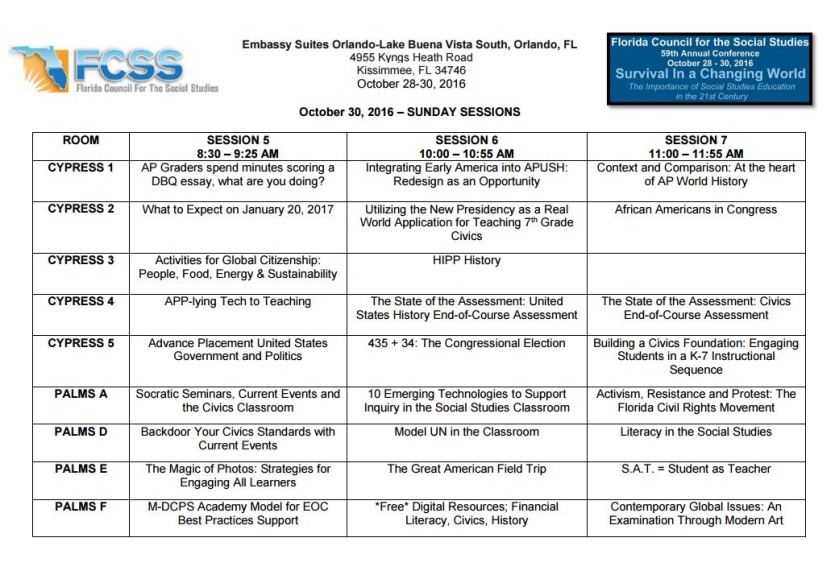
Have we mentioned that the Florida Council for the Social Studies Conference is coming soon (and that you should register)? No? Well, it is and you should! And we are happy to share with you information on sessions that will be taking place at the conference! Take a look at the matrices below for Saturday and Sunday, and then click here to get a description of each session: 2016-fcss-session-descriptions!


saturday-onesaturday-twosunday-one

Through out the next few weeks leading up to the conference, we will be highlighting sessions of interest, and just why you may enjoy them. Please be sure to take a look at the session descriptions (2016-fcss-session-descriptions) and of course register and join us for a great weekend in Orlando! 


Presidential Debate Quick Take

While I could endlessly pontificate about last night’s presidential debate, there’s not much I could add that hasn’t already been said by the many, many pundits and posters covering this race.

So I decided for today to do a very quick analysis of the debate transcript, as provided by the New York Times.

The transcript captures three speakers – Clinton, Trump, and moderator Lester Holt; and three interactions – crosstalk, laughter, and applause. The audience was under clear instructions to neither laugh nor applaud, but they did so anyway, getting, I think, a bit rowdier as the night went on.

The transcript watched 5 instances of audience laughter – 4 in response to Clinton and 1 in response to Trump (“I also have a much better temperament than she has, you know?”). Of the 12 instances of applause, 4 were in response to the moderator, 3 were in response to Clinton, and 5 were in response to Trump.

For crosstalk, the meaning is a little less clear – crosstalk is marked after 4 Trump comments, 3 Holt comments, and 1 Clinton comment…but this doesn’t explicitly indicate who was the actual interrupter.

While some have argued that Holt did an insufficient job of keeping time, Clinton and Trump did have about equal coverage – at least in terms of word count. Clinton spoke slightly less, using a total of 2403 words to Trump’s 2951. Interestingly, Clinton used more unique words – 788 to Trump’s 730.

And if you’re wondering, Lester Holt spoke a total of 1431 words, 481 of which were unique.

Using a simple log-likelihood technique, we can look at which words are most distinctive by speaker. That is, by comparing the frequency of words in one speaker’s text to the full transcript, we can see which words are over represented in that subsample.

In the role of moderator, for example, we see that Holt was much more likely to use words like “Mr”, “question”, “segment” and “minutes.”

Typically, you’d use log-likelihood on a much larger corpus, but it can still be fun for a single debate transcript.

Among Clinton’s most distinctive words were: “right”, “war”, and “country”

Among Trump’s most distinctive words were: “business”, “new”, and “judgment”. (Note that “bigly” does not appear in the transcript, since he actually said “big league”.)

This is a very rudimentary text analysis, but its still interesting to think about what we can learn from these simple assessments.

facebooktwittergoogle_plusredditlinkedintumblrmail

Pre-Conference Options for NCDD 2016

The 2016 National Conference on Dialogue & Deliberation is just around the corner, and we wanted to bring your attention to some cool options that are happening the day before the conference — Thursday, October 13th.

bumper_sticker_600pxAs you know, NCDD 2016: Bridging Our Divides is taking place October 14-16 in the Boston Metro Area, at the Sheraton Framingham Hotel & Conference Center. All pre-conference activities are taking place at the Sheraton.

The first three events below do require pre-registration, and there is (very reasonable) fee for participating in Essential Partners’ day-long workshop.  See below for details.

8:30am – 4:30 pm  –  WORKSHOP ON FACILITATING PUBLIC MEETINGS

Essential Partners (formerly the Public Conversations Project) is known for its high-quality workshops. We’re proud to say that they’re offering their advanced workshop on “Facilitating Public Meetings” on October 13th at the Sheraton!

Leading effective public meetings has become increasingly difficult. Designing and facilitating effective public meetings requires coolness, clarity, courage and skill. This workshop will help participants address the challenges of engaging an impassioned and deeply involved public in constructive conversation.

Dave Joseph, MSW will facilitate the training. The regular rate for this one-day training is $150, but NCDD members pay only $125. Learn more and register today. (Middlesex East)

4:00 – 5:30 pm  –  RED-BLUE DICTIONARY WORKSHOP

Do you mean by pro-life what I mean by pro-life? What about socialism? Freedom? Compassion? Answering these questions is the goal of the Red-Blue Dictionary, a transpartisan collaboration to help all Americans explore the varied meanings of commonly used (and misused) words. We’re not building a reference handed down from some great authority on high; we’re exploring what words really mean to all of us down here on the ground.

This free interactive workshop, co-facilitated by Cynthia Kurtz and John Backman, is your chance to learn about the Red-Blue Dictionary, join us in improving it, and explore our diverse experiences with the words we love (and love to hate) most. Email Cynthia Kurtz at cfkurtz@cfkurtz.com to let her know you’d like to participate in this workshop. (Commons II)

5:00 – 7:00 pm  –  DELIBERATION BOOTCAMP

This free evening session will provide an overview of the deliberative perspective and an introduction to many of the key concepts, organizations, and challenges related to the field. Specifically designed for newcomers to the field, the boot camp will help acclimate participants to the conference.

The session will be led by Martín Carcasson, NCDD Board member and Director of Colorado State University’s Center for Public Deliberation. Dr. Carcasson’s presentation will focus on the question of “what kind of talk does democracy need?” and will make the case for building deliberative capacity in our communities.

Email Martín at mcarcas@colostate.edu to let him know you’ll be attending the Bootcamp. (Commons I)

6:00 – 7:00 pm  –  INFORMAL RECEPTION / COCKTAIL HOUR AT THE BAR

Though the conference doesn’t begin officially until Friday morning, many of you are arriving on Thursday.  Plan on coming down to the hotel bar/restaurant for some informal networking if you’re around (food and drink is on you, though).  Of course, you’re welcome to stick around after 7pm!  (Hotel bar)

8:00 – 9:15 pm  –  EMERGING LEADERS PRE-CONFERENCE EVENT

NCDD is hosting a pre-conference event for young people and students. This will be a time for attendees 35 and under connect with the other younger conference attendees. During the event, we will be officially unveiling NCDD’s new Emerging Leaders Initiative and all the great ways NCDD will be working to bring younger folks into the D&D field and support them in shaping its future. We will also be kicking off our NCDD 2016 Mentoring Program, which will intentionally connect a cadre of experienced D&D leaders with students and youth attendees during the conference.