it’s hard to talk about tough issues if no organization represents you

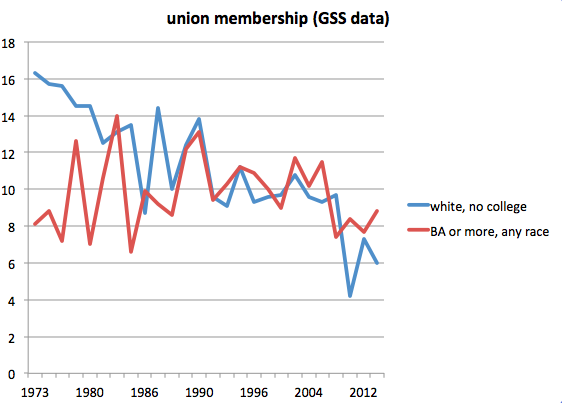
I’m back from a great meeting in Chicago in which one theme was the need to have honest, productive conversations between people who might support Donald Trump and members or supporters of movements like Black Lives Matter. I’d note a major obstacle: the fact that working-class white people–the demographic core of Trump’s support–don’t have organizations that answer to them. As an illustration, consider that just 6 percent of adult Whites without college educations now belong to unions. That’s below the rate for college graduates, many of whom have other organizations behind them.
union

A lack of organization blocks or distorts difficult discussions, for these reasons:

  1. It’s literally hard to convene people who aren’t organized. Absent organizations, conversations tend to be online or draw highly atypical individuals who show up of their own accord.
  2. People who have no organizations behind them usually feel powerless. If that’s how they feel, they are unlikely to want to participate in difficult conversations. Especially when the topic is their own ostensible privilege, they are likely to resist talking. To be clear: I believe that everyone who is White in the US gains privilege from that. But if I felt politically powerless, I would not be in a mood to have that conversation, especially with people who were better organized than I was.
  3. People without organizations end up being represented by famous individuals–celebrities–who claim to speak for them and who claim mandates on the basis of their popularity. Celebrities have no incentives to address social problems; they gain their fame from their purely critical stance. And they owe no actual accountability to their fans, since no one (not even a passionate fan) expects a celebrity to deliver anything concrete. Donald Trump is unusual in that he has moved from a literal celebrity to a presidential nominee; but he still acts like a celebrity, and presumably he will return to being a pure mouthpiece once the election is over. Meanwhile, back at the grassroots level, a person who feels represented by celebrities is unlikely to talk productively with fellow citizens who disagree.
  4. People without organizations cannot negotiate. For instance, imagine that an individual Trump voter becomes convinced of the case for reparations, or at for least for race-conscious policies aimed at equity. That person cannot literally support such remedies, because he has no means to enact them. All he can do is assent to their theoretical merit. That also means that he can’t get anything tangible out of a deal. He’s just being asked to concede a point.

In 1959, A. Philip Randolph helped found and led the Negro American Labor Council as a voice for civil rights within the labor movement. As he pressed and negotiated with his fellow labor leaders on matters of civil rights, he was giving their millions of White rank-and-file members the opportunity to discuss segregation and racism productively. Crucially, not only were the Sleeping Car Porters organized; so were the predominantly White autoworkers, steelworkers, and mineworkers. Randolph also had–and used–substantial leverage over a Democratic Party that was still dependent on working-class voters, White and Black.

I’m certainly not implying that everything went smoothly in those days and reached satisfactory conclusions, but Randolph at least had a strategy that made sense. In an era of niche celebrities, candidate- and donor-driven political parties, and weak civic institutions, that strategy looks much harder.

Counterargument: The Fraternal Order of Police is an organization. Its members, although diverse demographically and ideologically, need to be at the table for any discussion of racial justice. But the FOP has endorsed Trump; and in many local contexts, its spokespeople seem particularly unwilling to deliberate and negotiate. Hence being organized is not a path to productive conversations. … To which I’d respond: Privilege yields to political power. Only effective political action will bring a group like this to the table. But the police can come to the table because they are organized, and that creates a strategic opening that is absent when people with similar views aren’t organized. It also enables pressure to come from within. For instance, the association that represents 2,500 Black police officers in Philadelphia has called Trump an “outrageous bigot” even as the Philly FoP has endorsed him.

See also: why the white working class must organize.
Field Trip Option for NCDD 2016 – Youth PB Idea Collection

As if there wasn’t already enough to be excited about for this week’s NCDD 2016 conference, we wanted to make sure everyone knows about a great opportunity to take an experiential field trip during the gathering!

Field Trip: Participate in Boston’s Youth Lead the Change PB Process

NCDD participants will have an opportunity to not only learn about participatory budgeting (PB) but to participate in the historic Boston youth PB process. In 2014, Boston became the first city in the country to implement a citywide PB process focused on youth. The Youth Lead the Change program allows young people to directly decide how $1 million dollars of the city’s capital budget is spent every year.

Participants in this field trip will have the rare opportunity to join one of the official idea collection sessions in the Youth Lead the Change PB process – an event where youth PB participants get together to start formulating the ideas that will eventually become proposals to be voted on for how to spend this year’s $1M in PB funds. You can learn more about what the Boston youth PB experience is like for the young people in this write up from a youth participant.

By joining this field trip, you’ll have a chance to get an overview of PB, suggest ideas to make Boston better, and see one of the best PB process in the country live and in action. It’s an incredible opportunity! Then after the idea collection event is over, we’ll take some time to debrief and reflect together over dinner and drinks downtown.

The field trip will be co-hosted by Francesco Tena, the Manager of Boston’s Mayor’s Youth Council, and Shari Davis, Boston’s former Department of Youth Engagement and Employment Executive Director. Francesco and Shari have been involved in Boston’s youth PB process for years, and will be your expert guides and hosts for this unique experience.

We have space for 30 people in the bus, but the trip is filling up, so reserve your spot soon! Email our Logistics Manager Rob Laurent at robdotlaurent@gmail.com to claim your spot, and plan to bring a check for $35 or cash with you to cover your portion of the bus costs. The bus will leave at 4pm return to the conference hotel at around 10pm.

Haven’t registered for the 2016 National Conference on Dialogue & Deliberation? It’s not too late, but you have to register ASAP!

Upcoming FCSS Conference Highlights

Don’t forget that the FCSS Conference comes soon! I just want to take a few minutes and highlight some interesting conference sessions that may be of interest to a wide variety of audiences.

Saturday morning, Concurrent Session 1:

If this is a Woman: FKL Ravensbruck Tom Glaser, Mater Academy Charter High School

Ravensbruck was the only main concentration camp for women, and it held an astonishing variety of nationalities and reasons for incarceration. It was the last place where gassings took place. Learn about this often neglected aspect of the Holocaust.

Key People and Places: Focus on Famous Floridians Lesley Mace, Federal Reserve Bank of Atlanta – Jacksonville Branch Gloria Guzman, Federal Reserve Bank of Atlanta – Miami Branch

Join this interactive session featuring new ways to teach about Florida’s famous entrepreneurs. Participate in a hands-on lesson and discover a free tool for creating fun cellphone/tablet quiz games to reinforce and assess student learning. 

512px-us-federalreservesystem-seal-svg

Saturday, Concurrent Session 2:

Students Investigating Primary Sources: A FJCC & National Archives Partnership Val McVey, Florida Joint Center for Citizenship Dr. Charles Flanagan, Center for Legislative Archives at the National Archives

Come learn about S.I.P.S.! Learn how to access and implement a new series of primary source activities and experience new distance learning services from the National Archives to make S.I.P.S. come to life in your classroom!

sips-11


Engaging Social Studies in the Early Childhood Classroom (K-3) Kassie Erenstoft, Brevard Public Schools

Bring social studies to life for your youngest learners. Join us to discuss engaging, document analysis strategies to enrich social studies discussions in kindergarten through third grade classrooms. 

11001661_10106532786630041_8804654532248114877_o


And of course please don’t forget the fantastic keynote we have lined up! Please be sure to register now! We look forward to seeing you in Orlando.


NCDD’s Leadership is Evolving!

Hi, everyone! With our national conference in Boston just days away, I am excited to announce some important changes that are happening within NCDD.

Our conference is taking place just weeks before one of the most polarizing elections our country has ever experienced, and our intention is to lift up the many untold and under-told stories about how members of this community have bridged the divides that seem insurmountable to so many right now. No matter the outcome of the election, our community will be needed more than ever — and NCDD will be here to help keep this community connected, informed, and equipped.

courtney_sandy_border

Courtney Breese (left) and Sandy Heierbacher

In order to best serve our members and our own needs, and to meet these emerging opportunities and challenges, we are shifting to a new leadership model. Program Director Courtney Breese is stepping up to Managing Director, and will be taking over our day-to-day operations. I will become Founding Director which will free me up to focus more on what I truly love — supporting and nurturing our network.

This shift in NCDD’s leadership is part of a broader evolution that the organization is experiencing. Four of our current Board members — Barbara Simonetti, Marla Crockett, John Backman and Diane Miller — are nearing the end of their terms, and we are about to welcome some wonderful new Board members into the fold: Jacob Hess, Betty Knighton, Simone Talma Flowers and Wendy Willis, who will be joining Martin Carcasson and Susan Stuart Clark. In the coming year, we’ll focus more on strategic planning and fundraising in order to enhance our service to you and this wonderful community, which has grown from a group of 50 founding organizations in 2002 to a vibrant network of 2,300 members and 38,000 subscribers in 2016.

On a personal note, Courtney and I have worked closely for years both in her roles as a member of the Board and then as Program Director. I don’t know of a more calm, competent person, and have nothing but faith in Courtney. My own passion lies in creating networks and building supportive, collaborative communities, and after 14 years directing NCDD, I am drawn to new possibilities for how I can help build and strengthen others’ work. You are some of the most creative, intelligent and good-hearted people I’ve ever met, and I look forward to working with you, our wonderful staff, our Board, and other contributors in this new role.

I’m excited about what lies ahead — both for me and the network. Our community has become ever more active and responsive to each other, generously sharing their experiences and know-how over multiple platforms and forming many dozens — if not hundreds — of partnerships over the years. Our website will continue to provide a clearinghouse of thousands of resources and news items.

Courtney, our Board, and I intend to work together to see NCDD continue to grow and thrive so this field can have a greater and greater impact on the world.

Sincerely,

Sandy Heierbacher, Founding Director, on behalf of
Courtney Breese, Managing Director and the NCDD Board

the Pew climate change survey and the state of science

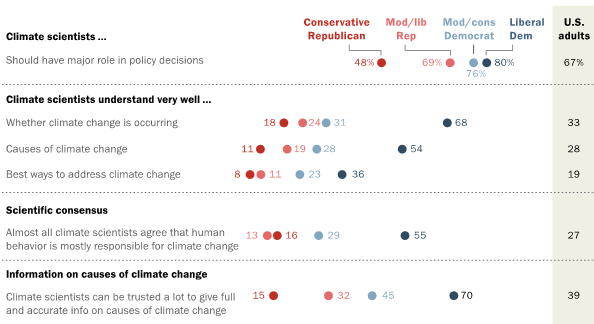
According to Pew’s new survey, only about one third of Americans care “a great deal” about climate change. That might be a matter of values: some citizens may set a higher priority on liberty or growth than on environmental protection, or they may not trust the government plus scientists to protect the climate.

But the public is also divided on a key matter of fact. In reality, there is near-universal scientific consensus that humans cause global warming, but only 27% of Americans perceive that consensus, including just over half of liberal Democrats.

If I thought that scientists were divided on the basic question of whether humans cause climate change, I would be much less confident that the problem is worth combating.climate

Two fairly obvious but crucial lessons:

  1. Giving an impression that a topic is contested is a great way to sew doubts about it. Once just a few people who claim expertise criticize the mainstream scholarly view, the issue looks debatable. Then everyone has permission to be skeptical.
  2. Scientists must take more responsibility for how their work is communicated, debated, received, and used by the public. There’s not much point to specific studies of climate change if a large majority of the public remains unconvinced about the basic problem. If the traditional division of labor–scientists conduct research; reporters cover it–ever worked, it doesn’t work now. Scientists and their institutions (including universities) must develop better ways of engaging in public life.

See also Five Strategies to Revive Civic Communicationscience, democracy, and civic life.

Collective Intelligence for Democracy

Participedia’s Design & Technology (D&T) Committee recently applied for the Collective Intelligence for Democracy workshop, hosted by Medialab Prado in Madrid. Their proposal, “Mapping Democratic Innovation” -- an idea jam based on foundational data and technology of Participedia -- was selected as one of eight featured projects for the event!

Idea Jam

Method: Idea Jam

Author: 
Definition An "idea jam" -- also known as a "design jam", "nerd jam" or, simply, a "jam" -- is a collaborative brainstorming activity or event, geared towards generating solutions in a fun and creative environment. Jams can be self or group-initiated or planned in advance and facilitated. The format of...

Elevating Public Views to Rebuild Faith in Higher Education

Experts, including presidential candidates, overwhelmingly assert the importance of education beyond high school. Yet research we released last month suggests these exchanges are not reaching the public. Just 42 percent of Americans say a college education is necessary for success in the workforce.

This month, we seek to elevate the public's voice on the problems and solutions facing higher education, through new findings released today. We hope these findings will help policymakers, experts, and college and university leaders better understand how they can rebuild the public's faith in higher education as a path to a better life.

In a pair of surveys funded by The Kresge Foundation, Public Agenda asked over 1,000 American adults about prominent problems and reforms facing higher education.

What are the problems?

  • 68% of Americans say cuts in state funding for public colleges is a problem. But they're just as likely to say colleges that are wasteful in how they spend their money is a problem.
  • Americans are also concerned about high schools that fail to prepare students for college-level work. However, they are less likely to view student persistence as a problem.

Most Americans view preparedness, compared to persistence, as a serious problem.

What are the solutions?

  • 66% of Americans support free college for low-and middle-income students, though they are divided by political affiliation and age.
  • Most Americans say colleges should prepare students for jobs and careers. They also support requiring colleges to publicly report graduation metrics.

Americans show varying support for common approaches to higher education reform.

We believe that efforts to boost college attainment will have the best chance of succeeding if they are informed by and responsive to the needs and perspectives of the American public. Do you agree? If so, help us spread the word about this research! Copy and paste the tweets below.

Just 42% of Americans say #college education necessary for success in the workforce, per @PublicAgenda survey http://ow.ly/GpQo304TR7E

New research from @PublicAgenda can help #highered leaders rebuild public faith in #highered: http://ow.ly/GpQo304TR7E

66% of Americans support free college, tho divided by age & politics: new @PublicAgenda research: http://ow.ly/GpQo304TR7E

Americans say #highered finances are a serious problem - both public funding & how colleges manage $: http://ow.ly/GpQo304TR7E