
Introducing NCDD’s New Board Members

As many in our network know, NCDD had a major transition on our Board at the beginning of this year. On January 1st, we were excited to have four new leaders from the field join our Board, and at the same time, we said goodbye four of our outgoing Board members.

The outgoing Board members – Barb Simonetti, Marla Crocket, Diane Miller, and John Backman – all worked tirelessly over the last six years to help steward NCDD through important transitions in our organization and guide our work to new heights. We can’t thank the four of them enough for all of the hard work they put in over the years, and if they weren’t all term limited, we would have kept them on forever! But thankfully, none of these incredible leaders will be going far, and you can expect them to remain regular parts of the NCDD network.

But as Barb, Marla, Diane, and John step off the Board, we couldn’t be more excited to be welcoming on four amazing new additions! These new Board members will be joining our remaining Board members – Martín Carcasson and Susan Stuart Clark – in helping provide vision and leadership for NCDD and our field more broadly, and we wanted to officially introduce them to our network! We encourage you to join us in thanking them for taking on these new roles and to learn a bit more about them below.

The New Members of the NCDD Board of Directors

Simone Talma Flowers

Simone Talma Flowers is the Executive Director of Interfaith Action of Central Texas (iACT), whose mission is to cultivate peace and respect through interfaith dialogue, service and celebration. Simone Talma Flowers brings over 26 years of extensive experience in non-profit management.

Simone promotes a culture of high performance, support and collaboration. She advances the mission of the organization by bringing people of diverse faiths, cultures and backgrounds together, to break down the barriers that divide us. She is passionate about diversity and inclusion and believes everyone should have access to opportunities, so they can live up to their fullest potential. Simone has a Bachelor of Arts in Psychology and a Master of Business Administration from St. Edward’s University.

Jacob Hess

Jacob Hess is the author of 14 peer reviewed articles exploring contrasting health and socio-political narratives and has (co)authored three books: You’re Not  as Crazy as I Thought, But You’re Still WrongOnce Upon a Time… He Wasn’t Feeling It Anymoreand A Third Space: Proposing Another Way Forward in the LGBT/Religious Conservative Impasse (Disagreement Practice, Treasonous Friendship & Trustworthy Rivalry in the Face of Irreconcilable Difference). His work with Phil Neisser at State University of New York has been featured on This American Life and was also recognized by Public Conversations Project (Essential Partners). Jacob enjoys being a part of Living Room Conversations and the Village Square – and is grateful for a chance to serve NCDD, as an organization he has loved for many years.

Betty Knighton

Betty Knighton is the director of the West Virginia Center for Civic Life, a nonprofit, nonpartisan organization that promotes public dialogue on issues that affect the quality of life in West Virginia. A primary focus of her work has been building a network for civic engagement in the state through collaborative partnerships with educational, civic, faith-based, and governmental organizations. Through the Center, she works with West Virginia communities to develop balanced frameworks for local issues, to convene and moderate community discussions, and to develop processes to move from dialogue to action.

Wendy Willis

Wendy Willis is the Executive Director of the Deliberative Democracy Consortium , a global network of major organizations and leading scholars working in the field of deliberation and public engagement. Wendy is also the Founder and Director of Oregon’s Kitchen Table, a program of the National Policy Consensus Center at Portland State University. Wendy is also a widely published poet and essayist, writing often on issues of public life. She is also the former Executive Director of the City Club of Portland and has served as an Assistant Public Defender for the District of Oregon and law clerk to Chief Justice Wallace P. Carson, Jr. of the Oregon Supreme Court. Wendy graduated magna cum laude from Georgetown Law Center and holds an M.F.A. from Pacific Lutheran University and a B.A. from Willamette University. Her next book, A Long Late Pledge, is due out in September.

We are so pleased to be working with this amazing new class of Board members and hope that you will join us in honoring their commitments to playing such key leadership roles in our field! You can learn more about all of NCDD’s Board and staff by visiting www.ncdd.org/contact.
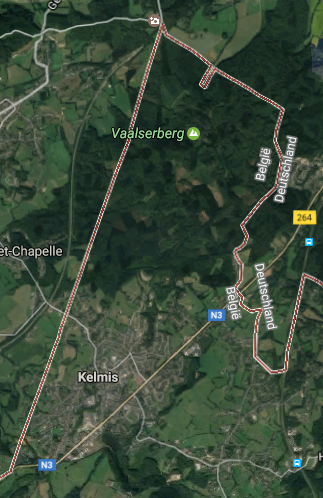
the European country that spoke Esperanto

Did you know that there used to be a quasi-autonomous European jurisdiction with a land area of 3.5 km and a population as large as 3,500 that used Esperanto as its official language?

Moresnet (Esperanto: Amikejo, or “friendship place”) lay among Belgium, Prussia/Germany and the Netherlands in roughly the location shown on this Google Map. It was established in 1816 and absorbed into Belgium in 1920. I exaggerate by calling it a “country,” but it was an international condominium with sovereignty shared by Prussia (later, Germany) and Belgium, official neutrality, its own tricolor flag, and a high degree of self-rule. In 1918, a project began to make it Esperanto-speaking; many residents learned the language, and the World Congress of Esperanto named it the capital of the global Esperanto community.

I learned this after reading about Alexander Dubcek, the face of Socialism with a Human Face and a Czechoslovak leader during both the Prague Spring and the Velvet Revolution. Dubcek was conceived in Chicago but born in what’s now Slovakia. He and his family moved to what’s now Kyrgyzstan at age 3. There he and his family lived in an experimental co-op called Interhelpo, where first Esperanto and then Ido (Esperanto for “offspring,” meaning a kind of Esperanto 2.0) was spoken as the main language. In 1943, Stalin liquidated Interhelpo and shot many of its crunchy residents, but by then Dubcek was back in Czechoslovakia, flighting the Nazis. He survived to be a thorn in the side of totalitarian communism, but not–as far as I know–a dedicated Esperantist.

Any dreams of uniting Moresnet and Interhelpo into a confederation of Esperanto states proved (shall we say) utopian.

The Gadaa System of the Oromo People

The Gadaa system is an indigenous egalitarian democratic system being practiced among the Oromo nation of East Africa for the last six hundred years. Among other structural elements of Gadaa system is its legislative body commonly known as Gadaa General Assembly. The assembly takes place under a sycamore tree -...

three views of the Democratic Party when democracy is at risk

View #1: The same two parties have alternated power since 1854 and will continue to do so for the foreseeable future. Today, the most serious threat to small-d democratic norms and institutions comes from the Trump Administration, and the Democratic opposition is an essential counterweight. A Democratic House in 2018 could begin serious investigations; a Democratic president in 2010 2020 would end the Trump era. You may or may not agree with the platform of the Party, but it’s a big tent, and you have your choice of intraparty factions to back, from Sen. Manchin to Sen. Warren. Moreover, any Democrat would endorse positions on some issues that are preferable to those of the Trump Administration. The Party is accountable to communities most threatened by Trump: for instance, half the voting delegates at the Democratic National Convention were people of color. That fact pushes the Party to defend basic rights for all. The Democratic Party is a bulwark of democracy; it must win the elections of 2018 and 2020.

View #2: At the root of our problems is partisanship. Most of us (including me) use partisan labels as heuristics for assessing policies, candidates, news sources, and opinions. As a result, we are prone to misunderstanding the situation and demonizing half of our fellow Americans. “Partisanship is a helluva drug.” What we need is less reliance on party labels and more cross-partisan or non-partisan dialogue. Maybe it would be better if more Democrats won elections, but that is up to the Party apparatus and should not be our focus as concerned citizens.

View #3: The party duopoly stands in the way of progress, for reasons specific to our moment. Once industrial unions declined and working-class whites migrated to the GOP, we were left with two parties controlled by economic elites. Main Street business interests and extractive industries like coal and oil control the GOP, drawing votes from working-class whites who are not likely to see their interests served. Highly educated coastal elites control the Democratic Party, with votes from people of color who have no better choice. The result is hard-wired neoliberalism, with modest distinctions between the parties on civil rights and environmental regulation. Democracy (in the sense of government that responds to mass economic needs) requires a major reorientation of the whole duopoly. Trump actually enables that in a way that Hillary Clinton could not, in part because of his potential to blow up his own party.

For those keeping score, these three views are most consistent with the first, sixth, and second boxes in my flowchart (below). They can be posed as stark alternatives, demanding a debate. But it’s possible that they all contain truths and that we need people working on all three.

The Joint Effects of Content and Style on Debate Outcomes

I am heading out later today to head to the Midwest Political Science Association (MPSA) conference. My advisor, Nick Beauchamp will be presenting our joint work on “The Joint Effects of Content and Style on Debate Outcomes.”

Here is the abstract for that work:

Debate and deliberation play essential roles in politics and government, but most models presume that debates are won mainly via superior style or agenda control. Ideally, however, debates would be won on the merits, as a function of which side has the stronger arguments. We propose a predictive model of debate that estimates the effects of linguistic features and the latent persuasive strengths of different topics, as well as the interactions between the two. Using a dataset of 118 Oxford-style debates, our model’s combination of content (as latent topics) and style (as linguistic features) allows us to predict audience-adjudicated winners with 74% accuracy, significantly outperforming linguistic features alone (66%). Our model finds that winning sides employ stronger arguments, and allows us to identify the linguistic features associated with strong or weak arguments.

facebooktwittergoogle_plusredditlinkedintumblrmail

The World Café: Shaping Our Futures Through Conversations That Matter

The 300-page book, The World Cafe, was written by Juanita Brown and David Isaacs and published April 2005. In the first comprehensive book on the World Café, co-founders Brown and Isaacs introduce readers to this simple yet powerful conversational process for thinking together, evoking collective intelligence, and creating actionable results.

Beautifully illustrated with stories contributed by World Café practitioners, this is still the most definitive compendium of Café Know-How available.

Available in Spanish, Portuguese, Turkish, Japanese, Simple Chinese, Complex Chinese, German, Korean, and Thai. Below is an excerpt from the foreword of the book, which can be purchased on the World Café site here.

From the foreword…

We Can Be Wise Only Together
By Margaret J Wheatley

The World Café process reawakens our deep species memory of two fundamental beliefs about human life. First, we humans want to talk together about things that matter to us. In fact, this is what gives satisfaction and meaning to life. Second, as we talk together, we are able to access a greater wisdom that is found only in the collective.

The World Café in Action
As you read the stories and counsel in this book, you will see these two beliefs brought to life in the Café process. In order to provoke your exploration of them, I’d like to underline some of the dimensions of the Café process that bring these beliefs into vibrant, healthy reality.

Belief in Everybody
The World Café is a good, simple process for bringing people together around questions that matter. It is founded on the assumption that people have the capacity to work together, no matter who they are. For me, this is a very important assumption. It frees us from our current focus on personality types, learning styles, emotional IQ—all the popular methods we currently use to pre-identify and pre-judge people. Each of these typologies ends up separating and stereotyping people. This is not what was intended by their creators, but it is what has happened. The Café process has been used in many different cultures, among many different age groups, for many different purposes, and in many different types of communities and organizations. It doesn’t matter who the people are—the process works. It works because people can work well together, can be creative and caring and insightful when they’re actively engaged in meaningful conversations around questions that count. I hope that these stories inspire us to move away from all the categories and stereotypes we currently use about who should be involved, who should attend a meeting—all the careful but ill-founded analysis we put into constructing the “right” group. We need to be focused on gathering the real diversity of the system, but that’s quite different from being absorbed with these other sorting devices.

Diversity
It’s important to notice the diversity of the places and purposes for which the World Café is used, and the diversity of participants who are encouraged to attend World Café gatherings. These pages contain a rich illustration of a value I live by: we need to depend on diversity. Including diversity well is a survival skill these days, because there’s no other way to get an accurate picture of any complex problem or system. We need many eyes and ears and hearts engaged in sharing perspectives. How can we create an accurate picture of the whole if we don’t honor the fact that we each see something different because of who we are and where we sit in the system? Only when we have many different perspectives do we have enough information to make good decisions. And exploring our differing perspectives always brings us closer together. One Café member said it well: “You’re moving among strangers, but it feels as if you’ve known these people for a long time.” Invitation In every World Café, there’s a wonderful feeling of invitation. Attention is paid to creating hospitable space. But the hospitality runs much deeper. It is rooted in the host’s awareness that everyone is needed, that anyone might contribute something that suddenly sparks a collective insight. Café facilitators are true hosts—creating a spirit of welcome that is missing from most of our processes. It’s important to notice this in the stories here, and to contrast it with your own experience of setting up meetings and processes. What does it feel like to be truly wanted at an event, to be greeted by meeting hosts who delight in your presence, to be welcomed in as a full contributor?

Listening
When people are engaged in meaningful conversation, the whole room reflects curiosity and delight. People move closer physically, their faces exhibit intense listening, and the air becomes charged with their attention to each other. A loud, resonant quiet develops, broken by occasional laughter. It becomes a challenge to call people back from these conversations (which I always take as a good sign).

Movement
In the World Café process, people generally move from table to table. But it’s much more than physical movement. As we move, we leave behind our roles, our preconceptions, our certainty. Each time we move to a new table, we lose more of ourselves and become bigger—we now represent a conversation that happened among several people. We move away from a confining sense of self and our small certainties into a spaciousness where new ideas can reveal themselves. As one participant describes it: “It’s almost as if you don’t know where the thought came from because it has merged so many times that it has been molded and shaped and shifted with new dimensions. People are speaking for each other and using words that started somewhere else that they hadn’t thought of before.” We also move into a greater awareness as we look for connections amongst the conversations, as we listen to voices other than our own. Patterns become apparent. Things we couldn’t see from our own narrow perspective suddenly become obvious to the entire group.

Good Questions
World Café dialogues, like all good conversations, succeed or fail based on what we’re talking about. Good questions—ones that we care about and want to answer—call us outward and to each other. They are an invitation to explore, to venture out, to risk, to listen, to abandon our positions. Good questions help us become both curious and uncertain, and this is always the road that opens us to the surprise of new insight.

Energy
I’ve never been in a World Café that was dull or boring. People become energized, inspired, excited, creative. Laughter is common, playfulness abounds even with the most serious of issues. For me this is proof positive of how much we relish being together, of how wonderful it is to rediscover the fact of human community. As one host from a very formal culture says: “My faith in people has been confirmed. Underneath all the formal ways of the past, people really want to have significant conversations. People everywhere truly love to talk with each other, learn together, and make a contribution to things they care about.”

Discovering Collective Wisdom
These are some of the Café dimensions that bring out the best in us. But this is only half the story. World Café conversations take us into a new realm, one that has been forgotten in modern, individualistic cultures. It is the realm of collective intelligence, of the wisdom we possess as a group that is unavailable to us as individuals. This wisdom emerges as we get more and more connected with each other, as we move from conversation to conversation, carrying the ideas from one conversation to another, looking for patterns, suddenly surprised by an insight we all share. There’s a good scientific explanation for this, because this is how all life works. As separate ideas or entities become connected to each other, life surprises us with emergence—the sudden appearance of new capacity and intelligence. All living systems work in this way. We humans got confused and lost sight of this remarkable process by which individual actions, when connected, lead to much greater capacity.

About World CaféWorld Cafe_logo
Using seven design principles and a simple method, the World Café is a powerful social technology for engaging people in conversations that matter, offering an effective antidote to the fast-paced fragmentation and lack of connection in today’s world. Based on the understanding that conversation is the core process that drives personal, business, and organizational life, the World Café is more than a method, a process, or technique – it’s a way of thinking and being together sourced in a philosophy of conversational leadership.

Follow on Twitter: @TWCcommunity

Resource Link: www.theworldcafe.com/world-cafe-book/

we are hiring: Tufts CTSI Director of Stakeholder and Community Engagement / Tisch College Director of Civic Learning for the Health Professions

Tufts CTSI Director of Stakeholder and Community Engagement / Tisch College Director of Civic Learning for the Health Professions

The Tufts Clinical and Translational Science Institute (CTSI) (www.tuftsctsi.org/), one of 64 organizations supported by the National Institutes of Health (NIH) Clinical and Translational Science Awards (CTSA), was established in 2008 to transform the biomedical research process through education, promoting collaboration, and the provision of research infrastructure and support services. Tufts CTSI accelerates the translation of laboratory research into clinical use, medical practice, and health policy. In addition to its work with Tufts University, Tufts Medical Center, and other partner organizations, Tufts CTSI contributes to the national CTSA Consortium.

Tufts CTSI is a leader nationally in the development of frameworks and methods for stakeholder and community engagement in translational research. Most recently, Tufts CTSI enlisted experts from the fields of civic engagement, stakeholder engagement, and participatory research to establish a broad set of resources and training programs to help researchers, communities and partnerships improve the relevance and transparency of research.

The Jonathan M. Tisch College of Civic Life (http://activecitizen.tufts.edu/) prepares Tufts University students to become active citizens and community leaders. The only university-wide college of its kind, Tisch engages Tufts students in meaningful community building, public service experiences, and transformational learning. It also conducts and supports groundbreaking research on civic and political participation and forges innovative community partnerships.

Tufts CTSI and Tisch College of Civic Life seek a faculty member to split his or her time between leading the Stakeholder and Community Engagement (SCE) Program [Tufts CTSI] and directing Civic Learning for the Health Professions at Tufts [Tisch College]:

More details: https://apply.interfolio.com/41316.

Deepening D&D’s Impact by Connecting Politicians to Theorists through Practitioners

We recently came across an article that frames a key issue in our field so well that we had to share it. The piece is by Lucy Parry, a researcher with NCDD member org Participedia, and Wendy Russell of the Canberra Center for Deliberative Democracy, both of whom are contributors for The Policy Space blog. In it, they describe the gaps and similarities between D&D theorists and practitioners, and the power of their synergy. They propose that in order for our field to influence policy outcomes and ultimately help our democratic systems become more deliberative, we have to connect politicians and elected officials meaningfully to our field’s theoretical grounding, and that D&D practitioners might be the right bridge for that connection.
What do you think? How should D&D theorists and practitioners work together? How should they not? We encourage you to read the excerpt below from the Lucy’s great piece and read the full version here.


Bridging the Gap: why deliberative democracy needs theorists and practitioners to work together

…[O]ne of the obstacles for successful use of deliberative approaches is the challenge of bringing the normative ideals of deliberative democratic theory – what it should look like and what functions it should serve – to the reality of political decision-making contexts. This raises a potential ‘gap’ between deliberative academics and practitioners, given the constraints of translating normative theory into workable political reality….

In general, practitioners work at the coalface, adapting to political constraints and timeframes, and doing what works in these contexts. Researchers tend to stand back, describe how best practice should look, and critique attempts to achieve it. In bringing a critical eye they play an important function, but collaboration between theory and practice is clearly important…

In some ways, practitioners of deliberative democracy are uniquely placed at the interface between theory and policy worlds and can act as mediators between the two. On the one hand, they work within the constraints of policymaking, familiar with the day-to-day rigmarole. On the other, they have the most experience of real-life deliberative democracy: they see it, they do it. Practitioners know what deliberative processes can achieve, in empowering citizens and improving the quality and legitimacy of political decisions. They also know how deliberative approaches can fail.

It is arguably the case that despite the different work that theorists and practitioners do, they park their cars in the same garage; sharing a commitment to enhancing inclusiveness and public reasoning in political decision-making. What’s more, practitioners are uniquely placed to bridge a much wider gulf: between theorists and policymakers….

We encourage you to read the full original version by Lucy Parry and Wendy Russell of The Policy Space at www.thepolicyspace.com.au/2016/17/125-bridging-the-gap-why-deliberative-democracy-needs-theorists-and-practitioners-to-work-together.