Using Data Mapping to Help Reclaim Urban Commons

Big Tech understands the power of data to advance its interests.  It’s time for commoners to do the same, especially in urban settings.

A pioneer in this style of high-tech activism is the Brooklyn-based group 596 Acres, whose name comes from apparent number of acres of vacant public land in Brooklyn in 2011 as determined by the NYC Department of City Planning.  Since its founding that year, 596 Acres has ingeniously used various databases to identify vacant lots throughout the City that could be re-purposed into public gardens, farms parks, and community meeting spaces.

Paula Z. Segal, an attorney who works with the Urban Justice Center in New York City, explained in a blog post that shortly after its founding in 2011, “the 596 Acres team started hunting down all available data about city-owned land. Once we got the data, we worked to translate it into usable information. For each publicly owned ‘vacant’ lot we found, we asked two questions: 1) ‘Is this lot in use already?’ and 2) ‘Can you reach this lot from the street?’”

The group used a combination of automated script, Google Maps, the interactive community maps at OASISNYC.net, and gardener surveys done by a NYC nonprofit, to identify the unused lots accessible from the street.  It discovered that there were approximately 660 acres of vacant public land in New York City, distributed across 1,800 sites.  But putting this land to better, public uses required commoners to organize and pressure elected officials and city bureaucrats to transfer ownership and allow the creation of new green spaces.

There is a backstory to 596 Acres’ activism: In the 1990s, many New Yorkers converged on trashed-out parcels of city land, converting them into hundreds of community gardens. This amazing surge of commoning helped to humanize the cityscape while, as a byproduct, raising property values for adjacent buildings in the neighborhood. People could undertake this work only because the vacant lots were open and accessible. (In the era of Mayors Guiliani and Bloomberg, by contrast, any vacant lots are fenced, effectively thwarting the reclaiming of vacant lots and abandoned buildings for commoners.) Guiliani sought to sell off the land that commoners had reclaimed, provoking a fierce backlash that resulted in the creation of scores of community land trusts to manage the gardens.

Now that vacant lots are fenced, 596 Acres post signs on the fences informing neighbors that the land is actually publicly owned (i.e., government, not commoners, has title to the land). The signs invite people to organize to try to convert the unused lots into gardens or parks. To help move this process along, 596 Acres has created online maps giving detailed information about each vacant lot – who is the registered owner, the land's legal status, city departments and politicians who should be contacted, etc.

Living Lots NYC now serves as “a clearinghouse of information that New Yorkers can use to find, unlock and protect our shared resources.”  The site features a searchable database and map of 899 “acres of opportunity” on 1,337 sites, and 1,186 acres of community projects on 584 sites.  The map also includes colored dots showing where people have access and where people are organizing to liberate land.  A primary goal of the site is to “broadcast what is know-able [about vacant city land parcels] and to help people find one another on a property-by-property basis.” 

Paula Segal explains that:

Wherever possible, the goal is a permanent transfer of public land to the NYC Parks Department, or private land to a community land trust. But sometimes creating a temporary space for a few years until other planned development moves forward—arranged via an interim use agreement—is the only achievable outcome.

In each instance, residents must navigate a unique bureaucratic maze: applying for approval from their Community Board, winning endorsement from local elected officials, and negotiating with whichever agency holds title to the land. Along the way, 596 Acres provides legal advice, technical assistance, and a network for sharing best practices from successful campaigns.

Some of the benefits of building power this way have been unexpected.  In January 2015, when NYC’s Department of Housing Preservation and Development (HPD) published a list of 181 “hard to develop” properties that they would sell for $1 to developers willing to build affordable housing, we were able to quickly analyze the list and find out that it included 20 community garden lots. Six of those were gardens that had been formed with our support.

Within three weeks of the list’s publication, over 150 New Yorkers, including four City Council members, were rallying on the steps of City Hall. By the end of that year, the administration had transformed 36 formerly “interim use” spaces to permanently preserved NYC Parks Department gardens, including fifteen of the gardens on the January list. Using our network, community gardeners had preempted a major threat, ensuring that the largest wave of garden preservation in NYC history would happen without a legal battle.

596 Acres has now moved beyond vacant lots, focusing on how inaccessible and neglected NYC parks, buildings and post offices could be put to better use.

In collaboration with the Urban Justice Center and Common Cause/NY, 596 Acres also operates a website called NYCommons that helps people learn more about New York City’s public spaces.  Some 3,243 properties are listed, with colored dots indicating whether the property is a library, post office, waterfront facility, public housing, garden, vacant lot, whether “development is pending” and if organizing [against “development”] is underway.

“Some are opportunities to organize new spaces for integrated community services,” writes Segal. “Others we hope to preserve in the face of a real estate market hungry for places it can transform into luxury development.”  Many of of the neglected land parcels, parks, community centers, public baths, rest rooms and buildings are in low-income communities of color -- victims of the city’s fiscal crisis and class-driven policy choices in the 1970s.

I’m impressed with how database-driven maps can be used to galvanize and assist citizen campaigns to reclaim the city.  It suggests that commoners should convene more “inter-mapping” confabs to trade insights and develop database activism.

Using Data Mapping to Help Reclaim Urban Commons

Big Tech understands the power of data to advance its interests.  It’s time for commoners to do the same, especially in urban settings.

A pioneer in this style of high-tech activism is the Brooklyn-based group 596 Acres, whose name comes from apparent number of acres of vacant public land in Brooklyn in 2011 as determined by the NYC Department of City Planning.  Since its founding that year, 596 Acres has ingeniously used various databases to identify vacant lots throughout the City that could be re-purposed into public gardens, farms parks, and community meeting spaces.

Paula Z. Segal, an attorney who works with the Urban Justice Center in New York City, explained in a blog post that shortly after its founding in 2011, “the 596 Acres team started hunting down all available data about city-owned land. Once we got the data, we worked to translate it into usable information. For each publicly owned ‘vacant’ lot we found, we asked two questions: 1) ‘Is this lot in use already?’ and 2) ‘Can you reach this lot from the street?’”

The group used a combination of automated script, Google Maps, the interactive community maps at OASISNYC.net, and gardener surveys done by a NYC nonprofit, to identify the unused lots accessible from the street.  It discovered that there were approximately 660 acres of vacant public land in New York City, distributed across 1,800 sites.  But putting this land to better, public uses required commoners to organize and pressure elected officials and city bureaucrats to transfer ownership and allow the creation of new green spaces.

There is a backstory to 596 Acres’ activism: In the 1990s, many New Yorkers converged on trashed-out parcels of city land, converting them into hundreds of community gardens. This amazing surge of commoning helped to humanize the cityscape while, as a byproduct, raising property values for adjacent buildings in the neighborhood. People could undertake this work only because the vacant lots were open and accessible. (In the era of Mayors Guiliani and Bloomberg, by contrast, any vacant lots are fenced, effectively thwarting the reclaiming of vacant lots and abandoned buildings for commoners.) Guiliani sought to sell off the land that commoners had reclaimed, provoking a fierce backlash that resulted in the creation of scores of community land trusts to manage the gardens.

read more

A new resource from CIRCLE: Reaching All Youth Strengthens Engagement (RAYSE)

(San Antonio) My CIRCLE colleagues have produced a user-friendly online tool called Reaching All Youth Strengthens Engagement (RAYSE). It provides information about youth voters (and potential voters) in every county of the US. It’s meant to help organizations and movements allocate their resources effectively. It’s designed to inform a range of agendas. You could use it to identify counties where an additional youth voter is most likely to affect the outcome of the 2018 election, or where highly disadvantaged youth are most prevalent, or to learn more about the counties where you already know you want to work.

In early 2016, CIRCLE launched the Youth Electoral Significance Index (YESI), which ranked states and congressional districts that showed high levels of youth engagement (and factors that correlate with engagement) and that were expected to be politically competitive in 2016. The RAYSE Index complements YESI. Whereas the YESI ranked states and congressional districts by the potential impact of youth on voting results in 2016, RAYSE looks at counties, provides data on forms of civic engagement beyond voting, and allows the user to choose priorities instead of providing a single ranking.

NCDD Members Win Big in Bridge Alliance Grant Competition

In case you missed it, we wanted to highlight the fact the a total of nine different NCDD member organizations were awarded grants as part of first round of the Bridge Alliance‘s Collective Impact competition. We think having so many NCDD members win grants in a competition aimed at helping transpartisan groups “to better collaborate on ways to fix political processes on the local, state, and national levels” is a huge testament to the powerful work that our network does. We invite you to join us in congratulating Bring it to the TableDavenport Institute, Essential Partners, Healthy Democracy, Institute for Local GovernmentLiving Room Conversations, National Institute for Civil DiscoursePublic Agenda, Village Square, and all of the other winners!
You can learn more in the Bridge Alliance’s announcement below (we’ve marked the NCDD member orgs with an asterisk) or find the original here.


The Bridge Alliance Collective Impact $500,000 Grant First-Round Projects, March 2017

Recognizing that organizations cannot effectively bridge the broad political divide alone, the Bridge Alliance is awarding up to $1 million in Collective Impact grants in 2017 to enable our member organizations to better collaborate on ways to fix political processes on the local, state and national levels. We are pleased to announce today the awarding of more than $525,000 in inaugural grants, to be shared by two dozen Bridge Alliance member organizations.

These joint projects will help members implement and test innovative approaches in our Alliance’s three core areas: expanding civic engagement and participation; improving governance; and reforming campaign and election processes. The programs are designed to generate tools, ideas and best practices for all Bridge Alliance members to use and to multiply the impact of each group’s work.

Additional grants will be awarded later this year, financed in partnership with Invest American Fund and others.

GOVERNANCE 

  • Improve the workings of state legislatures nationwide bybringingtogether legislators from across the country to study how to talk with others with opposing views and how to reach policy decisions without or with minimum acrimony.

Collaborating Bridge Alliance members: National Institute for Civil Discourse*; State Legislative Leaders Foundation; National Foundation of Women Legislators.  Grant amount: $50,000 in two phases.

  • Make local government meetings and decision making more effective by distributing a toolkit to make public meetings more productive and guide how people inside and outside of local government perceive and communicate with each other.

Collaborating Bridge Alliance members: Public Agenda*; Cities of Service; Institute of Local Government*. Grant amount: $45,000

CIVIC PARTICIPATION & ENGAGEMENT

  • Help people and groups find opposing forces who are willing to talk and stimulate dialogue between those of differing viewpoints by creating an online “matchmaking site” to help divergent Bridge Association members and others find each other for open conversations on difficult issues.

Collaborating Bridge Alliance members: AllSides, Living Room Conversations*, Digital Citizen. Grant amount: $65,000

  • Find out if voters can make better-informed decisions on initiatives and referenda, by expanding and testing new Citizen Initiative Review Panels’ voter information guides in a California demonstration project.

Collaborating Bridge Alliance members: Public Agenda*, Davenport Institute*, Healthy Democracy*. Grant amount: $60,000

  • Enable open conversation between leaders and groups with diverging views, with a test project in Utah to train civil discourse facilitators who will lead and teach others how to find common ground for discussion.

Collaborating Bridge Alliance members: Essential Partners*, Living Room Conversations*, Village Square*. Grant amount: $45,000

  • Improve government decision making and civic participation by better informing people of government procedures, successes and roadblocks, by creating, testing and distributing a new series of radio, TV and webcasts.

Collaborating Bridge Alliance members: AllSides, Living Room Conversations*, Bring it to the Table*, Coffee Party. Grant amount: $38,000

  • >Harness the power of social media to showcase positive acts of governing instead of just the negative, through research, tests and the participation of social media experts and companies

Collaborating Bridge Alliance members: Civil Politics, Living Room Conversations*, Village Square*. Grant amount: $25,000

  • Create a new model for Americans of different backgrounds and beliefs to come together in face-to-face conversations, with social media tools and guidelines to allow all Bridge Member groups, other organizations, and individuals to organize powerful “circles” and moderated dinners for cross-party dialogue and civil debate.

Collaborating Bridge Alliance members: 92Y, Village Square*. Grant amount: $90,000 in two phases

CAMPAIGNS AND ELECTIONS

  • Educate voters where new election processes are in place or under consideration, such as open primaries and ranked choice voting.

Collaborating Bridge Alliance members: Fair Vote, Open Primaries, Reconsider Media, Independent Voter Project. Grant amount: $35,000

  • Encourage and enable more people to run for public office, with social and other media outreach to potential candidates and the public at large, to foster a more representative, responsive, and functional government.

Collaborating Bridge Alliance members: Centrist Project, Independent Voting.org, Represent.Us. Grant amount: $60,000

You can find the original version of this Bridge Alliance announcement at http://www.bridgealliance.us/collective_impact1.

the impact of post 9/11 war on our politics

(San Antonio, TX) Any effort to understand the current political situation must take seriously the fact that we have been war since 2001. Although it’s problematic to assess wars as won or lost, that’s a hard framework to avoid; and in those terms, we’ve lost. Neither Afghanistan nor Iraq—let alone Libya or Syria—is in a state that any proponent of these wars would have remotely advocated before we invaded.

Nations typically respond poorly to the experience of losing wars. The post-9/11 conflicts have been somewhat unusual. Even though we failed in our objectives, the vast majority of the human price was borne by people who are remote from US voters in both space and culture—Iraqis and Afghans. We lost no territory and very few lives at home after 9/11. Meanwhile, a small proportion of US citizens have actually been deployed in those zones. Military personnel are far from representative of the US population. Instead, they are concentrated in certain communities and families. It’s easy for some of us to forget that we have been at war; impossible for those who have served in a war zone or have sent close relatives there.

I think that for many Americans, the experience of having fought and lost is very salient. For others, it’s hardly a thought. To be critical of George W. Bush for launching an unjust war (as I am) is very different from feeling the trauma of having personally served and suffered for no apparent reason. Across history, that type of experience has often produced very ugly political results.

Certainly, voters will blame leaders who were responsible for launching and then managing these conflicts. George W. Bush left office deeply unpopular. Hillary Clinton voted (with very few fellow Democrats) for the Iraq War and then, as Secretary of State, took partial responsibility for managing the conflicts (from Libya to Pakistan) when they weren’t going well. I think the political cost of that record has been under appreciated. It didn’t help that she prospered personally and sought even higher office while others paid for decisions that she had supported. Barack Obama got a partial pass because he—like Donald Trump—was out of office when the war began. However, one of several reasons that President Obama was a polarizing figure is that some Americans blamed him for losing the wars he had inherited, some thought he disappointingly continued the Bush policies, and others thought he managed these wars skillfully.

Trump lied that he opposed the war at first, but presumably many people believed him because they never saw the counter-evidence. More importantly, Trump acknowledged the experience of having lost wars and proposed a response: from now on, we will win, because we’ll spend much more money and ignore any moral and diplomatic constraints.

Veterans and people who live in communities with heavy military presence were far more likely to vote for Trump in November. Maybe I have missed it, but I don’t recall hearing a plausible message to those communities from politicians and movements that oppose these kinds of wars. I respect a genuinely pacifist (or anti-imperialist) stance, but it has a long way to go to capture majority support, and it faces valid questions as a policy position. (Should we really not intervene militarily against ISIS?) Any viable message must acknowledge the experience of trauma without patronizing those who have served. And it must recognize the desire for the nation to succeed without being bellicose.

Phoenix Students Spend $26K in District-Wide PB Process

We are proud to share that the Participatory Budgeting Project – an NCDD member org – recently completed the first-ever school district-wide participatory budgeting in Phoenix, AZ, and it was a huge success. The process empowered over 3,500 students to deliberate and vote on how to spend $26,000 of district money, and the project’s success is already being looked to as a model for more school PB processes in the future. It’s a great win for teaching D&D practices to more young people! We encourage you to read more about how it went in the PBP blog update below or find the original here.


What Happens When Students Lead PB?

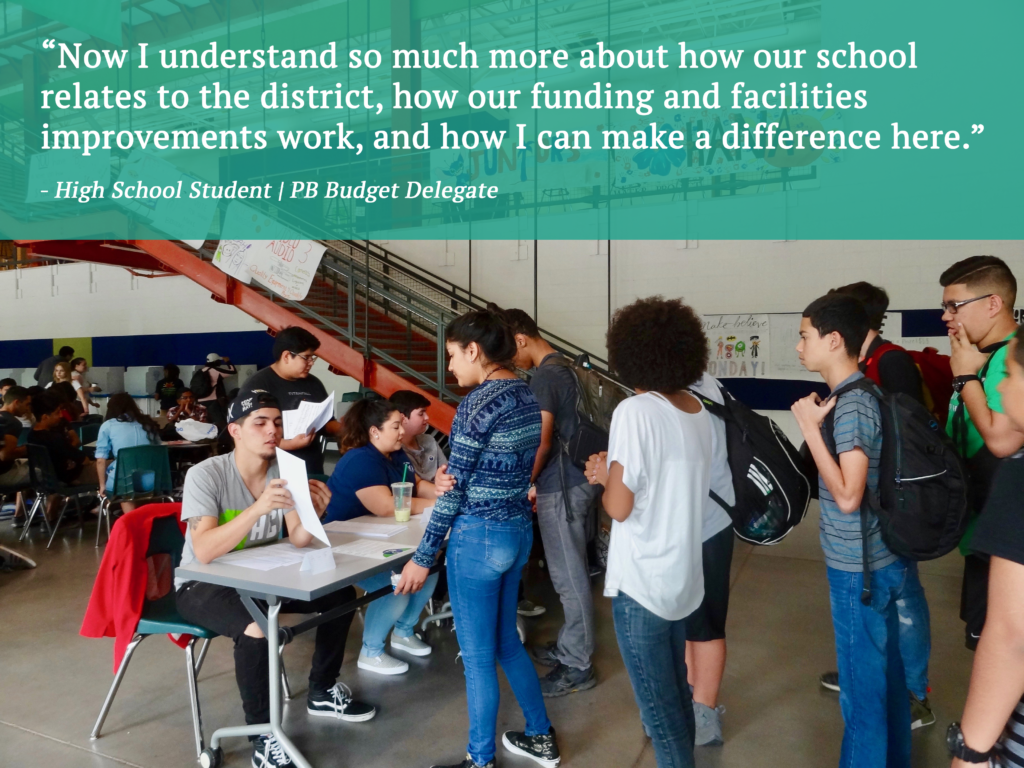
“Let’s rock and roll!” shouted Christopher Oglesby, Assistant Principal at Carl Hayden Community High School, to a team huddle of 30 spirited students. The group dispersed in all directions and prepared to welcome over 1,500 student voters to the gym.

This team of student leaders – along with school district staff, nonprofit partners, and volunteers – met just before the Phoenix sunrise to set up thousands of ballots and stickers, 40 voting booths, dozens of blue and gold posters, eight voter check-in stations, three display boards, and two official Maricopa County vote machines.

During this workshop, students, teachers, and staff from five public high schools in the Phoenix Union High School District (PUHSD) learned about PB, and began planning how students in each school would directly decide on how to spend part of the school district’s budget. Six months ago, in September of 2016, we kicked off  the school year in Phoenix with an introductory workshop on participatory budgeting (PB) – a democratic process in which local people directly decide how to spend part of a public budget.

PUHSD was the first school district in the U.S. to do school PB with district-wide funds. Since their introduction to PB in September, five schools have worked through six months of trainings, outreach efforts, idea collection events, and meetings with district staff to transform ideas about ways to improve their schools into project proposals. These student-led efforts culminated with an entire week of voting – five voting days that each began before the sun came up.

Making history in Phoenix made for deep learning about school PB

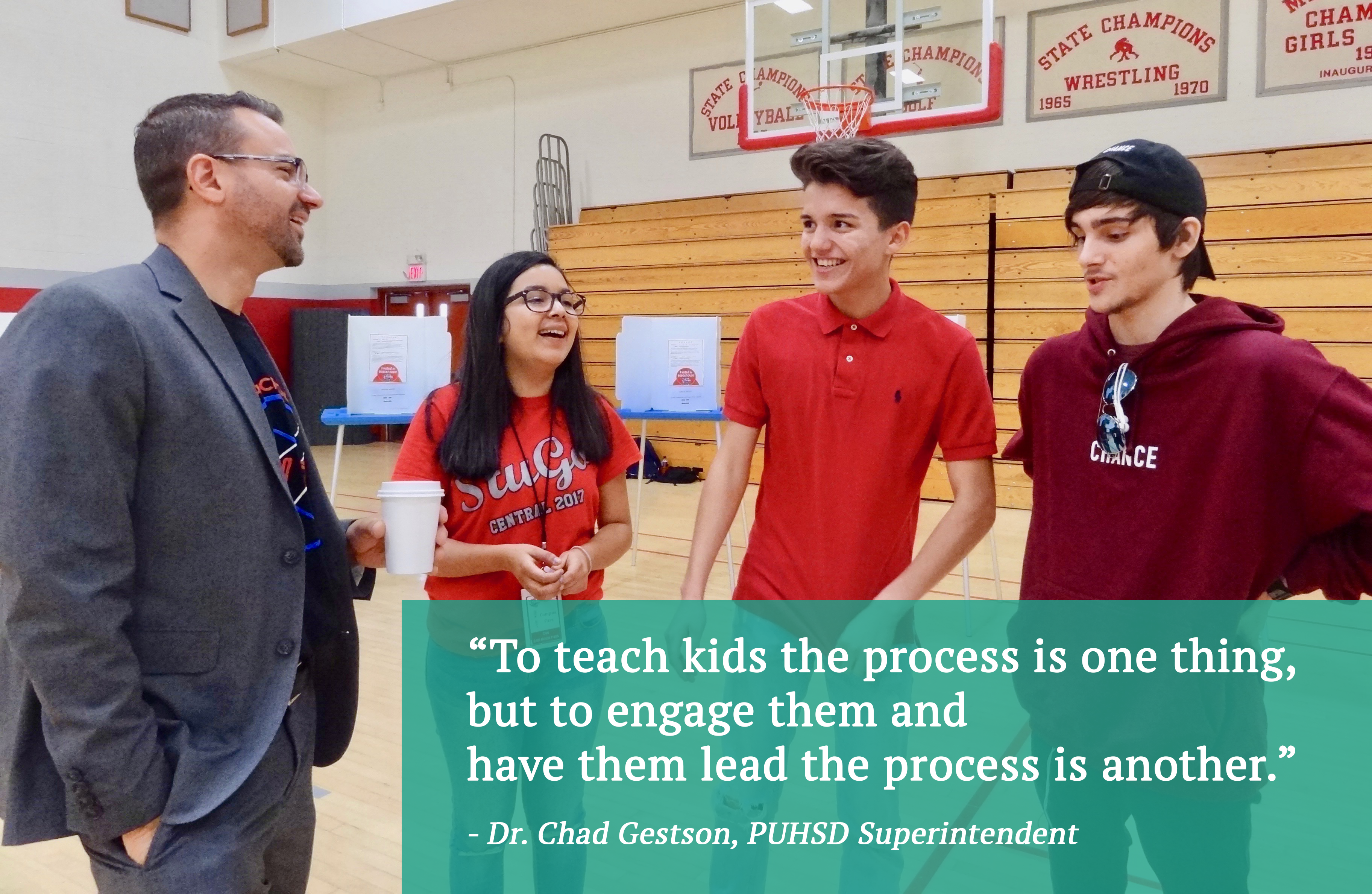
As the school district begins implementing winning projects at each school, we’re reflecting on the outcomes we’ve already seen beyond projects themselves. During Vote Week Dr. Chad Gestson, PUHSD Superintendent, said,

“If there are any schools or districts across the country that are thinking about doing school PB, in our opinion it’s a no-brainer.”

Impacts from this district-wide initiative underscore Dr. Gestson’s point, and highlight the potential for PB to create similar outcomes for students, teachers, school district staff, and beyond. When schools or school districts use PB to empower their students to decide how to spend the dollars that impact their daily lives, everyone wins.

Students

PB helped students build friendships across grade levels. Many students talked about the ways being involved in PB increased their own self-confidence and ability to talk with fellow students about how to improve their school.

Teachers

Teachers who stepped up to advise PB at each school developed stronger relationships with students outside their regular classes, and enjoyed seeing students learn and lead with great creativity and compassion throughout the PB process.

School District Staff

The PUHSD Executive Director of Logistics was so excited to see so much student interest in school maintenance and facilities that he’s planning to incorporate student input and participation into school improvement initiatives beyond the winning PB projects – including repainting some of the schools and renovating cafeterias.

Beyond PUHSD

City staff and community organizers from the City of Phoenix and the City of Tempe, and from as far away as Fresno, CA, and Toronto, Ontario attended a vote walkthrough and panel discussion with students, teachers, and staff involved in PB. These staff members and community organizers were excited by the work happening in the school district, and several are already planning for ways to bring PB to their communities!

And the winning projects are…

Drumroll, please!

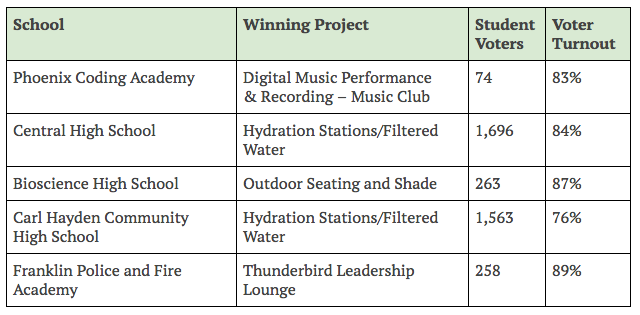
During Vote Week, 3,854 students in five public high schools – an average of over 80% turnout rate – directly decided how to spend $26,000 in school district funds. Students voted to fund music programs, filtered water stations, shade structures, and a study lounge.


Teamwork made this dream work

In any community, a successful PB process is built on strong collaboration.

PUHSD PB took teamwork to the next level, and established partnerships across Phoenix that have already inspired other school districts and cities to reimagine ways to work together.

During Vote Week, the Maricopa County Recorder’s Office generously partnered with PUHSD; they provided voting booths, official vote machines and ballots, and staff support for each voting day. In doing so, County Recorder Adrian Fontes and his office created a voting experience that embodied real democracy just as an election does – and in some ways did so even better.

Recorder Fontes has confidence that “there are other elected officials around the country just like [him] who would be more than happy to come on out and help support these sorts of elections with staff and equipment.”

“[PB] is part of education that’s not testable” he said, “isn’t this one of the most important aspects of our American democracy?”

Beyond support from an elected official, local partners from across Phoenix came together with commitment and creativity to support this student-driven initiative. This successful Vote Week was due in great part to the time, talent, and remarkable volunteers from the Center for the Future of Arizona, One Arizona, Mi Familia Vota, and Arizona State University.

Telemundo, NPR’s KJZZ, and Arizona PBS each covered Vote Week, and produced compelling news reports linked below:

Cronkite News AZ PBS’s coverage of Phoenix Union High School District PB process goes from 16:00 – 17:45 in this video.
More coverage of the first PB process with school district funds from 91.5 KJZZ.

What’s next for Phoenix?

We’ll wrap up this pilot year in PUHSD with a PB Celebration and Participatory Evaluation Workshop in May – where students, teachers, and staff from all five schools will come together to celebrate their work, reflect on what was challenging and what can be improved, and share ideas and plans for next year.

What’s next for you?

At PBP, we’re excited to see the movement for PB in schools continue to spread across Phoenix, and beyond! Our guide to PB in schools is supporting the growth of PB in schools around the world – download it here to take action.

How can we work together to bring PB to your community?

If you’re interested in more in-depth support from PBP to launch PB in your school, contact Ashley Brennan at ashley@participatorybudgeting.org.

You can find the original version of this Participatory Budgeting Project piece at www.participatorybudgeting.org/what-happens-when-students-lead-pb.

EvDem Offers $10K Award for Leadership in Democracy

We want encourage our network to consider submitting a nomination for the new $10K leadership award being offered by NCDD member organization Everyday Democracy. This new award can be granted to anyone 16 or older whose work embodies the values EvDem’s work reflects, but the deadline for nominations is June 15, so don’t wait too long! You can learn more about the award criteria and how to submit a nomination in the EvDem announcement below or find the original announcement here.


Announcing the Paul and Joyce Aicher Leadership in Democracy Award

EvDem LogoWe are pleased to announce the first annual Paul and Joyce Aicher Leadership in Democracy Award. This $10,000 award will be given to an individual and/or organization that demonstrates the values on which Everyday Democracy was founded – voice, connection, racial equity, and community change.

For more than 25 years, Everyday Democracy has worked in communities across the country to foster a strong and vibrant democracy – one that is characterized by strong relationships across divides, leadership development, lifting up the voices of all people, and celebrating racial equity.

Paul and Joyce Aicher’s generosity and creative genius have had a profound impact on individuals and organizations in every part of this country. Their passion and diligent effort inspired the dialogue guides, organizing and facilitating training, and community coaching that Everyday Democracy is so well known for delivering.

Through this award, we will recognize the work of individuals and/or organizations across the U.S. for outstanding achievement in creating opportunities for people to talk to and listen to each other, work together for equitable communities, and help create a democracy that works for everyone.

Download an information sheet about the award (PDF).

A brief history of Paul and Joyce Aicher

Paul J. Aicher’s motto, “Don’t just stand there, do something,” marked all that he did. Before founding the Study Circles Resource Center (now called Everyday Democracy) in 1989, he was a model for civic engagement. Shortly after graduating from Penn State, he participated in a discussion course which helped him find his voice in civic life and sparked his lifelong interest in helping others find their own. He saw a direct connection between his early experiences as a participant and a facilitator and his later vision for embedding these kinds of opportunities into American political life and culture.

Throughout his life, he spent his free time volunteering. Early in their marriage, he and his wife Joyce got involved with a refugee resettlement project in Illinois; Paul then served as president of the North Shore Human Relations Council. Back in Pennsylvania in the mid-1960s, he started the World Affairs Council of Berks County and led his neighbors in discussions of the “Great Decisions” guides published by the Foreign Policy Association. Through his long-time work and friendship with Homer Jack, an American Unitarian Universalist clergyman and social activist, Paul developed a passion for racial justice and international peace, both of which would inspire his later social action.

In the 1970s, he devoted his energies to launching his company Technical Materials and raising four children with Joyce. But he always returned to activism. In the early 1980s, after moving to Pomfret, Connecticut, Paul joined the local anti-nuclear freeze movement. In 1982, he formed the Topsfield Foundation, which was renamed The Paul J. Aicher Foundation after Paul’s passing in 2002. It began with making grants to advance a number of causes: affordable housing; educating and engaging the public on international security issues; and networking grass-roots peace and justice groups across the U.S. As it became an operating foundation, it focused all of its efforts on its current mission – to strengthen deliberative democracy and improve the quality of life in the United States. In the past twenty-five years, it has been best known through the work of its primary project, Everyday Democracy, which supports communities across the U.S. in implementing Paul’s vision of public dialogue that enables everyone to have a voice and be heard.

Joyce shared Paul’s commitment to civic engagement, community activism, and social justice. With her quiet strength and humor, she often worked behind the scenes to make the work of the Foundation possible. She also strengthened the local community through her numerous volunteer efforts. She and Paul shared a love of nature, books, and the arts and were self-effacing advocates of democratic values. Joyce passed away in 2016.

Who is eligible for the award?

Individuals 16 years of age and older, coalitions, and organizations conducting projects in the U.S. are eligible to be nominated. Current Everyday Democracy employees and Board members are excluded from being nominated.

Award criteria

The award will honor work that embodies Paul and Joyce Aicher’s values, such as the following:

  • Creating welcoming opportunities for meaningful civic participation for all people
  • Actively including people in civic life who have often been marginalized, and providing ways for them to develop their leadership capacities
  • Building the capacity of existing community leaders to include others in community life
  • Practicing the art of talking to each other and listening to each other
  • Taking action that is grounded in crossing divides, and aimed at meaningful transformation in people, institutions, community culture, and governance
  • Creating opportunities for empowered voice that is truly heard
  • Addressing racial inequities through dialogue and collective action
  • Showing the power of bridging all kinds of divides
  • Making dialogue a regular part of how a community works and, ultimately, of how our democracy works

Nomination process

Anyone may nominate any person or organization that meets the criteria for this award. Click here for the nomination form, which must be received by 5 pm EST on June 15, 2017. You will need to provide contact information for yourself and your nominee, a short summary of their work, and a 500-1,000 word essay describing why you think they should receive the award.

Once Everyday Democracy receives a nomination, we will reach out to the individual or organization to let them know they were nominated and to ask if they would like to supplement the form with additional information for the committee to review. Submissions will be evaluated by a panel put together by Everyday Democracy.

Once a final decision is made, the winner and others will be notified during the month of August. They will be publicly recognized at a reception later in the year.

You can find the original version of this Everyday Democracy announcement at www.everyday-democracy.org/news/announcing-paul-and-joyce-aicher-leadership-democracy-award.