Exploring Restorative Justice in Law Enforcement

In case you missed it, we wanted to lift up this exciting online course from the Zehr Institute for Restorative Justice, a program of NCDD member org, the Center for Justice and Peacebuilding at Eastern Mennonite University. The four-session course will provide an introduction to restorative justice with an emphasis on its application in law enforcement and other community partnerships. It will be a great opportunity for those working in or with law enforcement agencies, though make sure you sign up ASAP as the course is limited to 25 participants. You can read the announcement below or find the original on the Zehr Institute’s site here.


Law Enforcement Through Restorative Justice: Peacebuilding in the Community

This four-part online course is an introduction to restorative justice with an emphasis on its applications in law enforcement and community-engaged program partnerships. Participants will explore innovative ways to incorporate restorative justice within an agency, and to collaborate with community organizations on such initiatives. Through presentations and interactive discussions, examples of implementation in police agencies throughout the United States will be showcased. Some of these will include:

  • An alternative to, or within, the criminal justice system
  • Citizen complaints
  • Internal conflict and
  • Community engagement.

Restorative justice is often referred to as “the missing piece in law enforcement”. You will learn why police chiefs around the country have been utilizing or are incorporating restorative justice as an option within their organization. From victim advocacy, to offender accountability, restorative justice provides many benefits to an entire community. For example, police departments experience a high rate of victim satisfaction, community participation, and reduction in offender recidivism which ultimately results in accomplishing procedural justice and police legitimacy.

Course dates:

  • March 13, 2018 3 – 4:30 pm Eastern
  • March 20, 2018 3 – 4:30 pm Eastern
  • March 27, 2018 3 – 4:30 pm Eastern
  • April 3, 2018 3 – 4:30 pm Eastern

Course Fee: $200 for the full 4-week course.
Complete payment & registration by clicking here.

Course Objectives

  • Explore why and how law enforcement is implementing restorative justice programs across this country
  • Engage select guest speakers on the greatest successes and challenges they have faced in applying restorative justice to law enforcement.
  • Learn about innovative restorative justice practices that have enhanced law enforcement and community engagement, partnerships, and collaboration
  • Grapple with how to make law enforcement more restorative – changing structures, policies and procedures

Course Instructor(s): Dr. Carl Stauffer and Officer Vanessa Westley
Course Syllabus: Download Syllabus

Target Audience
The course is intended for people working in or associated with law enforcement agencies. Criminal justice practitioners, law enforcement agency directors, command level officers and those working in the field will benefit from this series.

Course Structure & Cost
The course will be held four consecutive weeks for 90 minutes per session – Tuesdays, March 13 – April 3, 2018 from 3-4:30 pm (EST), and will be synchronous, (i.e. live) through the Zoom platform. Unlike a webinar, all participants will be able to see, hear and speak to the others. Participants will need access to an internet-connected computer with webcam and microphone, head phones, a quiet spot and good lighting.

Enrollment is limited to 25. This is a non-credit course however, a certificate of participation will be provided upon request.

Instructor Bios
Officer Vanessa Westley is a twenty-five year veteran of the Chicago Police Department.  She has served in various positions within the Department’s Patrol Division and other units.  She began her service in Community Policing in 2004 under now-retired First Deputy Dana V. Starks, as project manager in the Department’s CAPS Project Office.  She later served as project manager for the Mayor’s Office of Faith Based and Community Partnerships.  Currently she is the program manager for the Chicago Police Department’s and the Metro YMCA’s “Bridging the Divide” program.  She is the special projects coordinator for the CAPS Revitalization effort launched in 2013.  She leads the community engagement training program for the Department through DePaul University’s Center for Urban Education.  Vanessa is a Restorative Justice and Art of Hosting practitioner and trainer.

Dr. Carl Stauffer teaches Restorative and Transitional Justice at the Graduate Center for Justice and Peacebuilding, Eastern Mennonite University, Harrisonburg, Virginia. Stauffer also serves as Co-Director of the Zehr Institute of Restorative Justice and the Academic Director of the Caux Scholars Program in Switzerland. Stauffer entered the Restorative Justice field as the first Executive Director of the Capital Area Victim-Offender Reconciliation Program in Richmond, Virginia in 1991. In 1994, Stauffer and his family moved to South Africa where he worked with various transitional justice processes such as the Peace Accords, Community-Police Forums, the Truth and Reconciliation Commission and Local Community Development structures. From 2000 to 2009, Stauffer was appointed as the Mennonite Central Committee Regional Peace Adviser for the Southern Africa region. His work has taken him to 20 African countries and 15 other countries in the Caribbean, Middle East, Europe, Asia and the Balkans.

You can find the original version of this announcement on the Zehr Institute’s site at www.zehr-institute.org/courses/law-enforcement-through-restorative-justice-peacebuilding-in-the-community/.

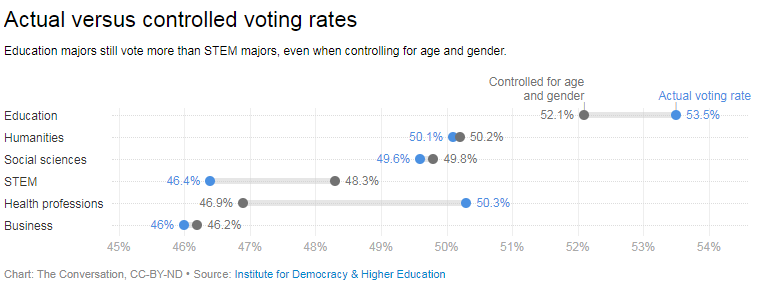
differences in voting by major

My colleague Inger Bergom has a piece in The Conversation with  entitled “Why don’t STEM majors vote as much as others?” They are analyzing data from the two million college students who are included in our National Study of Learning, Voting and Engagement at Tisch College.

The raw correlations between college majors and voting rates are pretty substantial. In 2016, more than half of all education majors voted (53.5%), which was more than 7 points ahead of the rate for business students.

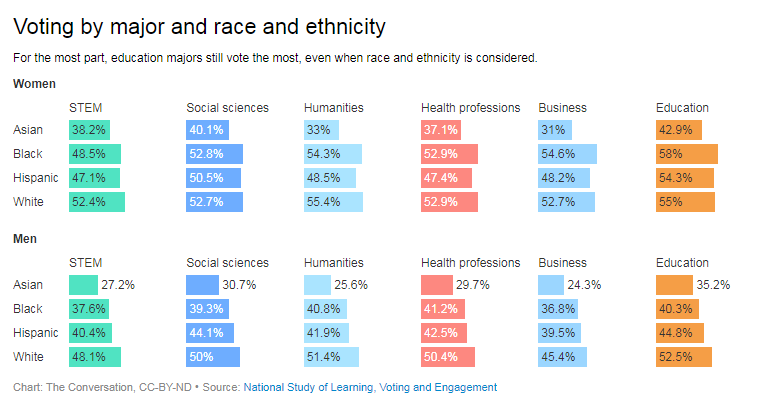
But majors attract different demographic groups. For example, women vote at somewhat higher rates than men. If more education majors were men, the turnout rates in education programs would fall. By the same token, STEM turnout would rise if STEM majors recruited more women. However, education majors would still be ahead.

Once you zero in on major, race and gender together, you see some interesting patterns. African American women who major in education voted at a 58% rate in 2016, well over double the rate of Asian-American men who majored in business.

Self-selection must be part of the story: people who are more interested in the kinds of issues that arise in politics may also enroll in majors like education. Still, there is room to improve the civic education that STEM and business majors experience.

Two Women & a Republic Blog Officially Launches

We are excited to share that NCDD board member, Wendy Willis, recently launched a blog in collaboration with Paula Ellis called, Two Women & a Republic: Letters to Democracy between friends. The site is a correspondence between the two women, focused on exploring the heart of democracy and the ways in which we can bring about a more humane democratic experience. We encourage you to check out their weekly musings which you can find on their beautiful new website here, created by NCDD co-founder Andy Fluke. You can read the inaugural blog post below or find the original on the Two Women & a Republic site here.


In Search of a Benevolent Form or Snipping and Shaping for Democracy

From Wendy Willis…

Well, here we are! After months of planning and talking and dreaming, we have finally arrived at launch day for our new labor of love, Two Women and a Republic.

In fact, now that I look at the calendar, I realize that this is a project 53 weeks in the making. Paula and I met last January—January 18, if I am not mistaken—at the Kettering Foundation Annual Retreat. There was a huge room of some of the nations’s smartest smarties offering thoughts and provocations about the state of citizen-centered democracy. After a back and forth about what could and should be done at a really critical moment for the country (and the world), Paula raised her hand and suggested (both brilliantly and understatedly): “What if we created a Brainpickings for democracy?” Well, that was an idea I had never heard before, so at the next break, I hot-footed it right over there and said: “Let’s do it.” We’ve been writing and talking and Skyping ever since. And once in a great while, we even get to see each other in person!

One of the things we realized in these months of conversation is that there are many opportunities to talk about the mechanics of democracy—the institutions, the legal bases, the processes. And believe me, both Paula and I talk about all those things, with each other and with others. But we also share a desire to talk with somebody about the culture of democracy or about what we might dare to call the heart of democracy. We’re interested in the habits and quirks and daily practices that might lead us to a more humane and democratic society. Or at least to a more humane and democratic hour.

There is also something attractive to us about the letter form, arcane as it might be. At the moment, I am binge-reading the novelist and critic, Elizabeth Hardwick, and this is what she had to say about letter-writing:

Letters are above all useful as a means of expressing the ideal self; and no other method of communication is quite so good for this purpose. . . .In letters we can reform without practice, beg without humiliation, snip and shape embarrassing experiences to the measure of our own desires — this is a benevolent form.

So even if we don’t begin each post with a “dear” and end it with a “very truly yours,” we think of these offerings as letters—letters to each other, letters to democracy, letters to those of you who might find your way here.

Though we are reluctant to make promises, we hope to post something new here each week, even if it’s just a quote or a provocation. Sometimes, we’ll write something longer. But we want to hear from you, too. We want to know what you’re thinking about and worrying over and dreaming into being. Comment here, post on our Facebook page, write us emails. Follow us on Instagram. It’s all a work in progress, but more than anything, we want to nurture a little community here amongst the letters.

Even as we’re just getting started, we have some people to thank. First, big thanks to Andy Fluke for his patience with us as he built our beautiful website. And to the good folks at Kettering who put us in the same place at the same time. And to our friends and family who listened to us fuss over what this project could be. And thanks to you for showing up here–right at the beginning–trusting that when women get together, something’s bound to happen.

You can read the original version of this post on the Two Women & a Republic site at www.twowomenandarepublic.com/2018/01/24/weve-moved-to-a-new-office/.

Paula Ellis also wrote a piece, “Our Eclectic Stew of Ideas” which you can read on the Two Women & a Republic site by clicking here.

Piano di tutela delle acque Valle d’Aosta [Regional Waters Protection Plan of Aosta Valley]

Il Piano di tutela delle acque (PTA) trova il suo riferimento normativo nella Direttiva Quadro sulle Acque (Dir. 2000/60/CE), recepita dal D. lgs. 152/2006. E’ uno strumento di scala intermedia, regionale, ed è sottoposto al Piano di gestione di distretto idrografico che in questo caso, per la Valle d’Aosta, è...

conflict v mistake as a framework for politics

Scott Alexander has an interesting blog post that distinguishes two ways of thinking about politics:

  1. “Politics as mistake.” I’d put this one a little differently. The core idea is that institutions have flaws that result from their designs and the incentives that they create for participants. Sometimes institutions work well enough, but we use the word “politics” for efforts to fix them. Political action is driven by a belief that the structure and incentives of existing institutions demands change.
  2. “Politics as conflict”: Here the idea is that different people have different interests and ideals, so it matters who’s in charge. Politics is mostly about putting one’s own side in control of institutions.

Alexander’s post is long and I could argue that it’s a bit tilted in favor of #1, partly because the examples he cites of #2 are unnecessarily tendentious, e.g., a Baffler article on James Buchanan. Very serious people from a range of perspectives agree with #2. Still, even with a possible tilt, I find Alexander’s framework useful.

The poster child for #1 would be China. The Communist Party took control in 1949, representing a demographic group (workers and peasants) and an ideology (state communism). A fairly continuous group of leaders still runs that Party and that country. For instance, the current premier, Xi Jinping, is the son of the Party’s former propaganda chief, vice-premier, and National People’s Congress vice chair (1952-62). But the regime has shifted from radically egalitarian to rapaciously capitalist, and many grandchildren of Red revolutionaries are billionaires. I make sense of this story by discounting politics as conflict. It doesn’t matter who runs the government or what they stand for. Structures and incentives ultimately prevail. If single-party government gives the ruling cadre a chance to rack up billions, they will sooner or later rack up billions.

Roberto Mangabeira Unger has unimpeachable leftist credentials, but he faults the 20th century left for ignoring institutional structures and the incentives they create. “With few exceptions (such as the Yugoslav innovations),” he writes, “the radical left … has produced only one innovative institutional conception, the idea of the soviet or conciliar type of organization: that is to say, direct territorial and enterprise democracy.” But soviets were never seriously developed to address “practical problems of administrative and economic management,” and they have “quickly given way to forms of despotic government” (False Necessity, pp. 24-5).

On the other hand, politics as conflict (#2) makes better sense of “realignment” elections in functional democracies. When FDR won the presidency in 1932, or when the British Labour Party won in 1945, new people with new interests and new ideas took over those countries. The result was a raft of new policies and institutions. When Thatcher and Reagan won elections decades later, they reversed some of those policies and began to dismantle some of those institutions. It matters who wins the support of the majority of voters and what program they propose.

The same debate also arises in specific domains of policy. For example, people who believe in politics as conflict think that the key questions for education are what is taught and how. There are lively debates between whole language and phonics, patriotic and critical versions of American history, STEM and the humanities. To influence the outcome of these debates, we can try to persuade teachers and schools to adopt our vision of education. We can also enact favorable policies, such as legislative mandates to teach or assess in certain ways.

Meanwhile, some people believe that the important questions in education concern structures and incentives. Maybe we must pay teachers more and protect their autonomy, or assess student outcomes and hold teachers accountable, or give parents choice and let dollars flow to the schools that they choose. These are politically and ideological contrasting theses, but all presume that the way to improve education is to get the incentives right.

It’s too easy to say, but I believe it: politics is both institutional design and conflict over ideas and interests, and each aspect requires attention. Unger recommends that reformers “develop elaborate institutional incentives, a strategy for putting them into effect, and a view of social transformation to inform both their programmatic and their strategic ideas. They must also redefine their guiding ideals and their conceptions of the relation of these ideals to the aims of their political opponents. For if the real meaning of an ideal depends upon its tacit institutional background, a shift in the latter is sure to disturb the former” (pp. 20-21).

It’s a mistake to ignore incentives and assume that institutions will do what they officially promise, unless that somehow pays off for the people in charge. To assume that public schools will serve every child is like assuming a can-opener on a desert island. (Or assuming that a dictatorial party will pursue equality just because it calls itself “communist.”) But it’s also a mistake to discount ideas and ideals or to presume that the only payoffs that people care about are monetary. For the purpose of explaining social change, both incentives and ideals have power.

Further, if you want to know whether you are changing the world for the better, you must rely on a range of evidence. It’s useful to observe people’s behavior under constraints. For example, price signals tell you what people value, given what they have. That kind of analysis falls under Alexander’s “politics as mistake” heading (although the word “mistake” is a bit misleading; it’s really politics as engineering). However, evidence from behavior is always insufficient, because you must also decide what means and ends are good. Unless you arrogantly assume that you can answer that question by yourself, you must listen to other perspectives. And that necessitates “politics as conflict.”

See also how to tell if you’re doing goodthe visionary fire of Roberto Mangabeira Ungerschool choice is a question of values not data.

The Role of Experts across Two Different Arenas in a Deliberative System

The 35-page article, The Role of Experts across Two Different Arenas in a Deliberative System (2017), was written by Rousiley C. M. Maia, Marcela D. Laranjeira, and Pedro S. Mundim, and published in the Journal of Public Deliberation: Vol. 13: Iss. 1. In the article, the authors respond to the call to explore a deliberative systems perspective by looking at how one arena of deliberation affects another; they do this by exploring the role of experts in two distinct arenas of legislative public hearings and the media. Read an excerpt of the article below and find the PDF available for download on the Journal of Public Deliberation site here.

From the introduction…

Recently, several deliberative scholars have called for a systemic approach to deliberation in order to expand the scale of analysis beyond individual sites or institutions and tap into the complexity of interrelations among parts in the political system (Bächtiger & Wegmann, 2014; Dryzek & Hendriks, 2012; Goodin, 2005; Maia, 2012; Mansbridge et al., 2012; Neblo, 2015; Parkinson, 2006, 2012; Steiner, 2014; Thompson, 2008). While empirical scholars have been developing ever more sophisticated analyses on deliberation and have brought careful empirical evidence to warrant their claims, most studies are conducted in one single arena or in a separate institution. Thus, interconnections among arenas remain poorly understood, and current research designs fail to take note (particularly through systematic measurement) of how findings in one environment relate to other arenas in regards to the larger purposes of democracy. Whereas the systemic approach to deliberation seems genuinely innovative and attractive, empirical research in this field is underdeveloped.

In this article, we attempt to add a layer to this field. While previous studies have compared debate across different assemblies or parliamentary settings (Stasavage, 2007; Steiner, Bächtiger, Spörndli, & Steenbergen, 2004), we are interested in investigating the role played by a particular actor – the experts – regarding a specific debate in two distinct discursive arenas: legislative public hearings and the media. Although the literature has asserted that this actor can play different roles within democracy (Brown, 2014; Christiano, 2009, 2012; Pielke, 2007), we still have a vague notion of how experts’ opinions in face-to-face discussions in forums can be compared to the mediated comments in the media. We assume part of the systemic function of public hearings is to inform expectations about policy-making choices in face to face meetings. Media-based communication is important to draw public attention to issues of public concern and helping citizens to understand public processes and policies. Processes of mediation by media professionals, considering both technological apparatus and institutional organization, operate with their own logic, needs and standards of newsworthiness (Esser & Strömbäck, 2014; Ferree, Gamson, Gerhards, & Rucht, 2002; Gastil, 2008; Schudson, 2003). By paying attention to the news media within the deliberative system, we follow Dryzek and Hendriks’ (2012, Kindle Locations 897-912) suggestion that “it might be a good idea to work on the parts of the political system that are the least deliberative, where policy debates are highly exclusive, and where the rationale for decisions cannot easily be scrutinized.” Then, we ask how experts express and justify their opinions on public policy in a deliberatively designed forum as well as when they are quoted in the news media. We inquire into the kinds of reasons presented and whether it is possible to find experts’ engagement with conflicting views in these settings.

Through a case study, we investigate the debate around a contentious issue – a bill of law proposing the relocation of a bus station from downtown to a more remote district in Belo Horizonte, Brazil. We look at how this controversy played out over two years (2007 and 2008) in: a) public hearings (ALMG) organized by the local government; and b) three major local daily newspapers. Our empirical procedures follow the guidelines of the Discursive Quality Index (DQI), as developed by Steiner, Bächtiger, Spörndli and Steenbergen (2004) and Steiner (2012). Findings reveal that experts, despite facing different conditions, played a fairly similar role in the legislative hearings and as sources in the mass media. Whereas partisan positions for and against the policy at stake had different configurations in these settings, the majority of speakers appealed to technical arguments, and they disputed experts’ diagnoses, knowledge and recommendations to win political disputes.

While focusing only on two sites, we understand this study has some implications for suggesting how the systemic investigation of deliberation can be broadened. First, this study has analytical implications for current research on the role of experts on deliberation, which has proposed that citizens should conduct some checks on the experts’ knowledge input that affects the decision-making process. This study examines practical circumstances of such exchange in both a microsetting (public hearings) and a macro-situation of public debate (the mass media). Second, this article can contribute empirically by examining how a collection of experts can produce intelligibility of controversial policy proposals and clarify policy choices across different settings.

This article is organized in the following manner. First, it outlines a critique of experts in democratic processes and surveys theoretical attempts to reconcile the role of expertise with democratic deliberation. Second, the analysis discusses inclusion in debates, processes of reason-giving and discursive accountability, focusing on public hearings and the news media. Third, we characterize our case study, the methodology and the main issues that structure our research questions. The remaining sections present our empirical results and a discussion on the empirical and theoretical implications of our findings.

Download the full article from the Journal of Public Deliberation here.

About the Journal of Public Deliberation
Journal of Public DeliberationSpearheaded by the Deliberative Democracy Consortium in collaboration with the International Association of Public Participation, the principal objective of Journal of Public Deliberation (JPD) is to synthesize the research, opinion, projects, experiments and experiences of academics and practitioners in the emerging multi-disciplinary field and political movement called by some “deliberative democracy.” By doing this, we hope to help improve future research endeavors in this field and aid in the transformation of modern representative democracy into a more citizen friendly form.

Follow the Deliberative Democracy Consortium on Twitter: @delibdem

Follow the International Association of Public Participation [US] on Twitter: @IAP2USA

Resource Link: www.publicdeliberation.net/jpd/vol13/iss1/art2/

Traversing Institutional Silos in Engagement

We wanted to share this article written by Matt Leighninger of NCDD member org Public Agenda, on the need for institutions to break out of their silos in order to improve public engagement. In the article, he talks about how public engagement efforts are often challenged and unnecessarily duplicated because of the common practice by institutions to perform their own engagement efforts, as opposed to working together with other groups. This article is part 5 in the series on ways that public engagement needs to improve and the links to the 4 previous installments are at the bottom of this article. You can read the article below or find the original on Public Agenda’s site here.


How Public Engagement Needs to Evolve, Part 5

How can public engagement evolve in order to meet the challenges and conditions of 2017? My previous post explored ways we can give engagement opportunities more authority, so that people are clear on how their voices will be heard and confident that it will make a difference. This time, I’ll address the need for public institutions to collaborate in their efforts to support engagement so that it becomes more efficient, systemic and sustained.

In most issue areas, engagement happens as a temporary, stand-alone activity – and even when those processes or initiatives are successful, participatory practices are rarely incorporated into the official avenues for engagement. So planners conduct participatory charrettes and then go back to contentious public hearings; police departments engage in police-community dialogue even as neighborhood watch groups flounder; school districts mobilize parents to support bond issues while PTAs languish.

Furthermore, the professionals in these different areas rarely work together when they are trying to engage the public. Even though education, health, policing, land use and other issues are inextricably intertwined, and even though a citizen who cares about one of them is quite likely to care about others, engagement rarely happens in ways that people can connect any of the dots. For each issue, there is a separate set of meetings to attend, announcements to track, processes to follow and websites to look at. In engagement, it is usually an every-department-for-itself situation.

This is a problem for several reasons. First, it is inefficient: engagement takes time and resources, and it is a duplication of effort for each individual department or issue area to create its own separate meetings, apps, processes and websites. Second, the people doing all this work are rarely able to learn from each other: instead of comparing notes and pooling community contacts, they essentially reinvent the wheel every time they try to engage citizens.

Finally, every-department-for-itself engagement usually results in lower turnout. Faced with a choice about which of many meetings to attend, busy citizens will usually choose the one that is most relevant to their interests (or none at all). So the parents of school-age children will attend the school meetings and not the ones about crime, while the senior citizens may be active in neighborhood watch but won’t be connected with the schools. It becomes very difficult for any single engagement opportunity to attract a broad cross-section of people. And since much of the power in engagement comes from being able to recruit a large, diverse number of people, all of these efforts suffer.

One way to break out of these engagement silos is to build some “universal pieces” of local engagement infrastructure. These include:

  • Hyperlocal and local online networks. This category of infrastructure (described in previous posts in this series) is already rapidly growing and holds great potential for connecting engagement in many different issue areas.
  • Buildings that are physical hubs for participation. The political philosopher Hannah Arendt is said to have remarked that “Democracy needs a place to sit down.” Communities need accessible, welcoming, wired public spaces for engagement on a range of issues.
  • Youth councils. Perhaps the most undervalued of our civic assets, youth leadership should be cultivated and supported in settings specifically for young people.
  • Engagement commissions. A local engagement commission (or advisory board) can advise a community on the design, implementation and evaluation of public participation tactics, and more broadly on building and embedding a sustainable participation infrastructure. Such a commission could be an official body constituted by local government, or a stand-alone entity recognized and supported by a range of community institutions, such as foundations, governments, school systems, chambers of commerce and interfaith councils and faith institutions.

Instead of always going it alone, officials, experts and activists in seemingly intractable issue areas might profit by working together to build and support these universal pieces of engagement infrastructure. At the very least, they should compare notes about how to do engagement well. But by taking that critical step towards building a participation infrastructure, leaders can begin to sustain and support regular opportunities, activities, and arenas for people to connect with each other, solve problems, make decisions and celebrate community.

Let us help you take that first step towards better engagement. Check out our free resource Strengthening and Sustaining Public Engagement In Vermont. Although created for Vermont, the guide is intended for local municipalities and community leaders across the country who are looking to plan for an overall system of engagement that’s both effective and sustainable.

You can find the original version of this article on Public Agenda’s blog at www.publicagenda.org/blogs/how-public-engagement-needs-to-evolve-part-5.