ENGAGING IDEAS – 03/16/2018
Reply

If you’re concerned about media education in the current fraught moment, you should read danah boyd’s “You Think You Want Media Literacy… Do You?” and Renee Hobbs’ response in Medium.
In my crude summary: danah boyd surveys some media literacy programs and sees a simplistic set of assumptions about the way media does–and should–work in our world. Hobbs replies that the actual field of media literacy education, which she has labored skillfully to build, welcomes complexity and diversity of views and nurtures sophisticated programs that boyd has overlooked. Hobbs also wonders why boyd selects media literacy education as her target instead of big media companies that are making money by degrading the public sphere.
I’m no danah boyd, and I’m no Renee Hobbs, but I recognize the appeal of both perspectives from my own work in different fields, such as service-learning, civic education, and deliberative democracy. There’s a role for the relatively detached critic who raises basic questions, but also for the field-builder who tries to create networks that enable experimentation and debate.
In the case of media literacy, I can offer my own view of the philosophical issues at stake, for what that’s worth. I don’t know to what extent people working in the field agree or disagree with the following ten theses. As I present them, I’ll use climate change as an example. Climate scientists make strong claims about truth, professional reporters must decide how to cover their claims, educators must decide whether climate change is a fact or rather a topic for debate, and the public is deeply polarized about all of the above.
See also: the Pew climate change survey and the state of science; mini-conference on Facts, Values, and Strategies (which led to a special issue of The Good Society, now in production); why we miseducate children to think of values as opinions; a media literacy education article; the history of civics and news literacy education; is all truth scientific truth?; don’t let the behavioral revolution make you fatalistic; Civic Science; pseudoscience and the No True Scotsman fallacy; the press loses its leverage; and generational change and the state of the press.

The Florida Council for the Social Studies, a Gold Star Council, is pleased to announce that proposals are now requested for the 61st annual conference, to be held at the Florida Hotel and Conference Center, October 19-21, 2018. The theme of this years conference centers around the importance of diversity and inclusion within the social studies at all levels of teaching and learning. We are looking for exciting and engaging sessions that will provide teachers with something they will be able to reflect on and use in their classrooms, and we know you have a great session that you are dying to share!
You can submit your proposal here. And you can find more information about this year’s conference at the FCSS website!
We believe we have a fantastic keynote lined up that we will be able to announce soon, and look forward to providing our teachers with some excellent and exciting sessions!
If you wish to sponsor or exhibit at the conference, you can complete the form here.
Questions about sponsorship or exhibits can be directed to Dr. Steve Masyada (stephen.masyada@ucf.edu) or Ms. Peggy Renihan (Peggy.Renihan@fcss.org).
We hope to see you join us!
Last week, NCDD Managing Director Courtney Breese and I had the pleasure of attending the Innovations in Participatory Democracy Conference in the Phoenix area. The conference was hosted by NCDD member organizations – the Participatory Budgeting Project and the Jefferson Center, as well as, the Center for the Future of Arizona, the Katal Center, the Participatory Governance Initiative at Arizona State University, Phoenix Union High School District, and the Policy Jury Group.

It was three exhilarating days of mixing and mingling and learning with folks from across the world about the innovative practices going on to better engage our communities and improve participatory democracy. Huge shout out to PBP and all the co-hosts for such a great event, we heard from several people that this was one of the most engaging conferences they had attended.
NCDD was well represented at the conference with pre-conference trainings and several folks from the network who presented sessions:
We had an NCDD meet up on Friday night in Tempe, where we had a great opportunity to connect with folks in our network and those new to NCDD – all of whom are passionate about participatory democracy. It was nice to be able to have a chance to sit down over drinks, get to know each other better, and learn about the work going on in each of our lives.
At the conference, several things stood out:

It was incredible to be able to see the participatory budgeting process going on at Central High School in Phoenix and hear from the students, staff, and administrators themselves about the impact of PB in their school and on the psyche of the student body. This was year two for this PB process and the effort has grown to include all Phoenix high schools. (By the way, have you heard the incredible news that PB will soon be implemented in all NYC high schools – which is over 400 schools! Learn more here about this phenomenal accomplishment.)
It was so rewarding to be in attendance with so many folks from across the world, each bringing exciting experiences of participatory democracy and how to transform the way that people engage. Below are some examples shared at IPDConf and by no means is an extensive list of the incredible individuals in attendance and work being done!
The closing panel was an energizing close-out to a powerful conference, featuring a conversation on each of the panelists’ visions for the Future of Democracy led by incoming Co-Executive Director of the Participatory Budgeting Project, Shari Davis, with Sarita Turner of Policy Link, Carlos Menchaca the NYC Council Member for District 38, Ashley Trim of the Davenport Institute, and Josh Lerner, fellow PBP Co-Executive Director. Check out the hashtag #IPDConf2018 on Twitter for more photos, quotes, and participant experiences!
The Massachusetts legislature is considering S. 2306, An Act to Promote and Enhance Civic Engagement. According to the Massachusetts Civic Learning Coalition‘s summary, the bill:
Here is an article in Commonwealth Magazine by Kei Kawashima-Ginsberg and me, defending the bill. Information about a “lobby day” and how to write your representative is here.

Today, around the country, students from Kindergarten through higher education are engaged in protests concerning gun violence. However one feels about the issues being debated, students assuming the rights and responsibilities of democratic citizenship in their communities is something to celebrate. What students are doing today is consistent with our nation’s recent and not so recent history of young people becoming engaged in their communities and learning the skills of citizenship and civic life. Let’s consider just a few examples.
Running for Governor in Kansas
In Kansas, which has no age restriction on becoming governor, six teenagers are running for the position, and are running serious campaigns around issues. And their political persuasions run across the spectrum, a mix of conservatism, liberalism, and libertarianism.
Being engaged in the issues, aware of the rules and requirements for office, and taking action to pursue change are not inherently conservative or liberal civic virtues. These young people are engaged in civic action in their state because they saw a need and decided to try and fill it.
Birmingham Children’s March
The Birmingham Children’s March involved more than 1000 kids skipping classes all across Birmingham and marching in favor of civil rights, despite threats and violence perpetrated by people far older than them. And they swore to continue doing it until change was on the horizon. They modeled for their fellow citizens the better angels of our nature and stood strong in the face of adult persecution and violation of their civil liberties.
Tinker v. Des Moines (1969)
‘Students do not shed their rights at the schoolhouse door.’ A legendary decision, arising as a result of 13 year olds protesting a war they saw as unjust. Indeed, the Tinker decision, and the actions of those students involved in that case, have in some ways inspired the movement today., with the Parkland students citing the Tinker case as something they learned about that helped show what can happen when students become civically engaged.
The Pro-Life/Pro-Choice Movements, Gun Rights, Student Busing, Black Lives Matter, and the ERA
Ongoing debates about controversial civic, political, and societal issues have always involved students, on both sides. Whether arguing and protesting over abortion, pointing out that there are is not uniformity among young people in the gun debate, wading knee deep into the disputes about busing students across northern cities like Boston to integrate schools, marching in the streets in defense of black lives and liberties, or taking sides for or against the Equal Rights Amendment, student civic activism is something that has always been an important pathway into civic life for young people. It is their first taste of the possibilities of civic life and fervor, and encouraging young people to engage with those possibilities can only strengthen the core of American democracy.
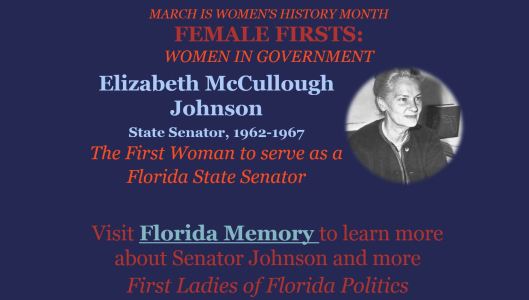
Elizabeth McCullough Johnson is an important figure in Florida civics, government, and history. She was the second woman elected to the Florida House, and the first women ever elected to the Florida State Senate. For those of us who live and work in the central Florida area, she is also an incredibly important figure because she is in many ways the mother of our University of Central Florida, the largest (at last count, by population) public university in the country.
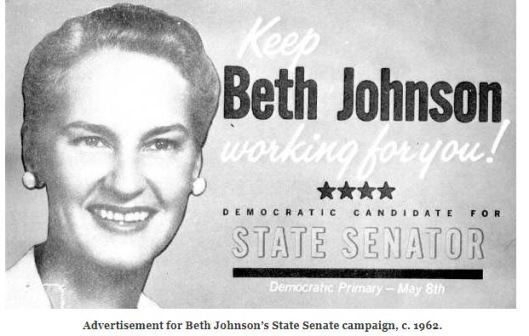
You can learn more about Senator Johnson at Florida Memory.
PowerPoint Slides:
Senator Johnson of FL