asking the public to do the reading

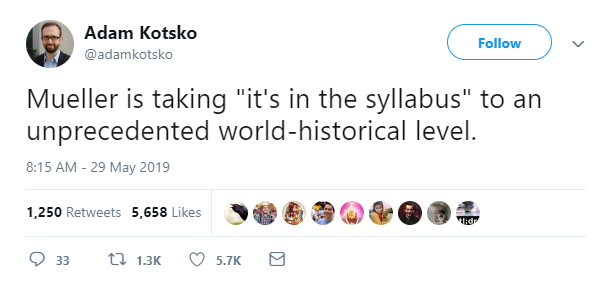
Buzzfeed’s Tanya Chen assembles lots of tweets and other quotes that analogize Bob Mueller to a frustrated college instructor. The American people are his students. Since we didn’t do the reading, we want him to explain it all in simple terms.

These are amusing responses, but they raise the question of what millions of Americans are really obligated to read. I once heard a Supreme Court justice say (to the approbation of the audience in the room) that citizens shouldn’t criticize judicial decisions unless they have read them, presumably in full. Some environmentalists despair that most people didn’t read the last big Intergovernmental Panel on Climate Change (IPCC) report for themselves. It seems outrageous that the President of the United States, who swore to uphold the Constitution, would fail a basic test of its contents. (For instance, he expects the judiciary to review an impeachment process.)

But once you put several of these assignments together, it makes for a daunting syllabus.

And it depends on what else you would do with your time. Instead of reading the Mueller Report, I have actually spent hours neurotically checking second-hand opinions about the report in order to root for the ones that say that Trump is in big trouble and boo the ones that say he’s been exonerated. That was a bad decision about how to allocate my attention. If I’d spent the same hours reading the report, I might have learned something. However, the text of the report would not change my opinions and behavior in a way that would matter for the country. So it would have been wiser still for me to spend my time not on the Mueller Report, nor on the endless second-hand commentary, but rather (for example) on the work of the astoundingly creative Anne Carson.

I start with faith that certain responsible summaries of the Mueller Report will give me what I need to know. I then waste time reading all the other commentary in the light of what I already believe. If I took Sean Hannity to be the responsible commentator instead of Lawfare or the New York Times, my behavior would be exactly the same but my conclusions would be the opposite. The problem is deciding who is the responsible intermediary, and you can’t do that with 100% certainty unless you read the original text for yourself. But again, it is not obvious that we are morally obliged to understand the Mueller Report with 100% certainty, when there are other things to do with our day.

The Great Professor in the Sky definitely expects us to do the reading. But I am not sure we are all obliged to take Professor Mueller’s class. We do face a mandatory exam called the 2020 election, but it will cover a whole lot of material, and you can do fine on it even if you didn’t take Mueller.

Your responsibility as a citizen–as distinct from your duty as a person–obliges you to collect information and insights about public affairs. (Your duty as a person is to read Anne Carson.) But there is an awful lot to learn about public affairs, of which the Mueller Report is only one sample. What bothers me is the implication that everyone should have mastered that particular body of material, when no one can understand everything that matters.

PACE Announces Funding for Faith & Democracy Initiative

ICYMI – There is a great funding opportunity that was just announced yesterday by the Philanthropy for Active Civic Engagement (PACE) to fund an initiative exploring the intersection of faith and democracy. PACE is offering $300k to support 5-7 projects that investigate the question, How can faith be a means to bridge divides and foster respect and cooperation in our democracy? Those accepted will join a year-long peer Learning Community to serve as a testing lab on key questions and share learnings. RFPs are now open and applications are being accepted until July 1st. We encourage you to share this with your networks! You can read the announcement below and find the original version on the PACE site here.


Faith In/And Democracy: A Funding and Learning Initiative from PACE

Philanthropy for Active Civic Engagement (PACE) has launched a pilot funding and learning initiative to invest in and promote engagement at the intersection of faith and democracy. The Faith In/And Democracy initiative will provide about $300,000 in grant support to 5-7 projects that explore this driving question: How can faith be a means to bridge divides and foster respect and cooperation in our democracy?  The Request for Proposals opens today; applications are open until July 1, 2019.

PACE is a community of funders that invest in the sustaining elements of democracy and civic life in the U.S.  “This exploration is a natural extension of PACE’s mission to deepen and enrich philanthropy’s support of democracy and civic life in the U.S.” said Kristen Cambell, Executive Director of PACE. “Faith communities have been a vibrant part of our civic fabric throughout the history of our nation.  With this project, we hope to uncover ways in which faith can serve to ease the divisions that plague our political, civic, and social processes.”

At this important moment in our democracy, many civic engagement funders and practitioners have redoubled efforts to bridge social and political divides.  This new initiative focuses on a largely unexplored connection point for bridge building: the power and potential of faith as a catalyst. In order to thrive, our democracy requires understanding, tolerance, and empathy across difference; this initiative seeks to uplift efforts to shift divisive perceptions of faith communities and build narratives about the power and potential of faith to bolster engagement in democracy and civic life.

While many institutions seek to engage people of faith in bridge-building and pluralism efforts, few organizations are funding specific interventions to engage people of faith in using their faith to support the well-being of democracy. Fewer still are considering the ways in which faith can serve to ease divisions that plague our political processes.  This pilot initiative led by PACE represents a meaningful step toward filling this gap. “We see this as a new mechanism of support to our members, as well as a vehicle for PACE to contribute learning and leadership to our field,” added Cambell. The initiative is inspired by PACE members and catalyzed in partnership with the Fetzer Institute and the Democracy Fund, as well as additional members of an Advisory Committee.

Embracing the exploratory nature of the initiative, a central aim of the effort is learning: in addition to funding 5-7 projects, PACE will launch a cohort-based, year-long peer Learning Community for those engaged with the initiative. This community will serve as a “laboratory” to test key questions about learning and impact, and enable us to reflect those learnings to funders, nonprofits, and our fields more broadly.

To learn more about the initiative, please visit PACEfunders.org/faith.  To access the full RFP and to apply, click here.

You can find the original version of this announcement on the PACE site at www.pacefunders.org/faith-in-and-democracy/.

Lots of New Jobs & Internships in Dialogue & Deliberation!

Did you know that every week we compile the hottest new jobs and internships related to dialogue, deliberation, civic tech, and public engagement work?! We work to stay up on the most recent opportunities and send them out at the beginning of the week on our Making-A-Living listserv.

While the Making-A-Living listserv is a benefit of being an NCDD member, we have been finding such a robust line-up of jobs and internships that we wanted to lift these up here on the blog. If you’d like to receive these weekly updates and are an NCDD member, sign up for the Making-A-Living listserv here. If you are not a member of NCDD, then we strongly encourage you to join so you can receive the most up-to-date positions we find! Learn more about the additional benefits of being an NCDD member by clicking here.

Remember if your org is hiring or seeking interns, to let us know by sending the postings to keiva[at]ncdd[dot]orgGood luck to all applicants!


Weekly List of New D&D Job & Internship Opportunities – May 30, 2019

* NEW – National Civic League looking to hire Civic Engagement Program Director (in Denver office). Read more here.

* NEW – Participatory Budgeting Project is seeking a Development Manager (in New York City or Oakland). Read more: https://www.participatorybudgeting.org/jobs-and-internships/

* NEW – Ethelo Decisions is hiring for a Sales Manager (Vancouver, BC). Read more: https://ethelo.com/blog/sales-manager/

* NEW – Social Pinpoint seeking New Sales Coordinator – Canada/USA (Remote). Read more: https://www.socialpinpoint.com/sales-coordinator-us-ca/

Community Water Center hiring for several positions in their Visalia CA office. Read more: https://www.communitywatercenter.org/careers

  • * NEW – Water Leadership Strategist
  • Community Organizer
  • Administrative Assistant

Generation Citizen is hiring for several positions – read more: https://generationcitizen.org/join-us/careers-internships/

  • * NEW – Program Manager, Massachusetts
  • Senior Director of Development Strategy (in either San Francisco, New York, or Boston)
  • Associate of Finance & Operations
  • Development OneStar VISTA (in Austin, TX)
  • Social Media and Digital Marketing Fellow (in either San Francisco, New York, or Boston)

RepresentUS is hiring for several positions – read more: https://represent.us/careers/

  • * NEW – Campaign Director
  • * NEW – Senior Campaign Director
  • Associate Administrative Director
  • Data Analyst
  • National Media Strategist
  • Online Campaigner
  • Organizer
  • VP of Development
  • Organizing Intern (Summer 2019)

Ag Innovations seeking for two positions in Sebastopol, CA. Read more: http://www.aginnovations.org/about/careers

  • * NEW – Office Coordinator
  • Senior Facilitator

**ICYMI – below are the positions we shared recently!

Democracy Fund is hiring for several positions below (in DC) – read more: https://www.democracyfund.org/page/jobs

  • Accounting Manager
  • DEI Fellow
  • Director of Partnerships
  • Director of People
  • Grant Associate
  • Program Associate, Elections and Voting
  • Senior Advisor Government Accountability
  • Senior Associate, Public Square Program
  • Staff Accountant
  • Communications and Network Internship (Summer 2019)
  • Elections Program Internship (Summer 2019)
  • Governance Program Internship (Summer 2019)
  • Legal Fellow (Summer 2019)
  • Public Square Program Internship (Summer 2019)
  • Strategy, Impact, and Learning Internship (Summer 2019)

Democracy Works has several positions and internships available (various locations). Read more: https://www.democracy.works/current-openings

  • Engineering Manager
  • Chief Technology Officer

BetaNYC is looking to hire a full-time Public Interest Technologist / Civic Hacker. Read more: https://beta.nyc/2019/05/13/job-opening-public-interest-technologist-civic-hacker/

CivicStory is hiring for a News Project Manager (in New Jersey). Read more: https://www.civicstory.org/press-release-srh-project-manager

EnviroIssues is seeking Project Coordinator candidates to support projects at their Seattle and Portland offices. Read more here

Knight Foundation looking to hire for several positions. Read more: https://knightfoundation.org/about/employment/

  • Detriot Director
  • Executive Assistant to VP of Journalism (Miami)

Change Research is seeking a part-time Operations and Sales Support Specialist in their Berkeley, CA office. Read more here.

JLA Public Involvement is looking to hire for two positions in their Portland office:

Net Impact runs a jobs-internship board at https://www.netimpact.org/jobs.

Democracy Fund’s electiononline has LOTS of positions in various cities across the country. Read more: https://electionline.org/jobs-marketplace/

Careers in Government has several engagement & communication-related opportunities. Use the keyword search at https://www.careersingovernment.com/.

Find value in what you see here? Please consider supporting our work through a tax-deductible donation and/or becoming an NCDD member (see more benefits here!).  We appreciate any contributions offered. Thank you for your support!

Wednesday Webinar Roundup Ft June Confab & Many More!

There are a lot of fantastic online events happening related to dialogue, deliberation, and civic engagement work; so moving forward we are going to start sharing the events happening two weeks out to give folks extra time to plan! This week’s roundup features events from NCDD sponsor org The Courageous Leadership Project, NCDD member organizations Living Room ConversationsNational Issues Forums Institute (NIFI), and MetroQuest, as well as, from the Tamarack Institute, International Association of Facilitators (IAF) and International Associate for Public Participation (IAP2).

As we mentioned last week, we have a great upcoming Confab planned with Bridge Alliance to explore how Slack can be used for collaboration and network building in the Democratic movement. Join us next Thursday, June 6th from 2-3 pm Eastern, 11 am-12 pm Pacific for this free call! We’d love for folks who have used Slack or are still currently using it to join the call and share their experience. Learn more and register to save your spot here!

NCDD’s online D&D event roundup is a weekly compilation of the upcoming events happening in the digital world related to dialogue, deliberation, civic tech, engagement work, and more! Do you have a webinar or other digital event coming up that you’d like to share with the NCDD network? Please let us know in the comments section below or by emailing me at keiva[at]ncdd[dot]org, because we’d love to add it to the list!


Upcoming Online D&D Events: NCDD June Confab, Courageous Leadership Project, MetroQuest, Living Room Conversations, NIFI, IAF, Tamarack, IAP2, and more!

NCDD & Bridge Alliance June Confab on Using Slack for D&D Movement Building

Confab bubble image

Thursday, June 6th
11 am Pacific, 2 pm Eastern

We are excited to co-host another Confab Call at the beginning of June, this time with our friends at the Bridge Alliance to explore the use of the collaboration tool, Slack. On this free call, we will discuss the capabilities of the platform for movement building around civic action and learn more about the development of Bridge Alliance’s new joint project, the Democracy Movement Slack Forum.

REGISTER: http://ncdd.org/29763

Online Living Room Conversation – Food: 90-Minute Conversation with Optional 30-Minute Bonus Round!

Thursday, May 30th
4 pm Pacific, 7 pm Eastern

Food is life itself. Food is sensual. Food can be used to manipulate. Food can be used to shame. Food can be used to show love. Food can be a sign of status. Food can be political. Does this make you hungry for more? In this conversation, we explore our personal relationship with food and the societal implications from individual choices. Check out the conversation guide.

REGISTER: www.livingroomconversations.org/event/food-90-minute-conversation-with-optional-30-minute-bonus-round/

NIFI June CGA Forum Series: A House Divided

Tuesday, June 4th
11:30 am Pacific, 2:30 pm Eastern

We’ll be talking about how to fix our broken political system in three different options: (1) Reduce dangerous, toxic talk: The problem is that the way we talk is poisoning public life. The “outrage industry” rewards people for saying and doing the most extreme things; (2) Make fairer rules for politics and follow them: The problem is that wealthy, powerful special interests game the political system, making it impossible to find compromise; (3) Take control and make decisions closer to home: The problem is that our most important decisions are being made too far away from home.

REGISTER: www.nifi.org/en/events

International Association of Facilitators webinar – Social Inclusion Facilitators online meet-up

Wednesday, June 5th
6 am Pacific, 9 am Eastern

The Social Inclusion Facilitators Special Interest Group would like to invite all facilitators who are engaged in Diversity and Inclusion  or Social Inclusion work to our first virtual meet-up in order to share experiences, challenges and good practices. For more information about the group, please check our page on the website – https://www.iaf-world.org/site/chapters/social-inclusion-facilitators

REGISTER: www.iaf-world.org/site/events/social-inclusion-facilitators-online-meet

Play-in-Action in the Public Sphere: Play, Development and Social Justice

Thursday, June 6th
9 am Pacific, 12 pm Eastern

In June, the Play, Development and Social Justice series will feature the work of practitioners and activists in the areas of afterschool development, civic engagement, and equity of access to the benefits of play. The conversation will explore how play is successfully creating grassroots cultures of creativity, inclusion and democracy. International play scholar and activist Carrie Lobman will be joined by Antoine Joyce, who creates environments for wealthy business people, elected officials, inner city youth and police officers to play together in Dallas; Don Waisanen who is pioneering the use of improvisation and play at the university and in the political arena; and Danielle Marshall who uses play as a vehicle to drive social-emotional learning, teach conflict negotiation, and build community in schools for 20,000 children in Maryland.

REGISTER: https://conta.cc/2GNuYXp?fbclid=IwAR2hGAp5D_ubwu9dKoLUKv8BbVI0rilRTv1u-zdUqnK5QFc_iAVA9ip7ZgY

Online Living Room Conversation – Women, Leadership and Power: 90-Minute Conversation w/ Optional 30-Minute Bonus Round!

Thursday, June 6th
4 pm Pacific, 7 pm Eastern

Women are increasingly sought out and encouraged to assume leadership positions in many walks of life, from business to community organizations to politics. While some call for further changes towards greater equality, others raise cautions about erasing any gender distinctions in an attempt to “make everything the same.” Are there ways the further expansion of women’s rights can complement traditional structures in society or are they destined to be at war? This broad topic on women and leadership can lead to many other conversations. Check out the conversation guide.

REGISTER: www.livingroomconversations.org/event/women-leadership-and-power-90-minute-conversation-w-optional-30-minute-bonus-round/

Tamarack Webinar – Bridging the Gap: Repairing Relationships for Stronger Community Engagement

Tuesday, June 11th
10 am Pacific, 1 pm Eastern

Most of us recognize the need for and importance of engaging the communities we serve. Working to uphold the slogan“nothing about us without us”we might try to engage communities as much as possible. But engagement is a two-way street, and people who work in institutions and organizations sometimes find that the communities they hope to engage are hesitant or even resistant to engage. This can often be true when the relationship between institutions and communities is damaged, or where there is a lack of trust in the organization’s ability to engage in an open and honest way. With that in mind, what might those of us who work in institutions and organizations do? Through this webinar Lisa Attygalle and Galen MacLusky, Tamarack’s Directors of Community Engagement and Community Innovation will explore our thoughts on this issue, drawing upon our experiences in supporting community engagement across North America.

REGISTER: https://events.tamarackcommunity.ca/webinar-bridging-the-gap-repairing-relationships-stronger-community-engagement

IAP2 Monthly Webinar – Diversity and Inclusion in P2

Tuesday, June 11th
11 am Pacific, 2 pm Eastern

Carrie McIntosh’s session explores five key lessons learned from working with small communities on BC’s west coast. From closed Facebook groups that house rampant rumour mills, to client frustration that threatens to derail well-intentioned strategies, this session explores them all with a dose of humour. Participants will walk away with a list of practical steps they can take to create meaningful engagement outcomes for their clients and the communities they serve. Read the session description from the 2018 IAP2 North American Conference here.

REGISTER: https://iap2usa.org/event-3076943

The Courageous Leadership Project webinar – Brave, Honest Conversations™

Wednesday, June 12th
9 am Pacific, 12 pm Eastern

Some conversations are hard to have. Fear and discomfort build in your body and you avoid and procrastinate or pretend everything is fine. Sometimes you rush in with urgency, wanting to smooth things over, fix them, and make them better. Sometimes you go to battle stations, positioning the conversation so you have a higher chance of being on the “winning” side. NONE OF THIS WORKS. Instead, it usually makes a hard conversation harder; more divided, polarized, and disconnected from others. The more people involved, the harder the conversation can be. I believe that brave, honest conversations are how we solve the problems we face in our world – together.

In this webinar, we will cover: What is a Brave, Honest Conversation™? Why have one? What can change because of a brave, honest conversation? How do you have one? What do you need to think about and do? How do you prepare yourself for a brave, honest conversation?

REGISTER: www.bravelylead.com/events/bhcfreewebinar

MetroQuest webinar – Millennials to Boomers | How MDOT Involved 6,300 for Its LRTP

Wednesday, June 12th
11 am Pacific | 12 pm Mountain | 1 pm Central | 2 pm Eastern (1 hour)
Educational Credit Available (APA AICP CM)
Complimentary (FREE)

Is traditional public involvement getting old? While transportation matters to residents of all ages, few attend public meetings. That’s why Michigan DOT went online to engage the broader public when it began working on a completely new state long range transportation plan (SLRTP).

Times are changing. On June 12th, find out how Michigan DOT and WSP joined forces to engage 6,300 people to uncover their evolving transportation priorities for the Michigan Mobility 2045 SLRTP. Join Shane Peck, Anita Richardson, Brad Sharlow, and Kyle Haller as they share what they learned about public preferences for modal tradeoffs, infrastructure investments, intelligent technologies, and transit

REGISTER: http://go.metroquest.com/Millennials-to-Boomers-How-MDOTs-LRTP-Involved-6300.html

Best Essay Writing Services in USA

Author: 
We offer premium quality academic writing services to our valued customers that reflect customer focus, reliability and awe-inspiring writing flair. Our squad of brilliant writing experts, consultants, editors and researchers is committed to concocting and delivering conspicuous and original online writing assignments for your academic papers. At Academic Writing Pro,...

what does the European Green surge mean?

The Greens did very well in the EU elections. One interpretation is that a substantial minority of Europeans are now seriously focused on climate issues and voted Green to promote EU-wide climate policies.

But the Greens also stand for pan-Europeanism, multiculturalism, civil liberties, and the rule of law; and they have a specific demographic base. They are challenging or even replacing social democrats as a pillar of the center-left, without expanding the total center-left vote by much (if at all). It is not clear that they have a stronger policy platform on climate issues than the socialist parties in countries like Germany.

Therefore, a different interpretation is plausible. Perhaps the social democrats have fractured along class lines, and the Greens have taken away their college-educated vote, not because of climate but because of a whole basket of issues and values.

To explore that second hypothesis, I’ll focus on Germany–the birthplace of social democracy (in 1875) and the EU’s most important economy. There, the Social Democratic Party (SDP) came in third with less than 16%, surpassed by the Greens at 20.5%.

The SPD was traditionally a coalition of unionized industrial workers plus college-educated employees who were close to the welfare state (teachers, civil servants, and the like). These were the groups that stood to benefit most from an active state, and they were effectively organized in unions, professional associations, and the SDP itself. In other words, they didn’t just have votes but also organizational muscle. They played a major role in building the welfare state.

However, at least some of the party’s white-collar base has migrated to the Greens, who have become less environmentalist and more of a socially-liberal, cosmopolitan, center-left party. And some of the industrial workers have left the SPD for the right. The net result is a weakening of the organized center-left. Yes, the Greens are flourishing, but that is mostly at the expense of the SDP and reflects a fracturing of the social democratic coalition that helped to build the Federal Republic.

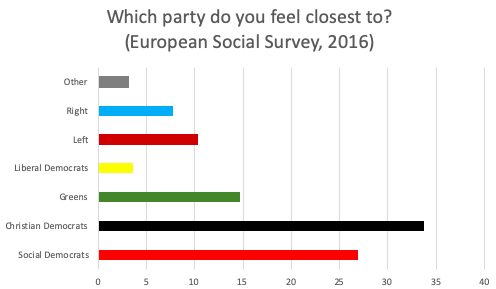
An EU election can be misleading if you want to understand the deeper state of a country’s politics. Only about 60% of eligible Germans voted this week, and they presumably focused more than usual on European issues. They certainly opted more than usual for small parties. Therefore, as second graph, I show how the whole German adult population responded when asked which party they felt closest to in 2016:

These data are now two years out of date but probably reflect the underlying conditions. The order is still the familiar one–Christian Democrats, Social Democrats, Greens, and then others–but the once-mighty SDP is already down to 26.2% in this survey. Left parties claim 58.7% of the total electorate but stand very far apart on issues. The traditional establishment parties (Christian Democrats, Social Democrats, and Liberal Democrats or FDP) claim just 64.2% of the vote in total. Both the left and the center are larger than the right, but the center-left is far from dominant.

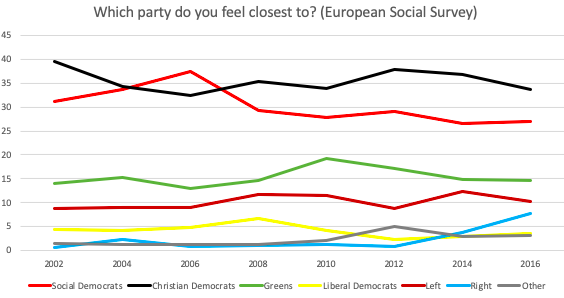
This third graph shows how this pattern had evolved since 2002:

The change in the position of the Christian Democrats has not actually been huge. They have certainly seen some erosion since the immigration crisis, but they are only six points less popular than they were in 2002. The Greens stand not far from where they were in 2002, but they temporarily improved their position while the Social Democrats were sustaining their largest decline (2006-10). The right also rose, but mostly after the SDP had seen its major losses (2012-16).

That graph is consistent with the theory of a fragmenting SDP. However, trends in party support do not tell you how individuals shifted. Maybe the Greens grew by attracting former SDP members, but maybe those two lines converged for other reasons. The Greens declined and the right-wing grew after 2010, but we don’t assume that Green Party members defected all the way to the right.

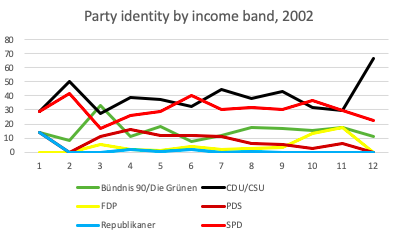
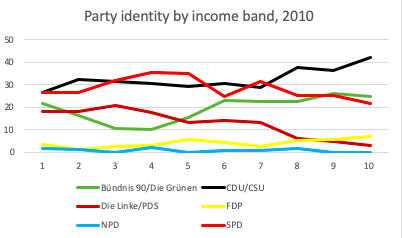
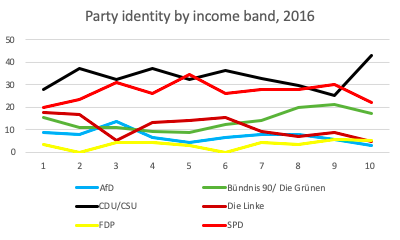
As an imperfect test of the thesis that the SDP has indeed lost members to the Greens and the right, I graphed party support by income band for three selected years. I am assuming that if the SDP falls and the Greens or the right-wing rises within a specific income stratum, then people are actually changing their party affiliations in that way.

In 2002, the SDP performed best at three levels: the poor (who might benefit most from welfare), the fourth and fifth deciles (which may reflect unionized industrial workers), and the 8th and 9th deciles (where people with a lot of education may land). The Christian Democrats dominated among the rich but drew votes from across the spectrum. The Greens could not yet be described as an affluent party. Also (not shown here) they performed worse than the SPD among students. The right drew strongest from the lower-middle class.

By 2010, the Greens were more affluent and the SPD had lost a substantial amount of support in the upper deciles. The Greens were now also running even with the SPD among current students. The far right was weaker than it was in 2002, but I think that reflected a temporary change in the array of parties. The left drew support almost entirely from the lower income bands.

And by 2016, the right was much stronger–in third place in some of the lower income bands, behind only the SDP and Christian Democrats. Meanwhile, the Greens had become distinctly affluent and (again not shown here) they dominated the current student vote. They lost support only in the top income range, where the Christian Democrats were still ahead (although less so than in 2002).

These patterns are not sharp and dramatic; there is actually a fair amount of stability despite tumultuous times. But it does look as if the SDP has lost members to the Greens over lifestyle issues, and to the right because of nationalism.

The SDP and the Greens can certainly come together again in parliamentary coalitions, but at the grassroots, the coalition that sustained the German welfare state looks weaker than it was for decades. Also, I am not sure the Greens have the organizational muscle that the SPD had in its heyday, which means that their capacity to implement policy may be weaker.

If you care about environmental policy and social justice, you have to welcome the Greens. But the question is whether the center-left as a whole has sufficient capacity to govern.

marginalizing views in a time of polarization

I recently posted “marginalizing odious views: a strategy,” which was about a powerful and sometimes valuable tool for self-governance. When communities define specific perspectives as beyond consideration, they uphold norms without needing formal censorship. This is good when it happens to Nazis (for instance), but problematic when it’s used to block serious consideration of minority views.

I assume that marginalization is a perennial strategy. Its advantages and risks–especially as compared to a strategy of engagement–are also perennial. But the context does make a difference.

When most Americans got their news from three rather similar TV networks plus a metropolitan daily newspaper that had from zero to three local competitors, marginalization depended on the mass media. You could try to marginalize a position that you considered odious, or create space for a currently marginalized view, but your success would depend on what Walter Cronkite and his ilk thought. If a position wasn’t marginalized on the network news, it wasn’t marginalized. And if a view never got aired in the mass media, then it was pretty marginal even if you and your friends believed in it.

At the same time, the two major parties had overlapping national elites with similar educational pedigrees who, while disagreeing about some important matters of policy, still tended to agree about what was marginal. Along with the mass media, they adjudicated what belonged on the national agenda. Thus the terms of the game were clearly defined, even if the rules were problematic because they gave too much power to homogeneous elites.

Now that the media landscape is highly fractured, we live in many separate epistemic communities. What is mainstream in one setting can be effectively marginalized in another. Just to name one example, the phrase “illegal immigrants” is pretty much marginalized in both my city and my university, but it is the standard phrase across large swaths of America.

The fact that our national discourse is polarized and balkanized has been widely noted, but I want to emphasize the consequences for a strategy of marginalization:

  1. It is now virtually impossible to marginalize across the society as a whole. Given any opinion, some people are comfortably expressing it right now in public (online) to their fellow believers.
  2. It is now much easier to marginalize within a community in which you in are the mainstream. The temptation to say, “We don’t say that here” is very high when that can be so successful.
  3. There is also a constant temptation to demonstrate that each community is biased by forcing it to confront views that it is trying to marginalize. That makes the community look intolerant to external audiences. For instance, if a university seems pervasively liberal, invite Milo, watch the reaction, and cry “Censorship!”
  4. Since being marginalized feels like being censored, more people have the experience of censorship in various specific settings where their own views are unpopular. In fact, almost everyone would be marginalized somewhere.
  5. The same statements often have a double effect. For their proponents, they reinforce shared norms. For their opponents, they serve as examples of what must be marginalized. For instance, Rush Limbaugh clearly has two audiences: conservatives who like what he says and liberals who are appalled by quotes that circulate in their networks. (Both reactions benefit Limbaugh by bolstering his prominence.)
  6. The strategy that is furthest from marginalization–trying to learn from other people while sharing your opinions with them–is harder than ever, because we all hide in homogeneous communities.

I continue to think that marginalization has a place in politics. Not every opinion deserves respectful consideration. Communities gain coherence and value by drawing limits around what they will consider. However, I suspect that a fractured media system makes marginalization too tempting and persuasion too difficult, with costs for democracy.

Exploring Podcasts as Emerging Medium for Civic Learning

For folks in the New York City area, there is a cool event coming up next week that we wanted to make sure our network knew about on exploring how podcasts are being used to deepen civic knowledge and practices. The Metropolitan New York Library Council is hosting the in-person event, “Podcasts To The Rescue! An Emerging Medium for Learning About Civics, Government, and the Social Contract” on Thursday, May 30th from 7-8:30 pm Eastern. There is a fantastic line-up of speakers planned for the night, including Jenna Spinelle from NCDD member organization, the McCourtney Institute for Democracy at Penn State. The event is free, but space is limited, so make sure you save your seat by registering. Learn more about the event in the post below and find the original version here.


Podcasts To The Rescue! An Emerging Medium for Learning About Civics, Government, and the Social Contract

Millions of Americans cast ballots in the 2018 Midterm Elections, but participation in our democracy was already on an upswing since Donald Trump won the Presidential Election in 2016. While 7 in 10 Americans report feeling generally negative about what is going on in the country today, Americans are also more hopeful about solving problems. This hopefulness may account for the increased interest in how our government works and what role individuals and communities can play in that process. And as ever, podcasters are responding to this interest by producing shows that tackle policy and civic engagement in a variety of formats.

Podcasts To The Rescue! An Emerging Medium for Learning About Civics, Government, and the Social Contract will feature a diverse group of podcast hosts and producers, looking at the ways each podcast engages and informs listeners on how to stay invested in the social contract.

Moderator: Matisse Bustos-Hawkes, Founder at Otro Lado Communications and former Associate Director, Communications & Engagement at WITNESS

Panelists:

  • Arden Walentowski, producer and co-host of Let’s Get Civical, a comedic and irreverent take on how our government works
  • Harry Siegel, co-host of FAQ NYC, a weekly dive into the big questions about New York City produced by Alex Brook Lynn
  • Jenna Spinelle, producer and host of Democracy Works an initiative of the McCourtney Institute for Democracy at Penn State
  • Mila Atmos, executive producer and host of Future Hindsight, where civic engagement meets civil discourse
  • Allison Daskal Hausman, producer and host of The Pledge Podcast, inspiring portraits of ordinary Americans stepping up to strengthen our democracy.

Panel discussions will take place 599 11th Avenue, 8th Floor, New York, NY 10003. The event is free but space is limited.

Other panels in this series include:

You can find the original version of this announcement on the Eventbrite site at www.eventbrite.com/e/podcasts-to-the-rescue-an-emerging-medium-for-learning-about-civics-government-and-the-social-tickets-59456853048.

the Civic Studies Wikipedia page

There is a new page on Wikipedia about Civic Studies. It’s not about civic education* but about the developing “interdisciplinary field that empirically investigates civic engagement, civic education, and civil society.” Civic Studies also strives to “influence the social sciences and humanities in general to take the perspective of intentional human actors–people who reason and work together to improve their worlds–in addition to institutions and impersonal social forces.”

I wrote all the text that’s on this page so far, but I’m hoping it will be a living document to which others will contribute.

*For civic education, you could consider the Stanford Encyclopedia of Philosophy entry by Jack Crittenden and me.

Jefferson Center Launches New Series on Citizen Juries

Our friends at The Jefferson Center, an NCDD Sponsoring member organization, recently shared an article on their site which offers a fantastic overview of Citizen Juries, that we wanted to repost here. The piece by Annie Pottroff answers some of the most frequently asked questions about the public engagement method, which was started in 1971 by Jefferson Center founder Ned Crosby. This is the initial post in the new blog series by The Jefferson Center to continue to dive into the Citizen Jury process – so stay tuned for more! You can read the article below and find the original piece here.


What exactly is a Citizens Jury, anyway?

We talk a lot about Citizens Juries at the Jefferson Center. After all, they were invented by our founder, Ned Crosby, in 1971. We believe they can help restore trust in democracy around the world. And they give everyday people the knowledge, resources, and time they need to create powerful solutions to our biggest challenges.

But what is a Citizens Jury? How do they work? Who’s involved? In this blog series, we’ll explore some of our most frequently asked questions, starting with Citizens Jury basics.

What is a Citizens Jury?

A Citizens Jury is a public engagement method that provides individuals with the opportunity to learn about an issue, deliberate together with a diverse group of their peers, and develop well-informed solutions to the given issue.

Juries also allows decision makers and the broader public to know what people really think once they have the opportunity to study an issue closely and weigh different options and perspectives.

Citizens Juries are typically composed of around 18-24 citizens who have been randomly selected to represent the demographics of the larger community.

Over a number of weekends, one week, or a few days, we provide the group with background information from expert speakers and stakeholders to inform their conversations. With this information in mind, Jurors deliberate and craft recommendations through dialogue and voting, which are then published and delivered to the public and decision makers.

Who are the “citizens?”

Citizen Jury participants are randomly selected to represent a specific population. For example, in the Willmar Community Assembly, participants represented their community of Willmar, Minnesota.

We invite citizens to apply to participate in the Jury via postcards, posters, direct community outreach, social media, local employment websites, and more. Citizens are selected to participate through stratified random sampling, often based on the age, race, gender, education, and socioeconomic background statistics of the target population. These criteria can slightly vary depending on the Jury. The population a Citizens Jury represents can range anywhere from a small town to an entire country.

Why might a Citizens Jury be used on an issue?

Citizens Juries are an important tool for decision-makers, organizations, and communities to use when faced with a particularly challenging issue. Often these issues are complex, technical, divisive, and can’t be resolved in a short amount of time, such as nuclear storage or climate change adaptation. Most individuals don’t have the opportunity, time, or energy in their daily lives to study these tough issues, understand the nuances, and form a strong opinion, making it difficult for decision-makers to know how the public really thinks. As a result, officials often make decisions based on their own assessment and the loudest voices in the room.

But at a Citizens Jury, participants learn more about the issue from experts and stakeholders, discuss different perspectives and considerations with their peers, and work together to create recommendations. This gives individuals the chance to confront the big challenges usually left to decision makers. Their conversations surface new ideas and overlooked problems, leading to more representative, informed, and powerful solutions.

How do you evaluate the success of a Citizens Jury?

Are Citizens Juries all the same?

Juries are specifically designed for the issue or problem at hand, and they can vary according to:

  • Number of Jury participants
  • Number of actual Juries per project
  • Jury topic
  • Target Jury community
  • Final report audience

Want to learn more about how to conduct a Citizens Jury and how to collaborate with us? Let us know below or contact us!

You can find the original version of this article on The Jefferson Center blog at www.jefferson-center.org/2019/05/what-exactly-is-a-citizens-jury-anyway/.