KidCitizen: A Great Resource for K-5 Civics and Primary Sources!

Civics is not something that should be limited to middle and high school, or post school life. Civics, that is, learning about and understanding the tools and responsibilities and obligations of engaging in the life of a community, is something that should be happening from the very first time a child sets foot in school. We need to be ‘doing civics’ with our elementary kids from day one!

KidCitizen is an exciting and increasingly popular new online tool for introducing concepts of civic engagement and civic learning through primary sources to kids of all ages, including kindergarten.

In KidCitizen’s interactive episodes, children explore civics and government concepts by investigating primary source photographs from the Library of Congress.  They also connect what they find with their daily lives.

KidCitizen episodes capitalize on the active and social nature of young children’s learning. They use primary sources for rich demonstrations, interactions, and models of literacy in the course of innovative hands-on activities that make academic content meaningful, build on prior experiences, and foster visual literacy and historical inquiry.  Each KidCitizen episode draws on a set of primary source photographs from the Library of Congress.

All KidCitizen episodes run on PCs, Macs, Chromebooks and iOS and Android mobile devices.

The great thing about Kid Citizen is that it focuses on just that: how can kids be engaged in civic life? A cursory glance at the interactive episodes and modules alone provide a good overview of this!

kid citizen episodes

Recently, our friends over at the National Council for the Social Studies interviewed Drs. Ilene and Michael Berson of the University of South Florida about KidCitizen, the fruit of much of their collaborative work. (Disclosure: Dr. Michael Berson is a Senior Fellow of FJCC)

The overview the Drs. Berson provide of KidCitizen, and why it can make a difference, is a really good one:

“Using primary sources in the classroom actively engages students in interpreting the mystery of the past and exploring multiple representations of events. KidCitizen was designed to provide scaffolded instruction for historical inquiry. The focus of the app is to facilitate a developmentally appropriate process of careful looking, historical thinking, and evidence-informed analysis that are at the center of disciplinary literacy. By slowing down the act of looking, children discover new information and construct viewpoints as primary sources are mined. The KidCitizen app provides authentic, age appropriate interaction with primary source materials, based on research-informed practices and evidence-based pedagogy, engaging children in exploring civics and government concepts through historical sources, and connecting what they find with their daily lives.”

We need to be giving our youngest participants in civic life the opportunity to engage, to learn, to think, and as they suggest, to involve themselves in the process of ‘looking’ in order to learn, construct, and think.
Check out KidCitizen here, and be sure to read the whole short interview here!

You can find other really great resources for civics students of all ages over at the Civics Renewal Network! 

New Cohort of A Prepared Classroom Now Enrolling!

Civics_Classroom_Logo_Final

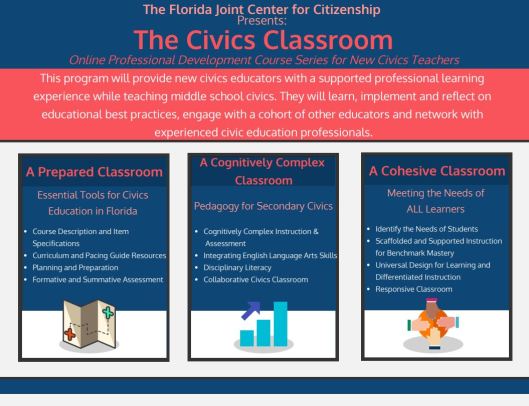
Friends in Civics, we have some exciting news. The Florida Joint Center for Citizenship at the Lou Frey Institute is now offering a free online Canvas course targeting primarily new and beginning civics teachers in Florida, though it is open to any and all civics educators who are interested.

This program will provide educators new to civics with a supported professional
learning experience while teaching middle school civics. They will learn,
implement and reflect on educational best practices, engage with a cohort of
other educators and network with experienced civic education professionals. You can learn more about the course series here!

For those teachers in Florida seeking points towards certificate renewal, this course series offers that opportunity through the ePDC (electronic Professional Development Connections) system. In the infographic below, you can see the scope and sequence of the course series.

InfoGRaphCanvas2

“I just wanted to thank you for offering the online Civics Modules, I learned so much during the first one and can’t wait to implement some of the things I learned.” —A beginning civics teacher “Thank-you also for the course- I learned quite a bit about how to teach Civics in Florida and to especially to 7th graders.” —An experienced teacher new to civics in Florida

In September, we will be starting the next cohort for COURSE ONE: A Prepared Classroom, and enrollment for that is open as of August 09, 2019. For those that finished Course One previously, Course Two will begin enrolling at the end of August!

A Prepared Classroom will focus on understanding the role of course descriptions and the Civics End-of-Course Test Item Specifications, utilizing curriculum and pacing guide resources, strategically planning and preparing for instruction, as well as providing data informed instruction based on formative and summative data. You can view the syllabus for the first course here: FJCC A Prepared Classroom Syllabus

This course has enabled open enrollment. You can self-enroll in the course once you share with them this URL: https://canvas.instructure.com/enroll/FCC4FH. Alternatively, you can sign up at https://canvas.instructure.com/register and use the following join code: FCC4FH

Are you more interested in the second or third courses because you feel pretty good about the content in the first one? That is fine! You DO NOT have to take every course; Florida teachers may earn renewal points for EACH course in the series. We will be launching the second course, A Cognitively Complex Classroom, in mid-September!

Each course in the series will be offered through the free version of the Canvas platform. Canvas Free for Teacher accounts are always free, but they do not contain all features available to institutional users of Canvas. For example, no client support beyond access to the Canvas Guides is offered to you as a Free for Teachers user. With a Canvas Free for Teachers account users can access and participate in courses as well as create (and host) their own online courses. Please note that you WILL have to create a new account to use this version of the platform; it is not compatible with the institutional version you may use in your school or district. You can learn more about this version of the platform here.

In order to enroll FOR RENEWAL CREDIT in the course, you will need to be sure that you register through the ePDC system. Let’s walk through the process together. First, go to the PAEC website at PAEC.org.
PAEC 1

Once there, click on ePDC and if this is your first time, click on ePDC and then ‘Create an Account.’ Once you confirm your account registration, sign in and then click again on ePDC and select ‘Course Offerings’. You should see a screen like this:

EPDC2

Click on ‘Course Offerings’, and you will see something like this:
PAEC3

In the ‘Search Text’ bar, you can type ‘FJCC’, and the course should appear! BE SURE TO ENROLL IN THE SEPTEMBER 2019 Fall Cohort Course. Course One is ‘The Prepared Classroom’ 


Click on ‘Register’ and you should be in. The ePDC course is setup to automatically direct the person that registers for the course to the Canvas Course page.  You will have to create an account if you do not already have one but the link to the September course is embedded in the ePDC PAEC course.

You can expect a follow up email or two from your course instructor in late August and early September, prior to the start of the course. At this time, registration is limited to the first 25 participants, but it may be possible to make exceptions!

How are in-service points handled?
PAEC extracts in-service records from the ePDC and submits in-service data for member and participating districts to the Florida Department of Education as a service to districts. Teachers from outside of PAEC member or participating districts should print the Certificate of Completion for each course and submit the certificate to the appropriate district professional development office.

We do hope to see you in this online space for learning and the development of a virtual professional learning community. Please share this with anyone you believe might benefit from this course series! 

Questions about this entire course series, or the first course in the series (‘A Prepared Classroom‘), can be directed to Dr. Steve Masyada. 

American civics versus socialism?

Announcing his reelection campaign, Senator Ben Sasse (R-NE) made two claims about civic education:

1) “What’s at stake in 2020 is nothing less than a choice between American civics and socialism,” Sasse said. ‘”Those are the stakes.”

2) Sasse drew a direct connection between American teenagers not knowing civics and the fact that polling data today suggests that nearly 40% of Americans under 30 believe the First Amendment might be harmful.”

Sasse also quoted Reagan to the effect that “freedom is always one generation away from extinction. [It] is not passed along in the bloodstream—it has to be taught.” The main theme of his reelection launch was civics, at least according to his website.

The Post’s Jennifer Rubin thinks this is just another example of a Republican politician debased by Donald Trump. She calls Sasse’s speech a “pathetic spectacle” and thinks he should know better. Perhaps, but my style is to take people seriously, and Sasse is generally a serious thinker.

Besides, he is not alone in arguing that countering a socialist revival (presumably embodied by a few junior members of the House of Representatives and a presidential primary candidate) is a reason to restore civic education. Such arguments will affect those of us who work for civics, changing the political context for our efforts.

We also confront claims that what is at stake in 2020 is nothing less than a choice between American civics and Donald Trump. One (or conceivably both) of these arguments might be right, but both raise partisan sensitivities in their opponents and thereby complicate the politics in state legislatures and elsewhere.

We can all agree with Sen. Sasse that principles of freedom must be taught and that low support for the First Amendment is troubling. The most alarming evidence of decline comes from Yascha Mounk, although I raise some doubts about his study here.

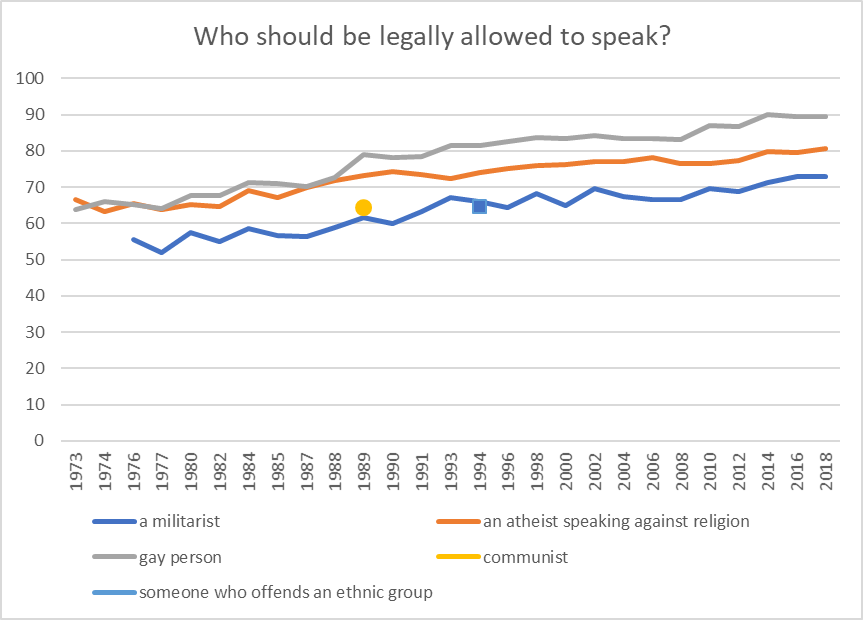
The General Social Survey has asked Americans whether various categories of people “should be allowed to speak.” The trends have generally risen over time. Americans have never been consistent supporters of the First Amendment, but they have generally become more willing to tolerate various categories of disfavored speakers. In 2019, Knight found that 58% of college students favored legally permitting “hate speech.” Perhaps this result reflects too little support for the First Amendment, but a similar proportion of adults in 1994 wanted to permit speech that (merely) offended another ethnic group. I think free speech requires constant attention, but I don’t see evidence of decline.

The controversial part of Sasse’s statement is not his support for the First Amendment or other civil liberties. It’s his contrast between “American civics” and “socialism.” That contrast raises the question of what those two categories mean. Sasse seems to suggest that support for the First Amendment and socialism are incompatible, but that is definitely not true; there is a long tradition of socialists who have also been strong supporters of free speech.

“Democratic socialism is committed both to a freedom of speech that does not recoil from dissent, and to the freedom to organize independent trade unions, women’s groups, political parties, and other social movements. We are committed to a freedom of religion and conscience that acknowledges the rights of those for whom spiritual concerns are central and the rights of those who reject organized religion.”

Where We Stand,” Democratic Socialists of America

On one view, socialism is about economics, and it’s a matter of degree. Perhaps the metric is the proportion of GDP managed by the state (between 15% and 25% in the USA ever since 1955). The US is more socialistic than it was in 1900 and a bit less so than Germany is today. But then one must decide whether the political economy established by the New Deal and the Great Society–since it is somewhat socialist–is compatible or not with the ideas that we should impart in “American civics.”

James Ceasar has distinguished between “civic education,” which by definition supports a regime, and “political education,” which aims to change the regime. For him, the educational reforms of the Progressive Movement, multiculturalism, and global education are three examples of political, not civic, education, because they have aimed to change what he identifies as the American regime. (Here “regime” doesn’t have a negative connotation; it just means the core features of a political order.)

My question is why our regime must be defined by the dominant constitutional theory of 1900. I’d read our current regime as (more or less) a multicultural welfare state, in which case an education that promotes the American regime should favor those values. Education that aims to delegitimize the welfare state is political, not civic, in the 21st century. It is a form of politics with a reactionary intent. Maybe the education that John Dewey and other Progressives promoted was political in their own time, but because they won victories as political reformers, now their ideas have become the civic ones (in Ceasar’s sense)–the ideas that bolster the present system. And if the present system is partly socialist, then “American civics” is partly socialist.

On a different view, socialism is something that we have never seen in America. It refers to policies that are more radical than, say, Social Security or the Environmental Protection Act, because these laws have passed constitutional muster and have become part of the American tradition. Some socialists would concur that Social Security and the EPA are not socialistic to a satisfactory degree; they want a lot more. (But such people are scarce in the USA.)

Sometimes in this debate, people say that students should learn to prize “limited” government. I would only observe that governments that are avowedly socialist can be very careful about limits–constitutional, legal, and democratic. The Scandinavian democracies are excellent examples. They endorse the idea of the Rechtsstaat (a government under law) even as they tax and spend at relatively high rates.

Moreover, the limits set by the US Constitution can be compatible with much more socialism than we have today. No one disputes, for example, that Congress has the constitutional authority to raise income tax rates by a lot and to spend a lot more on social welfare programs. So limits per se aren’t really the issue; the question is what policies we should choose.

A third view might be that civic education, properly understood, encourages students to be less individualistic, less acquisitive, and more concerned with the common good than they would be otherwise. Therefore, it may strengthen support for the kinds of policies that strong conservatives like Sen. Sasse would call socialistic. In that case, civics and socialism are not opposed; they go together. To argue this point well, I think you would have to define “socialism” very broadly, so that it encompasses Great Society liberalism, Christian and other faith-based communitarianism, and mild social-democratic reforms as well as more radical proposals.

On yet a different view, students should not be taught any substantive political views in public schools. Schools should be committed to impartiality and should respect the individual rights of students to form their own opinions. (Impartiality is also a safeguard against the regime’s propagandizing in its own favor.) Students should learn about socialism, libertarianism, constitutional originalism, feminism, critical race theory, environmentalism, and other doctrines and should be equipped to make their own choices.

The problem here is that schools inevitably impart values, and probably should instill the values that create and sustain a fundamentally decent regime. Even studying a range of political ideologies reflects a political stance (some form of liberalism). So, if we must teach values, then are the values of democratic socialism opposed to the legitimate American regime, or part of it now, or better than the regime–or is this all a matter that students should debate?

My own view, for what it’s worth, is that socialism names a basket of policy options that have been part of the American political debate since the 188os and that students should critically assess as part of their civic educations. They may also reflect on the other traditions, apart from socialism, that have animated the American left. And certainly they should understand and asses various forms of conservative thought. The values that Donald Trump represents have equally deep (or deeper) historical roots in America, but some of his values are contrary to the fundamental aspirations of the regime and should be marginalized in “American civics” worthy of the name.

See also civic education in the year of Trump: neutrality vs. civil courage; Bernie Sanders runs on the 1948 Democratic Party Platform; the Nordic model; What is the appropriate role for higher education at a time of social activism?

Wednesday Roundup Ft Courageous Leadership Project, National Civic League, and More!

This week’s list of upcoming D&D webinar events has a great line-up including NCDD sponsor The Courageous Leadership Project, NCDD member orgs National Civic League and Living Room Conversations as well as, from the International Associate for Public Participation (IAP2) and International Association of Facilitators (IAF).

NCDD’s online D&D event roundup is a weekly compilation of the upcoming events happening in the digital world related to dialogue, deliberation, civic tech, engagement work, and more! Do you have a webinar or other digital event coming up that you’d like to share with the NCDD network? Please let us know in the comments section below or by emailing me at keiva[at]ncdd[dot]org, because we’d love to add it to the list!


Upcoming Online D&D Events: The Courageous Leadership Project, National Civic League, Living Room Conversations, IAP2, IAF

Living Room Conversations Training (free): The Nuts & Bolts of Living Room Conversations

Thursday, August 8th
2 pm Pacific, 5 pm Eastern

Join us for 90 minutes online to learn about Living Room Conversations. We’ll cover what a Living Room Conversation is, why we have them, and everything you need to know to get started hosting and/or participating in Living Room Conversations. This training is not required for participating in our conversations – we simply offer it for people who want to learn more about the Living Room Conversations practice.

Space is limited so that we can offer a more interactive experience. Please only RSVP if you are 100% certain that you can attend. This training will take place using Zoom videoconferencing. A link to join the conversation will be sent to participants the day before the training.

REGISTER: www.livingroomconversations.org/event/training-free-the-nuts-bolts-of-living-room-conversations-14/

Online Living Room Conversation: Mental Health – 90-Minute Conversation w/ Optional 30-Minute Q & A with Hosts!

Thursday, August 8th
4 pm Pacific, 7 pm Eastern

Most people agree that we want to reduce the stigma around mental health issues so that individuals and families are more inclined to seek help. Many people look to traditional western medicine for the primary answers to mental health problems. There is growing interest in exploring a wider variety of ways to support people facing mental health challenges. The value of meditation, exercise and other practices show great promise as we learn more and more about the plasticity of our brains. What does it mean to ‘get better’ from a mental health problems, and is it even possible? Here is the conversation guide.

REGISTER: www.livingroomconversations.org/event/mental-health-90-minute-conversation-w-optional-30-minute-q-a-with-hosts/

IAP2 Monthly Webinar: Victoria Encore – “Navigating The Culture Wars Through Thoughtful P2”

Tuesday, August 13th
11 am Pacific, 2 pm Eastern

Once again, we’re excited to present one of the session presentations at the 2018 IAP2 North American Conference, that attendees told us would make a good Learning Webinar. In this, John Godec MCP3, Debra Duerr and Wendy Green-Lowe CP3 of The Participation Company, and Doug Sarno MCP3 of Forum Facilitation Group discuss delving into understanding of human behavior, the battle for control, and toxic participants and how we approach these issues as P2 practitioners.

It’s never been easy, but to be successful these days, we need to adjust to a hyper political and partisan environment. This session will explore the key battles we face in designing and conducting successful participation. We’ll discuss creating a level playing field, creating trust and facilitating success: what are the obstacles, and what are our “big guns”?

REGISTER: https://iap2usa.org/event-3166256

Online Living Room Conversation: (NC residents only) Reconnecting Across Differences in North Carolina

Wednesday, August 14th
4 pm Pacific, 7 pm Eastern

North Carolinians feel that disconnection from each other is the biggest issue facing our state, and they want to do something about it. This trend was discovered by NC State’s Institute for Emerging Issues, and ReCONNECT NC is their initiative to address it through a series of conversations and events around the state. These conversations are designed to invite North Carolinians from different backgrounds and perspectives to spend time together in real and rich conversation in which all listen first to understand.

This specific video-based “Reconnecting Across Differences in North Carolina” helps kick off ReCONNECT NC Day in collaboration with Living Room Conversations. Our mutual goal for these conversations is to build understanding and relationships and identify opportunities to bridge divides in North Carolina.

REGISTER: www.livingroomconversations.org/event/nc-residents-only-reconnecting-across-differences-in-north-carolina/

International Association of Facilitators webinar – ¿Qué pueden hacer los facilitadores en caso de desastre? (Español-Spanish)

Thursday, August 15th
3 pm Pacific, 6 pm Eastern

Este webinar, ofrecido gracias al apoyo de la organización Global Facilitators Serving Communities (GFSC). Facilitadores: Maria Francia Utard and Ximena Combariza.

REGISTER: www.iaf-world.org/site/events/what-facilitators-can-do-disaster-situations-espanyol

Online Living Room Conversation: Righteousness and Relationships – 90-Minute Conversation w/ Optional 30-Minute Q & A with Hosts!

Thursday, August 15th
4 pm Pacific, 7 pm Eastern

Racist, sexist, homophobe, even nazi: these words have lost their power for many conservatives. They don’t believe that these words describe them. They experience this as name-calling – part of an ongoing effort to undermine people on the right who have different values. Latte drinking liberal, femi-nazi, elitist: these are a few of the words that are used to dismiss people on the left. So now we are caught in a culture war where we are all losing. Losing friends, losing family, losing the ability to solve problems in a way that respects and honors the needs of everyone affected. How do we change this dynamic? Is there a way for us to tap into the kindness and goodwill that we’ve seen in friends across the political spectrum? Here is the conversation guide.

REGISTER: www.livingroomconversations.org/event/righteousness-and-relationships-90-minute-conversation-w-optional-30-minute-q-a-with-hosts/

The Courageous Leadership Project webinar – Brave, Honest Conversations™

Wednesday, August 21st
9 am Pacific, 12 pm Eastern

Some conversations are hard to have. Fear and discomfort build in your body and you avoid and procrastinate or pretend everything is fine. Sometimes you rush in with urgency, wanting to smooth things over, fix them, and make them better. Sometimes you go to battle stations, positioning the conversation so you have a higher chance of being on the “winning” side. NONE OF THIS WORKS. Instead, it usually makes a hard conversation harder; more divided, polarized, and disconnected from others. The more people involved, the harder the conversation can be. I believe that brave, honest conversations are how we solve the problems we face in our world – together.

In this webinar, we will cover: What is a Brave, Honest Conversation™? Why have one? What can change because of a brave, honest conversation? How do you have one? What do you need to think about and do? How do you prepare yourself for a brave, honest conversation?

REGISTER: www.bravelylead.com/events/bhcfreewebinar

Living Room Conversations Training (free): The Nuts & Bolts of Living Room Conversations

Thursday, August 22nd
2 pm Pacific, 5 pm Eastern

Join us for 90 minutes online to learn about Living Room Conversations. We’ll cover what a Living Room Conversation is, why we have them, and everything you need to know to get started hosting and/or participating in Living Room Conversations. This training is not required for participating in our conversations – we simply offer it for people who want to learn more about the Living Room Conversations practice.

Space is limited so that we can offer a more interactive experience. Please only RSVP if you are 100% certain that you can attend. This training will take place using Zoom videoconferencing. A link to join the conversation will be sent to participants the day before the training.

REGISTER: www.livingroomconversations.org/event/training-free-the-nuts-bolts-of-living-room-conversations-15/

International Association of Facilitators webinar – Becoming a CPF with the IAF

Thursday, August 22nd
3 pm Pacific, 6 pm Eastern

Making the decision to seek the IAF Certified™ Professional Facilitator (CPF) accreditation can be hard. Common questions people ask are What’s involved? How much time will it take? Will I meet the requirements? and What if I don’t pass? In response to strong interest from members, we will be exploring these questions at a webinar with hosts that have years of experience as professional facilitators and as IAF Assessors.

REGISTER: www.iaf-world.org/site/events/webinar-becoming-cpf-iaf-11

Online Living Room Conversation: Homelessness – 90-Minute Conversation w/ Optional 30-Minute Q & A with Hosts!

Thursday, August 22nd
4 pm Pacific, 7 pm Eastern

Homelessness in America is a problem that reminds us daily of our failure to be our best. How do we explain to children the presence of hungry, cold, neglected and often mentally ill men women and children on our streets in the midst of plenty? If we gather neighbors, business owners, health care workers, police, government officials, homeless people and their families in conversation might we build trust and begin to explore opportunities to do better? Conversations are admittedly only a starting point, but isn’t it time to start? Here is the conversation guide

REGISTER: www.livingroomconversations.org/event/homelessness-90-minute-conversation-w-optional-30-minute-q-a-with-hosts/

National Civic League AAC Promising Practices Webinar – Improving Health and Fitness through Inclusive Community Challenges

Wednesday, August 28th
11:30 am Pacific, 2:30 pm Eastern

Join the National Civic League to learn how two of our 2019 All-America Cities are using community recreation challenges to improve health & fitness. Battle Creek, MI will tell us about Operation Fit, which is a healthy community initiative of Bronson Battle Creek, the Battle Creek Community Foundation, Regional Health Alliance, and the Battle Creek Family YMCA. The goal of Operation Fit is to decrease childhood obesity in Calhoun County.

REGISTER: www.nationalcivicleague.org/resource-center/promising-practices/

NCDD Sponsor Shares Housing Engagement Best Practices

The issue of housing is complex and personal, and during community engagement efforts it’s vital to be able to inform participants about key points of an issue in order to best people to make decisions and engage fully. Knowing what information to share can be a daunting challenge, which is why we encourage folks to check out this piece from NCDD sponsor organization, Common Knowledge, with some best practices on developing housing issue guides. You can read the article below and find the original on CK’s site here.


What do community members want to know about housing?

When it comes to providing information on complex issues, such as housing, it can be hard to know where to begin. Some people seem to know a lot, some not very much and confusion feels prevalent.

For the past four years, Common Knowledge has been engaged in ongoing research about how people from different life stages and life experiences learn about the issue of housing. We support communities in developing some baseline reference points that are then accompanied by constructive dialogue about options for moving forward. An initial pilot in Marin County supported by the Kettering Foundation led to an extensive project with seven cities, so far, in San Mateo County, sponsored by Home for All.

Our approach is anchored in interactive outreach to a broad cross section of each community, including those who have not been involved in past discussions about housing, as well as those who have been highly engaged. Throughout, we use open-ended questions and are attentive to people’s starting points on the issue. We also listen closely for the prevailing narratives and the stories people tell about the issue. What types of information or perspectives might be missing from their working model of the situation?

We have conducted trainings on this topic for Home for All and other organizations.  You can see some of the training materials on this topic at our sample presentations page. The following are some highlights of our findings.

Community Information Needs

Before engaging people around any of the policy aspects of the housing issue, we’ve found that first it helps to assess what members of a given neighborhood or community need to know about  housing at the personal, community and system levels. Attending to information across these levels is an important way to address diverse community needs and to meet people where they are.

For example, the Redwood City housing department provides lots of information about housing resources, several of which were funded by the city. Yet, during interactive outreach and dialogues last spring, they heard that many in the community were not aware of these resources. In response, they developed a bilingual, community-friendly Resource Guide, which is also available in print.

Housing Policies or Projects

Once people’s personal and neighborhood information needs are satisfied, they are better prepared to focus on what is happening in the civic arena. Based on our research in two Bay Area counties, we’ve found that information about housing policies or projects should address four central objectives:

  • Where are we now?
  • How did we get here?
  • What can we do together?
  • How can I learn more?

This type of introductory background information helps community members deepen their understanding of the current housing context and enables them to talk more freely from a common set of facts. Background information can include basic demographic data, information about who lives and works in the community and current housing costs.

To see an example of the range of information presented, see the presentation and background handout from Half Moon Bay’s first community conversation. Meeting materials from each of the seven participating cities in San Mateo County can be viewed on the Home for All website.

In addition to facts about the current housing situation, sharing qualitative information gathered through prior outreach, such as commonly held hopes for the future and shared concerns, also helps to reinforce that past input was considered and valued. Acknowledging broadly values and interests in the language used by community members helps develop a cumulative sense of shared understanding, while also creating space for concerns that residents may bring into the room during a community meeting.

This type of background information is purposefully not exhaustive, but instead a pen and ink sketch that community members then color in through dialogue with one another. We have learned how most adults make sense of complex issues like housing by talking with each other, rather than through statistics or opinion pieces. In fact, it is the intentional combination of baseline facts and dialogue, guided by thoughtful questions, that draws out people’s lived experiences and helps people grow into a richer understanding of the multidimensional issue of housing. We’ve observed repeatedly that the most progress in learning happens when people sit and talk side by side with those they do not know well – e.g., longtime residents next to new arrivals, renters next to landlords, people from different occupations and income levels. Together, they make sense of what is happening, making them more likely to trust the broader, shared narrative that they help shape.

Community Curiosity & Energy

Over the past few years, we have designed, helped facilitate and analyzed informal outreach, surveys and over twenty large dialogues about housing. In these contacts with about 3,000 diverse community members, some patterns have emerged. People most frequently express interest in learning more about:

  • Current Actions on Housing: What are local governments, nonprofits, businesses and other community members already doing right now to address the community’s housing needs?
  • Innovative Solutions: How are cities thinking creatively about housing? What new approaches are being considered?
  • Community Partnerships: How are public agencies, employers, organizations and local groups working together to address the community’s housing needs? How have other cities formed creative partnerships to address land use or funding needs?
  • Related & Overlapping Issues: How is housing being addressed alongside related complex challenges, such as traffic, transportation or climate resilience? What is being done to ensure new developments address the community’s shared challenges?
  • Ways to Get Involved: In addition to staying involved with the civic process, people appreciate knowing about concrete actions they can take to enhance housing options, such as home sharing, helping to refurbish housing stock and other volunteer opportunities. People want to be able to share information about resources with others.

Accessible & Responsive Information Design

In addition to addressing the topics listed above, we’re also helping cities to be more inclusive, engaging new community members, particularly those who may have been less likely to participate in formal “civic process.” At Common Knowledge, one of our guiding principles is that information should be accessible and responsive, meaning we design for the broadest audience possible and iterate based on community member feedback.

Through interviews, surveys and feedback forms, we continually assess how well information is meeting community member needs. We ask people to identify the things they want to know more about and to reflect on what the broader community needs to know. We ask them to think about what might be missing or what can be simplified. This process of testing information with community members and refining content based on their feedback are essential parts of the community-based design process.

Ultimately, each interaction with the public is an opportunity to learn more about their information needs. By listening first, designing information with community input and iterating based on community feedback, we’re able to more effectively build shared understanding and encourage healthy, productive dialogue – even when it comes to a multidimensional issue, such as housing.

You can find the original version of this on Common Knowledge’s blog at www.ckgroup.org/what-do-community-members-want-to-know-about-housing/.

NICD Co-Produces New Docuseries Called Divided We Fall

NCDD member organization, The National Institute for Civil Discourse (NICD) has been working on a new television docuseries called, Divided We Fall, co-produced with New Voices Strategies to explore the wide realm of experiences of what it means to be American and how to bridge the divides that prevent it. In a series of tweets from NICD, they shared…

“For the past ten months NICD has been working in partnership with New Voice Strategies to produce and launch a new documentary series called Divided We Fall TV. This series is designed to disrupt the dominant national narrative that we are so divided we can’t listen to or learn from one another. We have filmed two casts to test this idea and you can see some of the results for yourself. We’re interested in your feedback about this exciting project and we’d love your help to spread the word.

Please “Like” and “Follow” this series on Facebook.

We encourage you to learn more and watch the trailer (voiced by Dan Rather) in the post below, as well as, check out the Divided We Fall website here.


More About Divided We Fall

Divided We Fall is a television docu-series created to match the challenges Americans are now experiencing in our political and public discourse. We were inspired to prove on camera: despite profound divisions, Americans are hungry to connect and bridge the divides. Americans want to talk with and listen to each other. Americans want the core of our democratic experiment– “We the People” to succeed.

Over 48 hours on set, twelve individuals faced a series of topics and exercises regarding what it means to be an American, the challenges facing our country, and their ideas for achieving a “more perfect union.” The participants include an equal number of men and women and equal number that strongly approve and disapprove of President Trump.

Moral Foundations theory and political processes

Moral Foundations theory is an important body of research that has generated significant findings. It belongs to a somewhat larger category of research about morality that has these features:

  • Many individuals are asked for their moral judgments of hypothetical or historical cases. (See this test, for example.)
  • The data from these individuals is analyzed to identify latent factors that statistically predict many people’s specific answers. Respondents may not be aware of the latent factors or even endorse them when they hear them, yet these factors are said to explain (statistically, and maybe causally) their actual judgments.
  • Some factors are found to be common across cultures and to have adaptive value for human beings as a species that evolved through natural selection. These factors are named “foundations.”
  • Variation among human beings depends on which of the foundations are more important for different groups. This is a structuralist theory, akin to Claude Levi-Strauss or Noam Chomsky. For structuralists, surface-level diversity results from variation in a finite set of underpinnings.
  • In ambitious versions of this method, morality is the list of foundations. Morality is what we think it is because of how we evolved. To debate the value of the various foundations or to argue for a different principle is pointless. There is no way to know the truth of moral claims, but science can reveal the foundations of our moral psychology, so those alone are real.

Despite my interest in learning from the specific findings of Moral Foundations research, I harbor many objections, summarized here. In this post, I would like to elaborate on one concern.

We human beings make individual judgments about cases and decisions. That’s what the data-collection of Moral Foundations Theory models. But we do many other things that also shape values. For instance, we buy things, which causes more of those things to be made and sold. We participate in bureaucratic institutions that manage themselves through chains of command, policies, and files. We join and quit groups. And we govern by making laws and policies at all levels.

As Owen Flanagan writes in The Geography of Morals (2016), “Moral stage theory conceives moral decision-making individualistically. The dilemmas are to be solved by singleton agents. This is ecologically unrealistic. Committees at hospitals decide policies on organ allocation; government agencies deliberate about monetary policy; officers deliberate about costs and benefits of military operations; and friends talk to friends about tough decisions.”

I’ll focus on political decisions, although we should also consider markets, bureaucracies, friendships, scientific disciplines, and other social forms.

People make laws and other rules to prohibit, regulate, tax, subsidize, and mandate various behaviors. These rules directly influence how we act and may also affect our values, if only because many of us display the Moral Foundation of “Authority.”

One might think that rules and laws are made by people who implement their moral judgments, which are influenced by their individual Moral Foundations. Laws would then simply be aggregated Moral Foundations.

Not so, for these reasons:

  1. An important determinant of the actual law is the choice of who gets to make it. That choice is often made by people other than those who do the governing. Millions of voters choose a president. A president plus 51 US Senators decides who sits on the Supreme Court (one opening at a time, spread over decades). In making these choices, people are not focused on the specific cases or controversies that come before the Court. Top of mind for a president may be finding a justice who can be confirmed, who impresses the electorate, and who is young enough to serve for a long time. These are different considerations from moral judgments about cases, but they shape the actual law. (Here I use a democratic example, but a dictator is also chosen, often by a military junta or by party cadres.)
  2. When multiple people make laws, they don’t do so by judging in isolation and then aggregating their votes. A secret vote may mark an important moment in a political process, but it is almost never the only moment. It usually follows argument, persuasion, and mobilization; and sometimes groups decide without voting at all. Communication plays an important role. But when we communicate, we are not merely expressing our moral judgments of concrete cases. We may be doing many other things: trying to go along with the group, trying to stand out, trying to look (or be) impartial or moderate, trying to waste time on a point of disagreement to prevent attention to a different topic that we fear (filibustering), trying to set a precedent for other topics, supporting someone else so she’ll help us later (logrolling), saying something to irk someone in particular, enjoying the sound of our own voices, and so on. Our moral judgment of concrete issues may be an input, but only one among many.
  3. The procedures for making collective decisions influence the outcomes. For instance, almost all procedures favor the status quo because it takes energy and agreement to shift it. Therefore, a group can live with a law or policy that every individual would prefer to change. This is common and it implies that law often fails to reflect the private opinions of the majority–even when everyone has an equal say, which is vanishingly rare.
  4. One way that laws and policies shift is that subgroups successfully advocate for changes, based not on abstract judgments but self-interest. I don’t think that attitudes toward sexual orientation changed over the past half century because the broad public decided to reconsider their views. I think sexual minorities felt compelled to take their struggles into the streets, the ballot booth, and the courts and won some significant victories. The resulting policies then began to change attitudes. (A different kind of example: girls’/women’s sports got a huge boost from Title IX, which originated when Congress rejected a mischievous amendment to exclude sports from civil rights legislation–a backdoor way to enact a policy that has changed everyday attitudes toward gender.)
  5. Often the subject of political or legal debate is not whether individuals should do specific things: marry, steal, take drugs. It is about our collective stance toward social constructs: the United States (or Russia), Christianity, the family, a forest. These things have histories, they are complex and internally inconsistent, and they reflect laws or norms that people have formed over time. Often we are not asked to assess concrete actions but big abstractions that embody, among other things, many previous concrete actions taken by many people for many reasons. A major question is what story we should tell about a large construct.

For these reasons, empirical moral psychology cannot stand on its own without institutional/political analysis. Moral Foundations Theory is strongest when it aims to predict how people will individually react to a situation that raises issues so general that it resembles the problems that confronted our prehistoric ancestors on the savanna. The theory is least helpful for explaining why the same group of people might change its stance toward a specific topic, as we see with sexual orientation since 1969.

See also Jonathan Haidt’s six foundations of morality; an alternative to Moral Foundations Theory; moral thinking is a network, not a foundation with a superstructure; and against methodological individualism.

Wednesday Webinar Roundup on Dialogue & Deliberation!

If you are looking to strengthen some skills and/or have a little extra D&D goodness for the summer months, then check out this fantastic line-up of webinars coming up from the NCDD network. We encourage you to check out these events from NCDD sponsor The Courageous Leadership Project, NCDD member orgs Living Room Conversations and National Civic League, as well as, from the International Association of Facilitators (IAF) and International Associate for Public Participation (IAP2).

NCDD’s online D&D event roundup is a weekly compilation of the upcoming events happening in the digital world related to dialogue, deliberation, civic tech, engagement work, and more! Do you have a webinar or other digital event coming up that you’d like to share with the NCDD network? Please let us know in the comments section below or by emailing me at keiva[at]ncdd[dot]org, because we’d love to add it to the list!


Upcoming Online D&D Events: Living Room Conversations, IAF, IAP2, The Courageous Leadership Project, National Civic League

Online Living Room Conversation: Entertainment & The Media – 90-Minute Conversation w/ Optional 30-Minute Q & A with Hosts!

Thursday, August 1st
4 pm Pacific, 7 pm Eastern

The role and impact of our larger entertainment and media system has long been a source of lively discussion in America. Since the advent of the radio, then television, then cable, now internet — there have always been groups of people asking questions about what these advances in technology will mean for US life and what, if any, cautions or guidelines should be embraced to ensure their productive use. How do we consume entertainment? And what is the impact that we experience personally or in the community? What are your perspectives on entertainment and media issues? Here is the conversation guide.

REGISTER: www.livingroomconversations.org/event/entertainment-the-media-90-minute-conversation-w-optional-30-minute-bonus-round/

International Association of Facilitators webinar – An introductory “depth-dive” webinar for Facilitators

Saturday, August 4th
1 am Pacific, 4 am Eastern

This webinar is a taster of relevance to Facilitators who desire to stretch and really engage with deeper human aspects of people, groups and their empowerment – in the service of an enriched Facilitation journey.

REGISTER HERE

Living Room Conversations Training (free): The Nuts & Bolts of Living Room Conversations

Thursday, August 8th
2 pm Pacific, 5 pm Eastern

Join us for 90 minutes online to learn about Living Room Conversations. We’ll cover what a Living Room Conversation is, why we have them, and everything you need to know to get started hosting and/or participating in Living Room Conversations. This training is not required for participating in our conversations – we simply offer it for people who want to learn more about the Living Room Conversations practice.

Space is limited to 12 people so that we can offer a more interactive experience. Please only RSVP if you are 100% certain that you can attend. This training will take place using Zoom videoconferencing. A link to join the conversation will be sent to participants by the Wednesday before this training.

REGISTER: www.livingroomconversations.org/event/training-free-the-nuts-bolts-of-living-room-conversations-14/

Online Living Room Conversation: Mental Health – 90-Minute Conversation w/ Optional 30-Minute Q & A with Hosts!

Thursday, August 8th
4 pm Pacific, 7 pm Eastern

Most people agree that we want to reduce the stigma around mental health issues so that individuals and families are more inclined to seek help. Many people look to traditional western medicine for the primary answers to mental health problems. There is growing interest in exploring a wider variety of ways to support people facing mental health challenges. The value of meditation, exercise and other practices show great promise as we learn more and more about the plasticity of our brains. What does it mean to ‘get better’ from a mental health problems, and is it even possible? Here is the conversation guide.

REGISTER: www.livingroomconversations.org/event/mental-health-90-minute-conversation-w-optional-30-minute-q-a-with-hosts/

IAP2 Monthly Webinar: Victoria Encore – “Navigating The Culture Wars Through Thoughtful P2”

Tuesday, August 13th
11 am Pacific, 2 pm Eastern

Once again, we’re excited to present one of the session presentations at the 2018 IAP2 North American Conference, that attendees told us would make a good Learning Webinar. In this, John Godec MCP3, Debra Duerr and Wendy Green-Lowe CP3 of The Participation Company, and Doug Sarno MCP3 of Forum Facilitation Group discuss delving into understanding of human behavior, the battle for control, and toxic participants and how we approach these issues as P2 practitioners.

It’s never been easy, but to be successful these days, we need to adjust to a hyper political and partisan environment. This session will explore the key battles we face in designing and conducting successful participation. We’ll discuss creating a level playing field, creating trust and facilitating success: what are the obstacles, and what are our “big guns”?

REGISTER: https://iap2usa.org/event-3166256

International Association of Facilitators webinar – What facilitators can do in disaster situations? (Espanyol)

Thursday, August 15th
3 pm Pacific, 6 pm Eastern

No description provided.

REGISTER: www.iaf-world.org/site/events/what-facilitators-can-do-disaster-situations-espanyol

Online Living Room Conversation: Righteousness and Relationships – 90-Minute Conversation w/ Optional 30-Minute Q & A with Hosts!

Thursday, August 15th
4 pm Pacific, 7 pm Eastern

Racist, sexist, homophobe, even nazi: these words have lost their power for many conservatives. They don’t believe that these words describe them. They experience this as name-calling – part of an ongoing effort to undermine people on the right who have different values. Latte drinking liberal, femi-nazi, elitist: these are a few of the words that are used to dismiss people on the left. So now we are caught in a culture war where we are all losing. Losing friends, losing family, losing the ability to solve problems in a way that respects and honors the needs of everyone affected. How do we change this dynamic? Is there a way for us to tap into the kindness and goodwill that we’ve seen in friends across the political spectrum? Here is the conversation guide.

REGISTER: www.livingroomconversations.org/event/righteousness-and-relationships-90-minute-conversation-w-optional-30-minute-q-a-with-hosts/

The Courageous Leadership Project webinar – Brave, Honest Conversations™

Wednesday, August 21st
9 am Pacific, 12 pm Eastern

Some conversations are hard to have. Fear and discomfort build in your body and you avoid and procrastinate or pretend everything is fine. Sometimes you rush in with urgency, wanting to smooth things over, fix them, and make them better. Sometimes you go to battle stations, positioning the conversation so you have a higher chance of being on the “winning” side. NONE OF THIS WORKS. Instead, it usually makes a hard conversation harder; more divided, polarized, and disconnected from others. The more people involved, the harder the conversation can be. I believe that brave, honest conversations are how we solve the problems we face in our world – together.

In this webinar, we will cover: What is a Brave, Honest Conversation™? Why have one? What can change because of a brave, honest conversation? How do you have one? What do you need to think about and do? How do you prepare yourself for a brave, honest conversation?

REGISTER: www.bravelylead.com/events/bhcfreewebinar

National Civic League AAC Promising Practices Webinar – Improving Health and Fitness through Inclusive Community Challenges

Wednesday, August 28th
11:30 am Pacific, 2:30 pm Eastern

Join the National Civic League to learn how two of our 2019 All-America Cities are using community recreation challenges to improve health & fitness. Battle Creek, MI will tell us about Operation Fit, which is a healthy community initiative of Bronson Battle Creek, the Battle Creek Community Foundation, Regional Health Alliance, and the Battle Creek Family YMCA. The goal of Operation Fit is to decrease childhood obesity in Calhoun County.

REGISTER: www.nationalcivicleague.org/resource-center/promising-practices/