We recently hosted another installment of our NCDD Confab call series featuring the Purple Project for Democracy! On the call, we were joined by one of the key organizers for the movement, Bob Garfield, who shared more about Purple Project and how the dialogue and deliberation field can tap into the upcoming November launch. We encourage you to listen to the recording and contribute to the movement!
Purple is a non-partisan coalition, campaign and movement to rediscover and recommit to democratic values and institutions. It begins this November with a media and education campaign that will “illuminate and dramatize the many glories of American democracy.” Participants in this campaign will include media outlets, schools, libraries, and other organizations committed to sharing the message of the importance of democracy and our participation in it. Their vision is to gain visibility and build a movement for civic participation and democracy across differences, which then leads to increased action, including volunteering, voting, serving, and participating in civic life. As Bob shared on the call, “friends don’t let friends check out of the [democratic] process”.
Like any long-standing movement, this can only be done in collaboration with the powerful work already being done in the participatory democracy and D&D field. The Purple Project invites individuals and organizations doing work related to participatory democracy and civic engagement, to share events and publications with their growing network! There is an opportunity to co-brand events with Purple Project to help amplify this work on a much larger scale and leverage efforts in each other’s networks. By doing connecting with the Purple Project, you can further increase visibility for your own work and in turn, help further expand the Purple Project movement. You can learn more about the November launch effort here and on the Purple Project for Democracy site here!
We want to thank Bob Garfield of the Purple Project for joining us on the call to share more about this exciting cross-sector collaboration and to all the Confab participants for contributing to this conversation! We recorded the whole presentation in case you weren’t able to join us, which you can access by clicking here. To learn more about NCDD’s Confab Calls and hear recordings of others, visit www.ncdd.org/events/confabs.
Finally, we love holding these events and we want to continue to elevate the work of our field with Confab Calls and Tech Tuesdays. It is through your generous contributions to NCDD that we can keep doing this work! That’s why we want to encourage you to support NCDD by making a donation or becoming an NCDD member today (you can also renew your membership by clicking here). Thank you!
Good afternoon friends! Don’t forget that the 2019 Florida Council for the Social Studies Annual Conference is coming and the end of this week, and there is still time to register! There will be so much good stuff. A fun themed reception will happen Friday night, so come dressed as your favorite villain or hero (historical or otherwise!) and enjoy some refreshments and networking with colleagues, friends, and peers. Explore the exhibit hall, where we have a number of excellent vendors available to support your work. Check out the keynote session on Saturday morning, and the excellentsessions all through the conference. And of course don’t forget the Professional Awards Dinner Saturday evening, where we will recognize our state social studies teachers of the year!
In 1979, I remember reading Lewis Hyde’s stunningly wise essay about the social dynamics of gifts in CoEvolution Quarterly -- the offshoot of the Whole Earth Catalog. I was twenty-three, and immediately chased down the book from which the essay was drawn, The Gift: Imagination and the Erotic Life of Property. The book has gone on to become a classic, especially revered within artistic and cultural circles, enough to warrant a 25th anniversary edition (with the disappointingly flat new subtitle Creativity and the Artist in the Modern World – and in the current edition, How the Creative Spirit Transforms the World).
Hyde’s book explores the strange dynamics of creativity as a mysterious, beautiful gift. While markets try to turn creative works into (private, bounded, inert) property and make money from them, they cannot really understand or explain the origins of creativity; that is an irreducibly human, poetic, and mythological enigma. Yet the culture of giving gifts is profoundly important because it brings people together in enlivening ways and enlarges the human spirit across time and space.
In Hyde’s reckoning, “the gift must always move” – it must constantly circulate if its value is to be sustained. So it is only appropriate that his book has now, finally, inspired a film to showcase the spirit of the gift. The wonderful new documentary film Giftis itself the result of many gifts -- “invisible means of support” from strangers and friends -- given to Canadian director Robin McKenna as she struggled to bring the ethos of the gift to the big screen.
McKenna toiled for years finding and shooting a diverse variety of gift cultures and raising the money to complete the film. And while the theme is inspirational, it is hardly commercially attractive. The film bravely challenges the juggernaut of market culture, showing us that the most valuable things in life are gifts that cannot be monetized; indeed, introducing money into a situation often destroys value and creative vitality.
After several months of irregular screenings here and there, Gift has just opened a national theatrical run, starting in New York and Los Angeles and continuing for weeks with screenings in dozens of theaters around the US. You can check the schedule of screenings here. You can watch the trailer here.
McKenna introduces us to the joys and satisfactions of gift culture by interweaving several storylines at once. We visit with a young Indigenous artist, a wood sculptor in the Pacific Northwest, whose work will be part of an elaborate potlatch ceremony. He is committed to passing on the learning and passions that his mentors gave to him, and to communing with his community through his artistic gifts.
We also visit a massive squat of an abandoned factory in Rome, which migrant families have adorned with murals and other breathtaking artworks. By making their collective and individual living spaces a kind of “living museum,” the squat has paradoxically thwarted businesspeople who would love to gentrify the space. Their art and its connection with their everyday live indirectly indicts the "deadness" of conventional artworks as commodities.
Another story follows a participant in Burning Man, the popup festival in the Nevada desert. The San Franciscan amateur artist spends weeks devising a crazy vehicle resembling a bumblebee for the week-long Burning Man encampment. She scoots around the playa, joyously distributing honey in her whimical vehicle.
The film is at once a meditation on timeless themes, a series of stories, and a moving work of art for reflecting on the power of gifts in making us whole human beings. Find out where Gift is playing near you – and then read Lewis Hyde’s book. Or if you’ve read the book, see the film and experience the sublime satisfactions of living within a web of gifting.
Without a doubt, one of the relevant social studies discussion topics in the news today is the topic of impeachment. This is not a subject that is approached without trepidation in the current climate, but can we really teach government, civics, or history without addressing such significant current events? So how we can do this in such a way that our students learn and grow and we don’t end up in the news? In this post, we’ll share some good resources that can help you teach about impeachment! One of the things you will note here is that we DO NOT suggest asking students to take a position on the impeachment of President Trump. That is simply not a feasible or appropriate question for many of our classrooms. Instead, let’s consider other ways to address the difficult but important current event.
Teaching the history can be another safe approach. And if you’re teaching older grades with higher reading levels, you can dive right into the Federalist Papers. What did Alexander Hamilton say in Federalist 65 about the impeachment process? Let’s start there. Let’s walk through what happened with President Johnson, with President Nixon, with President Clinton. What similarities do you see? How are these circumstances different? And ask a lot of questions. When students provide answers, really push them to provide evidence in those answers rather than just say what they’re feeling.
Be sure to check out the rest of her interview linked above! She discusses how to approach it with parents, how to address issues in the classroom, and more.
Teaching Impeaching: When Lessons Change Jennifer Hitchcock
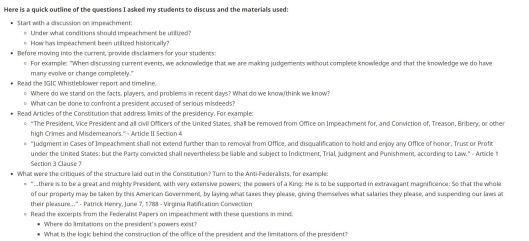
This blog post, by Jennifer Hitchcock from the iCivics Educator Network, presents her own experience in teaching about the impeachment inquiry and provides a good outline of the questions that she asked with her students. Please give it a read, as it really can help you decide how you want to approach this.
An Important Note
Well, we all want resources, don’t we? We’ve taken a look at some of the resources floating around out there (as always, be real careful about what you are pulling off of Teachers Pay Teachers or similiar sites), and identified a few that you might be able to use. As always, make sure that you are aligning your resources and instruction with the relevant standards and benchmarks. Some example middle school civics benchmarks are below.
Analyze the significance and outcomes of landmark Supreme Court cases including, but not limited to, Marbury v. Madison, Plessy v. Ferguson, Brown v. Board of Education, Gideon v. Wainwright, Miranda v. Arizona, in re Gault, Tinker v. Des Moines, Hazelwood v. Kuhlmier, United States v. Nixon, and Bush v. Gore.
Illustrate the structure and function (three branches of government established in Articles I, II, and III with corresponding powers) of government in the United States as established in the Constitution.
Analyze the structure, functions, and processes of the legislative, executive, and judicial branches. Also Assesses: SS.7.C.3.9—Illustrate the law making process at the local, state, and federal levels.
Diagram the levels, functions, and powers of courts at the state and federal levels. Also Assesses: SS. 7.C.2.6—Simulate the trial process and the role of juries in the administration of justice.
What benchmarks you choose will depend on the approach you take towards teaching about impeachment, so plan accordingly!
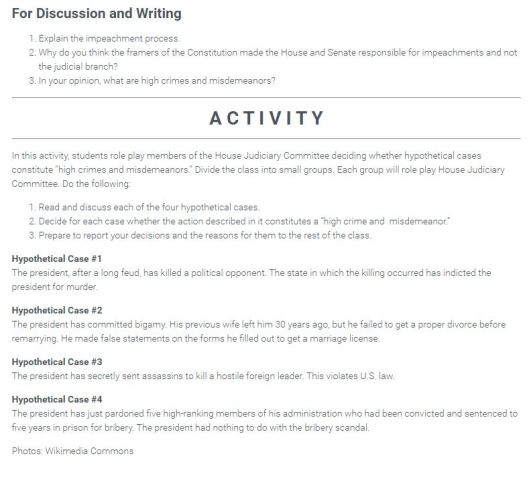
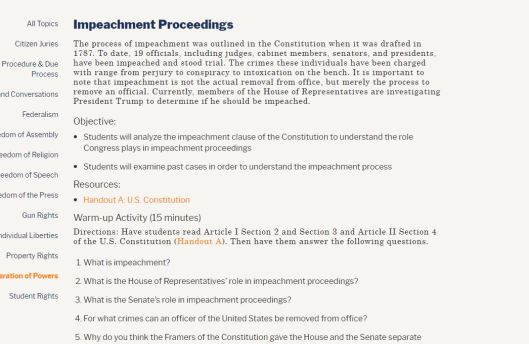
This resource provides a strong foundation in understanding the constitutional language around impeachment. It has students completing an extended reading and associated comprehension questions about what ‘high crimes and misdemeanors’ means, and then gets into a scenario-based activity around the concept.
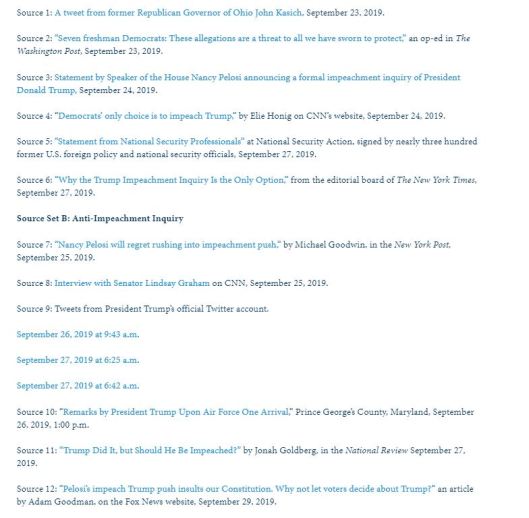
While the title of this resource may raise in the teacher the fear of parent (and school) pushback, it does not ask students to decide whether President Trump is worthy of impeachment. Rather, it is mainly focused on understanding media and sources, and developing media literacy skills, using the impeachment inquiry as a relevant and important foundation. Note, for example, that it provides sources from both sides of the question around the appropriateness of the inquiry. I would happily use this resource no matter what.
The video and its associated page (available at the link above) does a simply fantastic job laying out the process of impeachment and how it works. Indeed, the video is a really useful resource for helping kids how the process as a whole is supposed to be done. It’s worth your time!
This lesson, like others we have shared here, focuses on the process and the approach to impeachment, exploring the constitutional questions around impeachment.
A Final Note
The resources provided here take a couple of different approaches to teaching about impeachment, but they all have one thing in common: they DO NOT ask students to ‘decide whether President Trump deserves to be impeached’. While you are free to take that approach, you MUST recognize that you are likely opening a can of worms that could lead to challenges you may not want to or be able to deal with, especially as this is an ongoing event AND a heated emotional and political issue. The best approach is one that focuses on process and the Constitution and media literacy (which is why the Choices lesson is so good!).
Do you have resources about impeachment that you think are worth sharing? Shoot them our way!
Today I presented at Tufts’ Science, Technology & Society lunch seminar series on how knowledge and power interrelate. My basic thesis was that knowledge is produced by institutions, which are fields of power. Assessing knowledge therefore requires analyzing institutions (not claims about facts by themselves).
The general model I am assuming works like this.
Actors can be individual people or (at larger scales) such entities as firms, bureaus, or even nations. They have goals; mental constructs such as philosophies, identities, or ideologies; and relations with each other.
They interact in an Action Space, such as a market, a democratic election, or a scholarly publication. Their interactions vary, but actors always make choices shaped by rules, norms, and goods.
A “norm” is a shared expectation that has a positive moral valence. For instance, Robert K. Merton’s CUDOS Norms for science are values that are widely expected. An actual “rule,” on the other hand, structures outcomes but may not have a positive moral valence. Merton also coined the phrase “Matthew Principle” for the general rule that, in science, the person who is already most famous gets the most credit. That rule conflicts with the CUDOS norm of Universalism.
Action Spaces affect, and are influenced by, biophysical conditions, general social circumstances (e.g., poverty), and other institutions.
The institution as a whole has Inputs and Outputs. Insofar as the institution involves knowledge, Inputs may include ideas, opinions, and knowledge-claims and it may produce new ideas, opinions, and knowledge-claims.
We can assess the whole process in terms of value criteria, such as justice. Such assessments not only influence institutions; they are also shaped by institutions. In fact, we don’t have information or values that we can use for assessment except for those that have emerged from institutions. The interaction is reciprocal.
Each element of the whole system is a target for power. To use Stephen Lukes’ Faces of Power framework: one “face” involves actors influencing other actors within an Action Space; a second “face” involves changing the rules of the Action Space; and a “third face” involves changing either norms or the actors’ mentalities, or both. But we could add many more “faces” as we consider each element in the diagram.
We rarely assess knowledge directly, because we are rarely in a position to have justified true beliefs all on our own. Instead, we must assess knowledge as the product of institutions. But that is not a relativist claim, because some institutions are better than others. Assessing the value of an institution requires taking it apart and assessing its components.
We wanted to share these upcoming opportunities with NCDD member org, National Issues Forums Institute, for students to dive deeper into the Common Ground for Action online forums. The CGA forums will focus on the NIFI issue guide, A House Divided: What Do We Have To Give Up To Get The Political System We Want?, as part of a series of week-long student-focused forums. You can read about the series below and find the original version on NIFI’s site here.
Join In Cross-Campus Online Forums in November, 2019 – National Week of Conversation
Registration is now available for the student-focused November 2019 National Week of Conversation Common Ground for Action (CGA) forum series. This idea is the brainchild of faculty from the National Issues Forums (NIF) network who wanted their undergrads to have a chance to deliberate with students from other universities so they could hear different voices. We’ve done this the past two years and each year the pool of students and universities gets larger and more diverse. I’m hoping more faculty and students will join us. Since the forums will happen during local and state election week, we’ll be deliberating using the National Issues Forums Institute (NIFI) issue guide on A House Divided: What Do We Have To Give Up To Get The Political System We Want?
Here’s how it works:
There are five forums scheduled during the week – one per day at various times.
Monday November 4th at 1pm ET/10a PT
Tuesday November 5th at 7p ET/4p PT
Thursday November 7th at 9a ET/6a PT
Friday November 8th at 3p ET/12p PT
Saturday November 9th at 7p ET/4p PT
We will be organizing registered students into forums manually so we can try to have as much campus diversity as possible. Please encourage your students to register using their university emails so we can maximize diversity.
You can direct your students to participate in a forum date of your choice or you can have them participate in a forum that best fits their schedule. The day before the forum, registered students will receive an email with their forum Join ID and a copy of the issue guide. Please (please, please, please!) encourage them to read the guide before their forum.
I hope to host as many of your students in a CGA deliberative forum as possible. Please send as many as you think would benefit from deliberating to this event!
In Introduction to Civic Studies, we recently discussed Lynn M. Sanders, “Against Deliberation,” Political Theory, June 1997 v.25 no. 3
Here are some illustrative arguments from her important piece:
“Appeals to deliberation, I will argue, have often been fraught with connotations of rationality, reserve, cautiousness, quietude, community, selflessness, and universalism, connotations which in fact probably undermine deliberation’s democratic claims.” (p. 2)
“Some citizens are better than others at articulating their arguments in rational, reasonable terms. Some citizens, then, appear already to be deliberating, and, given the tight link between democracy and deliberation, appear already to be acting democratically.” (p.2)
“Deliberation is a request for a certain kind of talk: rational, contained, and oriented to a shared problem” (p. 13). “Arguing that democratic discussion should be rational, moderate, and not selfish implicitly excludes public talk that is impassioned, extreme, and the product of particular interests. (p. 14)
“Prejudice and privilege do not emerge in deliberative settings as bad reasons, and they are not countered by good arguments. They are too sneaky, invisible, and pernicious for that reasonable process. So worrying about specifying what counts as a good argument, or trying to enhance reason-giving either via the formulation of better rules and procedures or by providing the time, money, and education necessary to become a responsible deliberative citizen, does not engage some of the most serious challenges to the possibility of achieving democratic deliberation. Some people might be ignored no matter how good their reasons are, no matter how skillfully they articulate them, and when this happens, democratic theory doesn’t have an answer, because one cannot counter a pernicious group dynamic with a good reason.” (p. 4)
I see these as serious concerns. Rose Marie Nierras and I found that many activists from the Global South felt them acutely. (Levine, Peter and Nierras, Rose Marie [2007] “Activists’ Views of Deliberation,” Journal of Public Deliberation: Vol. 3 : Iss. 1 , Article 4.)
But I also sense that the main problem has shifted, requiring a reevaluation of these arguments against deliberation.
It’s true that reason-giving can favor the privileged because they are good at it (or they can hire professional reason-givers, such as lawyers), and because they are basically OK with the social system in which reasons are exchanged.
But it is also a characteristic of privilege not to feel any compulsion to give reasons. It is the autocrat who says, “Because I said so.” Donald Trump is completely unwilling to give or hear reasons, and he may have developed that attitude as a result of extreme socio-economic privilege. His opponents and critics want reasons from him and are willing to give reasons for their demands.
Indeed, there is a long tradition of the people demanding reasons, and authoritarian elites trying to evade reason-giving. When we have that tradition in mind, it’s natural to equate deliberation with political equity. On the other hand, when we think about formal deliberative bodies within a stable but imperfect state–American juries, for example–we worry that deliberation and equity can conflict, because those with advantage prevail in such discussions.
As with many issues, Donald Trump reminds us of the positive case.
We’ve entered World Commons Week, a second annual celebration/research fest organized by the International Association for the Study of the Commons! “The overarching idea,” explains the IASC, is “to celebrate and draw attention to commons research an practice and devote a week toward promoting local-to-global events.” Events began on Sunday, October 6, and will continue through Friday, October 12.
Local events range from teach-ins and local talks to community practitioner meetings and organizing events for commons. A map on the World Commons Week website lists three dozen or more events around the world. They include a showing of a documentary film on common land at the University of Aveiro, in Portugal; a webinar on peer production and commons by Michael Bauwens at Copenhagen University; and a webinar conference on open data mapping in Port Harcourt, Nigeria.
For my part, I will be speaking at an all-campus makerspace at the University of Massachusetts, Amherst, on Friday, October 11, about my new book with Silke Helfrich, Free, Fair and Alive. (Details in righthand column.)
Every day of Commons Week will also feature a “keynote webinar” by a commons scholar from diverse locations around the world. You can check out the list of webinar talks here.
A big salute to IASC for helping to bring more public prominence to commons scholarship and practice!
I argue that Elinor Ostrom’s thought offers powerful resources for people who see themselves as active members of communities (“citizens”). I discuss her emphasis on means, not ends; her vantage point as a citizen, not a state; how she deals with value questions in policy; and her work as a complement to deliberative theory and non-violent social movement theory (Habermas and Gandhi).
Guha’s biography is the essential work on Gandhi: much more detailed, better researched, and more persuasive than the earlier biographies that I know of. Volume Two, focusing on India, is 1,104 pages long but moves at a brisk pace. It’s detailed but never ponderous. The story is often suspenseful, even if you know how it will turn out in broad outlines. For example, just when all seems lost, Gandhi suddenly pulls off the Salt March. And the end of his life has the inexorability of a classical tragedy.
Guha generally proceeds chronologically, but now and then he pauses for an essay on a special topic, such as “Gandhi’s personal faith, his personal morality, as expressed in his words and actions in this decade of the 1920s.” The narrative is enlivened by numerous quotations from original documents, many never printed before. Along with Gandhi’s voice, we hear an amazing range of human beings who interacted with him or commented on him in one way or another, from Black American pastors to anarchists to the advertisers who used his silhouette as a brand.
One of the larger themes that emerged for me was Gandhi as polemicist. The Mahatma relished arguments, even though some of his opponents alienated and infuriated him. You could summarize his thought by capturing his long-lived debates with a few key rivals, especially B.R. Ambedkar and Muhammad Ali Jinnah. But he also sparred with many others.
For instance, I love to think of Margaret Sanger, the sex educator and popularizer of the phrase “birth control,” staying in Gandhi’s ashram and arguing with the celibate old man about first-wave feminism:
‘both seemed to be agreed that woman should be emancipated, that woman should be the arbiter of her destiny’. But whereas Mrs Sanger believed that contraceptives were the safest route to emancipation, Gandhi argued that women should resist their husbands, while men for their part should seek to curb ‘animal passion’. (p. 585)
Sanger was just one of scores of such visitors.
Guha is even-handed, judicious, and open-minded. Only at the end, in an epilogue on contemporary interpretations of Gandhi, does he emerge as a defender of his subject. By then, Guha has explored many flaws, errors, and vices, but he insists that Gandhi was far more complex and responsive than some of his critics have been. For instance:
[Arundhati Roy] presented Gandhi as a thoroughgoing apologist for caste, further arguing that this was in line with his views on race. Gandhi, she suggested, was casteist in India because he had been racist in South Africa. Roy claimed that Gandhi ‘feared and despised Africans’; this he certainly did in his twenties, but just as certainly did not in his forties and fifties. Reading Roy, one would not know that Gandhi decisively outgrew the racism of his youth, a fact that people of colour themselves acknowledged, and appreciated. … Roy has all of Ambedkar’s polemical zeal but none of his scholarship or sociological insight. … [She seeks] —by the technique of suppressio veri, suggestio falsi so beloved of ideologues down the ages—to prove a verdict they have arrived at beforehand.” (p. 876)
In contrast, Guha situates Gandhi in his time and cultural context, appreciates the Mahatma’s critics and opponents, explores his flaws and limitations (and occasional weirdness) at length, and paints a real-life portrait–which thereby emerges as a portrait of greatness.

 Purple is a non-partisan coalition, campaign and movement to rediscover and recommit to democratic values and institutions. It begins this November with a media and education campaign that will “illuminate and dramatize the many glories of American democracy.” Participants in this campaign will include media outlets, schools, libraries, and other organizations committed to sharing the message of the importance of democracy and our participation in it. Their vision is to gain visibility and build a movement for civic participation and democracy across differences, which then leads to increased action, including volunteering, voting, serving, and participating in civic life. As Bob shared on the call, “friends don’t let friends check out of the [democratic] process”.



 Registration is now available for the student-focused November 2019 National Week of Conversation Common Ground for Action (CGA) forum series. This idea is the brainchild of faculty from the