NCDD2016 Session Proposal Deadline Extended!

As we hope you’ve heard, we announced that we were opening the call for NCDD2016 conference session proposals earlier last month. We’ve had lots of great proposals come in so far, and we thank everyone who has submitted session ideas so far!

bumper_sticker_600pxWe’ve also received quite a few requests this week for extensions as folks firm up ideas and finalize plans with collaborators, so in honor of all the hard work our members are doing to make the conference an amazing experience, we are extending the deadline for session proposals! We are now accepting submissions until the end of the day on Wednesday, July 13th! 

If you’re rushing to finish up a proposal, you’ve got a few more days now, but don’t delay! There is going to be some stiff competition for session spots this year.

If you’re still looking for collaborators on your sessions, you can review the calls for session partners that some of our members have put out on our NCDD discussion listserv checking out the discussion topics from the last few weeks in our listserv archives – you could also join the listserv and ask for collaborators yourself!

We recommend that you read over the initial call for proposals one more time before submitting, but once you’re ready, visit the Application Form and submit your proposal!

We look forward to seeing all of your great ideas!

Mathews Center for Civic Life Seeks Summer Interns

We encourage our younger and student members to take note of the announcement below from the David Mathews Center for Civic Life – one of our NCDD member organizations. The internships they are offering this summer are great opportunities to gain experience in deliberation, and we encourage you to apply today! Learn more in their announcement below.


Looking for Interns

Our Jean O’Connor-Snyder Internship Program (JOIP) provides experiential civic learning opportunities for college students across multiple disciplines. Students research deliberative practices and asset-based approaches to working alongside Alabama communities in capacity-building projects. We at the DMC administer the JOIP program and collaborate with faculty mentors across the state.

Participating students build civic and professional skills while implementing asset-based, capacity-building projects in Alabama communities. JOIP interns apply their immersive civic learning experiences to their future studies and careers. Through JOIP, we hope to build upon the millennial spirit of civic engagement in Alabama.

For information about eligibility, project guidelines, proposal requirements, and other details, contact Rebecca Cleveland at rcleveland@mathewscenter.org.

We originally found this announcement on the NIF website at www.nifi.org/en/david-mathews-center-looking-interns.

PB Processes Grow Campus Democracy for NY Students

This week is the N. American PB conference in Boston, and given that one of its themes is “Youth Power through PB,” we thought we’d share the post below from the Participatory Budgeting Project. The piece shows what the concept behind that theme looks like in practice, as student-led pushes to have a say in how their schools spend their money through PB spread across NY state and beyond. Check out PBP’s piece on recent developments below or find the original here. And be sure to connect with us NCDD staff (myself included!) who will be at the PB conference this weekend!


College Students Learn Democracy through PB

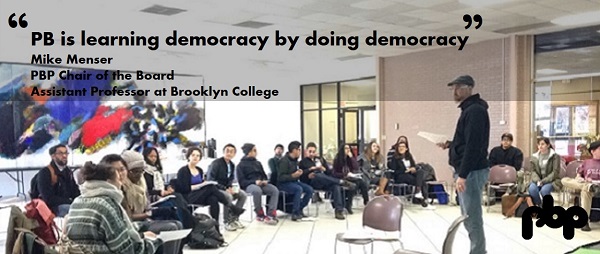
PBP-Logo-Stacked-Rectangle-web1All the buzz was around Queens College campus during the Participatory Budgeting 101 workshop. Over 25 students from at least 6 campuses attended and networked over complimentary bagels and coffee. Students were eager in learning how to gain decision-making power over spending $5,000 of the student government budget. The workshop engaged with student interests on equity and the role of tech tools.

Providing contracted technical support, our staff gave QC students a crash course on managing their own PB process. Students gathered around discussing the need for “transparency and accountability from their student government and campus administration” said Alex Kolokotronis, PB Queens College Coordinator and Founder/Lead Organizer of the Student Organization for Democratic Alternatives (SODA).

The common goal that students had: to have a say in the quality and future of their education. Many students also want to build skills that they can use in their post-college life and career. QC and CUNY students voiced a desire to open opportunities for those who don’t have equal access to higher education, keeping tuition down, and wisely allocating the existing school budget to improve school infrastructure. “Some students and even faculty hope PB can be part of a push to more broadly democratize CUNY” said Alex.

PB in a university setting was first launched at Brooklyn College in 2012 and is still going strong with students managing a budget of $25,000, which has grown over the past four years. “I believe finding out that Brooklyn College did PB gave Queens College students additional confidence that it could be done at a university level…” shared Mike Menser, PBP Chairman of the Board and Professor at Brooklyn College. Queens College has about 20,000  students, however, this process cannot be done successfully without support from the faculty and administration. PB offers a great platform for everyone on campus to engage in discourse that prioritizes the needs of students and faculty and streamlines this to the administration.

Follow Queens College Participatory Budgeting on Facebook!

You can find the original version of this post from the Participatory Budgeting Project blog at www.participatorybudgeting.org/blog/college-students-learn-democracy-through-pb-2.

Classroom Debate Can Boost Youth Democratic Capacity

The team at the Jefferson Center, an NCDD member organizations, recently began a series of guest blog posts on political engagement and democracy, and we were impressed by the series’ piece below from MN high schooler Bruce Acosta. In it, Bruce reflects about how increasing civic education, debate, and deliberation about social issues in schools can fight young people’s disengagement from political involvement and boost their democratic capacity – a trend our field can both support and benefit from. We encourage you to read his piece below or find the original version here.


Better Engaging Young People in Politics

The problem of political participation and awareness among young Americans manifests itself both in and outside schools. Combined with low current involvement in linkage institutions, standardized testing has shown that students and younger voters are missing critical knowledge about our government and their duty in maintaining it.

This is not to say that they do not care about their nation. On the contrary, studies suggest that this new generation of Americans is simply seeking out other, less institutionalized ways to enact change, including volunteering, activism, and organized protest. However, it is important to note that this is largely because of negative media portrayal of politics and narrowly-targeted campaigns that alienate these budding citizens. Thus, in order to effectively combat civic disengagement from traditional politics and promote political awareness, we must find how to utilize this desire to impact one’s community in addition to making voting intent and efficacy integral values in school curricula.

Among successful programs and reforms currently adopted by schools across the country are the open classroom climate and service learning. As a proven method in engaging students in politics, the open classroom climate is the teaching of civics with a strong focus on debate and discussion of social issues. Regarding the lack of appeal of traditional, or “big P” political activity shared by many young people that was mentioned earlier, a series of surveys in California and Chicago high schools and other research has highlighted the impressive results of this strategy in improving student interest in voting, as well as civic knowledge and general confidence in one’s democratic capacity.

On the other hand, service learning, the use of community involvement activities to enforce and supplement course concepts, provides students with a deeper connection to one’s ability to actualize their own goals through volunteering and activism, or “little P” politics. Overall, a study that compared the effects of these two pedagogical strategies affirmed that students exposed to service learning became significantly more involved in these unconventional actions, while open classroom students tended to lean towards participation through voting and joining a political party or interest group.

Despite the success of these schools in employing effective measures against political disengagement, it is also important that we continue to improve the current state of civics courses. While many ideas exist about the direction education should head, two particularly promising solutions stand out. Firstly, history classes, which are heavily favored by state curricula over government classes, could be taught with additional political context. By introducing more civics standards into history courses, schools that would otherwise be unable to provide their students with a background in politics would be able to teach them crucial skills and values to promote future activity.

Secondly, civics classrooms should adopt an increased use of the internet in teaching and student application of course content. For example, online discussion forums serve as potential avenues for children to debate and research issues that are relevant to them, helping to promote efficacy. Evidently, the classroom holds an infinite number of possibilities in expanding the political minds of young Americans.

You can find the original version of this guest blog post from the Jefferson Center at www.jefferson-center.org/engaging-young-people.

Host a 2016 Text, Talk, Act Mental Health Conversation

It’s the time of year again to get ready for Text, Talk, Act – the youth mental health conversation initiative launched in 2013 by NCDD-supported Creating Community Solutions (CCS). As most of you know, Text, Talk, Act comes around every Spring to help young people start talking about mental health issues that they or their friends may be facing and connecting them with ways to get help, and we always encourage our members to host their own conversation.

On Text Talk Act days, young people across the country will be having a nationwide conversation on mental health and how to help a friend in need through a text messaging platform. Small groups receive discussion questions to lead them through a conversation that seeks to help end the silence about mental health, and you can host one of these transformational discussions!

Anyone can register to host an event as part of the 2016 Text, Talk, Act days. This year’s dates are:

  • April 19th (with Active Minds’ Stress Less Week)
  • May 5th (with SAMHSA for National Children’s Mental Health Awareness Day)
  • May 21st (with the National Hook-Up of Black Women)
  • The month of June (with 4-H chapters across the country)

We know these events are helping make a difference in the lives of young people across the country, and we want to support this innovative way to engage young people in dialogue, so we encourage our NCDD members to consider signing up to organize a Text, Talk, Act event in your community! Be sure to check out the toolkit CCS created to support event organizers.

Also, don’t forget that schools, colleges, and community organizations that participate in this spring’s conversations are eligible to win the contest for one of five $1,000 prizes!

Contact Raquel Goodrich at rgoodrich@email.arizona.edu for additional information.

Want to know more about Text, Talk, Act? You can learn more in the video below or by visiting www.creatingcommunitysolutions.org/texttalkact.

Join Confab Call with Participatory Budgeting Project, 3/23

We wanted to share a friendly reminder that we are hosting out next NCDD Confab Call this Wednesday, March 23rd from 2-3pm Eastern / 11am-12pm Pacific, and you won’t want to miss it! This month’s Confab will focus on the Participatory Budgeting Project (PBP), an NCDD member organization and the leading US group working with participatory budgeting.

On this Confab, we will hear from PBP’s Communications Director David Beasley about participatory budgeting, and PBP’s work to bring this approach to managing public money to cities, districts and schools. PB is one of the fastest-growing D&D processes today, and David will talk with us about the that has Confab bubble imagecreated both successes challenges for PBP. We’ll also hear about PBP’s current PB Squared initiative (PB^2) which uses the participatory budgeting process to bring forward ideas on improving participatory budgeting practices. And of course, we’ll preview the upcoming Participatory Budgeting Conference in Boston.

The Confab will also feature Allison Rizzolo from Public Agenda, who will share about PA’s project aimed at evaluating participatory budgeting processes around the country. Come ready to learn more about this exciting work and to contribute your ideas about how PB can continue to develop and advance our field as a whole.

Register today to secure your spot for this great conversation!

Registration Open for 4th Int’l PB Conference, May 20-22

This year is going to be a great year for conferences! Of course we want our NCDD members to join us at our 2016 National Conference for Dialogue & Deliberation, but we also want to encourage our members to consider registering for the 4th International Conference on Participatory Budgeting in North America this May 20th-22nd in Boston, MA.

This year’s PB conference is especially exciting because it will coincide with the voting phase of the City of Boston’s award-winning youth participatory budgeting process, which adds an extra focus on young people’s participation in deliberative processes to the gathering. Regular registration is only $225 before the early-bird deadline on April 8th, but registration fees operate on a sliding scale that you can learn more about at www.pbconference.org.

Here is how PBP describes the conference:

The 4th International Conference on Participatory Budgeting in North America, organized by the Participatory Budgeting Project (PBP), will take place in Boston, Massachusetts, USA during the voting phase of their award-winning, city-wide, youth PB process.

The conference is a space for participants and organizers of PB processes to share and reflect on their experiences so far, alongside interested activists, practitioners, scholars, elected officials, and civic designers.

The PB Conference will be organized around three themes this year:

  • Youth power through PB: PB in schools, youth-only processes, and nearly every other PB process in North America uniquely gives real power to young people – as young as 11! What can we do to encourage even more youth leadership with PB?
  • PB in practice: What is working well? What has been less successful? What improvements can be made in the way the process is implemented? How can we do better and be more effective with existing PB processes and how can we put more processes in place across North America and around the world.
  • Measuring impact: How do we define a good PB process? What are the best ways to define success in this context? What are innovative, effective tools and methods we can use to assess the impact of processes that are currently underway as well as to shape new PB processes.

Conference participants will also have the chance to take advantage of a full-day introductory or advanced training on participatory budgeting before the conference May 20th from 9:30am-4pm. The regular registration rate for the trainings is $250, which is separate from conference registration.

The PB Conference promises to be a great gathering to learn more about one of the fastest-growing methodologies in our field, and we hope to see some of our NCDD members there! You can learn more and register for the conference at www.pbconference.org.

New Initiative Seeks to Reconnect Higher Ed & Democracy

Last year, the Kettering Foundation – one of our NCDD organizational members – convened several university presidents that inaugurated an important effort to help higher education reclaim its roots and role in supporting democracy throughout our society. The effort is being chronicled in a new KF blog series, and we wanted to share the first of the series here. We encourage you to read more about this great initiative below or find the original post here.


Template for Campus Conversations on Democracy

kfKettering has recently begun working with college presidents to move beyond their administrative and fundraising roles and provide new leadership for civic engagement. Beginning with a meeting with a small group of college presidents in July 2015, we found that these presidents were indeed eager to take leadership on themes of democracy and civic engagement on their campuses and with their stakeholders. This blog series, College Presidents on Higher Education and Its Civic Purposes, offers a space to gather and present their thoughts.

For inquiries related to Kettering’s research on college presidents and the civic purposes of higher education, please contact barker[at]kettering[dot]org.

Based on initial conversations at Kettering, Paul Pribbenow, president of Augsburg College, and Adam Weinberg, president of Denison University, working with public intellectual, political theorist, and civic organizer Harry Boyte, also of Augsburg College, have drafted a brief overview of how higher education leaders can initiate these conversations. Campus Compact, as part of its activities in recognition of its 30th anniversary, and Imagining America’s Presidents Council, have already expressed interest in sharing the document with leaders in their networks.

In this inaugural post, Pribbenow describes the purpose of the document and offers an initial draft for comments and feedback.

Letter from Paul Pribbenow

Dear Colleagues,

In July 2015, the Kettering Foundation convened a meeting of presidents on how we, as leaders of our institutions, can more intentionally become public philosophers of education and democracy, in a time of deep unrest in our society as well as on campuses.

The group commissioned Adam Weinberg, president of Denison University, and myself, working with Harry Boyte from Augsburg’s Sabo Center for Democracy and Citizenship, to develop a Leadership Template on the topic. The template offers a few suggested focus areas and resources for presidents and higher education leaders to initiate campus discussions about democracy and citizenship.

We are eager for you to offer your thoughts about the diverse ways in which this template can be used. We aim to help spark a broad discussion on campuses and beyond about how we can strengthen democracy as a “way of life,” with higher education playing vital roles. I don’t have to explain why we need such a discussion.

This effort is undertaken in cooperation with Campus Compact’s 30th anniversary and Imagining America’s Presidential Council, which also has been discussing the democratic purposes of higher education.

Yours in service of our democracy,
Paul Pribbenow, President, Augsburg College

Leading Democracy Colleges and Universities: The Public Roles of Presidents
Drafted by Paul Pribbenow and Adam Weinberg, with Harry Boyte, January 2016

“The first and most essential charge upon higher education is that… it shall be the carrier of democratic values, ideals and processes.”  – Truman Commission on Higher Education, 1947

“Our institutions need to be citizens of a place, not on the sidelines studying it.”  – Nancy Cantor, Chancellor of Rutgers-Newark, 2015

The Truman Commission drew from a large and inspiring view of “democracy as a way of life” widespread early in the 20th century. As John Dewey put it, “Whether this educative process is carried on in a predominantly democratic or non-democratic way becomes a question of transcendent importance not only for education itself but for the democratic way of life.”

This view once infused higher education – land grant and public universities, liberal arts colleges, historically black colleges and universities, normal schools, state universities, and community colleges. “Most of the American institutions of higher education are filled with the democratic spirit,” said Harvard president Charles Eliot, conveying a large conception of democracy.

Today, though many colleges and universities invoke “democracy” or “democratic engagement,” it is rare to have public discussions that reflect on the actual meaning of democracy, just as it is easy to miss the deep challenge to cultures of detachment in Nancy Cantor’s call for colleges and universities to be “citizens of a place, not on the sidelines studying it.” In a time of threats to democracy at home and abroad, the meaning of “democracy” has shrunk along with the purposes of higher education. Democracy often means simply free and fair elections, as the US Agency for International Development defines it (see page 37 of the USAID Strategy on Democracy, Human Rights, and Governance). For many, colleges are a ticket to individual success.

Yet there are signs of renewed concern for the public purposes and work of colleges and universities, reviving higher education’s democratic roles. In this view, colleges and universities are centers of knowledge making and leadership formation, responsible not only for creating and dispensing information but also for addressing local issues and stimulating public exploration of great questions: What does it mean to have a “democratic way of life”? How can higher education, working with communities, help get us there?

This template on leading democracy colleges and universities responds to a request from a group of presidents brought together in July 2015 by the Kettering Foundation on “College Presidents and the Civic Purposes of Higher Education.” Like two efforts by National Issues Forums to organize deliberative dialogues on the purpose of higher education, Shaping Our Future and The Changing World of Work, and the Imagining America Democracy’s College discussion among a group of colleges and universities, it grows from the American Commonwealth Partnership invited by the White House to mark the anniversary of land grant colleges, a coalition to strengthen the public purposes and work of higher education. This effort also builds from efforts like the Carnegie Classification on Community Engagement and the President’s Honor Roll for Community Service that push back against narrow views of “excellence,” like the rankings of US News and World Report.

This statement aims to help spark a broad discussion, on campuses and beyond, about what it means for college and university presidents to lead a public conversation about democracy as a “way of life” with higher education playing vital roles. There is evidence that the nation may be ready for such a discussion. To launch this process, we suggest five focus areas for conversation and action:

Democracy Saga/Public Narrative: This focus area emphasizes an intentional campus and community-wide effort, working with students to recover, discuss, and engage the “saga” or “public narrative” of each unique educational community (for example, see Paul Pribbenow, “Lessons on Vocation and Location: The Saga of Augsburg College as Urban Settlement”).

Democratic Excellence through Diversity: This area of focus revitalizes the conviction, buttressed by research, that a mix of students with diverse backgrounds and talents, interacting in learning cultures of high expectation which develop their unique gifts, can achieve both individual and cooperative excellence, which no focus on winnowing out the stars can achieve (see “Lani Guinier Redefines Diversity, Re-evaluates Merit,” New York Times).

Preparation for Citizen Professional Leadership: This area of focus involves professional programs, disciplinary fields, and learning outside the classroom that recall the democratic values of scientific and other fields and instill democratic skills and habits of public work in students, as well as faculty and staff, to prepare students to be empowering civic leaders and change agents (see citizen professionals at Augsburg).

Free and Public Spaces: This area of focus develops intentional plans to create diverse free spaces and public spaces where students and others learn the skills of surfacing tensions and conflicts constructively, while working with others who are different (see Project for Public Spaces, “Campuses” and Adam Weinberg, “6 Tips for Getting the Most from a Liberal Arts College”). (See also the National Issues Forums issue guides and other resources for engaging campuses in deliberative dialogues on controversial issues.)

Citizens of Places: Colleges and universities as “stewards of place” and “anchor institutions” contributing to the civic and economic health of communities are spreading rapidly. These include a variety of practices, from college purchasing power used to support local businesses and partnerships in creating public spaces to collaboration on local school improvement and support for staff involvement in civic life (see the Anchor Institutions Task Force).

Presidents who act as “public philosophers of democracy and education” are key players in recovering a vision of democracy as a way of life. We encourage presidents to consider their roles in the context of the 2016 Campus Compact Civic Action planning process, which will commence in early 2016, in conjunction with the Compact’s 30th anniversary. Future meetings of college and university presidents, under the auspices of the Kettering Foundation, will offer opportunities to refine and grow this emerging understanding of the public roles of presidents in our democracy.

Other resources: “Democracy University” WNYC Radio show with Harry Boyte and Tim Eatman on the new book collection, Democracy’s Education: Public Work, Citizenship, and the Future of Colleges and Universities (Vanderbilt University Press, 2015). Research on concepts and practices of higher education civic engagement can also be found in several Kettering Foundation publications.

You can find the original version of this Kettering Foundation blog post at www.kettering.org/blogs/template-campus-conversations.

NCDD’s 2015 Year in Review

When a new year begins, we naturally tend to reflect back on the previous year. As we look back on 2015, it’s clear that it was quite a year for NCDD, and it’s inspiring to look back and see all that’s happened.

Keiva-profile-borderThe year of 2015 was one of many transitions. NCDD had some personnel changes as we said a fond farewell to our former Creative Director Andy Fluke and gave a warm welcome to our new Resource Curator and Social Media Coordinator Keiva Hummel (pictured at left). We also brought Ellie Boynton on board to help maintain NCDD’s website.

In the midst of these transitions, I also made a personal transition with a move from rural Pennsylvania to Boston, moving NCDD headquarters (my home office!) closer to hundreds of our members in the process.

GrandeLum-NextStepBubble-borderNCDD also had a very dynamic year in 2015 in terms of programs and projects. 2015 saw the launch of our informal partnership with the U.S. Department of Justice’s Community Relations Service, which came out of CRS Director Grande Lum’s involvement in our 2014 national conference. Meetings were held between Community Relations Service leaders and NCDD members in Boston, Detroit, Chicago, Kansas City, New York, Dallas, and Seattle, and a few more are still in the works. The meetings were designed to be informal networking and information-exchange events, and next steps have emerged organically from the events such as a great new collaboration in Chicago, with more on the way.

RoshanPic2014At this time last year, we began a scoping project in which we had Roshan Bliss, NCDD’s Student & Youth Outreach Coordinator for the 2014 conference (and our fearless Blog Curator!; pictured at left), conduct an online youth survey, seek feedback from our network about the role of young people in the D&D field, and host a few “focus group” calls with younger NCDDers in an effort to frame a possible NCDD youth initiative. The results gave us some good insights into how NCDD can support young people and folks who are new to the field, and will form the basis of what a Youth Program we’ll be launching this year.

Our regular Tech Tuesday and Confab Calls continued to thrive in 2015 under the coordination of our wonderful Program Director Courtney Breese. As always, you can check out the archives of the confabs at www.ncdd.org/confabs and watch the Tech Tuesday videos at www.ncdd.org/tech-tuesdays.

Confab bubble imageOur Confab Calls covered such topics as how brain science supports constructive dialogue and deliberation, ethics for facilitators, and strategies for handling latecomers in public engagement programs and disruptors at public engagement events. We talked with NCDD members Pete Peterson (about his experience running for CA Secretary of State on a “civic engagement” platform), Matt Leighninger and Tina Nabatchi (about their great new book Public Participation for 21st Century Democracy), and John Gastil (about the opportunity for organizations to host a fellow as part of the new Nevins Democracy Leaders Program).

Tech_Tuesday_BadgeAnd our Tech Tuesday events, which are designed to help practitioners stay on top of new opportunities and developments in the online engagement realm, featured innovative tools like Consider.it, Bang the Table, QiqoChat, and Common Ground for Action. In all, we served 450 people through our online events in 2015.

2015 also saw the launch of a new partnership between NCDD and the McCourtney Institute for Democracy at Penn State to create infrastructure that will bring more young people into the D&D field. The Nevins Democracy Leaders program piloted its first two fellowship Mccourtney Institute Logoplacements in 2015 with Everyday Democracy and No Labels, and we are thrilled that 2016 will see nearly two dozen bright D&D-trained students placed with leading organizations in our field in fully funded fellowship positions.

In 2015, I continued to work very closely with the Kettering Foundation, in my role as Research Deputy and otherwise. KF’s president David Mathews took the time to write a special message to the NCDD community about the Kettering-sign-outlinedhistoric opportunity we have right now to “find the public voice that’s missing.” I worked particularly closely on Kettering’s annual A Public Voice event at the National Press Club. Also be on the lookout for a fascinating report on the strategies that public engagement practitioners use to develop productive relationships with public officials over time — a collaboration between NCDD, Kettering, and the Jefferson Center.

As we look forward to the coming year, we hope for more and more opportunities like our partnerships with the Kettering Foundation, the McCourtney Institute at Penn State, and the US DOJ Community Relations Service — opportunities that allow us to utilize the infrastructure we’ve built up to serve the broader field. We look forward to launching our youth program, distributing new materials, continuing to provide quality online programming for our community, and of course, hosting the 2016 National Conference on Dialogue & Deliberation this October in Boston, MA!!!

NCDD’s work is funded mostly by members’ dues and small donations. If you want to support all of the great work we do, please consider making a tax-deductible donation by visiting www.ncdd.org/donate or renewing or upgrading your membership at www.ncdd.org/renew.

We look forward to enjoying the coming year with all of you, no doubt feeling constantly inspired by the important, innovative work you all are doing.

New Curricula Teach Deliberation through Historic Decisions

The team at the Kettering Foundation recently shared a fascinating post about a new, innovative set of tools they’re creating to help teachers teach history and deliberation in classrooms that we wanted to share. Kettering and the National Issues Forums Institute are rolling out a set of deliberative decision guides based on historic decisions that shaped US history, and they’re finding success using them in classrooms. Check out the Kettering post below about the project or find the original here.


kfLisa Strahley of SUNY Broome recently shared a video her college and a local middle school produced based on their experience using NIF’s Historic Decisions curricula in their classroom. Historic Decisions issue guides take important decisions from American history and frame them, not as stories of great men making decisions for the country, but in terms of the difficult choices citizens at the time were confronting.

The goal of these issue guides is to allow students to feel the difficulty and power of making such choices and to learn to look at current-day problems with the same lens and sense of agency.

KF program officer Randy Nielson noted, “This video provides a really nice illustration of what political learning looks like. It shows what the subjects of the learning are (the practices of choice making and the effects of making the practices deliberative) and also the feeling of it – the kids were excited, because they had come to a different way of seeing the past, but also because their sense of themselves as actors in a life of choices with other people had changed. They had learned a new way of interacting and they knew it and could feel it. And that self-consciousness was beautifully evident.”

The 1776: What Should We Do? and A New Land: What Kind of Government Should We Have? guides are both available in print or digitally on NIF’s website. Eight more historic issues are currently being framed as part of a research exchange led by KF program officer Joni Doherty.

You can find the original version of this Kettering Foundation blog post at www.kettering.org/blogs/historic-decisions-create-citizens-tomorrow.