LinkedIn has a neat tool called InMaps that I just learned is being retired soon. With click of a button, it creates an interactive visual map of all your LinkedIn connections. It assigns them colors based on their similarities to each other, and you can to label those colored clusters based on the similarities you see.
Back when I first started using LinkedIn, I was pretty gung-ho about making connections. I currently have 2,147 LinkedIn connections, so my LinkedIn map is a little dense with people and the connections between them. Interestingly, my current InMap is more densely concentrated than it was a couple of years ago when I first generated my InMap. There are fewer individuals and nodes that seem distanced from the others.
It’s a little hard to see who some of the other nodes are that seem to connect multiple sectors, but I could get a sense of who the most connected people are by the size of their dot. Diana Whitney, Matt Leighninger, Thomas Valenti, Larry Schooler, Beth Offenbacker, Jon Ramer, Nancy White, Margaret Herrmann, and Libby and Len Traubman stand out to me as highly connected in LinkedIn.
One of the nice features InMaps offers is that it allows you to label your own clusters. If you click around all of the orange or blue dots on your map, it becomes clear that the people assigned to that color have something in common. The image to the right shows how I chose to label my colored clusters.
My connections on LinkedIn, in large part, are NCDD’s connections. Reflecting on Albert-László Barabási’s Linked (a book on the power of networks), I feel pretty encouraged by the denseness and variety of my network map. In Barabási’s chapter “Hubs and Connectors,” he writes:
“Indeed, with links to an unusually large number of nodes, hubs create short paths between any two nodes in the system. Consequently, while the average separation between two randomly selected people on Earth is six, the distance between anybody and a connector is often only one or two.”
I’m curious about what other NCDDers’ InMaps look like, and how you would label your own clusters. To create your own InMap (before it’s too late!), go to http://inmaps.linkedinlabs.com/ (you’ll have to enter your LinkedIn password). Once it has generated your map and you’ve added your labels, click Share and then add the web address of your map in the comments below so others can take a look. The link to your shareable map will look something like mine:
Also – I’m very curious about what network mapping tools have worked best for NCDDers? Mapping my own LinkedIn contacts or Facebook contacts is interesting, but NCDD is starting to map the organizations, collaboration, and capacity in our field. What tools would you suggest we learn more about as we embark on this important task? Are there any tools you’ve found particularly useful? What tools have disappointed you?
We are excited to share that our organizational partners at the Kettering Foundation have a series of at least three issue guides for facilitating deliberation on climate issues in the works. These guides can be an important tool for helping the public deal with this crucial issue. We encourage you to read the brief statement from Kettering’s online publication below.
The Kettering Foundation is breaking ground on an exciting new project–a series of National Issues Forums (NIF) framings for environmental issues. Amy Lee and Scott London have been doing the preliminary work for about a year now, but in April, they had their first official meeting with an old friend of the foundation’s, the North American Association of Environmental Educators (NAAEE). NAAEE actually produced a number of issue guides in the long, study guide-like format back in the 1990s, and they’ve become reacquainted recently with KF through research deputy Michele Archie.
Representatives from NAAEE included board member Bora Simmons, who was involved with Michele in producing the earlier issue guides, as well as other NAAEE staff members from different arms and levels of the organization. NAAEE, much like NIF, has a large, two-way network of local chapters as well as a national level, and both ends work together. Kettering hopes to produce at least three issue frameworks with NAAEE and to experiment with NAAEE in creating new materials for forums based on those frameworks. Standard NIF issue guides are certainly one possible product, but we hope to experiment with some new formats. We’ll also be observing, with NAAEE, the effects of engaging their members and audiences in deliberation, as well as how they negotiate cooperation with other kind of actors in the environmental arena, particular advocacy groups.
The work is off to a fantastic start. NAAEE is already planning some test forums for a framing on climate change that Scott London has begun, as well as making plans for creating a matrix of local frameworks on water issues from places around the country and perhaps using other materials NIF has developed, such as the soon-to-be-released Energy guide update.
Our partners at the Ash Center for Democratic Governance and Innovation recently published a great piece on their Challenges to Democracy blog by Hollie Russon Gilman that we are re-posting here. Gilman’s insightful article about innovation in governance is the third in a series (first and second), and we hope you will read it below or find the post from the Ash Center here.
It isn’t easy to innovate in governance. Bureaucracy can be hidebound. The private sector’s lean startup model, with its “fail forward” ethos, is antithetical to government as we know it. Electorates are not tolerant of failure, and voter confidence in government is at an all time low. In a 2013, more people listed government dysfunction as the problem they believe is the country’s most serious challenge. Given these headwinds, it’s not surprising that many officials resist the experimentation and risk necessary to innovate.
However, partly in response to this same citizen disaffection, a new wave of participatory policy reforms is springing up across the United States. This includes New Urban Mechanics in Boston and Philadelphia piloting experiments to engage citizens with City Hall to Participatory Budgeting, a process to enlist citizens as decision makers on public budgets. While the civic experiments differ in form, they reflect common principles in action that offer lessons for policy makers considering their own civic innovations.
Don’t Reinvent the Wheel. Instead of thinking about new laws, create innovation within existing institutional structures. For example, the U.S. already has a regulations comment and notice period. Instead of creating a new apparatus for citizen engagement, improve on existing structures such as Regulations.gov. This requires an investigatory, opportunistic approach to finding areas ripe for improvement and putting new tools to use.
When people apply the lens of innovation to existing structures, even small improvements can lead to more significant shifts by informing a new playbook that officials can replicate and scale.
Take a Hybrid Approach. Government cannot do it alone. Instead, find opportunities for non-government actors to contribute to governance. This can include public-private partnerships or leveraging the talent of universities. Citizens themselves are also a great, and often underutilized, repository of talent and local knowledge.
For example, Adopt a Hydrant is a Code for America project that enables citizens to take responsibility for shoveling out fire hydrants after heavy snowfall.
Collaboration Instead of Competition. The first mover advantage that is so critical in the private sector does not apply to the public sector. Innovation is most likely to spread when governments across localities work together to share lessons learned and best practices.
For example, Chicago is building an open source predictive analytics tool that other governments can use to translate open data to improve service delivery. This approach empowers citizens across geographic boundaries.
Government will never function like a Silicon Valley startup. But each of these observations – building on existing structures, enlisting the private sector, and sharing lessons—helps lower barriers.
What do these principles look like in practice?
Technology has transformed how the two major political parties compete for votes, from how campaigns receive donations to how they target voters. Yet we have not seen a commensurate civic-minded effort aimed at transforming voting processes and elections to empower citizens. Although voters often now tap a screen instead of punching a ballot, the act of voting otherwise remains relatively unchanged over the past several decades—even as technology remakes political campaigns.
As suggested above, governance innovations will be most successful when working within existing institutional structures. Elections, the wellspring of leaders’ and institutions’ democratic legitimacy, could also benefit from tapping into the energy and potential of technology and innovation.
One critical measure of successful elections is whether citizens feel equipped with information. This includes everything from where elected officials stand on key policy arenas to who is running and where to vote. Unfortunately, this information is scattered across many sources. A range of innovations, from open data API’s to new mobile apps are working to more effectively increase access to information.
One example is TurboVote. After signing up, a user will receive customized information on relevant voting rules, deadlines, and forms. All the voter has to do is drop them in the mail. This model suggests that providing easy access to information can reduce barriers to voting.
Even when citizens are empowered with information about elections, there is the further challenge of getting people to the polls. Nations handle this differently. Australia has compulsory voting. Some countries make Election Day a public holiday. Many countries host elections on Saturdays or Sundays. Thirty U.S. states, as well as the District of Columbia, now have the option for a mail in ballot.
Political scientists Donald Green and Alan Gerber have conducted experiments demonstrating that personalized messages are most effective in voter mobilization. Google launched a pledge website for India’s elections. Here people can take a personal pledge to vote and learn about their candidates. These examples suggest that creative and customized approaches can encourage people to get out to the polls.
Finally, the very process of voting can be filled with frustration. Long waiting times, obscure locations, and in some places, questions about the fidelity of vote counting processes can leave people disillusioned about the act of voting. Crowd sourcing mechanisms could empower citizens both during and after voting.
Political scientist Archon Fung launched MyFairElections a crowd sourced platform, based on the success of Ushahidi’s election monitoring, where people can “rate” their voting location. Voters can submit reviews of their polling place. This can capture everything from long voting lines to the number of voters turned away from the polls. The information is then publicly displayed and can create a transparency and accountability feedback mechanism. Further opportunities for feedback could lead to improvements in election processes. This could also enable voters to feel more agency in the basic procedures that determine their governance.
Technology is creating new expectations for how citizens engage with their world. Governments must adapt to keep pace or risk the dissatisfaction of those they represent. The problems are large and complex. Meanwhile, democracy requires free and fair elections to exist. Elections are its sacred rites. There is good reason to be cautious about changing them. Yet there is also a democratic imperative for elections to seize 21st century innovation opportunities.
Civic innovation—done right—can serve as an important part of the solution.
In principle, more often than not, a group will develop a great solution to the wrong problem. Before proceeding with a solution we need to see that it is aimed at the problem, and to do that we need to bring the problem into focus. Taking time to define the problem may seem annoying and unnecessary in the short term, but can save huge amounts of time and energy over the long run.
Defining the problem as a group also checks our shared expectations. It helps me decide, “Is this something that I want to participate in?”
Practical Tip: Before discussing solutions, discuss the problem. What are we trying to fix? What is the specific scope of the problem that we are willing to take on? How would we know if the problem were fixed? Are we the right group to fix it?
On paper, write something like, “The problem is that _____________.” It could be a sentence or it could be a paragraph.
Refrain from discussing solutions until you have agreement on the problem statement. Make sure that all those working on the problem are aware of the written problem statement and agree with it.
Before firing off solutions, make sure the problem is squarely in your sights.
For our June 24th Tech Tuesday, we’re pleased to have Brian Burt, CEO and founder of MaestroConference, host a session that lets us experience major new changes in their platform and talk together about how it could support upcoming projects we each may have. Registration is open now, so reserve your spot today!
Many of you are familiar with MaestroConference, as we’ve used it numerous times for our online activities (our last two Tech Tuesdays, a couple confab calls, and a few special calls), thanks in large part to NCDD member Ben Roberts, who has served as our host for the calls. MaestroConference is also well-known in our field because of its alignment with group process techniques — including its unique ability to enable break-out groups to form on conference calls.
MaestroConference is the leader in “Social Conferencing” technology serving more than 5 million participants, and is launching a new “Visual Interface” which allows people to see the faces of the people they’re talking to, edit documents together, leverage crowdsourcing applications, exercise the “law of two feet” and more.
For our June Tech Tuesday (on the 24th from 1-2pm Eastern / 10-11am Pacific), Brian will host a discussion leveraging the new Social Webinar platform for conveners and facilitators about enhancing interactivity and engagement with virtual conversations. Participants will experience break out groups with peer advice to examine how conversations with scalable breakouts can include the voices you want at the table, and address any challenges you have found in the past with technology-supported engagement.
This FREE event will take place on Tuesday, June 24 from 1-2pm ET / 10-11am PT. You do not have to be a member of NCDD to participate in our Tech Tuesday learning events.
We recently read a great piece on bringing out the gifts of introverted people over at NCDD supporting member Janice Thomson’s blog, Citizenize-Citizenise. Janice has been working with the Chicago chapter of the International Association of Facilitators on developing resources for effectively engaging quieter folks, and we think they could be quite useful to our members. You can read Janice’s piece below or find the original here.
“Stop the madness for constant group work. Just stop it!” pleads Susan Cain, author of Quiet: The Power of Introverts in a World That Can’t Stop Talking. Group work, she claims, stifles some of the most insightful and creative thinkers and inflates the influence of extroverts. To generate the best ideas, workplaces and schools need to provide more solitude for deep reflection and creative thinking.
As a facilitator, her critiques made me wonder. Do the group processes I use marginalize important voices and perspectives? Is it possible to design meetings and workshops to fully involve introverted participants? I started a conversation around these questions with fellow facilitator Margaret Sullivan and together we designed a workshop to test our ideas and learn from others.
This blog summarizes learning from our “Facilitating Introverts” workshop held May 16, 2014 with the International Association of Facilitators (IAF), Chicago chapter. We warmly invite additional suggestions for how to include introverts in meetings and workshops!
What’s an introvert?
The concept of introversion originated with psychologist Carl Jung who noticed that people tend to be energized either by going inward in quiet reflection (introverts) or outward in interactions with people (extroverts). Later personality theorists added concepts like how one processes information, sensitivity to novelty and stimulation, and attitudes toward privacy and public attention.
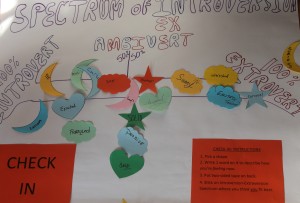
Spectrum of Introversion Photo: Al Rush
Introversion/extroversion is a spectrum (see top photo). The population is roughly equally divided between the two halves and most people fall somewhere toward the middle. Although most people can function in both introverted and extroverted ways, they prefer one or the other. So, traditional group work, which is designed for extroverts, can indeed disadvantage introverts. To rectify this imbalance, it is necessary to first understand the special needs and gifts of introverts.
Importantly, since nobody functions exclusively as an introvert or extrovert, it would in fact be more accurate to discuss facilitating introversion or incorporating introverted processes into group work. This however is linguistically and conceptually cumbersome. So, for clarity, we simply use the term “introverts”.
Needs and gifts of introverts
Reflecting on the ideas of personality theorists and considering group situations that challenge introverts, we created a list of needs and gifts of introverts relevant to group work.
Important themes include:
Managing energy. Introverts are drained by social interaction and need alone time to recharge.
Processing time. Introverts take in lots of multi-layered information. They may therefore need more time than extroverts to process information, reflect, and decide what to say. They also need to understand expectations so they may prepare in advance.
Privacy and caution. Introverts do not like to call attention to themselves and can be reticent to share their ideas — especially if they are not yet fully formed or may provoke conflict.
Meaning and focus. Introverts are drawn to meaningful conversations and can go deep into subjects. Conversely, they get overwhelmed when multiple themes are discussed simultaneously.
Deep listening. Introverts can be very attentive listeners. They may notice things and make connections that extroverts miss. They also ask great questions.
Writing and non-verbal expression. Many introverts prefer to communicate in ways other than talking and may be skilled at writing or drawing.
Creativity and imagination. Introverts have rich inner lives which can lead them to uncover valuable insights and generate creative solutions.
Tools and techniques to involve introverts
Using these needs and gifts, we brainstormed tools and techniques to help introverts feel comfortable, meet their needs, and share their gifts in group work. We then added ideas culled from online facilitator forums and workshop discussions. We offer this initial list of tools and techniques for facilitating introverts to facilitators as thought-starters in designing group processes.
An introvert-friendly workshop
To demonstrate what an “introvert-friendly” workshop might look like, the methods we used in our own “Facilitating Introverts” workshop and why we chose them are described below.
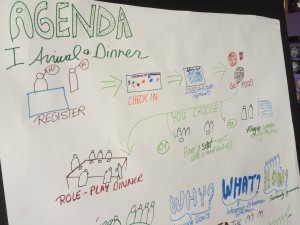
I. Arrival and Dinner
Arriving at a meeting or workshop can be uncomfortable for introverts, especially if they don’t know anyone. So it’s important to consciously design an experience to put them at ease. We provided:
Photo: Al Rush
Visible agenda. Introverts like to know what to expect, including when they may need to contribute. We displayed a large visual agenda at arrival and reviewed it at the start of the workshop.
Greeter and host. While extroverts can just dive into unstructured social situations, introverts welcome some assistance. Participants were met by a greeter at a registration table and a “host” who mingled and made sure everyone was comfortable – e.g., introducing people and suggesting activities.
Nonverbal check-in. Fun, non-verbal activities done at one’s own pace can be an easy warm-up and help facilitate connections. We invited participants to write their mood on a colored shape and place it on an introversion-extroversion spectrum chart. This also introduced a core concept of our workshop, showed who was in the room, and provided a “temperature check”.
Reflection pond. This served as both “graffiti wall” and “parking lot”. Introverts don’t like to draw attention to themselves or provoke conflict so it’s good to offer ways to share anonymously. They can also get overwhelmed when multiple topics are discussed simultaneously. So it’s useful to use methods like “parking lots” to keep conversations focused.
Dinner choices. It’s important to never label a person or activity as “introvert” or “extrovert”, but rather to offer choices that allow participants to manage their own energy. For dinner, we offered three options: mingling informally, sitting in small groups, or participating in a facilitated “role play” game. We also kept novelty and stimulation low by providing familiar food (pizza) and calming music.
Role play dinner. Since introverts may be reticent to draw attention to themselves, role play games can help them speak more freely. We created a scenario where five famous introverts and five famous extroverts worked together on a project team. Participants described how their character (e.g., Eleanor Roosevelt, Marie Antoinette, etc.) would feel and behave in different group situations. This provided both structured group interaction and a playful introduction to workshop themes.
Flexible meeting space. We chose a meeting space, the Thinkubator, that provides many seating options, nooks and crannies, and an outdoor deck for different types of group interaction and solo breaks.
II. Opening
After introducing the topic, we created community agreements that included:
Moment of silence. Because introverts take in so much information, they sometimes need extra time to “catch up”. To create opportunities for this, we created “silence” signs anyone could use to request the group to be quiet for a few minutes – no explanation needed.
Breaks. Introverts sometimes need alone time to recharge. So we gave participants permission to take a break at any time, for any reason, no questions asked.
OK to pass. Introverts sometimes need additional time to formulate their thoughts. So, in structured go-arounds and sharing times, participants can “pass” and talk later.
Don’t hold back. “Quieter people” were reminded that they too have contributions valuable to the group and not to “hold back” sharing.
Homework and paired sharing. Introverts like to come prepared to meetings. Assigning homework is one way to achieve this. We asked participants to watch Susan Cain’s TED Talk to prepare. The first social interaction was low-key: sharing one thing learned from this video with one’s neighbor.
III. Needs and Gifts
An individual “scenario reflection” exercise was used to identify introverts’ needs and gifts. Three situations were described that can be challenging to introverts: 1) arriving at a meeting of strangers, 2) being asked to share one’s viewpoint early in a meeting, and 3) a meeting on a contentious issue.
To share ideas, we planned a structured go-around using a talking stick. This gives introverts the floor without them having to ask for it, but also lets them “pass” and speak later if they aren’t ready to talk.
IV. Tools and Techniques
We began with individual brainstorming, followed by a 20 minute discussion in groups of 3-4 people to modify and add to our initial list of tools and techniques. Especially with introverts, it’s important to begin brainstorming individually. A group size of 3-4 people allows sharing, but is comfortable to introverts.
Here’s a 1 minute video of the entire workshop (thanks to Gerald and Steve at the Thinkubator):
V. Post-event
Introverts often get their best ideas after a meeting or workshop – i.e., once they’ve had time to fully process its content and reflect alone on its meaning. So it’s important to provide a method, such as an online forum, to continue sharing and discussion after the event. That is one goal of this blog.
What do you think?
Margaret and I are sharing this blog with both the Chicago IAF workshop participants and the broader facilitation community. We invite suggestions of additional tools and techniques, needs and gifts, and thoughts on “facilitating introverts”. Please leave your comments below in “Leave A Reply”. You may also post a comment on the Chicago IAF Facebook page or Linked In group.
If there is sufficient interest, we might offer this workshop again, perhaps in modified or expanded form. Please use the contact form to let me know of your interest in organizing or assisting with a future workshop.
In principle, moving quickly often seems like a good idea but moving quickly in the wrong direction simply gets you to the wrong place fast. Most groups have a high need for quick achievement. We have all heard someone say, “Enough talk, let’s just do something!” And we have all seen groups charge off quickly and with much enthusiasm…in the wrong direction.
Practical Tip: Even when under pressure to accomplish something in a hurry, resist the temptation to achieve a quick, although shabby, result. Quality group decisions, like anything of quality, require upfront investment. Determine your objective before springing into action. Spend some time planning. Read the directions. Check out the map. As Bob Dylan says, “I know my song well before I start singing.”
No matter how slowly you go, if you are headed in the right direction you might eventually get there.
Our organizational partners at Everyday Democracy recently shared a compilation of their top 10 resources for dialogue and deliberation practitioners that we highly encourage you to check out. They provide guidance on issues from incorporating racial equity into our work to training youth facilitators and are valuable tools for deepening our work. You can read more about the resources below or find EvDem’s original post by clicking here.
Over the past 25 years, our most important source of learning has been from the deep partnerships we have had with formal and informal leaders in communities from every region of the country. People come to us from places of all sizes and demographics, and with a wide variety of histories, assets and concerns. As we have coached them, we have learned with them, and as a result have created and adapted advice and tools that others can learn from and adapt to their particular situations.
Some of the lessons we have learned from our community partners include:
How community coalitions can work together to organize large-scale dialogue and action;
How to recruit a broad diversity of residents for dialogue, facilitation, and action;
How to engage those who are often left out or marginalized;
How to frame an issue so that people of all backgrounds and views can find their voice in the conversation;
Ways to use an intentional “equity lens” so that organizing, dialogue and action can take into account and address the underlying inequities and power dynamics of the community;
How to bridge dialogue and intentional action strategies;
How community voice and participation can change the way public instutions such as school systems and police departments work;
How to link community voice with policy-making;
How to embed dialogue and change processes in the regular culture and practices of the community.
Many of these lessons are captured the tools and advice you will find on our website. The tools that were most frequently clicked on in recent months reflect an interest in applying these lessons in other communities. Here is a sampling of our “readers’ favorites” of the recent past:
This six-session discussion guide helps all kinds of people take part in meaningful dialogue to examine gaps among racial and ethnic groups and create institutional and policy change.
This Action Road Map will help communities walk through the steps we need to take to carry out a plan for action. Using this worksheet, you will think about the people, places, and things in your community that can help you reach your goals. Each action team should create their own Action Road Map.
This five-session discussion guide is designed to help communities bring police and residents together to build trust and respect, develop better policies, and make changes for safer communities.
A Guide for Training Public Dialogue Facilitators is a comprehensive training curriculum. This guide includes advice for creating a training program for both youth and adults, with expanded facilitator training, plus suggestions for ongoing support and evaluation of dialogue facilitators.
This activity will help the group get to know each other better and understand our histories. The facilitator should post large sheets of paper with the timeline written on it for participants to add their events. Follow the instructions in the handout below to facilitate the discussion.
Building Prosperity for All is for people in rural communities and small towns who are working to move from poverty to prosperity. This resource was designed to benefit communities that participated in dialogue-to-change programs using the guide, Thriving Communities: Working Together to Move From Poverty to Prosperity for All. However, no prior experience with Thriving Communities is necessary to get involved.
This five-session discussion guide helps people get involved in an important issue facing all of us: the well-being of our youngest children. The guide looks at how we are connected to the lives of children in our community and the “invisible” effects of racism and poverty. It also guides people in developing plans for action.
Following each dialogue session, facilitators should take some time to debrief and make sure they are working well together.
Please let us know what tools and supports you are using in your community, and what you are learning as you apply democratic principles and practices. We look forward to working and learning with you, and to sharing your practical insights with others.
As with other NIFI issue guides, the new guide encourages forum participants to weigh three different courses of action on a controversial issue. The guide lays out the choices on dealing with the national budget in this way:
Option One: Keep Tightening Our Belt
Though painful, the sequester showed that we can get by with less. We should continue cutting gradually to bring down the deficit, shrink the national debt, and let the private sector drive the recovery.
Option Two: Invest for the Future
We are making progress on the deficit. We need to make some adjustments to entitlements, but now is not the time to slash programs and hobble the recovery.
Option Three: Tame the Monsters
We need to control the unbridled growth of defense, Social Security, and Medicare/Medicaid, which are the main consumers of federal dollars.
You can read more about the new issue guide at by clicking here, and we encourage you to order or download the issue materials here.
In principle, when we ask for feedback we increase our chances of making good group decisions. If we don’t ask we can’t expect people to tell us what’s going well and not so well. When we do ask we should be open to all answers. Asking for feedback takes courage but gives enlightenment. It helps us see things in new light, reflected off others.
Practical Tip: Ask how you are doing among those who care about what you do. What’s working well? What could be better? What questions or ideas do your stakeholders have? Be thankful for all invited feedback, positive or negative. Be open to how you might use it to make improvements.
Take positive comments to heart and share credit with others. When you receive a negative comment, consider that it’s probably not about you. It’s more likely about a particular idea, behavior, or situation. And, consider that negative comments are sometimes all about the world of the commentator and not about the topic at hand.


 It’s a little hard to see who some of the other nodes are that seem to connect multiple sectors, but I could get a sense of who the most connected people are by the size of their dot. Diana Whitney, Matt Leighninger, Thomas Valenti, Larry Schooler, Beth Offenbacker, Jon Ramer, Nancy White, Margaret Herrmann, and Libby and Len Traubman stand out to me as highly connected in LinkedIn.