Two New Issue Guides from NIF

NIF-logoOur partners at the National Issues Forums Institute – an NCDD organizational member – have just released two new issue guides for helping facilitate dialogue and public deliberation around two important issues: mental health and alcohol abuse. As always, NIFI’s discussion guides present three different approaches to addressing the problem at hand for participants to weigh.

In the mental health guide, “Mental Illness in America: How Do We Address a Growing Problem?“, the three options presented are as follows:

Option One: “Put Safety First” - This option would make public safety the top priority and support intervention, if necessary, to provide help for those with serious mental illness.

Option Two: “Expand Services” - This option would make mental health services as widely available as possible so that people can get the help they need.

Option Three: “Let People Plot Their Own Course” - This option would reduce the number of mental illness diagnoses and curtail the use of psychiatric medications, allowing for more individuality.

And in the alcohol abuse guide, “Alcohol in America: What Can We Do about Excessive Drinking?“, the options are framed this way:

Option One: “Protect Others from Danger” – Society should do what it takes to protect itself from the negative consequences of drinking behavior.

Option Two: “Help People with Alcohol Problems” - We need to help people reduce their drinking.

Option Three: “Change Society’s Relationship with Alcohol” - This option says that solutions must address the societal attitudes and environments that make heavy drinking widely accepted.

To find out more about these and other issue guides, you can visit the NIFI issue books store here.

NCDD 2014 Partner: League of Extraordinary Trainers

NCDD is proud to announce that The League of Extraordinary Trainers has signed on as a Partner of the 6th National Conference on Dialogue & Deliberation…

The League of Extraordinary Trainers are seven highly seasoned practitioners who have designed and presented some of the most powerful and recognized training in public participation, collaboration, consensus, high stakes communication, and facilitation in the world today. The League (known initially as the US Trainers’ Consortium) are practice leaders, developers and founders of the International Association for Public Participation (IAP2) and its spectrum, principles and ethics.

Specializing in the IAP2 Training program, the League of Extraordinary Trainers offers two courses, including (new for this year) a revamped IAP2 Certificate Program.  More information and their 2014 schedule can be found below…

IAP2 Foundations Program

Foundations in Public Participation was designed with the input of successful practitioners who work with diverse populations and divergent circumstances throughout the world. This course will let you hit the ground running, armed with the knowledge and confidence you need to plan and execute effective initiatives for any area in which you may be working.

September 8-12  -  Fort Worth, TX
October 27-31  -  Chicago, IL

Emotion, Outrage and Public Participation EOP2

This practical, hands-on workshop is a fresh mix of lecture, video, small and large group discussion and authentic, real world exercises that give you the answers, tools and ability to prevent problems, manage the tough public issues that you face and keep your organization on track and moving forward.

October 6-7  -  Las Vegas, NV
October 16-17  -  Austin, TX
December 4-5  -   Chicago, IL

Note: Discounts are available for NCDD members.  To take advantage of the NCDD Member Discounts contact them directly at info@extraordinarytrainers.com or 720-237-9175.

You can learn a lot more about The League of Extraordinary Trainers by visiting their website and when you meet the good folks from the league at the conference this Fall, please thank them for helping make NCDD 2014 possible!

Interested in Sponsoring the Conference?

Over the next few months leading up to NCDD’s 2014 National Conference (held this year at the Hyatt Regency in Reston, VA just outside DC), we’ll be highlighting the work of our event sponsors on our news blog, on social media, and on our listservs.  Those interested in helping us create our best event ever can learn more about sponsorship opportunities by downloading our 2014 Sponsorship Info PDF.

We also recommend you check out Seattle’s sponsors to get a sense of the fantastic organizations that step up to support NCDD events — and check out the guidebook from NCDD 2012 to see how sponsors are featured.

Community-Building Arts Project from Tamarack

We wanted to share a write up from Axiom News that featured a great initiative in Canada led by NCDD organizational member Tamarack. The lessons learned from this arts-based project to support community building are valuable for all of us, so we hope you’ll take a moment to read the Axiom piece below or find the original version here.


Massive, Main Street Photo Exhibit ‘Shifts Feelings’ in Alberta Community

The Village of Delburne, located halfway between Calgary and Edmonton, Alberta provides a model for communities looking to engage residents in setting priorities and making decisions on what matters.

Earlier this year the village engaged in the “1,000 Conversations Across Canada” initiative championed by Tamarack, the Institute for Community Engagement.

The intent of the 1,000 Conversations campaign is to help shape communities by promoting the idea that citizens can collaborate and communicate with one another to create positive change.

Close to half the village population of about 830 representing a broad cross-section of the community participated in the conversations, a related survey, and an art project geared to strengthening the community’s sense of connection.

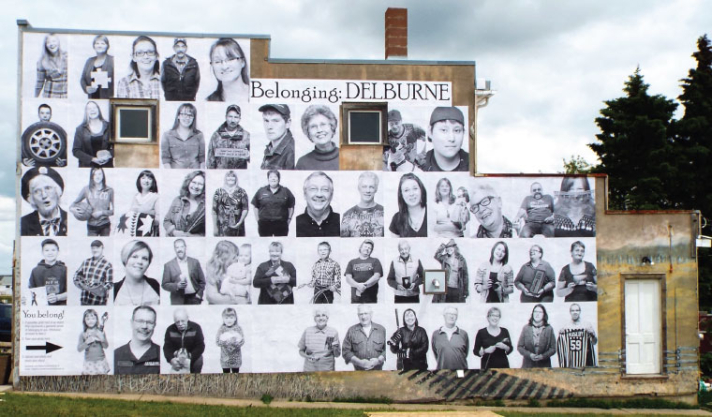
For the art project, internationally renowned portrait artist John Beebe collaborated with the village to create gigantic photos of local residents. These were then wheat-pasted on multiple exterior building surfaces throughout the village. The village school featured a collection of about 140 portraits.

Delburne Family and Community Support Services (FCSS) community worker Nora Smith has been a key champion of all of these efforts, but has been especially struck by the possibilities in art as a community-building tool.

“There’s something incredibly powerful in tying the art element into the community development piece,” says Nora. “I can’t really put my finger on it, but I know it’s there just by the way I watched the community members stop and appreciate each other.”

The art project is “shifting the feeling” in the community, which testifies to the foundational level of change that Nora and others are investigating through this community engagement process. The work is largely about the biases and prejudices that shape one’s thinking and therefore one’s way of being in society. “If we can start shifting people at that level, that would be fantastic,” Nora says.

Delburne residents have now identified and voted on the following four priorities for their community:

  • Main Street revitalization
  • Health and Wellness
  • A Belonging Delburne project (which includes the art project)
  • A communication project
  • Plans are underway to re-engage in the Fall to flesh out tangible action plans within each of these four priorities. These plans will be revisited on a yearly basis to gauge accomplishments and reevaluate priorities.

Delburne represents a growing shift amongst communities and neighbourhoods in Canada to focus on stronger resident engagement, reducing the “role” of the local government in deciding what gets done and what doesn’t.

What other communities can learn from Delburne:

  • Be strategic about engaging people. Paul Born’s book, Community Conversations, offers valuable insights on how to ensure everyone who should be at the table is there.
  • People inviting those they have a relationship with to participate in the community engagement process is critical to ensuring strong engagement.
  • Trust the process. “It’s so easy as someone working in community development to want to give the answers,” Nora says. “Have faith that the answers are eventually going to come out of the community itself.” It’s important that the answers do emerge this way, to ensure sustainability as residents “own” the actualization of these answers.
  • Strengthening community engagement is a process: it takes time and work.
  • Strongly consider integrating the art element into community development efforts.

This story is part eight of a series focused on placemaking and other citizen led initiatives. To read the other entries in this series, visit the original post here.

You can find the original version of this Axiom News piece at www.axiomnews.com/massive-main-street-photo-exhibit-%E2%80%98shifts-feelings%E2%80%99-alberta-community.

Featured D&D Story: Putting People at the Center in Public Health

Today we are happy to feature another great example of dialogue and deliberation in action. This mini case study was submitted by NCDD student member Megan Powers of Grassroots Solutions via NCDD’s Dialogue Storytelling Tool. Do you have a dialogue story that our network could learn from? Add YOUR dialogue story today! 


ShareYourStory-sidebarimageTitle of Project:

Putting People at the Center: A Fundamental Shift in Public Health Campaigns

Description

One of the most pivotal developments in public health practice over the past 20 years is the attention that is now being paid to the wide range of factors that influence health, such as social connectedness, the built environment, and the characteristics of the places where people live, work, and play. As a result, the public health field not only educates people about individual behavioral changes people can make to improve their health, but also works to change the policies, systems, and environments that shape our world and our ability to make healthy choices.

We’ve seen this impact firsthand. Grassroots Solutions works extensively with public health entities at the local, state, and national levels to reduce tobacco use, mitigate obesity, and address other critical public health concerns.

This work has taught us that while facts and data are, of course, powerful tools, the most successful public health campaigns put people at the center. When you combine data and facts with real people’s passion, commitment,
and involvement, communities embrace changes that have a significant impact on the health of residents.

Our whitepaper draws on our 12 years of on-the-ground experience to illustrate how putting people at the center of public health campaigns results in better and more sustainable health outcomes, and why we believe that people-centric campaigns should serve as the gold standard for population health management.

Which dialogue and deliberation approaches did you use or borrow heavily from?

  • Sustained Dialogue
  • Charrettes

What was your role in the project?

Grassroots Solutions served as the project manager and hired grassroots organizers for a variety of these projects, executing engagement tactics and in some cases, facilitating participatory dialogue.

Who were your partners in the project, if any?

Blue Cross Blue Shield Center for Prevention, Cities of Bloomington, Edina, and Richfield (for the do.town initiative), Minnesota Dept of Health (for the CDC Communities Putting Prevention to Work technical assistance project).

What issues did the project primarily address?

  • Mental or physical health

Lessons Learned

  1. An important shift is to move from a campaign that is data-centered and people-supplemented to one that is people-centered, and data-supplemented. We’ve learned that this shift enables campaigns to create space for residents to shape their own neighborhoods with health in mind, and offers the opportunity to form both an intellectual and emotional attachment to their vision for a healthier community.
  2. Putting people at the center means that everything in the campaign is done with an eye towards how residents can be involved. Whether it’s prioritizing which issues to pursue, examining how a neighborhood could be made more walkable and bikeable, or exploring how a new development can support healthy behaviors, a people-centered campaign focuses on engaging residents. Everyday people are encouraged to chime in, talk with others in the community, participate in planning sessions, and make the case for changes to their friends and neighbors.
  3. The reason it is critical to put people at the center of health campaigns is that it results in better health outcomes. Communities that are built to support health will produce better health outcomes, such as bike paths, access to healthy food, walkable neighborhoods, and safe walking and bike routes for kids to get to school. Additionally, these kinds of community features also help shape how people connect with each other and with their neighborhood, town, or city. When it comes right down to it, healthy living is about people and relationships.
  4. Putting people at the center shifts a campaign from episodic, isolated opportunities to engage, to a more relationship-driven approach. This means that residents are invited to help set the campaign’s tone and direction from the very beginning, they are offered leadership opportunities, and become a part of the campaign’s infrastructure. When the campaign’s orientation is centered on people, engagement becomes grounded in relationships with residents who get involved in different ways over time. People’s participation becomes more authentic, like an ongoing conversation, rather than just a single event or action.

Where to learn more about the project:

http://healthy-communities.grassrootssolutions.com

New Issue Guide on Economy Choices from NIFI

NIF-logoWe wanted to make sure the NCDD members heard that our organizational partners at the National Issues Forums Institute have published their latest issue guide for deliberative conversations. Released earlier this month, the newest guide is called The Future of Work: How Should We Prepare for the New Economy? The guide is designed to walk participants through tough choices about what policy directions we should take in dealing with the broader national economy.

The following excerpt can help you get a better sense of the approach the guide is taking:

The nature of the work we do has changed in ways that few Americans a generation ago could have imagined, and it will undoubtedly be dramatically different in yet another generation. These changes will bring both opportunities and difficulties…

The stakes are high. Many Americans share concerns about the nation’s competitive edge, stagnant wages, and a sense that young people today will be worse off than previous generations.

We have choices to make together in shaping the future of work. Business, government, individuals, and communities all play a role in addressing this issue. This guide presents some of the options we might pursue, along with their drawbacks.

As with other NIFI issue guides, the new guide encourages forum participants to weigh three different courses of action on a controversial issue. The guide lays out the choices on dealing with the national budget in this way:

Option One: “Free to Succeed”

Give individuals and businesses the freedom they need to innovate and succeed.

Option Two: “An Equal Chance to Succeed”

Make sure all Americans have a chance to succeed in an increasingly competitive environment.

Option Three: “Choose the Future We Want”

Strategically choose to support promising industries rather than simply hoping that the changes in work and the economy will be beneficial.

For more information on the new guide or to order, visit www.nifi.org/issue_books/detail.aspx?catID=6&itemID=26071.

Looking Closer at “Mixed Results” in Civic Participation

One our ever-insightful NCDD members, Tiago Peixoto, shared a summary of some important civic participation research that shows that “mixed results” of participation efforts say more when we delineate between “tactical” or “strategic” interventions. We’ve shared Tiago’s piece from his DemocracySpot blog below, and you can find the original here.


Social Accountability: What Does the Evidence Really Say?

democracy spot logoSo what does the evidence about citizen engagement say? Particularly in the development world it is common to say that the evidence is “mixed”. It is the type of answer that, even if correct in extremely general terms, does not really help those who are actually designing and implementing citizen engagement reforms.

This is why a new (GPSA-funded) work by Jonathan Fox, “Social Accountability: What does the Evidence Really Say” is a welcome contribution for those working with open government in general and citizen engagement in particular. Rather than a paper, this work is intended as a presentation that summarizes (and disentangles) some of the issues related to citizen engagement.

Before briefly discussing it, some definitional clarification. I am equating “social accountability” with the idea of citizen engagement given Jonathan’s very definition of social accountability:

Social accountability strategies try to improve public sector performance by bolstering both citizen engagement and government responsiveness.

In short, according to this definition, social accountability is defined, broadly, as “citizen participation” followed by government responsiveness, which encompasses practices as distinct as Freedom Of Information law campaigns, participatory budgeting, and referenda.

But what is new about Jonathan’s work? A lot, but here are three points that I find particularly important, based on a very personal interpretation of his work.

First, Jonathan makes an important distinction between what he defines as “tactical” and “strategic” social accountability interventions. The first type of interventions, which could also be called “naïve” interventions, are for instance those bounded in their approach (one tool-based) and those that assume that mere access to information (or data) is enough. Conversely, strategic approaches aim to deploy multiple tools and articulate society-side efforts with governmental reforms that promote responsiveness.

This distinction is important because, when examining the impact evaluation evidence, one finds that while the evidence is indeed mixed for tactical approaches, it is much more promising for strategic approaches. A blunt lesson to take from this is that when looking at the evidence, one should avoid comparing lousy initiatives with more substantive reform processes. Otherwise, it is no wonder that “the evidence is mixed.”

Second, this work makes an important re-reading of some of the literature that has found “mixed effects”, reminding us that when it comes to citizen engagement, the devil is in the details. For instance, in a number of studies that seem to say that participation does not work, when you look closer you will not be surprised that they do not work. And many times the problem is precisely the fact that there is no participation whatsoever. False negatives, as eloquently put by Jonathan.
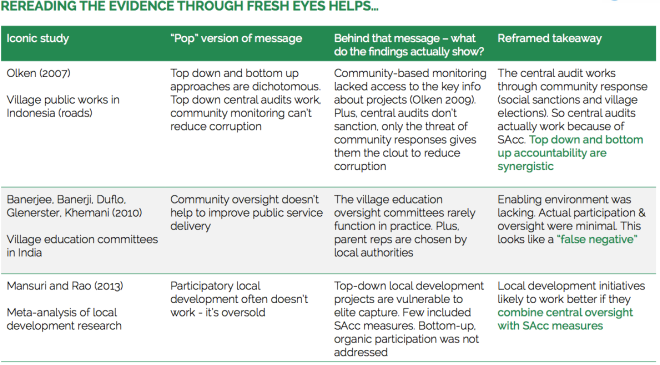
Third, Jonathan highlights the need to bring together the “demand” (society) and “supply” (government) sides of governance. Many accountability interventions seem to assume that it is enough to work on one side or the other, and that an invisible hand will bring them together. Unfortunately, when it comes to social accountability it seems that some degree of “interventionism” is necessary in order to bridge that gap.

Of course, there is much more in Jonathan’s work than that, and it is a must read for those interested in the subject. You can download it here [PDF].

You can find the original version of this piece on Tiago’s Democracy Spot blog at http://democracyspot.net/2014/05/13/social-accountability-what-does-the-evidence-really-say.

Let us know if you work with legislators — or would like to!

Later this week, Hawaii State Senator Les Ihara and I are both involved in an exciting workshop at the Kettering Foundation that will bring together 26 state legislators from 20 states to talk about effective public engagement.

Les asked me recently to gather information about NCDD members who had worked with legislators (or are currently working with them), and with all the conference goings-on, I haven’t been able to squeeze it in. But I think we can still help Les, and create a list of NCDDers who either (1) have experience working with legislators, (2) are interested in working with legislators, or (3) both!  I know Les’ impression is that there are not many NCDDers working with legislators, and I don’t believe that is the case at all.

Will you help me change Les’ mind and help me better represent you at this meeting by filling out the super-simple survey I’ve created.

Les IharaOver the last few years, I’ve networked with about 50 legislators who operate with a collaborative leadership model, rather than power-based model; and I plan to form a Collaborative Legislators Network when the time is right (we’re getting close).

We’re designing our meeting agenda to support legislators who want to conduct new citizen engagement type activities over the next year, and I’m looking for people who may have relationships with legislators in these states: Alabama, Arizona, Colorado, Florida, Georgia, Hawaii, Illinois, Kansas, Kentucky, Maryland, Massachusetts, Montana, Nebraska, Nevada, New Hampshire, North Dakota, Ohio, Texas, West Virginia, and Wisconsin.

If you haven’t yet worked with a legislator, I’d also like to know who might be interested in providing assistance to and collaborating with a legislator in your state. Thank you.

Aloha,
LES IHARA, JR.
Hawaii State Senator, 10th District

If you have worked with local, state or national policymakers, or would like to, please let us know by answering a few simple questions TODAY or TOMORROW. Again, here is the survey link:

Short Survey about Working with Legislators

Environmental Issue Guide Series from Kettering Underway

We are excited to share that our organizational partners at the Kettering Foundation have a series of at least three issue guides for facilitating deliberation on climate issues in the works. These guides can be an important tool for helping the public deal with this crucial issue. We encourage you to read the brief statement from Kettering’s online publication below. 


kfThe Kettering Foundation is breaking ground on an exciting new project–a series of National Issues Forums (NIF) framings for environmental issues. Amy Lee and Scott London have been doing the preliminary work for about a year now, but in April, they had their first official meeting with an old friend of the foundation’s, the North American Association of Environmental Educators (NAAEE). NAAEE actually produced a number of issue guides in the long, study guide-like format back in the 1990s, and they’ve become reacquainted recently with KF through research deputy Michele Archie.

Representatives from NAAEE included board member Bora Simmons, who was involved with Michele in producing the earlier issue guides, as well as other NAAEE staff members from different arms and levels of the organization. NAAEE, much like NIF, has a large, two-way network of local chapters as well as a national level, and both ends work together. Kettering hopes to produce at least three issue frameworks with NAAEE and to experiment with NAAEE in creating new materials for forums based on those frameworks. Standard NIF issue guides are certainly one possible product, but we hope to experiment with some new formats. We’ll also be observing, with NAAEE, the effects of engaging their members and audiences in deliberation, as well as how they negotiate cooperation with other kind of actors in the environmental arena, particular advocacy groups.

The work is off to a fantastic start. NAAEE is already planning some test forums for a framing on climate change that Scott London has begun, as well as making plans for creating a matrix of local frameworks on water issues from places around the country and perhaps using other materials NIF has developed, such as the soon-to-be-released Energy guide update.

Interview on Games & Engagement

As children run through sprinklers and enjoy fireworks (safely, we hope) over the holiday weekend, we thought it would be appropriate to share a post from the Davenport Institute’s Gov 2.0 Watch blog on games and engagement. As we know, civic participation can be fun, too! You can find it below or read the original here. Happy Independence Day, everyone!


DavenportInst-logoLast month, Project Information Literacy at the University of Washington Information School published an interview with Eric Gordon, a professor at Emerson College and Executive Director of Engagement Lab:

In his role as the Executive Director of the Engagement Lab, Eric leads play-based projects, spanning everything from community engagement in Detroit to disaster preparedness in Zambia. As he explains, the projects are “designed not just to facilitate official processes, education, and real-world action, but to natively be real-world actions themselves.

Through participatory action research in the United States, Europe, and Africa, Eric and his team are partnering with communities and organizations to understand how and where technology, play, and civic life intersect.

You can read the interview here.

CM’s 4 Tips for More Inclusive Communities

Our partners at CommunityMatters recently put together a useful list of tips for creating more inclusive communities to go along with their recent conference call on the same topic. We wanted to make sure to our members see these pointers, so we encourage you to read CM staffer Caitlyn Horose’s write up below or find the original CM blog post by clicking here

CM_logo-200pxWhat do you do to make people in your community feel welcome? How do you create opportunities for people from all backgrounds to participate fully in building and improving your community?

Creating an inclusive community isn’t easy, but many places are finding ways to start building a more inclusive and welcoming culture.

Here are four strategies from cities and towns committed to inclusivity—share your own stories and ideas in the comments!

1. Make a statement. Riverside, California developed a, set of principles for building a more inclusive community. Their Inclusive Community Statement identifies the responsibilities of individuals, groups and institutions for achieving this common goal. Through maintaining an openness to dialogue, building intergroup partnerships and providing education about diversity the principles set a path toward fair treatment and equal opportunity for all residents of Riverside.

2. Spread the word. Signs line the streets in Newark, California signifying the city’s ongoing efforts to foster acceptance and inclusion.

3. Welcome newcomers. How do newcomers in your city learn about local people and places? Communities in the West Kootenay and Boundary regions of British Columbia developed welcomemap.ca, The website welcomes new immigrants to the area, and provides easier access to local information and services. Similarly, British Columbia’s North Shore developed a short video that illustrates the power of individual action in welcoming newcomers. Both efforts are part of British Columbia’s Welcoming and Inclusive Communities Initiative.

4. Adopt a resolution. Greenacres, Florida, Fort Worth, Texas and many other cities and towns have demonstrated a commitment to inclusion through the adoption of a public resolution. The National League of Cities offers a sample resolution that communities can use and build from.

On June 12th, Moki Macias and Tramunda Hodges of the Annie E. Casey Foundation will join CommunityMatters to share their experience promoting equal treatment and opportunity in community decision-making at the Foundation’s Atlanta Civic Site. Join this call to hear more ideas and strategies for building inclusive communities. You can see the notes and listen to the call here.