Institute for Civility in Gov’t Offers New “Civility Training”

We want to make sure that NCDD hears about a great new training on civility being offered by the Institute for Civility in Government – an NCDD organizational member. We all know our nation’s civic life needs more civility, so please learn more about their training below or contact ICG to sign up.

InstituteForCivilityInGov-logoThe Institute for Civility in Government is a 501(c)(3) nonpartisan, grassroots non-profit organization founded in 1998, and is a member of NCDD. The Institute works to reduce the polarization of our political and legislative processes by facilitating dialogue, teaching respect, and building civility in both the public and private spheres. Our programs are a laboratory of civility, creating a model and setting a tone for each generation to experience and adopt as their own.

Maintaining civility makes life easier and more pleasant for everyone, but sometimes it can be a challenge. In response to popular demand, the Institute has developed and now offers online Civility Training based on our book, Reclaiming Civility in the Public Square – 10 Rules That Work.

The online course is divided into two sections. The first section teaches the ten rules. The second section provides real-life scenarios and then asks which of the ten rules are illustrated in the example given.

This short course helps people to not only be able to identify ten essential civility skills, but also to reflect on their application in daily life. The course has a wide range of applications, and is available for a small fee through the Institute’s website at www.instituteforcivility.org and/or at www.civilitytraining.org.

For more information, contact Cassandra Dahnke at 713-444-1254 or Tomas Spath at 281-782-4454, or email us at info@instituteforcivility.org.

Free book for first 60 people to register on Friday!

Here’s an incentive for showing up early to get your name tag and tote on Friday morning! Registration opens at 8am.

ReadTheRoom-coverThis weekend’s NCDD conference coincides with the publication of a new book called Read the Room For Real: How a Simple Technology Creates Better Meetings. The book is intended for facilitators, presenters, conference planners, or anyone who is curious about how to use increasingly accessible audience polling technology to improve meetings.

We are happy to provide preview copies of the book – which include a back cover endorsement from Sandy for which we are very grateful – as a gift to the first 60 people who register for the conference.

Our book is one of the first that we know of focused on the use of audience polling technology outside of the classroom environment. We have a deep background in facilitating dialogues about difficult diversity issues and as well as refining dialogic processes on all matter of topics for very small to very large groups of people. In our view, polling technology is severely under-appreciated by not just the dialogue community, but also by city planners, public officials, diversity professionals, and many others. Our goal is to accelerate the time when audience polling technology is as commonplace a meeting tool as Powerpoint.

We are organizing a campaign to make this dialogue book an Amazon bestseller on its launch day, November 28 (Black Friday). All conference attendees will have information in their packet about how to participate in the campaign, how to get a discount on the book, and how to enter a drawing to get a full day of pro-bono in-person consulting on audience polling.

For those not coming to the conference but who are interested in learning more about the book, contact us at david@read-the-room.com.

- David Campt and Matthew Freeman

NIF & Kettering Host Online Immigration Conversation Monday

We encourage NCDD members to join our partners with the National Issues Forums of Northern Virginia and the Kettering Foundation for a webinar conversation on immigration tomorrow, Sept. 29th. The conversation will use KF’s new online deliberation tool, Common Ground for Action, so make sure to join us and check it out! You can read the invitation from Bill Corbett of NIFNVA below or find the original here.


NIF-logoI’m writing invite you to an upcoming online National Issues Forum, a small, moderated, chat-based deliberation on a critical issue facing America.

It takes place on Monday, September 29 at 7:30 pm to 9:30 pm EDT. All you need to participate is a web browser and the willingness to use chat for conversation.

The topic is “Immigration in America — How Do We Fix a System in Crisis?” The issue guide is at this link. The issue guide provides the road map for our discussion and essential background. If you’d like to watch a three-minute video that previews the topic, you can view it on our website by clicking here.

You can register by reply to this message or by completing the online form at the new website of National Issues Forums of Northern Virginia. The forum is limited to twelve people…first-come, first-served…but more forums are coming.

The forum uses a new software tool from the Kettering Foundation that brings moderated deliberation on national issues to a wider audience.

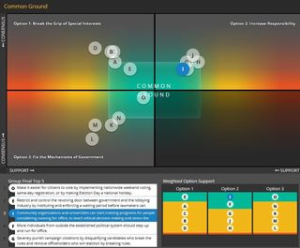
Below is a screen shot of a Common Ground graphic produced by an online National Issues Forum earlier this month. It is the product of ten people working through the issues together in a discussion about how to fix American politics.

I hope you are as interested as I am in helping to develop this new tool for more people to participate in political life.

Sincerely,

Bill Corbett National Issues Forums of Northern Virginia

Bill_Corbett_NIF_of_Northern_Vir@mail.vresp.com

When Citizens Bypass Government with Technology

The following post featuring a fascinating article about what technology can do to bring about “Democracy for the Next Generation” in local government came from the Davenport Institute’s Gov 2.0 Watch blog. Read it below or find the original here.


DavenportInst-logoCitizens across the country trust their federal, state and local government less. With this lack of trust, citizens are creating apps and using social media to help each other. Some cities are hesitant while others are embracing this phenomenon because technology is here to stay:

Local governments are facing new realities. Citizens’ trust in government has declined, and financial constraints do not allow local governments to deliver all of the services their communities would like. In response, citizens are changing as well. Increasingly, local residents and organizations are seizing opportunities to engage with their communities in their own ways by creating platforms that bypass government. . .

In Alexandria, Va., a citizens’ group launched ACTion Alexandria, an online platform for residents to engage in challenges, debate solutions, share stories and develop relationships, all on their own and without the help or permission of the city government. Even though ACTion Alexandria is a platform created and owned by citizens, the city government supports it and even partners with it.

You can read more here.

Did you miss August’s Tech Tuesday event? Watch it now!

The August NCDD Tech Tuesday on Local Governments Adopting Online Engagement looked at how local governments are adopting online engagement as part of their public participation activities. Our two presenters were:

  • Della Rucker, Managing Editor of EngagingCities and Chief Instigator at Wise Economy
  • Susan Stuart Clark, Director of Common Knowledge, NCDD board member and consultant to local governments

Della and Susan reviewed examples of how local governments are using online engagement, the state of the industry, key factors to consider in planning and implementing online engagement – and how online engagement can be used to complement and enhance in-person dialogue.

You can you watch the hour-long program above and on YouTube here.  You can also download:

  • Susan’s PowerPoint presentation about the context for how and why local governments are adding online engagement and critical strategies for successful implementation of these tools.
  • Highlights of questions and helpful comments from the participants, along with additional commentary by Della Rucker.

If this is a topic of interest to you, here are additional resources:

50 “Next Generation” Digital Engagement Tools

The theme for this year’s NCDD conference, “Democracy for the Next Generation“, is meant to invite us to build on all the innovative tools and practices that have been invigorating our field in recent years. Many of those innovations are digital, and that is why a major goal for NCDD 2014 is to help our field better understand how to utilize technology for engagement and to provide insights and know-how for harnessing the emerging technologies that support dialogue and deliberation. NCDD 2014 will feature tons of “next generation” engagement tech, so don’t miss it - register today!

In keeping with our theme, we are excited to share the great list of 50 “next generation” online engagement tools (no implied endorsement) that our partners at CommunityMatters compiled with help from our friends at New America, EngagingCities, the DDC, and NCDD’s own director. Check out the CM post and the comprehensive list below or find the original version here.


CM_logo-200pxOnline public participation is an effective complement to face-to-face events such as community workshops and design charrettes. Selecting the right platform to get the most out of digital outreach can be overwhelming.

The first step is to learn what tools are out there! Here are 50 tools for online engagement in no particular order (and with no implied endorsement). These digital platforms can help local government consult, collaborate with, and empower citizens in community decision-making.

Once you’ve perused the list, check out the notes and recording of our September 5 conference call with Alissa Black and Pete Peterson, who shared advice for selecting digital tools that align with engagement goals.

  1. coUrbanize: List project information for development proposals and gather online feedback.
  2. Cityzen: Gathers feedback by integrating polling and social media sites.
  3. Community Remarks: Map-based tool for facilitating dialogue and collecting feedback.
  4. Crowdbrite: Organizes comments for online brainstorming sessions and workshops.
  5. EngagementHQ: Provides information and gathers feedback for decision-making.
  6. MetroQuest: Incorporates scenario planning and visualizations for informing the public and collecting feedback.
  7. SeeClickFix: For reporting and responding to neighborhood issues.
  8. Neighborland: Forum that encourages community discussion and action at the neighborhood level.
  9. PublicStuff: Communication system for reporting and resolving community concerns.
  10. MindMixer: Ideation platform for community projects.
  11. NextDoor: Private social network and forum for neighborhoods.
  12. Adopt-a-Hydrant: Allows citizens to help maintain public infrastructure.
  13. CivicInsight: Platform for sharing progress on development of blighted properties.
  14. i-Neighbors: Free community website and discussion forum.
  15. Recovers: Engages the public in disaster preparedness and recovery.
  16. EngagingPlans: Information sharing and feedback forum for productive participation.
  17. Street Bump: Crowdsourcing application to improve public streets.
  18. neighbor.ly: Crowdfunding platform to promote local investment in improvement projects.
  19. TellUs Toolkit: Map-based tools for engagement and decision-making.
  20. Budget Simulator: Tool for educating about budget priorities and collecting feedback.
  21. CrowdHall: Interactive town halls meetings.
  22. Citizinvestor: Crowdfunding and civic engagement platform for local government projects.
  23. Open Town Hall: Online public comment forum for government.
  24. Shareabouts: Flexible tool for gathering public input on a map.
  25. Poll Everywhere: Collects audience responses in real time, live, or via the web.
  26. Tidepools: Collaborative mobile mapping platform for gathering and sharing hyperlocal information.
  27. Community PlanIt: Online game that makes planning playful, while collecting insight on community decisions.
  28. Open311: System for connecting citizens to government for reporting non-emergency issues.
  29. DialogueApp: Promotes dialogue to solve policy challenges with citizen input.
  30. Loomio: Online tool for collaborative decision-making.
  31. PlaceSpeak: Location-based community consultation platform.
  32. Citizen Budget: Involves residents in budgeting.
  33. e-Deliberation: Collaborative platform for large group decision-making.
  34. CrowdGauge: Open-source framework for building educational online games related to public priority setting.
  35. Citizen Space: Manage, publicize, and archive all public feedback activity.
  36. Zilino: Host deliberative online forums and facilitated participatory meetings.
  37. WeJit: Collaborative online decision-making, brainstorming, debating, prioritizing, and more.
  38. Ethelo Decisions: Framework for engagement, conflict resolution, and collective determination.
  39. Community Almanac: Contribute and collect stories about your community.
  40. GitHub: Connecting government employees with the public to collaborate on code, data, and policy.
  41. VividMaps: Engages citizens to map and promote local community assets.
  42. OSCity: Search, visualize, and combine data to gain insight on spatial planning. (EU only.)
  43. Civic Commons: Promoting conversations and connections that have the power to become informed, productive, collective civic action.
  44. Crowdmap: Collaborative mapping.
  45. Codigital: Get input on important issues.
  46. All Our Ideas: Collect and prioritize ideas through a democratic, transparent, and efficient process.
  47. Neighborhow: Create useful how-to guides for the community.
  48. OurCommonPlace: A community web-platform for connecting neighbors.
  49. Front Porch Forum: A free community forum, helping neighbors connect.
  50. PrioritySpend: Prioritization tool based on valuing ideas and possible actions.

Many thanks to the numerous sources whose work supported the creation of this list, including: @alissa007, @dellarucker, @challer, @mattleighninger and @heierbacher.

Did we miss something? Tell us about your favorite digital tools for public engagement in the comments section below!

You can find the original version of this CommunityMatters post at www.communitymatters.org/blog/let%E2%80%99s-get-digital-50-tools-online-public-engagement.

CM Call on Digital Public Participation, Sept. 5

CM_logo-200pxWe are pleased to invite NCDD members to join our partners at CommunityMatters for the next of their monthly capacity-building calls series. This month’s call is titled “Deepening Public Participation - Digitally”, and it will be taking place next Friday, September 5th from 2-3pm Eastern Time. 

We are excited to note that this month’s call features insights from Pete Peterson of the Davenport Institute for Public Engagement and Civic Leadership - NCDD organization member – as well as Alissa Black of the Omidyar Network. The folks at CM describe the upcoming call this way:

Your town is finally in the digital age with a website, online calendar, and Facebook page.  Now you can sit back and relax, right? Not exactly.

An array of online tools is available that can take your digital presence to the next level, promoting collaboration between government and citizens, engaging new audiences, and effectively complementing “analog” face-to-face engagement. It’s time for your town to get online and see what’s out there!

Join the next CommunityMatters® conference call and dig deeper into digital engagement with experts Alissa Black and Pete Peterson. You’ll learn about online public engagement and which digital tools are right for your town.

Make sure to register for the call today!

As always, we encourage you to check out the CommunityMatters blog to read Caitlyn Horose’s reflections on digital public participation as a way to prime your mental pump before the call. You can read the blog post below or find the original by clicking here.

Deepening Public Participation – Digitally

Commutes are too long. Schedules are too packed. Work is too demanding. With today’s busy schedules attending public meetings just isn’t a priority for many people. So how can local government get residents involved in tackling community problems?

The internet is one place that governments are turning for solutions. Digital tools for public engagement can effectively complement in-person meetings, and convenience is only one reason to invest in online participation. Here are several helpful resources to assist in ramping up engagement digitally.

Broadening Public Participation Using Online Engagement Tools outlines five benefits of online engagement: reaching more diverse residents, generating more informed participation, producing concrete data for reporting, and evaluation and setting the stage for sustained participation.

Despite the many benefits of online engagement, there are challenges. Using Online Tools to Engage the Public discusses the challenge of attracting participants and the need for targeted recruitment strategies. Also addressed is the uncertain legal landscape for digital engagement, as some public participation ordinances and policies predate current technology. The PlaceSpeak blog outlines additional issues in digital engagement—technical issues, “lurkers” and the lack of physical cues—with recommended strategies for overcoming them.

Knowing how to select appropriate online engagement tools is an added challenge. There are many considerations—project budget, desired outcomes and a community’s willingness to engage online.

Alissa Black presents a framework for categorizing and selecting digital engagement platforms in Public Pathways: A Guide to Online Engagement Tools for Local Governments. Modifying the IAP2 engagement spectrum, the guide divides the objectives of engagement into four categories: inform, consult, cooperate, empower. The progression of these categories represents a deepening in the level of public participation.

Golden Governance: Building Effective Public Engagement in California advocates for government to deepen engagement. With “deep participation,” citizens are empowered to work with government to make decisions and solve problems. While citizen empowerment shouldn’t be the goal of every public process, it needs to be a tool at the ready. When community members work together on solutions to local problems, there is greater buy-in, more can be done with less, and project stewardship is more likely.

Join Alissa Black and Pete Peterson on our next CommunityMatters conference call Friday, September 5 from 2-3 p.m. Eastern. Learn more about online public engagement and get advice on digging deeper with digital tools. There is no better way to spend your Friday afternoon, so register now!

You can find the original version of this post at www.communitymatters.org/blog/deepening-public-participation%E2%80%93digitally.

Can Pinterest Make Local Public Engagement More Effective?

We were intrigued by this commsgodigital piece on the ways that Pinterest can be used by local government officials for public engagement, and we wanted to share it with the NCDD community. The article was penned by Andrew Coulson, a local community engagement officer, and you can read it below or find the original commsgodigital piece by clicking here.


Pintresting: 10 tips for using Pinterest in local government

At 4 years old Pinterest is still recognised as a young social media platform. It has survived the storm of its first steps in society and has been accepted as a survivor. As a tool for potential engagement, I love it.

We started using Pinterest at the City of Salisbury very early on when it was still in Beta and in some case studies have been recognised as one of the first councils in Australia if not the world to use it as a tool in Community Engagement.

Pinterest overview

Pinterest is a free platform that basically resembles those old scrapbooks you used to keep as kids but instead of keeping paper clippings, stamps and stickers you can pin pictures on boards that link back to a whole world of things you want to make, bake and fake.

For those of you not on Pinterest here’s a quick overview of how it works. You can use Pinterest to upload, save, sort, and manage images as well as videos, known as ‘pins’, into collections on ‘boards’ you have created.

Pinners can browse others pins on the main page as well as follow friends and search specific topics/pins opening up a whole world of lost time. If you see something you like you can then pin it to your board and by using an additional ‘Pin It’ button can even pin direct from most websites. Interaction can be increased by liking and commenting on others pins and if you’re feeling collaborative you can start a pin board others can contribute too.

But how does this fit in with local government and council services. Jokes often refer to Pinterest as an abyss of wedding preparation boards and cakes you’ll never even attempt to make. But with just under 400,000 people in Australia using it (and rising) Pinterest holds a different key to peoples online experience because of its heavy reliance on the visual.

My top 10 tips for using Pinterest

Here are my 10 tips why and how local government could look at harnessing this free communication and potential community engagement tool. Some basics on how to set up, use and have a play.

1) Pinterest is growing every day. In over 4 years it has amassed over 70 million users worldwide. Yes the stats in Australia are low and slow but with Aussie trends often following America its potential here is huge. Stats show 8 in 10 users are female so think about how your council could harness this when setting up boards, preparing images to share that are maybe more female friendly. I spoke with The South Australian Country Fire Service recently about how pictures of hot fireman (come on we all know sex sells) could drive amazing traffic to other more serious boards about Bush Fire Survival and Health and Safety.

2) Plan your boards. Boards can be pinned too randomly but if you’re setting up a specific board to highlight an event or service; planned in advance boards can also tell a story. Pics you pin will start at the bottom of a board and fill from the top. A great way to tell a story is to think about pinning your pins in order. So for example if telling the story of a 3 day conference then pin pics from day three first and finish with day one if you want the story to go in order down the board. This is probably our best planned board showing the story of the making of our council film. In this case the story starts at the bottom and finishing at the top with the finished product: Lights, Camera, Action!

3) Secret boards. To help with tip 2 and also 6, Pinterest gives you the opportunity to set up a board in secret. By setting a board to secret when setting up it means not only does the public not see it until its ready to be launched but it allows you to plan and pin appropriately. This is helpful when starting a new board as each board cover shows the last 5 pins you have pinned and I will never let a board go live without those 5 spaces being filled… for me that’s like leaving an egg as your user profile pic on your Twitter, it looks unprofessional.

4) Pinterest board layout. Once you have set up a number of boards you can edit their position on the page. This is helpful to highlight certain boards as with most websites people’s eyes are drawn to the middle of the page. If you put your most recent or popular board in the middle then engagement is likely to be higher. You can also change each board cover photo which is important as I have read that people are more likely to open a board if the cover image is inviting you in. For example a smiling person or cute animal. Check out our homepage layout.

5) A picture is worth 1000 words. A picture will tell a story. A picture can evoke memories. A picture can aid discussion. Pictures are accessible across cultures, religions and languages. Next time you take photos think about how you can use them on Pinterest as well as your community magazine or website. Need I say more?

6) URL secrets. If pinning from another person’s board be aware that the picture will more than likely have an embedded URL. To check before you pin just click through the picture and if it does have a web link embedded you will be directed to that website. Its better safe than sorry as you never know where the image originally came from (under each image it should also say the URL). If pinning direct from a website the picture will automatically embed the web site URL for you.

Use this to your advantage. If the URL is unsuitable for a council board or you are uploading a picture directly from your computer, under the edit tool you can actually change or add a URL. This is important as in turn it can drive traffic back to your website and who wouldn’t want people finding your website simply by you pinning a great image of what services you offer in council.

7) More URL secrets. Pinterest is still new enough that most customized URLs, how people find your collections, are still available. As a council image is important claiming your URL while you can is crucial. This will allow you to make it easier share your Pinterest elsewhere and for people to find you especially if you’re not the only council with that name in the world. I work for the City of Salisbury of which there at least 2 others in the US and UK.

8) Use to inform in advance. Pinning pictures before an event; for example of speakers with bios, visual workshop content and videos of past opportunities may help people decide whether the event is for them rather than a standard heavy text based flyer/email. You can then enhance ticket sales by embedding a URL that takes people direct to your ticket sales page. Then once the event is over you can use the board to pin pictures of what happened and close the loop, great for feedback. Here is one of our upcoming events, the 10th Salisbury Writers Festival.

9) Share your photos. Like data sharing Councils have access to content people want so why not share your photos. Local councils have collections of pictures people would love to see and share dating back many many moons. Often these pictures just sit in archives or on databases and would never see the light of day once taken. 20+ photos can get taken at a ribbon cutting for a new leisure centre but only one will actually be used in your council magazine… so why not share the others; they have value to the people in them, connected to them and to the history of your area.

10) Collaborative projects. On Pinterest when you set up a board you have the option to add other people, who have Pinterest accounts, to the board so they can contribute. Now this one does come with a little warning as you have no way of moderating another person’s contribution until it’s already live and this could be a risky tactic for local government. However imagine the possibilities.

Ask your community to pin ideas for budget spends, park renewal designs or nominating priority areas that need attention. The comments function can then be used to provide feedback on pictures collected. Of course you can always set up a board and ask people to share pictures in other ways (Email, Instagram, Twitter) which you then pin on their behalf with a named credit. This is something I did when collecting photos of a 30 year old iconic playground as pre-engagement before looking at renewing the site through a full consultation process.

So there we have it, 10 tips why and how Pinterest for Local Government is a Pinteresting concept. I’m sure there are many others reasons to so why not let us know by commenting below and please do share how you use Pinterest especially in local government.

Happy pinning.

Picture credits: Top – The Art of Pinterest by MKHMarketing
Other pictures – City of Salisbury Pinterest.

You can find the original version of this commsgodigital piece at www.commsgodigital.com.au/2014/08/using-pinterest-local-government-pinteresting-concept.

So many ways to use technology, so many ways to learn at NCDD 2014

Past conference attendees* have approached technology for public engagement, dialogue, and deliberation in so many different ways:

  • Kira is hands-on and pragmatic, interested only in tools that fit into her work, today.
  • Bob’s a skeptic, so it’s tough to convince him that online technology can play a role in his work.
  • Ashante seeks technology that’ll make her dream process a reality.
  • Andrés has just scratched the surface, unsure where to begin.

LaptopsAnd they’ve all found sessions to expand their vision and knowledge at past NCDD conferences.

For all of his skepticism, Bob remembers Steven Clift’s presentation at NCDD’s 2012 conference in Seattle fondly. Clift’s 15 years of experience with email- and web-based community forums, particularly in immigrant and low income communities, and the way Clift’s work has been put to use in communities across the globe, resonated with him. Indeed, Bob surprised friends by asking Clift to help redesign an upcoming neighborhood summit using email to make it more inclusive. And he loves to tell the story of how some of his most important learning was about the value of going door to door and posting sign-up sheets at street fairs.

Few recall that Ashante’s fervor was sparked by her NCDD’s regional conference in Austin, in 2010. There, she first learned of the ways Manor, Texas used the web to harvest ideas from all residents. She realized that if a town of just 5000 residents could do this, her opportunities were far larger than she had thought. And Manor’s emphasis on low-cost technologies gave her hope that she could begin her efforts years sooner than she had planned.

That same year, at the regional conference in Boston, Kira encountered the University of New Hampshire’s efforts to facilitate discussions of state-sanctioned gambling in eleven communities. UNH had used an online forum to broaden the reach of the discussion, and she saw the potential for this approach to bring rural communities into a process she was managing in the Northwest.

LocalistoShowcaseAndrés has been energized by the more informal sessions. Face to face discussions during the technology showcase in Seattle gave him a real understanding of Mindmixer and how it compared to other web-based idea generation tools. And he dates his decision to start a blog on deliberation and outreach to old friends and new colleagues who walked him through their experiences with WordPress, Twitter, and Flickr at NCDD’s 2008 conference in Austin (and the pizza that night was delicious, too).

Of course, Andrés, Bob, Kira, and Ashante have helped one another and other attendees as well. Kira’s practical tricks for integrating technology into process work thawed Bob’s icy skepticism, and her results made him a bit envious. Bob paid that favor forward by participating vigorously in Ashante’s visioning workshop: his thoughtful cautions made Ashante set the bar for the quality of online interaction even higher. At that same workshop, Ashante’s enthusiasm fired Andrés up to explore how new social media tools could address the challenges he was facing. In turn, Andrés’ gentle but persistent questions made Kira realize that she’d have to spend more time to verify that the privacy of her participants was protected.

This interactive, top down, bottoms-up, and inside out enthusiasm is a hallmark of NCDD conferences.

So, whether you have an interest in technology for dialogue and deliberation or still need to be convinced, extensive experience or very little, you’ll find lots of opportunities to broaden your perspectives and lots of practitioners and technologists eager to learn from your experience, your insights, and your questions.

So please check out the conference schedule (Oct 17-19, 2014 in Reston, VA) for sessions suited to your own inner Kira, Andrés, Bob, and Ashante (sessions will be added within the next week!), register, and plan to share your wisdom and experience with 400 old and new friends and colleagues this October.

- Written by NCDD 2014 planning team member Chris Berendes of Netalyst, Inc.

*We confess that these four characters are fictional, but, as demonstrated by the links, the conference sessions that informed and inspired them are entirely real.

Surprising Results in Online Commenting Study

NCDD has been part of an ongoing conversation about whether online comment sections can be spaces for dialogue and if there are methods or tools we can use to make those spaces more civil. One of our NCDD organizational members, the National Institute for Civil Discourse, recently released on a study on the topic that has some surprising, though not exactly encouraging, results. You can read NICD’s announcement about the study below or find the original here.


NICD_logo3A new study confirms that incivility is common on online news websites. Researchers at the University of Utah and the University of Arizona analyzed more than 6,400 reader comments posted to the website of The Arizona Daily Star, a major daily newspaper in Arizona. They found that more than 1 in 5 comments included some form of incivility, with name-calling the most prevalent type.

“We tracked six different kinds of incivility, but name-calling was by far and away the most common,” said Kevin Coe, a faculty member in the Department of Communications at the University of Utah and one of the study’s authors. “Many people just can’t seem to avoid the impulse to go after someone.”

The study also showed that incivility in comment sections does not fit the stereotype of a few angry individuals who spend hours at their computers flaming other commenters and making baseless claims. In fact, incivility was more common among infrequent commenters than frequent ones. Equally surprising, uncivil commenters were just as likely to use evidence in support of their claims as were civil commenters.

“The results of our study run counter to several popularly-held beliefs about incivility” said co-author Steve Rains from the Department of Communication at the University of Arizona. “In the comments we examined, incivility was pervasive and not simply the product of one or two individuals with an axe to grind.” As might be suspected, stories that focused on well-known leaders with clear positions garnered more uncivil comments. “Strong partisan recognition activates incivility,” said co-author Kate Kenski, an Associate Professor at the University of Arizona. “When articles quoted President Obama, incivility in the discussion comments rose significantly above the average found in other discussions.”

Like many other online news outlets, The Arizona Daily Star now requires commenters to log into a personal account on Facebook before they can comment on a story.

The study, published in the Journal of Communication, was funded by the National Institute for Civil Discourse, a nonpartisan center for advocacy, research, and policy housed at the University of Arizona. The Institute’s honorary co-chairs are former Presidents George H.W. Bush and Bill Clinton.

Link to the full published study: http://onlinelibrary.wiley.com/doi/10.1111/jcom.12104/abstract or http://nicd.arizona.edu/research-report/online-and-uncivil-patterns-and.

The original version of this post can be found at http://nicd.arizona.edu/news/national-institute-civil-discourse-announce-0.