Five Strategies to Include Community in Collective Impact

As of late, our field and NCDD specifically has been looking more closely at “collective impact” models of creating change in our communities, and we saw an article from Rich Harwood, an NCDD organizational member and president of the Harwood Institute, on that theme recently that was worth sharing.

Rich’s article looked at the way that, though collective impact strategies are becoming more popular, the involvement of local communities is often left out of our thinking on how we create collective impact: “My chief concern here is that we sometimes leave robust notions of community out of collective impact discussions and implementation efforts. At times, the very nature of community seems like an afterthought, even a nuisance.” 

He says that rather than imposing collective impact strategies on communities, we have to ensure that the community and its civic culture are part of the calculations for how to succeed. What is civic culture? Rich says,  

Civic culture is how a community works—how trust forms, why and how people engage with one another, what creates the right enabling environment for change to take root and accelerate. It directly contributes to the degree of readiness and appetite for change among leaders, groups, and everyday people.

Each community has its own civic culture, and to make progress, it’s important that everyone understands and develops it.

As part of making sure that civic culture is factored into the ways we approach change, Rich describes what he says are five characteristics of a community’s civic culture that effective collective impact efforts have to address.

The first characteristic is community ownership:

…the success of collective impact depends on genuine ownership by the larger community, and that starts with placing value on both expert knowledge and public knowledge, which can come only from authentically engaging the community.

The starting point is to determine shared aspirations for a community and to know the challenges people face in moving toward those aspirations.

The second is selecting strategies that “fit” the community:

…organizationally aligned strategies will produce measurable progress when teams base them on data, evidence-based decision-making, best practices, and other inputs. But it is important to not confuse a commitment to rigorous analysis with developing strategies that actually fit a local context.

Collective impact efforts should actively use public knowledge to drive the definition of a common agenda and to understand what strategies are relevant to the community.

Third, it’s important that collective impact strategies create a sustainable enabling environment:

…it is critical to create the right enabling environment in a community. This means focusing on the underlying conditions in a community that allow change to occur—and for the community itself to change how it works together.

…These include different layers of leadership in a community, norms for interaction, the presence of multiple groups that span boundaries and bring people together, conscious community conversation, and networks for learning and innovation.

The fourth characteristic is a focus on impact and belief:

…the intense focus on impact alone is not enough to create that desired goal. Another necessary ingredient is belief… Belief, after all, is that intangible factor that prompts and prods people to step forward and engage… Belief arises when people feel they are part of something bigger than themselves. How we structure collective impact efforts can either enlarge or diminish people’s belief.

And finally, Rich writes that collective impact efforts that genuinely involves community have a story:

…traditional aspects of communications strategies are not adequate for addressing the challenge that narratives play in a community. This is the story the community tells about itself. And it is this story that helps shape people’s mindsets, attitudes, behaviors, and actions.

We took a lot from Rich’s insights and think that as we strive to innovate and change the way we engage with our communities for the better, keeping these five dynamics in mind will help us to do that better.

The full version of Rich’s article was published in the Stanford Social Innovation Review and we encourage you to read the full article, which you can find at www.ssireview.org/blog/entry/putting_community_in_collective_impact.

Managing Extreme Opinions During Deliberation

We are happy to share the reflective piece below from one of our newest NCDD supporting members, Donald Ellis of University of Hartford’s School of Communication. Donald’s post came via our Submit-to-Blog Form. Do you have news you want to share with the NCDD network? Just click here to submit your news post for the NCDD Blog!

Even during those heavy late-night conversations in college about God the guy with an unmovable opinion, who just couldn’t see outside his own boundaries, was annoying. Extreme voices, and the harsh opinions and rigid sensibilities that accompany them, are always a problem during deliberation or any attempted genuine discussion.

The practicalities of deliberation require manageably sized groups that are small enough for sufficient participation in genuine engagement with the other side that is not defused throughout a large network of people. In fact, smaller deliberative groups provide a more empirical experience one that is more easily observed and measured.

Originally, deliberation was associated with existing political systems working to solve problems through liberal democratic means that include all of the normative expectations of deliberation. The “rationality” associated with deliberation is most realistic for intact political systems.

Deeply divided groups – groups divided on the basis of ethnicity and religion – were thought incapable of such discourse. But in the last few years authors such as Sunstein and myself have made a case for deliberation and ethnopolitically divided groups on the basis not of rationality but of the “error reduction” that communication can provide. And as the empirical work in deliberation has evolved numerous practical issues focusing on how people actually communicate has been the subject of research attention. Moreover, researchers form smaller deliberative groups that are more practical.

One of the variables or issues that emerged from the research that the smaller deliberative groups make possible is the matter of extreme opinions. Deliberators in the true sense are supposed to be engaging one another intellectually for the purpose of preference formation, along with all of the normative ideals of deliberation. But in the “real world” of deliberation people behave differently and sometimes badly. Individuals with polarized opinions and attitudes are supposed to moderate them and work toward collaboration, but this is an ideal that is not often achieved. There are individuals who do not fully appreciate or respect deliberative ideals.

This difficulty of extreme opinions is particularly pertinent to conflicts between ethnopolitically divided groups where the conflicts are deep and intense. Conflict such as that between the Israelis and the Palestinians is characterized by highly divergent opinions and tension. People hold firm and unshakable opinions and discussions between these competing groups are filled with individuals who hold rigid and extreme opinions.

At first glance, you would think that rigid opinions would be disruptive and certainly damaging to the deliberative ideal. And, of course, that is possible. Research has shown that sometimes when groups get together and talk the result is a worsening of relationships rather than improvement. Efforts to reduce stereotypes by increasing contact with the target of the stereotype can sometimes simply reinforce already present stereotypic images.

Almost all decision-making groups of any type, deliberative or not, struggle with the problem of members who have extremely rigid opinions and cannot be or will not be moved. Subjecting one’s influence to the better argument is an ideal of deliberation and this is thwarted if group members resist exposure to the other side. Those with rigid opinions typically pay little attention to any collaborative strategy since their goal is the imposition of their own opinions. But the communication process can once again come to the rescue and at least increase the probability of moderation mostly through the process of continued exposure to information, ideas, and counter positions. And although it’s more complex than that the basic communicative process is the initial platform upon which change rests.

It turns out that educating people about how policies and positions actually work tends to increase their exposure to other perspectives and improves the quality of debate. This is one more weapon in the “difficult conversation” arsenal that can serve as a corrective and ameliorate the polarization process. Rigid opinions will not disappear but improving knowledge promises to be an effective unfreezing of attitudes procedure.

The Importance of Completed Conversations

This reflective piece was submitted by NCDD member Katy Byrne, MFT Psychotherapist, columnist, radio host, and public speaker, via our Submit-to-Blog Form. Do you have news you want to share with the NCDD network? Just click here to submit your news post for the NCDD Blog!

“We live in a time when there are so many sophisticated means for communication: email, telephone, fax, yet it is very difficult for individuals, groups, and nations to communicate with each other. We feel we can’t use words to speak, and so we use bombs to communicate.” – Thich Nhat Hanh, Calming The Fearful Mind.

Hairballs aren’t easy.

Why do we leave, abandon, disappear, walk away or never talk to someone again?

Those silly fights or sudden break ups, what’s that about? Twenty, thirty, forty years and vamoose… gone. What‘s up with that? Sometimes it’s a wife, a sister, a friend who just blows up and loses it. “Hey, what happened?” we ask ourselveswhile reading multiple emails with words in black and white.

Some of the past loves of our lives were important .Some died and we lost the opportunity for final closure. A few had unhappy endings. But don’t many of us have a couple past relations that were torn apart like a ripped sleeve?

As we age, don’t we want to be at peace with old friends or family? Don’t we want to feel complete with loved ones when we die? But it takes courage to reach out before it’s too late. It’s not easy to listen to unpleasant feedback or to risk speaking up.

I usually fear folks who yell or blame me. So, I excuse myself, “nuff of that…I’ve been around the bend and I don’t want to go there again.” Is it a way of letting myself off the hook? Or, is it time to let go? If I don’t step up to difficult conversations, who will?

Sometimes I still felt this edgy, lonely feeling inside about some people I cared for
who disappeared or maybe it was me who left them. So, what to do?

Hey, I wrote a book about the courage to speak up, but I have a helluva time doing it myself sometimes. I was writing about the importance of communication and self-responsibility, so I knew that I might have a part in these separations.

I wanted to risk knowing whatever I could about relationship rifts. It was for my own healing but also for the world – since splitting off from others and anger seems to be the problem of the planet. So I started a campaign.

With one old friend all it took was a phone call and we’re fine now. Later, I was a “wuss” with a relative and sent a hand-written letter using my skills to dwell on intention and wishes. I never heard back.

Another person didn’t want to talk about our break-up because she’s into meditation and love. I thought “what’s love got to do with it?” No, really I thought bridging gaps was love.

Anyway, to an old colleague, I said I didn‘t like doing this on email. Could we talk by phone? She insisted on computerized hairballs! So, I tried it, reluctantly.

Umpteen emails later we had different views of our split. She insisted it was nothing personal… just a new stage of life. I felt better that at least we “talked” about it.

Another acquaintance claimed he was just busy. I said, “Do you think there might be some other teensy, eensy thing, since I don’t hear from you anymore?” Bless his heart, he did finally send a loooooong  email saying he was surprised to find that even though it was twelve years later, sure ‘nuff… he did have unexpressed feelings but needed more time to sort through them. It kinda left the hairball up in the air, but at least I practiced bravery.

One old pal surprised me. He came over for coffee after my call and we told the whole truth- judgments, different perceptions and all. We talked it through and ended laughing with deep belly laughs– hairballs gone!

This old world is so full of blame and separation; can’t we do our part to mend it? What matters most?

John Donohue says: “Your way of life has so little to do with what you feel and love in the world but because of the many demands on you and responsibilities you have, you feel helpless to gather yourself; you are dragged in so many directions away from true belonging.”

I believe completion is better, can it always occur? Maybe not. But, do we have the courage to try?

Art of Hosting Trainings & NCDD Discounts

We’ve previously highlighted the newest round of skill-building retreats from the Art of Hosting Beyond the Basics team, and we wanted to make sure that NCDD members know it’s not too late to sign up for this year’s retreats. The next retreat will be taking place May 15th – 17th in Nova Scotia, followed by another in British Columbia this September 21st – 24th.

We are excited to announce that NCDD has been able to secure a discount for our members at the retreats! Teams of 3 or more NCDD members are eligible for a 15% discount on registration if you sign up as an “NCDD group”.  So if you plan on attending the AoH retreat, we encourage you to let the network know via our Discussion Listserv (find out more and sign up for the listserv here) so that you can connect with others interested in attending.  

We have been hearing very good things about the AoH retreats, and want to hear about the experiences our members have with them, so we also encourage you to consider sharing your reflections on the experience via our Submit-to-Blog form if you do attend an retreat.

For more information, or if you’re ready to register, visit www.aohbtb.com/nova-scotia.html for the Nova Scotia event or www.aohbtb.com/british-columbia.html for the British Columbia event. You can also learn more by checking out the new round of videos that the Art of Hosting team has shared on YouTube to help people get a better sense of the AoH gatherings.

We encourage you to watch the video below as a teaser on the retreats and sign up today!

Position Opening with InterFaith Works of CNY

We recently heard about a position opening with our friends at InterFaith Works of CNY that we wanted to share. IFW is seeking a new Program Director for their Center for Dialogue, and the position sounds like a great fit for some of our NCDD members, so we hope some of you will be interested in learning more about the opening.

IFW describes the position this way:

Creation of the Center for Dialogue: IFW is creating the Ahmad and Elizabeth El-Hindi Center for Dialogue (CfD) to build upon several successful models of dialogue that are currently part of the agency: Community Wide Dialogue to End Racism, Courageous Conversations about Race, Seeds of Peace, Sustained Dialogues for Communities in Conflictual Relationships, InterFaith Dinner Dialogues, Interfaith World Harmony Assembly, and InterFaith Dialogues to Understand Islam. The Center for Dialogue will build the capacity within the organization and within the community to more fully actualize the use of the dialogue-to-action model to address critical issues through cross-cultural dialogues…

Position Summary: The Program Director, under the guidance of the IFW Executive Director, is responsible for the overall operation of the Ahmad and Elizabeth El-Hindi Center for Dialogue.

Qualifications: Individual should have experience in the practice and philosophy of dialogue as a tool for human and community transformation; skills in human service administration and program development and delivery; demonstrated management experience including supervision of staff, budget, finance and fund development; awareness of and interest in the Central New York region; high level of initiative and creativity; proven ability to be an effective manager and leader; ability to handle a variety of tasks and responsibilities simultaneously and effectively; ability to work with diverse groups of people with diplomacy and discretion; ability to assume leadership in planning and programming for all areas of the Center for Dialogue.

You can find more info by visiting InterFaith Works’ website at www.interfaithworkscny.org, or you can find the full job description and application details at www.interfaithworkscny.org/blog/wp-content/uploads/2014/01/Director-Center-for-Dialogue.pdf.

Good luck to all the applicants!

Featured D&D Story: Strategic Planning for Sustainability in Dauphin Island

Today we’d like to feature a great example of dialogue and deliberation in action, Strategic Planning for Sustainability in Dauphin Island. This mini case study was submitted by Dr. R. Warren Flint of Five E’s Unlimited via NCDD’s Dialogue Storytelling Tool (add YOUR dialogue story today!).

ShareYourStory-sidebarimageTitle of Project:
Strategic Planning for Sustainability in Dauphin Island

Description
I was contracted to design and facilitate a long-term strategy and implementation plan (more here) to create a more resilient community able to balance economic development with environmental protection and conservation. I facilitated planning meetings that included the public, the Town Planning Comm., the U.S. EPA’s Mobile Bay NEP, the NOAA Mississippi-Alabama Sea Grant Program, and state/county agencies toward designing a strategic planning process to achieve sustainable community goals, adhering to NEPA guidelines and the protection of threatened species. I assisted the community in identifying how strategic planning process could better inform the Island’s Comprehensive Plan and enhance future community resiliency.

The results of this strategic planning process emphasized major issues such as water conservation, community behavior changes related to climate change strategies, including energy efficiency and greenhouse gas emissions, eco-tourism programs, rising sea level, protection of pristine coastal environments, diverse land-use strategies, and the general assessment of best uses for existing community assets (capital) to achieve long-term community resiliency.

The project planning activities developed both short- and long-term strategies for these issues and more. This project was recognized as a finalist in the International Association of Public Participation’s (IAP2) 2009 Project of the Year Award. The international recognition by IAP2 on pages 8 and 67 in the above linked report acknowledged the diversity of environmental, social, and economic issues addressed, as well as the project’s promotion of the IAP2 Core Values in public participation.

Which dialogue and deliberation approaches did you use or borrow heavily from?
Open Space / Unconference, Study Circles, World Cafe, Appreciative Inquiry, Public Conversations Project dialogue, Technology of Participation approaches, Future Search, Charrettes and Deliberative Polling

DauphinIsland

What was your role in the project?
Project director; Primary facilitator; Process design specialist

What issues did the project primarily address?

  • Economic issues
  • Education
  • Environment
  • Planning and development
  • Science and technology

Lessons Learned

  • Important to employ multiple ways of engagement for the different publics in community.
  • Make sure an implementation group is in place before project of planning is completed.
  • Keep reminding stakeholders of the role of sustainability in all discussions for actions.
  • Public engagement includes the promise that the public’s contribution will influence the decision.
  • Public participation seeks input from participants in designing how they participate.
  • Public participation must provide participants with the information they need to participate in a meaningful way.

Where to learn more about the project: www.eeeee.net

Beyond the Polls on Americans’ Feelings on Gov’t

This post comes from Beyond the Polls, a joint blogging initiative from Public Agenda, the National Issues Forums Institute, and the Kettering Foundation – all of which are NCDD organizational partners. We hope you’ll take moment to read about the latest insights they’ve gained from recent polls on opinions about government, which you can read below or find here.


beyond polls logo

Do Americans Really Loathe The Federal Government?

What does it mean when fewer than 1 in 5 Americans say they are satisfied with the federal government? Over the last few years, survey researchers have fielded dozens of questions that seem to show the public’s contempt for the federal government.

In a Pew poll last year, just 12 percent of Americans said they were “basically content” with the federal government, while 30 percent were angry about it, and 55 percent were frustrated. Just 19 percent of the public says it trusts the government in Washington to do what is right most of the time. It’s a stunning number. When Presidents Eisenhower and Kennedy were in office, that number was above 70 percent.

chart_agencyperformanceBut if so many Americans are so dismissive of government, then why were so many of us appalled by the government shutdown last fall? Is this just further proof that Americans will happily indulge in anti-government rhetoric, but that they really like government and what it does for them? Or are there more complex and consequential questions lying beneath the surface—questions that deserve much more careful analysis and discussion?

Here is a quick tour of some of what lies beneath.

  • There’s government – and then there’s politics. Then there’s the frustration factor – the sense that government has a crucial role to play, but that it’s just too bollixed up with politics to meet its responsibilities. This sentiment comes up forcefully in Public Agenda and Kettering research and the National Issues Forums. When citizens gathered in NIF forums a few years ago to discuss options for addressing the federal debt, many were honestly perplexed by the government’s inability to solve the problem. “Never in my 57 years have I seen our government so dysfunctional,” a man in Kansas said. “Everyone seems to be pointing fingers and calling each other names and not working together to compromise.” This participant wasn’t suggesting doing away with government. He was making a plea for government to function.

chart_institutionsThe fact is that public attitudes about government are mixed, multi-faceted, and to some degree unresolved. What’s more, Americans’ lack of resolution about what government can and cannot do — and what it should and should not do — lies at the very heart of debates on the economy, the budget, health care, education, and other key issues.

“Americans’ lack of resolution about what government can and cannot do — and what it should and should not do — lies at the very heart of debates on the economy, the budget, health care, education, and other key issues.”
This comes through clearly in the recent Public Agenda/Kettering Foundation work on curbing health care costs. Some people in our focus groups opposed and feared government action to contain costs, while others saw government as an institution that could help protect patients from insurers or providers who got greedy.

When surveys show Americans voicing disdain for government, it’s easy to jump to dramatic, but misleading conclusions—that large swaths of Americans want to roll back long-standing federal programs or that people always prefer local or private sector solutions for the problems we face.

In some very important respects, public dissatisfaction is real, and that’s worrisome. But there’s also ample evidence that most Americans want government to play an effective role in solving the country’s problems, even though many haven’t fully sorted out their expectations or priorities.

Our view is that opinion research should lead to more than sloganeering and hand wringing. It should point us to topics and themes that we as a people need to talk about and think through together. In this case, polls suggest that the U.S. is in dire need of a more detailed and far less categorical discussion about what we expect from the government and what costs and trade-offs we’re willing to accept to make it work.

Beyond the Polls is a joint endeavor of Public Agenda, the National Issues Forums, and the Kettering Foundation. Sign up to receive an email update when we have a new Beyond the Polls post.


New Medicaid/Medicare Issue Guide from NIFI

In case you missed it, we wanted to make sure to let you know that our partners at the National Issues Forums Institute released a new issue guide last month on Medicaid & Medicare. The health care issues our nation faces require serious deliberation, and we know this new guide will help guide good conversations around real solutions. You can read more from NIFI on the guide below or find their original post on the guide here.


NIF-logoThis issue guide was prepared for the National Issues Forums Institute in collaboration with the Kettering Foundation.

The following is excerpted from the introduction to this 16-page issue guide:

Nearly everybody will, at some point, get sick and need the help of health-care professionals. Finding the resources to cover these public programs is an ever-increasing challenge at a time when our national debt is at an all-time high. Ultimately, all Americans—policymakers as well as citizens—will have to face painful decisions about reducing the cost. This may mean fewer choices in health care for the tens of millions of people enrolled in these programs. The choices are difficult; the stakes, enormous…

The guide presents three options for deliberation:

Option 1: Do What It Takes to Maintain Our Commitment

Keeping the programs solvent may mean higher taxes for workers and companies, or raising the age of eligibility for Medicare. It could mean asking Medicaid patients to share the cost of their coverage. We need to do what is necessary to continue the commitment even if that costs everyone more.

But, raising taxes to pay for both programs may cost them the broad-based support they now enjoy. Making people wait longer to collect Medicare or forcing the poor to pay part of their health care may cause people to delay getting help, resulting in higher costs later on.

Option 2: Reduce Health-Care Costs Throughout the System

It is critical to put Medicare and Medicaid on a better financial footing. We need to pay for fewer lab tests people get and reduce money spent on end-of-life care. The U.S. government should negotiate for lower drug costs as other countries do.

But, fewer tests may mean more people will die from undiagnosed illnesses. Less end-of-life intervention may mean that more people will die sooner than they would otherwise need to. And lowering the profits of drug companies will mean less money for research into better drugs that benefit everyone.

Option 3: Get Serious about Prevention

One reason Medicare and Medicaid are headed for a crisis is because so many Americans have unhealthy lifestyles that cause them to develop preventable illnesses like diabetes and heart disease. We should stop expecting others to pay for the consequences of our bad choices. Government incentives should reward those who weigh less, eat right, and exercise more.

But, an emphasis on prevention and requiring that people adopt healthier lifestyles would invite unfair scrutiny of their behavior and would increase government intrusion into people’s lives.

Click here to order or download these issue materials.

Update from Participatory Budgeting Campaign in CA

We are always happy to hear good news from our partners with the Participatory Budgeting Project, an NCDD organizational member, and we wanted to share an update on their campaign in California from the PBP blog. We encourage you to read about how PB is growing below, or find the original post by clicking here.

PBP-logoLast October 2013, PBP began a year-long partnership with one of California’s foremost foundations to promote participatory budgeting (PB) across the state. Through our work with The California Endowment (TCE), PBP is supporting local advocacy for PB in the foundation’s Building Healthy Communities (BHC) program sites around the state. BHC is a 10-year initiative focused on empowering residents in 14 low-income California communities to eradicate health inequalities through community organizing and policy change. In each of these communities, PB presents a unique opportunity to channel public resources toward services and infrastructure that promote health and foster community economic development.

PB in Schools: Proposition 30 and the Local Control Funding Formula

Since PBP began working with Building Healthy Communities, a major shift in education funding in CA has presented an unexpected but promising opportunity for PB throughout the state. Through a new statewide tax passed by voters in 2012, millions of new education dollars are now flowing to California’s school districts, along with greater control over funds at the local level and new requirements to engage local stakeholders in the budget process.

C4J Workshop_California

In response to interest from advocates around the state, we held a webinar on this new Local Control Funding Formula (LCFF) and international models of PB in schools and school districts for over 60 participants, with representatives from the California Teachers AssociationCalifornians for Justice, and EdTrust West. PBP is now working with BHC groups and other community allies in Oakland, Sacramento, and Los Angeles to explore options for moving PB forward in schools.

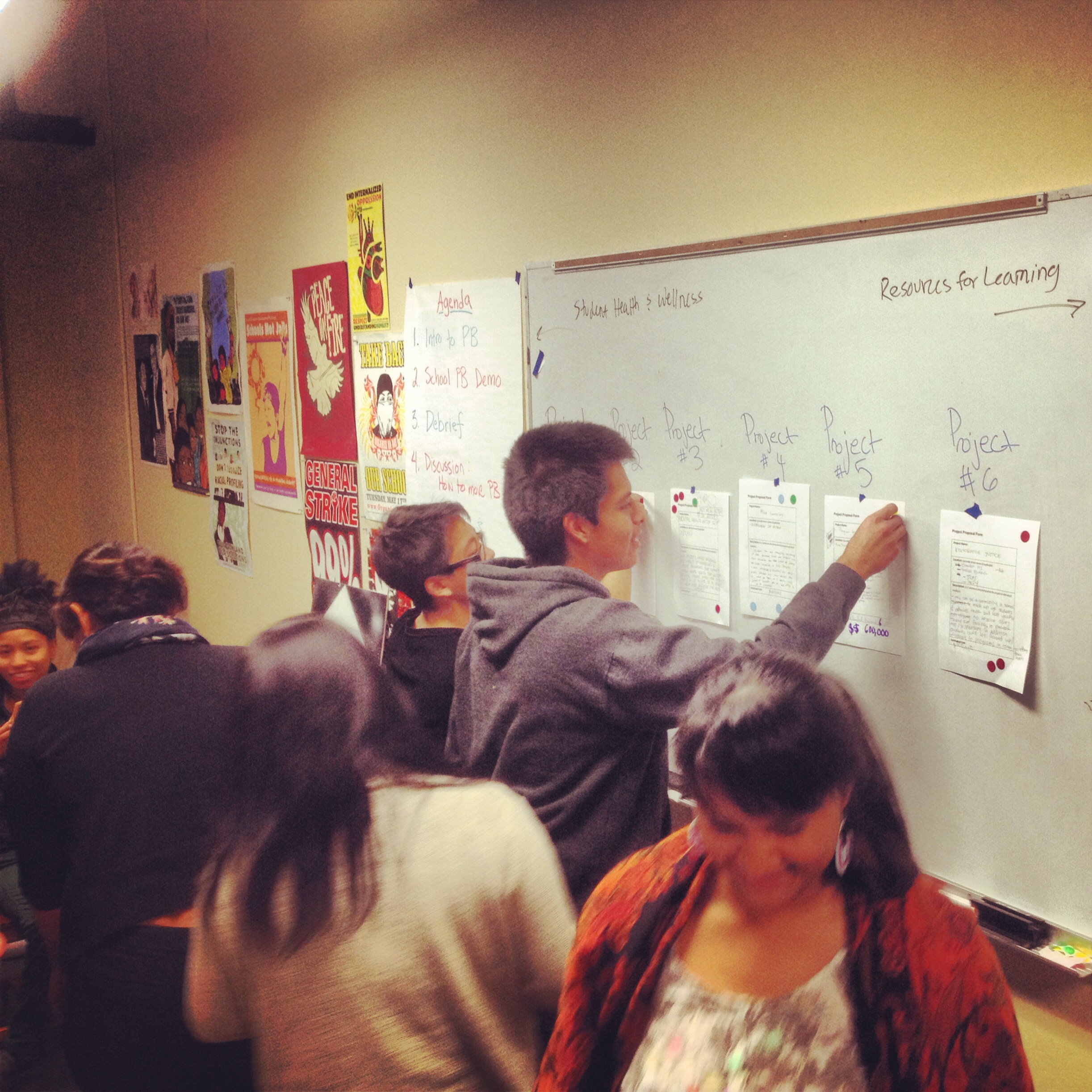
In the picture to the right, youth leaders and staff from Californians for Justice rank project ideas at a PB demo workshop in Oakland. Participants discussed projects to support student health and learning in Oakland and San Jose school districts.

PB in Cities: Long Beach, San Diego, Richmond

In addition to developing new PB models, we’re also supporting BHC groups in Long Beach, Richmond, and San Diego in launching new citywide and district-based processes. In November, PBP staff and Chicago Alderman Joe Moore went to Long Beach for a speaking tour, including a City Council briefing, several strategic meetings and a community form (pictured on the left). Since then, three candidates running for Long Beach City Council have endorsed PB, and a current council member, James Johnson, held a PB workshop with his constituents in February.

Right across the bridge from Vallejo, the City of Richmond is considering a youth PB process in conjunction with the city’s Youth Council. PBP will be leading a workshop at the Richmond Youth Summit on April 19. In San Diego, BHC groups active with the Community Budget Alliance, coordinated by the Center for Policy Initiatives, have also been meeting with their council members and Planning Department staff over the last few months to build support for PB. They’re looking at both district funds and CDBG funds as possible pots of money for PB.

Stay tuned for upcoming PB events in Long Beach, Richmond, and San Diego!

PB Conference

We’re now planning the first PB conference to take place in California, in the Bay Area in September 2014. Our 3rd annual international PB conference will bring together practitioners and advocates from across the state, country, and world. See more info.

Join us in expanding PB in California!

If you live, work or attend school in any of California’s 14 BHC sites and want to see PB in your community, contact Ginny Browne, Project Coordinator, at ginny@participatorybudgeting.org.

Featured D&D Story: Respectful Conversations Project

Today we’d like to feature a great example of dialogue and deliberation in action, the Respectful Conversations Project. This mini case study was submitted by Jerad Morey, Communications and Program Manager of the Minnesota Council of Churches via NCDD’s new Dialogue Storytelling Tool (add YOUR dialogue story today!).

Title of Project:
RespectfulConvProjectRespectful Conversations Project

Description
When the state of Minnesota was facing a ballot question defining marriage, people were divided. Churches found themselves in sharp internal disagreements that mirrored those in the broader community. Fearful of the end result of a year’s worth of polarizing media campaigns on Minnesota’s civic discourse, churches decided to build peace as a way to love the communities they were in and strengthen Minnesota’s civic culture.

The Minnesota Council of Churches, with support from the Bush Foundation and in partnership with The Public Conversations Project, Twin Cities Public Television and The Theater of Public Policy, designed a conversation model not to change minds, but soften hearts. Respectful Conversations on the Marriage Amendment were conducted across the state in rural, exurban, suburban and urban communities. One thousand five hundred fifty Minnesotans participated in 54 conversations. 62% of participants reported experiencing more empathy for those with whom they disagreed. That figure grew much higher in those conversations were the array of viewpoints was most diverse.

People were excited to participate in these conversations and they have proven to be generative. In level 2 evaluations, participants reported improved listening skills, facilitation skills, reduced tension in home conversations, improved parenting skills and paradigm shifts. Many congregations have gone on to create peace in their communities around other divisive issues and sectors such as higher education, government and public health have studied the model for future implementation.

Which dialogue and deliberation approaches did you use or borrow heavily from?
Public Conversations Project dialogue

What was your role in the project?
Program co-designer and communicator

What issues did the project primarily address?
Gender / sexuality

Lessons Learned
Budgeting more for evaluations that captured people’s stories of the experience in multiple media would have been a great idea — we were surprised by all of the good will and gratitude generated by the project, and the thirst for follow-up activities. Had we captured it better to better report on it then we would have had a great storytelling tool that Minnesotans could be proud of.

Where to learn more about the project:
http://www.mnchurches.org/respectfulcommunities/respectfulconversations.html