NCDD Orgs Respond on How to Save American Democracy

As we grapple with a quickly changing political environment, many are struggling with the current state of American democracy and what are the best steps to repair our damaged system. Over the course of the year, several writers have expressed their beliefs that the way to improve our political system is to reduce public participation and increase political intermediaries/institutions.

In a direct response to these viewpoints, NCDD member org Healthy Democracy, recently published the article on their blog, Actually, More Public Participation Can Save American Democracy, which can be found here. The Deliberative Democracy Consortium, also a NCDD member org, wrote an immediate follow-up piece inviting the dialogue, deliberation, and public engagement community to respond to these claims and the writers themselves. For information on how to send your responses, read the DDC’s article on their blog here.

The article from Healthy Democracy can be found below or read the original on their blog here.


Actually, More Public Participation Can Save American Democracy

Lee Drutman of the New America Foundation, writing on Vox.com’s Polyarchy blog, makes a bold statement: more public participation isn’t the answer to our political woes because the reasonable, civically-minded voter is a myth. This is the latest in a trend of articles analyzing American politics and the role of citizens, beginning with Jonathan Rauch’s sprawling analysis for the Atlantic of our political system and its populist weaknesses.

Fortunately, Mr. Drutman’s analysis is narrowly focused and should not discourage those of us who have broader imaginations about democracy and the power of an active citizenry. Public participation is not limited to voting for or against representative policymakers, as Drutman asserts. Rather, civic life is a rich ecosystem of opportunities to participate in our grand experiment in self-governance. The individual voter is the building block of democracy. Civically-minded wise Americans exist across the land, and they are doing good, important work in their communities.

Drutman’s article relies on a series of assumptions that are, at the very least, not the whole picture. They are based largely on assumptions that Jonathan Rauch and Benjamin Wittes make in their recent Brookings paper advocating for an increased role of political intermediaries and a decrease in direct democracy. In their world, participation in politics is limited to the election of representatives; the sole result of a citizen exerting their political wisdom is to vote out politicians who prioritize interest groups over the people; and, finally, making politicians serve the people is the end goal of public participation. But in reality, citizenship and public participation encompass a wide array of powers and responsibilities. To be clear, I don’t take issue with the negative impacts of unbridled, reactive populism. Rather, I see clearly the vast and largely untapped potential of democratic wisdom at the citizen level.

The mythical citizen

Drutman articulates others’ assertion that there is a mythical wise citizen who will save our democracy by influencing politicians to serve the people. This citizen is “moderate, reasonable, and civic-minded” and if given more power would compel politicians to behave differently. It would indeed be naïve to assume that this magic citizen would influence American society so greatly that they could change the fundamental behavior of politicians. In that way, the author’s objection to this mythical citizen is easy to make.

And I agree that waiting for a perfectly reasonable, moderate, and civically minded voter to fix our Republic is a flawed strategy. Thankfully for all of us, public participation is much broader, deeper, and more creative than that. The various mechanisms of public participation build civic literacy, increase citizen power through knowledge and interaction with our political systems, and build bridging social capital among disparate groups. There are positive downstream impacts on our local, state, and national communities that come from citizens engaging in their communities in a meaningful way.

Drutman also addresses the role of political intermediaries. These intermediaries, which he defines as “politicians, parties, and interest groups” are the people who help people recognize what their interests are through cues. But this group is depressingly limited, and strikingly partisan. It ignores faith leaders, universities, media, community groups, advisory groups, citizens’ juries, and local government engagement folks. These groups, many of which are nonpartisan, provide moral leadership, knowledge, and granular information about voter interests that Drutman’s definition of intermediaries ignores.

The power of regular citizens

Drutman’s article forecloses the citizen’s ability to participate in democracy in ways that consider tradeoffs and the long-term view. There is a glimpse of possibility in his discussion of hybrid systems, citing Rauch and Wittes’s assertion that ““better decisions” come when specialist and professional judgment occurs “in combination with public judgment.” Unfortunately, Drutman rejects the concept by conjecturing that hybrid systems are not possible because they would not have a clear person who is “in charge” and holding the power. In fact, the entire field of democratic deliberation is devoted to creating hybrid systems that connect citizens with policy experts and allow them the time, space, and information to carefully consider policy choices.

Of course, power is held both formally and informally, and differently depending on the situation. In a classic representative system, elected policymakers have the ultimate power, and they can gather input in various forms. There are also stakeholder processes where groups can be given very strong recommending power, to the point where it would be politically infeasible to reject their advice. There is also direct empowerment of citizens, such as through ballot initiatives and referenda, where a majority vote of the people makes policy. Drutman’s claim that “voters are not policymakers” is simply not true in states, cities, and counties with direct democracy.

Creative solutions

In all of these cases, there are opportunities to merge technical expertise with citizen participation. The example with which I most familiar is the Citizens’ Initiative Review. This process, which was developed by Healthy Democracy, is a hybrid system in which a microcosm of representative citizens (reasonable, moderate, and civic-minded, by the way) examines a ballot measure. They draw upon the arguments of partisan intermediates (advocates for and against the measure) and the input of independent policy experts. Their goal is to provide to their fellow voters a clear statement that outlines the key facts about a ballot measure as well as the best arguments on each side.

The result of public participation in the Citizens’ Initiative Review is an artifact that can be used by voters to make civic-minded decisions when participating in direct democracy. The knowledge that a group of fellow citizens spent four days sorting through the issue on their behalf is an inspiring service, one that can compel not only the people in the room but those who read their statement and appreciate the service to be more civic-minded and engaged in their own lives.

Research by scholars in the political science, communication, and government fields affirms that the Citizens’ Initiative Review process is democratic, deliberative, and unbiased. Their analyses find that Citizens’ Statements are highly accurate and are a reliable source of information for voters. They also find that voters actually do use the statement when casting their ballots, and that voters who read the statement have more knowledge and are more confident in their knowledge.

This piece is not intended to be an advertisement for the Citizens’ Initiative Review, but the fact is that reforms like it are rare and most folks do not have the opportunity to witness these processes and their results. In our unique position as a deliverer of these reforms, we see the extraordinary transformation that regular people undergo when called to serve their fellow voters in this way. The vast majority of citizen participants leave with a better understanding of democracy, political values, and policy analysis—not to mention a deeper understanding of the policy topic under study.

It should be noted that one reason these reforms are rare is because they disrupt the work of partisan intermediaries who would prefer to deliver information to voters through a lens that suits their own ends, often at the expense of accuracy. In a refrain familiar to many political observers, partisan intermediaries’ assessment of the value of nonpartisan intermediaries corresponds closely with how well the information produced via nonpartisan means supports their partisan ends.

Democracy starts–but does not end–with politics

You see, citizen participation takes many forms. And participating in democracy does not fit neatly in the world of policy and politics. It is a common lament recently that hyperpartisanship has led to two Americas, and that our problem is that we refuse to talk to one another. Well, the first step to breaking down hyperpartisanship is to personally know people with politics that oppose your own. Any action that builds bridging social capital (social capital across heterogeneous groups) is an act of democracy. Then, when our democratic systems are stressed, we can draw upon that social capital for resilience. If we can see the other side as people, and don’t demonize, dehumanize, and disregard them based on partisan cues, we can stay engaged in democracy with one another.

In the close of his piece, Drutman calls on us to abandon the search for the mythical average citizen and seek an alternative. Since the author fails to articulate an alternative, I offer one here: let us expand our understanding of public participation to include the multitude of civic actions that add value to our democracy.

We can start in the realm of policymaking and politics with deliberative democracy. Well-designed deliberative processes (see the National Issues Forums, citizens juries, and the Citizens’ Initiative Review, among others) give voters a structured container to consult experts, consider tradeoffs, and deliberate the merits, consequences, and underlying values of policy choices. These processes take time, patience, and resources, but it is a worthwhile investment in the health of our democracy.

Let’s also work to build social capital through community work. A bank of social capital can give us the tools and relationships to better consider policy tradeoffs and impacts to our communities in the future. Additionally, an expanded conception of public participation gives voters opportunities to grow into more civically literate people. Not only can they better understand and act on their interests, they will be more likely to consider political problems creatively if they choose to enter representative politics. These kinds of programs are all around us. See Community Oregon, our experiment in building statewide urban-rural social capital in the state of Oregon, as well as other organizations that bring different types of people together to build connections across differences (e.g. Everyday Democracy, The Village Square, and many others).

The mythical citizen is all around us. She sings in a choir, volunteers her time, helps her neighbor with homework, and teaches her grandchild about the branches of government. She is doing democracy in her everyday life. She is serving her fellow citizens. She is our Plan B.

You can find the original version of this Healthy Democracy blog article at: https://healthydemocracy.org/blog/2017/06/13/actually-more-public-participation-can-save-american-democracy/

To respond to this article via the Deliberative Democracy Consortium blog, click here: http://deliberative-democracy.net/2017/06/15/we-invite-you-to-respond/

Save the Date for David Mathew Center’s 2017 Civic Institute

The NCDD member organization, David Mathews Center for Civic Life announced the date for their upcoming 2017 Civic Institute on August 18. The 2017 Civic Institute is a day-long opportunity to meet with fellow civic engagement enthusiasts and practitioners to explore the future of Alabama. Participants choose one of three event tracks to delve into deeper during Civic Institute, which are: building civic infrastructure, renewing civic education, and creating civic media. This event will also serve as the official launch of the three year forum series, What’s Next, Alabama? which will be an opportunity for Alabamians to envision the future of their communities. We encourage you to read more about the 2017 Civic Institute in the announcement from David Mathews Center below or find the original version here.


2017 Civic Institute – Save the Date: August 18, 2017

The 2017 Civic Institute is your chance to connect with civic-minded change-makers and thought leaders from across Alabama in a dialogue on our state’s past, present, and future. From the morning panel discussion on the “geography of economic prosperity” in rural and urban communities, to the keynote address by Dr. David Mathews, (President and CEO of the Kettering Foundation), the day will be packed with engaging speakers and interactive sessions centered around some of the most profound issues we encounter as Alabamians.

Participants are able to choose among three different learning tracks for the day, including: building civic infrastructure, renewing civic education, and creating civic media. Each track includes a deliberative forum in the morning, as well as an interactive workshop in the afternoon–all in addition to the panel discussion and keynote address, which will be delivered over lunch!

With our state’s bicentennial on the horizon, we believe that the Civic Institute is the perfect event to collectively ponder the power of our citizens and our communities to build the kind of Alabama they want to call home. To this extent, the Civic Institute will serve as the official, statewide launch of the DMC’s newest forum series, aptly titled, What’s Next, Alabama?

This series is a three-year endeavor, focused on what economic prosperity means in different communities across our state. The series will conclude in 2019, coinciding with Alabama’s bicentennial celebrations, and will frame the conversation about our future, even as we celebrate our past.

2017 Civic Institute Learning Tracks:

Building Civic Infrastructure:
This learning track is tailor-made for those wanting to engage their own communities in dialogue and deliberation around important local issues. The morning forum is an abridged “What’s Next, Alabama?” forum, entitled, “The State We’re In.” This will be a deliberative experience in which participants will ask, “where are we now” as a state? What is the story of Alabama at the start of the 21st century? How far have we come? How far do we have to go? Instead of focusing on the assets and challenges of a single locale, this forum will give participants the opportunity to embrace a statewide perspective in order to reimagine the productive potential of what binds us together collectively, and what sets us apart from each other idiosyncratically.

The afternoon workshop, “Building Civic Infrastructure,” will equip participants with the tools necessary to engage their own community in dialogue and deliberation. From naming and framing local issues, to convening and moderating forums, participants will receive a crash course in the building of a meaningful and durable civic infrastructure capable of supporting and sustaining a robust public life for its citizens. The aim of the workshop is to give participants everything they need to bring “What’s Next, Alabama?” forums to their own communities.

Renewing Civic Education:
This track is perfect for educators, government officials, and anyone else interested in transforming the idea of civic engagement into real action. This learning track begins with a deliberative forum on the state of civic education (and education more broadly) in Alabama. With renewed interest in civic education statewide, this forum will be an opportunity to discuss what civic education could and should look like beyond the classroom. How do we get young people to be active citizens in their own communities? How can we create synergy between the classroom and the community? Is there a curricular way to achieve this, or should we also broaden our own understanding of youth engagement to include students and young people playing an active role in local government? These are some of the questions that will frame the morning discussion.

The afternoon workshop, “Community as Classroom: Equipping Youth for Civic Leadership” will give attendees a chance to connect with–and learn from–local elected officials from all over the state that are breaking new ground when it comes to young people playing an active role in their communities. Participants will hear from local elected officials about how they are working side by side with youth to confront the epidemic of brain-drain, retain the young talent they have in their communities, and propel that next generation into civic leadership roles.

Creating Civic Media:
This track is ideal for those interested in the fields of media, journalism, art, technology, and public life. To begin, attendees will participate in a group discussion entitled, “Flipping the Script: A Dialogue on Media, Representation, and the Role of Alabama in the National Imagination.” This dialogue is meant to elucidate ideas about the role that our state plays–willingly or unwillingly–on the national stage. We will discuss the production of “Alabama” as an archetype in traditional media and popular culture, before being introduced to emergent forms of media that serve to disrupt the conventional representations of Alabama as a monolith. This dialogue will lead naturally into the afternoon workshop, where participants will get a hands-on primer into actually creating civic media that defies typification and demands nuance.

The afternoon workshop, “Creating Civic Media: Provoking Thought, Inviting Action” is a crash course in solutions-oriented journalism and restorative narratives, aimed at creating connections among citizens and journalists to bridge the gap between statewide or national media outlets and local stories that often go unnoticed. Participants will learn best practices for crafting an op-ed piece for their local newspaper, or for a larger outlet. This workshop will teach participants how to take a local story from abstract idea to published piece. This is your chance to connect with other journalists, writers, and active citizens to tell your community’s story, reframe the narrative, and flip the script.

You can find the original announcement from David Mathews Center at: www.eventbrite.com/e/2017-civic-institute-tickets-33344668802

New Video on Bringing Participatory Budgeting in Schools

We are excited to announce that NCDD member org – The Participatory Budgeting Project recently released a new video on bringing participatory budgeting in schools. The video is on the recent participatory budgeting pilot in 5 Phoenix high schools, where more than 3,800 students participated in their first PB process. We encourage you to read more about the new PB in Schools video below or find the original on the Participatory Budgeting Project’s blog here.


NEW VIDEO – Participatory Budgeting in Schools

We are proud to share our newest tool to make civics education meaningful by putting real money on the table, our new Participatory Budgeting (PB) in Schools video!

This video introduces you to participatory budgeting in schools by showing you how it worked in Phoenix. Featuring interviews with students, teachers, principals, local elected officials, and the superintendent — see how PB can be a tool for learning democracy while building stronger schools.

Check out Participatory Budgeting in Schools from PBP on Vimeo.

Now we need your help to share the video and redefine the way democracy is learned.

1. Share this video!
Connect with students, parents, educators, school administrators, PTAs or anyone who wants to see the future of democracy start today. PB takes work from committed volunteers, but learning the importance of real democracy as a school community is worth it!

2. Download the guide to PB in Schools.
Get 18 lessons, 6 worksheets, and everything you need to bring PB to a school budget!
Students will learn to work collaboratively, conduct research, solve problems, present solutions, build empathy, deepen community, and explore why participation in democracy matters.

3. Learn more!
Sign up for our newsletter so you never miss an update about the future of PB in Schools.

Consider looking back to read our previous posts about PB in Schools—including the district-wide funds PB process that was featured in the video! [blog post link]

4. Join the community of supporters that make this work possible.
We’re really into this participatory budgeting thing.

Every year we set aside half the money raised by individuals to let our community directly decide how to spend it to make PB more equitable and effective. We call it PB2 (or “PB squared”), it’s PB for PBP.

We know that all PB processes address big concerns. It’s been surprising and exciting to see that for the last two years, our supporters have chosen to support PB processes in schools. You funded the PB in Schools Guide in 2015. In 2016, you supported this new advocacy video.

See what’s on the 2017 PB Ballot and donate to start building the pot of money for next year!

Support from donors lets us try new things. Without this support, thousands of students would never have had the opportunity to directly decide a portion of their school budgets.
PB works because you show up. Thank you for making democracy better with us.

You can find the original version of this blog post from the Participatory Budgeting Project at: www.participatorybudgeting.org/new-video-participatory-budgeting-schools/

Exploring Possibilities by Challenging Assumptions

We wanted to share this piece from NCDD member, Beth Tener, on the New Directions Collaborative blog about her recent experience at a workshop she ran on The Art of Strategic Questioning and the insights she took away about the power of framing questions. Tener notes how much more powerful questions can become when they are co-developed by a diverse group of people in order to test the assumptions on how a question is framed and consequently open up the creative possibilities. We encourage you to read Tener’s article below or find the original on the New Directions Collaborative blog here.


Questioning to Question Our Assumptions

Asking powerful questions can spark people’s intrinsic motivation to learn, contribute, and create positive change. They also allow organizations and networks to tap and synthesize the knowledge, experience, and perspectives of many people in a system, organization, or community. Today I taught a workshop called The Art of Strategic Questioning, with a group of about 30 people who do facilitation, sponsored by New Hampshire Listens, a civic engagement initiative of the Carsey School of Public Policy at UNH. We explored the art of framing questions that open up possibilities and help a group find its way to a joint vision and/or action steps.

Good questions are framed in a way that is truly open, meaning they don’t lead to a yes/no answer or contain or suggest a solution. Examples of open questions are, “what is an important conversation we are not having?” or “what gifts and assets can be better utilized and connected?” We practiced creating questions for one another’s current challenges and noticing what makes a question powerful. Here are some insights that emerged:

In the introductions, I asked people to share their name, organization, and a question they were sitting with. A wide range of interesting questions were shared and about halfway through, I asked people to notice how they felt hearing others’ questions. They said they were drawn in, curious, and wanted to talk further and hear more. Acknowledging our questions, what has us thinking, and where we are curious or don’t know naturally stirs human interest and puts us on a more equal footing.

A participant mentioned the need to be aware of her assumptions. This is hard to do on your own. The time spent talking and practicing questions revealed that the way to really see our own assumptions, beliefs, and blind spots is through the process of conversation. Being asked questions by people who have other perspectives sheds light on where our viewpoint or thinking is limited.

Through the course of the workshop, people noticed how their own assumptions affected how they framed the question. For example, we can frame a question as “will option A or B be a better way to go?” or we can open it up to ask “what course of action will help me achieve my intention; option A, B or some other option I can’t see yet?”

As a way to practice using good questions in meeting design, we practiced the 1-2-4-All exercise, a great alternative to traditional brainstorming. People answered this question:

What question could be most powerful for us to take into our communities at this time?

Participants wrote their ideas first and then shared in a pair. One of the participants wrote this question first:

What happens if the current versions of our social safety nets fail?

When he paired up to talk with another participant, the reaction he got was, “wow, that’s a downer of a question that would be hard to get people to engage with.” They both recognized that was true. His professional training as a software engineer had him trained to look for problems and what might fail. This is a valuable skill and way of thinking for some situations; however, in a context of engaging a group and community in a conversation, this question needed some work. Together, they came up with a reframed version:

What would our community look like if it didn’t matter if our safety nets failed?

A more powerful question, indeed. When the original pair joined another pair of people to talk, the other participants immediately began envisioning what that community would feel and look like. This is a sign of a good question – it unleashes a sense of potential and possibility, it draws us in, and sparks our intrinsic motivation to engage and contribute.

This story also illustrates how coming up with a powerful question is best done in conversation with a group. This allows us to can better see our own assumptions and get insights from various perspectives. This is why it is so valuable to have a design team work together well ahead of a meeting to “set the table” for a good meeting. The team can design the agenda and get clear on the appropriate questions and how to word them most powerfully. Diversity on a design team is key to discern the most appropriate question(s); diversity in a meeting or gathering is key to discern the best answers.”

When we ask questions we don’t know the answers to and trust the unknown and the wisdom of the group, new insights and possibilities can emerge. This quote from Ria Baeck and Helen Titchen Beeth sums this up beautifully:

“Emergence is the manifestation of the truly new that has never existed before, where new connections are made that create a new whole. It requires a degree of chaos, where the structuring comes not from manmade attempts at control, but from holding a strong energetic container for the necessary chaos, while staying with the guiding question and the intent that the emergence is invited to serve.”

You can find the original version of this New Directions Collaborative blog article at www.ndcollaborative.com/question-assumptions/

NCDD Member Shares Faith & Dialogue Insights on NPR

In a testament to the critical work of NCDD’s network, we were proud to hear our very own Parisa Parsa – Executive Director of NCDD member org Essential Partners and an ordained Unitarian Universalist minister – interviewed recently on NPR. Parisa was featured on the show Friends Talking Faith with The Three Wise Guys, where she shared about the keys to having good dialogue even in tough conversations. We encourage you to read more about her appearance in the EP blog piece below, find the original version here, or listen to the show here.


Making Difficult Conversations Not So Difficult

There you are – heart rate up, eyes dilated, adrenalin kicking in, jaw tightening. Maybe you’re the celebrity actor waiting for your big moment in your latest action movie. Maybe you’re about to experience your first skydiving jump. Or maybe you’re just standing, looking over the hedge of cubicles lining the company landscape, and beyond that is the curve of the earth.

Most people might see the Arctic Circle and Antarctica as being polar opposite to each other. Some people might see the United States as being on the opposite side of the planet from China. But we know that our planet is a sphere, and ‘opposites’ and ‘sides’ are all relative. We tend to live in fixed perspectives, not yet adjusted and molded as a result of different experiences.

Truth is that we don’t know who other people are until we get to know ‘them’. The other team, other cultures, different beliefs and values sprinkled with our own ignorances, and assumptions are ingredients that can serve up the perfect storm. In its wake there’s fear, anger and resentment. But at the center of a storm there’s is calm – the silent moment during which all sides of a conflict can be considered. Finding that space, in quiet reflection, we find chances to communicate, share stories, and engage in dialogue.

Speaking to this point, our very own Executive Director Parisa Parsa was recently featured on Central Florida’s NPR interview show, Friends Talking Faith with The Three Wise Guys with Imam Muhammad Musri (Senior Imam of the Islamic Society of Central Florida), Rabbi Steven Engel, and the Rev. Bryan Fulwider. Rev. Parsa talked about about faith, difficult conversations, and the key to dialogue that can bring positive results.

The May 2, 2017 episode titled Faith & Society: Difficult Conversations with the Rev. Parisa Parsa can be found here: www.twgradio.com/podcast/s10e18-rev-parsa-tough-talks-5217.

There just might be celebrity life, skydiving, or a trip to Antarctica in your future after all. Either way, step out of your sphere, and conquer fear.

You can find the original version of this Essential Partners blog piece at www.whatisessential.org/blog/making-difficult-conversations-not-so-difficult.

Addressing the Problem of Separation through Dialogue

In these divided times, we wanted to share an encouraging piece that NCDD member organization Public Agenda recently posted on their blog. It summarizes insights gained from focus groups PA convened which demonstrated something our field knows – when people from different perspectives engage in dialogue, they realize they aren’t so different or separate after all. We encourage you to read PA’s piece below or find the original version here.


What Discussing Polarizing Topics Like Inequality Exposes

After a divisive election season we continue to see stark evidence of polarization and conflict in our society. But also – and this is less frequently reported on – we see a desire to bridge gaps and find common ground.

Polarization is about more than simply holding differing or even opposing views. These days, it is also about how people with a certain view are, by choice or circumstance, increasingly isolated from those who think differently. The interaction of diverse views is valuable, but the trend of increasing separation of and decreasing interaction between those who hold opposing views is troubling and potentially consequential. The less we interact with those who think differently, the more hardened our views tend to become, and the more apt we are to vilify one another and rely on stereotypes, which in turn further divide us.

Such political polarization is on the rise. While this is much more extreme among political leaders, there are also troubling signs that it is becoming more true among the public. According to a 2014 Pew survey of over 10,000 Americans, Republicans and Democrats are more divided along ideological lines than at any point in the past two decades. And, among those who hold “consistently liberal” or “consistently conservative” views, the majority of each group report that most of their close friends hold their same views.

However, it is important to not gloss over the rest of the story. According to the same study:

These sentiments are not shared by all – or even most – Americans. The majority do not have uniformly conservative or liberal views. Most do not see either party as a threat to the nation. And more believe their representatives in government should meet halfway to resolve contentious disputes rather than hold out for more of what they want.

And while those with more “consistently held” ideological views are more likely than others to say it is important to them to live in a place where most people share their political views, still only 28% of Americans overall say this is important to them. Growing numbers of Americans also say racial diversity in the United States is important to them: in another Pew survey from this month, 64% of Americans said an increasing number of people from different races, ethnic groups and nationalities in the U.S. makes the country a better place to live, an increase from 56% who said so in August 2016.

When we convened groups of ideologically, racially, and socioeconomically diverse Americans in six large and small urban centers across the country to discuss the economy, inequality, and opportunity, people were clearly grateful for the exposure to different viewpoints and people.

Sitting in on each of these groups, I knew that the participants were a diverse yet accurate cross-section of their surrounding community. I knew there were Republicans, Democrats, and Independents; wealthy and unemployed people; and people of various racial and ethnic backgrounds sitting together at the table. Some of these differences were evident to our participants, others less so.

This meant that participants had many valuable moments of listening to, and learning from, people with very different backgrounds and experiences from their own. And it meant that when consensus emerged within the group, despite the diversity of views, it could be revelatory and important.

One example of learning from others’ experiences involved conversations about race and prejudice. In our Cincinnati group, there was an exchange about whether racial prejudice that limited people’s job prospects was more problematic than other forms of prejudice, such as gender or age discrimination. While there was no clear resolution to the discussion, white respondents were clearly deeply affected by the following story told by a black woman:

Female: My first name is [considered typically black], and I got out of my master’s program and I looked for a job for months, and months, and months…. I redid my résumé and instead of putting my full name, I just put my first initial, then my last name. Voilà.

Moderator: How do you feel about that?

Female: It’s sad. It’s sad. I personally named my daughter a white-sounding name so that in the future, when she gets old enough to get a job, she can get a job because her name sounds white.

Male: Wow.

Female: I considered that when I named her. It’s sad.

Cincinnati-area resident; in her 30s; black; upper-income; Democrat

In our follow-up interviews with respondents several days after the group, a number of people said this story stayed with them, including two white males. To me, it seemed that if they had not been brought together for this research focus group, they might not have ever had such exposure to an experience like the one this woman shared.

A good example of the importance of finding consensus also came from a participant in our Cincinnati group, who was surprised to find he had common ground with another participant who was different from him on numerous counts:

Now, you know, she’s a young African American female and I’m a more senior white male and she’s working and I’m retired, and we still came out thinking the same way. I think that’s kinda cool. That doesn’t mean her and I were right or wrong it just means we thought the same on that. I tend to be a conservative person and this made me think other ways, you know, whether I agreed or not but it made me come up with other ways to look at things. And I liked that.

Cincinnati-area resident; in his 70s; white; upper-income; Republican

Diversity of viewpoints and experience is not the problem we are faced with, but rather the separation we have between those who hold those different views and have had those different experiences, and the lack of ways to bring people of differing views together to gain perspective from one another. You can read more about these focus groups and the conversations between participants in the research report, The Fix We’re In.

You can find the original version of this Public Agenda blog piece at www.publicagenda.org/blogs/what-discussing-polarizing-topics-like-inequality-exposes.

Key Lessons on Community-Police Relations from APV2017

Last week, NCDD member orgs the Kettering Foundation and the National Issues Forums Institute hosted the 2017 “A Public Voice” forum that convened D&D practitioners with congressionl staff to talk about how to improve community-police relations. For those of you who couldn’t tune in to the livestream of the event, we wanted to share this insightful write up of the event’s highlights from our friends at Everyday Democracy below. We encourage you to read their piece below or find the original here. And if you’d like to watch the whole 90-minute recording of APV 2017, you can find links to it here.


A Public Voice 2017: Safety & Justice

EvDem LogoHighly-publicized police shootings, especially of unarmed black boys and men, have highlighted a national crisis of public safety and justice. These devastations lead us to ask how we can reduce crime as well as police violence, and how we can balance security and liberty. The National Issues Forums Institute (NIFI) recently published a Safety & Justice guide and is moderating forums throughout the country to help people grapple with these issues and work towards solutions.

“A Public Voice,” the Kettering Foundation and NIFI’s “annual exploration of public thinking on key issues,” held on May 9 in Washington, D.C., provided the opportunity for Kettering to share with policymakers their insights from the 150 Safety & Justice forums held so far. Senior Associate Leslie King represented Everyday Democracy.

In his opening address, David Mathews, President of the Kettering Foundation, declared “There is no one in this city, no matter how important they are, that can answer questions of judgement – we have to do that.” He characterized the event as part of the work to bridge divides between the people and the government of America.

At tabletop discussions, NIFI moderators, deliberative practitioners, Congressional staffers and federal officials discussed how people are thinking and talking about issues of safety and justice. Those watching the livestream of the event had the chance to listen in to one of those discussions. Read on for insights from the conversation.

A policing perspective

“We in policing have to demystify policing,” one participant remarked, and went on to describe a 70 year-old woman who only just learned about the concept of community policing after the 2014 shooting of Michael Brown. Part of demystifying the profession, according to him, requires acknowledging when someone has done wrong – otherwise, he said, the public assumes what police are thinking.

Talking about Safety & Justice leads to conversations about, and capacity to address, other issues

Leslie King pointed out that in dialogues about community-police relations, participants invariably end up talking about related issues such as employment, housing, and education. Having dialogues and organizing around community-police relations, she added, ends up building community capacity to deal with other issues. Community members realize they have agency and that government officials can’t simply dictate solutions.

People want to address root causes

In an online Safety & Justice forum, a representative from Kettering shared that the most-agreed-upon point was the need to invest more in education in communities with high rates of crime. He saw this as evidence of people’s desire to address root causes of violence and crime.

Gail Kitch, who serves on the NIFI’s board, reported on common themes from the initial Safety & Justice forums. These included:

  • People feel we urgently need to increase understanding and mutual respect between police and people of color. Popular suggestions for achieving this included police making connections with youth, and police going through cultural and racial bias trainings.
  • Participants took responsibility for the issue. Many identified community building and improving relationships within the community as tools to reduce crime.
  • Many expressed the belief that it is unsustainable for police to deal with mental illness and drug-related issues.
  • People expressed a desire to address root problems such as unemployment, poverty, and inequality.

In closing, Mathews described Kettering’s work as “awakening the capacities of people to deliberate with one another.” He left participants and viewers with a challenge he called daunting, but not hopeless: “to build on what grows” – a quote he credited to J. Herman Blake. Every person has the capacity for good judgement, he said — the job of people in the deliberative field, then, must be to nurture that ability.

You can find the original version of this Everyday Democracy blog post at www.everyday-democracy.org/news/public-voice-2017-safety-justice.

Navigating a Polarized Landscape with Our Nonpartisan Credentials Intact

In the post-2016 election landscape where talk of “threats to democracy” abounds, many organizations focused on deliberative democracy and public engagement, including NCDD, have had to relearn not only how to balance participating in public conversation about issues that didn’t used to seem partisan before, but how to do so while maintaining our nonpartisan stances and not violating our organizational or personal values. It’s not easy, which is why we appreciated NCDD member org Healthy Democracy‘s recent piece that offers solid advice for how to evaluate and maintain our nonpartisan nature in this fraught new environment. We highly recommend you read their piece below or find the original here.


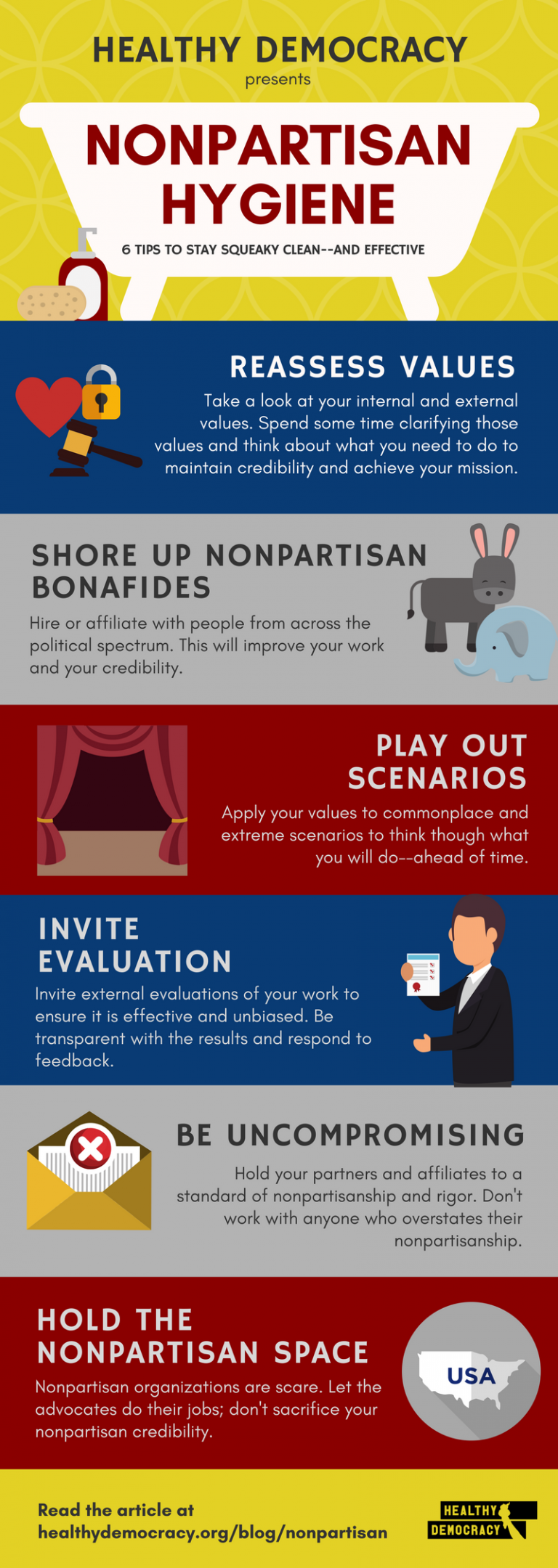
Nonpartisan Hygiene: 6 Tips to Stay Squeaky Clean

We find ourselves in a political moment where significant sectors of the country warn of existential threats to our democracy. This began before the 2016 election, but it has since reached a fever pitch. Signals such as the Economist Intelligence Unit’s recent “downgrade” of the US from a “full democracy” to a “flawed democracy” have added fuel to the fire. At Healthy Democracy, we do not take a position about whether these threats are real or not, though we spend a great deal of time trying to improve our democracy.

Nonpartisan “Positions”

As a nonpartisan organization, we cannot take a position that would turn off members of any political or demographic group. This is because we rely on our reputation as unbiased process experts when working with citizens from across the political spectrum. Additionally, we don’t take positions on issues that might come before a Citizens Initiative Review panel, including the proposals of our peers in the elections reform space.

In some ways, this makes it easy for us to choose the issues on which we take a public position (pretty much nothing), but when “threats to our democracy” come up, and considering our name is Healthy Democracy, what do we do? Do we retweet a statement praising a free press? Or is publicly expressing support for a free press now viewed as a partisan act?

We can make these decisions ad hoc, but we risk inconsistency, or worse: letting our personal perspectives and biases sway our decisions. We realized that Healthy Democracy needed to do some thinking. Some nonpartisan hygiene, if you will, to get our internal activities and the external communication of our work squarely in our nonpartisan ethos.

As a result of our analysis, we humbly share some “nonpartisan hygiene” tips that may come in handy to other organizations in this space, including bipartisan political organizations, nonpartisan think tanks, newsrooms, and professional organizations. Government scientists and policy thinkers may find this helpful, as well. This is written with nonpartisan nonprofits in mind, but please take from it anything that is helpful to your organization’s needs.

What we lose when we’re not scrupulously nonpartisan

There is an idea that floats around nonpartisan and social good organizations that we have “nonpartisan capital” that builds up when an organization is nonpartisan for a long time. The theory goes that we can spend this capital in little bits when it’s worth it, for example when a politician does something particularly egregious, or when a policy is implemented that violates our ethics. I speculate that this thinking is dangerous and flawed. Being nonpartisan is an all-or-nothing proposition when it comes to public perception. This is part of why nonpartisan spaces are precious and scarce.

Additionally, that perceived “nonpartisan capital” should not be mistaken for influence or power. Even if we accept the idea of nonpartisan capital, we cannot reliably mete it out, spending only enough to “make a difference” without trashing our reputation. In fact, we risk throwing away our most precious resource if we view it, incorrectly, as something can be given away in metered chunks.

6 Tips to Stay Squeaky Clean and Effective

1. Reassess your internal and external values. Most nonprofits have a set of values articulated in their strategic plan. These are typically things like transparency, service, and inclusion. Often, these are internal values about how the organization runs itself, or they are a mix of internal and external values. Take transparency, for instance. This is a laudable internal value, and many nonpartisan nonprofits list it among their core values. But if a politician or public figure does something that violates that value, should the organization publicly condemn it? Probably only if transparency is a core external value, such as the fictional nonpartisan group, Americans for Transparent Government.

Do the same exercise with service and inclusion and you can see how this can get tricky if you don’t have a clear sense of your organization’s internal versus external values. Spend some time clarifying internal and external values in a board meeting, retreat, staff meeting, or chat. If you are starting from scratch naming external values, start with your mission and think about what you need to do to keep credibility in your space. Your communications team should be well-apprised of these values, since they are on the front lines of selecting the media with which the organization affiliates and interacts.

2. Shore up your nonpartisan bonafides among your staff, board, and partners. The simplest way to get nonpartisan credibility is to have actual political diversity on your staff, even if you don’t publicly identify your political affiliations. Not only will this increase your organization’s credibility, it will make you better at your work.

If you have trouble attracting staff from one side of political spectrum, examine that! If you can’t easily hire to bring more political diversity onto your staff, consider affiliating with a thoughtful person who brings a different political orientation and is willing to consult now and again. If you have a question about whether a particular activity or position would be viewed as overtly partisan, get their take on it. This can reveal blind spots and save your bacon. And there is really no reason not to have a board that reflects political – and other – diversity.

3. Play out scenarios, both commonplace and extreme. In your retreat, staff meeting, or chat, start with your external values and play out some scenarios that would challenge them. Consider everything from the commonplace (“Should we retweet this?”) to the extreme (“What if we were asked to do our program on a policy that offends our values?”). In our version of this conversation, we asked ourselves whether we would agree to deliver a Citizens’ Initiative Review on a fictional ballot measure. The fictional measure would require members of a particular religious faith to register with the state government. This kind of policy deeply offends our personal values, and would be an “extreme” scenario.

We talked through the pitfalls: would our participation lend legitimacy to an unconscionable policy? Would we run the risk of becoming tainted by affiliating ourselves with the public conversation about the measure? We decided, somewhat to our surprise, that we would do it; we would deliver a citizen review of the measure. But only if we were sure it could be done in a fair and unbiased way, as with every measure we review. The legitimacy question is moot; the measure is already on the fictional ballot. Our participation would simply allow the voters of that state to shine a light on the measure, and that’s a good thing. You really have to believe in your programs in a case like this. Thankfully, we do.

4. Invite external evaluations of partisanship and effectiveness. Be transparent about the results, and make changes in response to critical feedback. Take advantage of university researchers who will fund themselves to research your work! Think of this like ripping off a band-aid. If you get spotless evaluations the first time, great, but you probably won’t. Be transparent about your efforts to improve non-partisanship and you’ll reap greater effectiveness and rewards.

We’re proud that every Citizens’ Initiative Review has been evaluated by independent university researchers, and we owe a great deal our credibility as a deliverer of fair and unbiased processes to those evaluation results. This is worth its weight in gold. If you can’t find a university researcher, at least partner occasionally with an external auditor of your programs to shore up your internal evaluation methods and get a reality check on how well you’re doing.

5. Be uncompromising in your affiliations. Hold partners to a high standard of nonpartisanship and rigor. If your work calls for you to affiliate with partisan groups, seek a balance. Don’t work with anyone who doesn’t evaluate their work, or who misrepresents themselves as nonpartisan when they’re not scrupulously so.

6. Hold the nonpartisan space. Nonpartisan spaces are scarce and valuable. There are many actors in the advocacy space. Let them do their jobs, and let us do ours.

You can find the original version of this Healthy Democracy blog piece at www.healthydemocracy.org/blog/nonpartisan.

Learn from Iceland’s Deliberative Constitutional Change

We want to encourage our NCDD network, especially those in California, to consider registering to attend an intriguing event this June 3 at UC Berkeley called A Congress on Iceland’s Democracy. This international gathering aims to explore new approaches to democracy inspired by the deliberative process that Iceland used to create its new constitution through a mock legislative process, and we’re sure many NCDDers would take a great deal of inspiration from participating.
You can learn more about the gathering in the invitation letter below sent to the NCDD network from our friends at Wilma’s Wish Productions, whose Blueberry Soup documentary on Iceland’s constitutional transformation we previously posted about on the blog, or learn more at www.law.berkeley.edu/iceland.


A Congress on Iceland’s Democracy

We are writing to extend an invitation to an event we believe would interest you. On June 3rd, 2017, we are hosting a citizen’s gathering at the University of California, Berkeley.

This event will translate participatory discussion into concrete action proposals by organizing as a mock legislative body to develop, debate, and decide on proposals for moving forward with Iceland’s constitutional change process. The event’s structure takes inspiration from the 2010 Icelandic National Assembly and Robert’s Rules of Order.

This powerful summit will revolve around discussions on how to address the current political and social climate in the United States, using Iceland’s constitutional reform process as an example. Iceland’s new constitution was written in perhaps the most democratic way possible and we want to model this methodology and learn how it can be applied in communities across the United States and the world. Our goal is to create a non-partisan environment that will foster new approaches to democracy and a shared vocabulary.

Many prominent political figures from Iceland will be in attendance as well as many of the authors of the new constitution. Furthermore, academics, activists, startups, and journalists from all over the United States and Europe are also coming to participate in this “Icelandic National Assembly” style event.

This gathering of citizens has piqued the interest of people from all around the globe – a mass exodus of Icelanders and Europeans are flying in just to sit at these tables because they know real change is possible through dialogic methodologies. We hope this historic gathering will shape the way Americans think about democracy with a focus on the impact that dialogue can have on the democratic process on a local as well as global scale.

This conference aims to achieve exactly what many of you have dedicated your life to – reimagining democracy and the way we converse with one another about tough issues. Your passion for dialogue and democracy in addition to your excellent facilitation skills makes me believe you would be a valuable asset to this event and an excellent voice for others to engage with.

We want a broad range of perspectives present at this event, so we invite you to register to attend this citizens gathering and participate in history as it is being made.

You can learn more about the Congress on Iceland’s Democracy at www.law.berkeley.edu/iceland.

Tune into “A Public Voice” Safety & Justice Event Tomorrow!

We want to remind the NCDD network – especially those of you focused on community-police dialogue – to tune in live to the 2017 “A Public Voice” event tomorrow, May 9th from 1:30 -3pm Eastern via Facebook Live.

APV2017 Facebook Event

“A Public Voice” is the annual event that the Kettering Foundation and National Issues Forums Institute – both NCDD member orgs – host every year to bring public input on policy straight to Washington DC. This year’s APV forum will be a working meeting with Congressional staff about the results of the numerous forums on safety and community-police relationships that NIFI, many NCDD members, and other D&D organizations hosted this year using NIFI’s Safety & Justice issue guide.

They will be streaming the live event tomorrow on Facebook Live, and we encourage our network to join the broadcast, not just to watch, but to send in your questions, comments, and other feedback that will be incorporated directly into the event!

Don’t miss this important discussion! You can sign up for a reminder and find the link to the live feed on May 9th in the APV 2017 Facebook event or learn more at www.apublicvoice.org.