Graduate students and advanced undergraduates at the University of Kentucky, watch this VIDEO (4m29s) about why you should take my EPE 525 / 640 course in the fall of 2020 on the Philosophy of Education. The EPE 525 course is the undergraduate version of the EPE 640 class, which is for graduate students, and both meet at the same time and in the same room.
[youtube id=”PHIKvuteoHM”]
Why study the Philosophy of Education?
a) Educators and leaders are expected to have a meaningful grasp of their own philosophies of education;
b) All research is rooted in frameworks of ideas that support and contextualize our work and thought, and that can clarify and help us to focus or be conflicted and confuse us if not carefully considered;
c) Everyone working in educational administration contributes to a system that functions with respect to or in conflict with underlying philosophical ideas. That calls for appreciating and always keeping in mind what we ought to be doing in education.
What you’ll get out of it / create:
Photo Credit: Jacob Slaton
1) A short “teaching statement,” “Statement on Educational Philosophy,” or related document commonly requested in academic job applications, as well as for administrative positions that often involve teaching courses or otherwise supporting them;
2) A book review for possible publication (optional route for students’ presentation);
3) A conference-length paper ready for submission to professional calls for papers;
4) A full-length research paper suitable for submission to journals and that could support your other projects;
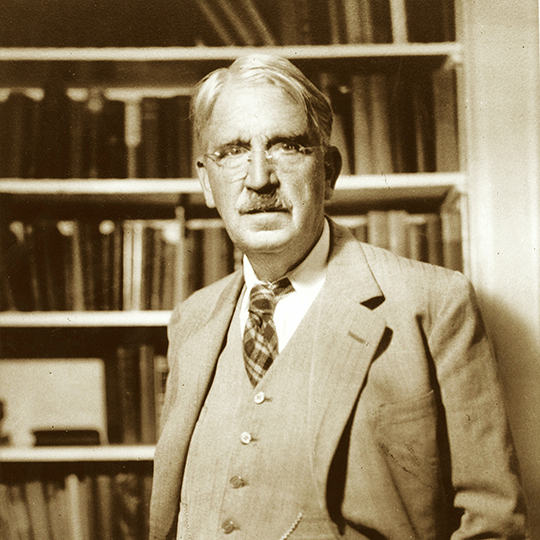
John Dewey, concerned that you’re not yet signed up for the course.
5) An op-ed-length version of the research paper for possible submission to newspapers or educational periodicals (optional);
6) Credits that can contribute to the Graduate Certificate in College Teaching and Learning.
When & Where?
It’ll be on Mondays from 4-6:30pm in Dickey Hall rm 127. It is possible that we may start the semester with online meetings via Zoom, but details on such arrangements are yet to be determined. Decisions will follow the University of Kentucky’s guidelines for the sake of safety in the midst or wake of the COVID-19 pandemic.
Since the beginning of the coronavirus outbreak, legislative bodies around the world have struggled to function. Meanwhile, from Europe, all the way to Australia and Pakistan, calls to ensure that national legislatures continue to operate abound. In the UK, over 100 MPs signed an open letter asking for the creation of a digital parliament to “maintain democratic traditions in accordance with social distancing.” In the US, amidst media concerns of a “sidelined” Congress, dozens of House Democrats sent a letter to their leadership calling for a change in the rules to enable remote voting.
The disruption in legislative work caused by the pandemic has visibly impacted crisis response efforts. For instance, in Canada, the House of Commons delayed for weeks the vote on a critical wage bill, aimed at covering a percentage of employees’ wages so that employers can keep them on the payroll. The key point of contention? Liberals wanted to vote via virtual parliament, while Conservatives asked for in-person participation.
The functioning of parliaments becomes all the more important as fears of executive overreach are revealed to be founded). Indeed, previous evidence suggests that a pandemic crisis is fertile ground for authoritarian drifts; and chronic abuses are unlikely to stop as the outbreak expands and a growing number of parliaments are unable to work.
Freedom of information for example – particularly relevant during such crises – is under assault. The Global Right to Information Rating shows that since the beginning of the coronavirus outbreak, countries on multiple continents have altered or lifted their “right to know” legislation. At the same time, a growing number of governments restrict journalistic coverage of the outbreak through threats and detentions.
In a context where traditional forms of collective action and resistance – such as social movements and protests – are constrained by physical distancing, parliaments should be the first line of defense in flattening the authoritarian curve. While innovative models of social activism are certainly emerging, they may not be sufficient to contain authoritarian drifts. To avoid rule of law giving way to rule by decree, parliaments must continue working, even if virtually.
The Brazilian Virtual House of Representatives
On March 11th, the Director General of the World Health Organization (WHO) declared the coronavirus outbreak a pandemic. Six days later, in one of the swiftest parliamentary responses, the Brazilian House of Representatives approved a normative resolution authorizing MPs to vote online and provided guidelines for the launch of a “virtual parliament”.
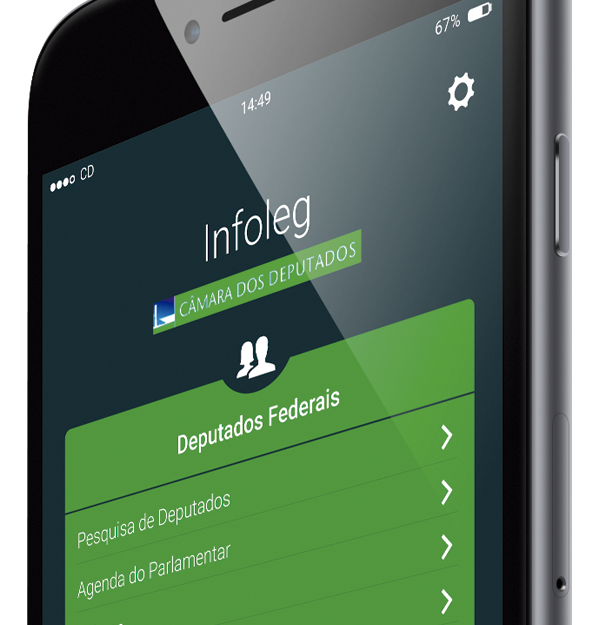
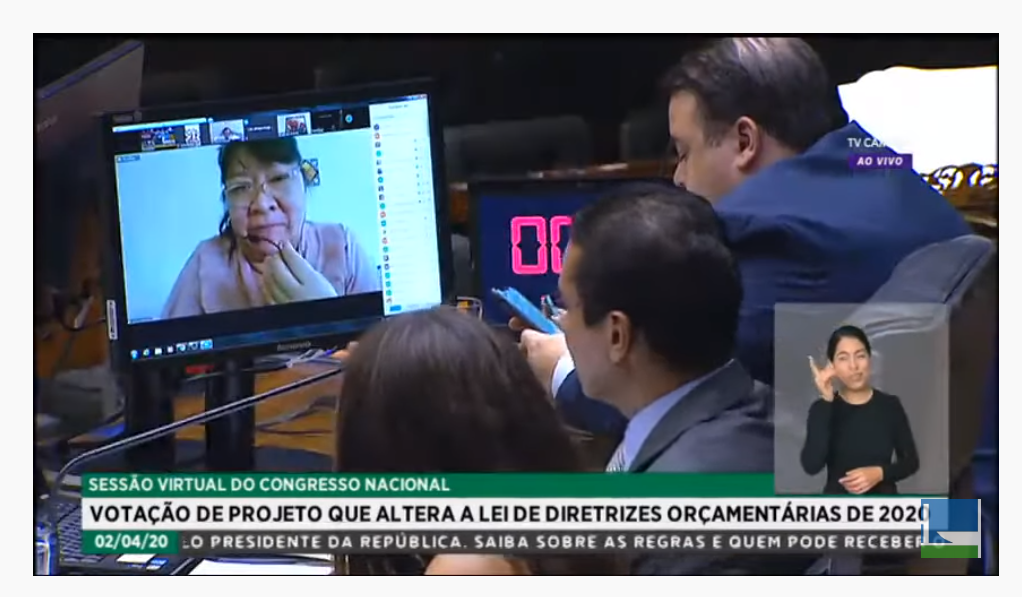
The Office of the Clerk and the House’s digital services (Department for Information Technology and Innovation, DITEC) immediately got to work on the technical solutions required by this rule change. The mobile application Infoleg, originally developed to follow up on the work of the House of Representatives, was repurposed to enable MPs’ mobile phones, following authentication protocols, to function as remote devices for registering presence and casting votes. But Infoleg is more than an e-voting app: it integrates most of the information required by an MP to properly navigate parliamentary sessions, including the list of representatives that will discuss a bill, or the pending procedural motions involved in the deliberation of a matter. While MPs use an external videoconferencing system for their interventions during sittings, the critical systems for registering presence and votes are entirely developed and managed by the House’s internal digital services.
On March 25th, eight days after enacting the new Rules of Procedure, the House of Representatives conducted the first online voting in its history. By April 9th ten virtual sessions had been held, with 15 pieces of legislation, six urgency motions and one constitutional amendment passed. Average attendance for these ten virtual sessions was 98.6% (503 out of 513 representatives), far above the in-person average (87.1%). The constitutional amendment, it seems, was the first ever to be approved by a legislative body through online voting. It was also one of the fastest legislative responses to the financial challenges generated by the pandemic – especially important given the delicate fiscal situation of the country.
Explaining the rapid transition
There is no single explanation of why some parliaments are struggling to function, while others are being more reactive. Yet in the case of Brazil, three enabling factors are worth highlighting.
Political response
Strong digital capacity does not guarantee a smooth transition to a virtual modus operandi. Take for instance Estonia, which has one of the most technologically savvy governments in the world and where online voting for elections is old news: as noted by Andy Williamson, Senior Researcher for the Inter Parliamentary Union, existing regulation prohibits remote sitting of the Estonian parliament. In other words, along with digital capacity, the shift to a virtual parliament may in many cases require political leadership to eliminate analog obstacles. In the Brazilian case, this included swift action by the Speaker of the House, who expedited a normative resolution that was rapidly approved by MPs across the political spectrum. This process, however, must be understood in its broader political context. The current relationship between the national Executive and Legislative is notoriously conflictual. It is therefore possible that the rapid response was also a preemptive move by the House to avoid executive overreach and to maintain political relevance during the crisis. Parliaments in similar situations may want to take note.
Administrative capacity
The importance of the administrative capacity of the Office of the Clerk (the Office) should not be understated. Amassing some of the most qualified civil servants in Brazil, it is the Office that makes political responses technically viable – examining constraints and opportunities and advising the House leadership on the most effective approaches. It should be noted that the adoption of the virtual parliament resolution was facilitated by existing legislation. Passed in October 2019 as a result of a shared vision between the House leadership and the Office of the Clerk, this legislation includes guidelines for a paperless legislative process.
Digital capacity
Finally, a key enabler of the rapid response by the Brazilian House was the existence of a highly qualified, in-house digital team (DITEC), with the mandate and resources to quickly redesign systems that were already developed , maintained and updated internally (e.g. Infoleg, remote voting for committees). The full implementation of the virtual parliament was by no means a small task, and involved DITEC’s core teams on user experience, cybersecurity, application development, legislative informatics, voting and attendance systems, plenary operation (e.g. video streaming), help desk, and emergency response.
It is worth noting that DITEC’s response builds on a tradition of excellence. The House of Representatives has for over a decade been a trailblazer in digital democracy, illustrated for instance by the 2009 launch of e-Democracia, a collaborative platform to engage citizens and civil society organisations in the lawmaking process.
In short, digital transformation does not happen overnight, and the House’s timely response to pandemic-related challenges was in part due to in-house capacity built and honed over the years. (Full disclosure, I was an adviser to the e-Democracia program in its early days, when working on my research ondigital parliaments).
(MP connects to virtual session)
Potential effects of virtual parliaments
It is too early to assess the effects of the pandemic on democratic institutions. The same is true for the medium- and long-term effects of legislatures’ transitions to digital environments. But for the Brazilian case, we can hypothesize:
Effects on party politics
The virtualization of parliamentary procedures may lead to further strengthening of party leaders. First, given that MPs are no longer traveling to the capital, the number of in-person meetings, both formal and informal, is drastically reduced. This reinforces the coordination role of party leaders, already an important position in Brazil. Second, with sittings taking place virtually, for practical reasons the ‘floor time’ allocated to MPs is reduced, increasing the visibility of party leaders who also control the floor time allowed for their MPs.
The impact of this increased influence and visibility of party leaders is uncertain. On the one hand, in a multi-party system with 24 parties represented in the House, a strengthening of leaders’ coordination roles may facilitate the management of legislative politics and even enhance House efficiency. On the other hand, it may weaken the position of a considerable contingent of representatives who work somewhat independently, across party lines. This could be particularly problematic for newly elected MPs who benefited from the support of political renewal movements, whose allegiances to party lines are weaker. This effect could be offset, however, by the stronger online presence of these new, often younger MPs who are used to engaging remotely with their constituents.
Effects on media coverage and third party oversight
As in most countries, the media coverage of politics in Brazil is centered in the capital city, with most journalists, offices and support staff based in Brasília. A good part of that infrastructure depends on in-person and informal exchanges between journalists and their sources, through hallway conversations, over coffee, or at social events. Civil society organisations follow a similar pattern, focusing their advocacy and oversight activities where most MPs are found. With a transition to virtual operation, economies of scale in terms of geographic location and in-person interactions are lost.
A potential secondary effect is that the House becomes less subject to scrutiny from the press and organized groups. Some CSO leaders have indeed expressed such concerns over the shift. José Antonio Moroni, leader of a coalition of social movements for political reform lamented to a local media outlet: “[…] before the MPs circulated in the corridors, and we managed, to a certain extent, to have a dialogue. Now, with this process, we get nothing.” But organisations are reacting quickly, as described by a member of the Education Workers’ Confederation: “We, for instance, already have a list of all the MPs, with e-mail, WhatsApp details, and now we are incentivizing our member organizations not only to maintain their communication with MPs, but actually to intensify the online pressure.”
More digital politics (and fake news)
As the Brazilian parliament moves to an online environment and physical distancing measures continue to be implemented (with varying degrees of success), we should also expect that more political conversations will take place online. This is not necessarily good news, particularly given that somestudies suggest that Brazil is particularly fertile ground for fake news. Add to this a combination of a growing polarization between the branches of government, and the infodemic generated by the current crisis, and you have all the ingredients for accelerating the fake news arms race in the country. As we argued in a recent report, a possible consequence of this arms race is a further and unhealthy shift of the focus of public debates: towards disputes over the authenticity of statements and evidence, reducing the time and energy left to discuss possible actions and solutions to problems.
Whether these hypotheses are validated or not remains an empirical question. These effects become more probable the longer that parliament is obliged to work remotely – a function of the length of the crisis.
So what?
For national legislatures like Brazil’s, the hypothetical adverse effects of a virtual parliament are dwarfed by the possibility of undermining the structure of checks and balances. In other words, these potential effects should be weighed against the possibility of a closed parliament.
The temporary transition to an online environment should also be regarded as an opportunity to explore options for a more open parliament going forward. For example, virtual citizen panels, consisting of randomly selected citizens representing a microcosm of the population, could be convened online to advise on divisive issues including crisis response measures (after all, if parliament can function in a decentralized manner, why not consider the same for a more participatory model of politics?) Such an effort – which would, again, require a political decision by the House leadership – would put the parliament at the forefront of democratic innovations.
In this respect, from a digital democracy perspective, the Brazilian case is one more example of the prospects and limitations of technology for achieving democratic aspirations. The fact that the House adopted a virtual model is critical at this moment. Yet it does not render the legislative any more transparent, representative or participatory than before. Without reforms, digital practices will always mirror their analog origins, whether good and bad. International organizations, donors and tech enthusiasts should not therefore delude themselves: establishing virtual parliaments will do nothing for national legislatures that suffer from pre-existing conditions or that are already on life support. As some recent events attest, national parliaments themselves can be accomplices in the crossing of democratic lines during the coronavirus response.
From a more technical perspective, democracy scholars and practitioners (myself included), have long been aware of the importance of face-to-face interactions for democratic processes. The limitations of existing solutions for digital replication of these interactions was no secret. What few of us expected, however, was how fast democratic praxis would have to transition to a virtual space in order to maintain basic functioning. This applies not only to legislative procedures but also to democratic innovations such as participatory budgeting and citizens assemblies. Unless one believes this pandemic is a one-off with short-term consequences only, the current context reveals the need to invest time and resources in reducing, at least partially, the dependency of democratic processes on face-to-face interaction. If the question of how to best achieve online participation and deliberation at scale was once a niche area, this is no longer the case.
On a more futuristic note: could virtual parliaments be an additional source of resilience in the case of unilateral action by any given executive? Consider the case of Estonia’s Digital Embassies program. Based on cloud technology and off-site servers based in Luxembourg, the program aims to ensure the functioning of critical government functions regardless of Estonia’s territorial integrity. Historically, parliaments have been shut down through coercion of parliamentarians and the closure of legislatives’ physical spaces. But what happens if a parliament can work virtually, with MPs geographically dispersed within and outside their territory? Again, it is an empirical question that – one hopes – won’t need to be answered anytime soon.
Finally, and back to the Brazilian case: as previously mentioned, several countries have altered or lifted their “right to know” legislation during the crisis. The Brazilian President recently enacted a provisional measure temporarily suspending deadlines for answering certain information requests from the public. The Speaker of the House has already announced his intention to reverse the measure in parliament. While the final result is hard to anticipate, one thing is certain: the next battle for the right to information in Brazil will take place online.
I’m excited to announce that my latest paper has been published in the journal, Essays in Philosophy, volume 21, issue 1/2, in 2020. If you want to read the paper, you can click on the image below or click here.
[featured-image link=”https://www.pdcnet.org/scholarpdf/show?id=eip_2020_0021_0001_0029_0045&pdfname=eip_2020_0021_0001_0029_0045.pdf&file_type=pdf” link_single=”https://www.pdcnet.org/scholarpdf/show?id=eip_2020_0021_0001_0029_0045&pdfname=eip_2020_0021_0001_0029_0045.pdf&file_type=pdf” single_newwindow=”false” alt=”Image of the top of my paper, ‘The Pragmatist’s Call to Democratic Activism in Higher Education,’ published in Essays in Philosophy. “]
My abstract for the paper reads as follows:
This essay defends the Pragmatist’s call to activism in higher education, understanding it as a necessary development of good democratic inquiry. Some criticisms of activism have merit, but I distinguish crass or uncritical activism from judicious activism. I then argue that judicious activism in higher education and in philosophy is not only defensible, but both called for implicitly in the task of democratic education as well as an aspect of what John Dewey has articulated as the supreme intellectual obligation, namely to ensure that inquiry is put to use for the benefit of life.
I’m very grateful to Dr. Ramona Ilea for her excellent work as editor of the journal.
The rapid evolution of digital technologies has been changing relationships between governments and citizens around the world. These shifts make it the right time to pose the key question a new World Bank publication explores:
Will digital technologies, both those that are already widespread and those that are still emerging, have substantial impacts on the way citizens engage and the ways in which power is sought, used, or contested?
The report, Emerging Digital Technologies and Citizen Participation, benefits from the insights of 30 leading scholars and practitioners, and explores what technology might mean for citizen engagement and politics in the coming years.
The report argues that, regardless of lower technology penetration levels, and given more malleable governance contexts, developing countries may be more influenced by the effects of emerging technologies than older states with greater rigidity and legacy technologies. Digitally influenced citizen engagement is potentially a “leapfrog” area in which developing nations may exploit emerging technologies before the wealthier parts of the world.
But countries can leapfrog to worse futures, not only better ones. The report also conveys concerns about the negative effects digital technologies can have on the governance of nations. Yet, despite emerging challenges, it contends that new and better citizen engagement approaches are possible.
What is missing from public discourse is a discussion of the wide range of options that citizens and decision-makers can call upon to enhance their interactions and manage risks. To consider these options, the report makes 11 predictions regarding the effects of technology on citizen engagement in the coming years, and their policy implications. It also offers six measures that would be prudent for governments to take to mitigate risks and leverage opportunities that technological development brings about.
None of the positive scenarios predicted will emerge without deliberate and intentional actions to support them. And the extent to which they can be shaped to further societal goals will depend on constructive dialogue between governments and citizens themselves. Ultimately, this new publication aims to contribute to this dialogue, so that both developing and developed countries are more likely to leap into better futures.
*************
Text co-authored with Tom Steinberg, originally cross-posted from the World Bank’s Governance for Development blog. You can also read another article about this report in Apolitical here. While I’m at it: if you work in public service and care about making government work better, I highly recommend Apolitical, a peer-to-peer learning platform for government, sharing smart ideas in policy globally. Join for free here .
A moving & humane argument concerning medicare and opioid prescriptions*
Printable PDF
There is no question that every reasonable and effective method to stop the opioid epidemic should be investigated, and if proven effective, implemented. The horrors and wrecked lives this epidemic have caused are all too real to many people of all ages.
However, we must remember that the opioid epidemic was primarily caused by prescribing these medicines for those with chronic pain not caused by cancer.
In the “Other View” op ed published on Nov 2, 2019, Senators Shelley Capito and Jeanne Shaheen are featured claiming that Medicare encourages over-prescribing of opioids. They are correct in that there have been articles published showing that the number of prescriptions in the Medicare population is rising.
They are also correct that their publicizing this problem has great “optics” and could help their political careers.
However, what is missing from the reports is very important. How many of these prescriptions were written for treatment of cancer pain?
In the 1970’s I watched my friend die in agony with pancreatic cancer because his doctors were afraid of losing their licenses if they gave him adequate pain medicine. They would not treat his pain because of the fear they would addict him.
In his last six weeks of life, he never slept more than 10 to 15 minutes at a time because of the severe, unrelenting pain.
Fast forward to the early part of this century when I had to watch another friend suffer needlessly. He had multiple myeloma, a cancer that causes severe bone pain all over the body. He was getting adequate amounts of pain medicine until well-meaning politicians crafted laws that restricted access to these medicines. It affected everyone, regardless of legitimate need.
These laws did little to curb the over-prescribing of opioids judging by how bad the epidemic got even after they were passed.
But what it did do what make it very difficult for him to get the pain medicine he needed. Anything less than a narcotic, in a big dose was totally worthless.
This is a plea for more information before this gets worse. Medicare-age patients are the most likely to have cancer, and treatment of cancer pain has been a great medical victory in the last 40 years.
Well-meaning laws enacted without considering the collateral damage that could be done to those with a true need would be a horrible tragedy. Or should I say, make a horrible tragedy even worse than it is for the cancer-patients in need.
By all means make it less financially rewarding for inappropriately prescribing opioids for non-cancer pain, but it is too easy to craft a bad policy than it is to fix it later.
We as a society must protect those in the greatest need.
We must ensure that the right drugs are available to the right patients in a timely manner, while keeping harmful treatments of any kind away from everyone.
* I (Eric Thomas Weber) received and read a scan of the printed version of this article in early November and was deeply moved. Wanting to share it, I visited ‘The Courier’s’ Web site, and then reached out to them when I could not find it there. I learned that they do not post the essays of guest columnists online, and so I requested permission to share the essay here. As I have lived in Mississippi and presently now live in Kentucky, two states deeply affected by drug addiction, I believe it all the more important that our lawmakers and policymakers think carefully and humanely about the kinds of rules that they establish concerning opioids.
This article is republished here with the permission of the author and of the staff of The Courier of Findlay, Ohio.
Graduate students and advanced undergraduates at the University of Kentucky, watch this VIDEO (4m29s) about why you should take my EPE 640 course this fall on the Philosophy of Education.
If you can’t see this video in your RSS reader or email, then click here.
Advanced undergraduates, if you’d like to take this course, email the instructor at eric.t.weber@uky.edu.
Why study the Philosophy of Education?
a) Educators and leaders are expected to have a meaningful grasp of their own philosophies of education;
b) All research is rooted in frameworks of ideas that support and contextualize our work and thought, and that can clarify and help us to focus or be conflicted and confuse us if not carefully considered;
c) Everyone working in educational administration contributes to a system that functions with respect to or in conflict with underlying philosophical ideas. That calls for appreciating and always keeping in mind what we ought to be doing in education.
What you’ll get out of it / create:
Photo Credit: Jacob Slaton
1) A short “teaching statement,” “Statement on Philosophy of Education,” or related document commonly requested in academic job applications, as well as for administrative positions that often involve teaching courses or otherwise supporting them;
2) A book review for possible publication;
3) A conference-length paper ready for submission to professional calls for papers;
4) A full-length research paper suitable for submission to journals and that could support your other projects;
John Dewey, concerned that you’re not yet signed up for the course.
5) An op-ed-length version of the research paper for possible submission to newspapers or educational periodicals;
6) Credits that can contribute to the Graduate Certificate in College Teaching and Learning.
When & Where?
It’ll be on Wednesdays from 11am-1:30pm in Dickey Hall rm 127.
I’m pleased to report on two exciting invitations I’ve had to speak in the spring of 2019. For one of them, the Ron Messerich Distinguished Lecture that I delivered in February, I spoke on “Correcting Political Correctness,” a piece from my book in progress titled A Culture of Justice. On Tuesday, February 26th, I gave the talk at Eastern Kentucky University. While there, I had the pleasure of meeting with students in the journalism program, who interviewed me for Eastern Progress, their television program. I’m quite grateful to Mike Austin for inviting me to deliver this lecture. The attendance was great and the questions and comments offered after my talk were really rich and engaging. Here is the video interview:
If you can’t see this video in your RSS reader or email, then click here.
The next trip I’m taking will be next week, when I’ll be heading to give three talks at Texas State University San Marcos. I’ll be talking at the local library about “Democracy and Public Philosophy,” from 4:30-6pm on Wednesday, March 13th. Then, on Thursday, March 14th, I’ll be talking about “Culture and Self Respect” from 2-3:00pm in the Alkek 250 Theater on campus. Friday morning, March 15th from 9-10am I’ll be talking about “Democracy and Leadership” in PS3301. More on that as it develops, but it is coming soon.
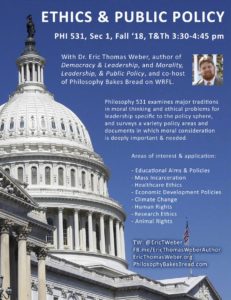
For the Fall semester of 2018, I’m planning an upper level course here at the University of Kentucky in ‘Ethics and Public Policy,’ PHI 531, Section 1, which will run on Tuesdays and Thursdays from 3:30 – 4:45 pm. The course will begin with an examination of major moral traditions as well as ethical problems that are special challenges for leadership in the policy sphere. We will then survey a variety of policy areas and documents in which moral consideration is deeply important and needed.
Areas of interest and application for the course will include:
Educational Aims & Policies
Mass lncarceration
Healthcare Ethics
Economic Development Policies
Climate Change
Human Rights
Research Ethics
Animal Rights
Flyer for the course.
My former students who have studied ethics and public policy with me have gone on to work in the White House, under both the present and previous administrations, the House of Representatives and the Senate, the State Department, the F.B.I., the Heritage Foundation, the Center for American Progress, and numerous think-tanks, as well as a variety of offices in state government. There is need for study of the kind addressed in this course also for countless advocacy groups and organizations, as well as in current events journalism.
In addition, for those who are unfamiliar, I co-host the Philosophy Bakes Bread radio show & podcast that airs on WRFL Lexington, 88.1 FM and in the show we cover a number of public policy topics. Give it a listen!
Today I had the honor of having been invited to speak at the University of Kentucky’s Graduate Student Leadership Conference. My talk was called “Democracy and Leadership in Higher Education: A Talk for Graduate Students.” I seconded some of the prior speaker’s remarks, which concerned the value of networking, including online and via social media. One student had expressed her aversion to social media. I explained that at least one wants to have a good Web site, as people do want to look you up some when getting to know you. One avenue that can help are social media profiles, but a good Web site can do wonders too. I would encourage some of the same things. He had said that Facebook isn’t a great medium, but that’s because he was thinking of one’s personal Facebook profile. And obviously he hasn’t read my post about why scholars need Facebook author pages (and since I wrote that piece, my author page following has grown from ~2k to ~141k).
I wasn’t there today to talk about social media, though. Instead, I spoke mainly about my 2013 book, Democracy and Leadership, and showed what I think we still have to learn from Plato, even if it needs updating for the modern and democratic era. I find a lot of value in reminding myself of what Plato’s Socrates says in the first book of the Republic. There, Socrates says that good people won’t be willing to lead. They’d rather others do it. But, some compulsion weighs on good people, inspiring them to be leaders against their inclinations. That compulsion is the fact, in his way of thinking, that worse people will lead. In the democratic era, the language of good people and bad people generally rings as unpleasant at best. My translation for democracy is to say that the compulsion could be instead that good people care about problems, injustices, that could be ameliorated with effort. Good people don’t want to be at the top for its own sake, but accept positions of responsibility because of what would happen if other people would not stand up to address key problems.
Socrates.
After that, I explained how and why I think it’s important that we continue to learn about leadership from Plato, even while we disagree with and let go of his authoritarian outlook. In other words, how he characterizes the virtues of leadership is problematic, but there’s no doubt that wisdom is important for leadership, for example, including in the democratic era. It just needs to be understood, pursued, and embodied democratically. So, I talked about what I take that to mean in many contexts of leadership today, but focusing on prime challenges for grad students. After all, good people will need compulsion in grad school too. Leadership is generally thankless, or worse. Plus, it takes a great deal of time and effort, which generally means a distraction from one’s other work. As such, engaging in leadership efforts as a grad student may well mean taking longer to finish one’s program. That’s something serious to accept. To want to lead despite that may well take some compulsion. Even if it does, however, grad student leaders would be wisest if they engage in democratic practices, acknowledging the dangers, challenges, and harms that can come from leading. They should also beware not to carry the world on their shoulders, as time is short, even at its longest, in graduate school (or we generally want it to be), and colleges and universities are slow-moving, relatively conservative institutions. So, at best one can make incremental change and pass on to the next group of leaders their chance to make a further difference.
As such, leadership in the grad school context should stay humble and stoic about what’s possible, want to lead for the right reasons, and be award of the costs, challenges, and reasons not to lead, all while going after it anyway in those cases that truly call for such a sacrifice.
————–
P.S. Of course there was more detail in the talk, but this is the gist of what I had to say this morning, and the people in attendance seemed to appreciate thinking through these matters with me, raising some very thoughtful and valuable questions. My thanks go out to James William Lincoln and the Graduate Student Congress for the invitation.
The Hewlett Foundation is seeking consultants to help design a potential, longer-term research collaborative to study the application of behavioral insights to nudge governments to respond to citizen feedback. This is just fantastic and deserves a blog post of its own. Hopefully I will be able to do that before the EOI period ends.
Rise and fall of participatory democracy in Brazil?
In an excellent article for Open Democracy, Thamy Pogrebinschi and Talita Tanscheit ask what happened to citizen participation in Brazil. The authors note that “The two main pillars on which institutional innovations in Brazil had been erected – extensive institutionalization and a strong civil society – have not been enough to prevent a functioning system of social participation being torn to shreds in little more than a year.”
I have been asked for my take on the issue more than once. Personally, I am not surprised, despite all the institutionalization and the strength of civil society. Given the current Brazilian context, I would be surprised if the participatory spaces the article examines (councils and conferences) remained unaffected.
Playing the devil’s advocate, this period of crisis may also be an opportunity to reflect on how policy councils and conferences could innovate themselves. While they extremely important, one hypothesis is that these structures failed to appropriately channel societal concerns and demands that later exploded into a political crisis, leading to the current situation.
Provocations aside, it is just too early to tell whether this is the definitive death of conferences and councils. And my sense is that their future will be contingent upon two key points: i) the direction that Brazilian politics take following the 2018 general election (e.g. progressive x populist/authoritarian), ii) the extent to which councils and conferences can adapt to the growing disintermediation in activism that we observe today.
The Business Model of Civic Tech?
If you are working in the civic tech space, you probably came across a new report commissioned by the Knight Foundation and Rita Allen Foundation, “Scaling Civic Tech: Paths to a Sustainable Future.” As highlighted by Christopher Wilson at the Methodical Snark, while not much in the report is surprising for civic technologists, it does provide the reader with a good understanding of the expectations of funders on the issue of financial sustainability.
When thinking about business models of civic tech efforts, I wonder how much money and energy were devoted to having governments open up their datasets while neglecting the issue of how these governments procure technology. If 10% of those efforts had been dedicated to reforming the way governments procure technology, many of those in the civic tech space would now be less dependent on foundations’ grants (or insights on business models).
Having said this, I am a bit bothered by the debate of business models when it comes to democratic goods. After all, what would happen to elections if they depended on business models (or multiple rounds of foundations’ grants)?
Walking the talk: participatory grant making?
A new report commissioned by the Ford Foundation examines whether the time has come for participatory grant making. The report, authored by Cynthia Gibson, explores the potential use of participatory approaches by foundations, and offers a “starter” framework to inform the dialogue on the subject.
Well-informed by the literature on participatory and deliberative democracy, the report also touches upon the key question of whether philanthropic institutions, given their tax benefits, owe the public a voice in decisions they make. If you are not convinced, this Econtalk podcast with Bob Reich (Stanford) on foundations and philanthropy is rather instructive. There is also a great anecdote in the podcast that illustrates the point for public voice, as described by Reich:
“So, in the final days of creating the Open Society Institute and associated foundations, there was disagreement amongst the staff that Soros had hired about exactly what their program areas, or areas of focus would be. And, to resolve a disagreement, Soros allegedly slammed his fist on the table and said, ‘Well, at the end of the day, it’s my money. We’re going to do it my way.’ And a program officer that he’d hired said, ‘Well, actually Mr. Soros, about 30% or 40% of it would have been the taxpayer’s money. So, I think some other people actually have a say in what you do, here, too.’ And he was fired the next week.”
Democracy podcasts
Talking about podcasts, the Real Democracy Now Podcast is fantastic. It is definitely one of the best things out there for practitioners and scholars working with citizen engagement.
Although broader in terms of the subjects covered, Talking Politics by David Runciman and Catherine Carr is another great option.

 a) Educators and leaders are expected to have a meaningful grasp of their own philosophies of education;
 In Fall 2019, 3 of 6 grad students in my EPE 640 class submitted their papers to conferences and had them accepted for presentation. They included: Joseph Barry and Josh Smith presented their papers at the 2020 Southeastern Philosophy of Education Society conference at the University of Georgia in February 2020. Also, Samer Jan had his paper accepted for presentation at the 2020 conference of the Society for Philosophy in the Contemporary World. Josh Smith also will be publishing his book review of Teaching In the Now by Jeff Frank in Columbia University’s Teachers College Record. The photo on right features Weber with two students from his Spring 2019 Ethics and Educational Decision Making course, Andrew Nelson and Maria Richie, whose papers from that class were accepted for presentation at the 2019 Midwest Educational Research Association conference.