watching democratic cultures decline

Yesterday, I offered some evidence that broad public deliberation declines when authoritarianism rises. I used data Varieties of Democracy, which asks 2,800 experts questions about specific countries in specific years.

For this purpose, I’ll define “authoritarianism” as a system that relies on the arbitrary will of leaders. It’s a system of rulers without many rules. Its opposite, then, is “republicanism” in Philip Pettit’s sense: a system in which nobody can be told what to do without a justification. Many variables in the V-Dem database relate to authoritarianism, but I’ve selected two: (1) whether the executive branch respects the constitution of its country, and (2) whether elections are held without intimidation. I chose this election-related variable because regular and fair elections provide a check on arbitrary rule, and also because a typical tactic of an autocrat is to interfere with elections.

Pettit, citing Quentin Skinner, emphasizes that “one of the central themes” of the civic republican tradition is “belief in dialogical reason.” The connection between republicanism and deliberation is not definitional. In other words, you could imagine an authoritarian state that encourages deliberation or a genuine republic that is weak on deliberation. But republicanism and deliberation have often been connected because one way to make decisions non-arbitrary is to encourage discussion of them.

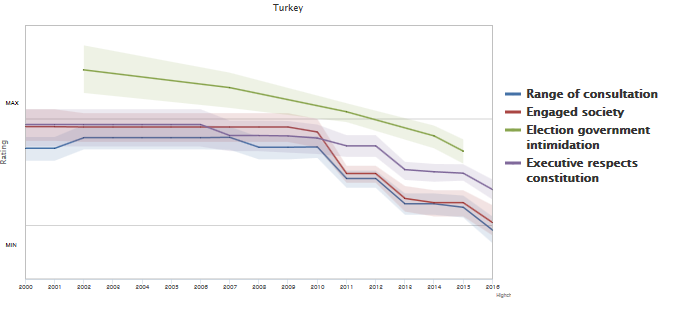
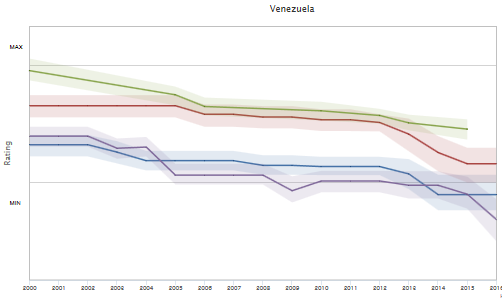
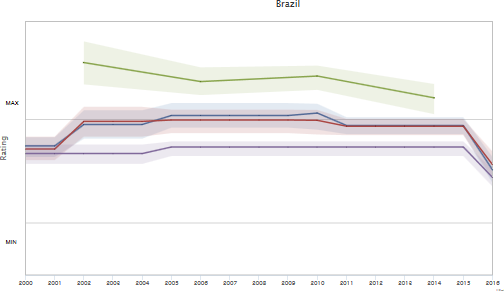
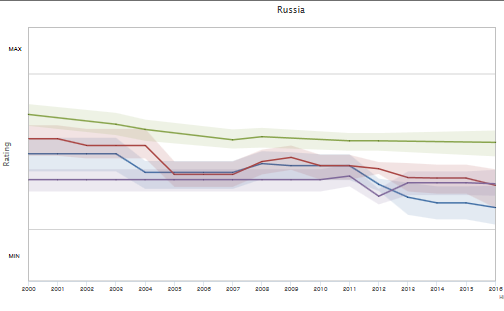
V-Dem offers two measures of deliberation: 1) to what extent do “large numbers of non-elite groups as well as ordinary people … discuss major policies among themselves, in the media, in associations or neighborhoods, or in the streets”?; and 2) to what extent do leaders consult a wide range of stakeholders? Along with the two measures of authoritarianism, we have four variables whose relationships interest me.

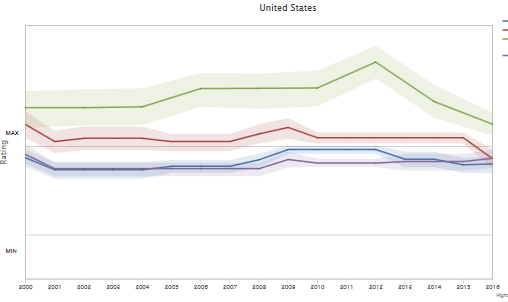
In Turkey, for example, all four measures have fallen since 2010. The fair elections variable began to decline first; then the other three fell in tandem.

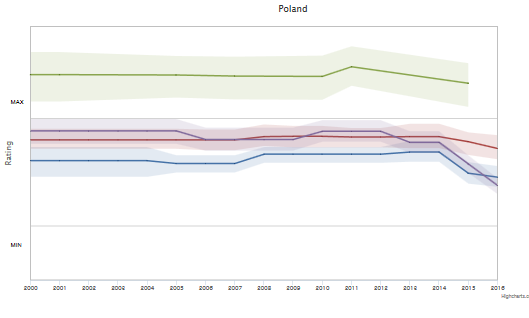
The pattern is less pronounced but similar in Poland since 2011.
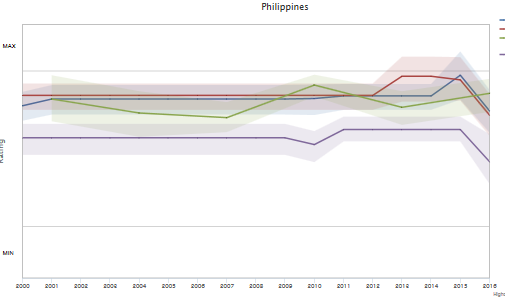
In the Philippines, election intimidation has not grown worse, but the other three variables have taken a dive since 2012.

In Venezuela, it’s been steadily downhill since 2000.

Brazil’s elections got a little worse first (starting at a high baseline), and then everything plunged after 2015.

Russia has seen fairly steady declines from a lower baseline.

And the US saw declines before 2016 in elections and in public dialogue that may presage rising state authoritarianism in 2017 and ’18 (not shown yet).

authoritarianism and deliberative democracy

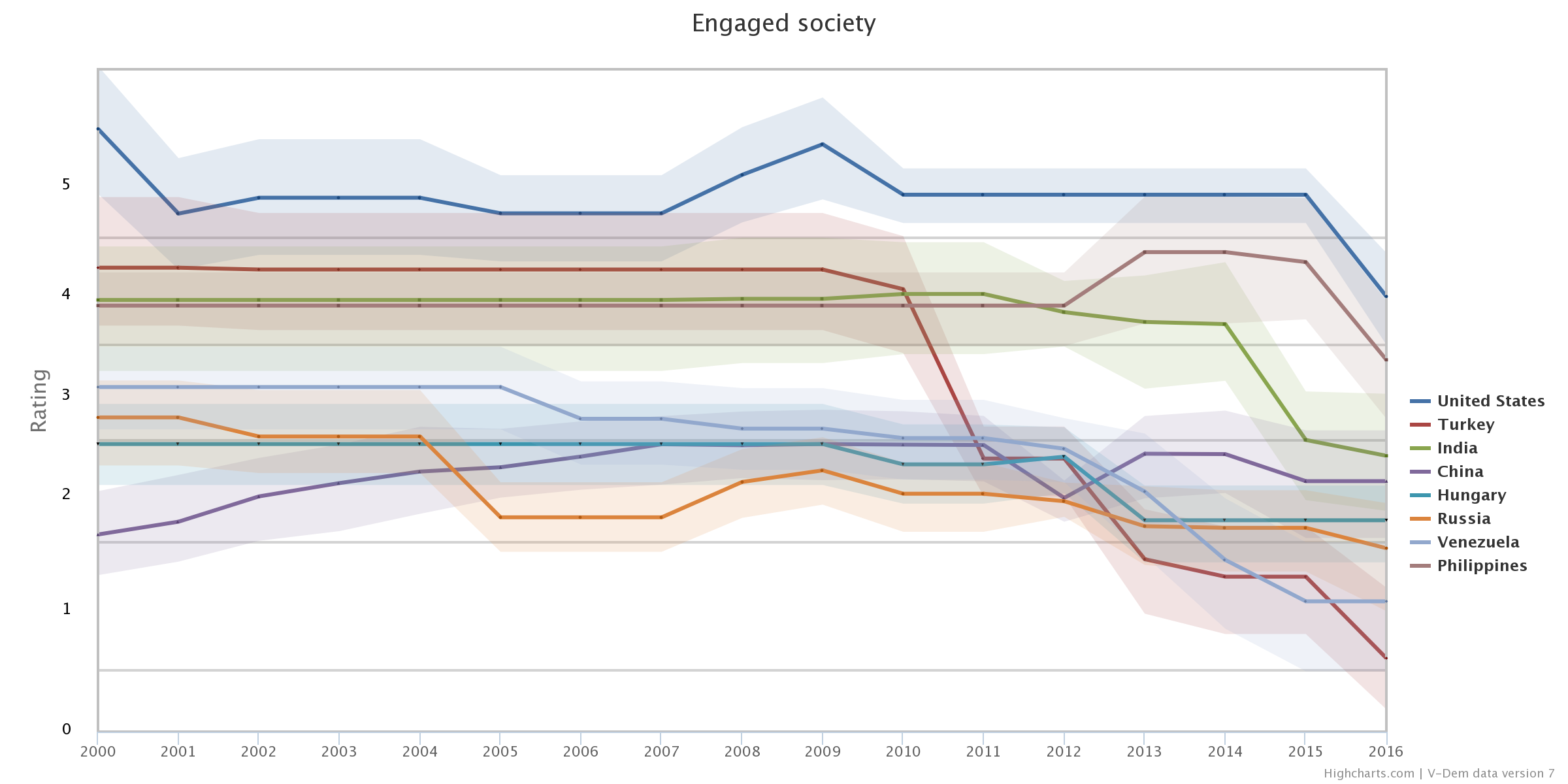
The Varieties of Democracy project asks 2,800 experts many questions about specific countries in specific years. One question is “When important policy changes are being considered, how wide and how independent are public deliberations?” The scale ranges from zero (“Public deliberation is never, or almost never allowed”) to 5 (“Large numbers of non-elite groups as well as ordinary people tend to discuss major policies among themselves, in the media, in associations or neighborhoods, or in the streets. Grass-roots deliberation is common and unconstrained”).

Below is a graph that shows the change in public deliberation (so measured) since 2000 for eight countries that I see as increasingly authoritarian. My choice of these countries is subjective. (Why not the Central African Republic, which Freedom House names as the single-biggest “backslider” on democracy in the world? Because I don’t know much about the CAR.) But of the countries that I selected in advance to serve as examples of growing authoritarianism, all but one showed declines in the V-Dem measure of broad public deliberation.

This pattern may seem self-evident or even tautological. Perhaps countries that are tending toward authoritarianism see less deliberation because authoritarianism is the opposite of deliberation. But I find the graph at least somewhat meaningful. At the core of authoritarianism is a reliance on powerful leaders who disdain constitutional limits. It’s possible for authoritarians to run a state even while “large numbers of people … discuss major policies among themselves, in the media, in associations or neighborhoods, or in the streets.” Some authoritarian states even choose to expand deliberative fora. For example, China’s Communist Party is implementing deliberative processes, which it probably sees as devices for blunting criticism and improving satisfaction with its deeply undemocratic regime (He & Warren 2017). Caroline W. Lee (2015) has argued that small-scale deliberation co-opts resistance in the USA, and Cristina Lafont (2017) worries that creating ideal deliberative fora can delegitimize regular democratic processes.

So the question arises whether authoritarianism is really contrary to deliberation at all. One might even suspect that the biggest threats to deliberation arise in mass capitalist societies, where corporate and partisan propaganda drown out reasoned conversation on poorly designed platforms, like Twitter.

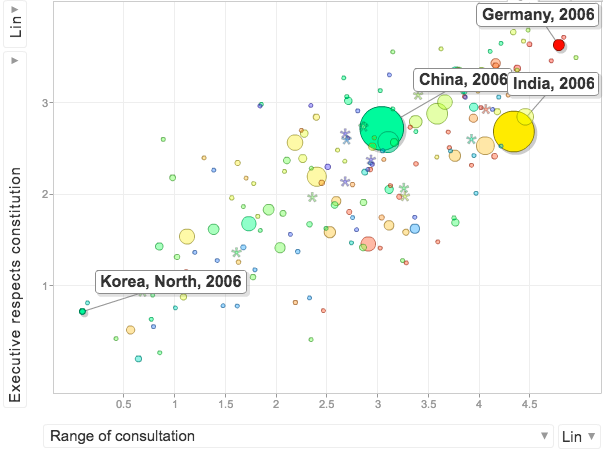
But this is partly an empirical question, and I do see evidence of a negative correlation between authoritarianism and deliberative values. Above I showed that countries well known for turning more authoritarian are also seeing less public deliberation. Below are two graphs showing a different relationship–between leaders’ respect for the constitution and the government’s tendency to consult a wide range of stakeholders. Again the source is V-Dem data, but unfortunately from 2006.

I take respect for the constitution as an inverse measure of authoritarianism, and consultation as a sign that a government wants to deliberate. The correlation is pretty clear. Most countries fall on a line between North Korea and Germany. India’s government consults more than China’s does. Neither respects its own constitution more than the other, but the Indian constitution is much better on civil liberties. The US is a circle between those two countries but a little higher up.

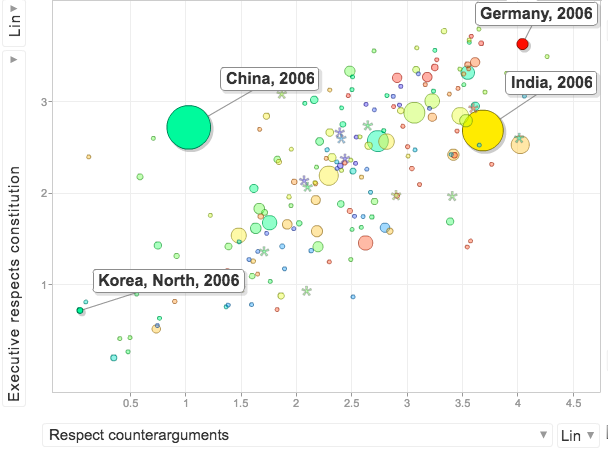
The next graph shows the same y-axis (respect for the constitution) plotted against the degree to which politicians respect counter-arguments. A high score on that measure means that they generally feel compelled to give explanations when they are challenged. Again, the line is defined by North Korea and Germany. On this plot, China is an outlier, showing decent respect for its own constitution but reluctance to consult diverse stakeholders.

Much more analysis could be done (and it would be better to use more recent data than 2006). Still, this seems to be evidence of a correlation–in practice, if not in theory–between respect for constitutional restraints and deliberative values. One reason may be that political leaders tend to model deliberation in societies where they also respect limits, and they fail to do so when they turn authoritarian. Or it could be that when publics are organized and motivated to demand discussion, they also block authoritarianism.

Sources: Baogang He  & Mark E. Warren “Authoritarian Deliberation in China,” Daedalus, 146, 3, 155-166; Caroline W. Lee, Do-It-Yourself Democracy: The Rise of the Public Engagement Industry New York: Oxford University Press, 2015; Cristina Lafont, “Can Democracy be Deliberative & Participatory? The Democratic Case for Political Uses of Mini-Publics,” Daedalus 2017 146:3, 85-105.

how to tell if you’re doing good

If you have the capacity to affect other people, there seem to be three basic ways to decide what to do–and then to assess how much good you’ve done once you’ve acted.

  1. You can talk to the people affected. You can consult your fellow citizens or even convene them to deliberate and decide together. The advantages include sensitivity to a wide range of perspectives and considerations, from justice to practicality; nuance and complexity; and the chance for people to learn and enrich their individual views. Asking people to assess and influence the policy also honors their dignity and agency. On the other hand, actually asking very large numbers of people to deliberate and decide everything is prohibitively difficult and expensive. Consulting samples of people fails to enhance the agency of everyone else. Further, discussions are subject to serious and pervasive flaws, such as cognitive biases, inequalities of power and influence, tyranny of the majority, and vulnerability to manipulation and strategic action.
  2. You can predict and empirically assess the impact of what you do. You can use scientific methods to make predictions and test causal hypotheses. Science incorporates safeguards against biases, such as random sampling and blind review. It’s much more likely than deliberation to predict accurately what will happen if you do something. But it cannot determine whether your methods or your goals are good ones. And it confers power on experts (or employers of expertise) in ways that can be problematic.
  3. You can observe price signals. If milk is selling for more than the price of producing it, then people must want milk, and providing it meets a need. The feedback from prices is immediate; it reflects many people’s knowledge, choices, and agency; it’s hard to manipulate; and it allows comparisons. Since you are responsible for allocating finite resources among all possible purposes, prices give you a common metric. One evident drawback  is inequality. For example, market prices would suggest that there’s weak demand for clean water, even though 2.1 billion people lack access to it. They have too little money to affect prices. However, if you are concerned with justice, you can adjust price signals for equity. For instance, you can give poor people money and let them decide how to spend it, instead of dictating their choices. The other major problem with price signals is that they fail to make moral distinctions. Methamphetamine and antibiotics both have prices. It takes a combination of science (to assess affects) and deliberation (to discuss values) to determine that antibiotics are good while meth is bad.

All sectors of a modern society use all three methods. But I would argue that democratic governments are particularly obliged and well-suited to use deliberation. The fact that every citizen has a vote reflects: 1) the equal right of each person to affect outcomes, and 2) the obligation of every citizen to learn and discuss before making choices. For that reason, governments have formed parliamentary bodies and courts that are supposed to deliberate, they have safeguarded free speech, and they have built ways of consulting publics. Unlike a discretionary decision by a private entity, a government program must be subject to public deliberation because it is the people’s government.

Nonprofit associations and philanthropies use discussion and price-signals. But they are particularly well suited to use “science” (in its broadest form, including ad hoc experimentation and program evaluation). The fact that there are large numbers of modest-sized nonprofits and donors means that each one can try different things and observe the effects without accumulating dangerous amounts of power and influence. When their experiments work, others can pick them up. And unlike for-profit firms, they can ignore price signals in order to pursue goals that they believe in for moral reasons. This is why program evaluation is so common in the non-profit sector, whereas major governmental decisions–even massive tax cuts or wars–are hardly ever subject to formal evaluation.

Companies, obviously, use price-signals. If Toyota can’t sell enough Corollas at a profit, it will realize it must change its business. If it observes that Subaru is more profitable, it will consider copying Subaru. However, it’s worth noting that prices offer insufficient guidance even for profit-maximizing firms. Again, assume that Toyota suddenly cannot sell enough Corollas. It must find out why not, and that will probably require some combination of asking people what they value and studying causes and effects–the same techniques used by democratic governments and philanthropies.

Among people committed to democracy and/or philanthropy, prices provoke unease. When something previously offered free is charged for, critics will complain of “neoliberalism” and “marketization” or “commodification.” But if that good was scarce and provided to some group without a charge, then someone must have decided to allocate resources for that purpose and to that group (instead of to something and someone else). Those who make such decisions are morally responsible for exercising their power well. They should strive to determine whether their choices benefit the world. Consultation and science are two means for that purpose, but both have limitations. Prices are also very useful for determining demand and for making comparisons. Not only should responsible people notice prices, but they should worry about whether their actions (through governments and philanthropies) are distorting price signals in ways the deprive them of useful information about other people’s needs. For instance, if you offer free tuition, you can no longer tell whether schooling is what people want.

On the other hand, prices certainly do not offer all the necessary and relevant information, even for people and firms that want to make a profit–and still less for people who pursue justice.

What Should We Do About The Opioid Epidemic? (NIFI Issue Advisory)

The National Issues Forum Institute released the six-page Issue Advisory, What Should We Do About The Opioid Epidemic?, published October 2017. The issue advisory presents three options to use during deliberation on how society can address the rising opioid epidemic that has swept the U.S. The issue advisory is available for free download on NIFI’s site here, as well as, a post-forum questionnaire.

From NIFI…

Drug abuse, a problem the United States has faced for decades, has taken a sharp and lethal turn with the rise of opioids—both legal pain- killers, such as oxycodone and fentanyl, and illegal ones like heroin.

More than 64,000 Americans were killed by drug overdoses in 2016, according to the Centers for Disease Control, and at least two-thirds of those deaths were caused by opioids. That is worse than the peak of the HIV epidemic in 1995 and more than the number of US combat deaths in the entire Vietnam War.

In the last year, doctors wrote more than 236 million prescriptions for opioids, or about one for every American adult. But many patients became addicted to the painkillers as their bodies began to tolerate higher and higher doses. Others, if they could no longer get prescriptions, switched to heroin; then came the even deadlier fentanyl.

Now drug abuse is so widespread it is even affecting productivity–employers say they can’t fill positions because too many applicants fail a drug test. The Federal Reserve reports that opioid addiction may be shrinking the number of job applicants because it is keeping otherwise able-bodied people out of the workforce.

The problem exists in almost every community throughout the United States, though it has hit hardest in the Northeast, the Midwest, and Appalachian regions, where joblessness and poverty have hollowed out many small towns and left families in desperate circumstances. In Cincinnati, Ohio, police estimated that police officers and paramedics spent at least 102 hours tending to overdose patients in just one week. Responding to the crisis is straining the budgets of many small towns and counties.

Doctors and nurses now see the epidemic’s effects on the next generation, a wave of babies born addicted to painkillers or heroin. Sara Murray and Rhonda Edmunds, nurses in Huntington, West Virginia, founded Lily’s Place, a facility for addicted babies and their mothers.

“The devil has come to Huntington,” Murray said on CNN. “We have generational addiction and that’s their normal. It was their mother’s normal. It was their grandmother’s normal. And now, it’s their normal.”

What should we do to relieve the opioid epidemic facing our communities? This issue advisory presents three options for deliberation, along with their drawbacks. Each option offers advantages as well as risks. If we increase enforcement, for example, this may result in many more people in prison. If we reduce the number of prescriptions written, we may increase suffering among people with painful illnesses.

Option 1: Focus on Treatment for All
This option says that, given the rising number of deaths from opioids, we are not devoting enough resources to treatment to make real headway in turning around the epidemic. Addiction is primarily a medical and behavioral problem, and those are the best tools for combating the crisis. Treatment should be available on demand for anyone who wants it. At the same time, the pharmaceutical companies that have profited from making and promoting opioid painkillers need to contribute more to the solution

Option 2: Focus on Enforcement
This option says that our highest priority must be keeping our communities safe and preventing people from becoming addicted in the first place. Strong enforcement measures are needed, including crackdowns and harsher sentences for dealers, distributors, and overprescribing doctors. And we should take tougher measures to cut off the supply of drugs at the source. Addiction to opioids and other hard drugs brings with it crime and other dangers, and closing our eyes to these dangers only makes the problem worse. Mandatory drug testing for more workers is needed. In the long run, a tough approach is the most compassionate.

Option 3: Focus on Individual Choice
This option recognizes that society cannot force treatment on people. We should not continue to waste money on a failed “war on drugs” in any form. Only those who wish to be free of addiction end up recovering. We should be clear that crime will not be tolerated, but if people who use drugs are not harming society or behaving dangerously, they should be tolerated and allowed to use safely, even if they are damaging their own lives. Those who do not or cannot make the decision to get well should not be forced, and communities shouldn’t spend their limited resources trying to force treatment on people.

About NIFI Issue Guides
NIFI’s Issue Guides introduce participants to several choices or approaches to consider. Rather than conforming to any single public proposal, each choice reflects widely held concerns and principles. Panels of experts review manuscripts to make sure the choices are presented accurately and fairly. By intention, Issue Guides do not identify individuals or organizations with partisan labels, such as Democratic, Republican, conservative, or liberal. The goal is to present ideas in a fresh way that encourages readers to judge them on their merit.

Follow on Twitter: @NIForums

Resource Link: www.nifi.org/en/issue-guide/issue-advisory-what-should-we-do-about-opioid-epidemic

why the deliberative democracy framework doesn’t quite work for me

In some ways, I came of age in the field of deliberative democracy. I had an internship at the Kettering Foundation when I was a college sophomore (when the foundation defined itself more purely in deliberative terms than it does today). By that time, I had already taken a philosophy seminar on the great deliberative theorist Jürgen Habermas. In the three decades since then, I’ve served on the boards of Kettering, Everyday Democracy, and AmericaSPEAKS. I wrote a book with “deliberative democracy” in its subtitle and co-edited The Deliberative Democracy Handbook with John Gastil. I was one of many co-founders of the Deliberative Democracy Consortium and have served on its steering committee since the last century.

None of these groups is committed to deliberation in a narrow sense (although opinions differ within the field). For me, these are the main limitations of focusing on deliberation as the central topic or unit of analysis:

Deliberative values are worthy ones, but they are not the only worthy ones. My own values would also include personal liberties and nonnegotiable rights, concerns for nature, and virtues of the inner life, such as equanimity and personal development. Stating my values doesn’t substitute for an argument, but it may suffice to make the point that deliberation is not the only good thing, and it’s in tension with other goods. A deliberative democrat will reply that I should discuss my values with other people. And so I should–but that doesn’t mean that the norms intrinsic to deliberation trump all other norms. Nor are fellow citizens the only sources of guidance; introspecting, reading ancient texts, consulting legal precedents, and conducting scientific experiments are helpful, too.

By the same token, deliberative virtues are not the only civic virtues. Deliberation is about discourse–talking and listening–so its virtues are discursive ones: humility and openness, empathy, sincerity, and perhaps eloquence. (The list is contested.) But a good citizen may be hard-working, physically courageous, or aesthetically creative instead of especially good at deliberating. The people who physically built the Athenian agora were as important as the people who exchanged ideas in it.

Deliberation depends on social organization. In order for people to have something that’s worth discussing, they must already make, control, or influence things of value together. That requires social organization, whether in the form of a market, a commons, a voluntary association, a functional network, or a political institution. Discussion rarely precedes these forms, because people can’t and won’t come together in completely amorphous groupings. Discussion is more typically a moment in an ongoing process of governance. Often a small group of founders chooses the rules-in-use that create a group in which deliberation can occur.

Thus we should ask about leadership and rules, not just about deliberation. Another way to put that point is that deliberation is often a good rule for a group to follow, but it is only one of the rules that they need. Indeed, some functional groups wisely choose rules that limit deliberation or that keep excessively divisive topics off the agenda.

A good argument for deliberation is that people gain practical wisdom and make better judgments by exchanging ideas and information. I see enough potential in that process to disagree with Austrian School economists who think that there is no way to make informed decisions without the data provided by prices in an unregulated market. But the ideas that arise in a deliberation (just like the prices that emerge in a market) are highly fallible. We ought to consider as much information as we can, including market signals and scientific findings as well as other people’s ideas and values. This is an argument for deliberation, but only as one source of guidance. In an ideal deliberative democracy, where “the people” governed through discourse alone, there would be no price signals, and so groups would make poor decisions.

The logic of deliberative democracy suggests that every institution should be a mini-public in which equal members exchange reasons. Moreover, there should be no rigid barriers among institutions: One Big Deliberation is the implicit goal. That goal has been challenged by “difference democrats” like Nancy Fraser, who writes, “public life in egalitarian, multicultural societies cannot consist exclusively in a single, comprehensive public sphere.” Fraser favors “a multiplicity of publics” over a “single public”; and she particularly celebrates “subaltern counterpublics,” meaning “parallel discursive arenas where members of subordinated social groups invent and circulate counterdiscourses to formulate oppositional interpretations of their identities, interests, and needs” (“Rethinking the Public Sphere,” 1994). I’m for that, but I would go further. We need not only “subaltern counterpublics” in which minority groups hold their own deliberative conversations. We also need non-deliberative institutions: hierarchical churches, efficient markets, massive social networks, and laboratories. That is because a plurality of power-centers–polycentricity—is essential to maintain liberty. 

Finally, deliberation by itself has limited power, and especially limited power to challenge dedicated opponents, such as authoritarian states and metastasizing markets. Authoritarian states can be persuaded to organize deliberative fora: see Baogan He & Mark E. Warren, “Authoritarian Deliberation in China,” Deadalus (summer 2017). Deliberative processes help the Party manage complex problems that would undermine its authority if left unaddressed. But deliberative fora don’t challenge illiberal regimes or powerful companies unless they are “free spaces” (Evans and Boyte) within social movements that can deploy power.

Because deliberative values are genuine values, it is absolutely worth giving them attention–in both theory and practice. But because deliberation depends upon so many other values, virtues, institutional forms, and political configurations, it is best not analyzed or pursued on its own.

assessment criteria for participation in a seminar

Thinking that I should be explicit about how I define good participation in a seminar that I’m teaching, I circulated these eight criteria:

  • Being responsive to other students. (Responsiveness needn’t always be immediate, verbal, or occur within the class discussion itself.)
  • Building on others’ contributions, and sometimes making links among different people’s contributions or between what they have said and the text.
  • Demonstrating genuine respect for the others, where respect does not require agreement. (In fact, sometimes respect requires explicit disagreement because you take the other person’s ideas seriously.)
  • Focusing on the topic and the texts, which does not preclude drawing unexpected connections beyond them.
  • Taking risks, trying out ideas that you don’t necessarily endorse, and asking questions that might be perceived as naive or uninformed.
  • Seeking truth or clarity or insight (instead of other objectives).
  • Exercising freedom of speech along with a degree of tact and concern for the other people.
  • Demonstrating responsibility for the other students’ learning in what you say (and occasionally by a decision not to speak).

Students also privately wrote how they will assess themselves. Their assessments will be for their reflection alone–I won’t ever see them.

See also: responsiveness as a virtuewhat makes conversation go well (a network model); and network dynamics in conversation.

Land of Plenty: How Should We Ensure that People Have the Food They Need? (NIFI Issue Guide)

The 25-page issue guide, Land of Plenty: How Should We Ensure that People Have the Food They Need?, was published June 2017 from National Issues Forums Institute and Kettering Foundation.. The issue guide offers participants three options to use during deliberation on how to address the inequities within the current food system and how to create a world where all people have the food they need to thrive. The issue guide is available to download for free on NIFI’s site here, where you can also find a post-forum questionnaire.

From NIFI…

All of us affect, and are affected by, the food system: students who grow and eat carrots and tomatoes from their school garden; farm owners who maintain patches of natural habitat for bees; immigrants who hand-pick our apples, grapes, and oranges; public employees who design food-nutrition labels and monitor food safety; restaurant workers who take our orders and serve our meals; food reporters who write about ethnic cuisine; local groups of gleaners who keep edible food out of the dumpster and put it to good use; food pantries that teach teenagers to garden on vacant lots; parents who work to stretch their food budgets to the next payday; policymakers who determine agricultural subsidies; community members who advocate for policies to ensure that all of us have the food we need.

While we have one of the most productive and efficient food systems in the world, millions of people in the US still fall between the cracks. People who may have enough to eat today worry about the availability and quality of food for future generations.

This guide explores different approaches and actions that are, or could be, taken to create a food system that works for all of us. While the approaches overlap in some respects, they do suggest different priorities and involve different trade-offs. With this in mind, what should we do to ensure that people from all walks of life have the food they need?

This issue guide placemat presents three options for deliberation:

Option 1: Improve Access to Nutritious Food
Despite our nation’s abundance of food, some people still don’t have enough to eat, which undermines their health, productivity, and overall well-being. According to this option, we need a food system that ensures everyone has a stable source of affordable, nutritious food. We must strengthen our school nutrition programs and food assistance for low-income families, as well as improve access to fresh food in rural and low-income communities.

Option 2: Pay More Attention to the Multiple Benefits of Food
We have drifted away from traditions and principles that once helped us enjoy a healthier relationship to food, according to this option. We all need to be better informed about the foods we choose, their nutritional value, and how they’re produced and processed. Rather than allowing food advertisements to determine our choices, we need to pay closer attention to what we value about our food, traditions, and well-being.

Option 3: Be Good Stewards of the Food System
We are not managing our food system as well as we should, according to this option. We must do more to safeguard the quality and availability of food for generations to come. Good stewardship is needed at every link in the food-supply chain, from the seeds we plant to the reduction of food waste. It also includes preserving our natural resources, choosing sustainable methods of production, and strengthening the food-system workforce.

Preview the starter video above. Like what you see? Press the ‘BUY’ button in the upper right hand corner of the video. Your purchase includes UNLIMITED streaming and downloads of this starter video.

NIF-Logo2014About NIFI Issue Guides
NIFI’s Issue Guides introduce participants to several choices or approaches to consider. Rather than conforming to any single public proposal, each choice reflects widely held concerns and principles. Panels of experts review manuscripts to make sure the choices are presented accurately and fairly. By intention, Issue Guides do not identify individuals or organizations with partisan labels, such as Democratic, Republican, conservative, or liberal. The goal is to present ideas in a fresh way that encourages readers to judge them on their merit.

Follow on Twitter: @NIForums

Resource Link: www.nifi.org/en/issue-guide/land-of-plenty

deliberation depends on social movements

Why would people deliberate? Here I’ll argue that citizens will only come together to exchange reasons if they are empowered to make decisions. In turn, it often takes a social movement to  change institutions so that any particular group of citizens has power. And social movements cannot be (fully) deliberative.

In an important passage in Talking to Strangers, Danielle Allen argues that it’s an error to assume that speakers “enter [any] deliberative forum already mutually well-minded toward one another.” She writes, “If they do so enter, the battle to achieve a reasonable policy outcome is already 75 percent won. The hard part is getting citizens to that point of being mutually well-intentioned.”

Allen proposes rhetorical solutions to this problem: ways of communicating that encourage other people want to hear your reasons and respond with good arguments, rather than walk out or shout you down. For example, you can begin a conversation by making an unsolicited sacrifice, which is “the most powerful tool for generating trust.” You can also “aim to convince 100 percent” of the audience instead of trying to build a mere majority, and you can look for ways to “ameliorate the remaining disagreement and distrust” after a decision has been reached. These are techniques for creating the conditions under which people will exchange reasons about what is right to do.

The rhetorical techniques that Allen suggests manifest political friendship, in Aristotle’s sense. First you act like a friend; then people will trust you enough to deliberate with you. The good news is that many people exhibit a desire for such friendship that makes deliberation possible. In 1982, my friend James Youniss, a developmental psychologist who had studied with Habermas, wrote:

Persons enter discussion, debate, negotiation, and so on … to clarify uncertainties, check doubts, receive criticism, justify views, gain different opinions, or explore novel ideas. But that is not all. Persons who respect one another seek to maintain their relation, and they communicate voluntarily for this purpose. They want to understand and to be understood. They want to show that they care and want to be cared for in return. In the reciprocal cooperation epitomized in friendship, each retains freedom of thought by acknowledging freedom in the other and, thus, communication is essential so that the respective parties do not lose the opportunity for truth seeking in common. [“Why Persons Communicate on Moral Matters: A Response to Shweder,” Merrill-Palmer Quarterly, vol. 28, no. 1, 1982]

These relational motives make deliberation seem plausible. Talking can be its own reward, if and when people value friendship. However, the mode of discussion may have to be emotional and personal and may have to involve speech-acts like making sacrifices. Abstract arguments will fall on deaf ears unless trust has been built.

Allen’s rhetorical suggestions are valuable as long as relevant citizens have chosen to gather together at one time and place in order to communicate. But most people allocate their time and energy to purposes other than meetings. Those who stay away may be foolishly renouncing their influence, or selfishly free-riding on others’ efforts–but both behaviors are predictable.

If group exists, we can try to invite, entice, cajole, or reward people to participate. But we cannot just assume that a group exists that has the capacity to make decisions. To be sure, once a group forms, then (almost regardless of its assets) it can empower itself by creating goods that it allocates. A Parent-Teacher Association (PTA) raises money at a bake-sale, which gives it a budget to deliberate about. In such cases, the deliberation depends on a prior solution to a collective-action problem: getting parents to contribute goods for the sale.

In many circumstances, the problem is more difficult than that. It’s not just a matter of generating a resource that can be discussed, but of capturing it from someone else. For instance, if the municipal government sets the city budget, then a public meeting about priorities is not really a deliberation; it is just a forum for talking to power. Forcing or persuading the city to share ts power would require an organized political effort that would precede a citizen deliberation about taxing and spending. But how to get people involved in that political effort is again a problem of motivation and coordination.

The broader point is that any reasonably decent conversation depends on rules, which must not only cover the speech itself (e.g., by giving everyone an equal chance to talk) but must also create groups that have the power to make decisions that are worth talking about. Since power rarely yields voluntarily, the main way to change unacceptable rules is to organize social movements. Such movements may harbor some internal deliberations, but they cannot be deliberative fora. They must aim for specific reforms that then create groups that are worth deliberating in.

This is why I think that “Ostrom, Habermas, and Gandhi are all we need.” See also: Habermas, Ostrom, Gandhi (II) and how to get a deliberative democracy.

so, you want to strengthen democracy?

This year’s Frontiers of Democracy conference explored a set of analytical tools that may be useful if you want to improve or defend democracy:

  1. You should decide where you stand on the current crisis in American democracy (which is mirrored in many other nations). You may conclude that there isn’t a special, short-term crisis, that the issues are long-lasting, or even that the Trump Administration has positive potential. That is still a stance on the current situation. This flowchart can help you navigate to a position of your own.
  2. You should decide on the core values that define a good democracy. Edna Ishayik presented a draft framework from Civic Nation in which the core values are deliberation, collaboration (or public work) and civic relationships. That framework is similar to the one in my book We Are the Ones We Have Been Waiting For. You may prefer alternative values, however.
  3. You should practice systems thinking. Social problems don’t have root causes. Almost every problem has many contributing causes. For each cause, there are other factors that cause it, in turn. These chains of causation often produce vicious or virtuous circles. To decide where to intervene, you must begin to understand the relevant factors and how they relate in a complex web. The Democracy Fund presented a draft systems map for US democracy, still in development. Here is an overview of the approach.
  4. You should think about multiple levels of power. This discussion goes back at least to Stephen Lukes in the 1970s. At Frontiers, Archon Fung offered a version of this framework, which has four levels. The first level is getting a better deal for an individual (e.g., obtaining a visa for a refugee). The second is changing laws or policies (e.g., restricting or liberalizing immigration law). The third is changing who decides and how decisions are made (e.g., by making visas subject to judicial oversight). The fourth is changing what people believe and value (e.g., shifting views about immigrants–for better or worse). Archon argued that organizations tend to focus on the first and second level of power, but the other two levels are more important. What are you doing about levels 3 and 4?
  5. You are going to need processes of one kind or another. Ceasar McDowell offered a framework of design principles in a version of this talk.
  6. You should try to maximize Scale, Pluralism, Unity, and Depth, even though those objectives are in tension, because bottom-up social movements only win when they have SPUD.