Join Everyday Democracy’s Orientation Webinar on Feb. 12

If you’re not already familiar with the work of Everyday Democracy, one of our founding NCDD organizational members, we highly encourage you to register for their upcoming orientation webinar on Thursday, February 12th at 2pm Eastern.

EvDem LogoEvDem has been honing its dialogue-to-change model for years in a huge variety of communities and has developed a wide ranging suite of tools to support the communities they work with, and this webinar is a great opportunity to get an overview of what resources they have to offer and how you can engage with their great work.

Here’s how the folks at EvDem describe the webinar:

Are you new to Everyday Democracy? Do you want to hear about success stories of communities that have used dialogue to create positive change? Join us for a webinar on Thursday, February 12 at 2pm ET for an orientation of our approach to change…

During this webinar, we will explore Everyday Democracy’s approach to change through dialogue and action. We will give an overview to how the process works, what kinds of results we’ve seen from using our approach, and  share a few stories of some of the communities we have worked with.

Not familiar with Everyday Democracy’s work? Here’s a bit of how they describe what they do:

We help communities build their own capacity for inclusive dialogue and positive change. Our ultimate aim is to create a national civic infrastructure that supports and values everyone’s voice and participation.

Because structural racism and other structural inequities affect communities everywhere, we help community groups use an “equity lens” in every phase of dialogue and change – coalition building, messaging, recruitment, issue framing, facilitation, and linking the results of their dialogues to action and change. We provide advice, training and flexible how-to resources on a wide range of issues – including poverty, racial equity, education, building strong neighborhoods, community-police relations, violence, early childhood, and community planning.

This webinar will be a great chance to learn about the work and resources of one of the leading D&D organizations in the field, so we hope you will consider attending. You can learn more about the webinar on EvDem’s website by clicking here, and you can register for it by visiting https://attendee.gotowebinar.com/register/5362336164849502721.

We hope to “see” you online next Thursday!


3 Questions for Navigating Conflict in Dialogue from PCP

We thought our members would resonate with this piece from the blog of our friends with NCDD organizational member the Public Conversations Project that offers key questions you can ask as you seek to address conflict. The post came from a discussion on the NCDD discussion listserv, and we encourage you to read it below or find the original by clicking here.


At Public Conversations Project, we work with groups torn by deep divisions over issues related to different identities, beliefs and values – divisions that tear apart communities and block progress toward shared goals. One of the most important preparatory measures we take as dialogue practitioners is crafting opening questions that promote understanding and reduce stereotyping.

We’ve found that asking questions that promote reflection and elicit personal speaking is especially critical if some of the participants have come to see each other in unidimesional ways, perhaps even as the cause of, or sustaining force behind, the “problem.”

Here are three questions we’ve developed that cultivate a sense of curiosity and encourage participants to view each other – and even themselves – in a richer and more nuanced manner:

1. “How has this conflict had an impact on you and your life?”

We begin by inviting participants to share a story from their life experience. We typically invite a “story from your life experience that might help others understand how you have come to the perspectives you hold on the issue at hand.” The effect of this question is quite powerful; it de-stereotypes individuals in each other’s eyes and allows people to be seen in their living, breathing complexity (rather than as bearers of slogans). We sometimes precede that question with another. For example, we sometimes ask participants to share a story that might help others understand the impact of the conflict in their lives.

By locating the fears associated with the conflict in real lives, the question supports better understanding of the views of the other, even if those views conflict with one’s own. Another option for a preceding question is to elicit stories about the values or motivation that brought participants into the room, or a way in which the community or organization has had significant meaning in their lives. Responses to these questions underscore their shared commitment to the group, and highlights the worth of what is at stake for each person if the community remains blocked.

2. “What is at the heart of the matter for you?”

The middle question that we often use allows people, with this expanded sense of connection as a backdrop, to speak briefly about what most deeply matters to them in relation to the issue. This question elicits a more heartfelt presentation of core concerns, visions and values than questions about positions.

3. “Within your thinking about the issue, do you have some gray areas or uncertainties, or are there times when some of your values related to this issue bump up against other values you hold?”

This is a very powerful antidote to views of “the other” as simple-minded, and allows each person to “own,” for others and themselves, the views and values normally set aside or suppressed in the polarized battle. These questions offer a solid foundation for fostering a constructive conversation on a divisive issue, but they’re not a recipe for all situations. The most crucial question we ask ourselves as dialogue practitioners is: “What questions will best serve the shared purposes of this group, at this time, and in this setting?”

This blog is adapted from a listserv entry that Founding Associate Maggie Herzig wrote on the listserv of the National Coalition on Dialogue and Deliberation. Want more tips from Public Conversations Project? Check out our resource library or upcoming open enrollment workshops.

To find the original version of this piece, please visit www.publicconversations.org/blog/3-questions-open-constructive-conversation#sthash.MppNwawE.dpuf.

Community-Police Dialogue Resources from ED

The tragic killings of two NYPD officers last month has continued to ripple through our communities and our conversations as the officers’ funerals finished this weekend. As the incident and the #BlackLivesMatter movement continue to drive conversations about police-community relationships in our country, we want to highlight the resource below from Everyday Democracy – an NCDD organizational member – for those using this moment to have these much-needed conversations.

You can read ED’s post below or find the original here. We also encourage you to look into ED’s other police-community conversation resources by clicking here.

Strategies to Take Action and Build Trust Between the Community and the Police

EvDem LogoIn the wake of recent events in Ferguson and New York City, there has been a call for a new way of building relationships with the police. Leaders want to provide ways for people to have a voice, work across divides and establish equitable policing that is accountable to the community.

In our work over the past 25 years, Everyday Democracy has partnered with several diverse coalitions that have created large-scale dialogue and change processes to address community-police relations.  Though there is much to be done in communities across our country, we know from experience that change is possible.

While recognizing the complexity of the issue, we want to share some strategies you can use to create positive change in community-police relations where you live:

1. Join with others who want to create change on this issue

Community change happens when we all work together.  Join others already working toward change on this issue, or start a new group to organize community dialogue and action on community-police relations. Check out stories from South Bronx, N.Y., Stratford, Conn., and Lynchburg, Va., to see what’s possible when communities come together after a tragic incident involving a community member and police officer.

As you join with others, think about how you can:

  • Include all voices in the community, especially those who have been marginalized or excluded. Think about the neighborhoods, racial/ethnic groups, people with various viewpoints, and people who work in specific sectors who may be affected by this issue; invite them to take part in community conversations and action steps. Community conversation and action work best when people from all parts of the community come together.
  • Involve local officials and members of the police community. Having these groups take part in the conversation and action steps will begin to open a different form of communication between police and residents.
  • Involve young people. The disconnect between police and the community is particularly wide between police and young people, especially youth of color. That’s why it’s essential for young people be involved from the beginning both in decision-making and implementation of change.
  • Work with bridge-building organizations and leaders in your community. Find local organizations and people to partner with who have trusting relationships with both the police department and community members.
2. Create opportunities for genuine community engagement

Having a structured process for people, institutions, and government to work together can lead to real change. Our discussion guide, Protecting Communities, Serving the Public: Police and Residents Building Relationships to Work Together helps to create a space for community members and police to talk about trust, expectations, policing strategies and tactics.  This allows residents to communicate their concerns and allows the police community to communicate how residents can play critical roles in effective partnership strategies.

3. Address the history of mistrust and disconnection between the community and the police

Tragic incidents don’t happen in a vacuum – there are hundreds of years of history and policies that have shaped our communities today. Our Facing Racism in a Diverse Nation discussion guide can help you have a conversation with your community to begin to dismantle stereotypes, understand the impact of structural racism, build mutual trust and respect, and develop strategies for changing institutions and policies.

4. Link dialogue to action and community change

With appropriate planning and organizing, the buy-in of local officials and the police community is possible. A dialogue initiative with community residents and police can become a springboard not just for building relationships, but also for transforming the practices and policies of our public institutions. We must address the systemic roots of the recurring tragedies in our communities and work toward inclusive, equitable communities where everyone has voice and opportunity.

You can find the original version of this Everyday Democracy post at www.everyday-democracy.org/news/strategies-build-trust-and-take-action-wake-ferguson#.VKncNivF_Ze. You can find ED’s other resources on community-police dialogue at www.everyday-democracy.org/resources/police-community-relations#.VKnj6ivF_Zc.

Healing, Transformation, & Change from Ferguson

As negativity continues to swirl around Ferguson, MO and the country at large in the aftermath of the non-indictment of Officer Darren Wilson last week, the time is ripe for real and challenging dialogue about how we can transform this energy into something positive. Everyday Democracy program officer Janee Woods wrote a powerful piece for Guernica Magazine in which she says that both punitive justice and restorative justice models are inadequate for healing the deep wounds that racism has caused our country, and advocates instead for rehabilitative justice, saying that “[w]e need to rehabilitate ourselves and our relationships with each other, across differences of perspectives and background, before we can successfully change the way inequitable systems and institutions work.”

We were particularly impressed and inspired by the list of suggestions that Janee offers for those of us grappling with how to move our work and conversations toward the rehabilitation of people and relationships that we need now. We’ve excerpted those suggestions below, but we encourage you to read her piece in its entirety by clicking here.


Janee Woods: A Different Kind of Justice

…We may feel powerless standing in the shadow of institutions, politics and the long history that got us here but that does not mean that we are, in fact, powerless. We know there is power in public protest that demands large scale change but not all of us are ready to engage with the system in that way. Try to develop your power by engaging truthfully with yourself and with neighbors in your community on a smaller scale. The inaugural step toward rehabilitating our humanity is honest communication with those who are near us. In many ways, this might be the hardest step because we must first create spaces where we can come together as individuals with disparate life experiences, diverse racial and ethnic backgrounds, and varying levels of understanding about the legacy and impact of American racism. And once we come together, we must share a commitment to follow through in learning together and moving to action together. There are many ways you can create the space and structure that allow for this kind of communication and commitment.

Bring people together for conversations that transform conflict into meaningful relationships. Use conversations to Continue reading

Resources for Dialogue After the Ferguson Decision

With yesterday’s announcement of a grand jury’s decision to not indict Officer Darren Wilson for the shooting death of Michael Brown in Ferguson, Missouri, the need for dialogue in our communities about race, police, deadly use of force, and our criminal justice system is high. In moments like these, it is hard to know where to even begin with these kinds of conversations, so we want to offer some resources to help those of our NCDD community who may be working to facilitate conversations about the issues swirling around Ferguson.

NCDD’s Director, Sandy Heierbacher, put together a great list of NCDD resources as well as a few more from our network earlier this summer, so we encourage you to look back at her post for that list, which you can find at www.ncdd.org/15953. We especially recommend that you check out the Race Issues tag in NCDD’s Resource Center of nearly 3,000 resources for D&D.

We also recommend a couple of great blog posts on the subject from our partners at Everyday Democracy:

And for those looking for reflections on how to navigate difficult conversations about the surrounding racial issues with white folks, Janee Woods Weber wrote a powerful piece with some advice called “Becoming a White Ally to Black People in the Aftermath of the Michael Brown Murder” that can be a good place to start.

We wish all of you having these challenging conversations the best of luck, and hope you will remember to take some of the reflections and lessons from them with you to the upcoming meetings between NCDD members and the Department of Justice’s Community Relations Service next year. They will certainly help us find ways to try to keep moving forward together.

Job Opening with DOJ’s Community Relations Service

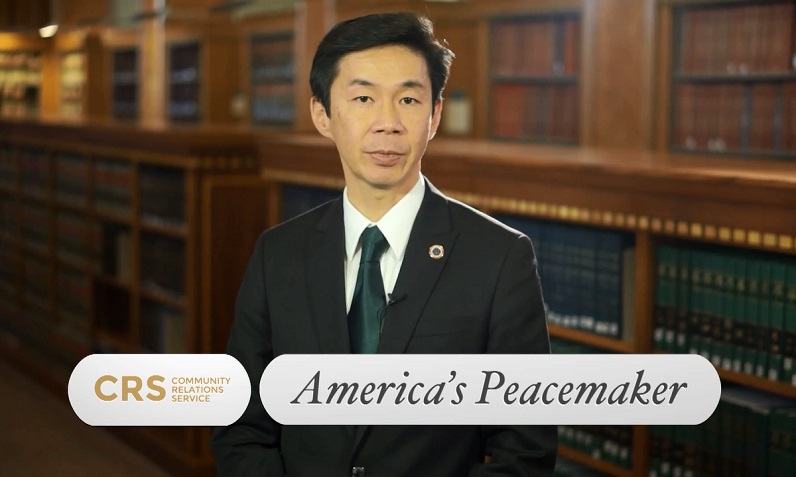
As we hope you’ve heard by now, NCDD was honored to host Grande Lum, director of the Department of Justice’s Community Relations Service (CRS), as one of our featured speakers at the NCDD 2014 conference. During his address, Grande made the commitment to host meetings across the country between CRS staff and NCDD members to talk about how we might collaborate more closely. We encourage you to learn more about the meetings and give us your input on how we can make the best use of them by sharing your thoughts in the comments section at www.ncdd.org/16724.

As we continue to gear up for the meetings this winter, we are also pleased to announce that CRS has openings for a Conciliation Specialist in their Denver and Dallas regional offices. Grande Lum sent the job announcement to NCDD’s director, Sandy Heierbacher, because he sees NCDD as a great source for the kind of expertise they need in this position.

Be sure to check out the job announcements at www.usajobs.gov/GetJob/ViewDetails/385601200 (Denver) or www.usajobs.gov/GetJob/ViewDetails/383494100 (Dallas) if you think you’re a good fit for this position. The deadline to apply is December 1st, so don’t delay.

Hawaii Senator Pursues “Collaborative Legislators Network”

Our partners with the Kettering Foundation recently published a great interview with Hawaii Senator Les Ihara Jr. – who we are proud to have as an NCDD supporting member – about some exciting work he’s doing to get legislators doing more and better public engagement work. Sen. Ihara’s ideas have great potential, and we encourage you to read more about them below or find the original here.


kf

Developing Our Civic Culture: State Legislators and Public Engagement

Hawaii state senator Les Ihara Jr. has found many state legislators interested in engaging, deliberating, and collaborating with citizens and stakeholders on public policy issues. Former Kettering Foundation research assistant Jack Becker recently sat down with Senator Ihara to talk about his work in supporting legislators’ citizen engagement interests.

Senator Ihara has served as majority policy leader with the Hawaii State Legislature since 2006. He entered the Hawaii State House in 1986 and the Hawaii State Senate in 1994. Senator Ihara is helping to organize a National Collaborative Legislators Network to support the state legislators citizen engagement research project of the National Conference of State Legislatures in partnership with the Kettering Foundation. In addition, he cochaired NCSL’s Legislative Effectiveness Committee from 2011 to 2014 and currently serves on the Kettering Foundation’s board of directors.

Jack Becker: When were you first exposed to public engagement?

Senator Ihara: In the late 1990s I attended a public forum using the National Issues Forums Institute (NIFI) framework. Since then I’ve organized a number of NIFI forums in Hawaii on legislative issues, such as gambling, death and dying, and campaign finance. During those forums I experienced public deliberation. A group of citizens were speaking together as a group about their problems rather than advocating a single solution. They were thinking through issues and problems and examining pros and cons. It was more of a learning community than I had experienced before.

At the Kettering Foundation’s 2014 Deliberative Democracy Exchange (DDEx), you said, “To me, citizen engagement is a reflection of the culture.” Could you talk about what you meant by this?

Having been involved with the Kettering Foundation, one of the things we’ve learned is that public engagement practices do not become ongoing until they become part of the culture of a community. If an organization simply does an event, a practice, it often stops. What it takes is a culture that values and has practical use of engagement in the community.

What exists now in society is a reflection of our culture. We’ve lost some of the habits that used to foster engagement. Kettering has learned this working with schools and connecting communities with schools. We’re interested in learning how a community’s culture can evolve to include public engagement practices as part of what it means to be a community.

Photo taken at the National Conference of State Legislatures & Kettering Foundation Citizen Engagement Workshop • Dayton, Ohio • July 9-10, 2014

How have you approached supporting a culture of engagement in Hawaii?

The civic culture in Hawaii doesn’t quite have the capacity to support ongoing engagement practices. Like other cities and states, it is not well developed. I’ve worked with many citizens groups as a member of the legislature, and I provide as much support as I can to them. I’ve created a number of citizen networks and supported others, but community support, funding, and energy for them has not been sustained.

Rather than promoting public engagement because of my interest, I’ve started to focus on the needs and interests of particular communities and demonstrate that engagement can help address their needs. For example, the monthly meetings of Hawaii Legislature’s Kupuna Caucus bring together senior citizen leaders, public and private agencies, and legislators to share information and develop legislation and other actions to address common concerns among our senior citizen community. We’ve been doing this for nine years, and there’s a sense of community among participants. Engaging together feels natural and essential for the well-being of this community.

What issues are ripe for more engagement?

An example would be a zoning issue, a development issue or something that negatively impacts a neighborhood. On these types of issues, engagement is often more reactive, rather than proactive. The opportunity and challenge is to mature the initial negative energy into ongoing efforts to promote the future we want as a community.

It’s unfortunate that it often takes a negative reaction to get people to do something. The reactions we see are a reflection of the culture that exists today. Our civic culture is very critical of government and doesn’t react as a partner with government and institutions, but more so in opposition to them. It would be helpful to have a government that emulates public collaboration in its management of our common resources and spaces. Neighborhoods would then have an important partner to join with in addressing the larger public issues and problems.

Is there some particular role for legislators during these forums?

I did a project in the early 2000s with Kettering examining this question. We were trying to encourage state legislators to conduct public deliberation-type activities and act as conveners for NIF forums. We didn’t yield many results then. Our thought now is to start where legislators are. We first identify the public engagement interests legislators have, and then support those interests. The earlier project focused on encouraging legislators to become interested in what we wanted, which may have been seen as competition for their limited time and resources.

State legislators are focused on state-level public policy issues and legislation. In the NCSL-Kettering project, I’m finding more legislators who have an interest in turning the policymaking process into a collaborative venture. One of my major efforts is to find and identify these types of legislators who have an interest in collaboration and figure out how to support their interests. I do this through a variety of organizations, including the Kettering Foundation, National Conference of State Legislatures, and others.

What are the biggest challenges you face identifying these people and supporting them in this work?

One of the challenges is that it takes time to identify legislators, get to know them, and then support them along the way. It’s a long process, and legislators are busy. But it’s encouraging that the legislators we work with suggest other legislators to contact. So I see promise in building this network.

During legislative sessions, it’s especially hard to get away from legislative work. And so one of the biggest challenges is to find time when legislators are available to meet. Face-to-face meetings are critical to building understanding and support. It is during these meetings that we identify the type of support that legislators want. This is critical.

The other challenge we face is in building capacity within non-legislator networks, such as the National Coalition for Dialogue and Deliberation, so that practitioners can engage legislators as partners and support them with what they need. Since legislative bodies have little capacity for public deliberation type work, the opportunity is to build capacity amongst external partners to provide group facilitation and deliberative experience to legislatures. Another opportunity is to facilitate connections and ongoing relationships between external facilitators and interested legislators.

At DDEx you went on to propose what you called a “collaborative legislators network.” What kind of space or association would this be?

I want to establish a group or network for state legislators from around the county—legislators who have a more collaborative approach to policymaking or want to learn more about being collaborative with citizens and stakeholder groups. What I’ve learned in the last several years is that there is a distinct leadership model that some legislators emulate that is more collaborative. These people use principles of facilitation and a partnership approach with the public when developing policy.

This leadership model is notable because collaborative legislators do this as opposed to wielding power and pushing through legislation with little engagement. The prevailing leadership culture in politics tends to be more about pushing for certain goals and outcomes. I believe there are many politicians who want to embody a more collaborative model. I am very hopeful after our meeting at DDEx that we met some of these people in Dayton, Ohio.

So far, I’ve been in contact with more than 100 legislators who could become part of a national network of legislators interested in public engagement and collaboration. My vision is for this network to become a national community of state legislators that serve as a model for collaborative, problem-solving leadership, as an alternative to traditional power-based leadership.

One of my upcoming projects is to help connect practitioners of public deliberation with legislators. For example, I’ve heard from members of the National Coalition for Dialogue and Deliberation who want legislators to do more public deliberation. My advice is that instead of pursuing this as an item on their agenda, they should start where legislators are and what their interests are. Legislators each have their own story on why and how they ran for office. For many, that includes an interest in an engaged citizenry and healthy democracy, which is a good starting place for practitioners and activists to build a supportive relationship with a legislator.

Jack Becker is a former Kettering Foundation research assistant. He currently works for Denver Public Schools Office of Family and Community Engagement. He can be reached at jackabecker@gmail.com. Follow him on twitter: @jackabecker

You can find the original version of this Kettering Foundation blog post at http://kettering.org/kfnews/developing-our-civic-culture.

Help Move Us Beyond Partisan Polarization

We hope you will read the letter below from NCDD supporting member Mark Gerzon asking NCDD members to share their ideas and input for how we can transcend the partisan political divide of our times. Mark and the Center for Transpartisan Leadership will also be offering a chance to be part of the conversation in the “Co-Designing our Transpartisan Journey” workshop during NCDD 2014. Learn more about what the CTL is doing and comment with your ideas below.


Before we are Republicans or Democrats, liberals or conservatives, or any of the other labels that divide us as often as define us, we are Americans, all with a personal stake in our country. For some time now we’ve all fallen into a pattern of describing our choice as Left or Right. But is that really an accurate description of the choice before us? Isn’t our choice really not one of Left or Right, but of up or down?

CTL logo no wordsWhat do you think of the preceding sentences?

Whatever you reaction may have been, you should know that I didn’t write them. The author of the first sentence was one of the most liberal presidents in recent memory, Bill Clinton. The author of the second and third sentences was President Ronald Reagan, who spoke them exactly thirty years ago when accepting the Republican Party’s presidential nomination. George W. Bush in 2000 and Barack Obama in 2008 made very similar statements.

These leaders know that there is another dimension to political life. It is not all about a horizontal (Left-Right) ideological divide, but also about a vertical (Higher-Lower) axis. In other words:

There is a path that goes “up” toward collaboration, problem-solving and co-creation, not “down” toward cynicism, polarization, and national decline.

NCDD members collectively have both the knowledge and commitment to charting this path toward higher ground. For this reason, we at the Center for Transpartisan Leadership are convening a one-day dialogue immediately preceding the NCDD conference to explore how organizations engaged in cross-boundary, cross-partisan work might deepen our synergy and potentially increase our collective impact.

We are inviting you to share your ideas with us so that they can become part of our agenda.

Some of the converging factors that make now the time to explore this emerging opportunity are “positive” ones:

  1. Parallel visions among thought leaders of the D&D field
  2. Promising cross-partisan initiatives
  3. New methods for civic engagement
  4. The maturing field of dialogue, deliberation and conflict resolution

Other converging factors making now the time for this work appear as more “negative” ones:

  1. Sharply increased government dysfunction
  2. Record levels of public dissatisfaction
  3. Predictions of a unprecedentedly toxic 2016 election

In fact, both the “positive” and “negative” factors make this meeting extremely timely. Given this confluence of all these factors, we believe it is an extremely promising moment to explore greater synergy between and among key organizations and greater collective impact on public discourse, citizen engagement, and democracy reform.

We invite you, as NCDD members, to respond to this blog by sharing any specific action ideas you (or your organization) believe are part of this movement for transforming partisanship into genuine, collaborative problem-solving.

If this “transpartisan” work intrigues you, here are four steps you can take to start getting involved:

  1. Respond to this blog post in the comments section with your own specific proposal for actions that could transform partisanship.
  2. Join us at the reception (co-sponsored by us, Community Matters, and NCDD) on October 16th at 6 PM in the lobby of the Hyatt Regency during the NCDD 2014 officially begins to hear firsthand the results of our pre-conference dialogue with the major organizations in the field.
  3. Attend our NCDD 2014 workshop, “Co-Designing our Transpartisan Journey”, on October 17th from 11am-12:30pm where we can learn from each other how to build a transpartisan movement.
  4. Subscribe to our Transpartisan listserv and be part of the discussion on advancing this kind of work.

Free 3-Part Webinar on Talking about Difficult Public Issues

We want to share the following announcement from the American Library Association Center for Civic Life, and the David Mathews Center for Civic Life about a great 3-part webinar on discussing public issues that starts next week. We found the announcement over at the NIF blog, and hope you will read it below or view it here.

Does your community have a problem that looks like this?

Join us to learn how you can help overcome deadlock and lead change in your community.

Session 1: “Beyond Deadlock: A Better Way to Talk about Difficult Issues”

Tuesday, October 14, 4 – 5 p.m. EDT / 3 – 4 p.m. CDT / 1 – 2 p.m. PDT

  • Learn to help people work together to talk about public issues and make choices.
  • Uncover the deeper concerns of our communities.
  • Register for Session 1 at http://bit.ly/namingframing1

Session 2: “Tools for Naming and Framing Public Issues”

Wednesday, December 3, 4 – 5 p.m. EDT / 3 – 4 p.m. CDT / 1 – 2 p.m. PDT

  • Learn the steps and processes for leading a “naming and framing” effort.
  • Apply tools that help people weigh options for moving forward together
  • Register for Session 1 at http://bit.ly/namingframing2

Session 3: Check-in (date TBD)

  • Share experiences with fellow participants in a follow-up webinar or conference call.
  • Registration is free, but space is limited. Participation in all three sessions is encouraged.

Questions? Contact Nancy Kranich, nancy.kranich@rutgers.edu.

NCDD 2014 Feature: “What’s Equity Have to Do with It?” Workshop

As we get closer and closer to NCDD 2014, we have asked our workshop presenters to share a bit more info about their sessions with you. So we are pleased to start by featuring “What’s equity have to do with it? Ensuring inclusive participation”, a great session being offered by Carrie Boron, Susan McCormack, and Valeriano Ramos. Read more about their workshop below and find out more about read about all of our NCDD 2014 sessions by clicking hereStill not registered for NCDD 2014? Make sure to register today


NCDD2014-blogimageNext month, my colleagues and I are co-presenting a session at the NCDD conference on the role of equity in public participation. Creating Community Solutions’ Susan McCormack and Everyday Democracy’s Valeriano Ramos, and me, Carrie Boron, and will join together with conference attendees to help answer the question, “What’s equity have to do with it?”

Taking on the topic of equity is challenging, confusing and conflicted, and requires much more time, knowledge and resources than are usually available. This is especially true given our limited session time at the conference. So, we thought we would give more “air time” to the subject here on the NCDD blog.

Those who work to bring people together in their communities to talk and find ways to make progress on various public issues often use the word “inclusive” to describe diverse participation. The aim is to have people from different ethnic, gender, age, sexual orientation, educational and socioeconomic backgrounds join the effort. Although such work is well-intentioned, organizers often miss the mark because they have not considered the societal structures and policies that perpetuate inequities.

Understanding the structures that support inequity (with a particular emphasis on structural racism) is essential for effective dialogue and long-term change on every issue. For instance, there are still many public and private institutions that exclude people of color. Schools in poor neighborhoods lack resources. Many police departments protecting and serving mostly people of color often lack ethnic diversity on their own force. Ferguson, MO, is the latest example of this scenario. We need to consider these structures and policies as we work to engage people in decisions that affect their lives.

Val, Sue, and I will be offering a tutorial on concepts related to equity, power and privilege; interactive discussions; and hands-on activities as well as best practices to use in engaging all kinds of people in your community. So, join us on Sunday, Oct.19, at 9 a.m. (bring your coffee!) for “What’s equity have to do with it? Ensuring inclusive participation” and dig into how we can ensure that people of all backgrounds have the opportunity to take part in civic life.

In the mean time, here are a handful of resources to help you create opportunities for equitable public engagement:

  • Race Forward’s “Racial Equity Impact Assessment Toolkit
  • RacialEquityTools.org, a website featuring tools, research, tips, curricula and ideas for those working to achieve racial equity
  • Everyday Democracy’s “Racial Dynamics to Watch For” – This handout provides a sampling of scenarios of power, privilege and inequity at play in organizing, facilitation and action planning, and asks organizers how they might avoid such situations.
  • Everyday Democracy’s “Focusing on Racial Equity as We Work” – This handout offers a set of questions for community organizing coalitions working to ensure that they’re working together in an equitable manner.
  • Everyday Democracy’s “Facilitators’ Racial Equity Checklist” – This handout outlines a set of debrief questions for small-group dialogue co-facilitators to use in debriefing and assessing their work together and in ensuring an equitable dialogue experience for participants.