Sign Up for an NCDD 2014 Field Trip to “Toast”

We are excited to share the invitation below from Marla Crockett – NCDD Board member and one of our DC site coordinators for NCDD 2014 – to join her for a great field trip during NCDD 2014! Find out more below and read more about our field trips by clicking here.

Join us for Toast during the NCDD Conference!

Wondering what to do on Saturday night during the NCDD Conference? Tickets are still available, so sign up for our field trip to Capitol Hill to see Toast. Produced by the highly respected theatre group, dog & pony dc, the show is described as a “participatory-performance-meets-science-fair.” You and other members of the audience will get drafted by a “secret society of inventors” to help push the boundaries of technological invention. It’s a fun and creative way to explore engagement and innovation, a few things we’re all interested in.

I saw a performance of dog & pony’s Beertown a few years ago and loved how they got the audience involved. We all became citizens of this fictional community in order to help the cast, playing city officials, determine which items should come out of Beertown’s time capsule and which ones should go in. We made up characters and played our parts seamlessly, arguing and weighing how to best represent life in “our” community. I would expect the same sort of role-playing and interaction with the actors during Toast.

In addition, dog & pony will be helping us integrate the arts during our conference, so you can reciprocate by helping them finish their show!

We’ll get started around 4:30, take the Metro to Capitol Hill, have dinner in the neighborhood, and then head to the theatre for the 7:30 performance. Tickets are $15, and transportation and dinner are on you, so join our group for a fun evening on beautiful Capitol Hill!

We have a limited number of tickets, so register for the field trip soon at http://ncdd.org/16398. Thanks!

CM Call on Rural Brain Drain, Oct. 9th

CM_logo-200pxWe are pleased to invite NCDD members to join our partners at CommunityMatters for the next of their monthly capacity-building calls series. This month’s call is titled “Rewriting the Rural Narrative”, and it will be taking place next Thursday, October 9th from 4-5pm Eastern Time. 

This month’s call will feature the insights of Ben Winchester, research fellow, University of Minnesota Extension. CM describes the upcoming call like this:

Brain drain – the loss of 18-29 year olds – dominates the conversation about rural population change. Yet at the same time, a lesser known migration is occurring. A majority of rural counties are, in fact, experiencing “brain gains” as newcomers age 30-49 move in.

Most communities aren’t tuned in to positive migration and miss out on the opportunities that come with newcomers. Ben Winchester, Research Fellow for the University of Minnesota Extension, Center for Community Vitality, has studied the trend and has great ideas for making the most of positive migration patterns.

Join our next CommunityMatters® and Citizen’s Institute on Rural Design™ webinar to hear Ben’s research on rural migration trends and the impacts they have on social and economic opportunity. Learn how communities are responding to these trends and what can be done in your town.

Make sure to register for the call today!

As always, we encourage you to check out the CommunityMatters blog to read Caitlyn Horose’s reflections on brain drain as a way to prime your mental pump before the call. You can read the blog post below or find the original by clicking here.

Brain Drain or Brain Gain? A New Narrative for Rural America

It seems the rural story has already been told. Small towns keep getting smaller. Schools and businesses are closing their doors. Young people are packing their bags for the city.

The loss of youth following graduation, the “brain drain,” dominates how we talk about rural population change. Hollowing Out the Middle describes the emptying of small towns. Fear feeds a narrative about rural areas “dying” or becoming “ghost towns.”

It is true that most counties – rural and urban alike – lose young people following high school graduation. Yet at the same time, a less recognized migration is occurring, and has been since the 1970s. Many rural counties are experiencing “brain gains” as newcomers age 30-49 move in. This migration is keeping small towns alive and contributing to a new narrative about rural places.

What is influencing brain gain? Research on newcomers points to quality of life as a driving force. Young professionals are looking for simpler schedules, better schools, affordable housing and recreational opportunities for themselves and their families. And, they are escaping the crime, congestion and fast pace of city life.

Surprisingly, jobs aren’t a chief motive. The quality of life factors appear to trump economic factors. However, telecommuting opportunities and the prevalence of rural broadband allows people to move into rural communities and stay employed through distant employers, even when local jobs aren’t plentiful. These trends have helped to diversify the local economic base across rural America.

Newcomers may be getting a better quality of life in small towns, but what do they bring in return? Rural communities can benefit from the unique skills and ideas of new residents. Newbies contribute to civic life - they volunteer, hold leadership positions and donate to charitable organizations. They spend money and start new businesses, aiding local economic development.

Most communities do little to recognize migration patterns or capitalize on them. What can your community do to build on this positive trend?

Join Ben Winchester, research fellow for the University of Minnesota Extension, Center for Community Vitality, for an hour-long CommunityMatters® and Citizen’s Institute on Rural Design™ webinar on rural migration trends and the impacts they have on social and economic opportunity. Learn how communities are responding to these trends and what can be done in your town. Register now.

Harwood: Is Focus on “Impact” Distracting from Change?

We are pleased to share a thought-provoking blog piece penned by Rich Harwood, director of The Harwood Insitute – an NCDD member organization. Rich reflects on a significant trend in the non-profit world that is familiar to many of us, and how our thinking around it can change. We encourage you to read the piece below or find the original here


HarwoodLogoThe watchword for community change nowadays is “impact.” This little, two-syllable word seemingly insinuates itself into every discussion about change. In doing so, it has redirected everyone’s attention, but not always in the right direction. If we’re not careful, we’ll lose sight of our most precious mission: to help people transform their lives and build stronger communities.

Don’t get me wrong: I’m all for “impact.” Who isn’t? I’ve spoken before hundreds of funders at an Aspen Forum for Community Solutions conference, published in the Stanford Social Innovation Review on this topic, engaged in various roundtables and webinars, and developed thousands of “public innovators” to create collective change in communities across the U.S. and overseas. But the impact of this seemingly little word is not always so productive or positive.

My experience working with people in communities, with foundation leaders, with various national initiatives, and with a variety of others is that the deifying of this word has produced a cascading effect of collective responses that endanger our mission. Consider the kind of discussion that ensues when we all start to talk about impact:

  • Our frame instantly becomes that of metrics and measurement – in other words “data.”
  • We then lunge toward enlisting large numbers of professionals and organizations to sit around a table and develop the right answers to whatever the data tell us.
  • Then we generate committees and workgroups and initiatives to implement the answers.
  • Our focus is then transfixed on the mechanics of managing all of these moving parts.

On the surface, nothing I’ve written sounds blatantly wrong. And as I’ve travelled the country, I have become convinced – indeed, moved – that those of us engaged in this work are excited about it because we so deeply want change. We believe that we, as a society, can do better. We have come to the conclusion that only by working together can we build stronger and more resilient communities and lives.

But the notion of “impact” can drive and distort our mindset and behaviors in ways I doubt most of us either intend or want.

The word immediately drives us to focus on data, activity and the mechanics of change. In the process, we can lose sight of the actual pain and suffering of people in our communities. We can forget that people not only want to alleviate their pain, but they also hold aspirations to move their lives forward.

We can get so lost in the mechanics that we fail to actually build different community relationships, norms and practices that change how a community works together – not just now, but in the future. We can wholly buy in to our own plans and initiatives without paying attention to how change truly occurs in communities.

The idea of impact can cast a spell over us. It shapes what we do and say. But if we want to create impact – to help people transform their lives and build stronger communities – we’ll need to break this spell.

Let’s make sure that in our quest for impact we keep communities and the people who live in them as our reference points.

Please show your support of youth at NCDD 2014!

NCDD’s 6th National Conference on Dialogue & Deliberation is right around the corner, and we couldn’t be more excited!

CPD_Students_Signs-borderPart of the reason we chose our theme Democracy for the Next Generation is that we are committed to encouraging and cultivating the young leaders who are emerging in our field. We will have more students and young people joining us at NCDD 2014 than at any previous conference.

We’ve made this happen through our $250 rate for full-time students (35 students have registered using this option), and through granting an additional 50+ scholarships for students and youth that need help with registration, and often travel stipends and lodging too.

This was made possible through an anonymous donation of $10,000, but we have tapped out these funds and then some. We just couldn’t turn away the amazing young leaders who showed sincere interest in joining us, and passion about building their future careers in this field. Plus, we know this is one of the smartest investments we can make, for the conference and for our field.

Will you help show our community’s support for these emerging leaders by donating to the youth scholarship fund? At this point, we need to cap new scholarship requests (which keep coming in!) – unless we get your support.

So we are calling on our fabulous community to help us raise another $4000 to support the literal “next generation” in joining us in Reston, VA later this month.

Martins-Students-border-350pxPlease contribute to our student & youth scholarship fund today by completing the short form at www.ncdd.org/donate – NCDD, and all of these promising young people, could really use your support right now!

Your tax-deductible donation will go directly to helping us provide travel reimbursements, shared hotel rooms, and registration for the last batch of scholarship hopefuls.  Plus anyone who donates $50 or more will have their contribution acknowledged in the printed conference guidebook.

Additionally, we are thrilled that NCDD Board member and Colorado State University professor Martin Carcasson is bringing a whopping 15 of his students to join us all the way from Colorado! Though we’re helping them with registration, Martin and his students are raising funds for their travel and lodging expenses through a Kickstarter-style campaign here. Check out their great video and support them as well!

NIF & Kettering Host Online Immigration Conversation Monday

We encourage NCDD members to join our partners with the National Issues Forums of Northern Virginia and the Kettering Foundation for a webinar conversation on immigration tomorrow, Sept. 29th. The conversation will use KF’s new online deliberation tool, Common Ground for Action, so make sure to join us and check it out! You can read the invitation from Bill Corbett of NIFNVA below or find the original here.


NIF-logoI’m writing invite you to an upcoming online National Issues Forum, a small, moderated, chat-based deliberation on a critical issue facing America.

It takes place on Monday, September 29 at 7:30 pm to 9:30 pm EDT. All you need to participate is a web browser and the willingness to use chat for conversation.

The topic is “Immigration in America — How Do We Fix a System in Crisis?” The issue guide is at this link. The issue guide provides the road map for our discussion and essential background. If you’d like to watch a three-minute video that previews the topic, you can view it on our website by clicking here.

You can register by reply to this message or by completing the online form at the new website of National Issues Forums of Northern Virginia. The forum is limited to twelve people…first-come, first-served…but more forums are coming.

The forum uses a new software tool from the Kettering Foundation that brings moderated deliberation on national issues to a wider audience.

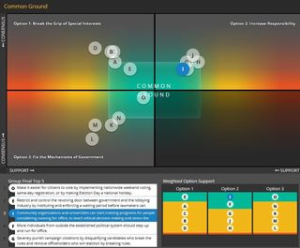
Below is a screen shot of a Common Ground graphic produced by an online National Issues Forum earlier this month. It is the product of ten people working through the issues together in a discussion about how to fix American politics.

I hope you are as interested as I am in helping to develop this new tool for more people to participate in political life.

Sincerely,

Bill Corbett National Issues Forums of Northern Virginia

Bill_Corbett_NIF_of_Northern_Vir@mail.vresp.com

NCDD 2014 Feature: “What’s Equity Have to Do with It?” Workshop

As we get closer and closer to NCDD 2014, we have asked our workshop presenters to share a bit more info about their sessions with you. So we are pleased to start by featuring “What’s equity have to do with it? Ensuring inclusive participation”, a great session being offered by Carrie Boron, Susan McCormack, and Valeriano Ramos. Read more about their workshop below and find out more about read about all of our NCDD 2014 sessions by clicking hereStill not registered for NCDD 2014? Make sure to register today


NCDD2014-blogimageNext month, my colleagues and I are co-presenting a session at the NCDD conference on the role of equity in public participation. Creating Community Solutions’ Susan McCormack and Everyday Democracy’s Valeriano Ramos, and me, Carrie Boron, and will join together with conference attendees to help answer the question, “What’s equity have to do with it?”

Taking on the topic of equity is challenging, confusing and conflicted, and requires much more time, knowledge and resources than are usually available. This is especially true given our limited session time at the conference. So, we thought we would give more “air time” to the subject here on the NCDD blog.

Those who work to bring people together in their communities to talk and find ways to make progress on various public issues often use the word “inclusive” to describe diverse participation. The aim is to have people from different ethnic, gender, age, sexual orientation, educational and socioeconomic backgrounds join the effort. Although such work is well-intentioned, organizers often miss the mark because they have not considered the societal structures and policies that perpetuate inequities.

Understanding the structures that support inequity (with a particular emphasis on structural racism) is essential for effective dialogue and long-term change on every issue. For instance, there are still many public and private institutions that exclude people of color. Schools in poor neighborhoods lack resources. Many police departments protecting and serving mostly people of color often lack ethnic diversity on their own force. Ferguson, MO, is the latest example of this scenario. We need to consider these structures and policies as we work to engage people in decisions that affect their lives.

Val, Sue, and I will be offering a tutorial on concepts related to equity, power and privilege; interactive discussions; and hands-on activities as well as best practices to use in engaging all kinds of people in your community. So, join us on Sunday, Oct.19, at 9 a.m. (bring your coffee!) for “What’s equity have to do with it? Ensuring inclusive participation” and dig into how we can ensure that people of all backgrounds have the opportunity to take part in civic life.

In the mean time, here are a handful of resources to help you create opportunities for equitable public engagement:

  • Race Forward’s “Racial Equity Impact Assessment Toolkit
  • RacialEquityTools.org, a website featuring tools, research, tips, curricula and ideas for those working to achieve racial equity
  • Everyday Democracy’s “Racial Dynamics to Watch For” – This handout provides a sampling of scenarios of power, privilege and inequity at play in organizing, facilitation and action planning, and asks organizers how they might avoid such situations.
  • Everyday Democracy’s “Focusing on Racial Equity as We Work” – This handout offers a set of questions for community organizing coalitions working to ensure that they’re working together in an equitable manner.
  • Everyday Democracy’s “Facilitators’ Racial Equity Checklist” – This handout outlines a set of debrief questions for small-group dialogue co-facilitators to use in debriefing and assessing their work together and in ensuring an equitable dialogue experience for participants.

When Citizens Bypass Government with Technology

The following post featuring a fascinating article about what technology can do to bring about “Democracy for the Next Generation” in local government came from the Davenport Institute’s Gov 2.0 Watch blog. Read it below or find the original here.


DavenportInst-logoCitizens across the country trust their federal, state and local government less. With this lack of trust, citizens are creating apps and using social media to help each other. Some cities are hesitant while others are embracing this phenomenon because technology is here to stay:

Local governments are facing new realities. Citizens’ trust in government has declined, and financial constraints do not allow local governments to deliver all of the services their communities would like. In response, citizens are changing as well. Increasingly, local residents and organizations are seizing opportunities to engage with their communities in their own ways by creating platforms that bypass government. . .

In Alexandria, Va., a citizens’ group launched ACTion Alexandria, an online platform for residents to engage in challenges, debate solutions, share stories and develop relationships, all on their own and without the help or permission of the city government. Even though ACTion Alexandria is a platform created and owned by citizens, the city government supports it and even partners with it.

You can read more here.

“Text, Talk, Act” Mental Health Conversations Return Oct. 6

We are so pleased to announce that the Text, Talk, Act mental health conversation is returning, this time with a great contest element. TTA is part of the NCDD-supported Creating Community Solutions initiative, and we highly encourage our members, especially those of you who work with youth, to consider hosting your own conversations! Learn more below or visit www.creatingcommunitysolutions.org/texttalkact.


One in four adults suffer from this in any given year. If it were cancer, diabetes or heart disease, we’d label it an epidemic. The once silent killer has suddenly starting screaming at us everywhere we go. It’s rocking our communities, and it’s affecting our families.

“It” is the state of our mental health – and it’s time we all started talking about it. And given that 3/4 of all mental health problems begin between the ages of 14 and 24, young people desperately need to have this conversation. But how do you bring up the elephant in the room? And how do you talk about something that’s been left in the shadows for so long?

Right now, across the country, young people are finally having this conversation. Through text messaging, groups of emerging adults are receiving discussion questions to start the conversation, and are given resources to learn how to take care of themselves and how to help a friend in need. These brave young people are ending the silence and taking to social media to encourage others to talk about the elephant in the room.

On Monday, October 6th, this conversation will go nationwide. Anyone, anywhere, at any time can join this vital effort. It’s easy:

  1. Gather 3-4 people* and text START to 89800
  2. Talk with their group using the text-enable questions
  3. Be part of the change

To encourage the conversation, participants can win prizes for themselves or their schools/community organizations. One of 10 lucky winners (between the ages of 18-24) will receive $500, and three $1,000 prizes will go to a winning high school, college and community organization. In addition, three lucky participants will receive an iPad mini. Visit bit.ly/TTAcontest for more details and to register.
Groups that can’t join the nationwide discussion on Oct. 6th can host a Text, Talk, Act event any time from now through the end of October. Simply text START to 89800 to begin.**

This initiative was developed in concert with Creating Community Solutions, part of the National Dialogue on Mental Health, Lady Gaga’s Born This Way Foundation, The National Institute for Civil Discourse, Everyday Democracy, American Association of Suicidology, National Alliance on Mental Health, the National Campus Leadership Council, and Crisis Text Line.

*Don’t have 3-4 peeps with you on Oct 6? Join the discussion on Twitter using #TextTalkAct

**From Canada? Short codes blocked on your phone? Use 7785881995

50 “Next Generation” Digital Engagement Tools

The theme for this year’s NCDD conference, “Democracy for the Next Generation“, is meant to invite us to build on all the innovative tools and practices that have been invigorating our field in recent years. Many of those innovations are digital, and that is why a major goal for NCDD 2014 is to help our field better understand how to utilize technology for engagement and to provide insights and know-how for harnessing the emerging technologies that support dialogue and deliberation. NCDD 2014 will feature tons of “next generation” engagement tech, so don’t miss it - register today!

In keeping with our theme, we are excited to share the great list of 50 “next generation” online engagement tools (no implied endorsement) that our partners at CommunityMatters compiled with help from our friends at New America, EngagingCities, the DDC, and NCDD’s own director. Check out the CM post and the comprehensive list below or find the original version here.


CM_logo-200pxOnline public participation is an effective complement to face-to-face events such as community workshops and design charrettes. Selecting the right platform to get the most out of digital outreach can be overwhelming.

The first step is to learn what tools are out there! Here are 50 tools for online engagement in no particular order (and with no implied endorsement). These digital platforms can help local government consult, collaborate with, and empower citizens in community decision-making.

Once you’ve perused the list, check out the notes and recording of our September 5 conference call with Alissa Black and Pete Peterson, who shared advice for selecting digital tools that align with engagement goals.

  1. coUrbanize: List project information for development proposals and gather online feedback.
  2. Cityzen: Gathers feedback by integrating polling and social media sites.
  3. Community Remarks: Map-based tool for facilitating dialogue and collecting feedback.
  4. Crowdbrite: Organizes comments for online brainstorming sessions and workshops.
  5. EngagementHQ: Provides information and gathers feedback for decision-making.
  6. MetroQuest: Incorporates scenario planning and visualizations for informing the public and collecting feedback.
  7. SeeClickFix: For reporting and responding to neighborhood issues.
  8. Neighborland: Forum that encourages community discussion and action at the neighborhood level.
  9. PublicStuff: Communication system for reporting and resolving community concerns.
  10. MindMixer: Ideation platform for community projects.
  11. NextDoor: Private social network and forum for neighborhoods.
  12. Adopt-a-Hydrant: Allows citizens to help maintain public infrastructure.
  13. CivicInsight: Platform for sharing progress on development of blighted properties.
  14. i-Neighbors: Free community website and discussion forum.
  15. Recovers: Engages the public in disaster preparedness and recovery.
  16. EngagingPlans: Information sharing and feedback forum for productive participation.
  17. Street Bump: Crowdsourcing application to improve public streets.
  18. neighbor.ly: Crowdfunding platform to promote local investment in improvement projects.
  19. TellUs Toolkit: Map-based tools for engagement and decision-making.
  20. Budget Simulator: Tool for educating about budget priorities and collecting feedback.
  21. CrowdHall: Interactive town halls meetings.
  22. Citizinvestor: Crowdfunding and civic engagement platform for local government projects.
  23. Open Town Hall: Online public comment forum for government.
  24. Shareabouts: Flexible tool for gathering public input on a map.
  25. Poll Everywhere: Collects audience responses in real time, live, or via the web.
  26. Tidepools: Collaborative mobile mapping platform for gathering and sharing hyperlocal information.
  27. Community PlanIt: Online game that makes planning playful, while collecting insight on community decisions.
  28. Open311: System for connecting citizens to government for reporting non-emergency issues.
  29. DialogueApp: Promotes dialogue to solve policy challenges with citizen input.
  30. Loomio: Online tool for collaborative decision-making.
  31. PlaceSpeak: Location-based community consultation platform.
  32. Citizen Budget: Involves residents in budgeting.
  33. e-Deliberation: Collaborative platform for large group decision-making.
  34. CrowdGauge: Open-source framework for building educational online games related to public priority setting.
  35. Citizen Space: Manage, publicize, and archive all public feedback activity.
  36. Zilino: Host deliberative online forums and facilitated participatory meetings.
  37. WeJit: Collaborative online decision-making, brainstorming, debating, prioritizing, and more.
  38. Ethelo Decisions: Framework for engagement, conflict resolution, and collective determination.
  39. Community Almanac: Contribute and collect stories about your community.
  40. GitHub: Connecting government employees with the public to collaborate on code, data, and policy.
  41. VividMaps: Engages citizens to map and promote local community assets.
  42. OSCity: Search, visualize, and combine data to gain insight on spatial planning. (EU only.)
  43. Civic Commons: Promoting conversations and connections that have the power to become informed, productive, collective civic action.
  44. Crowdmap: Collaborative mapping.
  45. Codigital: Get input on important issues.
  46. All Our Ideas: Collect and prioritize ideas through a democratic, transparent, and efficient process.
  47. Neighborhow: Create useful how-to guides for the community.
  48. OurCommonPlace: A community web-platform for connecting neighbors.
  49. Front Porch Forum: A free community forum, helping neighbors connect.
  50. PrioritySpend: Prioritization tool based on valuing ideas and possible actions.

Many thanks to the numerous sources whose work supported the creation of this list, including: @alissa007, @dellarucker, @challer, @mattleighninger and @heierbacher.

Did we miss something? Tell us about your favorite digital tools for public engagement in the comments section below!

You can find the original version of this CommunityMatters post at www.communitymatters.org/blog/let%E2%80%99s-get-digital-50-tools-online-public-engagement.

Updates from the Deliberative Democracy Consortium

DDC logoWe recently received a newsletter from NCDD supporting member Matt Leighninger of the Deliberative Democracy Consortium (DDC), and we wanted to share it with you. The DDC has been working on some important and exciting projects, and they have 3 big announcements.

First, the DDC has released a significant new white paper:

Infogagement: Citizenship and Democracy in the Age of Connection is the latest white paper from PACE (Philanthropy for Active Civic Engagement). Written by the DDC’s Matt Leighninger, the report – downloadable here - describes the innovative collision of journalism, technology, and public engagement. It is based on interviews with PACE members and many other leading thinkers, and presents the main arguments in the form of six sections, a series of charts, and a two-act play. Leighninger, Paula Ellis, and Chris Gates will discuss the report in a PACE webinar next Tuesday, September 16th – register at www.pacefunders.org/events.html.

Second, the DDC is part of hosting a new round of the wonderful Text, Talk, Act initiative, which is jointly supported by NCDD:

Monday, October 6th, will be the next big day for “Text, Talk, and Act” – a nationwide, text-enabled, face-to-face on mental health. Thousands of people have taken part in “Text, Talk, and Act,” which is a Creating Community Solutions event in the National Dialogue on Mental Health. Participating is easy: just get together with 4-5 other people on the 6th and text “START” to 89800. For more information, see www.bit.ly/texttalkact.

Lastly, Matt is releasing a great new textbook soon that is sure to be a key work for those teaching about our field’s work:

Coming soon: Matt Leighninger and Tina Nabatchi (Maxwell School, Syracuse University) are hard at work on a textbook on Public Participation in 21st Century Democracy, to be released in early 2015 by Wiley/Jossey-Bass.

We encourage you to learn more about the Deliberative Democracy Consortium and their work at www.deliberative-democracy.net.