
Coming to America: Who Should We Welcome, What Should We Do? (NIFI Issue Guide)

The 23-page issue guide, Coming to America: Who Should We Welcome, What Should We Do? was published in January 2018 from National Issues Forums Institute and Kettering Foundation. The issue guide offers participants three options to use during deliberation on how to address current immigration to the US. The issue guide is available to download for free on NIFI’s site here and is also available in Spanish here, and there is a post-forum questionnaire for both languages.

From NIFI…

The immigration issue affects virtually every American, directly or indirectly, often in deeply personal ways. This guide is designed to help people deliberate together about how we should approach the issue. The three options presented here reflect different ways of understanding what is at stake and force us to think about what matters most to us when we face difficult problems that involve all of us and that do not have perfect solutions.

The issue raises a number of difficult questions, and there are no easy answers:

Should we strictly enforce the law and deport people who are here without permission, or would deporting millions of people outweigh their crime?

Should we welcome more newcomers to build a more vibrant and diverse society, or does this pose too great a threat to national unity?

Should we accept more of the growing numbers of refugees from war-torn regions, or should we avoid the risk of allowing in people whose backgrounds may not have been fully checked?

Should our priority be to help immigrants assimilate into our distinctively American way of life, including learning English, or should we instead celebrate a growing mosaic of different peoples?

The concerns that underlie this issue are not confined to party affiliation, nor are they captured by labels like “conservative” or “liberal.”

The research involved in developing the guide included interviews and conversations with Americans from all walks of life, as well as surveys of nonpartisan public-opinion research, subject-matter scans, and reviews of initial drafts by people with direct experience with the subject.

This issue guide placemat presents three options for deliberation:

Option 1: Welcome Immigrants, Be a Beacon of Freedom
This option says that immigration has helped make America what it is today- a dynamic and diverse culture, an engine of the global economy, and a beacon of freedom around the world.  It says that part of what defines America as a nation is the opportunity for all to pursue the American dream. We should develop an immigration policy that builds on that tradition by welcoming newcomers, helping immigrant families stay together, and protecting those fleeing from war and oppression.

Option 2: Enforce the Law, Be Fair to Those Who Follow the Rules
This option says we need a fair system, where the rules are clear and, above all, enforced. With an estimated 11 million people living in the country illegally, our current system is unjust and uncontrolled. In fairness to the long lines of people who are waiting to come to America legally, we must strengthen our commitment to border security, crack down on visa overstays, and introduce more stringent measures to deal with immigrants living here without authorization.

Option 3: Slow Down and Rebuild Our Common Bonds
This option recognizes that newcomers have strengthened American culture in the past. But the current levels of immigration are so high, and the country is now so diverse, that we must regain our sense of national purpose and identity. We should have a measured immigration policy—one that reduces the rate of immigration and assists newcomers as they become part of the American community. We need to find ways to accommodate newcomers without compromising our sense of national unity.

Preview the starter video above. Like what you see? Press the ‘BUY’ button in the upper right-hand corner of the video. Your purchase includes UNLIMITED streaming and downloads of this starter video.

NIF-Logo2014About NIFI Issue Guides
NIFI’s Issue Guides introduce participants to several choices or approaches to consider. Rather than conforming to any single public proposal, each choice reflects widely held concerns and principles. Panels of experts review manuscripts to make sure the choices are presented accurately and fairly. By intention, Issue Guides do not identify individuals or organizations with partisan labels, such as Democratic, Republican, conservative, or liberal. The goal is to present ideas in a fresh way that encourages readers to judge them on their merit.

Follow on Twitter: @NIForums

Resource Link: www.nifi.org/en/issue-guide/coming-america
new CIRCLE report on Millennials’ ideology

CIRCLE has released a new report entitled “Millennials’ Diverse Political Views: A Typology of the Rising Generation.” From the summary:

Millennials are already the largest group of potential voters and are destined to dominate American politics in decades to come. As a demographically and economically diverse generation, they naturally hold a wide range of opinions. In the 2016 election, for example, voters under the age of 30 split their support: 55% percent for Hillary Clinton, 37% for Donald Trump, and 8% for other candidates.

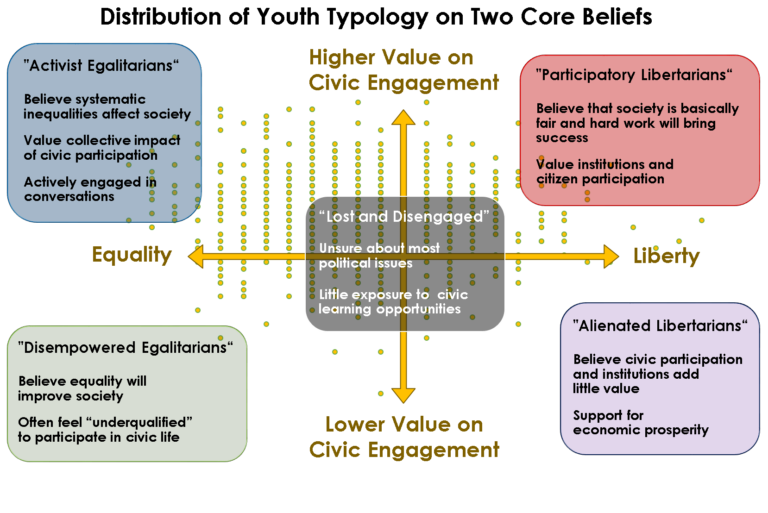
We use recent data to identify clusters of Americans between the ages of 18 and 34 into five groups:

  • Activist Egalitarians (39% of Millennials)
  • Participatory Libertarians (29%)
  • Disempowered Egalitarians (8%)
  • Alienated Libertarians (5%)
  • The Lost and Disengaged (18%)

The two egalitarian groups are concerned about social, political, and economic inequality, and they tend to support government action to combat it. The two libertarian groups are concerned about individual freedom and are more skeptical of government. These orientations characterize some, but not all, core characteristics of young people’s beliefs about the size and responsibilities of government, and whether inequality is seen as a major barrier to progress.

Within both the libertarian and the egalitarian sides, there are disagreements about civic engagement. Millennials of all political stripes differ on whether it is useful for people like them to engage with fellow members of their community or with institutions—or both—to change society. Meanwhile, the Lost and Disengaged do not seem sure where they fall, are disconnected from news media, and largely disengaged from civic life.

The largest group, Activist Egalitarians fit an influential stereotype of Millennials. However, they number less than two-fifths (39%) of all Millennials, and are themselves not monolithic. Less than a third (28%) see themselves as liberal or extremely liberal, and 14% see themselves as conservative or extremely conservative. More than half (54%) of Hillary Clinton’s Millennial voters came from this group, but they have mixed feelings about the Democratic Party.

Demographic and Social Differences

There are important demographic and social differences between the groups, particularly related to education and income.

Participatory Libertarians are almost three times as likely to have a college degree as the Lost and Disengaged.

Among the two Egalitarian groups, the Activists are almost twice as likely to have completed college as the Disempowered, more than half of whom have no college experience at all. That a lack of civic efficacy and confidence correlates with these disparities only exacerbates political and social inequalities.

Those who do not believe in the power of people’s collective work in communities and society vary not only on their Egalitarian-Libertarian polarity, but also on why they may not believe that people can make a difference:

Disempowered Egalitarians acutely feel social inequities but may be hopeless that anything could change.

Alienated Libertarians appear to worry about individual prosperity first and foremost and believe that everyone should look out of themselves rather than work with institutions or with each other.

It is encouraging that a majority of young people of diverse ideologies believe that they should work with others to benefit society and communities, and that civic institutions can play a positive role if they are kept accountable. Still, a troublingly sizable minority are unconvinced that they and their fellow citizens can effect change, and/or feel unqualified to contribute to civic life. Engaging these young people will be challenging, but it is not impossible. We must implement multi-pronged, short- and long-term strategies for engagement that support all young people as they develop their civic and political identity. And we must ensure that Millennials have the resources and opportunities to express their identities with a loud and clear voice, and to turn that voice into effective action.

Taylor Willingham Award Winner Announced for 2018

The National Issues Forums Institute – an NCDD member organization – recently awarded their annual Taylor L. Willingham Legacy Award given in loving memory of our friend Taylor and her work in the field. We’d like to invite you to join us in congratulating Matt Miller, the recently re-elected mayor of Ashland Ohio. The award is given to those who are working to advance deliberative democracy in their communities, and you can read more about Matt’s work in the NIFI announcement below or find the original here.


Matt Miller is the 2018 Recipient of the Taylor L. Willingham Legacy Award

Matt Miller, of Ashland, Ohio, is this year’s recipient of the Taylor L. Willingham Legacy Award. The award, which is administered by the National Issues Forums Institute (NIFI), is intended to help people who are interested in promoting deliberative forums in their communities as a way to help people talk about difficult public issues.

Miller, the recently-elected mayor of Ashland, Ohio, is especially interested in helping the community talk about the opioid epidemic, among other issues.

The following is more information about Miller’s interest in deliberative forums and his plans for using the Taylor L. Willingham Legacy Award:

Matt is a new member of the Advisory Committee for the Center for Civic Life at Ashland University. In November, he was elected as Mayor of Ashland, Ohio, and he is enthusiastic to learn more about the deliberative process and to use it to gain a public voice on major issues in the city. Additionally, people in the community will have a chance to learn about the power of democratic deliberation to engage them as citizens.

Matt’s plan for becoming involved in democratic deliberation is to host a moderator training for himself and other city officials to learn how to moderate forums, followed by forums on city issues. Grant money will be spent on the moderator training, as well as the first deliberative forum.

Click here for more information, or to contact Miller about his work.

You can find the original version of this NIFI blog post at www.nifi.org/en/matt-miller-2018-recipient-taylor-l-willingham-legacy-award.

Piano urbanistico comunale (PUC) di Olbia [Olbia local plan]

Il Laboratorio PUC Olbia è un processo di partecipazione attivato dall’Amministrazione a supporto delle fasi di elaborazione del nuovo Piano Urbanistico Comunale (PUC) per la città e il territorio di Olbia. Nelle Linee programmatiche e procedure operative per la redazione del nuovo piano, il Consiglio comunale ha previsto una intensa...

Participatory Budgeting Coming to NYC High Schools

Very exciting news from NCDD member org – the Participatory Budgeting Project, Mayor Bill de Blasio recently announced that participatory budgeting will soon be happening in all NYC public high schools. With over 400 high schools, this is bringing PB to schools in a way that sets a powerful precedent for youth engagement and participation in democracy. Friendly reminder about the Innovations in Participatory Democracy conference happening next week and we encourage folks in the NCDD network to attend!

For those that will be at IPD, NCDD will be co-presenting a session on the first day which you can learn about in our blog post here and we also plan on having an NCDD meet up on Friday night – which we would love for you to join! You can read the PBP announcement below or find the original here.


BIG News for PB in Schools – and a BIG invitation!

Did you hear? Just this week Mayor Bill de Blasio announced the launch of Participatory Budgeting (PB) in all public high schools in New York City!

That’s over 400 schools in total!

In his State of the City address, Mayor de Blasio emphasized:

“We’ve got to prove to our young people that they’ve got the power to change the world around them. When people feel empowered they participate. When they can see the impact they’re making they come back for more. So starting next school year public school students will learn how to stay civically engaged and to fight for the future they believe in with our Civics for All initiative.”

At the Participatory Budgeting Project (PBP), we’re fighting for this future alongside young leaders like Jacinta Ojevwe and Vanessa Gonzalez – two of our youth scholarship recipients for the Innovations in Participatory Democracy Conference.

To continue growing this work, we’re hosting many conference sessionson how to engage, support, and empower youth leadership in reimagining democracy. I’m especially excited to open our conference at Phoenix’s Central High School during their PB vote – where we’ll hear from students and teachers and see nearly 3,000 students cast their ballots on how to spend part of the school district budget.

We’re eager to continue scaling and deepening the impacts of PB because, as Mayor de Blasio said:

“We know that when students feel that opportunity to make a difference it will be the beginning of a long lifetime of participation.”

Will you join us in empowering even more young leaders, and celebrating with them at our Innovations in Participatory Democracy Conference?

For a preview of the PB vote in Phoenix, see (and share!) our PB in Schools Video.

Hope to see you there!

You can find the original version of this PBP blog post at www.participatorybudgeting.org/big-news-pb-schools-big-invitation/.