Sponsored by Tufts University’s Tisch College of Civic Life and the association “i-dijaspora,” Switzerland
Co-organized by Peter Levine, Tufts University, and Nenad Stojanovi?, University of Geneva, with academic collaborations in Bosnia and Herzegovina
Discussions about deliberative democracy represent one significant area of focus for the emerging interdisciplinary field of Civic Studies (Levine and So?tan 2014). Deliberative democracy is also a component of the Council of Europe’s Action Plan for Bosnia and Herzegovina and inspires ongoing work in the City of Mostar. An international group of scholars and practitioners will meet from 8 October (evening) until 10 October (midday) to learn about the deliberations in Mostar, to consider theoretical frameworks and their practical applications, and to discuss the value–and possible limitations–of deliberation. Participants will be asked to read selected texts in advance and will spend the time in discussion.
Approximately 20 participants will be selected on the basis of their backgrounds and expertise, level of interest in the topic, and diversity of perspectives. Postgraduate students, university faculty, journalists, and experienced practitioners from civil society and government are welcome to apply. Applicants are welcome from any country. There is no fee for participation, and meals will be provided. Limited subsidies will be available for travel and lodgings for some of those who demonstrate need. The language of the readings and discussions will be English.
To apply, please complete this form, which will include a request to upload your CV. Deadline: 30 April 2021
Tufts University’s Jonathan M. Tisch College of Civic Life will award a Postdoctoral Fellowship in Civic Science for the 2021-22 academic year (June 1, 2021-May 31, 2022). This postdoctoral fellowship is offered in partnership with the Charles F. Kettering Foundation in Dayton, OH and involves some work at Kettering’s offices in Dayton as well as full-time employment at Tufts in the Boston area.
The Tisch College Civic Science initiative (https://tischcollege.tufts.edu/civic-studies/civic-science), led by Dr. Peter Levine and Dr. Samantha Fried, aims to reframe the relationships among scientists and scientific institutions, institutions of higher education, the state, the media and the public. It also asks about the relationships and distinctions among those institutions, historically and today. With this context in mind, Civic Science seeks to…
Reconfigure the national conversation on divisive and complex issues that are both scientific and political in nature, thereby connecting scientific institutions, research, and publications to people’s values, beliefs, and choices.
Define and advance the public good in science, thereby finding ways for scientific institutions to better serve communities.
Explore the concept of knowledge as a commons (or common-pool resource), developing a line of work pioneered by Elinor Ostrom and her colleagues
Develop curricula that simultaneously attend to scientific and civic issues and that teach students to understand and communicate both kinds of narratives together to a variety of audiences.
Develop approaches to democratic governance that are attuned to the role of the scientific enterprise in society.
Ask what it would mean to earn the trust of communities that have been historically marginalized by the institution of science, and what science would look like if this was a priority.
Intervene at institutional and grassroots levels, alongside a robust theoretical analysis.
A PhD is required. Applicants must also demonstrate a strong interest in investigating the intersections of science and civic matters as the focus of their postdoctoral year.
Civic Science is interdisciplinary, and this fellowship is open to specialists in any relevant field.
Qualifications
A scholar with a Ph.D. in any relevant discipline who is not yet tenured.
Desirable qualifications include, but are not limited to, the following:
A background, degree, or certificate in a STEM –– or STEM-adjacent –– field, OR
Work on strengthening, designing, or evaluating democratic processes, OR
A background in the Bloomington School approach to political economy and/or studies of common-pool resources, OR
A background in political science or political theory, OR
Previous work on the connections between community health and civic life, OR
A background in science, technology, and society (STS), OR
A background in critical theory, media studies, rhetoric, philosophy of science and technology, or science communication.
The ideal candidate may have more than one of these backgrounds.
The Postdoctoral Fellow will conduct research related to Civic Science, both independently and in collaboration with Peter Levine, Samantha Fried, and the Kettering Foundation. The Fellow may teach or co-teach one course to undergraduates in the Civic Studies Major. The Fellow will attend orientation and research meetings at the Kettering Foundation as requested.
A cover letter that includes a description of your research goals during the fellowship year (which must relate to Civic Science) and courses you would like to offer;
Your CV;
One writing sample;
Three letters of recommendation which should be uploaded by your recommenders to Interfolio directly; and
Teaching course evaluations, if available.
Opens March 17, 2021 and will continue until the position is filled, or May 20. Questions about the position should be addressed to Dr. Peter Levine, Associate Dean of Tisch College at Peter.Levine@tufts.edu.
Non-Discrimination Statement Our institution does not discriminate against job candidates on the basis of actual or perceived gender, gender identity, race, color, national origin, sexual orientation, marital status, disability, or religion. Tufts University, founded in 1852, prioritizes quality teaching, highly competitive basic and applied research and a commitment to active citizenship locally, regionally and globally. Tufts University also prides itself on creating a diverse, equitable, and inclusive community. Current and prospective employees of the university are expected to have and continuously develop skill in, and disposition for, positively engaging with a diverse population of faculty, staff, and students. Tufts University is an Equal Opportunity/ Affirmative Action Employer. We are committed to increasing the diversity of our faculty and staff and fostering their success when hired. Members of underrepresented groups are welcome and strongly encouraged to apply. If you are an applicant with a disability who is unable to use our online tools to search and apply for jobs, please contact us by calling Johny Laine in the Office of Equal Opportunity (OEO) at 617.627.3298 or at Johny.Laine@tufts.edu. Applicants can learn more about requesting reasonable accommodations at http://oeo.tufts.edu/.
Equal Employment Opportunity Statement
Tufts University, founded in 1852, prioritizes quality teaching, highly competitive basic and applied research, and a commitment to active citizenship locally, regionally, and globally. Tufts University also prides itself on creating a diverse, equitable, and inclusive community. Current and prospective employees of the university are expected to have and continuously develop skill in, and disposition for, positively engaging with a diverse population of faculty, staff, and students.
Tufts University is an Equal Opportunity/Affirmative Action Employer. We are committed to increasing the diversity of our faculty and staff and fostering their success when hired. Members of underrepresented groups are welcome and strongly encouraged to apply. See the University’s Non-Discrimination statement and policy here https://oeo.tufts.edu/policies-procedures/non-discrimination/. If you are an applicant with a disability who is unable to use our online tools to search and apply for jobs, please contact us by calling Johny Laine in the Office of Equal Opportunity (OEO) at 617-627-3298 or atjohny.laine@tufts.edu. Applicants can learn more about requesting reasonable accommodations at http://oeo.tufts.edu.
Exciting news, friends! In the Spring of 2017, The Lou Frey Institute (LFI) and the Boys & Girls Clubs of Central Florida (BGCCF) established a partnership, designed to help implement and support the creation of a Civic Action Project (CAP) Program in BGCCF’s After School Zone for middle school students. This program was adapted for middle schools and after-school environments from the original Civics Action Project first developed by the Constitutional Rights Foundation. Since the launch of this effort, over 100 middle school students have participated in the CAP program, where they identify a community issue or problem of interest to them, research it, and propose a detailed plan for how to address it. In support of these students and their facilitators is the Institute’s Civics Instructional Specialist, Chris Spinale. Participating students attend a Civic Education Showcase on the UCF campus where they present their projects and findings to community stakeholders and policy makers.
Because of the hard work of BGCCF staff, site facilitators, CAP teachers, and their club members, the Boys & Girls Clubs of Central Florida’s Civic Action Project Program for the After School Zone was named the recipient of the 2020 Best Overall Program Impact Excellence Award for the State of Florida by the Boys & Girls Clubs of America (BGCA) and Florida Area Council.
CAP took home the prize for the State of Florida as the overall standout program among all the Boys & Girls Club programs in the state. Kelvin Curry, Director of Middle School Programs for BGCCF, thanked LFI for its partnership and all it has afforded their club members.
Both LFI and BGCCF are committed to continuing the hard work of cultivating a citizenry that is informed, engaged, and active. Questions about the program can be directed to LFI Interim Director Steve Masyada (Stephen.masyada@ucf.edu) or Civics Instructional Specialist Chris Spinale (Christopher.spinale@ucf.edu).
Good morning, friends in Civics! As you likely know if you are at all familiar with our work, the Lou Frey Institute is constantly looking to improve our work and ensure that our resources are the best that they can be. As the state has begun introducing new/revised benchmarks for K-12 civics (to be released for public comment soon) and ELA (the BEST Standards), we want to start revisions on existing materials and the development of new materials sooner rather than later. However, we want to prioritize what teachers feel they need most, and in pursuit of that, we have crafted a short survey for elementary grade band teachers to help us in our initial stages. This survey will simply ask you to prioritize the types of resources you would like us to address at the K-5 level, and also asks whether you might be interested in a compensated opportunity to be involved in the work. So if you have a few minutes and teach K-5 in Florida, please let us know how we can help you. Complete our short survey, and share with others who might have interest.
If you’re a good ancestor of the Enlightenment, you probably believe that “nature” is something entirely separate from us. We moderns live at a sanitized distance from messy biophysical realities, after all. Lately, this casual premise of ours has been taking some serious hits, however, with the acceleration of climate change, species extinctions, collapsing coral reefs, cataclysmic weather events, and more.
In recent weeks, I've noticed a big uptick in the number of creative overtures to the realm previously known as nature (a term that implies that humanity and nature are separate). I decided to bring together some of the more imaginative gambits that I've encountered.
What underlies each example, it seems, is our aspiration to treat “nature” as a living system of diverse elements, each with its own agency and imperatives. Or as Oren Lyons, a Native American Faithkeeper of the Seneca Nation, put it years ago: “What you people call your natural resources, our people call our relatives.”
So how do we get better acquainted with our nonhuman relatives?
A New Pronoun for the Natural World
Robin Wall Kimmerer, the celebrated author of Braiding Sweetgrass, suggests we should start with the idea of using a new pronoun when referring to nature. In a recent essay in The Ecologist magazine, she urges us to avoid the use of the pronoun “it” in such circumstances:
“Objectification of the natural world reinforces the notion that our species is somehow more deserving of the gifts of the world than the other 8.7 million species with whom we share the planet. Using 'it' absolves us of moral responsibility and opens the door to exploitation. When Sugar Maple is an 'it' we give ourselves permission to pick up the saw. 'It' means it doesn't matter….
"Singing whales, talking trees, dancing bees, birds who make art, fish who navigate, plants who learn and remember. We are surrounded by intelligences other than our own, by feathered people and people with leaves. But we’ve forgotten. There are many forces arrayed to help us forget – even the language we speak….
"In indigenous ways of knowing, other species are recognized not only as persons, but also as teachers who can inspire how we might live. We can learn a new solar economy from plants, medicines from mycelia, and architecture from the ants. By learning from other species, we might even learn humility.
Kimmerer informs us that the proper Anishinaabe word for beings of the living earth is Bemaadiziiaaki. Since that's a mouthful for we English speakers, she suggests shortening it to “ki” or “kin.” “Might the path to sustainability be marked by grammar?” asks Kimmerer.
Eco-co-operativess called Zoöp
In the same vein as a new pronoun for nature, a Dutch webpage called Zoöpis calling for a new type legal entity that recognizes collaboration between human organizations and multispecies ecological communities. The term “Zoöp” is short for “zoöperation,” which itself is a combination of the word “co-op” (short for “co-operation") and “zoë” (Greek for "life").
The zoöp concept is based on the idea that the profit-maximizing greed of capitalism is overriding most human and nonhuman lives, so a different organizational form is needed. The stated goal of Zoöp is to “strengthen the position of nonhumans within human societies,” to “contribute to ecological regeneration in a way that resists extractivist dynamics,” and to apply the Zoöp model “to a wide variety of organizations.” A Dutch law firm is “critically assessing the zoöp legal structure and developing the charters and documents required to establish actual zoöps,” the group’s website notes. I'm curious about how the self-imposed criteria are to be enforced.
The project explains that “its key methods were developed in a public research trajectory of Het Nieuwe Instituut that took place during the Terraforming Earth Labs (2018), the Neuhausacademy for more-than-human knowledge (2019), and the Venice Exploratorium (2020).”
The Idt Suffix as an Alternative to Inc. or Ltd.
In yet another innovation along these lines, the Community Economics Research Network – an international group of activist-minded academics with new visions for economic life – has proposed a new suffix to identify an organization as committed to interdependence. Businesses often have “Inc.,” “Ltd.” or “LLC” at the end of their names.
A CERN project called “The Interdependence” proposes that organizations add an "idt" to the end of their name if they “cultivate economic principles and practices that recognize our universal responsibility of mutual care, and strive to bring that understanding into the practice of everyday life.” The acronym idt would signal that the organization intends “to explore, experiment, share and learn together how to create ethical relations of interdependence.”
Already there are a number of enterprises that use the idt tag: Company Drinks idt., a UK community space and social enterprise; Brave New Alps idt., a participatory research project in the Italian Alps; Cube Cola idt., an open source soft drink in Bristol, England; and Trajna idt., a design collective that explores sustainable production in Slovenia that “works towards supporting multispecies livelihoods.” More about idt. in an Idt Charta statement.
Assigning Legal Personhood to Nature
Years ago the impulse to affirm our kinship with nature has manifested in the “rights of nature” movement. The tactic here is to assign legal personhood to mountains, rivers, and forests, and other elements of the Earth so that they can be properly “represented” in courts and legislatures. The states of Ecuador, New Zealand, Colombia, and India have already enacted laws giving specific legal rights to nature.
But now this bold move in jurisprudence have found a footing in North American law. In February 2019, the citizens of Toledo, Ohio, approved Lake Erie Bill of Rights Charter Amendment, which authorizes people to sue polluters on behalf of Lake Erie.
Self-Owning Trees
While nature’s rights as a legal doctrine is fairly new, the idea that nature is alive and sovereign has a long history, even in pockets of western culture. In Athens, Georgia, local lore celebrated the “Tree That Owns Itself for more than a century.
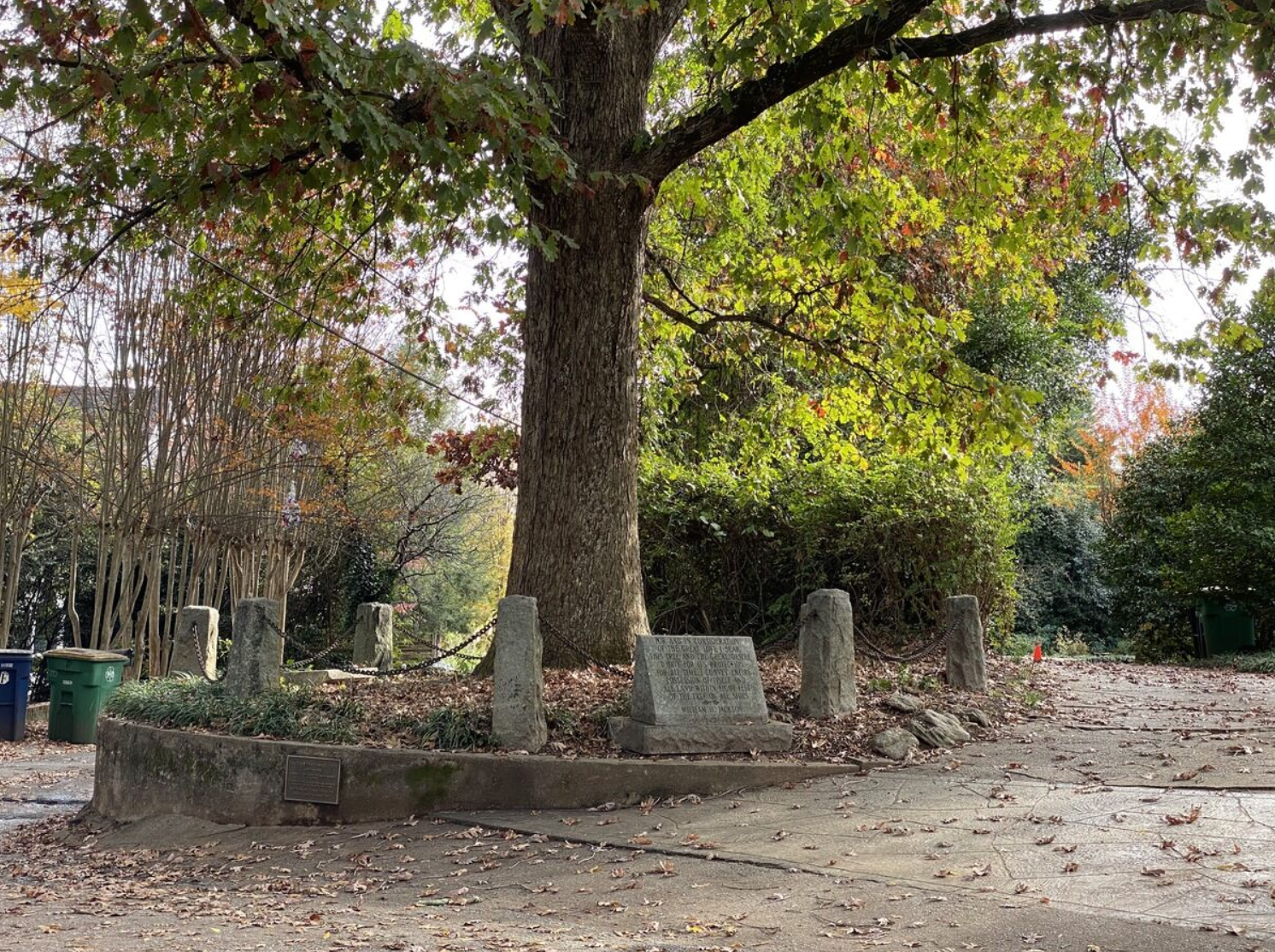
There is a huge white oak tree at the corner of South Finley and Dearing Streets in Athens that is said to have legal ownership of itself. A gentleman who lived across the street from the tree, William H. Jackson, bequeathed the eight-foot-wide tree to itself, circa 1832, with this legal statement: “For and in consideration of the great love I bear this tree and the great desire I have for its protection for all time, I convey entire possession of itself and all land within eight feet of the tree on all sides.”
The Tree That Owns Itself, Athens, Georgia
As recounted by Wikipedia, “The original tree, thought to have started life between the mid-16th and late 18th century, fell in 1942, but a new tree was grown from one of its accords and planted in the same location. The current tree is sometimes referred to as the ‘Son of the Tree That Owns Itself.’” The tree is recognized by National Register of Historic Places 1975, but almost certainly not by any court of law. (More about the tree here.)
Did law scholar Christopher Stone have this tree in mind when he wrote his famous 1972 law review called “Should Trees Have Standing?” His point – written in the fevered early days of the modern environmental movement – was to suggest that courts should recognize the rights of nonhuman beings in western courtrooms.
The Embassy of the North Sea
Another creative idea is to give distinct elements of nature political representation. Some folks in The Hague, The Netherlands, founded “The Embassy of the North Sea” in 2018 as a way for the sea to own itself. As the “About” section on its website explains:
“Diversity is in the interest of all life. Therefore, direct political representation of the sea and the life within it is necessary. The Embassy of the North Sea was founded on the principle that the North Sea owns itself. Here, the voices of plants, animals, microbes, and people in and around the North Sea are listened to and involved….
“The Embassy researches how non-humans, from phytoplankton to ship wrecks and cod fish – can become full-fledged members of society. We have plotted a route through to 2030, firstly learning to listen to the sea before we learn to speak with it. Finally, we will negotiate on behalf of the North Sea and all the life that it encapsulates.”
The Self-Owning Forest (via Digital Technology)
Even techno-solutionists seem to be jumping on the idea of sovereign nature, albeit through the narrow lens of their own high-tech vision. A Silicon Valley-inspired project called terra0 is proposing that blockchain software, artificial intelligence, and remote sensors be used to enable a forest to self-govern itself. In the capitalist/libertarian mindset, this means that the forest should have the capacity to manage itself as a business. Using a high-tech system (devised by humans presumably), the forest could selectively choose which of its trees are suitable to cut for timber, and then self-authorize the sale of those trees, based on algorithms that some programmer would write.
The idea is that the forest’s selective monetization of itself would allow it to "self-own" itself as a “digital autonomous organization” (or DAO). This is an idealized but elusive organizational form that many self-styled tech visionaries are striving to create. The “forest as a DAO” would ostensibly give it sovereignty over its future and even (if terra0 gets its way) generate a universal basic income for everyone. Terra0 describes itself as
“a group of developers, theorists, and researchers exploring the creation of hybrid ecosystems in the technosphere. Driven by a keen interest in remote sensing, machine learning, and distributed ledger technology, we develop tools for the management of natural ecosystems and resources via the creation of meshes of interacting decentralized autonomous organisations. We believe that these key technologies give us the opportunity to rethink existing and ineffective governance and regulatory structures and that they will play a crucial role in creating a sustainable, resilient, and biodiverse future.”
In more technical terms, terra0 describes the forest-as-DAO idea as “a scalable framework built on the Ethereum network that provides automated resilience systems for ecosystems.” For more, see also this TEDx Amstelveen video by Hilde Latourvideo by Hilde Latour(at 8 minute timemark).
Personally, I find the vision set forth by terra0 rather monstrous: a world “where we are free of our labors and joined back to nature, returned to our mammal brothers and sisters, and all watched over by machines of loving grace.”
How do machines confer loving grace on us? And who oversees the designers as they presume to re-program forests as business-like DAOs? There are surely many kinks to work out in humanity's laudable efforts to sync with the more-than-human world.
If you’re a good ancestor of the Enlightenment, you probably believe that “nature” is something entirely separate from us. We moderns live at a sanitized distance from messy biophysical realities, after all. Lately, this casual premise of ours has been taking some serious hits, however, with the acceleration of climate change, species extinctions, collapsing coral reefs, cataclysmic weather events, and more.
In recent weeks, I've noticed a big uptick in the number of creative overtures to the realm previously known as nature (a term that implies that humanity and nature are separate). I decided to bring together some of the more imaginative gambits that I've encountered.
What underlies each example, it seems, is our aspiration to treat “nature” as a living system of diverse elements, each with its own agency and imperatives. Or as Oren Lyons, a Native American Faithkeeper of the Seneca Nation, put it years ago: “What you people call your natural resources, our people call our relatives.”
So how do we get better acquainted with our nonhuman relatives?
A New Pronoun for the Natural World
Robin Wall Kimmerer, the celebrated author of Braiding Sweetgrass, suggests we should start with the idea of using a new pronoun when referring to nature. In a recent essay in The Ecologist magazine, she urges us to avoid the use of the pronoun “it” in such circumstances:
“Objectification of the natural world reinforces the notion that our species is somehow more deserving of the gifts of the world than the other 8.7 million species with whom we share the planet. Using 'it' absolves us of moral responsibility and opens the door to exploitation. When Sugar Maple is an 'it' we give ourselves permission to pick up the saw. 'It' means it doesn't matter….
"Singing whales, talking trees, dancing bees, birds who make art, fish who navigate, plants who learn and remember. We are surrounded by intelligences other than our own, by feathered people and people with leaves. But we’ve forgotten. There are many forces arrayed to help us forget – even the language we speak….
"In indigenous ways of knowing, other species are recognized not only as persons, but also as teachers who can inspire how we might live. We can learn a new solar economy from plants, medicines from mycelia, and architecture from the ants. By learning from other species, we might even learn humility.
Kimmerer informs us that the proper Anishinaabe word for beings of the living earth is Bemaadiziiaaki. Since that's a mouthful for we English speakers, she suggests shortening it to “ki” or “kin.” “Might the path to sustainability be marked by grammar?” asks Kimmerer.
Eco-co-operativess called Zoöp
In the same vein as a new pronoun for nature, a Dutch webpage called Zoöpis calling for a new type legal entity that recognizes collaboration between human organizations and multispecies ecological communities. The term “Zoöp” is short for “zoöperation,” which itself is a combination of the word “co-op” (short for “co-operation") and “zoë” (Greek for "life").
The zoöp concept is based on the idea that the profit-maximizing greed of capitalism is overriding most human and nonhuman lives, so a different organizational form is needed. The stated goal of Zoöp is to “strengthen the position of nonhumans within human societies,” to “contribute to ecological regeneration in a way that resists extractivist dynamics,” and to apply the Zoöp model “to a wide variety of organizations.” A Dutch law firm is “critically assessing the zoöp legal structure and developing the charters and documents required to establish actual zoöps,” the group’s website notes. I'm curious about how the self-imposed criteria are to be enforced.
The project explains that “its key methods were developed in a public research trajectory of Het Nieuwe Instituut that took place during the Terraforming Earth Labs (2018), the Neuhausacademy for more-than-human knowledge (2019), and the Venice Exploratorium (2020).”
The Idt Suffix as an Alternative to Inc. or Ltd.
In yet another innovation along these lines, the Community Economics Research Network – an international group of activist-minded academics with new visions for economic life – has proposed a new suffix to identify an organization as committed to interdependence. Businesses often have “Inc.,” “Ltd.” or “LLC” at the end of their names.
A CERN project called “The Interdependence” proposes that organizations add an "idt" to the end of their name if they “cultivate economic principles and practices that recognize our universal responsibility of mutual care, and strive to bring that understanding into the practice of everyday life.” The acronym idt would signal that the organization intends “to explore, experiment, share and learn together how to create ethical relations of interdependence.”
Already there are a number of enterprises that use the idt tag: Company Drinks idt., a UK community space and social enterprise; Brave New Alps idt., a participatory research project in the Italian Alps; Cube Cola idt., an open source soft drink in Bristol, England; and Trajna idt., a design collective that explores sustainable production in Slovenia that “works towards supporting multispecies livelihoods.” More about idt. in an Idt Charta statement.
Assigning Legal Personhood to Nature
Years ago the impulse to affirm our kinship with nature has manifested in the “rights of nature” movement. The tactic here is to assign legal personhood to mountains, rivers, and forests, and other elements of the Earth so that they can be properly “represented” in courts and legislatures. The states of Ecuador, New Zealand, Colombia, and India have already enacted laws giving specific legal rights to nature.
But now this bold move in jurisprudence have found a footing in North American law. In February 2019, the citizens of Toledo, Ohio, approved Lake Erie Bill of Rights Charter Amendment, which authorizes people to sue polluters on behalf of Lake Erie.
Self-Owning Trees
While nature’s rights as a legal doctrine is fairly new, the idea that nature is alive and sovereign has a long history, even in pockets of western culture. In Athens, Georgia, local lore celebrated the “Tree That Owns Itself for more than a century.
There is a huge white oak tree at the corner of South Finley and Dearing Streets in Athens that is said to have legal ownership of itself. A gentleman who lived across the street from the tree, William H. Jackson, bequeathed the eight-foot-wide tree to itself, circa 1832, with this legal statement: “For and in consideration of the great love I bear this tree and the great desire I have for its protection for all time, I convey entire possession of itself and all land within eight feet of the tree on all sides.”
The Tree That Owns Itself, Athens, Georgia
As recounted by Wikipedia, “The original tree, thought to have started life between the mid-16th and late 18th century, fell in 1942, but a new tree was grown from one of its accords and planted in the same location. The current tree is sometimes referred to as the ‘Son of the Tree That Owns Itself.’” The tree is recognized by National Register of Historic Places 1975, but almost certainly not by any court of law. (More about the tree here.)
Did law scholar Christopher Stone have this tree in mind when he wrote his famous 1972 law review called “Should Trees Have Standing?” His point – written in the fevered early days of the modern environmental movement – was to suggest that courts should recognize the rights of nonhuman beings in western courtrooms.
The Embassy of the North Sea
Another creative idea is to give distinct elements of nature political representation. Some folks in The Hague, The Netherlands, founded “The Embassy of the North Sea” in 2018 as a way for the sea to own itself. As the “About” section on its website explains:
“Diversity is in the interest of all life. Therefore, direct political representation of the sea and the life within it is necessary. The Embassy of the North Sea was founded on the principle that the North Sea owns itself. Here, the voices of plants, animals, microbes, and people in and around the North Sea are listened to and involved….
“The Embassy researches how non-humans, from phytoplankton to ship wrecks and cod fish – can become full-fledged members of society. We have plotted a route through to 2030, firstly learning to listen to the sea before we learn to speak with it. Finally, we will negotiate on behalf of the North Sea and all the life that it encapsulates.”
The Self-Owning Forest (via Digital Technology)
Even techno-solutionists seem to be jumping on the idea of sovereign nature, albeit through the narrow lens of their own high-tech vision. A Silicon Valley-inspired project called terra0 is proposing that blockchain software, artificial intelligence, and remote sensors be used to enable a forest to self-govern itself. In the capitalist/libertarian mindset, this means that the forest should have the capacity to manage itself as a business. Using a high-tech system (devised by humans presumably), the forest could selectively choose which of its trees are suitable to cut for timber, and then self-authorize the sale of those trees, based on algorithms that some programmer would write.
The idea is that the forest’s selective monetization of itself would allow it to "self-own" itself as a “digital autonomous organization” (or DAO). This is an idealized but elusive organizational form that many self-styled tech visionaries are striving to create. The “forest as a DAO” would ostensibly give it sovereignty over its future and even (if terra0 gets its way) generate a universal basic income for everyone. Terra0 describes itself as
“a group of developers, theorists, and researchers exploring the creation of hybrid ecosystems in the technosphere. Driven by a keen interest in remote sensing, machine learning, and distributed ledger technology, we develop tools for the management of natural ecosystems and resources via the creation of meshes of interacting decentralized autonomous organisations. We believe that these key technologies give us the opportunity to rethink existing and ineffective governance and regulatory structures and that they will play a crucial role in creating a sustainable, resilient, and biodiverse future.”
In more technical terms, terra0 describes the forest-as-DAO idea as “a scalable framework built on the Ethereum network that provides automated resilience systems for ecosystems.” For more, see also this TEDx Amstelveen video by Hilde Latourvideo by Hilde Latour(at 8 minute timemark).
Personally, I find the vision set forth by terra0 rather monstrous: a world “where we are free of our labors and joined back to nature, returned to our mammal brothers and sisters, and all watched over by machines of loving grace.”
How do machines confer loving grace on us? And who oversees the designers as they presume to re-program forests as business-like DAOs? There are surely many kinks to work out in humanity's laudable efforts to sync with the more-than-human world.
If you’re a good ancestor of the Enlightenment, you probably believe that “nature” is something entirely separate from us. We moderns live at a sanitized distance from messy biophysical realities, after all. Lately, this casual premise of ours has been taking some serious hits, however, with the acceleration of climate change, species extinctions, collapsing coral reefs, cataclysmic weather events, and more.
In recent weeks, I've noticed a big uptick in the number of creative overtures to the realm previously known as nature (a term that implies that humanity and nature are separate). I decided to bring together some of the more imaginative gambits that I've encountered.
What underlies each example, it seems, is our aspiration to treat “nature” as a living system of diverse elements, each with its own agency and imperatives. Or as Oren Lyons, a Native American Faithkeeper of the Seneca Nation, put it years ago: “What you people call your natural resources, our people call our relatives.”
So how do we get better acquainted with our nonhuman relatives?
A New Pronoun for the Natural World
Robin Wall Kimmerer, the celebrated author of Braiding Sweetgrass, suggests we should start with the idea of using a new pronoun when referring to nature. In a recent essay in The Ecologist magazine, she urges us to avoid the use of the pronoun “it” in such circumstances:
“Objectification of the natural world reinforces the notion that our species is somehow more deserving of the gifts of the world than the other 8.7 million species with whom we share the planet. Using 'it' absolves us of moral responsibility and opens the door to exploitation. When Sugar Maple is an 'it' we give ourselves permission to pick up the saw. 'It' means it doesn't matter….
"Singing whales, talking trees, dancing bees, birds who make art, fish who navigate, plants who learn and remember. We are surrounded by intelligences other than our own, by feathered people and people with leaves. But we’ve forgotten. There are many forces arrayed to help us forget – even the language we speak….
"In indigenous ways of knowing, other species are recognized not only as persons, but also as teachers who can inspire how we might live. We can learn a new solar economy from plants, medicines from mycelia, and architecture from the ants. By learning from other species, we might even learn humility.
Kimmerer informs us that the proper Anishinaabe word for beings of the living earth is Bemaadiziiaaki. Since that's a mouthful for we English speakers, she suggests shortening it to “ki” or “kin.” “Might the path to sustainability be marked by grammar?” asks Kimmerer.
Eco-co-operativess called Zoöp
In the same vein as a new pronoun for nature, a Dutch webpage called Zoöpis calling for a new type legal entity that recognizes collaboration between human organizations and multispecies ecological communities. The term “Zoöp” is short for “zoöperation,” which itself is a combination of the word “co-op” (short for “co-operation") and “zoë” (Greek for "life").
The zoöp concept is based on the idea that the profit-maximizing greed of capitalism is overriding most human and nonhuman lives, so a different organizational form is needed. The stated goal of Zoöp is to “strengthen the position of nonhumans within human societies,” to “contribute to ecological regeneration in a way that resists extractivist dynamics,” and to apply the Zoöp model “to a wide variety of organizations.” A Dutch law firm is “critically assessing the zoöp legal structure and developing the charters and documents required to establish actual zoöps,” the group’s website notes. I'm curious about how the self-imposed criteria are to be enforced.
The project explains that “its key methods were developed in a public research trajectory of Het Nieuwe Instituut that took place during the Terraforming Earth Labs (2018), the Neuhausacademy for more-than-human knowledge (2019), and the Venice Exploratorium (2020).”
The Idt Suffix as an Alternative to Inc. or Ltd.
In yet another innovation along these lines, the Community Economics Research Network – an international group of activist-minded academics with new visions for economic life – has proposed a new suffix to identify an organization as committed to interdependence. Businesses often have “Inc.,” “Ltd.” or “LLC” at the end of their names.
A CERN project called “The Interdependence” proposes that organizations add an "idt" to the end of their name if they “cultivate economic principles and practices that recognize our universal responsibility of mutual care, and strive to bring that understanding into the practice of everyday life.” The acronym idt would signal that the organization intends “to explore, experiment, share and learn together how to create ethical relations of interdependence.”
Already there are a number of enterprises that use the idt tag: Company Drinks idt., a UK community space and social enterprise; Brave New Alps idt., a participatory research project in the Italian Alps; Cube Cola idt., an open source soft drink in Bristol, England; and Trajna idt., a design collective that explores sustainable production in Slovenia that “works towards supporting multispecies livelihoods.” More about idt. in an Idt Charta statement.
Assigning Legal Personhood to Nature
Years ago the impulse to affirm our kinship with nature has manifested in the “rights of nature” movement. The tactic here is to assign legal personhood to mountains, rivers, and forests, and other elements of the Earth so that they can be properly “represented” in courts and legislatures. The states of Ecuador, New Zealand, Colombia, and India have already enacted laws giving specific legal rights to nature.
But now this bold move in jurisprudence have found a footing in North American law. In February 2019, the citizens of Toledo, Ohio, approved Lake Erie Bill of Rights Charter Amendment, which authorizes people to sue polluters on behalf of Lake Erie.
Self-Owning Trees
While nature’s rights as a legal doctrine is fairly new, the idea that nature is alive and sovereign has a long history, even in pockets of western culture. In Athens, Georgia, local lore celebrated the “Tree That Owns Itself for more than a century.
There is a huge white oak tree at the corner of South Finley and Dearing Streets in Athens that is said to have legal ownership of itself. A gentleman who lived across the street from the tree, William H. Jackson, bequeathed the eight-foot-wide tree to itself, circa 1832, with this legal statement: “For and in consideration of the great love I bear this tree and the great desire I have for its protection for all time, I convey entire possession of itself and all land within eight feet of the tree on all sides.”
The Tree That Owns Itself, Athens, Georgia
As recounted by Wikipedia, “The original tree, thought to have started life between the mid-16th and late 18th century, fell in 1942, but a new tree was grown from one of its accords and planted in the same location. The current tree is sometimes referred to as the ‘Son of the Tree That Owns Itself.’” The tree is recognized by National Register of Historic Places 1975, but almost certainly not by any court of law. (More about the tree here.)
Did law scholar Christopher Stone have this tree in mind when he wrote his famous 1972 law review called “Should Trees Have Standing?” His point – written in the fevered early days of the modern environmental movement – was to suggest that courts should recognize the rights of nonhuman beings in western courtrooms.
The Embassy of the North Sea
Another creative idea is to give distinct elements of nature political representation. Some folks in The Hague, The Netherlands, founded “The Embassy of the North Sea” in 2018 as a way for the sea to own itself. As the “About” section on its website explains:
“Diversity is in the interest of all life. Therefore, direct political representation of the sea and the life within it is necessary. The Embassy of the North Sea was founded on the principle that the North Sea owns itself. Here, the voices of plants, animals, microbes, and people in and around the North Sea are listened to and involved….
“The Embassy researches how non-humans, from phytoplankton to ship wrecks and cod fish – can become full-fledged members of society. We have plotted a route through to 2030, firstly learning to listen to the sea before we learn to speak with it. Finally, we will negotiate on behalf of the North Sea and all the life that it encapsulates.”
The Self-Owning Forest (via Digital Technology)
Even techno-solutionists seem to be jumping on the idea of sovereign nature, albeit through the narrow lens of their own high-tech vision. A Silicon Valley-inspired project called terra0 is proposing that blockchain software, artificial intelligence, and remote sensors be used to enable a forest to self-govern itself. In the capitalist/libertarian mindset, this means that the forest should have the capacity to manage itself as a business. Using a high-tech system (devised by humans presumably), the forest could selectively choose which of its trees are suitable to cut for timber, and then self-authorize the sale of those trees, based on algorithms that some programmer would write.
The idea is that the forest’s selective monetization of itself would allow it to "self-own" itself as a “digital autonomous organization” (or DAO). This is an idealized but elusive organizational form that many self-styled tech visionaries are striving to create. The “forest as a DAO” would ostensibly give it sovereignty over its future and even (if terra0 gets its way) generate a universal basic income for everyone. Terra0 describes itself as
“a group of developers, theorists, and researchers exploring the creation of hybrid ecosystems in the technosphere. Driven by a keen interest in remote sensing, machine learning, and distributed ledger technology, we develop tools for the management of natural ecosystems and resources via the creation of meshes of interacting decentralized autonomous organisations. We believe that these key technologies give us the opportunity to rethink existing and ineffective governance and regulatory structures and that they will play a crucial role in creating a sustainable, resilient, and biodiverse future.”
In more technical terms, terra0 describes the forest-as-DAO idea as “a scalable framework built on the Ethereum network that provides automated resilience systems for ecosystems.” For more, see also this TEDx Amstelveen video by Hilde Latourvideo by Hilde Latour(at 8 minute timemark).
Personally, I find the vision set forth by terra0 rather monstrous: a world “where we are free of our labors and joined back to nature, returned to our mammal brothers and sisters, and all watched over by machines of loving grace.”
How do machines confer loving grace on us? And who oversees the designers as they presume to re-program forests as business-like DAOs? There are surely many kinks to work out in humanity's laudable efforts to sync with the more-than-human world.
On February 17th NCDD held our first call of 2021. This all-network call asked participants to share where they are putting energy into their work this year. They proposed topics they would like to discuss with others, and we had about 6-7 active sessions going on simultaneously. It was a great networking event!
Topics mainly focused in a few areas:
Online engagement, including expanding participation, access, and inclusion
Diversity, equity, and inclusion
Building others skills and increasing the value of good process
In the wrap-up of the event, the groups shared highlights from the conversations, and plans to continue talking or explore further. It was an inspiring session, and it helped NCDD learn more about what we can help support through programming in 2021.
If you would like to see the introduction and the wrap-up, check out the call recording here. Half of the event took place in breakouts, so the recording only captures the main room conversation, which provides a good recap of what happened in each room.
The topics were proposed in a spreadsheet which can be accessed here. Those who proposed the topic and others interested shared names and contact information. Some groups even shared link to their notes! If there is a topic of interest, feel free to connect with those who said they are interested.
Is there a topic we missed? Feel free to share it in the comments!
The Educating for American Democracy (EAD) Roadmap and related materials are now public on an interactive website. This has been my top extracurricular priority for the past year and a half (working along with many wonderful colleagues), and I’m excited it’s out.
There will be a free national forum to discuss it later today, and you can register to attend here.
In The Wall Street Journal, six former U.S. education secretaries (Lamar Alexander, Arne Duncan, John King, Rod Paige, Richard Riley and Margaret Spellings) write together:
Despite our differences on policy and priorities, we believe that the Roadmap to Educating for American Democracy provides a promising path. The project is the result of a 19-month collaboration among more than 300 scholars, educators, practitioners and students from diverse backgrounds. The ambition of this plan is to re-establish civics and American history as essential components of education.
Or, Be Nice, Not Machiavellian, in Professional Networking
Today, I led a discussion for the department of Educational Policy Studies and Evaluation’s Lunch & Connect series, which we run to keep people connected despite the pandemic. My meeting was titled: “Prepare to Act Naturally! … Or, Be Nice, Not Machiavellian, in Professional Networking.”
For the talk, I created a handout, which is available here: etw.li/networking.
We recorded today’s talk, which you can watch here:
If you can’t see this video in your RSS reader or email, then click here.
If you enjoyed this video, consider sharing it with anyone looking for thoughts about professional networking in higher education.
In the video, Dr. Kelly Bradley mentioned a resource that I may get ahold of and be able to share with you here, updating this post.