One should accept the advice of those who are able to direct others, who offer unsolicited aid. One should be the pupil of everyone all the time.
– Shantideva, The Bodhicaryavatara 5:74, translated by Kate Crosby and Andrew Skilton (ca. 700 CE)
The fifth book of this major work is devoted to “The Guarding of Awareness.” Here Shantideva offers many precepts, of which this is just one. For instance, in the previous verse, he recommends moving quietly: like a crane, a cat, or a thief.
No one could fully follow all these instructions all the time. That is a problem of which Shantideva is fully aware. Chapter 4, “Vigilance Regarding the Awakening Mind,” addresses the inevitable backsliding that comes after an oath to attain Buddhahood. “Swinging back and forth like this in a cyclic existence, now under the sway of errors, now under the sway of the Awakening Mind, it takes a long time to gain ground” (4:11). The best we can do is try. “If I make no effort today I shall sink to lower and lower levels (4:12).
Therefore, the question is not whether it is possible to be the pupil of everyone all the time (it is not), but whether that is a valid aspiration. It isn’t obviously so. After all, many people communicate false and even wicked ideas. Why listen to them? We are also very repetitious. I offer virtually nothing that hasn’t already been said better by others. Why should everyone be my pupil; and I, theirs? And if we are always listening to everyone, when are we acting to improve the world?
The first quoted sentence recommends taking advice from “those who are able to direct others”–presumably those who have something valuable to offer. It doesn’t imply the striking second sentence, which tells us always to be learning from everyone. Why?
Maybe it is hyperbole: an exaggerated reminder to be more open to other people (and other animals) than we would otherwise tend to be, but not a rule that the wise would apply literally.
Or maybe it connects to Shantideva’s core recommendation: compassion for all. The argument would go: Each of us knows the most about our own situation and context. We each have a world of our own, which is a portion of the whole world viewed from our particular spot. The best life is a life of compassion for all those individuals. To be compassionate toward them requires understanding their situation as much as possible. And that implies being their pupil, all of the time.
Is this right? How does it relate to the virtue of justice? And what should we think about scientific methods of discernment? For instance, is surveying a representative sample of Americans a way of being a pupil of them all? If not, why not?
How long people expect to live could be important for at least two reasons.
First, individuals may know information about their own circumstances that affect their predictions. Maybe they know that they are sick or in frequent danger from gun violence. In that case, their prediction of their own life-expectancy might be a proxy for their social circumstances.
Second, their prediction may change some of their own cost/benefit calculations. There is, for example, no economic or other extrinsic reason to pursue education if you fear that your life is nearly over. Then again, you might procrastinate on getting more education if you think you have a very long time left to live.
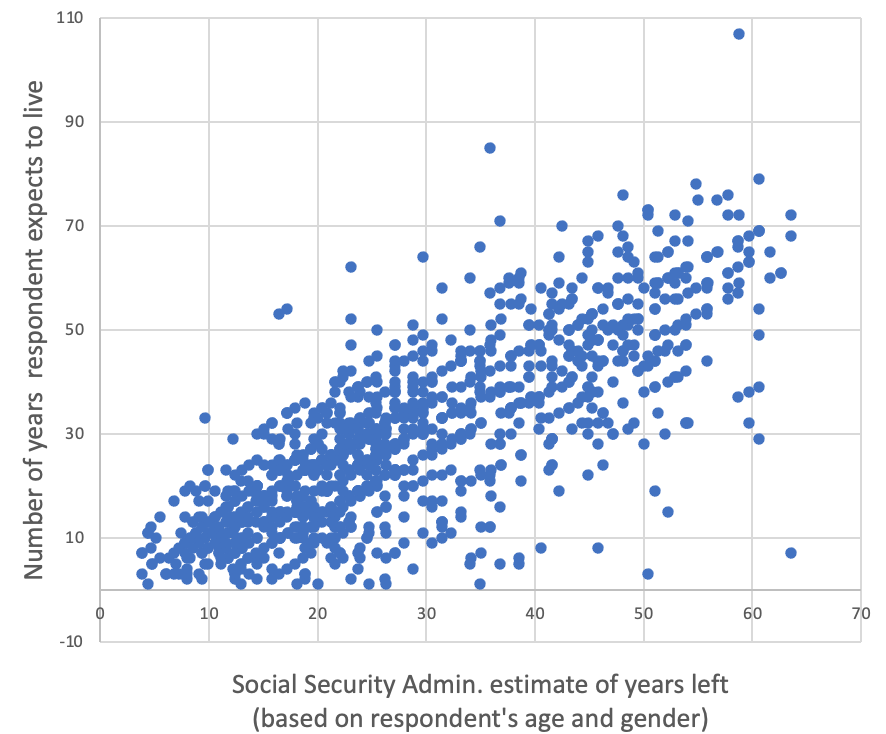
Therefore I am interested in who makes optimistic or pessimistic estimates of their own life-expectancies. Of course, younger people will expect to live for more years, on average, than older people, and that doesn’t reflect optimism. So I adjusted for age by looking at the difference between how long people expect to live and how long the Social Security Administration (SSA) predicts that someone of their age and gender will live. If people give a higher number than the SSA, they are optimistic; a lower number reflects pessimism. Pessimism may be entirely warranted and reasonable, but it could still have negative effects on some important behaviors.
Data: Tufts Equity Research Group. Analysis: Peter Levine
The scatterplot shows that individuals’ predictions correlate with what the SSA would say, but there is a lot of variation. One young dude expects to live for another 110 years, whereas the SSA would give him 58 years. Several people expect to die very soon. What accounts for these differences?
Using the Tufts equity research survey, I looked first at the factors that are incorporated in prominent actuarial models–the things that we’re told actually lengthen or shorten our lives. If you go to a “longevity calculator” like this one, it will ask you to enter your own year of birth, gender, race, education level, body mass index, income, whether you are retired, and your habits of exercise, smoking, and drinking alcohol. It will tell you how many years you probably have left to live, based on your answers and a significant body of research.
Some of those factors affect optimism, but some do not. Reporting results from a regression model that are significant at p<.05:
Younger people are more optimistic, meaning not that they expect to live more years than older people but that their predictions for their lives are higher in comparison to the SSA’s predictions for them.
White people are more optimistic than people of color, and they have a basis for that.
Higher body mass index (BMI) correlates with pessimism.
Regular vigorous exercise predicts more optimism.
Education, gender, marital status, income, employment status, and drinking and smoking are not related to optimism, even though they are significant predictors of life expectancy in actuarial models.
I also went looking for measures that might predict optimism even though they are not in the actuarial models that I see online. Some of them are quite significant. When added to a regression model with the variables listed above …
Frequency of attending religious services predicts optimism.
People with better overall health (per their self-report) are much more optimistic.
Stress about climate change comes close to predicting pessimism (p=.054).
Whether you own a gun and whether you planned to vote for Trump or Biden are not related to optimism.
To some extent, people seem to be making accurate predictions based on life circumstances. For instance, they are right to worry about high BMIs. They seem to be missing some important factors, such as smoking and drinking. The correlation with religious participation could reflect the beneficial results of participating in communities, or perhaps religion makes one optimistic about one’s own life, or perhaps people who think they have a long time to live are motivated to attend services.
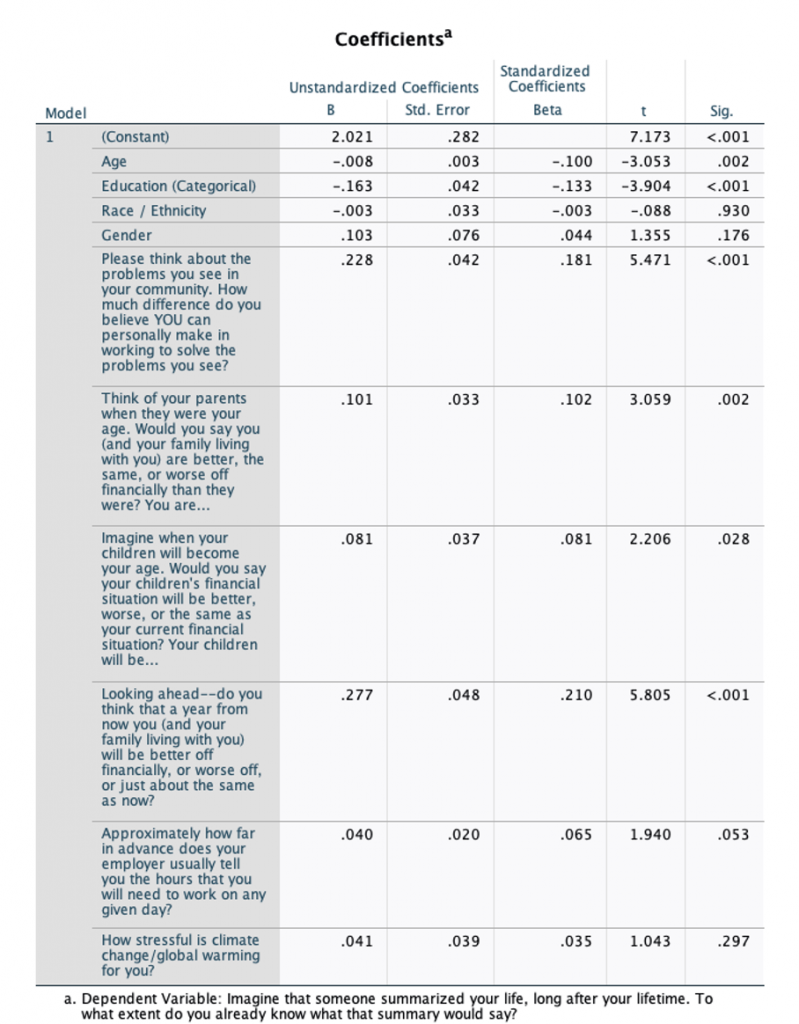
Imagine that someone summarized your life, long after your lifetime. To what extent do you already know what that summary would say?
I was interested in how people’s life circumstances might lead them to answer that question differently, and what different answers might mean. For instance, you might be a successful young student for whom the unpredictability of the rest of your life is a sign of broad options and unlimited possibility. You might hate your current situation and feel depressed because you don’t believe it will ever change. You might feel precarious, so that your uncertainty about the remainder of your life is mostly stressful.
I hope to investigate how various subgroups answer the question. In the meantime, I ran a very simple regression to try to predict answers based on people’s demographics (age, race, gender), their perception of their own economic trajectory (Are you better of than your parents, will you be better off next year, and will your children be better of than you?), their sense of civic or political efficacy (Can you make a change in your community by working with others?), a measure of stability at work (How far in advance do you know how many hours you will be working per day?), and a measure of stress about climate change (to see whether worries about the climate were making some people uncertain about their lives).
The results are below. (A positive coefficient indicates less certainty.) I’ll summarize the results that are statistically significant (p<.005):
Certainty about the story of one’s whole life rises with age, but the coefficient is small. People tend to get just a tiny bit more certain with each passing year. I am more interested in the small relationship than its statistical significance.
Certainty rises with more education. At least if you put the whole sample together, it seems that people who have more education don’t feel greater uncertainty because their options are expanded. Rather, they feel more certain, perhaps because they are more secure or feel more control over their lives.
Certainty falls with civic efficacy. Apparently, if you think you can make a difference in the world around you, you are less confident that you know the whole story of your life. I hope this is because you believe that unexpected good options might open up.
Certainty is lower for people who see their own families on a positive economic trajectory. Maybe perceiving that you are getting wealthier makes you hope for unexpected futures. I find it interesting that economic optimism and education have the opposite relationship to this outcome.
The demographic measures, stability at work, and climate stress are not related to this outcome.
As always, I would welcome any thoughts about these very preliminary findings.
Nearly twenty years ago, just after I published Silent Theft, my first book about the commons, I was mingling with strangers at a conference reception at Georgetown University. The World Wide Web and open source software were still in their infancy, and few people in mainstream circles gave much thought to the implications of copyright law on human freedom and creativity. Suddenly a French fellow appeared out of nowhere and introduced himself to me, saying that he wanted to talk about the commons.
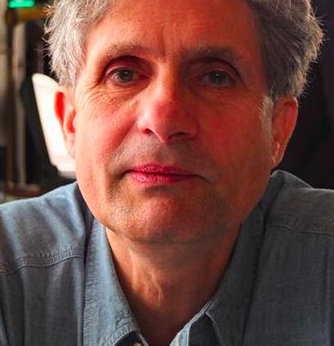
Philippe Aigrain, 1949-2021
And that is how Philippe Aigrain soon became a friend and my first European colleague in studying the commons, circa 2003. With great sadness, I learned last week that Philippe died on July 11 following a hiking accident in the French Pyrénées, at age 72. I share the heartbreak expressed by Francophone commoners and beyond at this crushing news.
Philippe was a computer scientist and activist who led many early fights against software patents, especially as director of the Software Freedom Law Center. He was also a cofounder of the French advocacy group La Quadrature du Net in 2008, which fights for basic human rights on digital networks, free software, and the commons.
In 2005, Philippe published a lengthy essay, Cause Commune, that proposed that we begin thinking about information commons as an alternative to intellectual property, which has so many anti-social, anti-competitive, and politically restrictive effects.The piece was one of the earliest, most thoughtful pieces in any language to develop the idea of the commons with respect to knowledge. He later published Sharing: Culture and the Economy in the Internet Age (Amsterdam University Press, 2012), which gave a richer development to the whole idea of digital knowledge and culture commons.
What I found so memorable about Philippe was his astute political insight, quiet courage, and his deep well of gracious humanity. As his colleagues at La Quadrature du Net wrote in its appreciation of him:
Photo of flowers posted on 'Atelier de Bricolage Litteraire,' July 10, 2021
We admired [Philippe’s] capacity for indignation, the thoroughness and depth of his analyses, the way he could set aside certain activist reactions to size up a situation in all its complexity. When there was a risk of drowning in the details of an issue, he would encourage us to step back and return to the fundamental political issues at stake….Philippe taught us that it is possible to combine a lucid view of the world and a high level of political commitment, while never forsaking either care for others or for oneself, nor indeed joy and poetry.
Philippe’s colleague Jérémie Zimmermann admired him as “a rare being, with a humility that was matched only by the strength and freedom of his thought.”
When I visited Paris with my family in 2005, Philippe and his wife Mirielle went out of their way to invite us to their apartment for a fantastic dinner. We talked long into the evening, and I recalled how his generosity of spirit turned strangers into friends and made the world a more welcoming place.
Much of Philippe’s attention in recent years was devoted to the plight of refugees. He also directed the publishing house PublieNet, and published his first novel Sœur(s) [Sisters], which deals with the issue of surveillance. Some of Philippe’s poems and other writings can be found at Atelier de Bricolage Littéraire. Heartfelt condolences to Mirielle and the Aigrain family.
Nearly twenty years ago, just after I published Silent Theft, my first book about the commons, I was mingling with strangers at a conference reception at Georgetown University. The World Wide Web and open source software were still in their infancy, and few people in mainstream circles gave much thought to the implications of copyright law on human freedom and creativity. Suddenly a French fellow appeared out of nowhere and introduced himself to me, saying that he wanted to talk about the commons.
Philippe Aigrain, 1949-2021
And that is how Philippe Aigrain soon became a friend and my first European colleague in studying the commons, circa 2003. With great sadness, I learned last week that Philippe died on July 11 following a hiking accident in the French Pyrénées, at age 72. I share the heartbreak expressed by Francophone commoners and beyond at this crushing news.
Philippe was a computer scientist and activist who led many early fights against software patents, especially as director of the Software Freedom Law Center. He was also a cofounder of the French advocacy group La Quadrature du Net in 2008, which fights for basic human rights on digital networks, free software, and the commons.
In 2005, Philippe published a lengthy essay, Cause Commune, that proposed that we begin thinking about information commons as an alternative to intellectual property, which has so many anti-social, anti-competitive, and politically restrictive effects.The piece was one of the earliest, most thoughtful pieces in any language to develop the idea of the commons with respect to knowledge. He later published Sharing: Culture and the Economy in the Internet Age (Amsterdam University Press, 2012), which gave a richer development to the whole idea of digital knowledge and culture commons.
What I found so memorable about Philippe was his astute political insight, quiet courage, and his deep well of gracious humanity. As his colleagues at La Quadrature du Net wrote in its appreciation of him:
Photo of flowers posted on 'Atelier de Bricolage Litteraire,' July 10, 2021
We admired [Philippe’s] capacity for indignation, the thoroughness and depth of his analyses, the way he could set aside certain activist reactions to size up a situation in all its complexity. When there was a risk of drowning in the details of an issue, he would encourage us to step back and return to the fundamental political issues at stake….Philippe taught us that it is possible to combine a lucid view of the world and a high level of political commitment, while never forsaking either care for others or for oneself, nor indeed joy and poetry.
Philippe’s colleague Jérémie Zimmermann admired him as “a rare being, with a humility that was matched only by the strength and freedom of his thought.”
When I visited Paris with my family in 2005, Philippe and his wife Mirielle went out of their way to invite us to their apartment for a fantastic dinner. We talked long into the evening, and I recalled how his generosity of spirit turned strangers into friends and made the world a more welcoming place.
Much of Philippe’s attention in recent years was devoted to the plight of refugees. He also directed the publishing house PublieNet, and published his first novel Sœur(s) [Sisters], which deals with the issue of surveillance. Some of Philippe’s poems and other writings can be found at Atelier de Bricolage Littéraire. Heartfelt condolences to Mirielle and the Aigrain family.
In The Sound of Two Hands Clapping, Georges B.J. Dreyfus describes Tibetan monasteries as homes for “scholasticism,” using a word originally coined to describe a form of Catholic thought and practice that was most influential in the thirteenth and fourteenth centuries–later to be mocked and repudiated by both Protestants and Catholic Humanists. As Dreyfus notes, this word has also been used to describe specific traditions in Islam, and more recently in Hinduism and Buddhism. In his book, he explores strong parallels in Judaism.
It could be that scholasticism is an option within any heavily organized and sustained tradition of thought, whether we classify it as a religion or as something else.
One core component is a belief in argument–not just discussion and disagreement, but contentious, often competitive pro/con debate. Debates in Tibetan monasteries are high-pressure, competitive affairs conducted before active audiences. The same was true in medieval universities, where students paid the lecturers individually and enjoyed competitive showdowns. King and Arling write that Abelard’s “quick wit, sharp tongue, perfect memory and boundless arrogance made him unbeatable in debate—he was said by supporter and detractor alike never to have lost an argument.” Dreyfus recalls the Jewish practice of havruta, learning in pairs, and emphasizes that these pairs debate each other.
In scholastic traditions, debate is not seen as a temporary necessity while we sort out important topics once and for all. Instead, it is a form of religious practice, comparable to meditation or ritual and something like an end in itself.
Martin Luther hated it for just that reason. Luther was a formidable debater, but he was trying to defeat heresy. He would have been deeply disappointed to learn that people are still debating theology centuries later. In contrast, I think that Tibetan monks work to keep the debate going. They see it as a good way of life.
Debating what is actually said in the most revered texts of any tradition is risky. While arguing about such texts, it is hard to avoid arguing with them. Therefore, an interesting pattern in scholasticism is a tendency to argue about the previous commentators. According to Dreyfus, “Tibetans emphasize less the inspirational words of the founder (the sutras) and more the study of their content as summarized by the great Indian treatises.” In theory, “the authority of the Indian commentaries is extremely important; practically, they are used in Tibetan education relatively rarely by teachers and students.” Instead, Tibetan monks memorize and debate Tibetan commentaries on the Indian summaries of the sutras that are attributed to the Buddha. My sense is that Catholic commentaries on Aristotle, Jewish Talmudic study, and Islamic jurisprudence have a similar flavor.
Again, this style drove Luther crazy. The truth was in the original Word of God (sola scriptura) not in pedantic commentaries. Erasmus opposed scholasticism for a different but compatible reason. For him, the ancient texts–including but not limited to the Bible–made better literature than the ponderous tomes of the scholastics. The classics had style and form. However, if you want to keep on debating forever, then it makes sense to focus on the commentaries and let them accumulate, layer upon layer.
Another common feature is a focus on law–not necessarily in the literal sense of state-enforced rules and punishments, but at least the question of what counts as the right action in all kinds of circumstances; call it casuistry, jurisprudence, or applied ethics. I’m guessing this is a fruitful focus because we can invent new ethical questions endlessly. Besides, if the real purpose of the debate is self-improvement, then good behavior makes an ideal topic.
Social stratification often emerges in these traditions, to the point where the scholastic authorities can be quasi-hereditary. Yet the traditions offer stories about talented teachers who came up from nowhere. That is the point of the opening story of the Platform Sutra, when an illiterate monk grasps the point that the educated ones have missed and becomes a great authority. (This is my example, not Dreyfus’, and it might not be germane.) Jean Gerson, who became the most senior scholar in Paris, was born as one of twelve children of pious peasants. Of course, meritocratic anecdotes serve as great justifications for hierarchical systems.
I share this generic definition of scholasticism without a value-judgment. I am not sure how much I admire these traditions or resonate to them. Presumably, they are best assessed as parts of much larger social orders that offer other options as well. In any case, it seems valuable to recognize a form of life that recurs so widely.
The Justice Sandra Day O’Connor Civic Education Act
Any discussion of civics in Florida, and its success, begins with the Justice Sandra Day O’Connor Civic Education Act. Passed in 2010, this Act required the creation and implementation of a civics course in middle school. This course includes an end-of-course exam that counts as 30% of a student’s final grade, as well as for school grade and teacher evaluation. In addition, in order to go on to high school, students MUST pass civics. So since at least 2013, as civics was implemented, Florida has had a strong civic education initiative. Every middle school student in the state of Florida MUST pass civics.
What Is Required?
The middle school civics course in Florida contains 40 benchmarks, 35 of which are directly assessed on the End of Course Assessment. The standards are traditionally organized into 4 reporting categories:
Origins and Purposes of Law and Government
Roles, Rights, and Responsibilities of Citizens
Government Policies and Political Processes
Organization and Function of Government
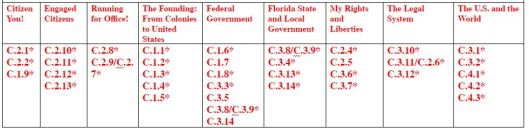
You can further break these down into 9 topic areas that cover a wide variety of civics content and benchmarks:
So, what is covered in these benchmarks? Essentially, the benchmarks address the comprehensive knowledge that students need to be engaged with civic life in the United States, from the workings of the US Constitution to the role of political parties in the United States and everything in between! You can review each of the benchmarks below, organized by reporting category. Click on the link to go to Florida Joint Center for Citizenship resources for each one! It should be noted that the state has adopted new benchmarks as of July 14th, effective for 2023-2024. But this is what they are right now.
Recognize how Enlightenment ideas including Montesquieu’s view of separation of power and John Locke’s theories related to natural law and how Locke’s social contract influenced the Founding Fathers.
Trace the impact that the Magna Carta, English Bill of Rights, Mayflower Compact, and Thomas Paine’s “Common Sense” had on colonists’ views of government.
Evaluate the obligations citizens have to obey laws, pay taxes, defend the nation, and serve on juries. Also Assesses: SS.7.C.2.3—Experience the responsibilities of citizens at the local, state, or federal levels. Also Assesses: SS.7.C.2.14—Conduct a service project to further the public good.
Analyze the significance and outcomes of landmark Supreme Court cases including, but not limited to, Marbury v. Madison, Plessy v. Ferguson, Brown v. Board of Education, Gideon v. Wainwright, Miranda v. Arizona, in re Gault, Tinker v. Des Moines, Hazelwood v. Kuhlmier, United States v. Nixon, and Bush v. Gore.
Evaluate candidates for political office by analyzing their qualifications, experience, issue-based platforms, debates, and political ads. Also Assesses: SS.7.C.2.7—Conduct a mock election to demonstrate the voting process and its impact on a school, community, or local level.
Develop a plan to resolve a state or local problem by researching public policy alternatives, identifying appropriate government agencies to address the issue, and determining a course of action.
Illustrate the structure and function (three branches of government established in Articles I, II, and III with corresponding powers) of government in the United States as established in the Constitution.
Analyze the structure, functions, and processes of the legislative, executive, and judicial branches. Also Assesses: SS.7.C.3.9—Illustrate the law making process at the local, state, and federal levels.
Diagram the levels, functions, and powers of courts at the state and federal levels. Also Assesses: SS. 7.C.2.6—Simulate the trial process and the role of juries in the administration of justice.
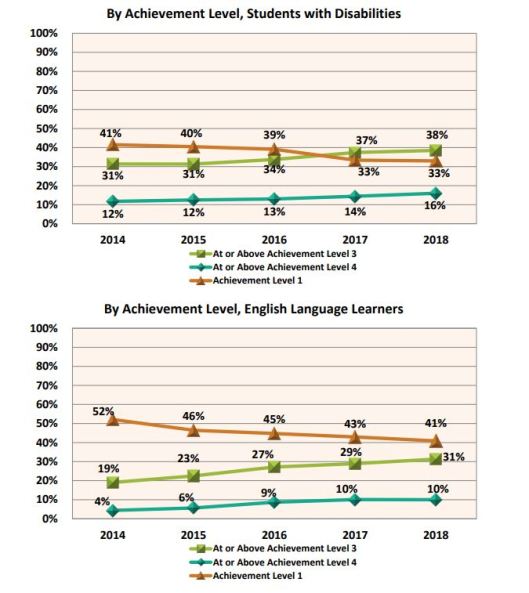
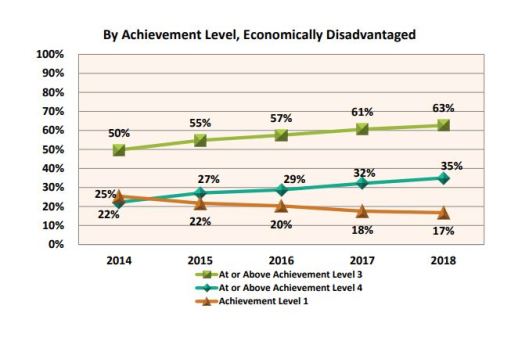
Good news on the data front when it comes to civics! As of the 2019 Civics EOCA administration, 71% of all students that took the exam scored a 3, 4, or 5. What this means is that 71% of all students passed the Civics End Of Course Assessment. This is 10 percentage points higher than the initial administration from 2014! As the charts below (from the Florida Department of Education) indicate, we are also seeing some positive growth among minority students as well. This is a trend that we hope to see continue, as FJCCand other organizations continue to work hard to provide resources and support for teachers and students.
So What Needs to Improve?
Without a doubt, Florida has seen significant positive results from the implementation of civic education at the middle school level. At this point, as a state, we are doing well with the knowledge aspect. But there is certainly room for improvement. At FJCC, we have been working to build a collection of resources and supports that address the skills and dispositions that can be used in conjunction with the knowledge that students have gained. You know how government works, and the role the Constitution plays in your life. So what can you do with that knowledge? We are working with organizations like the Civics Renewal Network, the Boys and Girls Clubs of Central Florida, the Constitutional Rights Foundation, and others to improve opportunities for engagement.
We also need to do far more in elementary schools. That, however, is a bit of a sticky wicket, as social studies as a whole has struggled for attention in elementary schools; the pressure of preparing students for math, ELA, and science assessments has often crowded out untested content areas like social studies, both here and Florida and nationally.
That beings said, there ARE some good resources out there, like FJCC’s own Civics in a Snap. Civics in a Snap is a collection of K-5 lessons around civics content and questions that can be done in an elementary class in about 15 to 20 minutes. Take a look!
We are also thinking about ways in which we can do more at the high school level to engage students in experiential learning around civic knowledge, skills, and dispositions.
Moving Forward
We at the Florida Joint Center for Citizenship at the Lou Frey Institute at the University of Central Florida applaud the governor’s call for a prioritization of civic education. We hope that it includes an in depth consideration of ways in which we get students to engage in civic life at all levels, and a renewed focus on getting social studies back into the elementary schools. And the continued leadership that Florida has shown in quality civics teaching and learning!
Apparently, at public meetings about social studies curricula, some people are saying: “Just teach facts.” Insofar as this call is coming from people incensed about Critical Race Theory in our k-12 schools, the irony is hard to ignore. CRT is very rarely, if ever, taught, and some of the ideas being attributed to it are factual. Yet I think there is also something else going on. Across many issues and in many political subcultures, it’s common to demand facts instead of opinions, as if the facts are all on our side and the other side is the opinionated one. I have encountered liberals who make versions of this argument, whether about COVID-19 or about history and politics.
In their 2002 book Stealth Democracy, John R. Hibbing and Elizabeth Theiss-Morse argue that about 70% of Americans are drawn to the idea that gives their book its title. These people basically see disagreement as a sign of corruption. It should not be necessary to disagree about matters of political or moral importance. People who express contrasting opinions must have bad motives or be sadly misguided. Since disagreement is rife, it would be “better if decisions were left up to nonelected, independent experts.”
In a great 2010 paper, Michael Neblo, Kevin Esterling, Ryan Kennedy, David Lazer, and Anand Sokhey showed that fewer people probably held the stealth democracy position than Hibbing and Theiss-Morse had found, and Americans were more tolerant of disagreement. However, Neblo and colleagues didn’t find zero support for stealth democracy, and I think it pops up fairly often.
It may reflect frustration about opinions that one strongly dislikes: Why can’t those misguided people just acknowledge the facts? But it may also reflect a deeper problem.
In an era when science (as popularly defined) has enormous prestige and purports to distinguish facts sharply from values, people don’t know what to make of value-laden disagreements. Justin McBrayer found this sign hanging in his son’s second-grade classroom:
Fact: Something that is true about a subject and can be tested or proven.
Opinion: What someone thinks, feels, or believes.
McBrayer attributes this distinction to the Common Core. I think the text of the Common Core is actually a bit subtler, and the sign reflects a widespread view. In any case, the distinction is untenable.
First of all, we must select which facts to investigate. We could teach George Washington’s achievements or slavery in colonial America–or neither, or both–but the facts themselves can’t tell us which of those things to study.
Second, the information we possess always reflects other people’s interests and concerns. American historians, for example, study marginalized and oppressed people more than they did a half century ago. This shift reflects ethical principles. Historians do not, and cannot, pursue all facts indiscriminately. You might dispute their emphasis, but then you’re arguing for different values, not rejecting their facts.
Third, it is very hard to identify a fact that is free of value-judgments or a value-judgment that does not encompass empirical beliefs about the way the world works.
Fourth, many of the most important facts about history are the opinions people held. Lincoln’s response to secession was his opinion, but attributing a position to him is either correct or incorrect. You cannot teach history without teaching–and spending a lot of your time teaching–opinions.
Perhaps most importantly, not all values are just opinions that people happen to hold. Valuing chocolate ice cream over vanilla ice cream is subjective, in this sense. Believing that genocide is evil is not. It isn’t a fact “that can be tested or proven,” but it also isn’t just something I happen to feel. It is something we are all obliged to feel.
Education inevitably involves choices about what to teach and how to talk about and interpret information. It inevitably conveys values and causes students to make judgments–whether as intended or in reaction to what the school wants them to think. Education is better when it helps students to develop political and intellectual virtues. But adults disagree about virtues, and our disagreements reflect our freedom, our diversity, and our nature as finite, embodied, fallible creatures. Therefore, disagreement about what and how to teach is inevitable, permanent, and a sign that free people care about the future. “Just teach the facts” is a call to stop this debate, when what we need is more and better.
The Economist/YouGov has released a survey of 1,500 U.S. Adult Citizens (fielded from June 13 – 15, 2021) that asks some questions about Critical Race Theory (CRT). This is their summary.
This issue is deeply partisan and breaks in Republicans’ favor. Eighty-five percent of Republicans are very unfavorable to CRT, whereas 58% of Democrats are very favorable. But the public as a whole breaks against CRT, 58%-38%, due to Independents’ opposition (71% are very unfavorable) and Democrats’ somewhat mixed support.
Party ID appears more significant than demographics. For instance, a slight majority of Blacks (52%) are very favorable to CRT, but 16% are very unfavorable: a less positive balance than we see among Democrats. Women, college graduates, and young people are a bit more favorable than others, but those differences are small. (With access only to the printed report, I can’t run a regression to see how these variables may interact.)
Fifty-four percent of Americans say they have a very good idea what CRT is. The remainder are split between not being sure whether they know and being sure that they do not know what it is: 23% each. Thirty-five percent have heard nothing at all about CRT, 38% a little, and 26% a lot.
I think most of the people who say they know what CRT is are giving themselves too much credit. It names a rather specific academic movement that few of us understand. I would not claim that I have reliable knowledge of CRT (when knowledge = justified true belief) even though I study this general topic. But 54% of Americans are confident that they know what it is.
Although almost half of people are not sure what CRT is, 96% of respondents state a favorable or unfavorable view of it, and a total of 78% hold either a very favorable or a very unfavorable view. In other words, many people have opinions–even strong ones–about CRT even though they do not believe they know what it is and have heard nothing at all about it.
A mainstream position in political science these days is that Americans lack well-justified and autonomous opinions about most political issues. Achen and Bartels argue that even politically conscious citizens usually display “just a rather mechanical reflection of what their favorite group and party leaders have instructed them to think” (Achen and Bartels 2017, p. 12).
I dissent from this general view and have spent the past week on a methodological paper that aims to show that individuals hold more complex and individualized structures of opinions than one can glean from standard survey research. Yet the nature of public opinion depends on the issue, and especially on whether political professionals are exploiting it.
CRT is a great example of an issue on which public opinion reflects partisan heuristics and cues from leaders rather than careful thought. It’s bound to stay near the top of the national agenda, not only because it serves as a proxy for deeper issues related to race, but also because of the partisan politics. Republicans aren’t going to drop an issue that polls so well for them, but Democratic leaders–even if they wanted to–can’t strongly oppose CRT while 58% of their voters strongly favor it.
In a dialogue with his disciple Tsze-kung, Confucius advises that a government needs three things: weapons, food, and trust. And if a ruler cannot maintain the three of them, he should give up the weapons first and the food next.
Fast forward over two thousand years, and trust in government remains a hot topic. After all, rule of law and democratic institutions clearly require some minimal consent and trust in government. And, to varying degrees, the success of most public policies and programs, from paying taxes to recycling, depends on citizens’ compliance and cooperation.
Trust in government has also generated increased interest during the pandemic. For example, in an article for The Atlantic, Francis Fukuyama described trust in government as the most important predictor of a government’s capacity to respond to the ongoing health crisis. His argument is intuitive: particularly during times of crisis, discretionary authority needs to be delegated to executive branches, as “no set of preexisting laws or rules can ever anticipate all of the novel and rapidly changing situations that countries will face”. In that context, so goes the argument, “citizens have to believe that the executive knows what it is doing.” Fukuyama’s take on the importance of trust during the pandemic resonates with evidence from previous health crises and, not surprisingly, scholarly interest in the subject has soared since the outbreak. Confucius’ argument still resonates.
Equally interesting, however, has been the emergence of a public debate that also asks whether, in some cases, trust in government may be unwarranted. For instance, reporting on the health situation in Lebanon, a Washington Post article highlighted that “paradoxically, distrust of the notoriously dysfunctional government may have helped.” In a similar vein, The Economist argued that, during an epidemic, trust can be a “double-edged sword”. The behavior of many political leaders in downplaying the seriousness of the crisis has also illustrated how, in certain cases, distrusting the government is the healthiest option available.
These insights run counter to the conventional wisdom, which tends to consider trust in government as a good in itself. For instance, a frequent selling point for open government reforms is the (often misleading) claim that transparency will lead to increased trust in government. But it shouldn’t take a pandemic to realize that trust in government can also be overrated. Checks and balances, foundational to the modern state, were built upon the premise of distrust. For Montesquieu, the separation of powers was necessary to avoid exposing citizens to “arbitrary control.” David Hume cautioned that when designing government systems, “every man ought to be supposed a knave.” And, for Madison, “If angels were to govern men, neither external nor internal controls on government would be necessary.”
But if there are good reasons to trust in government, as well as good reasons not to, when is trust more or less appropriate? This is certainly a complex question, and the purpose of this post is by no means to provide a definitive answer. Instead, it aims to put forward a very simple (and perhaps simplistic) framework to start thinking about the imponderable problem of trust in government according to its context.
To understand the proposed framework, we can start with the following premise:
All else equal, individuals’ trust in their government should be expected to be proportional to the trustworthiness of that government.
This premise, I believe, is uncontroversial. As put by philosopher Onora O’Neill, trust is valuable only “when placed in trustworthy agents and activities, but damaging or costly when (mis)placed in untrustworthy agents and activities.”
But how do we define trustworthiness? Any attempt is bound to generate contestations, as has been the case for the definition of trust in government. For the purpose of this exercise, I borrow a definition from Margaret Levi, a prominent scholar on the subject, who considers a government to be worthy of citizens’ trust when it
(…) keeps its promises (or has exceptionally good reasons why it fails to), is relatively fair in its decision-making and enforcement processes, and delivers goods and services.
With this definition in mind, and the premise put forward earlier, the more a government keeps its promises, is fair, and delivers goods and services, the more citizens should trust that government, and vice-versa. If we depict the relationships between levels of trust and trustworthiness in a matrix, an interesting perspective emerges, as shown below:
Figure 1: Trust Matrix
In the top right and lower left (quadrants 2 and 3), we have scenarios of consistency, where citizens’ level of trust in governments corresponds to the level of government trustworthiness. In quadrant 2 we have scenarios of constructive consistency, characterized by a virtuous cycle where high trust leads to higher trustworthiness and vice-versa. In these scenarios citizens are, for instance, more willing to cooperate with government policies (e.g. taxation, vaccination), thereby enhancing governmental capacity to respond to public needs (e.g. public investments, disease control). Quadrant 3 represents scenarios of disruptive consistency, with disruptive meaning a context that can lead to both negative and positive developments. On the one hand, it may engender a vicious and destructive cycle whereby the government’s poor performance leads to less trust, further reducing the likelihood that governments are able to perform. On the other hand, it may lead to a process of creative destruction. After all, distrust of authorities often sparks democratic progress. In this respect, a context of disruptive consistency may open spaces of contestation and competition (e.g. through elections), generating incentives for political actors to perform better.
Quadrants 1 and 4 reflect scenarios of inconsistency, where the level of trust in government does not correspond to a government’s trustworthiness. In the cynical quadrant, despite government trustworthiness, citizens still show low levels of trust towards their government. Such a scenario is not free from implications: governmental policies may have disproportionately higher implementation costs, given that the public is less likely to comply and cooperate with these policies. In quadrant 4, (credulous), citizens trust their governments even though they are not deserving of that trust. In this scenario, untrustworthy governments have little incentive to change their behavior (e.g. delivering public goods and services), given that their citizens already trust them and do not present any threat to the status quo. This becomes a low-accountability trap, with citizens unlikely to engage to keep office-holders accountable for their actions in the public realm.
What does this all look like in practice? Into which quadrants do countries fall? While measuring trustworthiness goes beyond the scope of this post (more on that below), we can map it against existing indicators linked to trustworthiness, such as the Government Effectiveness Index, which captures, among other things, quality of public services, quality of civil service and governments’ commitments to their policies.
Figure 2. All over the map: the relationship between trust and government effectiveness
Source: author’s own based on Government Effectiveness Index (2020) and World Economic Forum Executive Survey (2018)
As the figure above illustrates, the 135 countries covered by the dataset fall into all four quadrants. Trust in government, as it turns out, is not consistently aligned with dimensions of government trustworthiness. Yet two-thirds of the countries (89) fall into the dark green consistent scenarios, indicating that in most countries, the level of trust in government is commensurate with the level of trustworthiness. This calls into question narratives that typically suggest a widespread crisis of trust in governments. Increased trust in government in this majority of countries would result in shifts towards situations of credulity: arguably the worst-case scenario, and a boon for women and men in power to behave more as knaves than angels. More importantly, the figure shows that increased trust in government emerges as a clearly desirable goal in just one of the four scenarios of the trust matrix (cynical, upper-left), where only 29 of 135 countries currently find themselves, including Argentina, Poland and South Korea.
Even if this framework may be reductionist, I believe it could still be useful for several reasons, a few of which I would like to highlight. First, the matrix gives us an indication of where trust in government may need to be increased or decreased. If one knows how to increase trust in government (and that’s a bold assumption), the framework provides some guidance on where it would make sense to start.
Second, these scenarios may help us better hypothesize which types of policy reforms would be desirable to pursue. For instance, in the scenario of credulous inconsistency (lower-right), the desirable outcome is that citizens become less credulous of their government and replace it through the ballots (in the case of a democracy), or dissent (in the case of an authoritarian regime). In these cases, potential activities could be efforts that i) increase transparency of government’s poor performance (to reduce trust), and ii) facilitate individual and collective action (to sanction poor performance). If these assumptions hold true in practice and at scale, and whether they can be voluntarily induced, remains an empirical question.
Finally, by adding trustworthiness as a variable, we expand our focus beyond “the eyes of the [governed] beholder” to a relational dimension in which governmental actions play an important role. By doing so, we also become more wary of hasty assumptions such as “transparency leads to trust”, where low trust in government is perceived more as a function of the opacity of a government’s behavior, rather than of its behavior. Which brings me to my next point.
Pathways towards consistency
If we consider that individuals’ trust in their government should be proportional to the trustworthiness of that government, we should contemplate the factors contributing to such consistency. Two are particularly noteworthy here: education and transparency.
As highlighted by Armen Hakhverdian and Quinton Mayne, citizens with a higher level of education are more likely to i) identify practices that negatively affect the functioning of government institutions, and ii) be normatively troubled by these practices. For example, the authors show that education is negatively related to institutional trust in corrupt societies and positively related to institutional trust in clean societies. If we consider that integrity is a property of trustworthy governments, education acts as a force creating consistency and moving away from cynical or credulous inconsistency.
But how do citizens identify, in the first place, the government practices that affect the functioning of institutions? One way is through personal experience: for instance, when citizens are either victims or witnesses of abuse by state agents (e.g. bribery requests, police violence). However, the most important way in which citizens identify these practices is through publicly available information on governmental actions. This brings me to the issue of transparency: its instrumental value is not whether it leads to more trust in government, as is often advocated. Rather, its value lies in its capacity to help individuals calibrate their trust vis-à-vis their governments, either towards more, or less, trust.
Final notes: measurements and definitions
One practical issue when it comes to trust in government is the availability of data. The most recent World Values Survey (WVS) has data on trust in government institutions for only 50 countries, the Gallup Poll for 43 countries, and the widely publicized Edelman Trust Barometer Survey covers no more than 28 countries. And by any count, there are at least 193 countries in the world. While claims about a global crisis of trust abound, global data about trust in government is less abundant.[1]
And which data one uses also matters, as illustrated below. For instance, when using data from the WVS, the countries falling under each quadrant differ from the results presented earlier (from the World Economic Forum’s Executive Survey). In short, different surveys will offer different results, each of them with their own shortcomings in terms of sample size, accuracy, or both.[2] In short, claims about trust in government, particularly at the global level, should be made carefully. Bearing these considerations in mind, the analytical framework put forward remains useful. Whichever indicator of trust one finds more appropriate to use, the framework still helps highlight in which cases trust in government is consistent or not with measures of government trustworthiness. In a passage of his most recent book, Ethan Zuckerman refers to “a sweet spot between too much trust and too little.” This framework, I believe, provides clues on where that spot may be.
Figure 3: Government Effectiveness vs Trust in Government (WVS survey)
Source: author’s own based on Government Effectiveness Index (2020) and World Values Survey (Wave 7)
A final note regarding the definition of trustworthiness is important. Levi’s definition certainly covers most of the characteristics that one would attribute to a trustworthy government, such as keeping promises, fairness in decision-making and enforcement, and delivery of goods and services. But as Levi highlights, the relative fairness of processes involves “the norms of place and time,” which makes fairness a concept that is contextual and of an evolving nature. This adds layers of complexity and raises some interesting questions, two of which I would like to highlight here.
The first regards the procedural and substantive dimensions of fairness and trustworthiness. In recent decades, many high-income democracies have performed well in procedural terms, with free and fair elections and laws that are mostly clear, stable, and equally enforced. From a procedural angle, these governments are worthy of trust. Nevertheless, on substantive grounds, one could contend that the opposite is also true. Take, for example, the overwhelming evidence that in these same democracies, government responsiveness has been systematically biased towards the needs of the better-off. Add to that growing inequality and a shrinking provision of public goods and services, and it becomes difficult to advocate for trustworthiness calculations based solely on procedural attributes.
As a side note, precisely because of the factors described above, one could say that part of the political polarization we see within countries today can be attributed to a growing divide between segments of the population that favor either procedural or substantive aspects of trustworthiness. For instance, some segments may privilege fair elections, while others attach more importance to substantive matters, such as bridging the gap between the rich and poor. Going back to the proposed trust matrix, the question then becomes whether trustworthiness should be assessed on procedural or substantive grounds and, if the answer is “both”, how to conciliate them. While answering this question brings its own normative and methodological challenges, evading it may fail to capture nuances that underpin the relationship between trust in government and government trustworthiness.
The second question is much simpler, albeit one with procedural and substantive consequences. Shouldn’t a government’s trustworthiness also be measured by the extent to which it offers participatory avenues for citizens to express themselves, beyond regular elections? After all, considering that trust is a two-way street, if governments expect to be trusted, shouldn’t they also trust citizens to shape decisions that affect their lives?
***
P.S.: I’m thankful for comments on earlier versions of this text from Amy Chamberlain, Jonathan Fox, Quinton Mayne, Jon Mellon, Hollie Russon Gilman, Paolo Spada and Tom Steinberg.
[1] On claims of a global crisis of trust see, for instance, here, here and here.